
Ancient China Outcome Geography Culture Satellite Image Geography


- Slides: 29
Ancient China Outcome: Geography & Culture
Satellite Image
Geography & Culture 1. Setting the Stage: a. China’s first city walls were built 1000 years after the walls of Ur, the great pyramids, and the planned cities on the Indus River. b. Unlike most cultures on earth, the civilization that began in China 4000 years ago still thrives there today.
Geography & Culture 2. The Geography of China a. Natural barriers isolated ancient China b. East: The Yellow Sea, East China Sea, and Pacific Ocean c. West: Taklimakan Desert and 15, 000 ft Plateau of Tibet d. Southwest: Himalayas e. North: Gobi Desert and Mongolian Plateau f. Mountain ranges and desert dominate 2/3 of China’s landmass
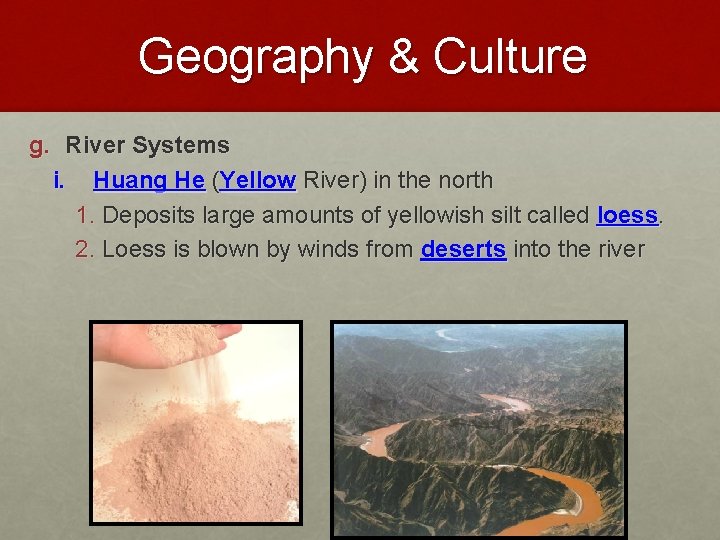
Geography & Culture g. River Systems i. Huang He (Yellow River) in the north 1. Deposits large amounts of yellowish silt called loess. 2. Loess is blown by winds from deserts into the river
Huang He (Yellow River)
Geography & Culture i. Chang Jiang (Yangtze) in central China 1. Flows east from the Yellow Sea 2. At 3, 988 miles long, it is the longest river in Asia
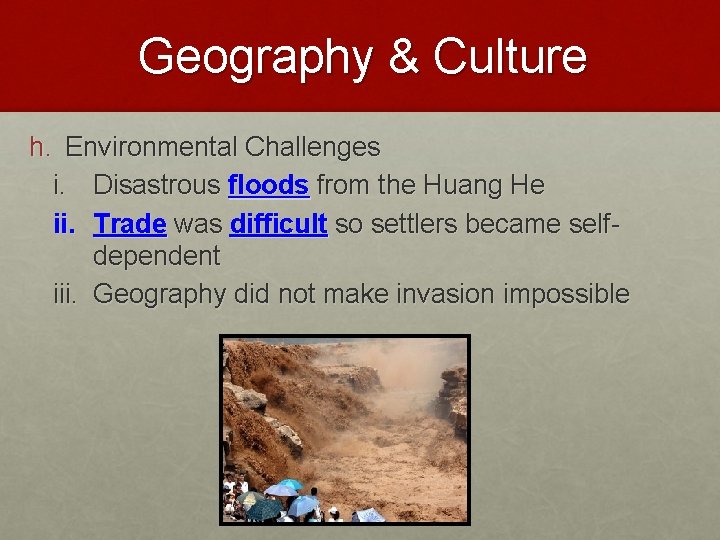
Geography & Culture h. Environmental Challenges i. Disastrous floods from the Huang He ii. Trade was difficult so settlers became selfdependent iii. Geography did not make invasion impossible
Geography & Culture i. Only 10% of China’s land is suitable for farming j. Most of farmable land is on North China Plain between Yellow River and Yangtze
Geography & Culture 3. The Development of Chinese Culture a. Fossils show that modern humans lived in SW China 1. 7 million years ago b. According to legend, the first Chinese dynasty, The Xia Dynasty, started about 2000 B. C. c. Chinese viewed everyone outside of their culture as barbarians d. Viewed themselves as center of civilized world e. Chinese name for China was Middle Kingdom f. Family is central to Chinese society; respect for one’s parents g. Women treated as inferiors h. Girls were arranged to be married between 13 and 16
Geography & Culture i. Religion: Spirits of ancestors had power to bring good fortune; not seen as gods j. Use of Oracle Bones- priests scratch question on bones, apply hot poker, bone would split, interpret the cracks
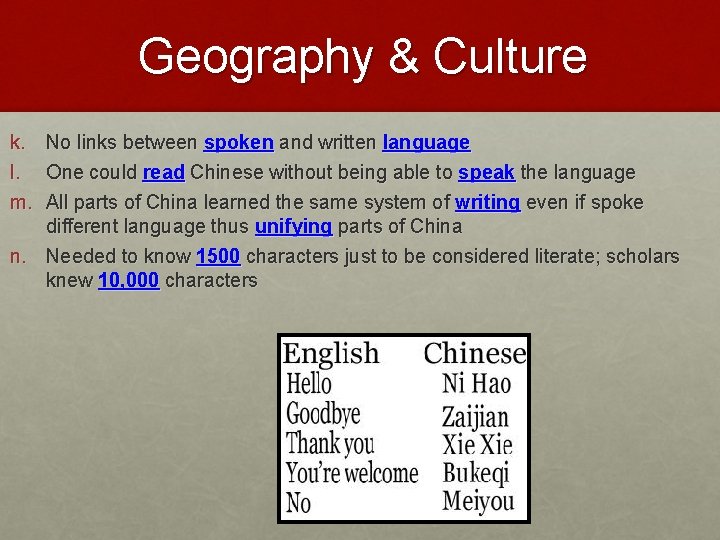
Geography & Culture k. No links between spoken and written language l. One could read Chinese without being able to speak the language m. All parts of China learned the same system of writing even if spoke different language thus unifying parts of China n. Needed to know 1500 characters just to be considered literate; scholars knew 10, 000 characters
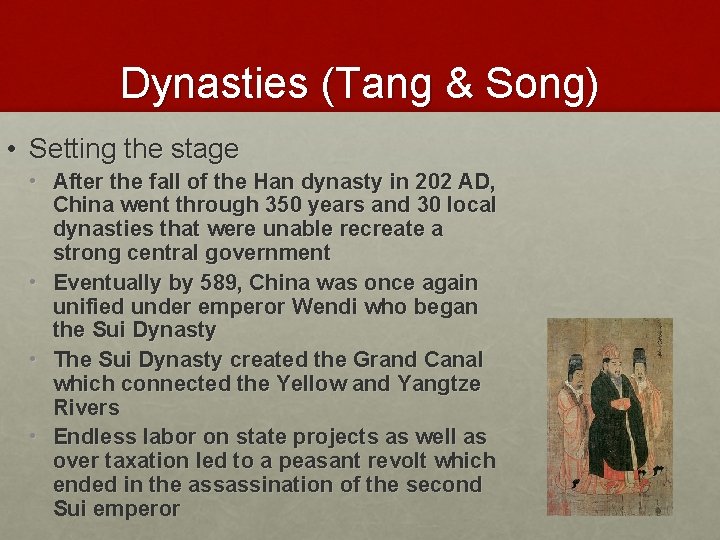
Dynasties (Tang & Song) • Setting the stage • After the fall of the Han dynasty in 202 AD, China went through 350 years and 30 local dynasties that were unable recreate a strong central government • Eventually by 589, China was once again unified under emperor Wendi who began the Sui Dynasty • The Sui Dynasty created the Grand Canal which connected the Yellow and Yangtze Rivers • Endless labor on state projects as well as over taxation led to a peasant revolt which ended in the assassination of the second Sui emperor
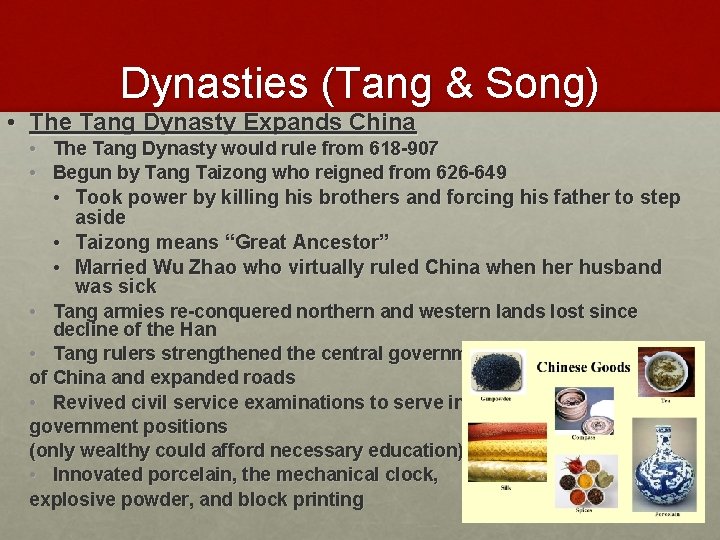
Dynasties (Tang & Song) • The Tang Dynasty Expands China • The Tang Dynasty would rule from 618 -907 • Begun by Tang Taizong who reigned from 626 -649 • Took power by killing his brothers and forcing his father to step aside • Taizong means “Great Ancestor” • Married Wu Zhao who virtually ruled China when her husband was sick • Tang armies re-conquered northern and western lands lost since decline of the Han • Tang rulers strengthened the central government of China and expanded roads • Revived civil service examinations to serve in government positions (only wealthy could afford necessary education) • Innovated porcelain, the mechanical clock, explosive powder, and block printing
Dynasties (Tang & Song) • The Tang Lose Power • To meet the rising costs of government, Tang rulers imposed crushing taxes in mid 700 s • Muslim armies defeated the Chinese at the Battle of Talas • Internal rebellions chipped away at imperial government • Chinese rebels sacked and burned Tang capital in 907 • Murdered the last Tang emperor who was only a child
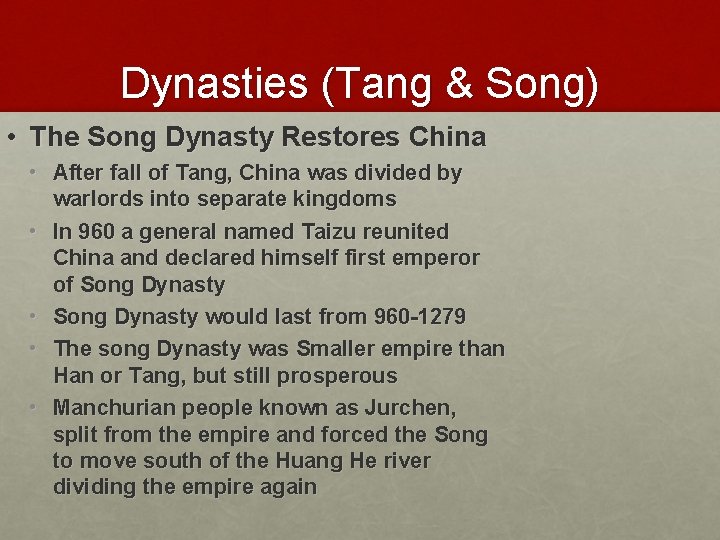
Dynasties (Tang & Song) • The Song Dynasty Restores China • After fall of Tang, China was divided by warlords into separate kingdoms • In 960 a general named Taizu reunited China and declared himself first emperor of Song Dynasty • Song Dynasty would last from 960 -1279 • The song Dynasty was Smaller empire than Han or Tang, but still prosperous • Manchurian people known as Jurchen, split from the empire and forced the Song to move south of the Huang He river dividing the empire again
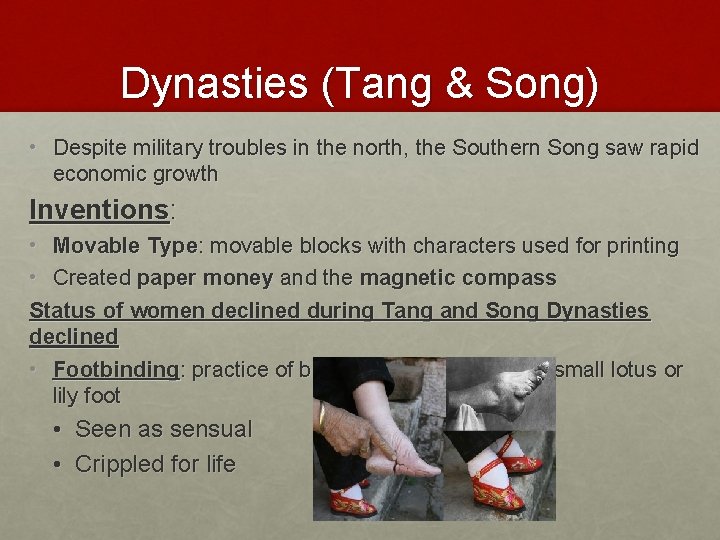
Dynasties (Tang & Song) • Despite military troubles in the north, the Southern Song saw rapid economic growth Inventions: • Movable Type: movable blocks with characters used for printing • Created paper money and the magnetic compass Status of women declined during Tang and Song Dynasties declined • Footbinding: practice of binding feet to conform to small lotus or lily foot • Seen as sensual • Crippled for life
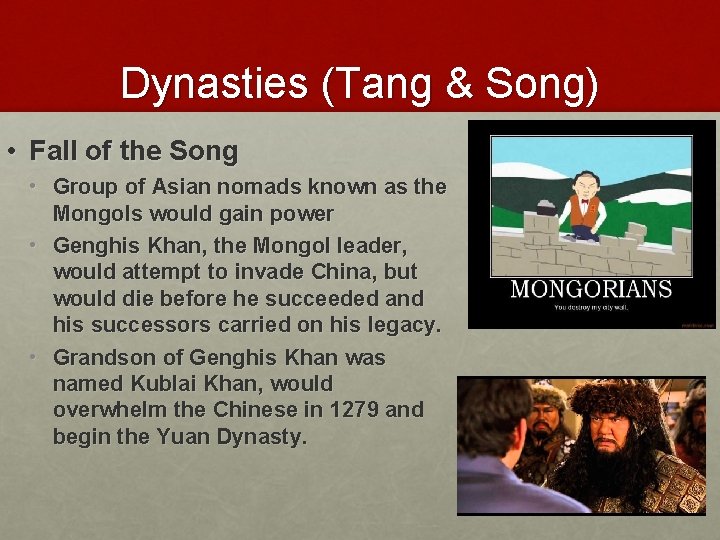
Dynasties (Tang & Song) • Fall of the Song • Group of Asian nomads known as the Mongols would gain power • Genghis Khan, the Mongol leader, would attempt to invade China, but would die before he succeeded and his successors carried on his legacy. • Grandson of Genghis Khan was named Kublai Khan, would overwhelm the Chinese in 1279 and begin the Yuan Dynasty.
Kublai Khan
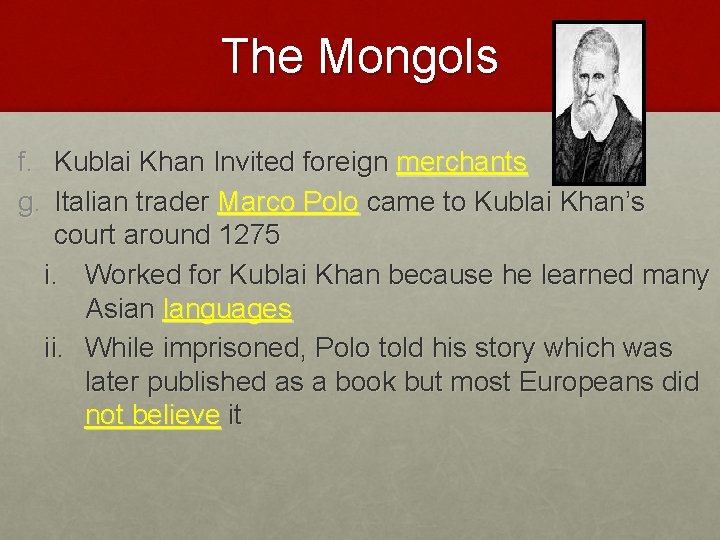
The Mongols f. Kublai Khan Invited foreign merchants g. Italian trader Marco Polo came to Kublai Khan’s court around 1275 i. Worked for Kublai Khan because he learned many Asian languages ii. While imprisoned, Polo told his story which was later published as a book but most Europeans did not believe it
The Mongols 1. The Rise of the Mongols a. Temujin sought to unify the Mongols under his leadership around 1200 b. Slowly Temujin defeated his enemies (and friends) one by one c. In 1206 he accepted the title of universal ruler of Genghis Khan d. Genghis Khan conquered much of Asia and had goal of invading China e. By 1225 Central Asia was under Mongol control
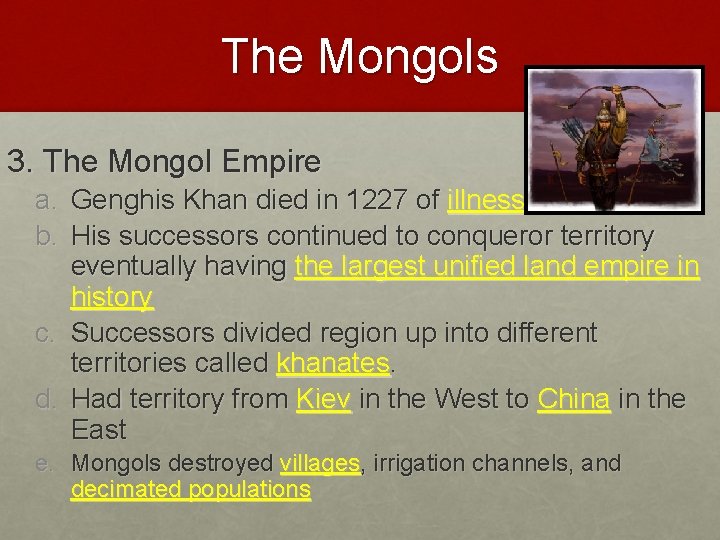
The Mongols 3. The Mongol Empire a. Genghis Khan died in 1227 of illness b. His successors continued to conqueror territory eventually having the largest unified land empire in history c. Successors divided region up into different territories called khanates. d. Had territory from Kiev in the West to China in the East e. Mongols destroyed villages, irrigation channels, and decimated populations
Mongol Empire at its Peak
The Mongols f. Rarely imposed their beliefs on conquered peoples g. Even adopted some of the culture of those they ruled h. Pax Mongolica: Mongol Peace- time of peace and stability across the Mongol Empire from mid 1200 s to mid 1300 s i. Trade and inventions spread rapidly during Pax Mongolica due to safe travel j. Traders wanted silk, porcelain, gunpowder, paper currency, and the compass
The SILK ROAD - a 4, 000 mile trade route that stretched from China to the Constantinople in southwestern Asia it was opened up by the Chinese and expanded and protected by the Mongols. THE CHINESE WANTED TO MAKE A PROFIT ($) FROM SELLING SILK.
GLOBALIZATIONThe process by which the people of the world are unified into a single society reliant on and functioning together. The internet promotes globalization in the world today.
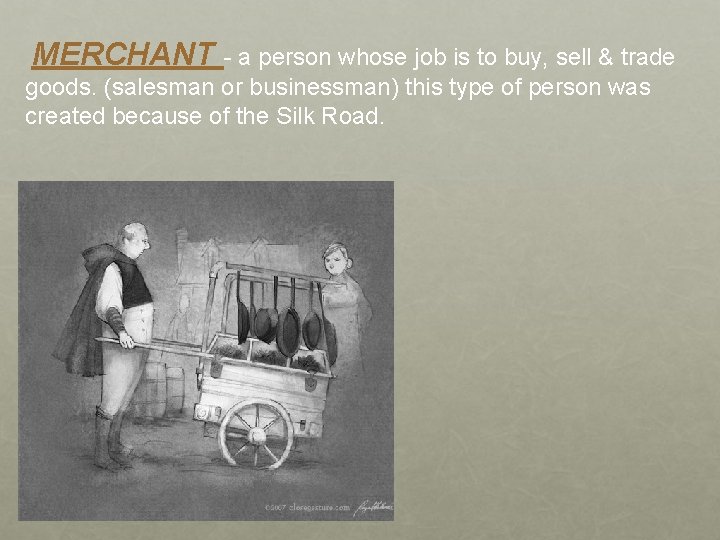
MERCHANT - a person whose job is to buy, sell & trade goods. (salesman or businessman) this type of person was created because of the Silk Road.
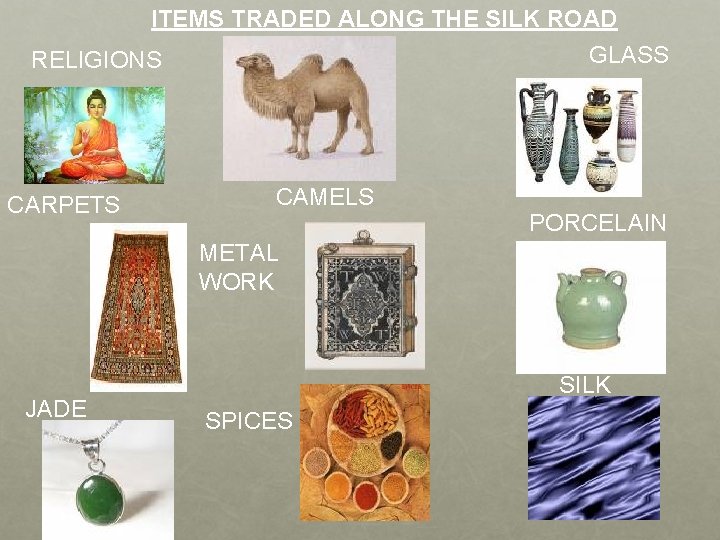
ITEMS TRADED ALONG THE SILK ROAD GLASS RELIGIONS CARPETS CAMELS PORCELAIN METAL WORK JADE SILK SPICES