
Ancient Astronomy and History of Astronomy Physics 101
- Slides: 42
Ancient Astronomy and History of Astronomy Physics 101 Physical Science Dr. Swez
Prehistoric Astronomy pre 500 B. C. ► Daily motions of Sun, moon, planets, stars ► Constellations ► Annual motions of Sun, moon, planets, stars ► Eclipses ► Phases of the moon ► Time keeping and navigation
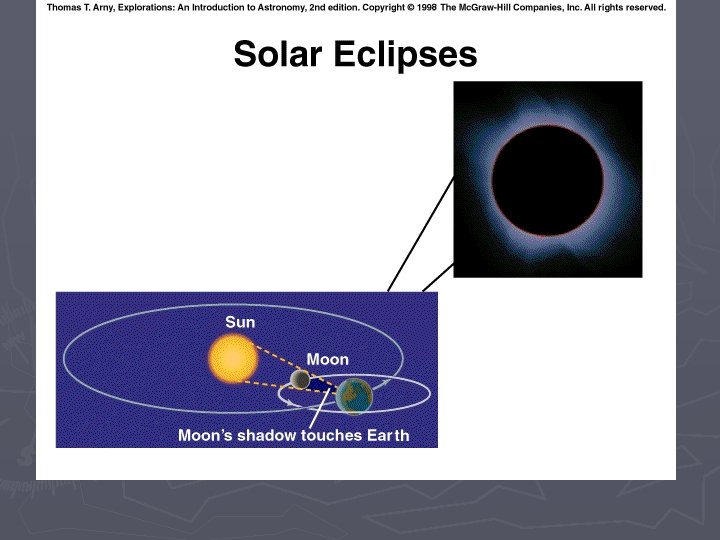
Prehistoric Astronomy Cyclicity ► Celestial sphere, poles, equator ► Constellations ► Seasons ► Ecliptic ► Planets, Retrograde motion of planets ► Zodiac ► ► Solar and Lunar Eclipses
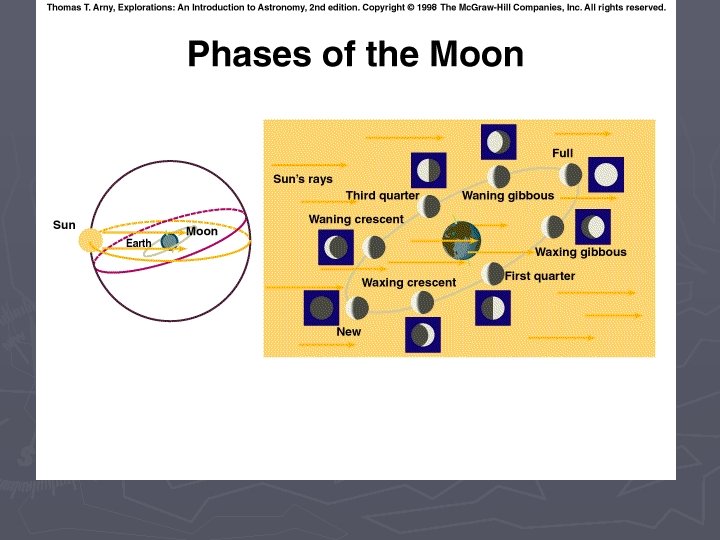
Prehistoric Astronomy - Cyclicity ► Rising and setting of the Sun, moon ► Phases of the moon ► Planets (wanderers) different from stars ► Allowed time-keeping, prediction ► Eclipses predicted ► Recognized several thousand years ago
Prehistoric Astronomy - Cyclicity ► Ancient Structures built to track astronomical motions (for predictions? ) ► Stone circles, Standing stones, Stone rows, Barrows, Hillforts, Settlements, Dolmens, Menhirs, Stonehenge ► Date back about 4000 years
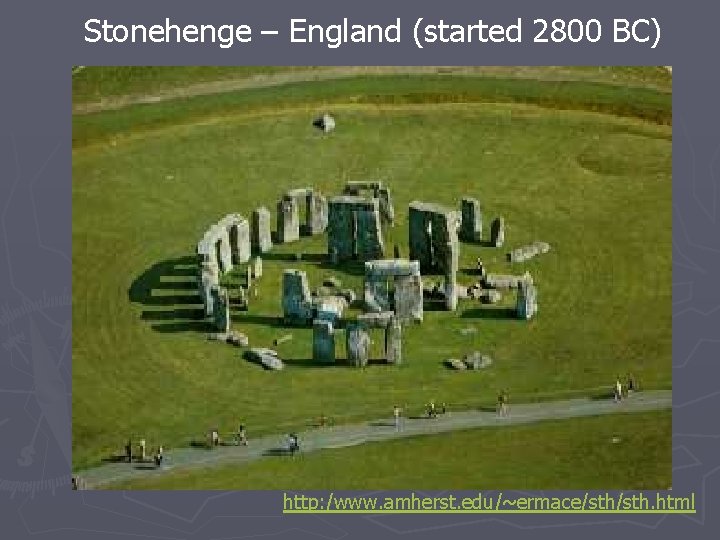
Stonehenge – England (started 2800 BC) http: /www. amherst. edu/~ermace/sth. html
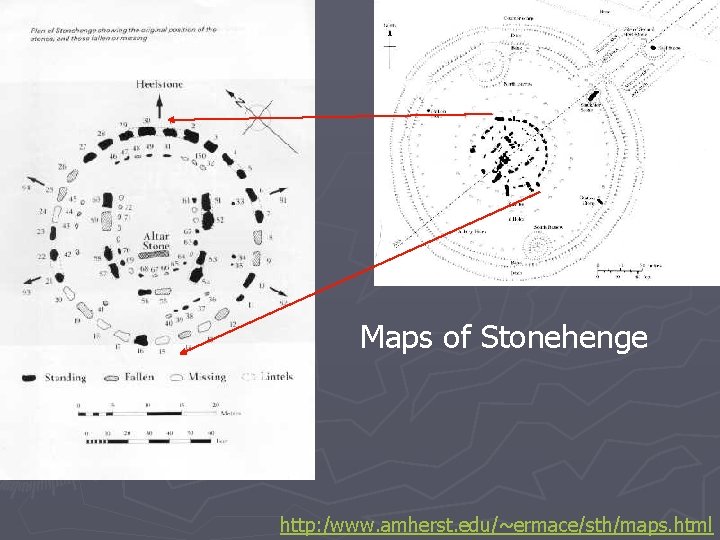
Maps of Stonehenge http: /www. amherst. edu/~ermace/sth/maps. html
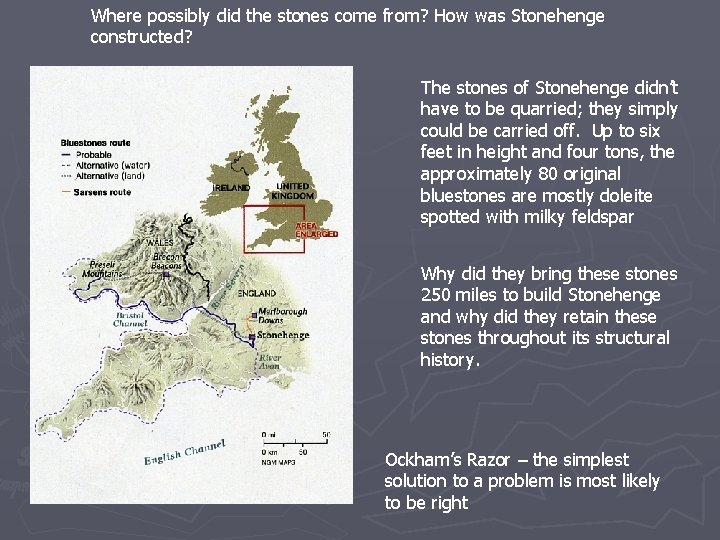
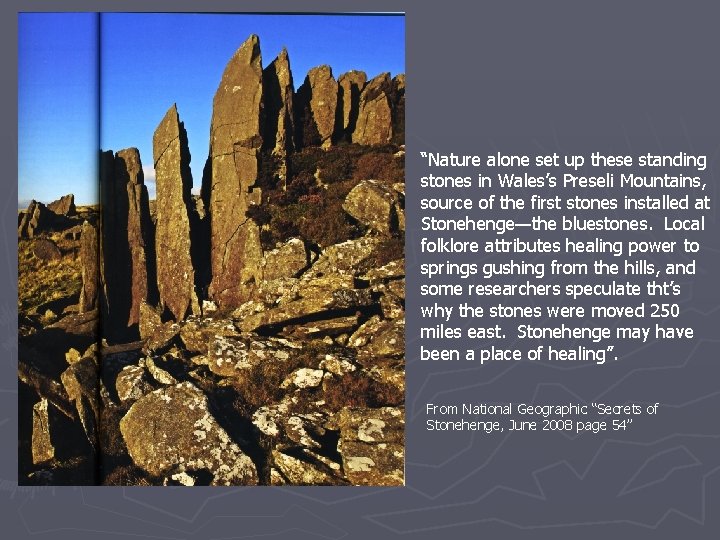
Where possibly did the stones come from? How was Stonehenge constructed? The stones of Stonehenge didn’t have to be quarried; they simply could be carried off. Up to six feet in height and four tons, the approximately 80 original bluestones are mostly doleite spotted with milky feldspar Why did they bring these stones 250 miles to build Stonehenge and why did they retain these stones throughout its structural history. Ockham’s Razor – the simplest solution to a problem is most likely to be right
“Nature alone set up these standing stones in Wales’s Preseli Mountains, source of the first stones installed at Stonehenge—the bluestones. Local folklore attributes healing power to springs gushing from the hills, and some researchers speculate tht’s why the stones were moved 250 miles east. Stonehenge may have been a place of healing”. From National Geographic “Secrets of Stonehenge, June 2008 page 54”
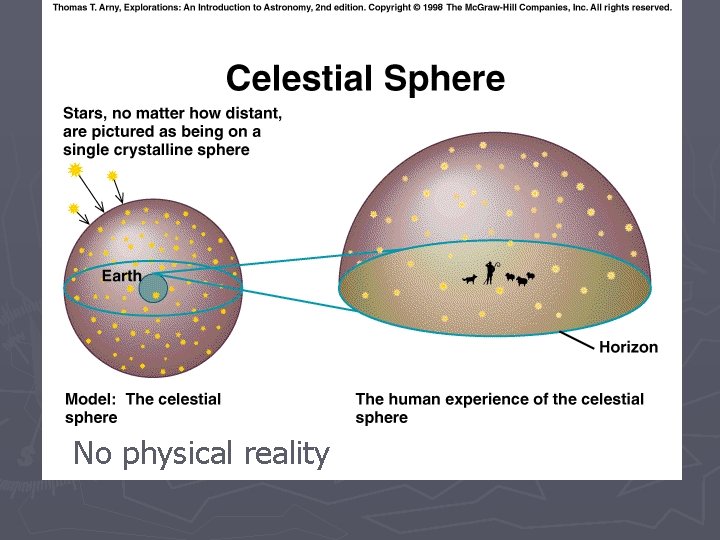
No physical reality
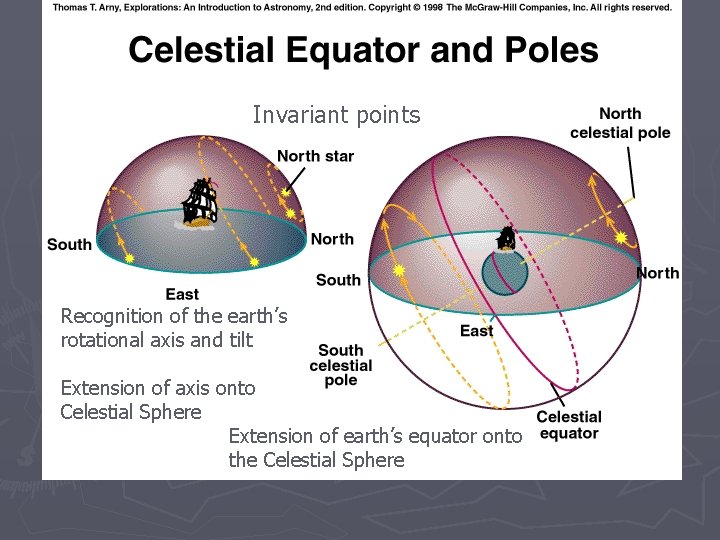
Invariant points Recognition of the earth’s rotational axis and tilt Extension of axis onto Celestial Sphere Extension of earth’s equator onto the Celestial Sphere
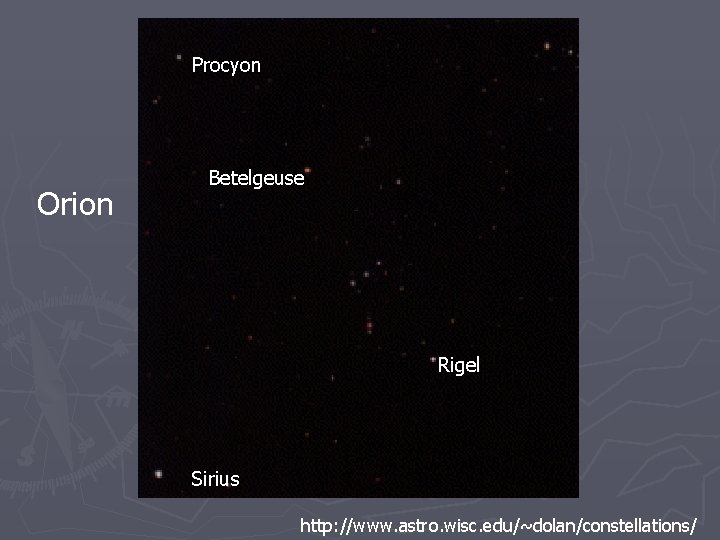
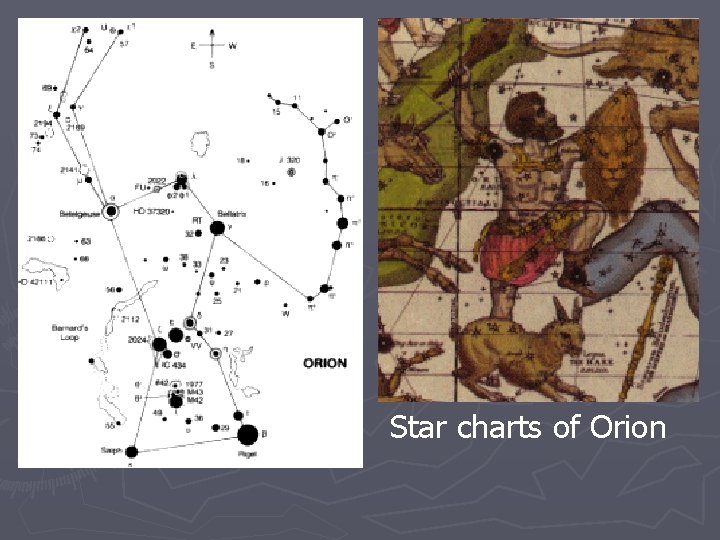
Constellations ► Constellations are not real! ► Imaginary ordering of stars ► Stars have no physical relation to each other ► Form of mnemonic to help us order the sky ► Navigational aids ► Time keeping
Procyon Orion Betelgeuse Rigel Sirius http: //www. astro. wisc. edu/~dolan/constellations/
Star charts of Orion
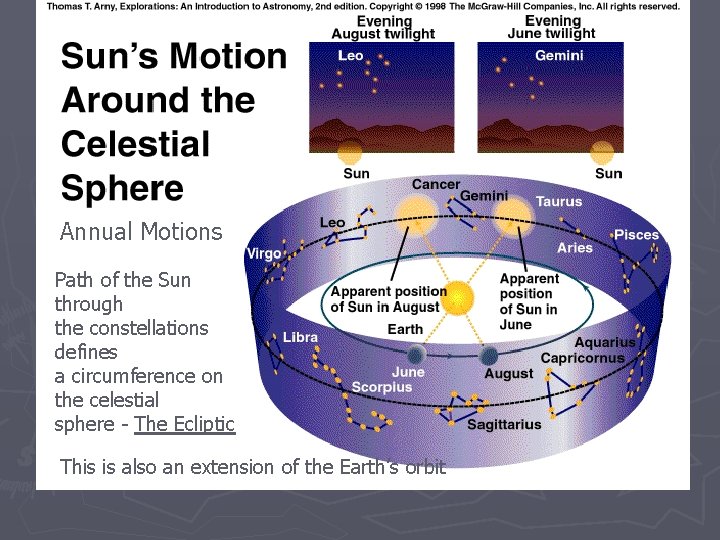
Annual Motions Path of the Sun through the constellations defines a circumference on the celestial sphere - The Ecliptic This is also an extension of the Earth’s orbit
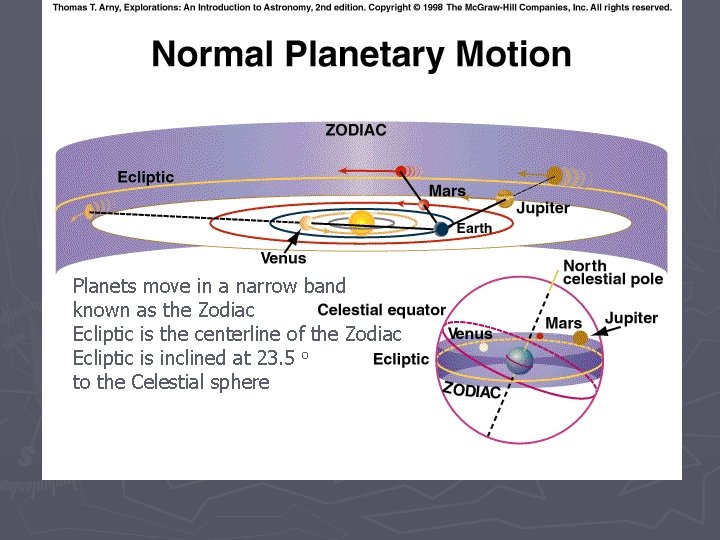
Planets move in a narrow band known as the Zodiac Ecliptic is the centerline of the Zodiac Ecliptic is inclined at 23. 5 o to the Celestial sphere
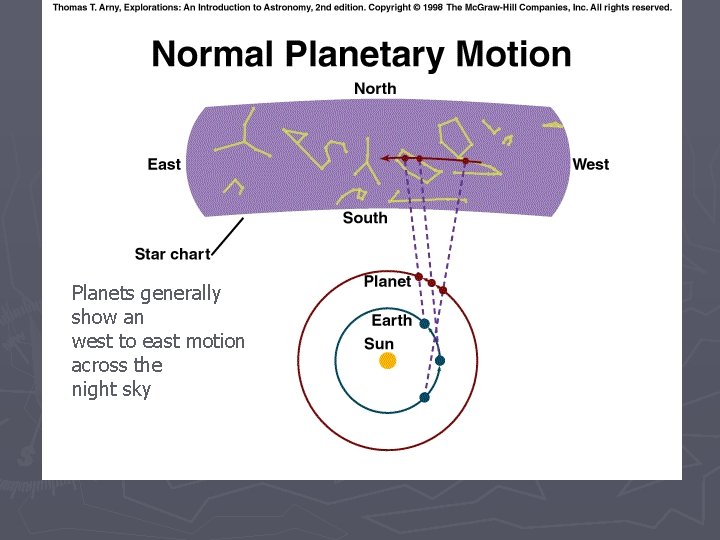
Planets generally show an west to east motion across the night sky
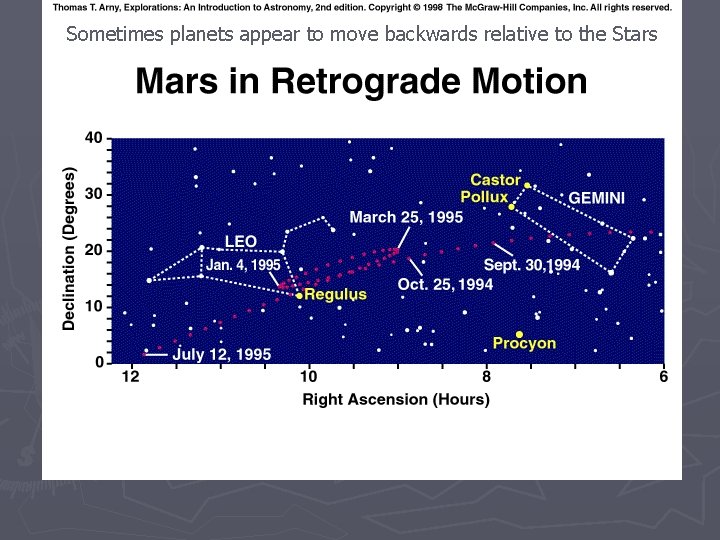
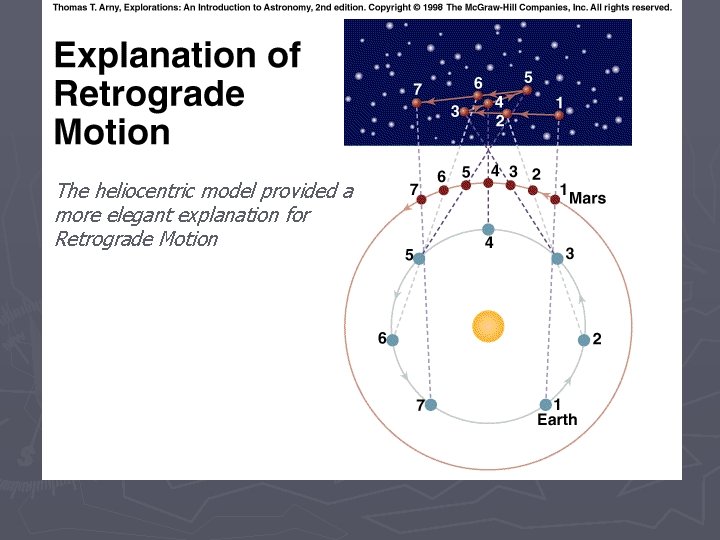
Sometimes planets appear to move backwards relative to the Stars
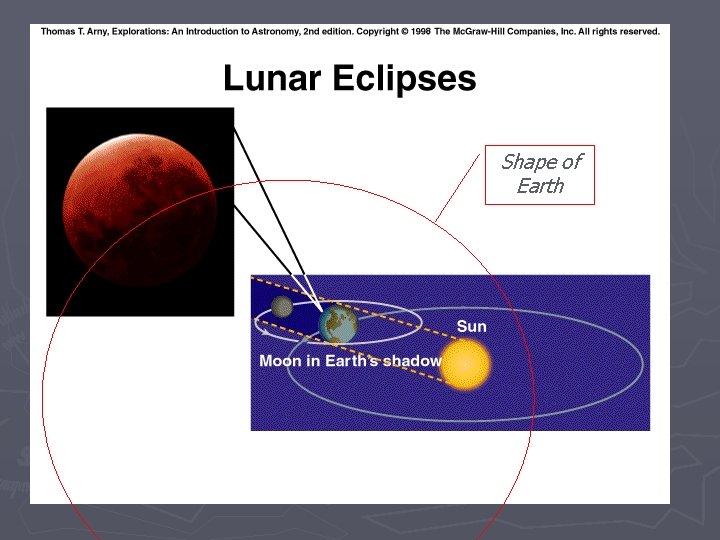
Shape of Earth
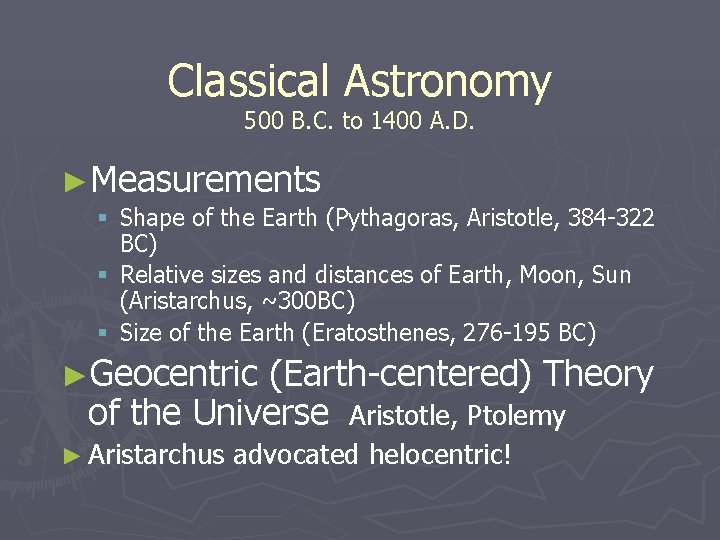
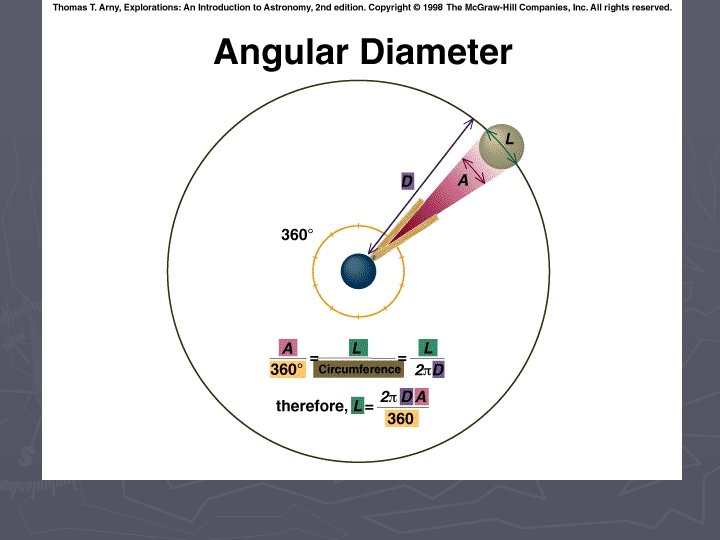
Classical Astronomy 500 B. C. to 1400 A. D. ►Measurements § Shape of the Earth (Pythagoras, Aristotle, 384 -322 BC) § Relative sizes and distances of Earth, Moon, Sun (Aristarchus, ~300 BC) § Size of the Earth (Eratosthenes, 276 -195 BC) ►Geocentric (Earth-centered) Theory of the Universe Aristotle, Ptolemy ► Aristarchus advocated helocentric!
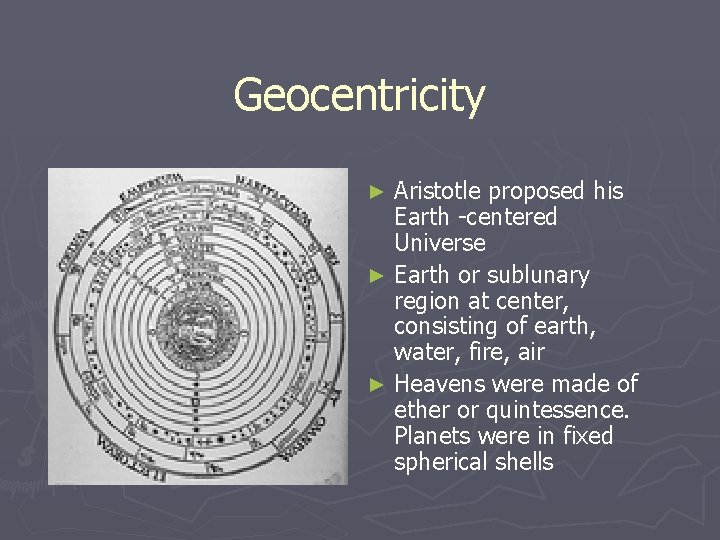
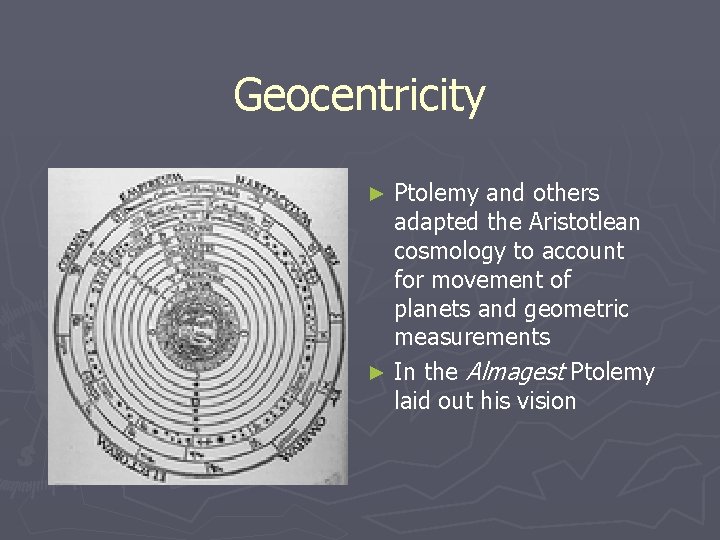
Geocentricity Aristotle proposed his Earth -centered Universe ► Earth or sublunary region at center, consisting of earth, water, fire, air ► Heavens were made of ether or quintessence. Planets were in fixed spherical shells ►
Geocentricity Ptolemy and others adapted the Aristotlean cosmology to account for movement of planets and geometric measurements ► In the Almagest Ptolemy laid out his vision ►
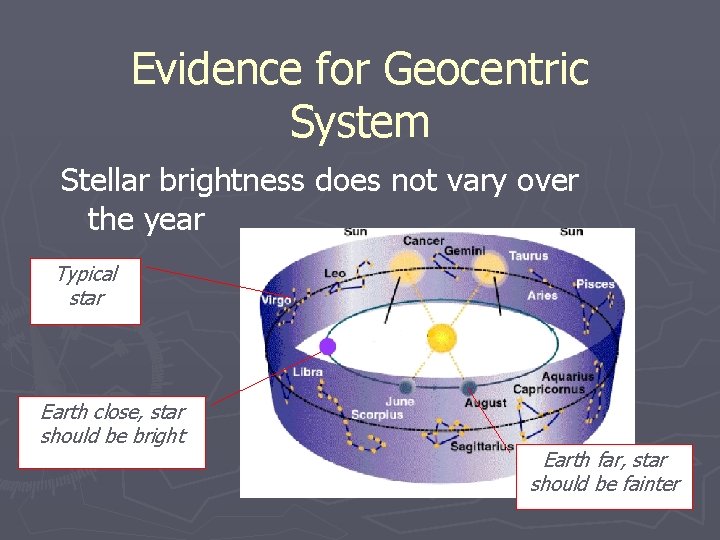
Evidence for Geocentric System Stellar brightness does not vary over the year Typical star Earth close, star should be bright Earth far, star should be fainter
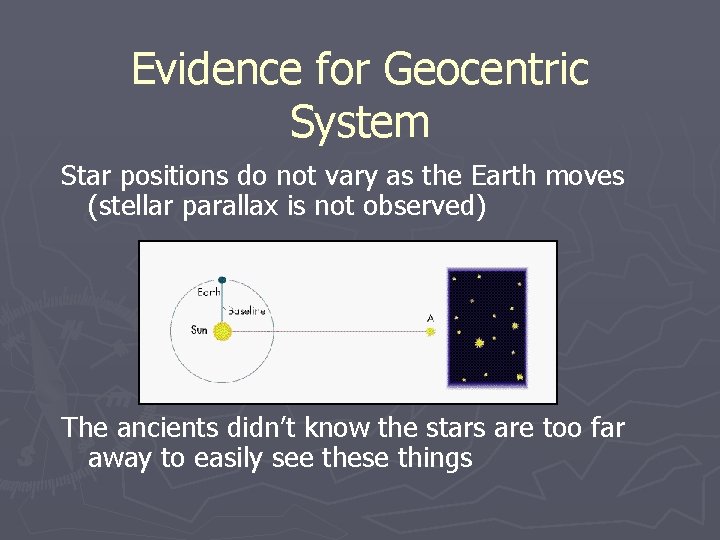
Evidence for Geocentric System Star positions do not vary as the Earth moves (stellar parallax is not observed) The ancients didn’t know the stars are too far away to easily see these things
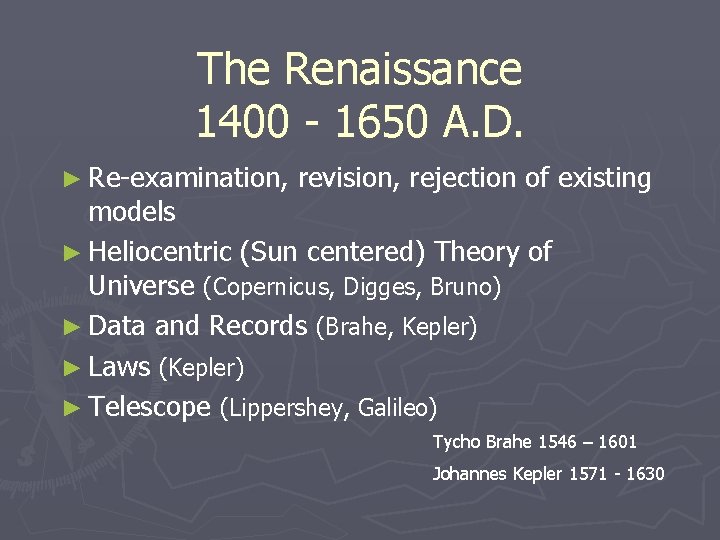
The Renaissance 1400 - 1650 A. D. ► Re-examination, revision, rejection of existing models ► Heliocentric (Sun centered) Theory of Universe (Copernicus, Digges, Bruno) ► Data and Records (Brahe, Kepler) ► Laws (Kepler) ► Telescope (Lippershey, Galileo) Tycho Brahe 1546 – 1601 Johannes Kepler 1571 - 1630
The heliocentric model provided a more elegant explanation for Retrograde Motion
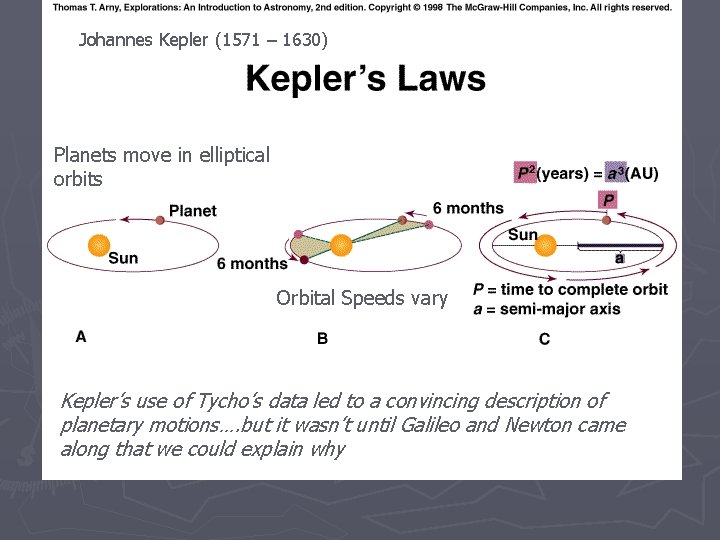
Johannes Kepler (1571 – 1630) Planets move in elliptical orbits Orbital Speeds vary Kepler’s use of Tycho’s data led to a convincing description of planetary motions…. but it wasn’t until Galileo and Newton came along that we could explain why
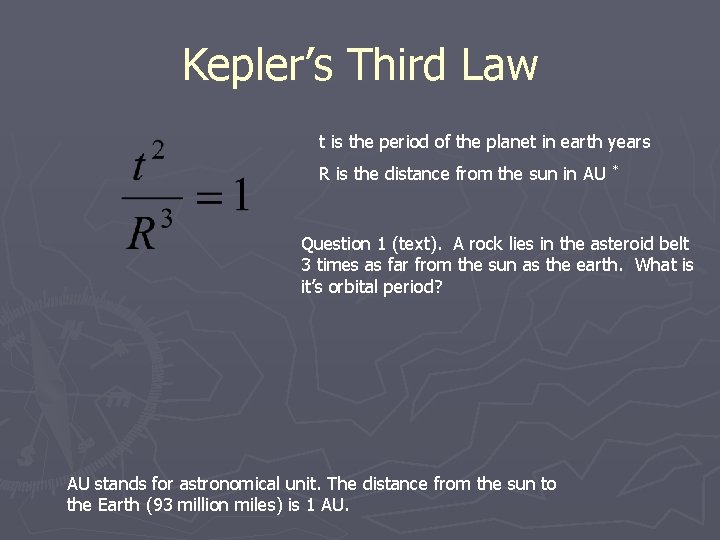
Kepler’s Third Law t is the period of the planet in earth years R is the distance from the sun in AU * Question 1 (text). A rock lies in the asteroid belt 3 times as far from the sun as the earth. What is it’s orbital period? AU stands for astronomical unit. The distance from the sun to the Earth (93 million miles) is 1 AU.
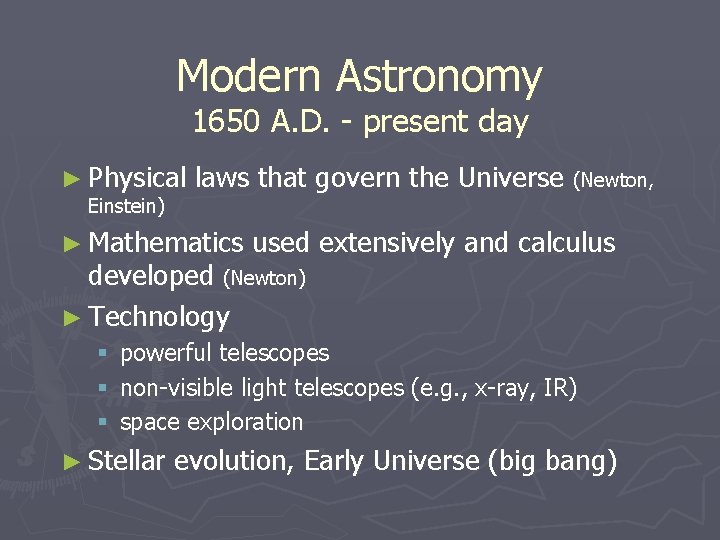
Modern Astronomy 1650 A. D. - present day ► Physical Einstein) laws that govern the Universe (Newton, ► Mathematics used extensively and calculus developed (Newton) ► Technology § § § powerful telescopes non-visible light telescopes (e. g. , x-ray, IR) space exploration ► Stellar evolution, Early Universe (big bang)
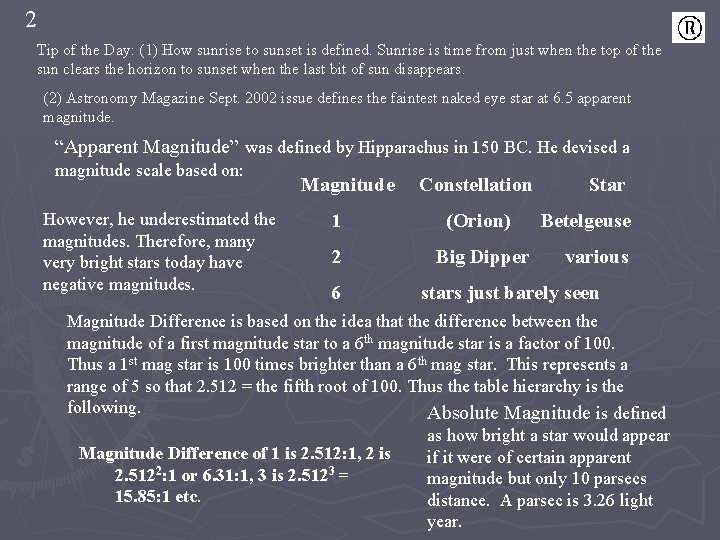
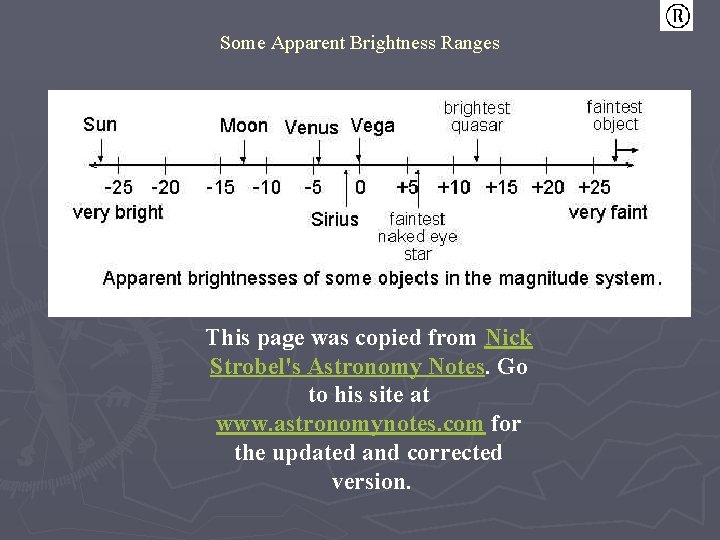
2 Tip of the Day: (1) How sunrise to sunset is defined. Sunrise is time from just when the top of the sun clears the horizon to sunset when the last bit of sun disappears. (2) Astronomy Magazine Sept. 2002 issue defines the faintest naked eye star at 6. 5 apparent magnitude. “Apparent Magnitude” was defined by Hipparachus in 150 BC. He devised a magnitude scale based on: However, he underestimated the magnitudes. Therefore, many very bright stars today have negative magnitudes. Magnitude Constellation 1 (Orion) 2 Big Dipper 6 Star Betelgeuse various stars just barely seen Magnitude Difference is based on the idea that the difference between the magnitude of a first magnitude star to a 6 th magnitude star is a factor of 100. Thus a 1 st mag star is 100 times brighter than a 6 th mag star. This represents a range of 5 so that 2. 512 = the fifth root of 100. Thus the table hierarchy is the following. Absolute Magnitude is defined Magnitude Difference of 1 is 2. 512: 1, 2 is 2. 5122: 1 or 6. 31: 1, 3 is 2. 5123 = 15. 85: 1 etc. as how bright a star would appear if it were of certain apparent magnitude but only 10 parsecs distance. A parsec is 3. 26 light year.
Some Apparent Brightness Ranges This page was copied from Nick Strobel's Astronomy Notes. Go to his site at www. astronomynotes. com for the updated and corrected version.
1. 1 This page was copied from Nick Strobel's Astronomy Notes. Go to his site at www. astronomynotes. com for the updated and corrected version Men and women have looked up at the sky and wondered about the things they see up there for as long as humans have lived on our Earth. Long ago, the Sun and Moon were mysterious objects that could be seen in the day and night. But the planets and stars were even more mysterious probably because they are so far away that we could only see them as points of light. Unlike things on the Earth that we can study up close, handle, listen to, smell, and taste, the only thing ancient watchers of the sky had to learn about things in space was their eyes and imaginations. Only very recently in the history of humanity have astronomers been able to extend the reach of our eyes (and our imaginations!). Galileo pioneered modern explorations in the early 1600's by using a device originally invented for naval operations to explore the heavens. The device he used, of course, was the telescope, an instrument used to gather and focus light. Our atmosphere prevents most of the electromagnetic radiation from reaching the ground, allowing just the visible band, parts of the radio band, and small fractions of the infrared and ultraviolet through. Our eyes can detect the visible (optical) band, so the early telescopes were all built to observe in that part of the electromagnetic spectrum. It wasn't until the 1930's that astronomers began observing with another part of the electromagnetic spectrum---the radio band. The development of space technology has enabled astronomers to put telescopes above the atmosphere and explore all of those places out there using the full range of the electromagnetic spectrum
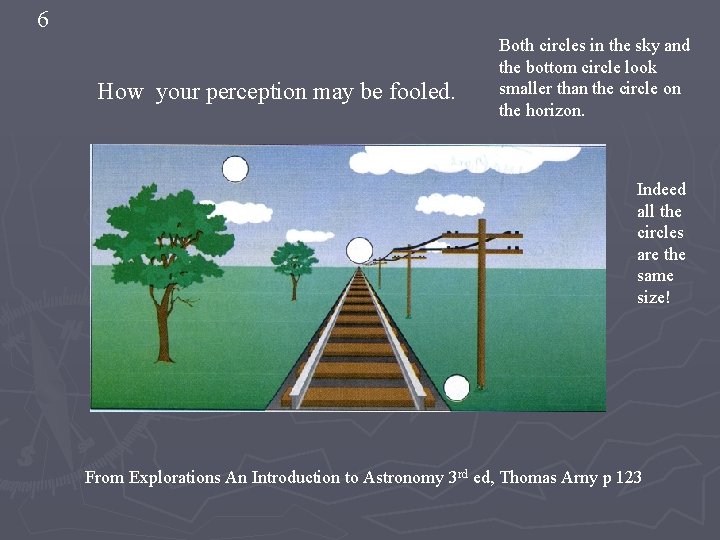
6 How your perception may be fooled. Both circles in the sky and the bottom circle look smaller than the circle on the horizon. Indeed all the circles are the same size! From Explorations An Introduction to Astronomy 3 rd ed, Thomas Arny p 123
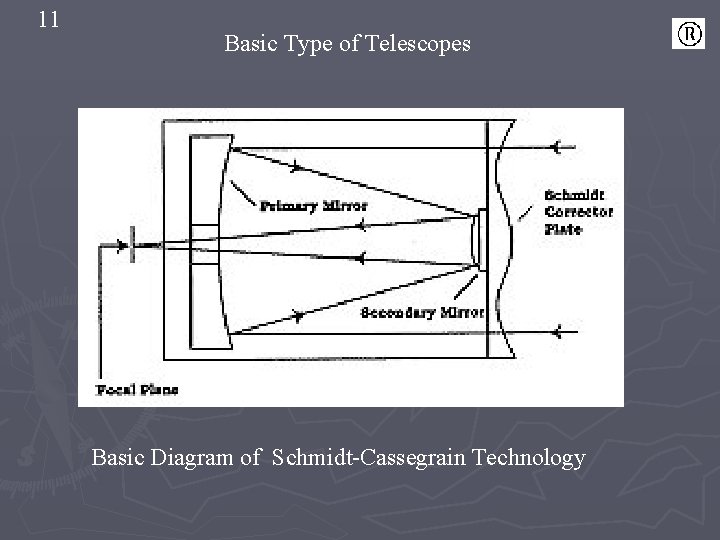
11 Basic Type of Telescopes Basic Diagram of Schmidt-Cassegrain Technology
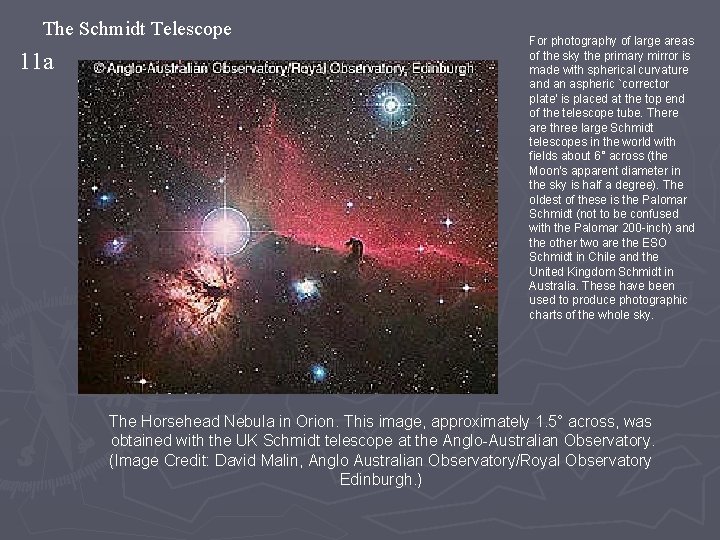
The Schmidt Telescope 11 a For photography of large areas of the sky the primary mirror is made with spherical curvature and an aspheric `corrector plate' is placed at the top end of the telescope tube. There are three large Schmidt telescopes in the world with fields about 6° across (the Moon's apparent diameter in the sky is half a degree). The oldest of these is the Palomar Schmidt (not to be confused with the Palomar 200 -inch) and the other two are the ESO Schmidt in Chile and the United Kingdom Schmidt in Australia. These have been used to produce photographic charts of the whole sky. The Horsehead Nebula in Orion. This image, approximately 1. 5° across, was obtained with the UK Schmidt telescope at the Anglo-Australian Observatory. (Image Credit: David Malin, Anglo Australian Observatory/Royal Observatory Edinburgh. )
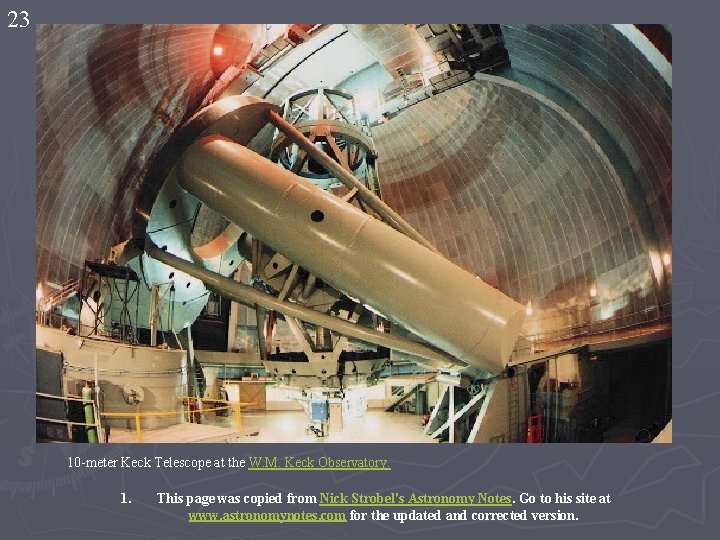
23 10 -meter Keck Telescope at the W. M. Keck Observatory. 1. This page was copied from Nick Strobel's Astronomy Notes. Go to his site at www. astronomynotes. com for the updated and corrected version.
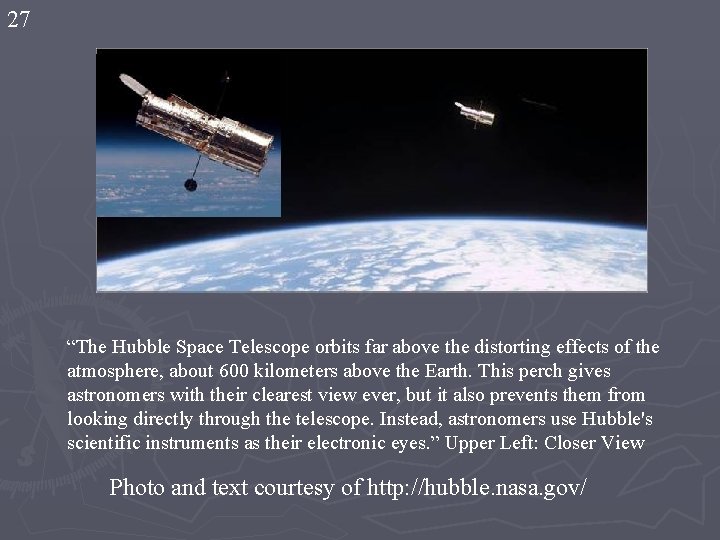
27 “The Hubble Space Telescope orbits far above the distorting effects of the atmosphere, about 600 kilometers above the Earth. This perch gives astronomers with their clearest view ever, but it also prevents them from looking directly through the telescope. Instead, astronomers use Hubble's scientific instruments as their electronic eyes. ” Upper Left: Closer View Photo and text courtesy of http: //hubble. nasa. gov/
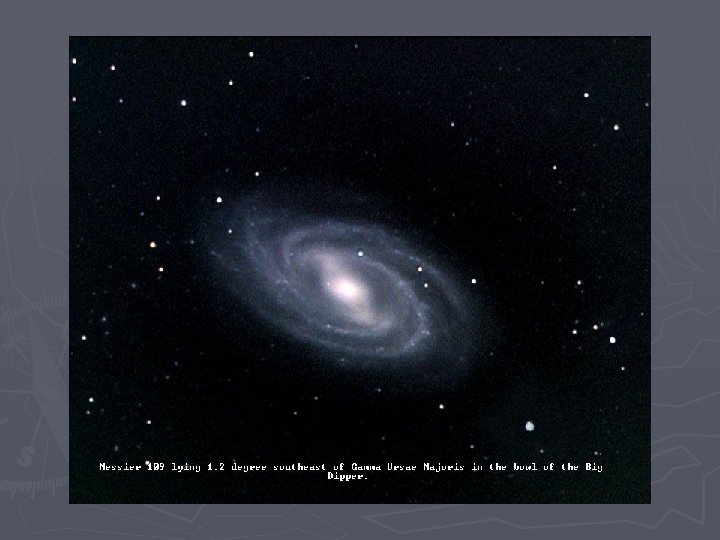
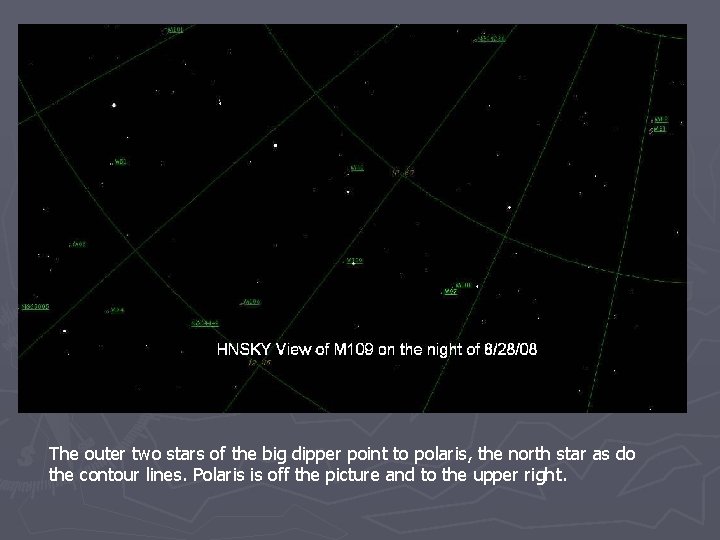
The outer two stars of the big dipper point to polaris, the north star as do the contour lines. Polaris is off the picture and to the upper right.