
Ancient Art and Architecture What We Will Learn

- Slides: 11
Ancient Art and Architecture
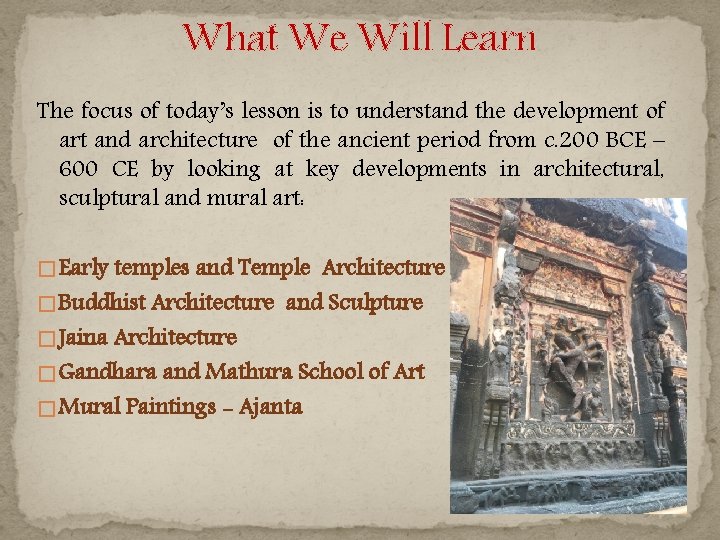
What We Will Learn The focus of today’s lesson is to understand the development of art and architecture of the ancient period from c. 200 BCE – 600 CE by looking at key developments in architectural, sculptural and mural art: � Early temples and Temple Architecture � Buddhist Architecture and Sculpture � Jaina Architecture � Gandhara and Mathura School of Art � Mural Paintings - Ajanta
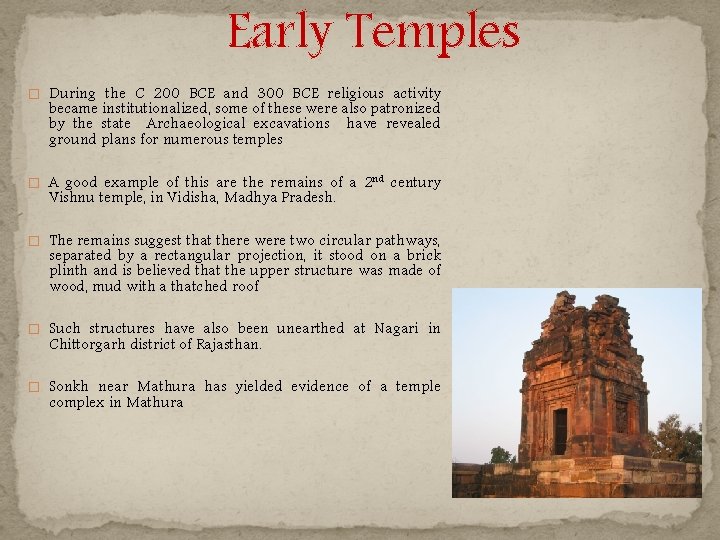
Early Temples � During the C 200 BCE and 300 BCE religious activity became institutionalized, some of these were also patronized by the state Archaeological excavations have revealed ground plans for numerous temples � A good example of this are the remains of a 2 nd century Vishnu temple, in Vidisha, Madhya Pradesh. � The remains suggest that there were two circular pathways, separated by a rectangular projection, it stood on a brick plinth and is believed that the upper structure was made of wood, mud with a thatched roof � Such structures have also been unearthed at Nagari in Chittorgarh district of Rajasthan. � Sonkh near Mathura has yielded evidence of a temple complex in Mathura
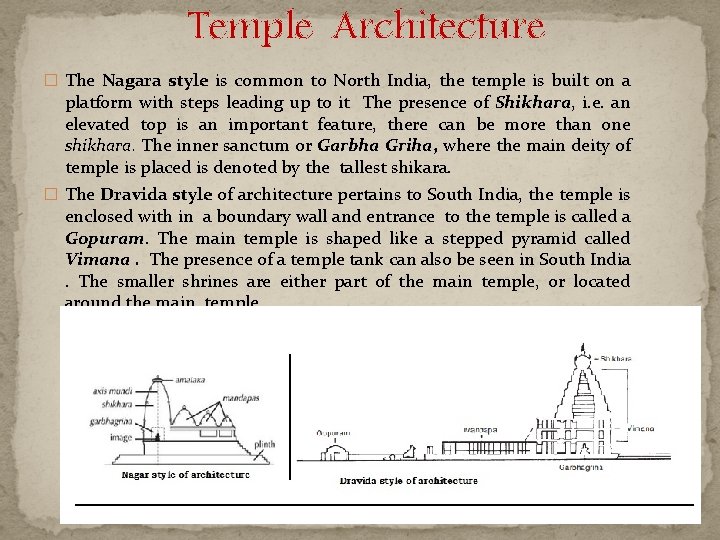
Temple Architecture � The Nagara style is common to North India, the temple is built on a platform with steps leading up to it The presence of Shikhara, i. e. an elevated top is an important feature, there can be more than one shikhara. The inner sanctum or Garbha Griha, where the main deity of temple is placed is denoted by the tallest shikara. � The Dravida style of architecture pertains to South India, the temple is enclosed with in a boundary wall and entrance to the temple is called a Gopuram. The main temple is shaped like a stepped pyramid called Vimana. The presence of a temple tank can also be seen in South India. The smaller shrines are either part of the main temple, or located around the main temple
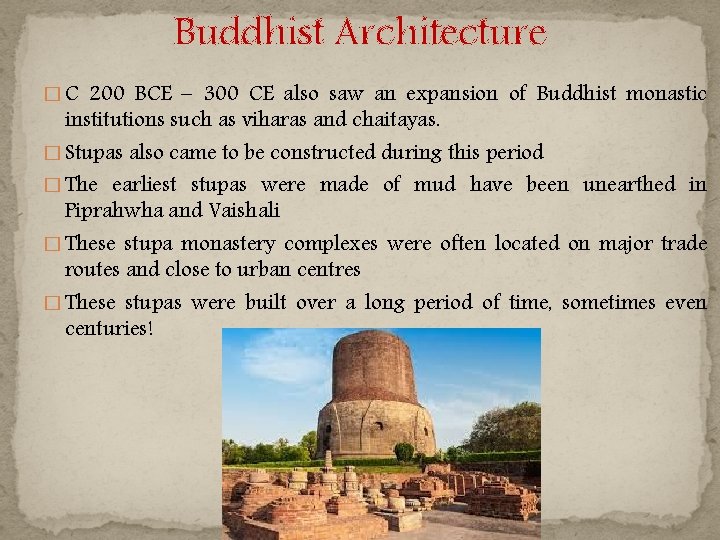
Buddhist Architecture � C 200 BCE – 300 CE also saw an expansion of Buddhist monastic institutions such as viharas and chaitayas. � Stupas also came to be constructed during this period � The earliest stupas were made of mud have been unearthed in Piprahwha and Vaishali � These stupa monastery complexes were often located on major trade routes and close to urban centres � These stupas were built over a long period of time, sometimes even centuries!
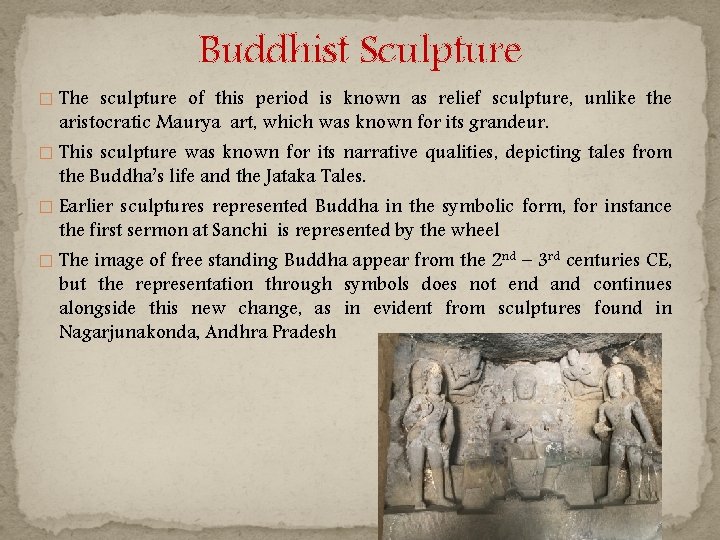
Buddhist Sculpture � The sculpture of this period is known as relief sculpture, unlike the aristocratic Maurya art, which was known for its grandeur. � This sculpture was known for its narrative qualities, depicting tales from the Buddha’s life and the Jataka Tales. � Earlier sculptures represented Buddha in the symbolic form, for instance the first sermon at Sanchi is represented by the wheel � The image of free standing Buddha appear from the 2 nd – 3 rd centuries CE, but the representation through symbols does not end and continues alongside this new change, as in evident from sculptures found in Nagarjunakonda, Andhra Pradesh
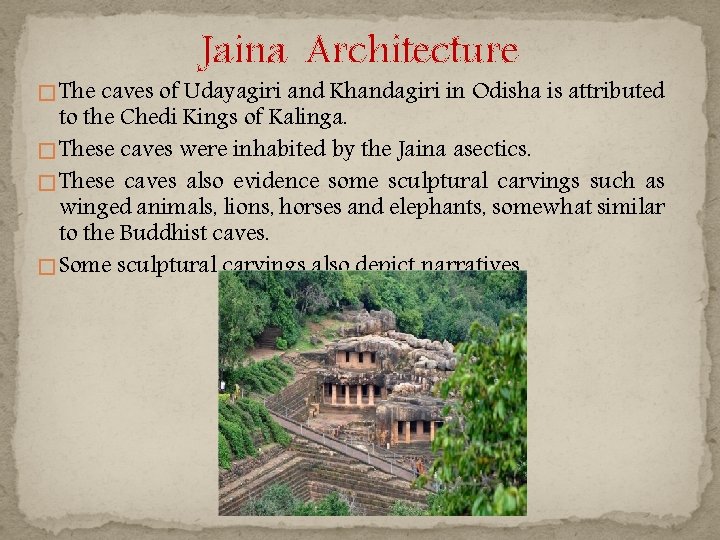
Jaina Architecture � The caves of Udayagiri and Khandagiri in Odisha is attributed to the Chedi Kings of Kalinga. � These caves were inhabited by the Jaina asectics. � These caves also evidence some sculptural carvings such as winged animals, lions, horses and elephants, somewhat similar to the Buddhist caves. � Some sculptural carvings also depict narratives.
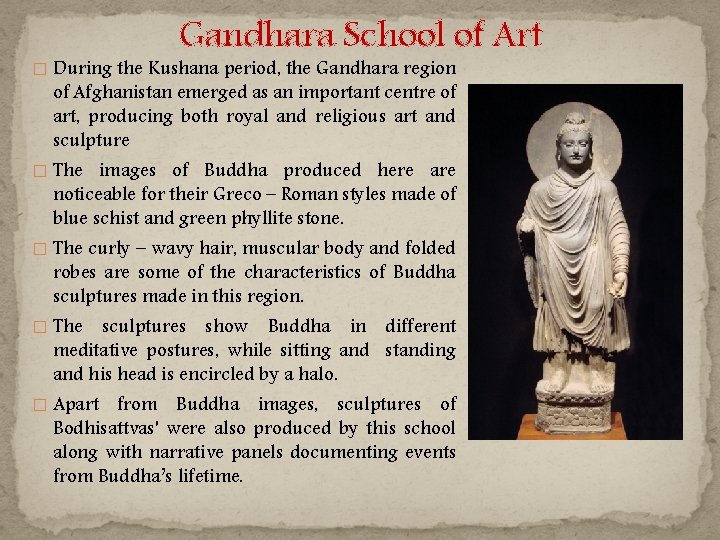
Gandhara School of Art � During the Kushana period, the Gandhara region of Afghanistan emerged as an important centre of art, producing both royal and religious art and sculpture � The images of Buddha produced here are noticeable for their Greco – Roman styles made of blue schist and green phyllite stone. � The curly – wavy hair, muscular body and folded robes are some of the characteristics of Buddha sculptures made in this region. � The sculptures show Buddha in different meditative postures, while sitting and standing and his head is encircled by a halo. � Apart from Buddha images, sculptures of Bodhisattvas' were also produced by this school along with narrative panels documenting events from Buddha’s lifetime.
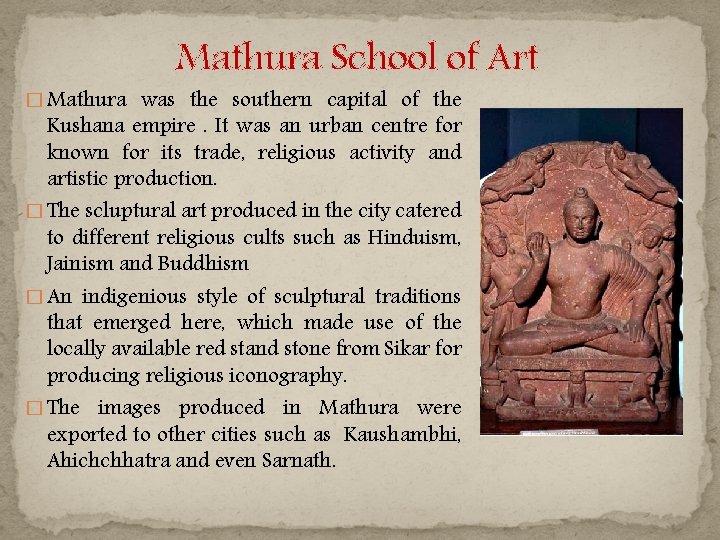
Mathura School of Art � Mathura was the southern capital of the Kushana empire. It was an urban centre for known for its trade, religious activity and artistic production. � The scluptural art produced in the city catered to different religious cults such as Hinduism, Jainism and Buddhism � An indigenious style of sculptural traditions that emerged here, which made use of the locally available red stand stone from Sikar for producing religious iconography. � The images produced in Mathura were exported to other cities such as Kaushambhi, Ahichchhatra and even Sarnath.
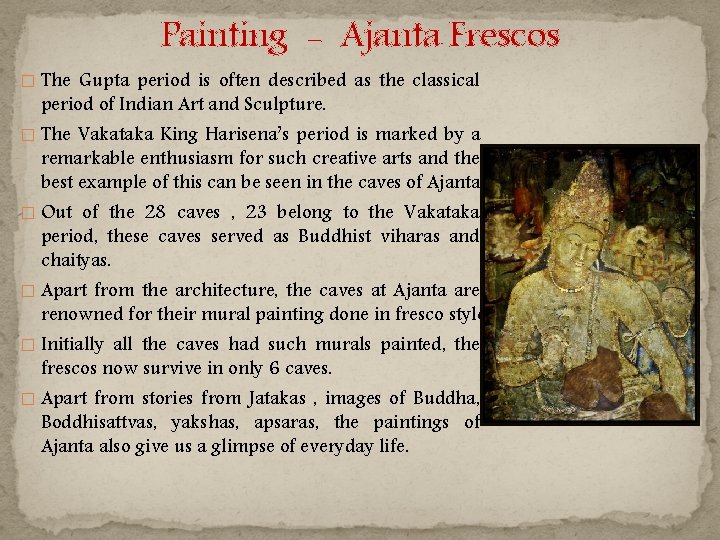
Painting - Ajanta Frescos � The Gupta period is often described as the classical period of Indian Art and Sculpture. � The Vakataka King Harisena’s period is marked by a remarkable enthusiasm for such creative arts and the best example of this can be seen in the caves of Ajanta. � Out of the 28 caves , 23 belong to the Vakataka period, these caves served as Buddhist viharas and chaityas. � Apart from the architecture, the caves at Ajanta are renowned for their mural painting done in fresco style � Initially all the caves had such murals painted, the frescos now survive in only 6 caves. � Apart from stories from Jatakas , images of Buddha, Boddhisattvas, yakshas, apsaras, the paintings of Ajanta also give us a glimpse of everyday life.
Conclusion During this period, the expansion of state power and emergence of new cultural centers was seen on a different scale, the new religious sects that emerged was patronized by rulers which led to creation of religious and cultural establishments , that paved way for its development and spread in the future.