
AnatomySkeletal System Classification of Bones AnatomySkeletal System Bell
Anatomy-Skeletal System Classification of Bones
Anatomy-Skeletal System Bell Work Grab your notes for the day on the front table n Grab your supply boxes & white boards n n On your white boards, discuss in your groups how you think bones are classified and give examples
Anatomy-Skeletal System Objectives n Students will be able to: n Define terms that are used to classify bones. n Identify the characteristics of bone. n Identify the function of bone. n Identify the classification of bones. n Label the parts of long bones.
Anatomy-Skeletal System Terminology Metabolism n Chemical reactions that occur in living organisms to maintain life n Bone marrow n Flexible tissue found in the hollow interior of bones n
Anatomy-Skeletal System Classification of Bones. Characteristics n Bone tissue is very active material that is continually being broken down and reconstructed n Responds to use and disuse n Physical activity places stress on the bone causing it to thicken & strengthen (hypertrophy) n Lack of physical activity causes bone to become thinner & weaker
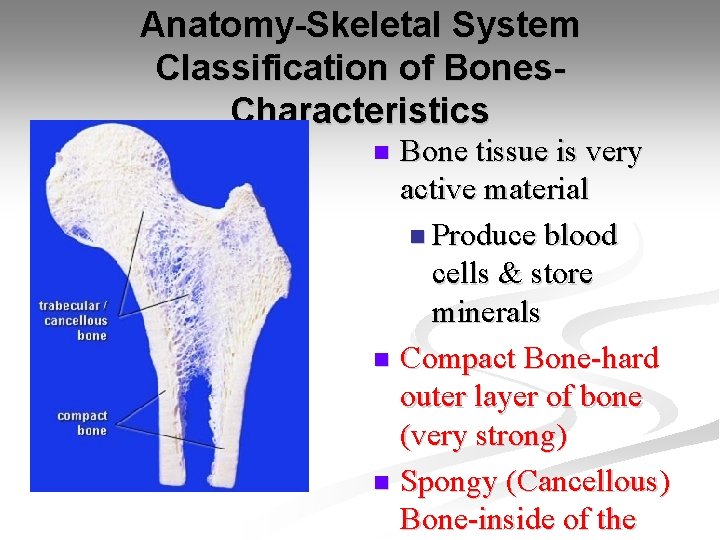
Anatomy-Skeletal System Classification of Bones. Characteristics Bone tissue is very active material n Produce blood cells & store minerals n Compact Bone-hard outer layer of bone (very strong) n Spongy (Cancellous) Bone-inside of the n
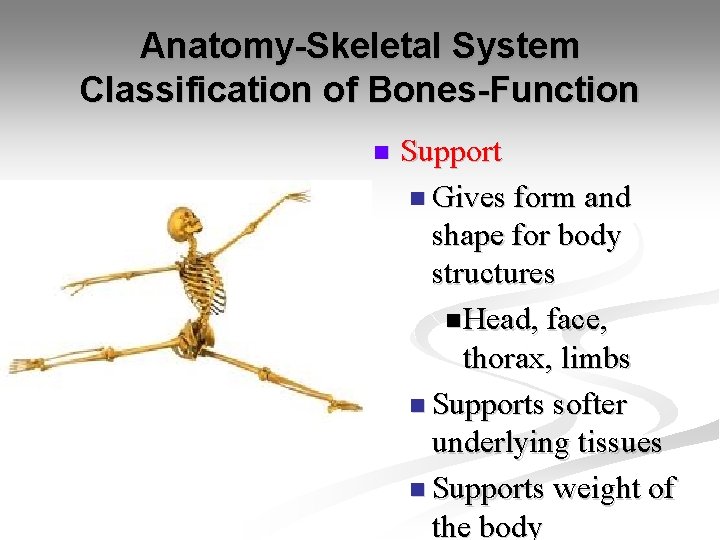
Anatomy-Skeletal System Classification of Bones-Function n Support n Gives form and shape for body structures n Head, face, thorax, limbs n Supports softer underlying tissues n Supports weight of the body
Anatomy-Skeletal System Classification of Bones-Function n Protection n Skull protects eyes, ears, brain n Ribs protect heart, lungs, liver, stomach, spleen, kidneys n Pelvic girdle protects internal reproductive organs, urinary bladder n Vertebral column protects spinal cord
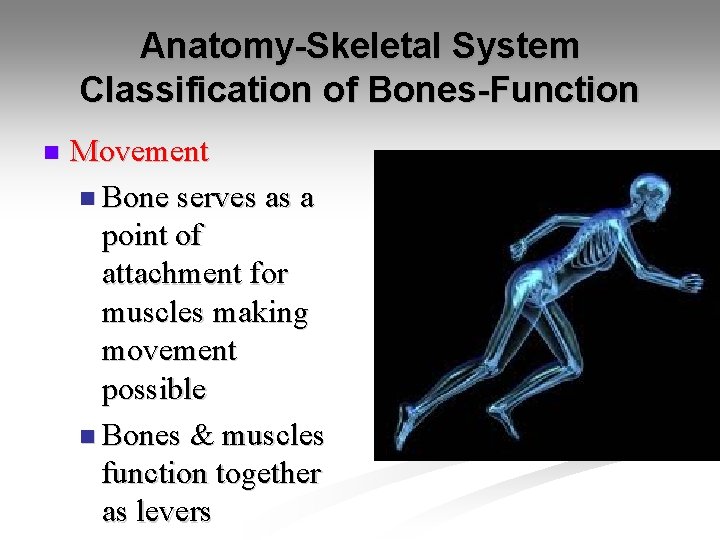
Anatomy-Skeletal System Classification of Bones-Function n Movement n Bone serves as a point of attachment for muscles making movement possible n Bones & muscles function together as levers
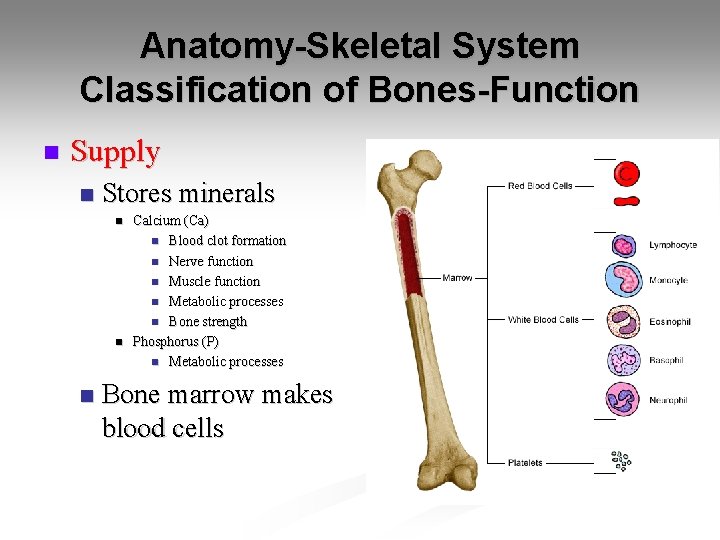
Anatomy-Skeletal System Classification of Bones-Function n Supply n Stores minerals n n n Calcium (Ca) n Blood clot formation n Nerve function n Muscle function n Metabolic processes n Bone strength Phosphorus (P) n Metabolic processes Bone marrow makes blood cells
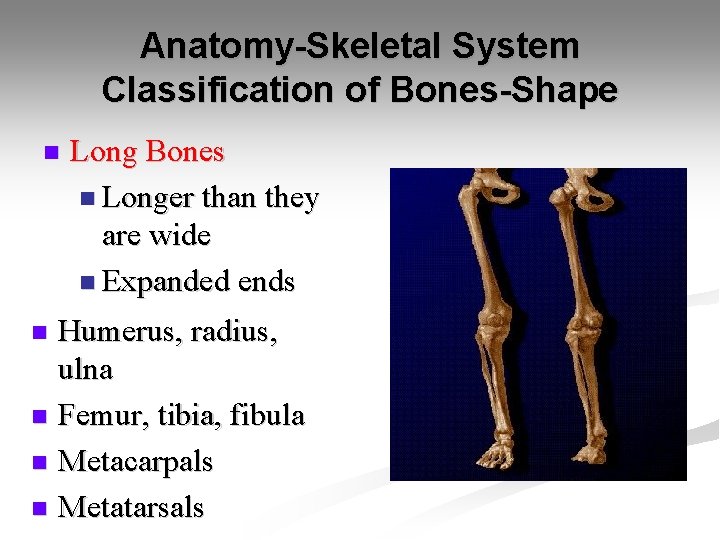
Anatomy-Skeletal System Classification of Bones-Shape n Long Bones n Longer than they are wide n Expanded ends Humerus, radius, ulna n Femur, tibia, fibula n Metacarpals n Metatarsals n
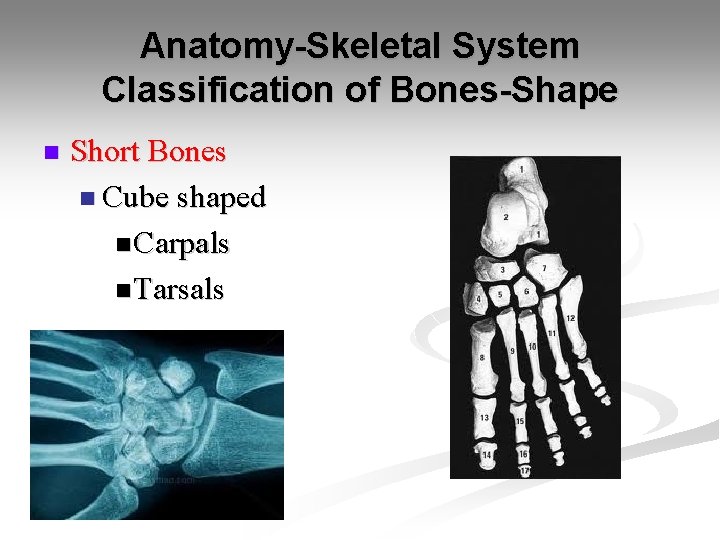
Anatomy-Skeletal System Classification of Bones-Shape n Short Bones n Cube shaped n Carpals n Tarsals
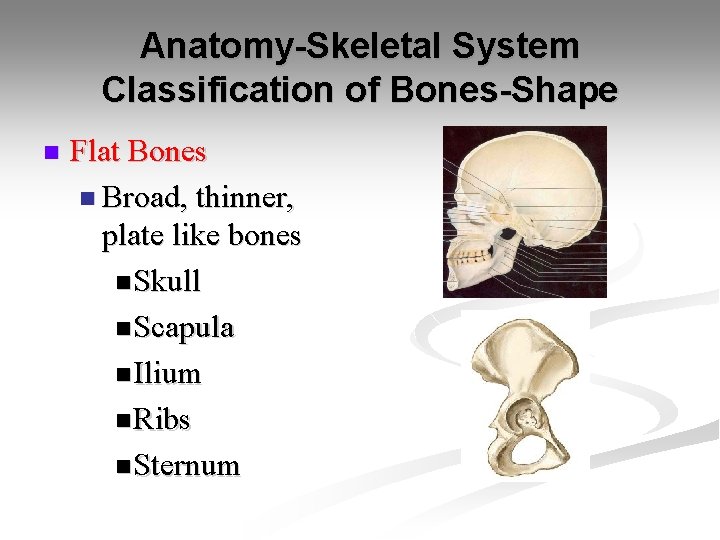
Anatomy-Skeletal System Classification of Bones-Shape n Flat Bones n Broad, thinner, plate like bones n Skull n Scapula n Ilium n Ribs n Sternum
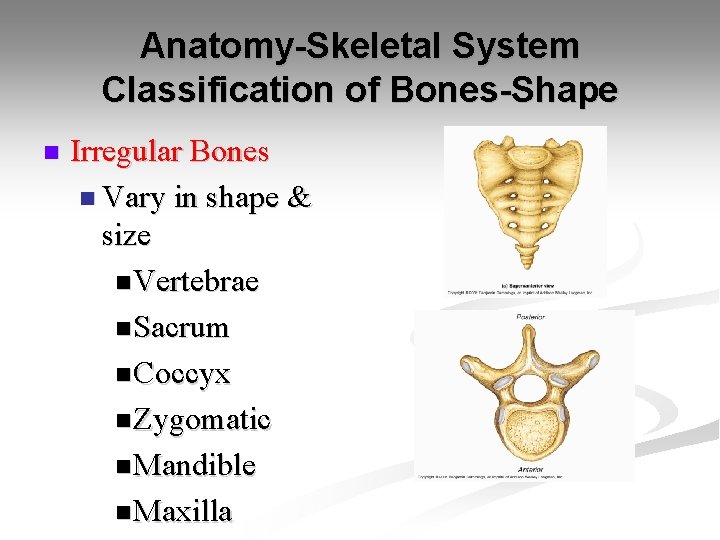
Anatomy-Skeletal System Classification of Bones-Shape n Irregular Bones n Vary in shape & size n Vertebrae n Sacrum n Coccyx n Zygomatic n Mandible n Maxilla
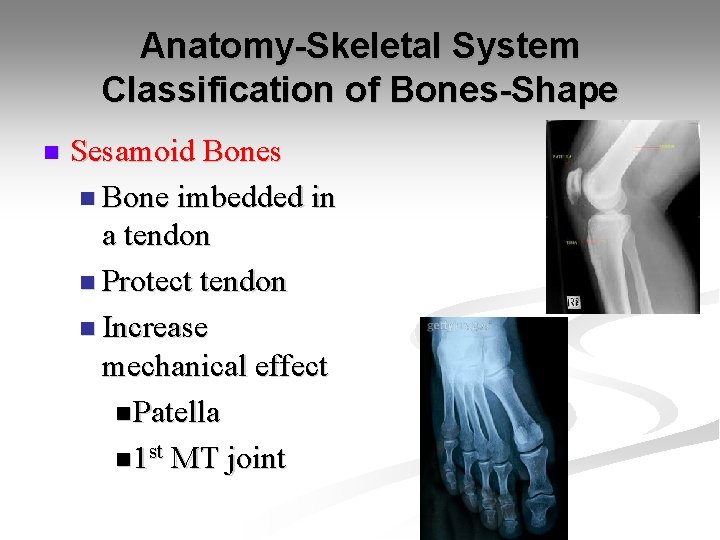
Anatomy-Skeletal System Classification of Bones-Shape n Sesamoid Bones n Bone imbedded in a tendon n Protect tendon n Increase mechanical effect n Patella n 1 st MT joint
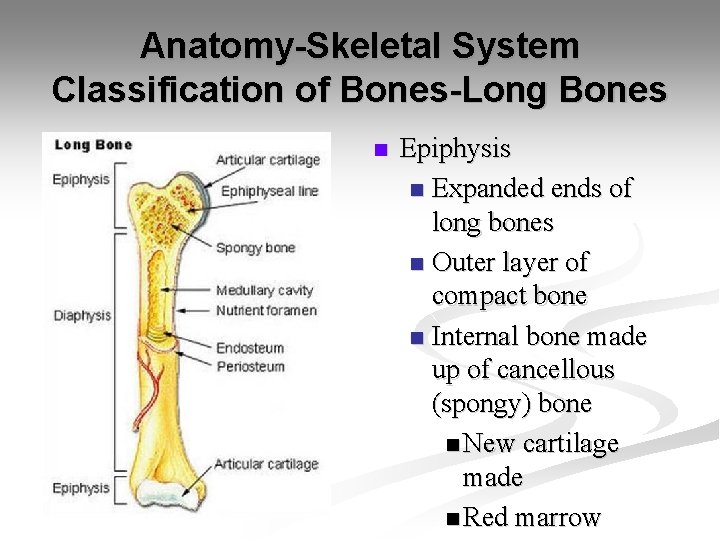
Anatomy-Skeletal System Classification of Bones-Long Bones n Epiphysis n Expanded ends of long bones n Outer layer of compact bone n Internal bone made up of cancellous (spongy) bone n New cartilage made n Red marrow
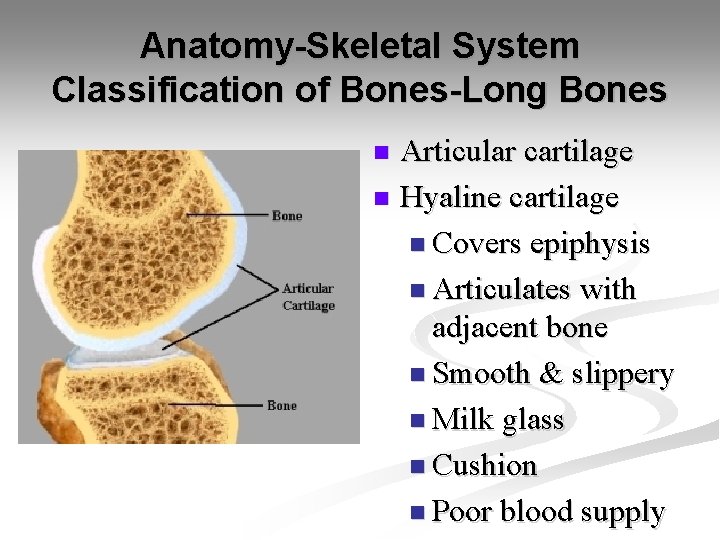
Anatomy-Skeletal System Classification of Bones-Long Bones Articular cartilage n Hyaline cartilage n Covers epiphysis n Articulates with adjacent bone n Smooth & slippery n Milk glass n Cushion n Poor blood supply n
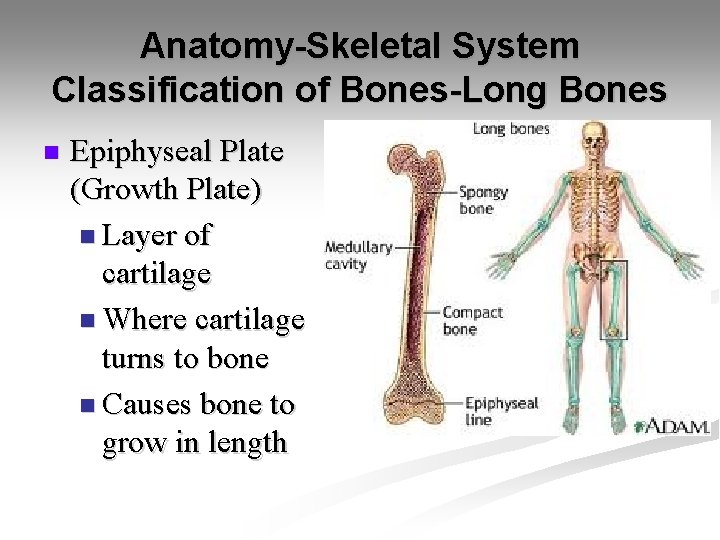
Anatomy-Skeletal System Classification of Bones-Long Bones n Epiphyseal Plate (Growth Plate) n Layer of cartilage n Where cartilage turns to bone n Causes bone to grow in length
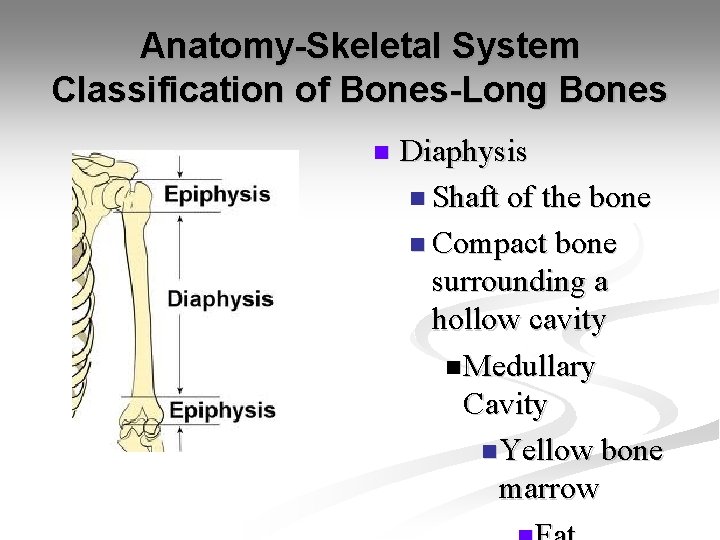
Anatomy-Skeletal System Classification of Bones-Long Bones n Diaphysis n Shaft of the bone n Compact bone surrounding a hollow cavity n Medullary Cavity n Yellow bone marrow
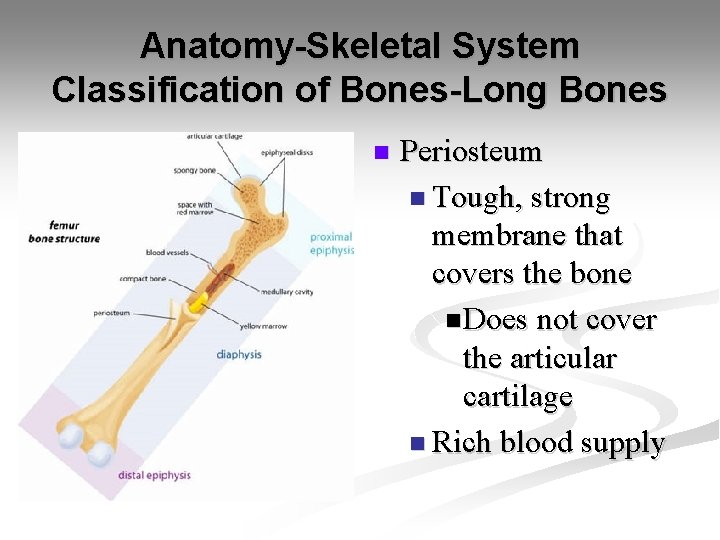
Anatomy-Skeletal System Classification of Bones-Long Bones n Periosteum n Tough, strong membrane that covers the bone n Does not cover the articular cartilage n Rich blood supply
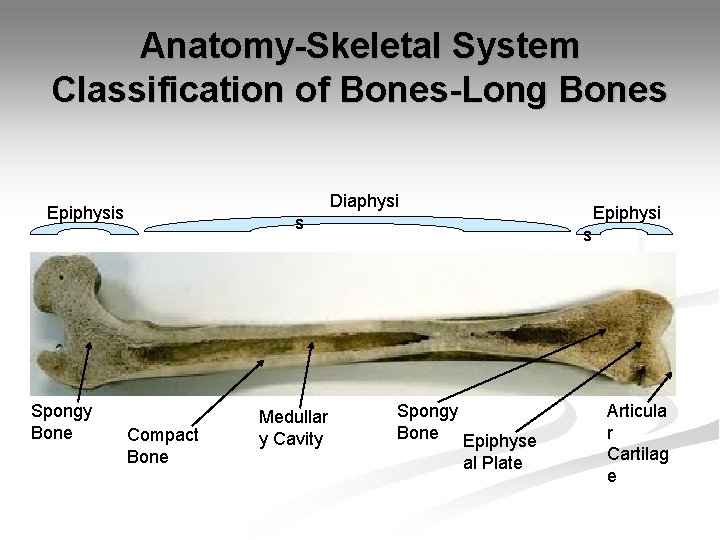
Anatomy-Skeletal System Classification of Bones-Long Bones Diaphysi Epiphysis Spongy Bone Epiphysi s Compact Bone Medullar y Cavity s Spongy Bone Epiphyse al Plate Articula r Cartilag e
Closure q. Grab a ½ sheet of paper and on your own… 1. Describe how the bone responds to use and disuse 2. list the 4 functions of bones 3. List the 5 categories for classifying bone and give 1 example of each 4. The hard outer layer of bone that is very strong is called_______ 5. The inside of the bone that fills the cavity is called______
- Slides: 22