
AnatomyMuscular System Muscle Types Characteristics Function Introduction n

- Slides: 24
Anatomy-Muscular System Muscle Types, Characteristics & Function
Introduction n What do you know about muscles? n List as many muscle names as you can in 60 sec! What do muscles do? n Do you remember your anatomical movements? n Show and Tell! Flexion – Extension – Abduction – Adduction – Rotation – Circumduction – Supination – Pronation – Inversion – Elevation – Depression – Protraction - Retraction n
Objectives n Students will be able to: n Define terms for muscle types & characteristics n Identify muscle types, characteristics & function n Label & give examples of muscle types
Terminology Myo n Muscle n Tendon n Connects muscle to bone n Contraction n Shortening or tensing of a muscle n Striated n Striped n Voluntary n Conscious control by will/choice n Involuntary n Not under conscious control n
General Characteristics Muscles provide ACTION for the body n Excitable n Muscles are electrically excitable n Action occurs when nerve cell stimulates the muscle cell n Contractable n Muscle cells contract n Shorten or tense n
General Characteristics Extensible n Ability to stretch from the normal resting length n Elastic n Ability to return from a stretch to normal resting length n
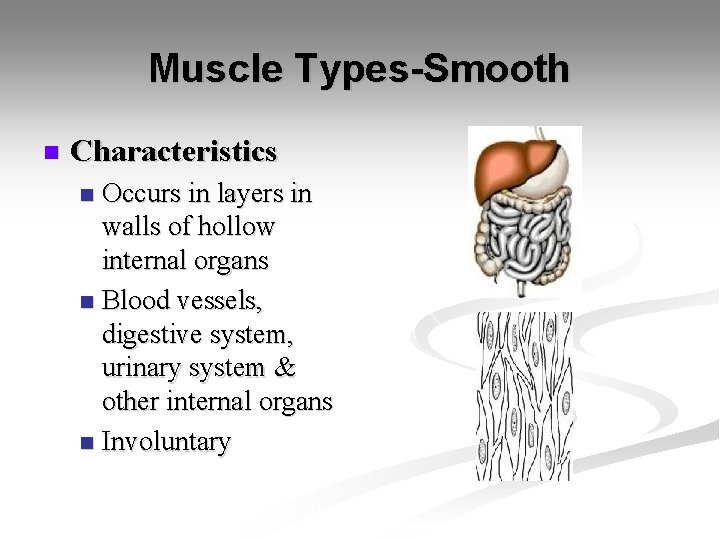
Muscle Types-Smooth n Characteristics Occurs in layers in walls of hollow internal organs n Blood vessels, digestive system, urinary system & other internal organs n Involuntary n
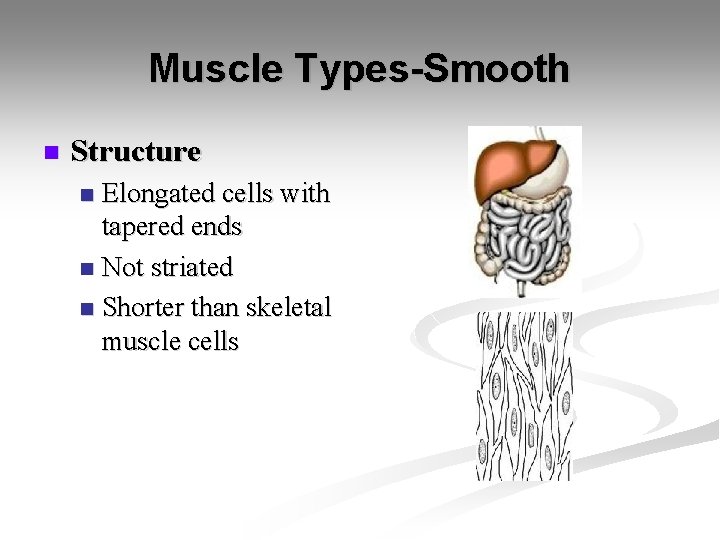
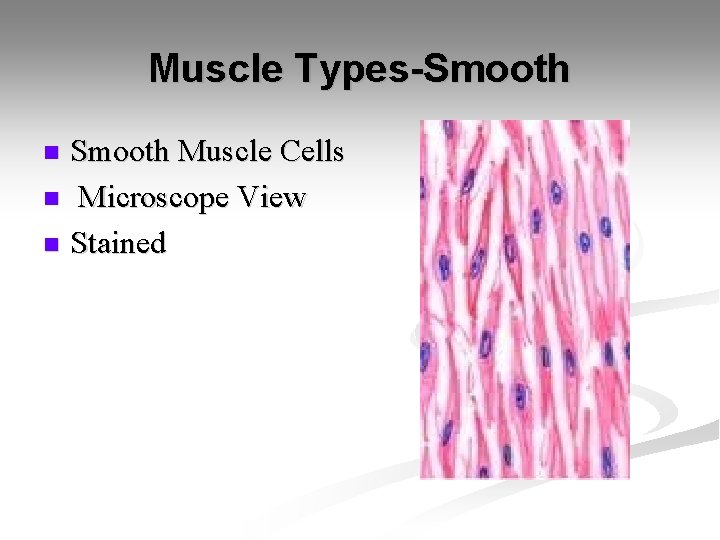
Muscle Types-Smooth n Structure Elongated cells with tapered ends n Not striated n Shorter than skeletal muscle cells n
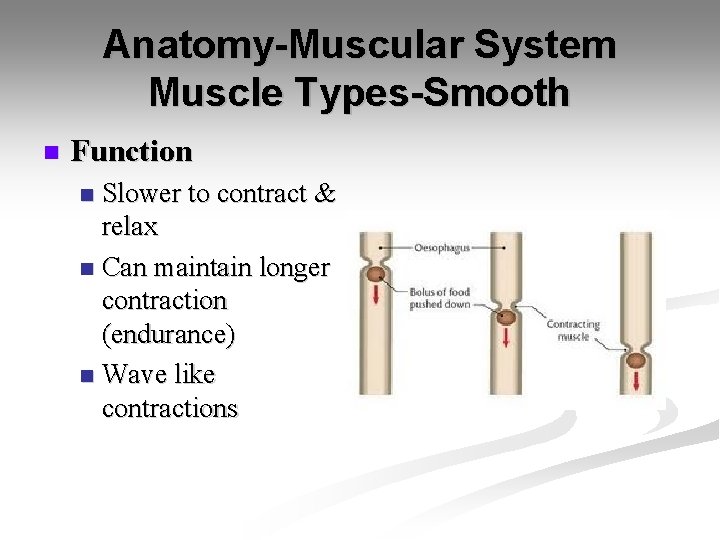
Anatomy-Muscular System Muscle Types-Smooth n Function Slower to contract & relax n Can maintain longer contraction (endurance) n Wave like contractions n
Muscle Types-Smooth Muscle Cells n Microscope View n Stained n
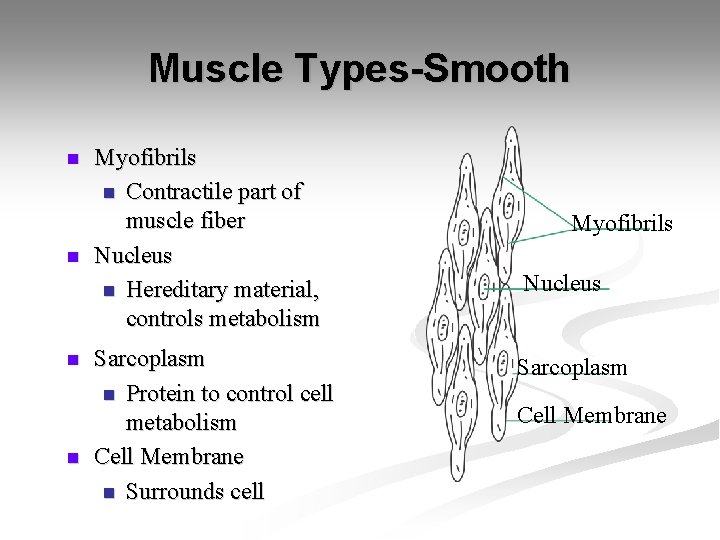
Muscle Types-Smooth n n Myofibrils n Contractile part of muscle fiber Nucleus n Hereditary material, controls metabolism Sarcoplasm n Protein to control cell metabolism Cell Membrane n Surrounds cell Myofibrils Nucleus Sarcoplasm Cell Membrane
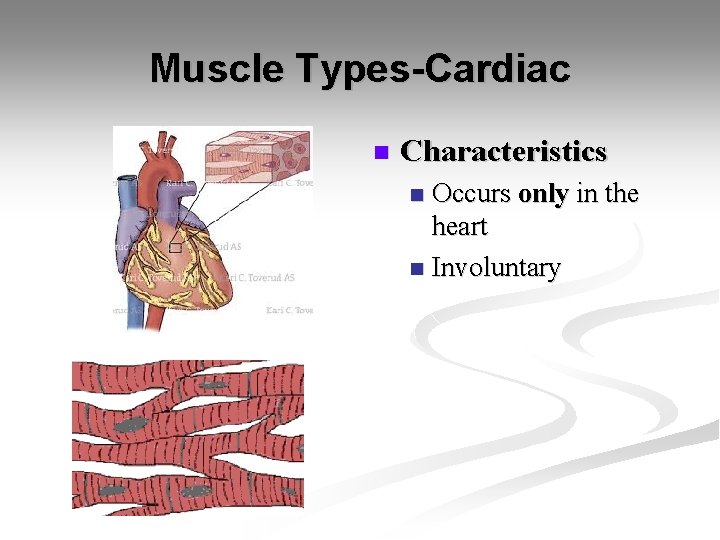
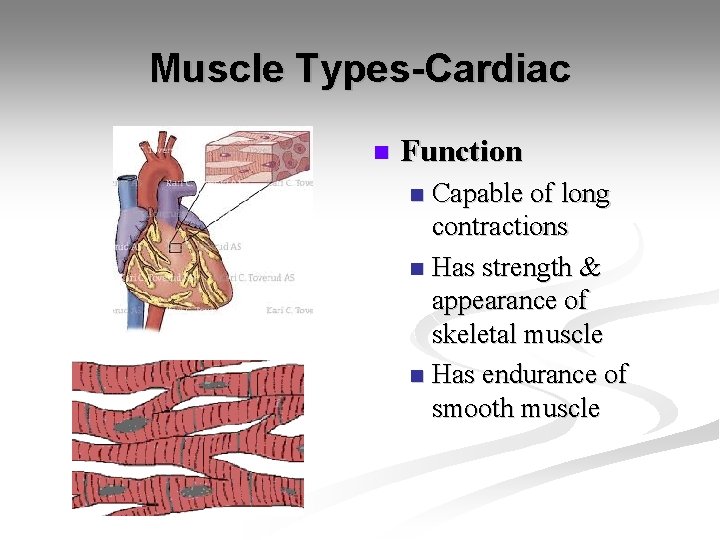
Muscle Types-Cardiac n Characteristics Occurs only in the heart n Involuntary n
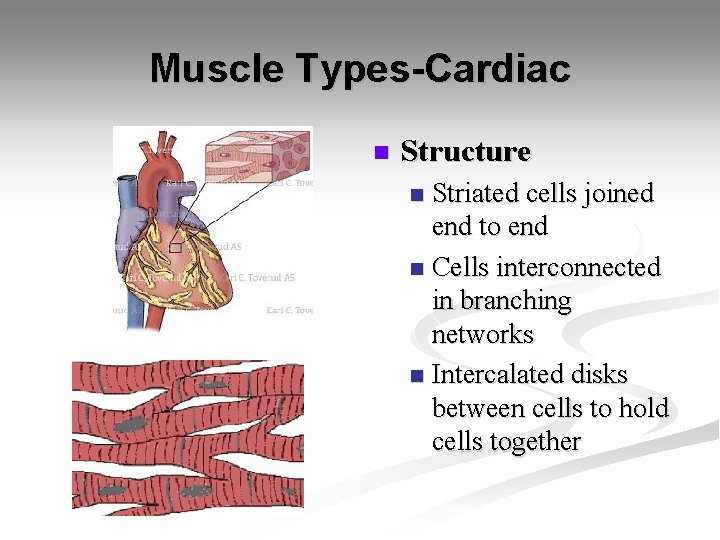
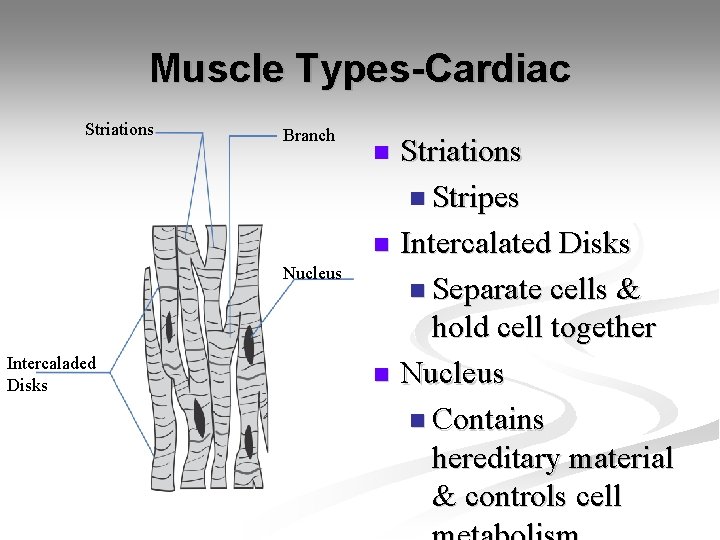
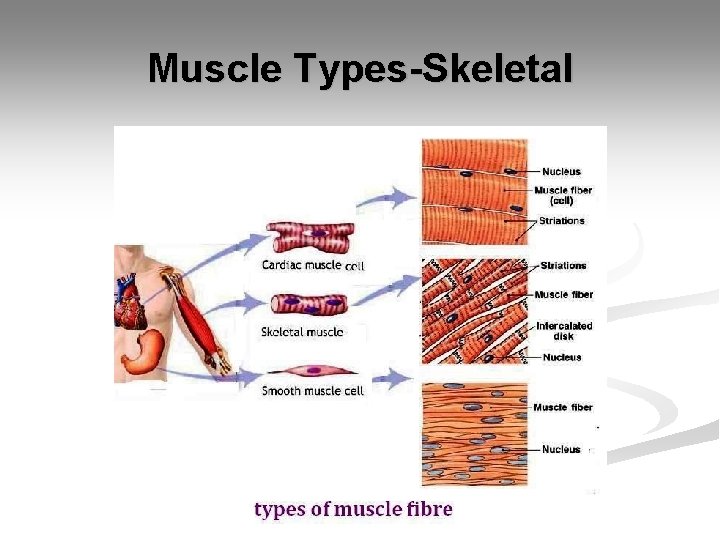
Muscle Types-Cardiac n Structure Striated cells joined end to end n Cells interconnected in branching networks n Intercalated disks between cells to hold cells together n
Muscle Types-Cardiac n Function Capable of long contractions n Has strength & appearance of skeletal muscle n Has endurance of smooth muscle n
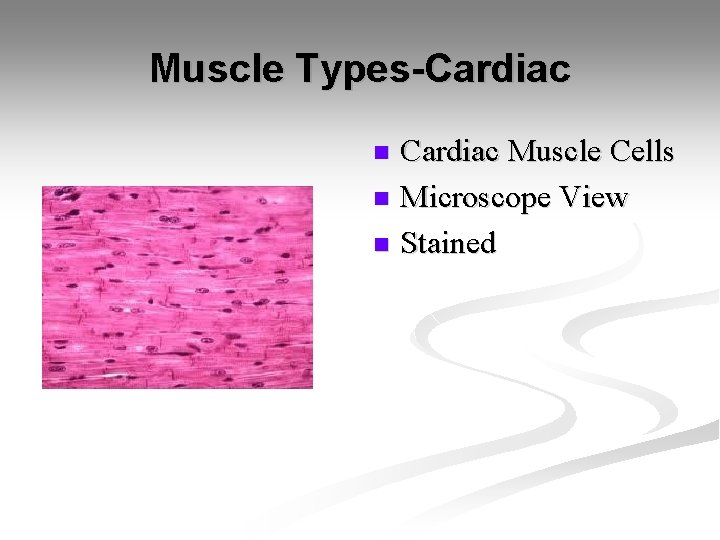
Muscle Types-Cardiac Muscle Cells n Microscope View n Stained n
Muscle Types-Cardiac Striations Branch Nucleus Intercaladed Disks Striations n Stripes n Intercalated Disks n Separate cells & hold cell together n Nucleus n Contains hereditary material & controls cell n
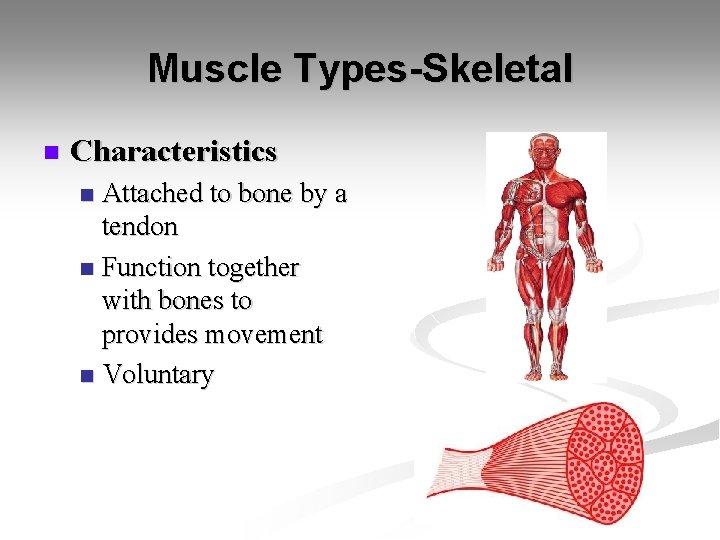
Muscle Types-Skeletal n Characteristics Attached to bone by a tendon n Function together with bones to provides movement n Voluntary n
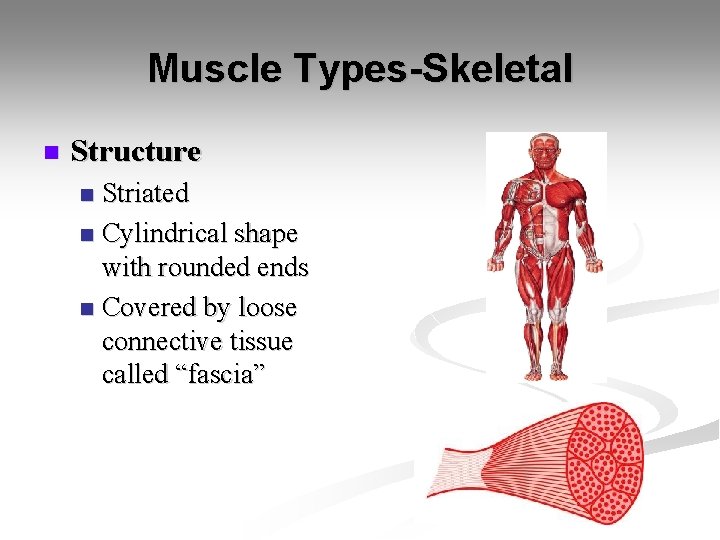
Muscle Types-Skeletal n Structure Striated n Cylindrical shape with rounded ends n Covered by loose connective tissue called “fascia” n
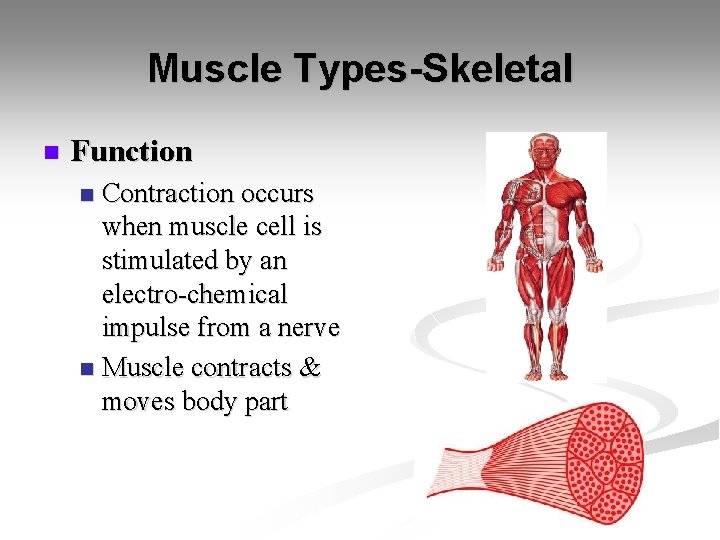
Muscle Types-Skeletal n Function Contraction occurs when muscle cell is stimulated by an electro-chemical impulse from a nerve n Muscle contracts & moves body part n
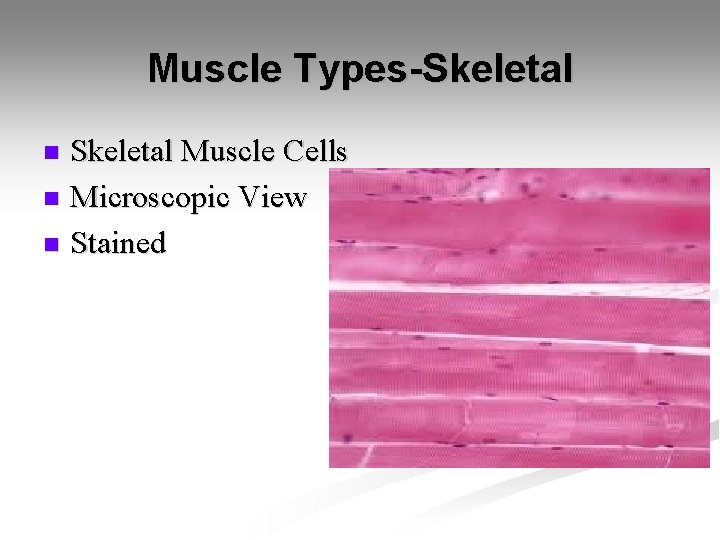
Muscle Types-Skeletal Muscle Cells n Microscopic View n Stained n
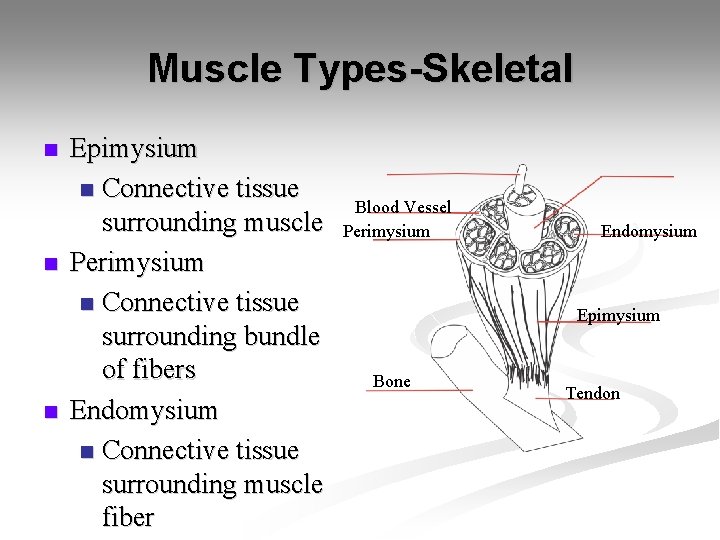
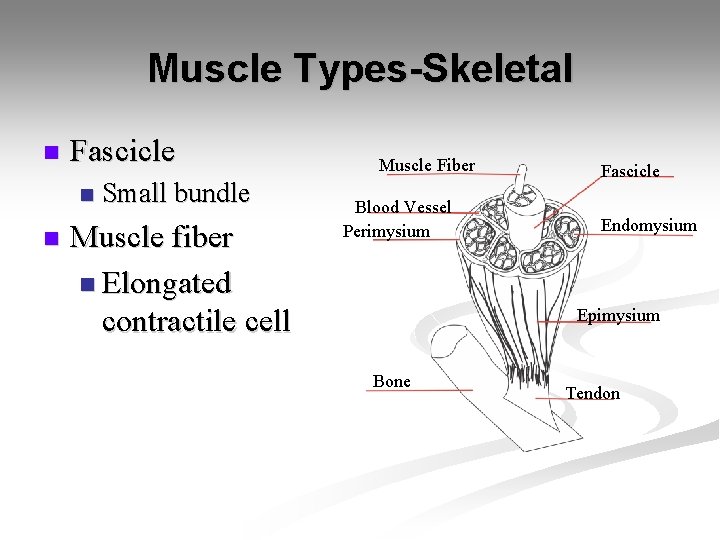
Muscle Types-Skeletal n n n Epimysium n Connective tissue surrounding muscle Perimysium n Connective tissue surrounding bundle of fibers Endomysium n Connective tissue surrounding muscle fiber Blood Vessel Perimysium Endomysium Epimysium Bone Tendon
Muscle Types-Skeletal n Fascicle n n Small bundle Muscle fiber n Elongated contractile cell Muscle Fiber Blood Vessel Perimysium Fascicle Endomysium Epimysium Bone Tendon
Muscle Types-Skeletal
Wrap it up… n Go back to your list of muscles from the beginning of class n n What muscle type are they? - Label on your sheet On that same sheet… n Take one of the muscle types and give me n One Characteristic n It’s structure n One function n Turn in.