
ANATOMY SURGICAL APPROACHES TO LATERAL VENTRICLES Anatomy Two

- Slides: 39
ANATOMY & SURGICAL APPROACHES TO LATERAL VENTRICLES
Anatomy Two paired cavities C Shaped Each cavity contains about 10 ml CSF Divided into: Frontal horn (Length 6 cm) Body between IVF and atrium Temporal horn ( length 4 cm) Occipital horn Atrium
Frontal horn Boundaries Medial wall �Septum pellucidum Roof, anterior wall and Floor �Anterior wrapping of the corpus callosum, genu, rostrum & trunk Lateral wall �Internal aspect of the head of the caudate nucleus.
Body Boundaries Medial wall Septum pellucidum & body of fornix Roof Body of corpus callosum Lateral wall Medial part of body of caudate nucleus Floor Dorsal surface of thalamus between thalamo-caudate sulcus and tenia thalami (attach line of choroidal plexus on thalamus)
Atrium Confluence of horns. Communicates cranially, ventrally and medially with frontal horn, dorsally with occipital horn, & caudally, ventrally and laterally with inferior horn. Overlies the pulvinar, posterior pole of thalamus which constitutes anterior wall. Roof: fibers coming from the splenium. Medial wall: choroidal fissura with choroidal plexus (glomus); isolates the LV from the cisterna ambiens.
Occipital horn Internal wall 2 prominences formed cranially & inferiorly by fibers of splenium of corpus callosum & deep part of calcarine sulcus Floor Bulged by collateral sulcus forming collateral eminence, Lateral wall White matter of tapetum formed by external fibers of the splenium of corpus callosum, overlaid laterally by optic radiations and then inferior longitudinal fasciculus
The temporal horn Floor Hippocampus & caudally collateral eminence Roof Inferior aspect of thalamus, tail of the caudate nucleus & deep white matter of temporal lobe, Medial wall Choroidal fissura & choroid plexus clinging to the fimbria and to inferior aspect of the hemisphere The anterior extremity is situated just behind amygdaloid nucleus.
Interventricular foramen Bounded on each side by anterior pole of thalamus and ventrally by anterior crus fornicis Diameter 3– 4 mm & presents a posterior concavity Marked by reflexion of choroidal plexus of roof of third ventricle which continues with choroidal plexus of LV & venous angle between thalamostriate vein & internal cerebral vein.
Arterial vasculature of the VL Anterior choroid artery Arises from terminal segment of ICA closer to the origin of the PCo. M than the carotid bifurcation Two segments: cisternal and plexal Frequently anastomoses with branches of other choroidal arteries Sends branches to adjacent nervous structures Optic tract, cerebral peduncle, globus pallidus, origin of optic radiations
Posterior choroid artery The medial posterior choroid artery Gives a few feeding vessels for the choroidal plexus of the VL except anterior anatomosis at the level of the interventricular foramen Arises from the posterior cerebral artery (P 1 segment) Anastomoses are often found between the medial posterior choroidal artery and the lateral posterior choroidal artery through the interventricular foramen (IVF)
The lateral posterior choroid artery Number per hemisphere ranges from 1 to 9 (average 4) Arises from either P 2 or P 3 segment of the PCA Runs laterally to the PCA and enters the choroidal fissure Area of distribution �Cerebral peduncle, fornix, pulvinar and caudate nucleus.
Veins of the lateral ventricles Provide valuable landmarks in directing the surgeon to the foramen of Monro and choroidal fissure during operations on the ventricles The choroidal veins are bulky and tortuous, easily seen, run over the plexus Superior choroid vein , very bulky, drains the glomus & runs ventrally towards the ventricle body to end close to the IVF either in the thalamostriate vein or in the ICV Inferior choroid vein ends in the inferior ventricular veins and also in the basal vein at the same place. Medial choroid veins course from the plexus of the ventricular body to the ICV
Veins of the ventricular walls Medial wall of the LV Anterior septal vein , the most constant, drains into the venous confluent of the IVF Posterior septal veins Medial atrial veins Transversal veins of the hippocampus draining into the basal vein Vein of the amygdaloid body draining into the basal vein or into a transversal vein of the hippocampus
Veins of the lateral wall Anterior caudate veins , draining into the thalamostriate vein Thalamostriate vein , the most constant, runs in the thalamocaudate sulcus & forms the venous angle with the ICV through the IVF Posterior caudate veins ending to the thalamostriate vein Thalamocaudate vein joins the ICV before the atrium
Key features Craniotomy flap placed so as to minimize brain retraction. Self retaining rather than handheld retractor Minimum Neural incision
Internal debulking of tumor before separation. Preservation of arteries Minimal sacrifice of veins CSF diversion
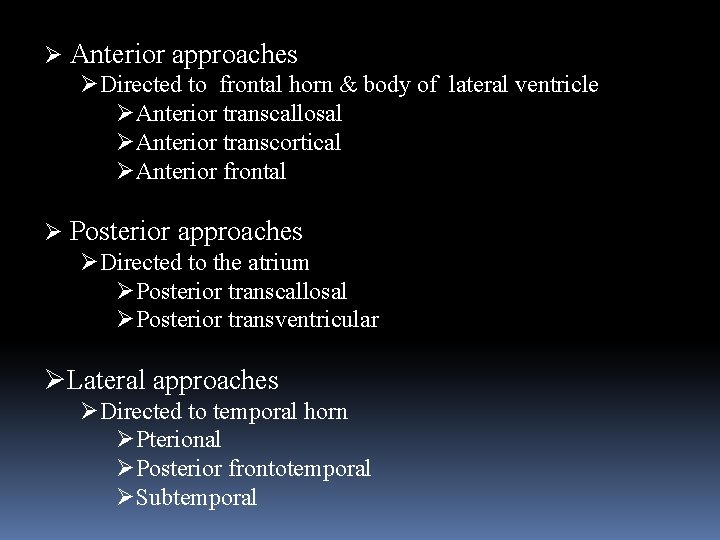
Ø Anterior approaches ØDirected to frontal horn & body of lateral ventricle ØAnterior transcallosal ØAnterior transcortical ØAnterior frontal Ø Posterior approaches ØDirected to the atrium ØPosterior transcallosal ØPosterior transventricular ØLateral approaches ØDirected to temporal horn ØPterional ØPosterior frontotemporal ØSubtemporal
Transcallosal approach Indications: Frontal horn tumors located mainly in the ventricle. Minimal hydrocephalus Tumor extending to both frontal horns and to third ventricle
Positioning and craniotomy Supine position Lateral position Ipsilateral approach Contralateral approach Craniotomy Cross midline 2/3 rd anterior and 1/3 rd posterior to coronal suture
Surgical technique Reflect dura based on sinus Identify bridging veins and preserve Identify corpus callosum and ACAs Callosotomy
Intraventricular orientation Choroid plexus and thalamostriate veins Foramen of monro Tumor identification Resection of tumor as internal debulking followed by dissection.
Complications Vascular injury Arachanoid granulations Bridging veins ACAs Corpus callosal syndrome Reduced spontaneity of speech to frank mutism. Interhemispheric transfer syndromes
Advantages Less chances of Neural injury Access to both ventricles Less chances of epilepsy (? ) Entry to third ventricle easy if required
Disadvantages More chances of Vascular injury Theoretical risks of callosotomy Superiorly located tumors are generally can not be tackled.
Transcortical approach Indication: Tumor growing outside the ventricle Tumor located mainly in antero-superiorly in frontal horn Non-dominant hemisphere Surgeons preference
Positioning and craniotomy Principles followed are same Cortisectomy in middle frontal gyrus Entry in ventricle Tumor debulking and dissection
Complications Epilepsy Direct cortical incision and damage Memory loss Retraction of caudate nucleus. Hemiplegia Retraction of centralis semiovalis
Disadvantages More chances of epilepsy and porencephalic cysts Limited entry to opposite ventricles Small ventricles- chances of missing
Tumors involving the body Transcallosal approach is better Combined transcallosal and transcortical approach is needed for large tumors involving both ventricles
Atrial tumors Transcortical approach is favored. Lateral decubitus position with face turned towards the floor Superior parietal lobule is identified 1 -2 cm cortisectomy
Why transcortical approach preferred? Ventricles diverge posteriorly Splenium sacrifice has physiological risks PCA injury is more common
Complications Speech problems Acalculia, apraxia Visual field deficits Homonymous hemianopia Visual spatial processing Splenium syndrome Interhemisphere disconnection syndrome
Occipital approach Suitable for tumours situated in part of the pulvinar, medial occipital lobe, and medial atrial wall facing the quadrigeminal cistern Three-quarter prone position with occipital area to be operated lowermost and face turned toward the floor An atrial tumor that extends into the medial occipital cortex, near the junction of the vein of Galen and straight sinus, can be exposed by opening through the isthmus of the cingulate gyrus in front of the calcarine sulcus.
Lateral approaches Frontotemporal / Post frontotemporal Supine with head turned laterally Small temporal craniotomy Dura opened based on base
ØCortical incision If the lesion is strictly localized to the region of the tip of the temporal lobe ØTemporal lobectomy If the lesion not only involved the temporal pole but also extended into the temporal horn ØFor the transcortical approach, lower part of middle temporal gyrus or upper part of inferior temporal gyrus is opened in the long axis of the gyrus & the incision is directed backward through the temporal lobe to the anterior part of the temporal horn
Transtemporal / Subtemporal approaches Used for a lesion in the middle or posterior third of the temporal horn. Supine with head turned almost laterally. Small temporal craniotomy. Dura opened based on base.
Cortical incision in the middle or inferior temporal gyrus anterior to the optic radiations. An alternative route Subtemporal route, in which an incision is made in the inferior temporal or occipitotemporal gyrus or the collateral sulcus on the lower surface of the temporal lobe Minimizes the possibility of damage to the optic radiations and speech centers of the dominant hemisphere
Complications Visual field deficits �Superior quadrantonopia Language deficits Others �Dyslexia �Agraphia �Acalculia
THANKS