
Anatomy Physiology Lecture 22 The Lymphatic System and
- Slides: 54
Anatomy & Physiology Lecture 22: The Lymphatic System and Immunity Lecturer: Dr. Barjis Room P 307 Phone: (718) 260 -5285 E-Mail: ibarjis@citytech. cuny. edu Copyright © 2004 Pearson Education, Inc. , publishing as Benjamin Cummings Frederic H. Martini Fundamentals of
Learning Objectives • Describe the structure and function of lymphatic cells, tissues and organs • List the body’s nonspecific defenses and describe the components and mechanisms of each • Define specific resistance and distinguish between cell-mediated immunity and antibody mediated immunity
Learning Objectives • Discuss the role of the T cell, B cell and antibodies in specific immunity • Describe the origin, development, activation and regulation of normal resistance to disease • Discuss the effects of stress and aging on the immune system
lymphatic system • The lymphatic system • Contains cells, tissues, and organs responsible for defending the body • Lymphocytes resist infection and disease by responding to • Invading pathogens such as bacteria or viruses • Abnormal body cells such as cancer cells • Foreign proteins such as toxins
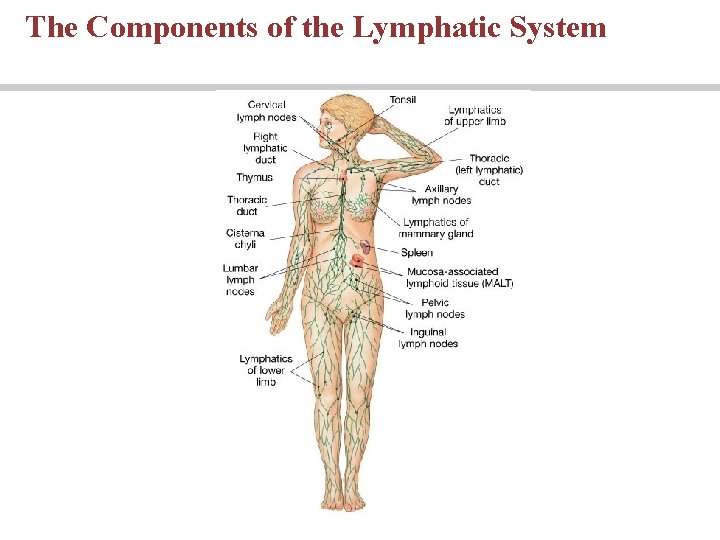
The Components of the Lymphatic System
The lymphatic system consists of • Lymphatic vessels • Lymphoid tissues and organs • Lymphocytes and supporting phagocytic cells
Functions of lymphatic system • Primary function is production, maintenance, and distribution of lymphocytes • Lymphocytes must: • Detect where problems exist • Be able to reach the site of injury or infection • Return of fluid and solutes from peripheral tissue to blood • Distribution of hormones, nutrients, and waste product from their tissue of origin to general circulation.
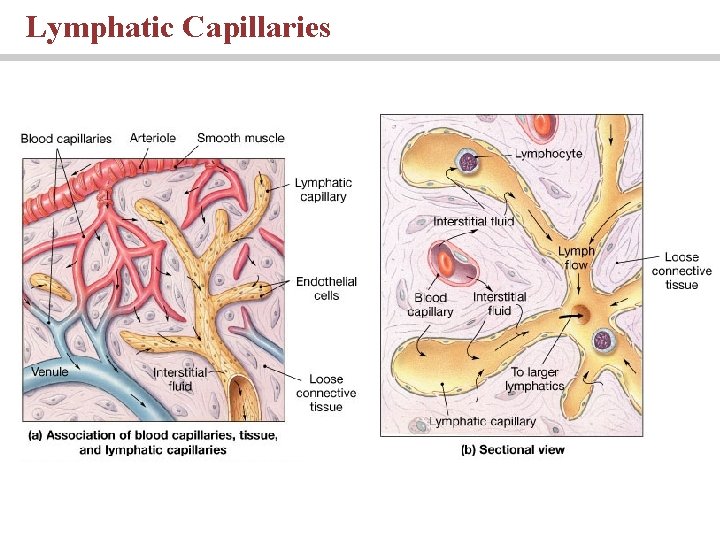
Lymphatic vessels include • Lymphatic capillaries • Small lymphatic vessels • Major lymph-collecting vessels
Lymphatic Capillaries
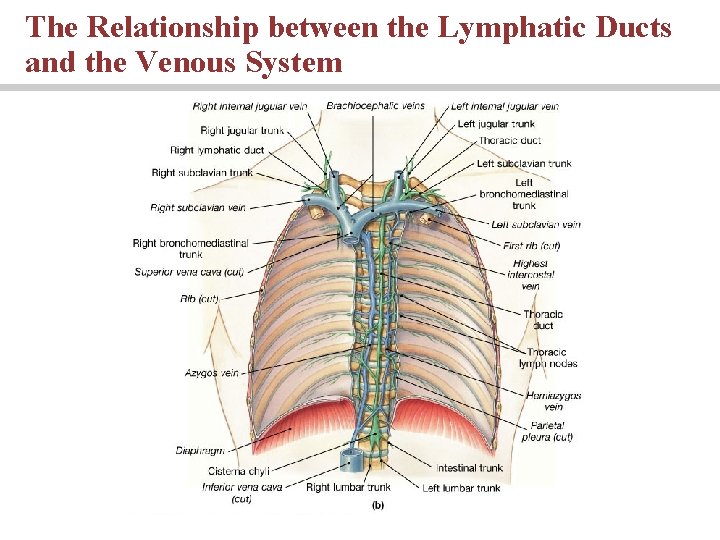
Major lymph-collecting vessels • Superficial and deep lymphatics • Thoracic duct • Cisterna chyli • Right lymphatic duct
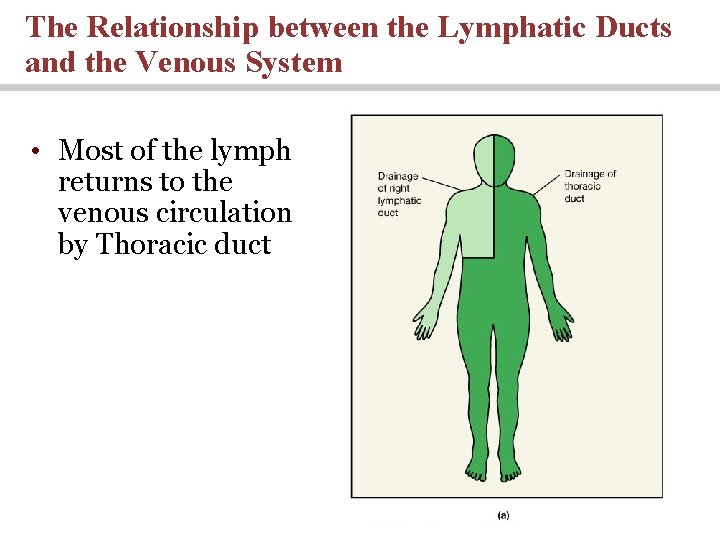
The Relationship between the Lymphatic Ducts and the Venous System • Most of the lymph returns to the venous circulation by Thoracic duct
The Relationship between the Lymphatic Ducts and the Venous System
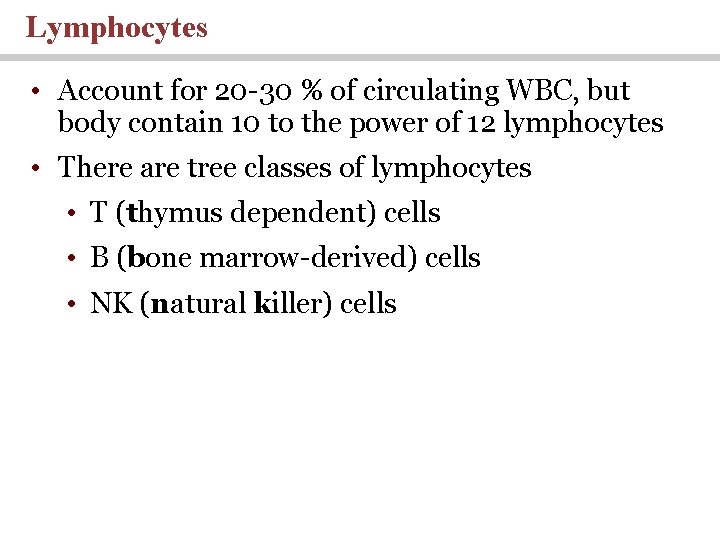
Lymphocytes • Account for 20 -30 % of circulating WBC, but body contain 10 to the power of 12 lymphocytes • There are tree classes of lymphocytes • T (thymus dependent) cells • B (bone marrow-derived) cells • NK (natural killer) cells
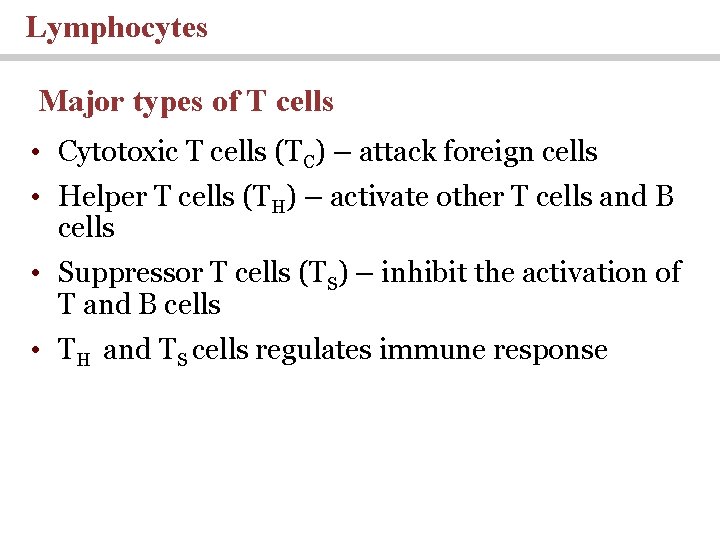
Lymphocytes Major types of T cells • Cytotoxic T cells (TC) – attack foreign cells • Helper T cells (TH) – activate other T cells and B cells • Suppressor T cells (TS) – inhibit the activation of T and B cells • TH and TS cells regulates immune response
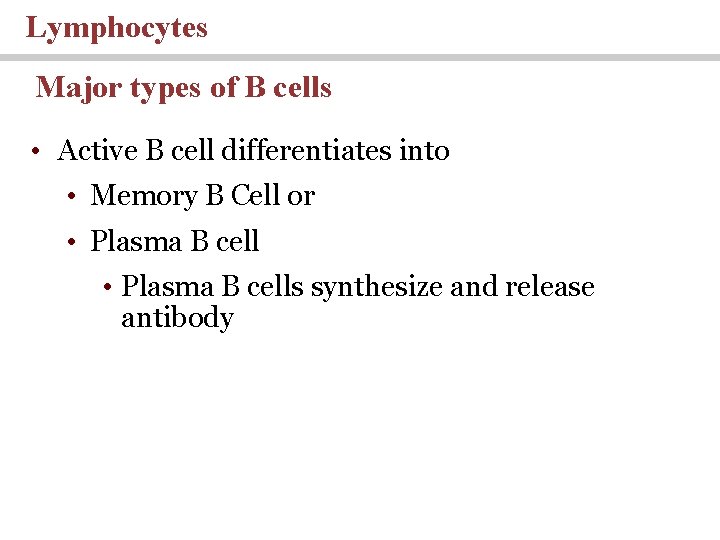
Lymphocytes Major types of B cells • Active B cell differentiates into • Memory B Cell or • Plasma B cells synthesize and release antibody
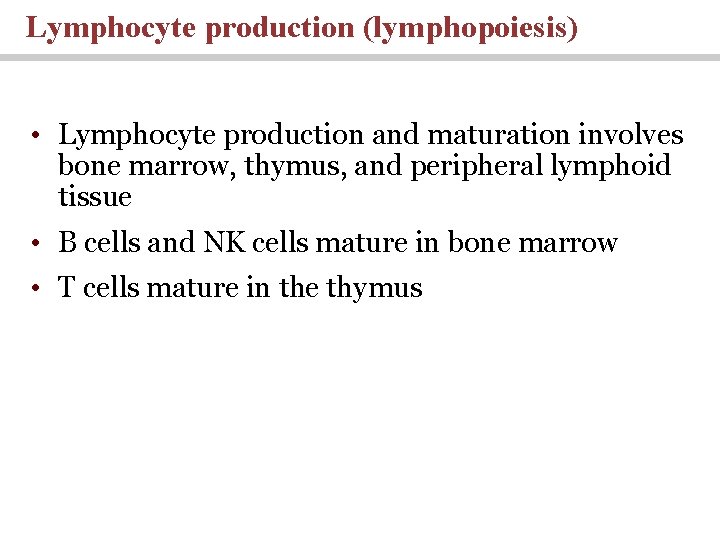
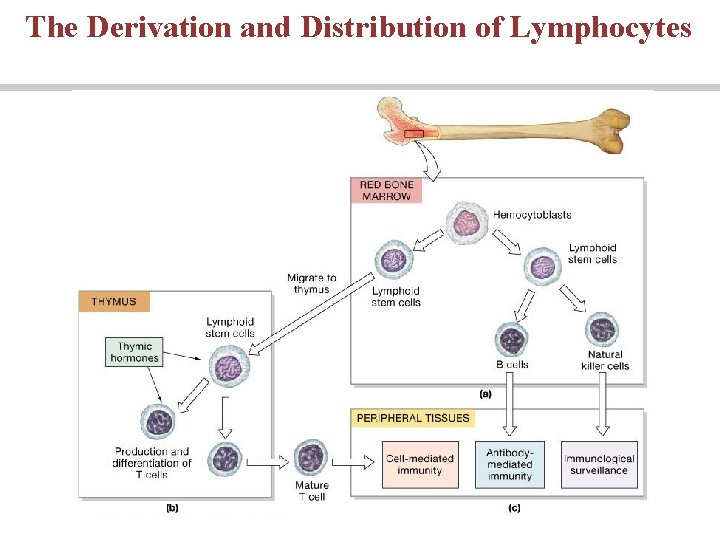
Lymphocyte production (lymphopoiesis) • Lymphocyte production and maturation involves bone marrow, thymus, and peripheral lymphoid tissue • B cells and NK cells mature in bone marrow • T cells mature in the thymus
The Derivation and Distribution of Lymphocytes
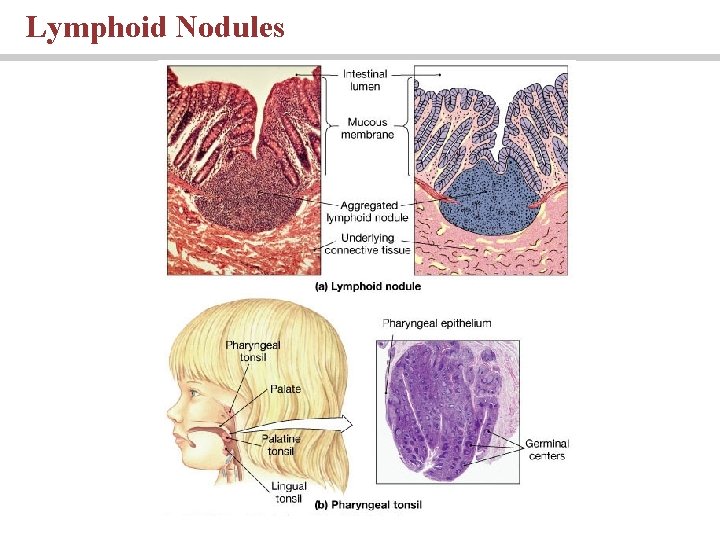
Lymphoid tissue • Connective tissue dominated by lymphocytes • Lymphoid nodules • Lymphocytes are packed densely • Found in the respiratory, digestive, and urinary tracts • MALT (mucosa-associated lymphoid tissue) • Collection of lymphoid tissues linked with the digestive system
Lymphoid Nodules
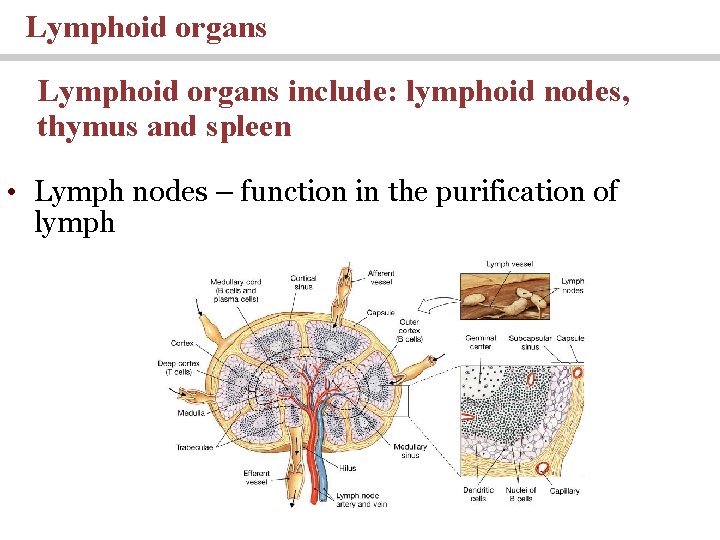
Lymphoid organs include: lymphoid nodes, thymus and spleen • Lymph nodes – function in the purification of lymph
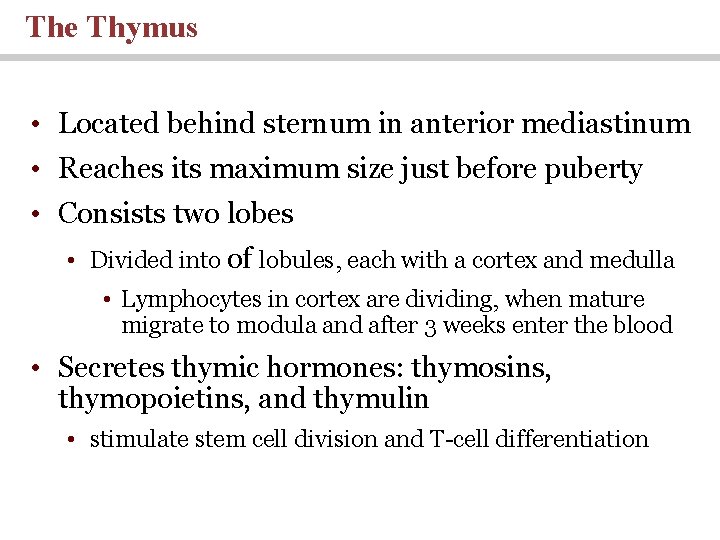
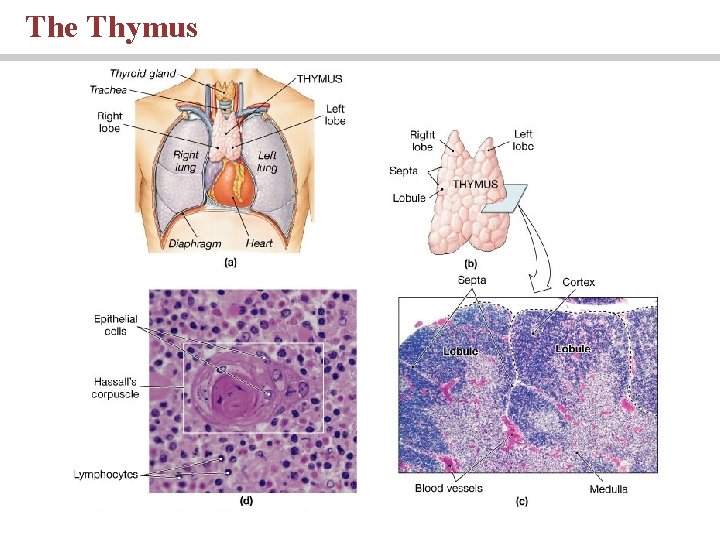
The Thymus • Located behind sternum in anterior mediastinum • Reaches its maximum size just before puberty • Consists two lobes • Divided into of lobules, each with a cortex and medulla • Lymphocytes in cortex are dividing, when mature migrate to modula and after 3 weeks enter the blood • Secretes thymic hormones: thymosins, thymopoietins, and thymulin • stimulate stem cell division and T-cell differentiation
The Thymus
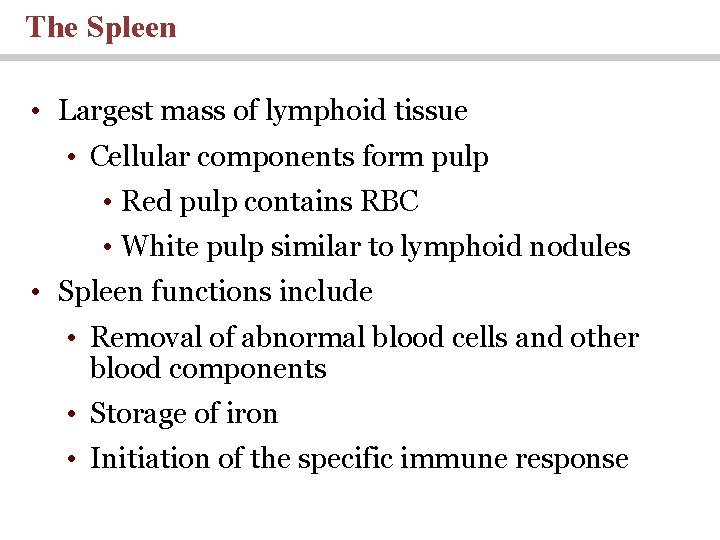
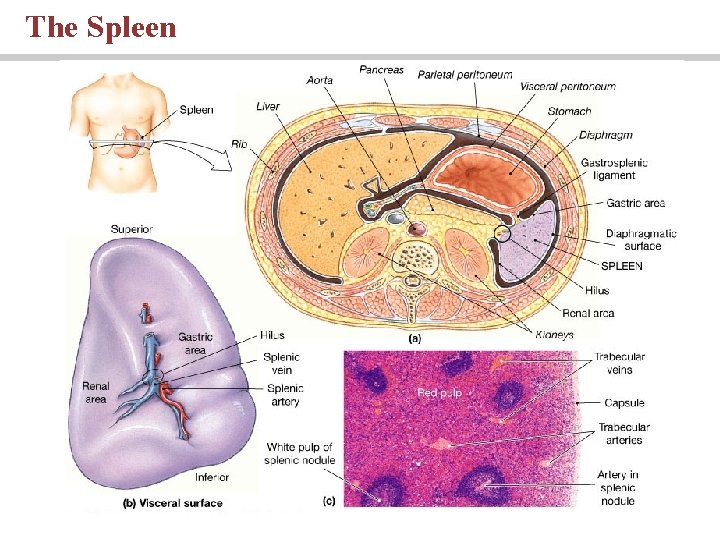
The Spleen • Largest mass of lymphoid tissue • Cellular components form pulp • Red pulp contains RBC • White pulp similar to lymphoid nodules • Spleen functions include • Removal of abnormal blood cells and other blood components • Storage of iron • Initiation of the specific immune response
The Spleen
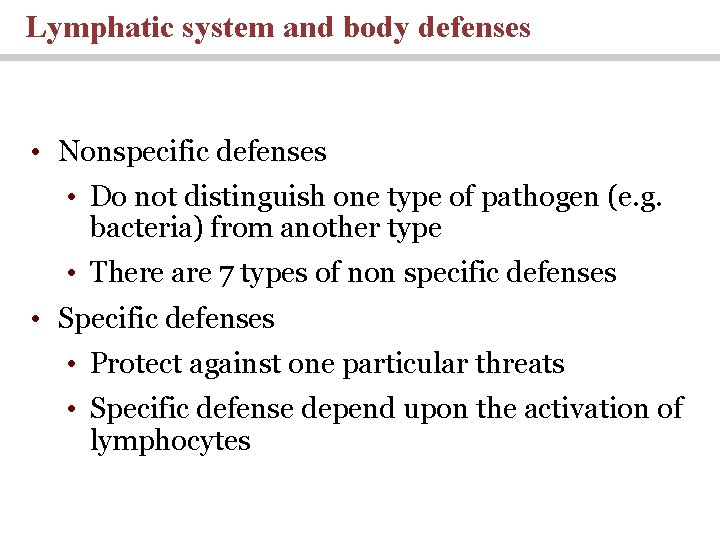
Lymphatic system and body defenses • Nonspecific defenses • Do not distinguish one type of pathogen (e. g. bacteria) from another type • There are 7 types of non specific defenses • Specific defenses • Protect against one particular threats • Specific defense depend upon the activation of lymphocytes
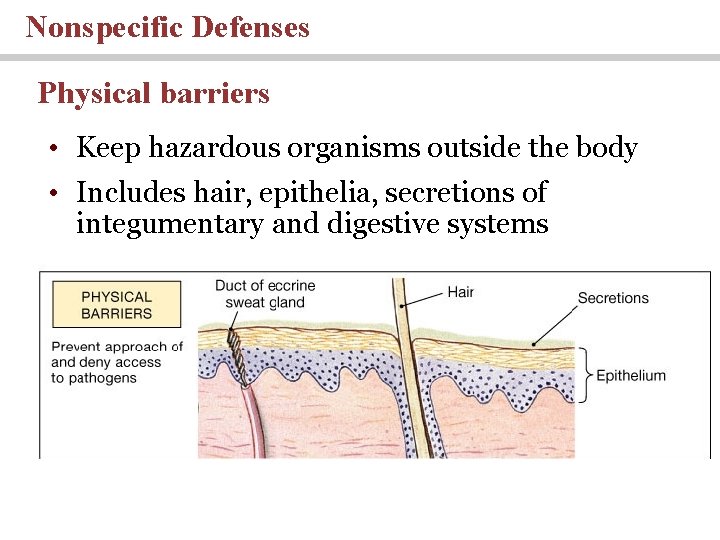
Nonspecific Defenses Physical barriers • Keep hazardous organisms outside the body • Includes hair, epithelia, secretions of integumentary and digestive systems
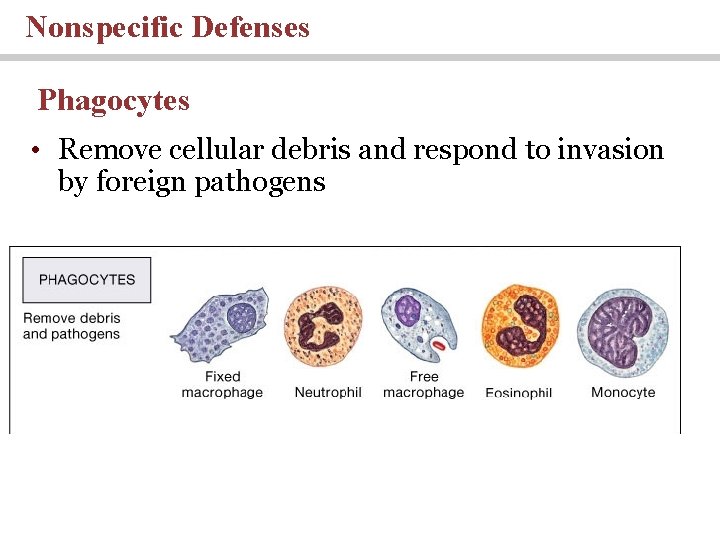
Nonspecific Defenses Phagocytes • Remove cellular debris and respond to invasion by foreign pathogens
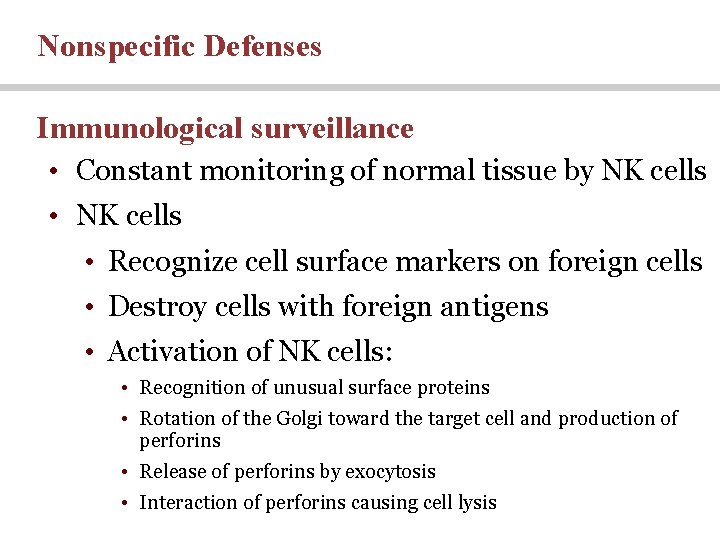
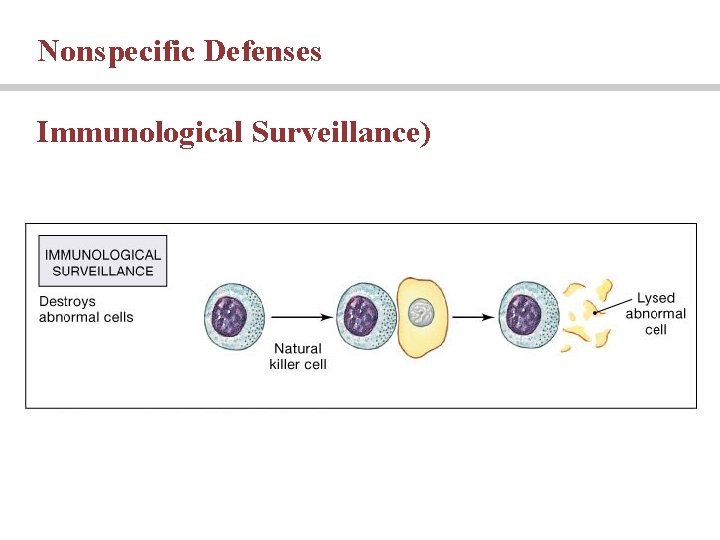
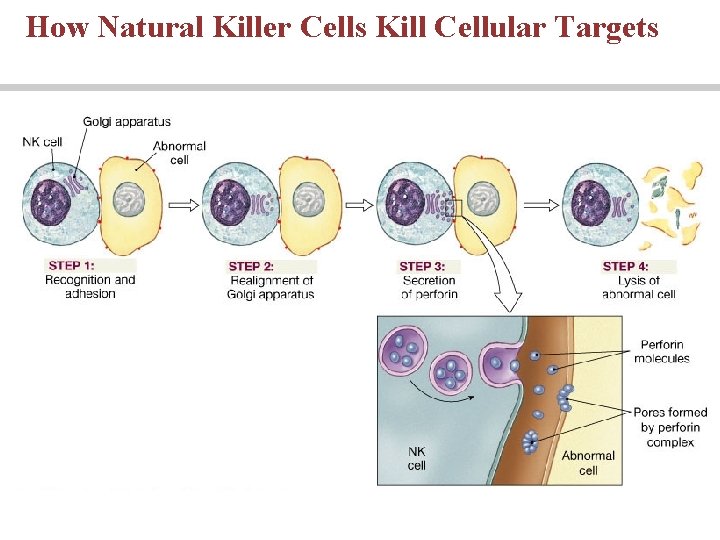
Nonspecific Defenses Immunological surveillance • Constant monitoring of normal tissue by NK cells • Recognize cell surface markers on foreign cells • Destroy cells with foreign antigens • Activation of NK cells: • Recognition of unusual surface proteins • Rotation of the Golgi toward the target cell and production of perforins • Release of perforins by exocytosis • Interaction of perforins causing cell lysis
Nonspecific Defenses Immunological Surveillance)
How Natural Killer Cells Kill Cellular Targets
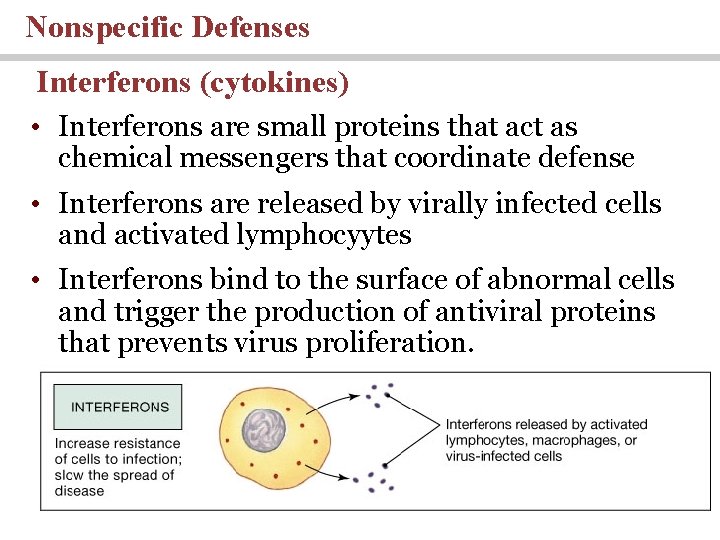
Nonspecific Defenses Interferons (cytokines) • Interferons are small proteins that act as chemical messengers that coordinate defense • Interferons are released by virally infected cells and activated lymphocyytes • Interferons bind to the surface of abnormal cells and trigger the production of antiviral proteins that prevents virus proliferation.
Nonspecific Defenses Complement system • There are 11 plasma complement proteins (C) • They are activated by: • Classical pathway • In Classical pathway compliment binds to Ab molecule, • Alternative pathway • In alternative pathway compliment binds to bacterial cell • Both pathways trigger: • Chain of reaction and result attraction of phagocytes, • Stimulation of phagocitic activity, • Promotion of inflammation and • Result puncture of bacterial cell
Nonspecific Defenses Inflammation • Localized tissue response to injury producing • Swelling • Redness • Heat • Pain • Effects of inflammation include • Temporary repair of injury • Slowing the spread of pathogens
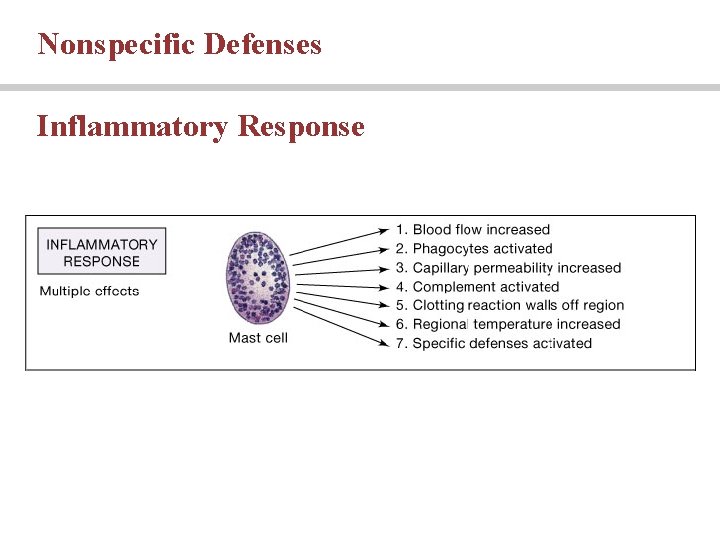
Nonspecific Defenses Inflammatory Response
Nonspecific Defenses Fever • Maintenance of a body temperature above 37. 2 o. C (99 o. F) • High temperature may inhibit some viruses and bacterial activities. • It increases metabolism (1°C increase in temperature would increase metabolism by 10%) • Pyrogens reset the hypothalamic thermostat and raise body temperature • Pyrogen secretion is stimulated by Ag, macrophages
Specific Defenses • Act on specific Ag only • T-Cells are responsible for cell mediated immunity (cellular immunity) – defense against abnormal cells and pathogens inside cells • B-cells provide Ab-mediated immunity (also called humoral immunity) – defense against Ags and pathogens in body fluid
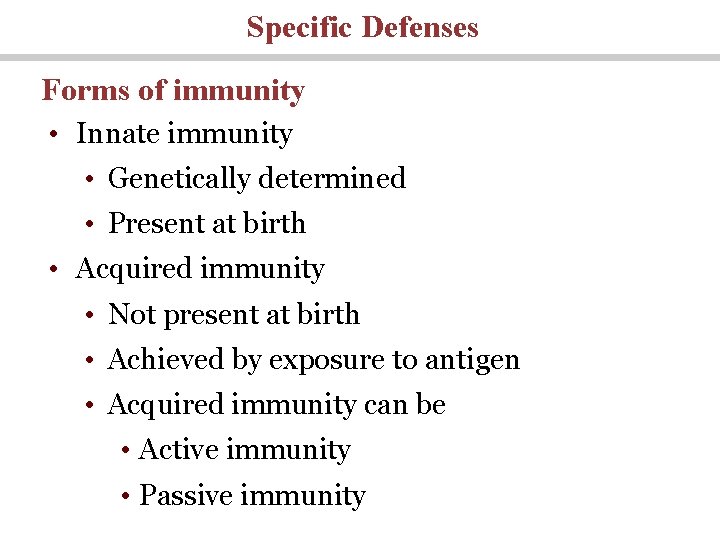
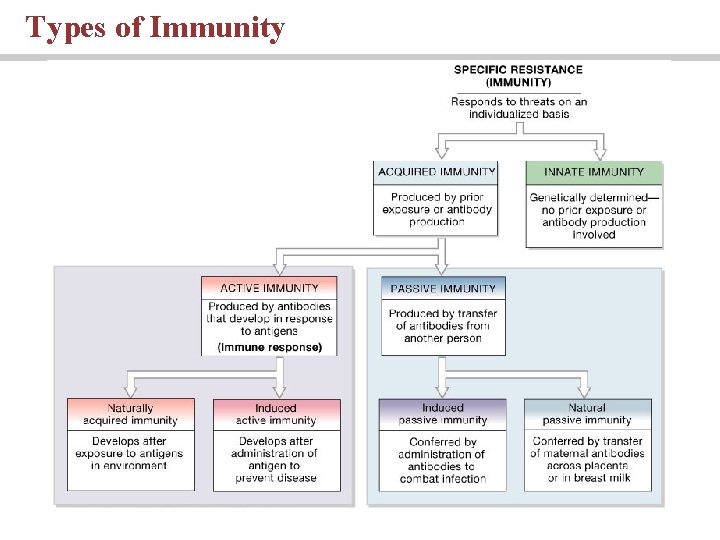
Specific Defenses Forms of immunity • Innate immunity • Genetically determined • Present at birth • Acquired immunity • Not present at birth • Achieved by exposure to antigen • Acquired immunity can be • Active immunity • Passive immunity
Types of Immunity
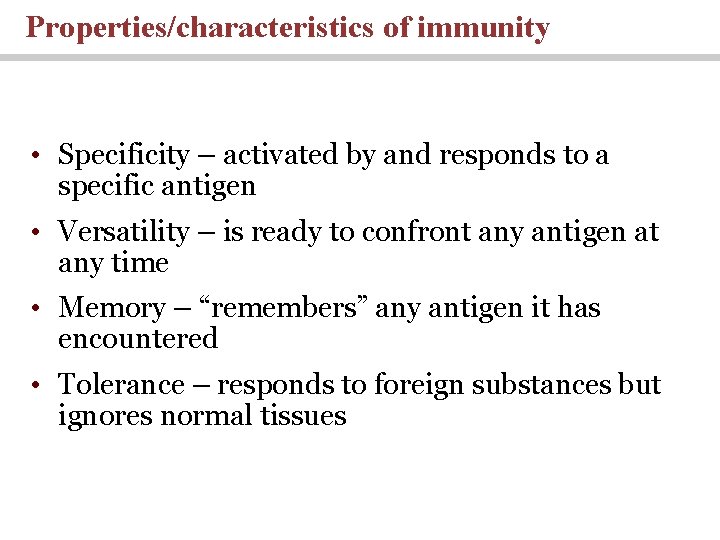
Properties/characteristics of immunity • Specificity – activated by and responds to a specific antigen • Versatility – is ready to confront any antigen at any time • Memory – “remembers” any antigen it has encountered • Tolerance – responds to foreign substances but ignores normal tissues
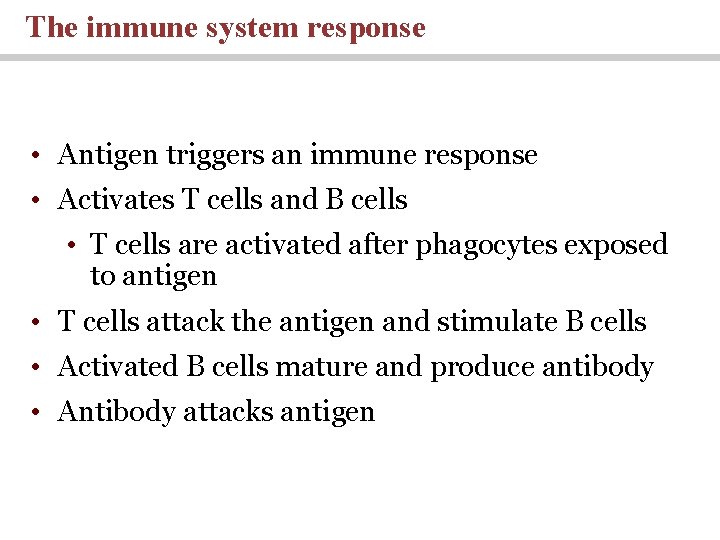
The immune system response • Antigen triggers an immune response • Activates T cells and B cells • T cells are activated after phagocytes exposed to antigen • T cells attack the antigen and stimulate B cells • Activated B cells mature and produce antibody • Antibody attacks antigen
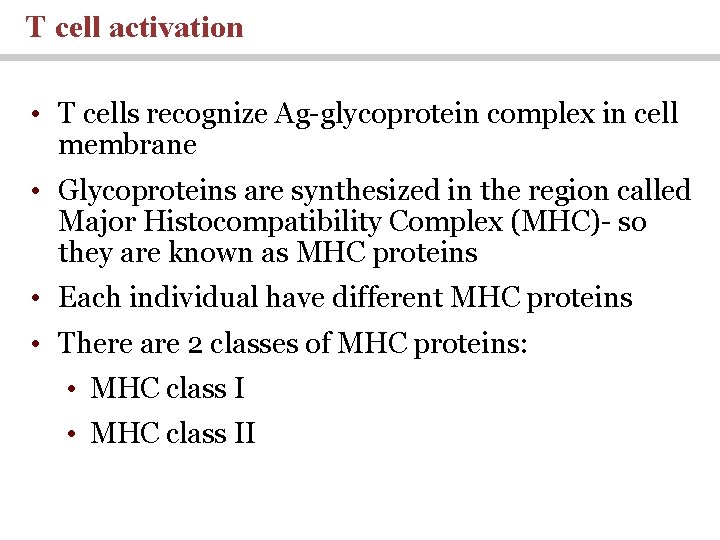
T cell activation • T cells recognize Ag-glycoprotein complex in cell membrane • Glycoproteins are synthesized in the region called Major Histocompatibility Complex (MHC)- so they are known as MHC proteins • Each individual have different MHC proteins • There are 2 classes of MHC proteins: • MHC class II
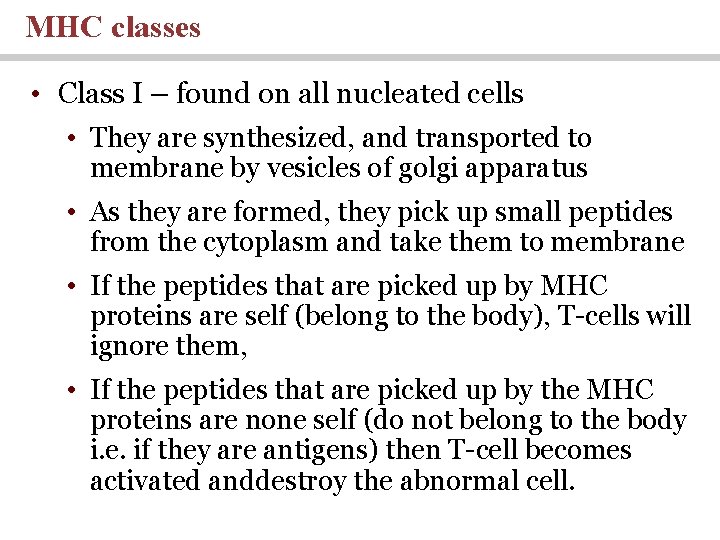
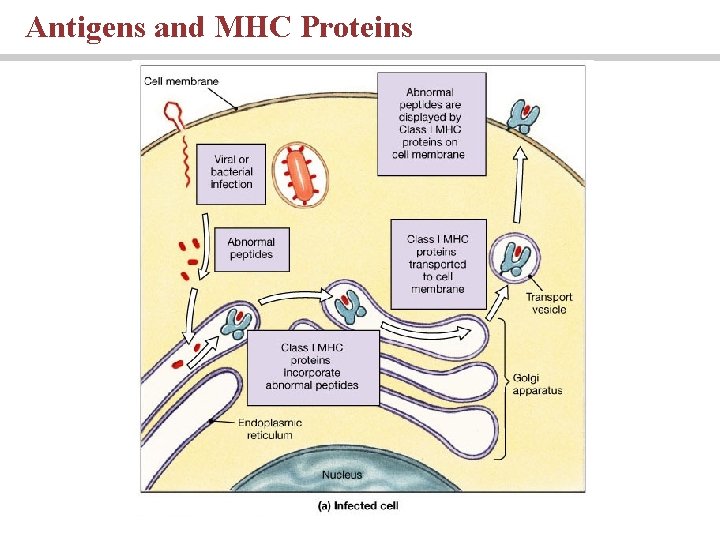
MHC classes • Class I – found on all nucleated cells • They are synthesized, and transported to membrane by vesicles of golgi apparatus • As they are formed, they pick up small peptides from the cytoplasm and take them to membrane • If the peptides that are picked up by MHC proteins are self (belong to the body), T-cells will ignore them, • If the peptides that are picked up by the MHC proteins are none self (do not belong to the body i. e. if they are antigens) then T-cell becomes activated anddestroy the abnormal cell.
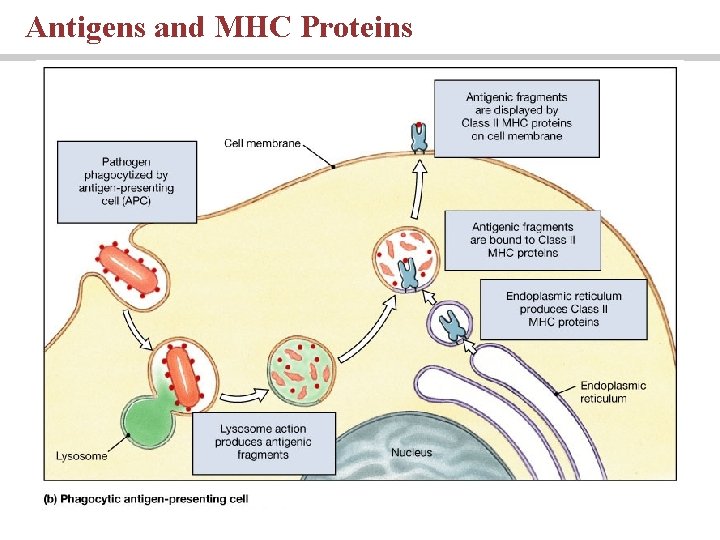
Antigens and MHC Proteins
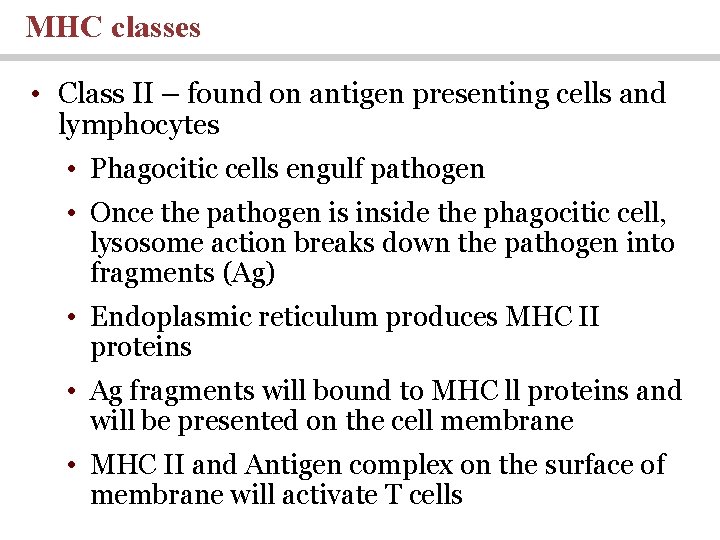
MHC classes • Class II – found on antigen presenting cells and lymphocytes • Phagocitic cells engulf pathogen • Once the pathogen is inside the phagocitic cell, lysosome action breaks down the pathogen into fragments (Ag) • Endoplasmic reticulum produces MHC II proteins • Ag fragments will bound to MHC ll proteins and will be presented on the cell membrane • MHC II and Antigen complex on the surface of membrane will activate T cells
Antigens and MHC Proteins
B cells and Antibody Mediated Response • B cells produce specific Ab • There are millions of B-cells - each with specific Ab on its membrane • When B- cells are activated they can produce up to 100 million Ab per hour
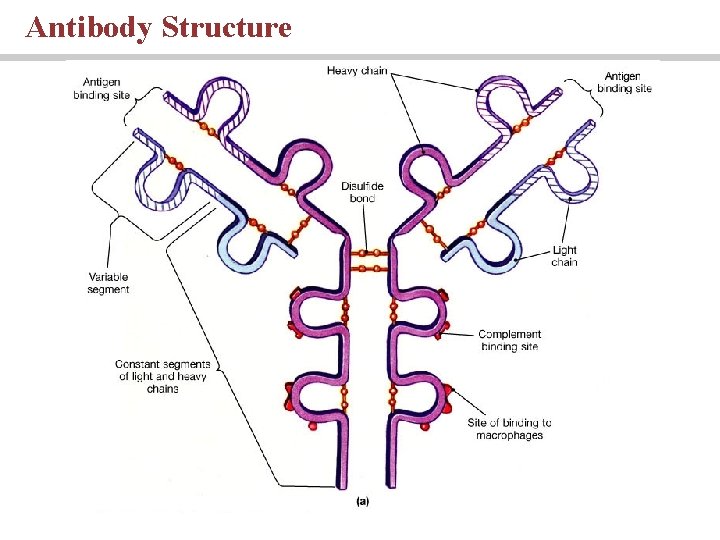
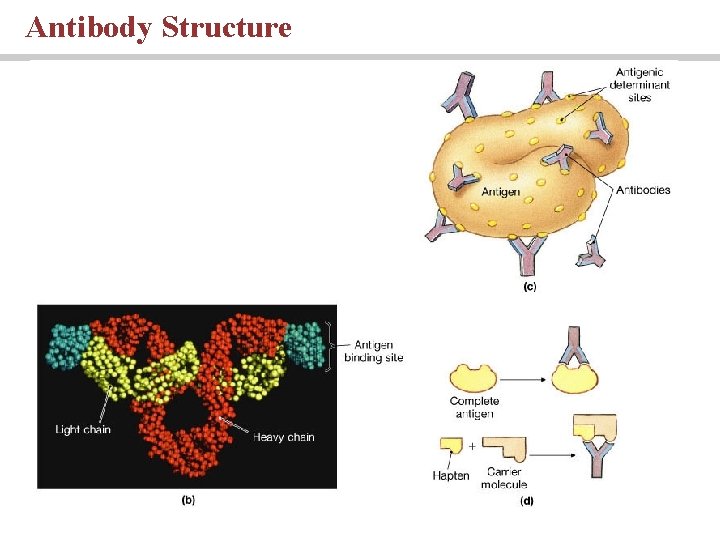
Antibodies structure • Antibodies are Y-shaped proteins consisting of: • Two parallel polypeptide chains • Heavy chains and light chains • Constant region and variable region • Antigen binding site
Antibody Structure
Antibody Structure
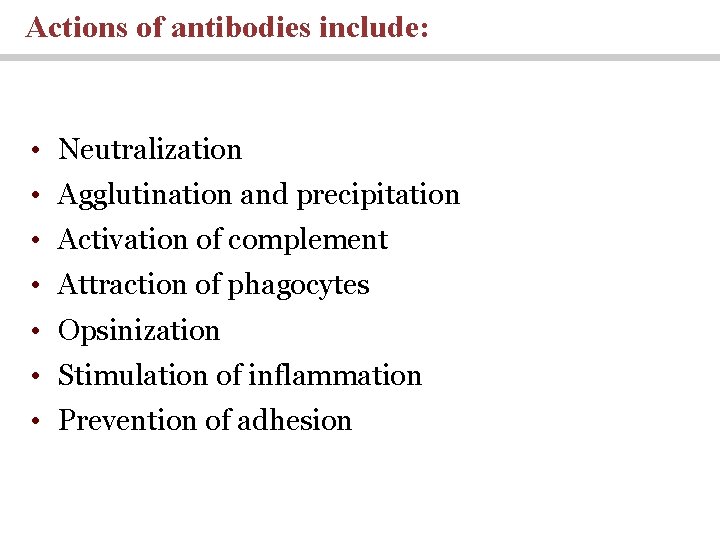
Actions of antibodies include: • Neutralization • Agglutination and precipitation • Activation of complement • Attraction of phagocytes • Opsinization • Stimulation of inflammation • Prevention of adhesion
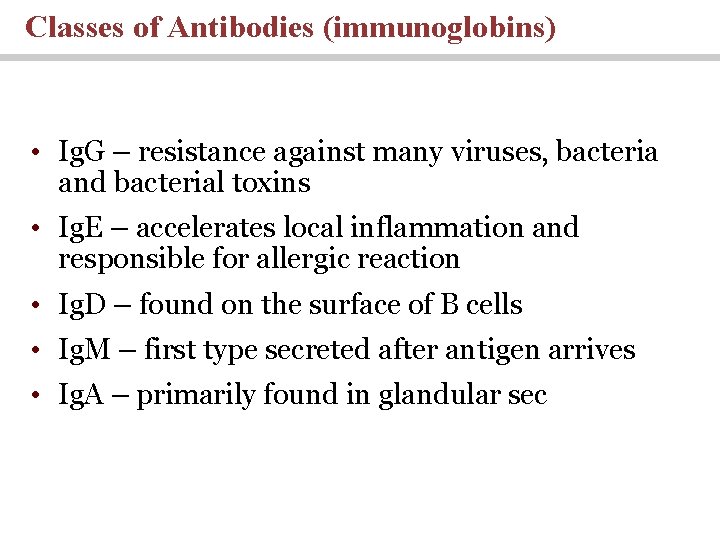
Classes of Antibodies (immunoglobins) • Ig. G – resistance against many viruses, bacteria and bacterial toxins • Ig. E – accelerates local inflammation and responsible for allergic reaction • Ig. D – found on the surface of B cells • Ig. M – first type secreted after antigen arrives • Ig. A – primarily found in glandular sec
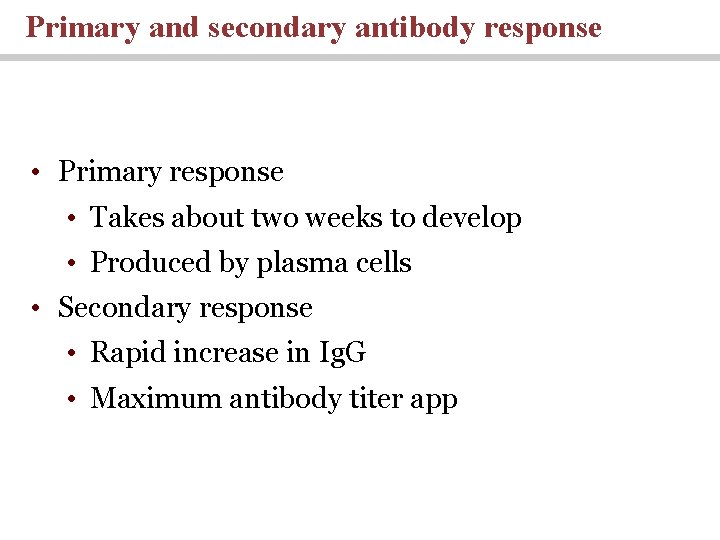
Primary and secondary antibody response • Primary response • Takes about two weeks to develop • Produced by plasma cells • Secondary response • Rapid increase in Ig. G • Maximum antibody titer app
Aging and the Immune Response With age • Immune system becomes less effective • Increased susceptibility to infection • Immune surveillance declines
You should now be familiar with: • The structure and function of lymphatic cells, tissues and organs • The body’s nonspecific defenses and the components and mechanisms of each • Specific resistance, cell-mediated immunity and antibody mediated immunity • The role of the T cell, B cell and antibodies in specific immunity • The origin, development, activation and regulation of normal resistance to disease • The effects of stress and aging on the immune system