
Anatomy Physiology and Ecology of Fishes I Biology
Anatomy, Physiology, and Ecology of Fishes I Biology of Fishes 10. 18. 12
Overview n Exam I – Return & Review next week n Presentations & Other Assignments n Introduction to Anatomy, Physiology, and Ecology of Fishes
Anatomy, Physiology, and Ecology n Buoyancy and Locomotion n Swimming n Feeding Mechanisms
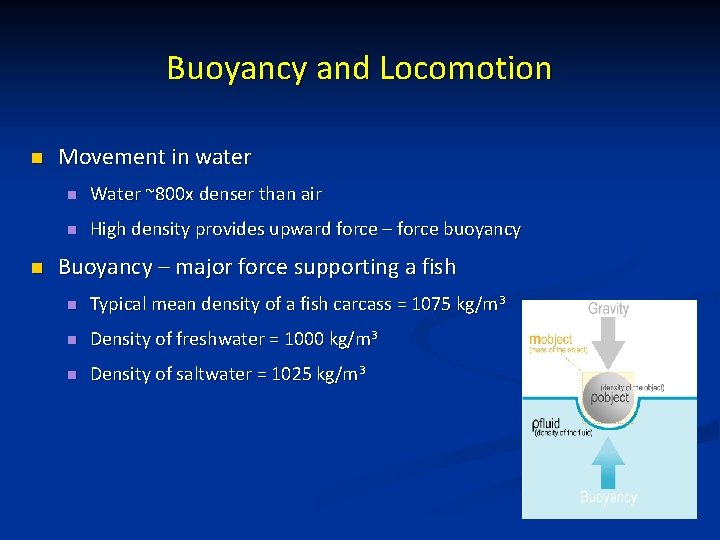
Buoyancy and Locomotion n n Movement in water n Water ~800 x denser than air n High density provides upward force – force buoyancy Buoyancy – major force supporting a fish n Typical mean density of a fish carcass = 1075 kg/m 3 n Density of freshwater = 1000 kg/m 3 n Density of saltwater = 1025 kg/m 3

Buoyancy and Locomotion n Weight of fish slightly greater than buoyancy force – fish must produce an upward force or life force that overcomes the downward pull of gravity not compensated for by buoyancy of water n Mechanisms for generating lift n Hydrodynamic lift n Hydrostatic lift
Buoyancy and Locomotion n n Hydrodynamic lift n Achieved using pectoral fins like airplane wings – generate lift as fish swims; thrust applied via caudal fin n Most common method for supporting weight of fish in water n Also used by fishes that regulate buoyancy in other ways n Costs increase as speed decreases – primarily due to increases in drag Examples n Sharks, tunas, mackerels (fast-swimming teleosts)

Hydrodynamic Lift
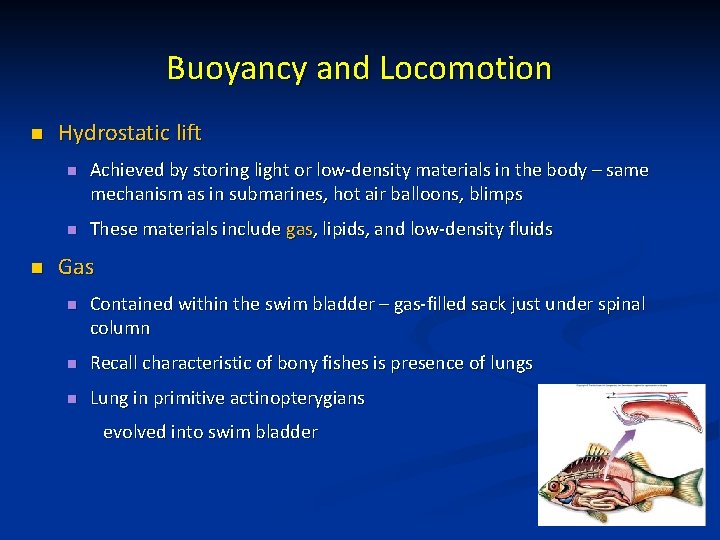
Buoyancy and Locomotion n n Hydrostatic lift n Achieved by storing light or low-density materials in the body – same mechanism as in submarines, hot air balloons, blimps n These materials include gas, lipids, and low-density fluids Gas n Contained within the swim bladder – gas-filled sack just under spinal column n Recall characteristic of bony fishes is presence of lungs n Lung in primitive actinopterygians evolved into swim bladder
Hydrostatic Lift n n Gas – contained in the swim bladder n Physostomous – bladder-gut connection – can gulp or burp air (primitive condition) n Physoclistous – bladder is sealed – must secrete into or diffuse gas out (Paracanthopterygii and Acanthopterygii) Gas provides greatest amount of hydrostatic life per unit volume, but presents a few problems n Unstable in roll – fish can easily tip side to side n Gas changes volume with pressure; pressure increases with depth (1 atm pressure for every 10 m depth). Fish must continuously add or remove gas to remain neutrally buoyant if fish changes depths. n Doesn’t respond quickly to changes in position

Gas Bladder n Most fishes have gas/swim bladders, but some have lost them in favor of other strategies – benthic life, lipids, low-density fluids.
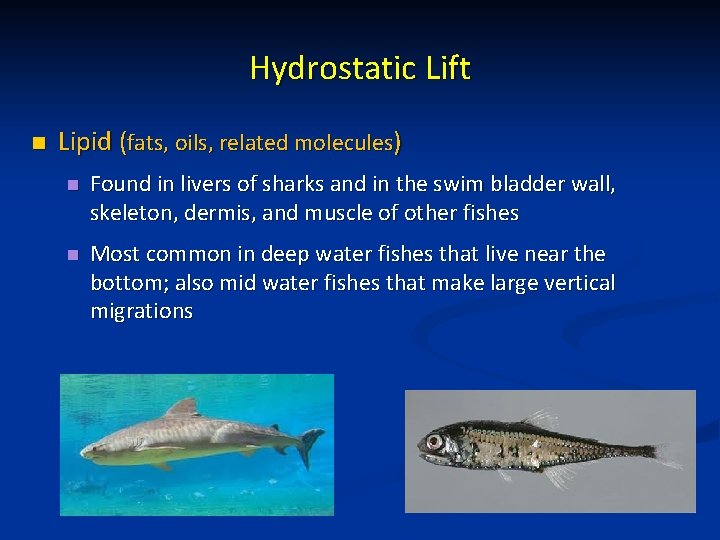
Hydrostatic Lift n Lipid (fats, oils, related molecules) n Found in livers of sharks and in the swim bladder wall, skeleton, dermis, and muscle of other fishes n Most common in deep water fishes that live near the bottom; also mid water fishes that make large vertical migrations
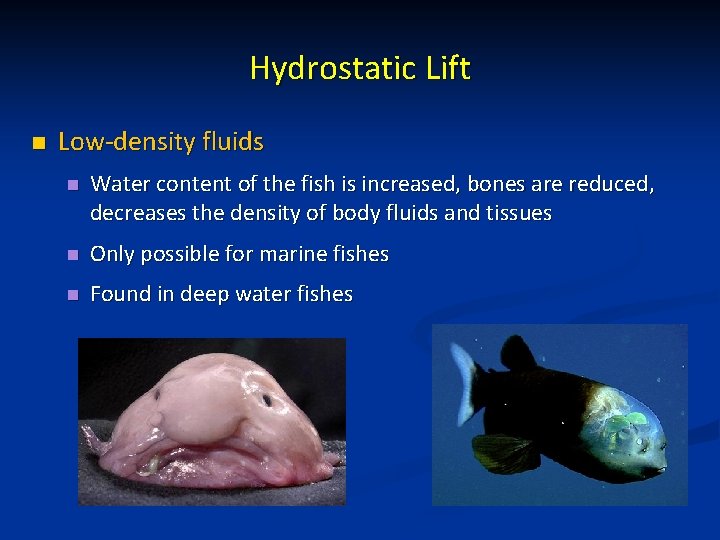
Hydrostatic Lift n Low-density fluids n Water content of the fish is increased, bones are reduced, decreases the density of body fluids and tissues n Only possible for marine fishes n Found in deep water fishes
Buoyancy and Locomotion n Trade-offs of various buoyancy mechanisms n n Swimming speed n Hydrodynamic lift is more economical at higher swimming speeds – cost of drag increases at low speeds, also harder to steer (maintain position) at slow speeds n Hydrostatic lift is more economical at slow swimming speeds n Gas is cheaper than lipids Depth n n Gas becomes expensive at large depths – high pressure makes it costly to fill, difficult to prevent diffusion into blood Exceptions to trends – adaptations to specific habitats n Sculpins, darters, etc.
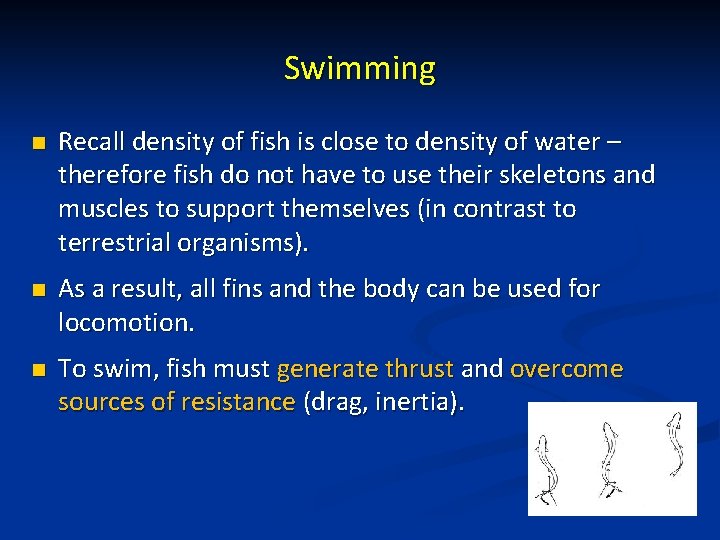
Swimming n Recall density of fish is close to density of water – therefore fish do not have to use their skeletons and muscles to support themselves (in contrast to terrestrial organisms). n As a result, all fins and the body can be used for locomotion. n To swim, fish must generate thrust and overcome sources of resistance (drag, inertia).

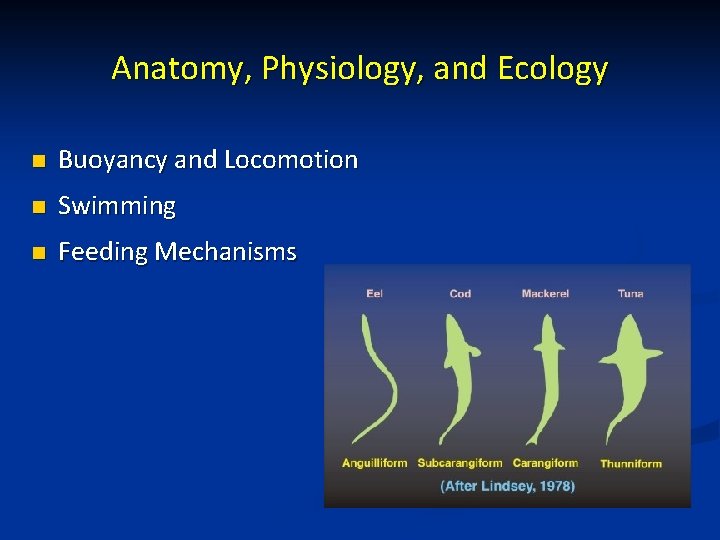
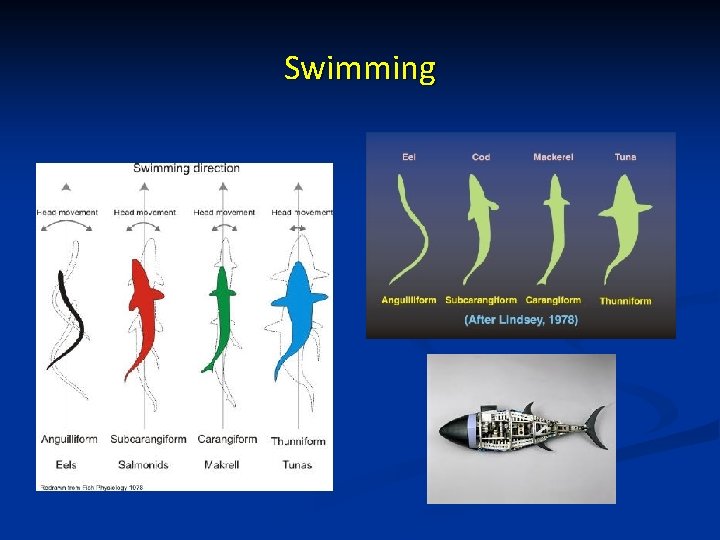
Swimming n Types of swimming (6 primary forms) n Anguilliform locomotion n Subcarangiform locomotion n Carangiform locomotion n Thunniform locomotion n Ostraciiform locomotion n Median or paired fins

Swimming n Anguilliform Locomotion – “eel like” n Successive waves of muscle contraction passed backward on alternate sides of body – throws body into series of S-shaped curves n Amplitude increases toward tail n Body wave pushes mass of water backward – inertia of water n Nearly all of body participates in undulatory, side-to-side motion n Inefficient mode of swimming – body is long, most of body (especially anterior) participates. Tail wags the head, therefore high drag
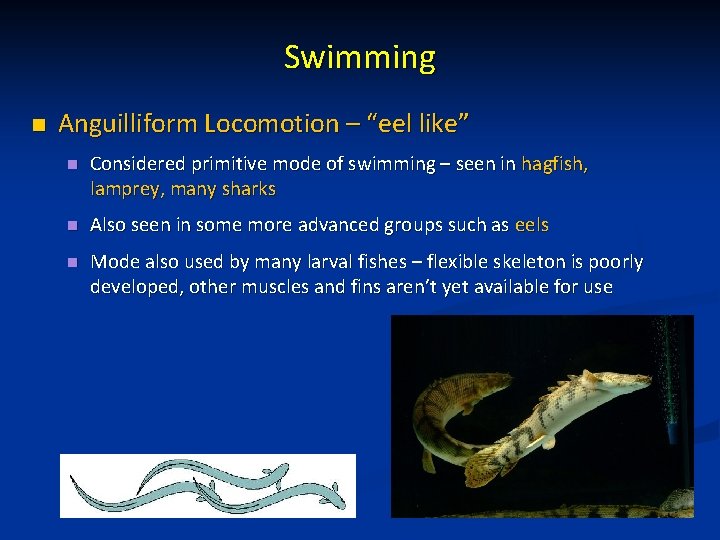
Swimming n Anguilliform Locomotion – “eel like” n Considered primitive mode of swimming – seen in hagfish, lamprey, many sharks n Also seen in some more advanced groups such as eels n Mode also used by many larval fishes – flexible skeleton is poorly developed, other muscles and fins aren’t yet available for use
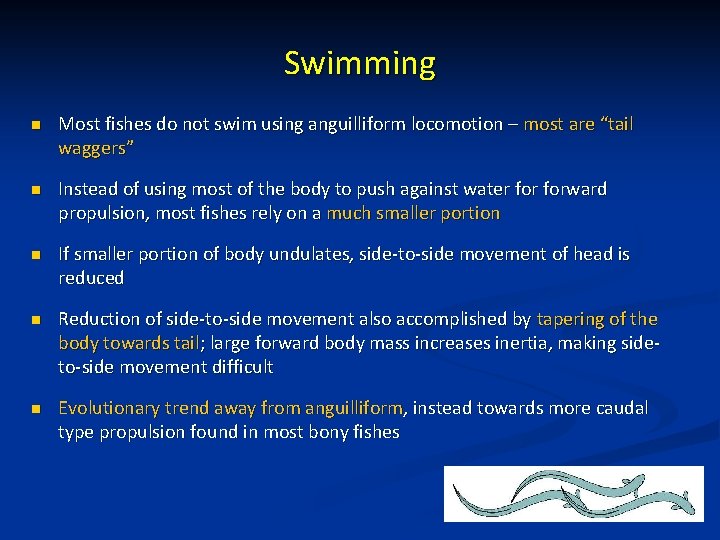
Swimming n Most fishes do not swim using anguilliform locomotion – most are “tail waggers” n Instead of using most of the body to push against water forward propulsion, most fishes rely on a much smaller portion n If smaller portion of body undulates, side-to-side movement of head is reduced n Reduction of side-to-side movement also accomplished by tapering of the body towards tail; large forward body mass increases inertia, making sideto-side movement difficult n Evolutionary trend away from anguilliform, instead towards more caudal type propulsion found in most bony fishes
Swimming
Swimming n Subcarangiform Locomotion n Two-thirds to one-half of the body is involved in producing the propulsive wave responsible forward motion n Side-to-side movement of head greatly reduced compared to anguilliform n Fish using this method typically have large flexible caudal fins n Most of swimming is accomplished by the waves passing down the body n Caudal fin probably evolved for use in fast turning, hovering, and fast starts n Examples: trout, salmon, minnows, cods
Swimming n Carangiform Locomotion n Side-to-side undulations are confined to the last third of the body n Fish using this method typically have stiff caudal fins that are deeply forked with elongated upper and lower lobes n Fin design is easier to move through the water (less drag) but still generates great force n Two major evolutionary developments to counteract side-to-side movement of the head: n n 1 – trend towards deeper body with more weight concentrated towards head n 2 – caudal peduncle is greatly reduced Examples: clupeids, mackerels, jacks
Swimming n Thunniform Locomotion n Carangiform locomotion developed to the extreme n Represents the end-point in evolutionary trend toward greater speed in underwater locomotion among fishes – burst swimming speeds over 40 mph and cruising speeds ~10 mph n Very little of the body is involved in producing forward movement n Thrust generated almost entirely by tall, stiff, and deeply forked caudal fin – easy to move, very powerful n Drag is greatly reduced by extremely narrow caudal peduncle
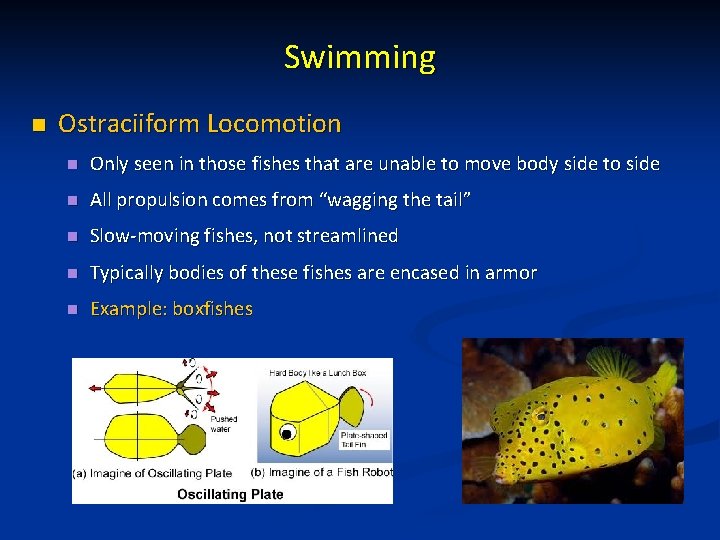
Swimming n Ostraciiform Locomotion n Only seen in those fishes that are unable to move body side to side n All propulsion comes from “wagging the tail” n Slow-moving fishes, not streamlined n Typically bodies of these fishes are encased in armor n Example: boxfishes
Swimming n Median or Paired fins Locomotion n Wide variety of fishes that typically swim without using their body or caudal fin n These fishes use either their median (anal and/or dorsal) or paired fins (pectoral) to move n Generally tend to be slow-moving fishes n Continuum of those that use undulation to those that use oscillation n Median fin undulation n Paired fin undulation n Intermediate n Oscillation
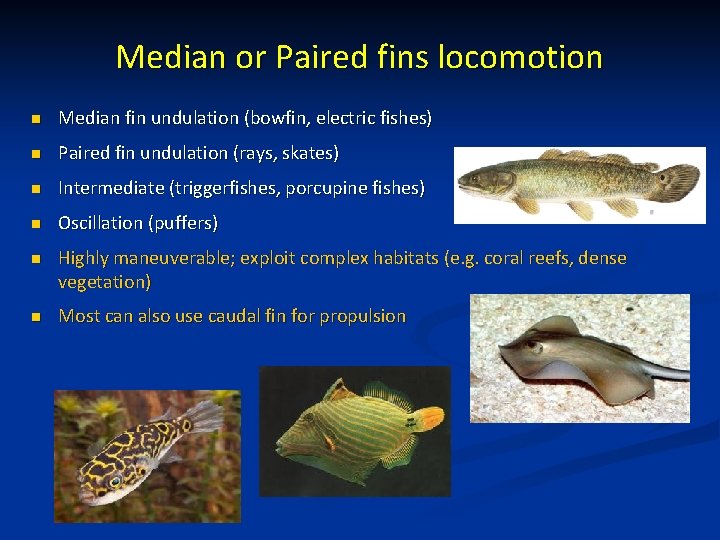
Median or Paired fins locomotion n Median fin undulation (bowfin, electric fishes) n Paired fin undulation (rays, skates) n Intermediate (triggerfishes, porcupine fishes) n Oscillation (puffers) n Highly maneuverable; exploit complex habitats (e. g. coral reefs, dense vegetation) n Most can also use caudal fin for propulsion
Swimming n Important considerations in fish locomotion n Many fishes have a specialized form of swimming n Specialization for 1 function usually involves a tradeoff in another function n Tunas are specialized for high-speed cruising – great distances at high speed, but not very maneuverable and poor swimmers at low speeds n Cichlids and reef fishes are specialized for high maneuverability, but lower speed – deep bodies, high dorsal/anal fins, large paired fins allow for precise movements in complex environments n Pikes are specialized for accelerating – large caudal fin with dorsal/anal fins set back on body
Swimming n Important considerations in fish locomotion n n We can identify some fishes that are specialized for one trait, however, most fishes use a variety of modes of swimming and are locomotor generalists as opposed to locomotor specialists n Most fishes must cruise to get from place to place, accelerate to eat and avoid being eaten. n Largemouth bass can raise dorsal/anal fins to gain thrust in a “fast start” attack, and can depress fins to reduce drag while chasing prey. Can also raise dorsal/anal fins to aid in maneuvering. Not all fishes fit neatly into these categories. These specializations are likely related to how fish feed…
- Slides: 27