
ANATOMY OF THE SHOULDER REGION Dr Ahmed Fathalla

- Slides: 23
ANATOMY OF THE SHOULDER REGION Dr. Ahmed Fathalla Ibrahim & Dr. Zeenat Zaidi
OBJECTIVES At the end of the lecture, students should: § List the name of muscles of the shoulder region. § Describe the anatomy of muscles of shoulder region regarding: attachments of each of them to scapula & humerus, nerve supply and actions on shoulder joint § List the muscles forming the rotator cuff and describe the relation of each of them to the shoulder joint § Describe the anatomy of shoulder joint regarding: type, articular surfaces, stability, relations & movements.
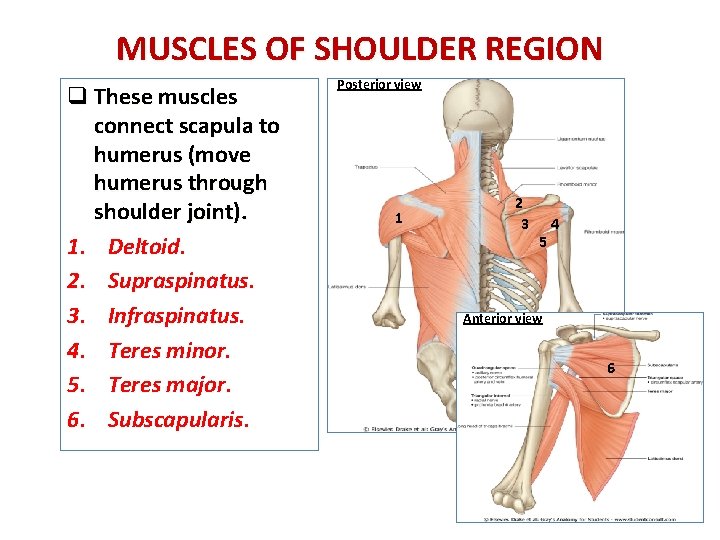
MUSCLES OF SHOULDER REGION q These muscles connect scapula to humerus (move humerus through shoulder joint). 1. Deltoid. 2. Supraspinatus. 3. Infraspinatus. 4. Teres minor. 5. Teres major. 6. Subscapularis. Posterior view 1 2 3 5 4 Anterior view 6
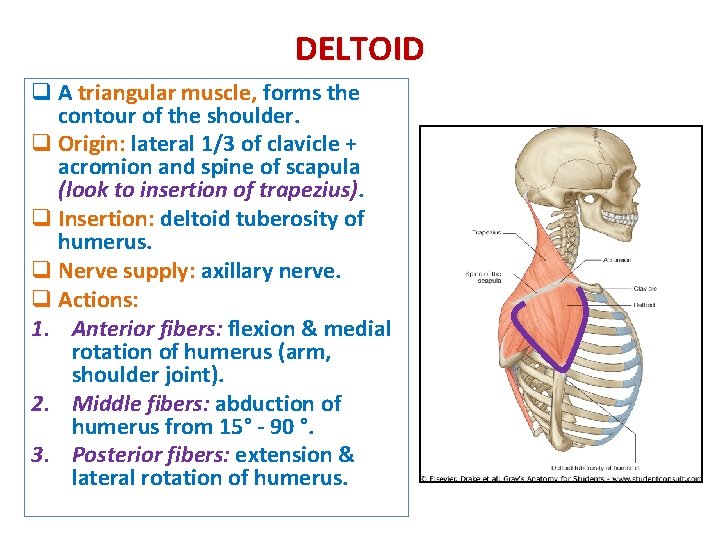
DELTOID q A triangular muscle, forms the contour of the shoulder q Origin: lateral 1/3 of clavicle + acromion and spine of scapula (look to insertion of trapezius). q Insertion: deltoid tuberosity of humerus. q Nerve supply: axillary nerve. q Actions: 1. Anterior fibers: flexion & medial rotation of humerus (arm, shoulder joint). 2. Middle fibers: abduction of humerus from 15° - 90 °. 3. Posterior fibers: extension & lateral rotation of humerus.
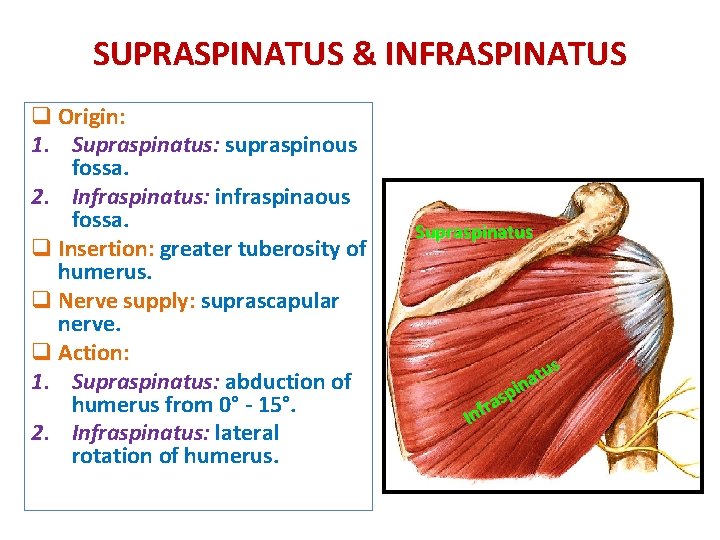
SUPRASPINATUS & INFRASPINATUS q Origin: 1. Supraspinatus: supraspinous fossa. 2. Infraspinatus: infraspinaous fossa. q Insertion: greater tuberosity of humerus. q Nerve supply: suprascapular nerve. q Action: 1. Supraspinatus: abduction of humerus from 0° - 15°. 2. Infraspinatus: lateral rotation of humerus. Supraspinatus s u t na i p s a r Inf
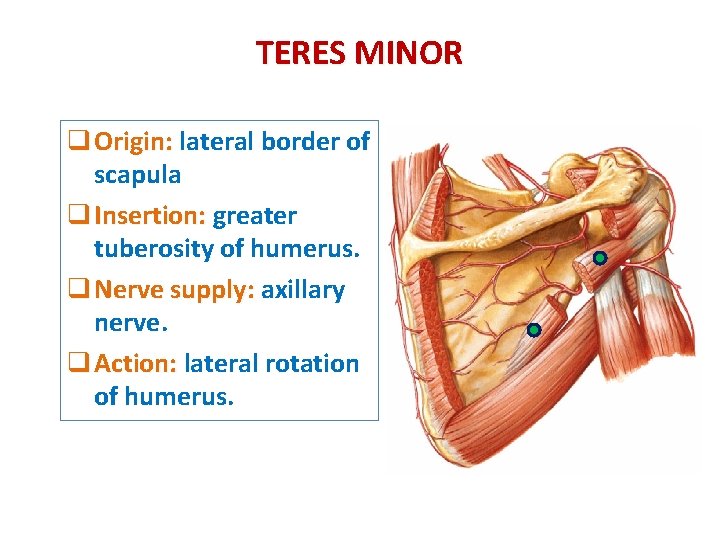
TERES MINOR q Origin: lateral border of scapula q Insertion: greater tuberosity of humerus. q Nerve supply: axillary nerve. q Action: lateral rotation of humerus.
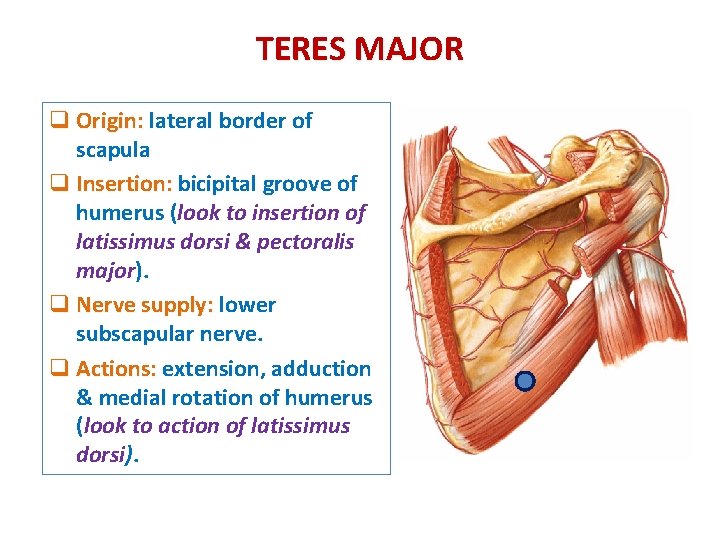
TERES MAJOR q Origin: lateral border of scapula q Insertion: bicipital groove of humerus (look to insertion of latissimus dorsi & pectoralis major). q Nerve supply: lower subscapular nerve. q Actions: extension, adduction & medial rotation of humerus (look to action of latissimus dorsi).
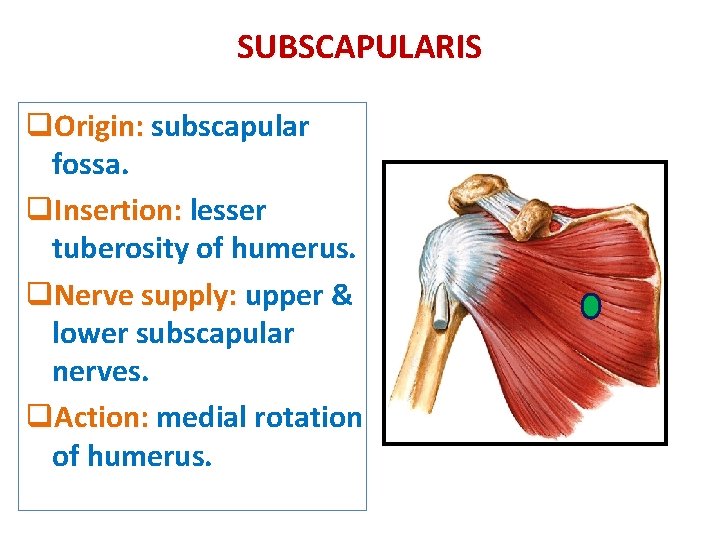
SUBSCAPULARIS q. Origin: subscapular fossa. q. Insertion: lesser tuberosity of humerus. q. Nerve supply: upper & lower subscapular nerves. q. Action: medial rotation of humerus.
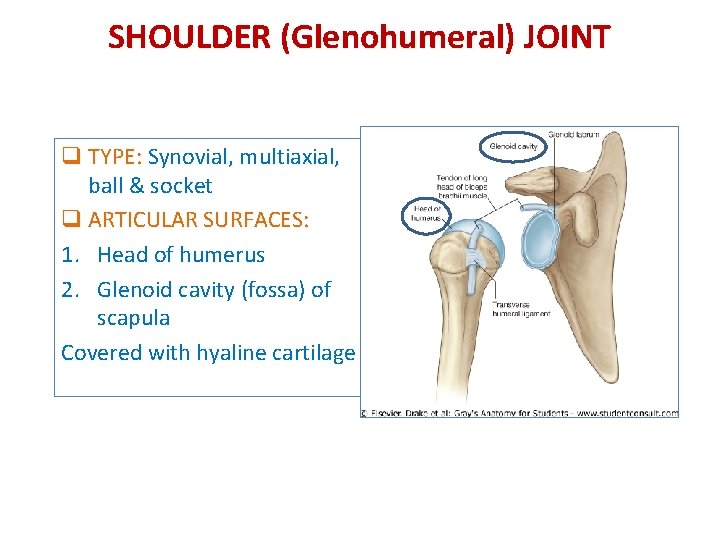
SHOULDER (Glenohumeral) JOINT q TYPE: Synovial, multiaxial, ball & socket q ARTICULAR SURFACES: 1. Head of humerus 2. Glenoid cavity (fossa) of scapula Covered with hyaline cartilage
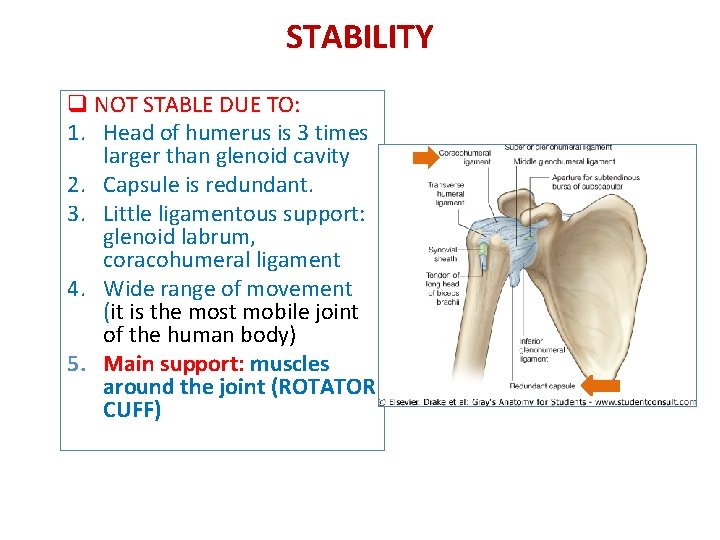
STABILITY q NOT STABLE DUE TO: 1. Head of humerus is 3 times larger than glenoid cavity 2. Capsule is redundant. 3. Little ligamentous support: glenoid labrum, coracohumeral ligament 4. Wide range of movement (it is the most mobile joint of the human body) 5. Main support: muscles around the joint (ROTATOR CUFF)
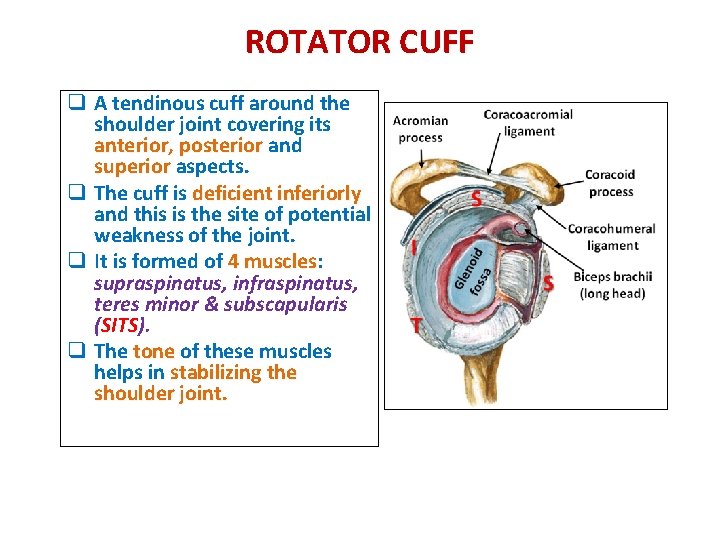
ROTATOR CUFF q A tendinous cuff around the shoulder joint covering its anterior, posterior and superior aspects. q The cuff is deficient inferiorly and this is the site of potential weakness of the joint. q It is formed of 4 muscles: muscles supraspinatus, infraspinatus, teres minor & subscapularis (SITS). q The tone of these muscles helps in stabilizing the shoulder joint.
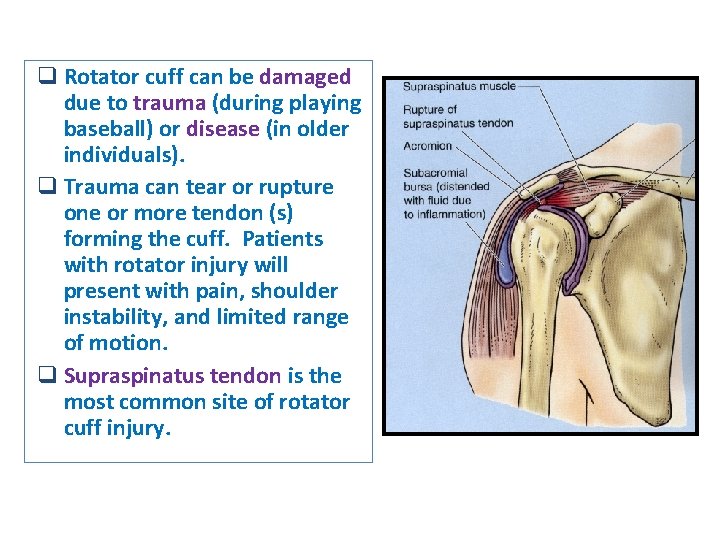
q Rotator cuff can be damaged due to trauma (during playing baseball) or disease (in older individuals). q Trauma can tear or rupture one or more tendon (s) forming the cuff. Patients with rotator injury will present with pain, shoulder instability, and limited range of motion. q Supraspinatus tendon is the most common site of rotator cuff injury.
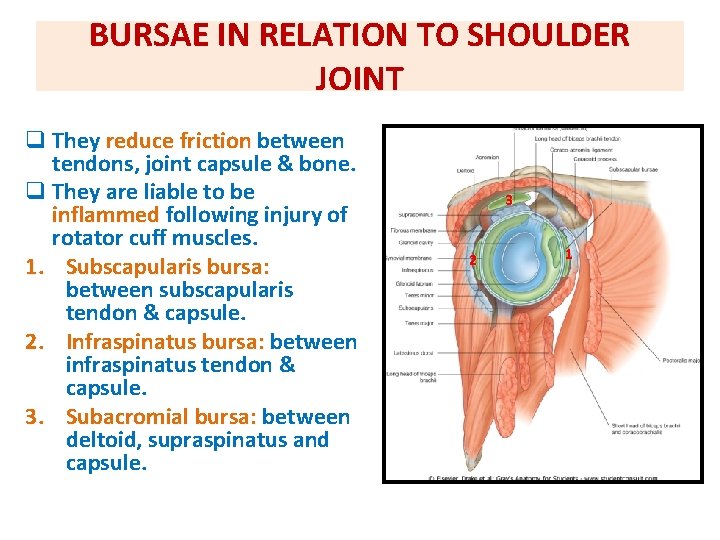
BURSAE IN RELATION TO SHOULDER JOINT q They reduce friction between tendons, joint capsule & bone. q They are liable to be inflammed following injury of rotator cuff muscles. 1. Subscapularis bursa: between subscapularis tendon & capsule. 2. Infraspinatus bursa: between infraspinatus tendon & capsule. 3. Subacromial bursa: between deltoid, supraspinatus and capsule. 3 2 1
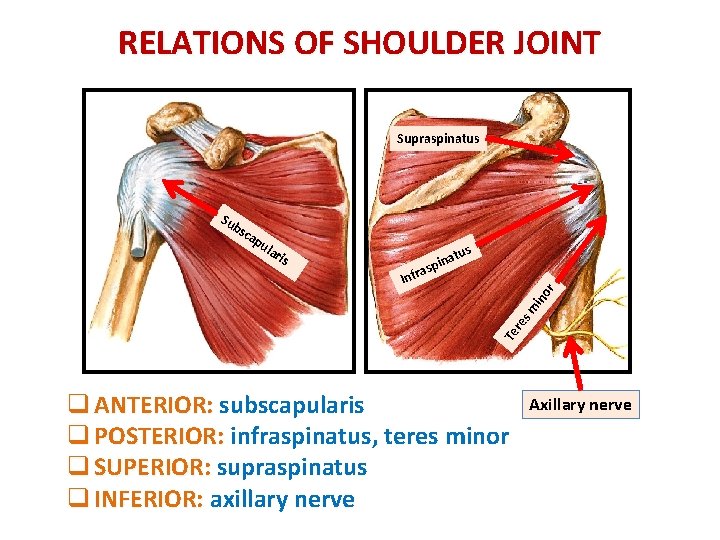
RELATIONS OF SHOULDER JOINT Supraspinatus Su bs ca lar i s Infr a a spin tus Te re sm ino r pu q ANTERIOR: subscapularis q POSTERIOR: infraspinatus, teres minor q SUPERIOR: supraspinatus q INFERIOR: axillary nerve Axillary nerve
MOVEMENTS OF SHOULDER JOINT q FLEXION: 1. 2. 3. 4. Anterior fibers of deltoid Pectoralis major Coracobrachialis (muscle of arm) Short head of biceps brachii (muscle of arm) q EXTENSION: 1. Posterior fibers of deltoid 2. Latissimus dorsi 3. Teres major
MOVEMENTS OF SHOULDER JOINT cont’d q ABDUCTION: 1. 2. q 1. 2. 3. From 0° - 15°: Supraspinatus From 15° - 90 °: Middle fibers of deltoid ADDUCTION: Pectoralis major Latissimus dorsi Inserted in bicipital groove Teres major
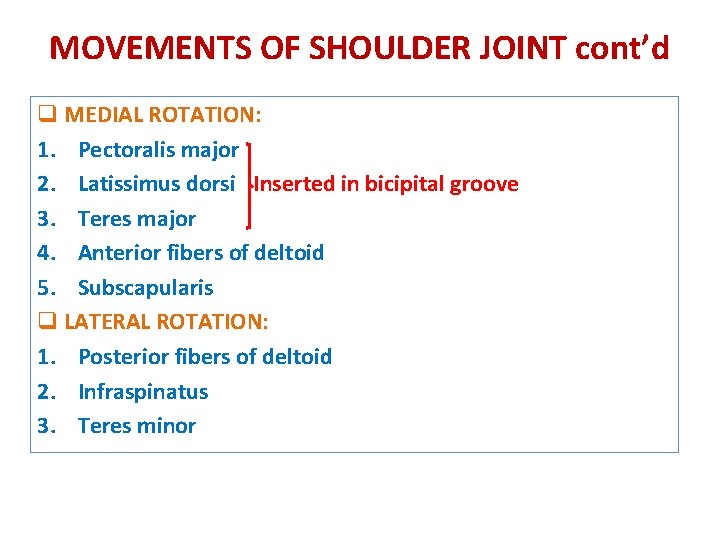
MOVEMENTS OF SHOULDER JOINT cont’d q MEDIAL ROTATION: 1. Pectoralis major 2. Latissimus dorsi Inserted in bicipital groove 3. Teres major 4. Anterior fibers of deltoid 5. Subscapularis q LATERAL ROTATION: 1. Posterior fibers of deltoid 2. Infraspinatus 3. Teres minor
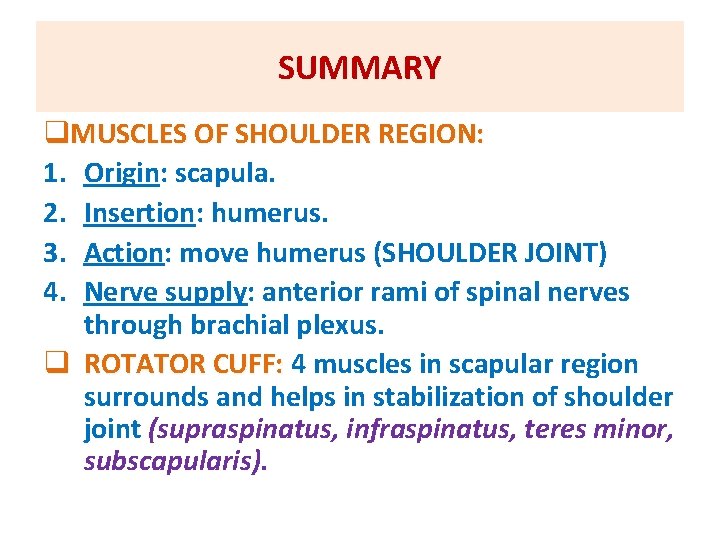
SUMMARY q. MUSCLES OF SHOULDER REGION: 1. Origin: scapula. 2. Insertion: humerus. 3. Action: move humerus (SHOULDER JOINT) 4. Nerve supply: anterior rami of spinal nerves through brachial plexus. q ROTATOR CUFF: 4 muscles in scapular region surrounds and helps in stabilization of shoulder joint (supraspinatus, infraspinatus, teres minor, subscapularis).
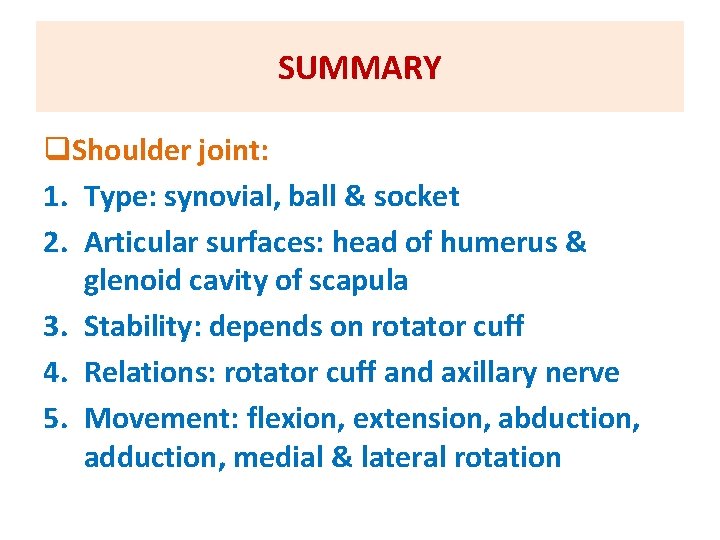
SUMMARY q. Shoulder joint: 1. Type: synovial, ball & socket 2. Articular surfaces: head of humerus & glenoid cavity of scapula 3. Stability: depends on rotator cuff 4. Relations: rotator cuff and axillary nerve 5. Movement: flexion, extension, abduction, adduction, medial & lateral rotation
QUESTION 1 q. Which one of the following muscles is inserted into the lesser tuberosity of the humerus? 1. Subscapularis 2. Deltoid 3. Teres major 4. Infraspinatus
QUESTION 2 q. Which one of the following muscles belong to the rotator cuff? 1. Subscapularis. 2. Deltoid. 3. Teres major. 4. Rhomboid minor.
QUESTION 3 q. Regarding the shoulder joint, which one of the following statement is correct? 1. It is a stable joint. 2. It is a synovial joint of hinge variety. 3. Deltoid muscle adducts shoulder joint. 4. Downward dislocation of shoulder joint may cause injury to axillary nerve.
THANK YOU