
Anatomy of the Female Pelvic Organs Lulu AlNuaim
- Slides: 59
Anatomy of the Female Pelvic Organs Lulu Al-Nuaim
Aims To fully understand the anatomy of the female pelvis in terms of bones and tissues, and fetal skull, this would help in explaining the mechanism of Labour To predict and thus prevent postpatum haemorrhae related to the placenta To understand the major events in fetal circulation; during pregnancy and after birth AL Nuaim 11/29/2020
Objectives v. Student at the end of session should be able to: Ø Explain the relationship between pelvic organs Ø Comprehend the normal organs Ø Understand the relationship between the female pelvis (Bones& Soft Tissue) and fetal skull, in order to understand the mechanism of labour AL Nuaim 11/29/2020
Objectives Student at the end of session should be able to: • Understand the major variant in the fetal circulation that of the adult • Know the significance of ductus venousus ductus anteriousus and the first breath. • Explain the changes that occur after birth. • Familiarize yourself with the placental structure. • Know the significance of placental and umbilical cord inspection after birth • Differentiate between the different types of placental abnormalities and their significance AL Nuaim 11/29/2020
The Vulva external organs of the female Include: - ü Mons veneris ü Labia majora ü Labia minora ü The clitoris ü The vestibule has six openings: • Urethral meatus • Two skene’s ducts • Vaginal orifice • Two Bartholin ducts. 11/29/2020 AL Nuaim
The Vulva Bartholin glands - lies on each side of the vagina, in the posterior lower third 1/3 of the interiotus. • Secrete mucus – alkaline • Blood supply: Pudendal artery from the femoral aa Venous drainage in the corresponding vein. • Lymphytic inguinal glands External iliac glands • Nerves: Branches of the pudendal nerve, perineal nerve (T 12 L 1 -2, S 2 -4) • In labour: Catheterization, Episiotomy, Anaesthetic infiltration AL Nuaim 11/29/2020
The vagina A Canal/tube extend from the vulva to the uterus • Runs upwards and backwards • Walls lie in close contact, easily separated. Speculum examination • The posterior vaginal wall is longer than the anterior 11. 5 cm (4. 5 in) vs 7. 5 cm • Cervix enters the vagina at a right angle. • Tornices = four Anterior, posterior, lateral AL Nuaim 11/29/2020
The Vagina Blood supply • Vaginal aa, uterine aa, middle haemorridal, inferior vesical, pudendal branch of the internal iliac aa. • Venous drainage to corresponding veins. • Lymph: inguinal, internal iliac, sacral glands • Nerves: symphatetic and parasymphatetic • Relations: Anterior : base of the bladder on upper ½ of vagina. Posterior: Pouch of Douglas in the lower ½ Rectum centrally Perineal body inferiorly Laterally: 11/29/2020 AL Nuaim
The Cervix Forms the lower 1/3 of the uterus • Enter the vagina at a right angle • Barrel shape • 2. 5 cm (1 in) long • Two parts: – Supra vaginal – Intra vaginal • Cervical os – Internal os – External os • Cervical canal between the internal os and the external os • Transformation zone; squamous-columnar junction. 11/29/2020 AL Nuaim
Blood supply: Uterine artery Lymphatic drainage Internal iliac, sacral glands 11/29/2020 AL Nuaim
The Cervix Supports: Cardinal ligaments Pubocervical ligaments Utero sacral ligaments In pregnancy: Rich blood supply – bluish coloration Soft Cervical glands – mucus plug “operculum” Late in pregnancy – softer and starts to dilate. In labor: The longitudinal fibres of the uterus contract and retract pulling upward thus reducing the length of the cervix. The cervix is made up of fibrous and elastic tissue Full dilatation marks the end of the first stage of labour. AL Nuaim 11/29/2020
The Uterus The uterus lies in the true pelvis. Anteverted (A/V)and anteflexed (A/F)in position. The body of the uterus lies above the bladder. • Size: 7. 5 cm length • 5 cm wide • 2. 5 cm thick • 50 -75 gm weight Gross structure: • The cervix lower 1/3 • The isthmus • The cavity • The corpus • The cornua. • The fundus AL Nuaim 11/29/2020
Layers: Endometrium Myometrium Perimetrium - peritoneum Adherent, where? ? ? Loose, ? ? ? Blood supply: Arteries: fundus – ovarian artery (aa) Body - uterine aa , directlty from internal iliac aa The relationship between the ureter and uterine aa v Uterine artery runs behind the peritonieum, cross transeverse cervical ligament (Cardinal ligament) then it pass anterior to and above the uerter 1. 5 cm from lateral vaginal wall fornix AL Nuaim 11/29/2020
Venous: Right ovarian vein - inferior vena cava Left ovarian vein – renal vein Lymph internal and external iliac gland inguinal /Sacral gland AL Nuaim 11/29/2020
THE FALLOPIAN TUBEs • Extend from the cornua of the uterus, travels towards the sidewalls of the pelvis. Then turns downwards and backwards. The tube lies in the upper margin of the broad ligaments • Communicate; superiorly with the uterine cavity, Inferiorly with the perineal cavity Length 10 cm (4 cm) : 3 mm thick • 4 PARTS ü Interstitial ü Ampula ü Infundebulum ü Fimbrial BLOOD SUPPLY - ovarian artery Uterine artery Venous drainage by corresponding veins AL Nuaim 11/29/2020
THE OVARIES Lie in the posterior wall of the broad ligament at the fibrial end of the fallopian tubes at the level of the pelvic brim. Size: almond like = 3 x 2 x 1 cm Dull white colour, Corrugated surface Structure varies with woman’s age. AL Nuaim 11/29/2020
The Ovaries Blood supply – ovarian artery Ovarian vein Lymphatic lumbar glands Nerves ovarian plexus SUPPORTS They lie in a fossa Attached to broad ligament – meso ovarian The meso salpinx is the broad ligament that extend between the fallopian tube and the ovary. q The Fallopion tubes, ovaries and broad ligments are called Adenxa 11/29/2020 AL Nuaim
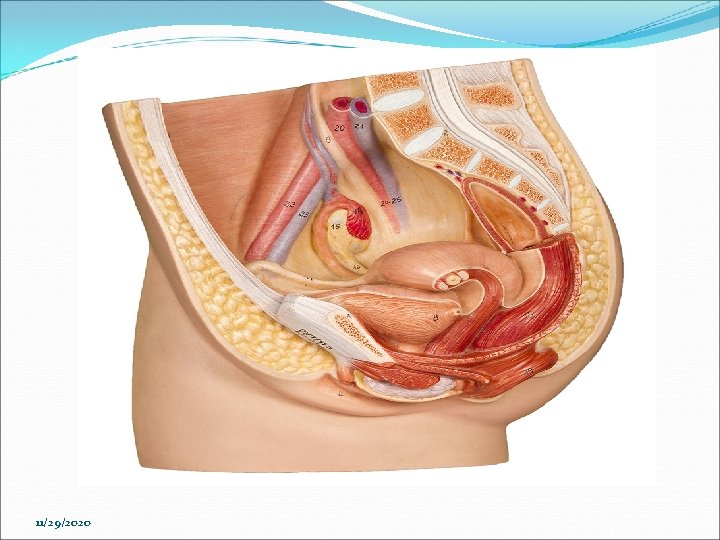
Ligaments: • Round ligaments Maintains uterus in A/V + A/F From the cornua of the uterus – pass downwards and insert in the tissue of the labia majora. • Broad ligaments Not true ligament Folds of peritoneum extend laterally from the uterus to the pelvic side walls. • Cardinal ligaments (transverse cervical ligament) – Pubocervical – Uterosacral 11/29/2020 AL Nuaim
11/29/2020
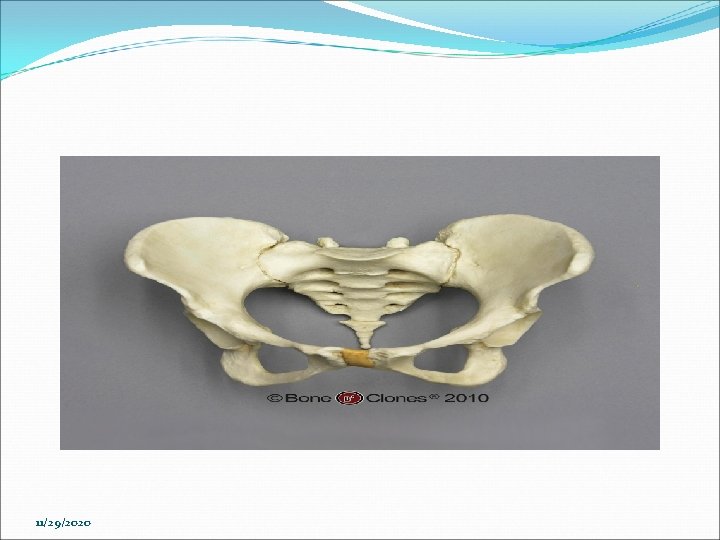
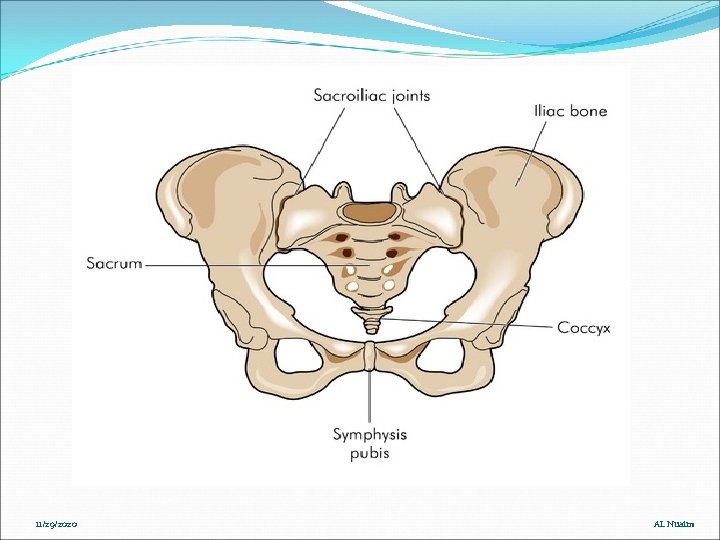
THE NORMAL FEMALE PELVIS The pelvis articulate with the fifth lumbar vertebra above and with the head of each femur in the right and left acetabulum. The weight of the trunk is transmitted through the pelvis into the legs. Gives protection to the pelvic organs The pelvis is the largest bone in the body. Gross structure: Consists of: 5 fused sacral vertebrae and coccyx left & right innominate bones 4 pairs of holes (nerves, blood vessels/lymph) 8/29/2014 AL Nuaim
11/29/2020
The Sacrum A triangular shape; The hollow of the sacrum – smooth and concave The alae of the sacrum - give the appearance of wings • The sacral promontary is the centre point of the upper border of the first sacral vertebrae. • The sacral canal opens at the level of 5 th sacral vertebra, a passage for spinal cord. • At the level of the 2 nd and 3 rd sacral vertebrae, the nerves spread out to form the cauda equina. • Anaesthesia in labour 11/29/2020 AL Nuaim
THE COCCYX 11/29/2020 4 Fusesd coccygeal vertebrae Triangular shape Articulate with the sacrum Muscles are attached to its tip. AL Nuaim
11/29/2020 AL Nuaim
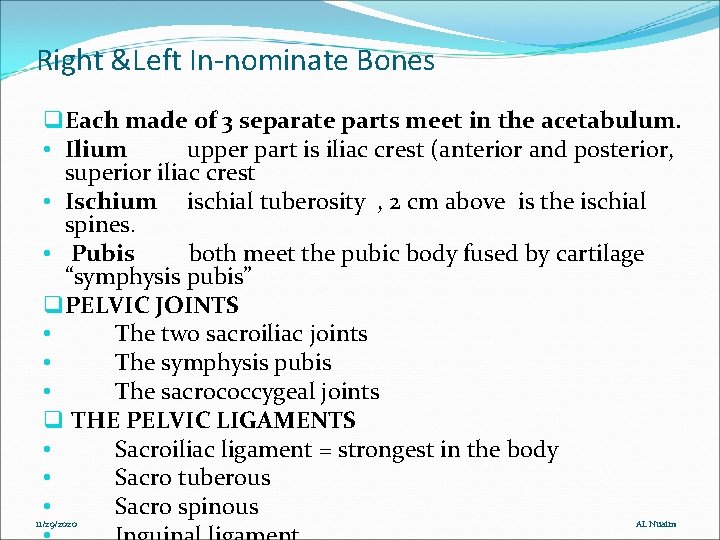
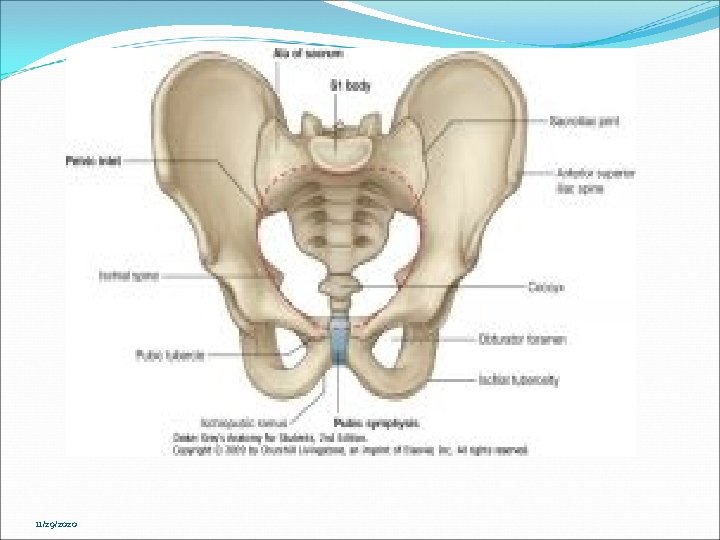
Right &Left In-nominate Bones q Each made of 3 separate parts meet in the acetabulum. • Ilium upper part is iliac crest (anterior and posterior, superior iliac crest • Ischium ischial tuberosity , 2 cm above is the ischial spines. • Pubis both meet the pubic body fused by cartilage “symphysis pubis” q PELVIC JOINTS • The two sacroiliac joints • The symphysis pubis • The sacrococcygeal joints q THE PELVIC LIGAMENTS • Sacroiliac ligament = strongest in the body • Sacro tuberous • Sacro spinous 11/29/2020 AL Nuaim
11/29/2020
DIVISIONS OF THE PELVIS The brim divides the pelvis into the parts: v The false: lies above the pelvic brim not important in obstetrics v The true: what lies below the pelvic brim. It has a : cavity, outlet and a brim Ø Forms the curved canal through which the fetus pass during labour. AL Nuaim 11/29/2020
The brim or inlet • • Round in shape Has eight points as demonstrated Bounded anteriorly by the pubis Laterally by illiopectineal lines Posteriorly by ale and sacral promentary Widest diameter is, Transverse True Conjugate ( Anteroposterior diameter) from sacral promentary to upper inner border of Symphysis pubis Diagonal Conjugate 11/29/2020 AL Nuaim
The Pelvic cavity Extend from the brim above to the pelvic outlet below The posterior wall 11 cm formed by hollow of the sacrum The anterior wall is formed by the symphysis pubis and obturator foramen 3. 8 cm The lateral walls sacrosciatic ligamnet and ischial spines Interspines Diameter 11/29/2020 AL Nuaim
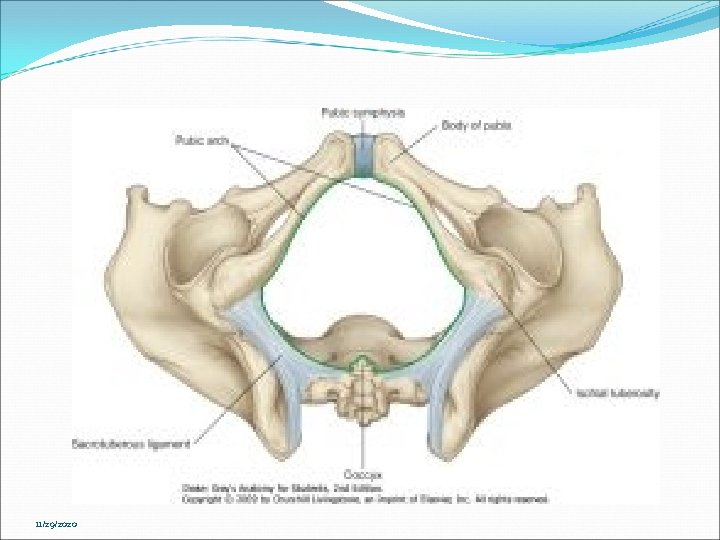
The pelvic outlet • Anatomical outlet • Obstetrical outlet Ø The anatomical outlet is formed by fixed pointes useful landmarks for taking pelvic measurement. Ø Bounded anteriorly by pubic Arch Ø Laterally by sacrosciatic lig&Ischail Tuberosity Ø Posteriorly by tip of Coccyx Ø The obstetrical outlet The landmarks are: • The lower border of the symphysis pubis • The ischial spines • The sacro-spinous ligament • The lower border of the sacrum. 11/29/2020 AL Nuaim
11/29/2020
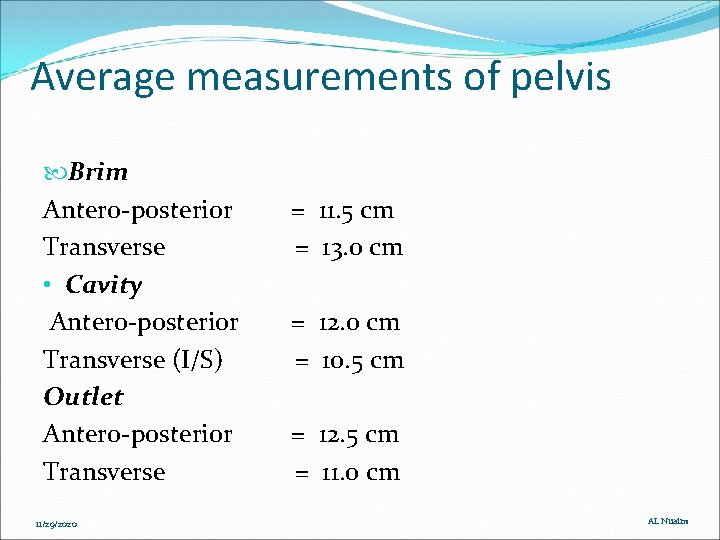
Average measurements of pelvis Brim Antero-posterior = 11. 5 cm Transverse = 13. 0 cm • Cavity Antero-posterior = 12. 0 cm Transverse (I/S) = 10. 5 cm Outlet Antero-posterior = 12. 5 cm Transverse = 11. 0 cm 11/29/2020 AL Nuaim
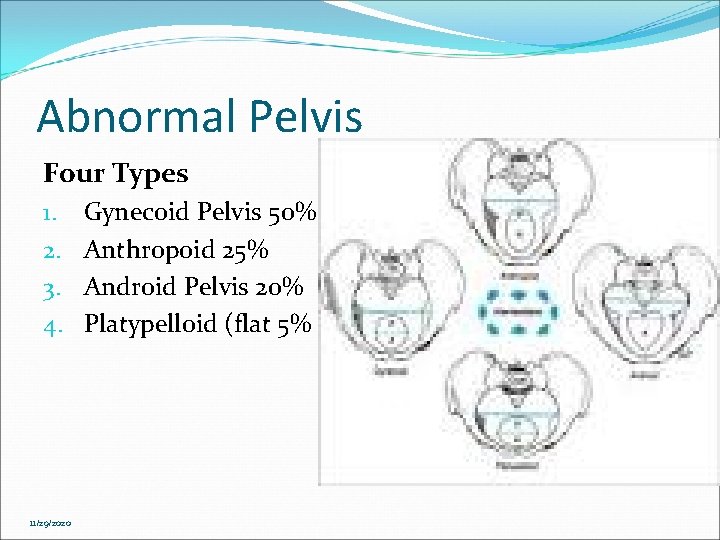
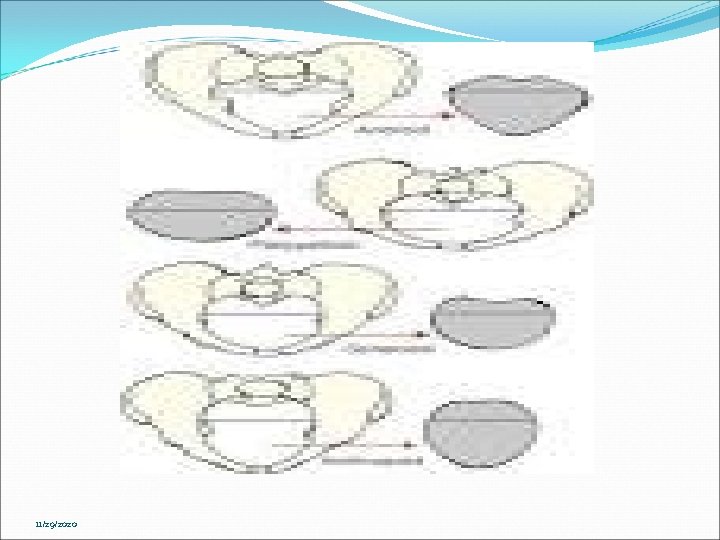
Abnormal Pelvis Four Types 1. 2. 3. 4. 11/29/2020 Gynecoid Pelvis 50% Anthropoid 25% Android Pelvis 20% Platypelloid (flat 5%
11/29/2020
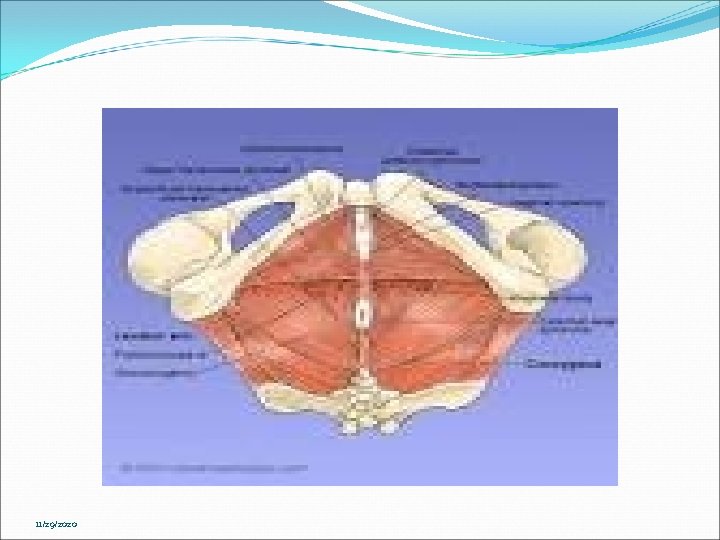
THE PELVIC FLOOR The outlet of the pelvis is filled with a soft tissue that supports the pelvic and abdominal organs. It forms as a gutler-shaped structure highest anteriorly than posteriorly. Three canals with external orifices run through the tissue 1. The urethra 2. The vagina 3. The rectum AL Nuaim 11/29/2020
11/29/2020
Pelvic Floor There are six layers of tissue. 1. An outer covering of skin 2. Subcutaneous fat 3. Superficial muscles enclosed in fascia 4. Deep muscles enclosed in fascia 5. Pelvic fascia, thickened to form pelvic ligaments 6. Peritoneum AL Nuaim 11/29/2020
Pelvic Floor Superficial muscles: 1) Transverse perinei 2) Bulbo-cavernosus 3) Ischio-cavernosus Deep muscles Three pairs of muscles all have their insertion around the coccyx Their anatomical name is levator ani muscles, 5 mm thick 1. Ilio coccygeus 2. ischio coccygeus 3. pubo- coccygeus AL Nuaim 11/29/2020
perinea body • Lies between the vaginal and rectal canals Is triangular, the base is the skin and the apex pointing upward each side is 3. 8 cm in length Three layers of tissue 1. outer covering of skin 2. superficial pelvic floor bubo-cavernous transverse perinei 3. deep pelvic floor muscle. Episiotomy, types, indications, AL Nuaim 11/29/2020
FETAL SKULL Vault of fetal skull – formed from membrane and not cartilage There are 5 points – oosification centres Calcification begins as early as 5 weeks after conception Premature baby is born, intracranial damage!!!! Skull is divided into regions v The vault. v The face. v The base Bones: Bones are separated by? ? Ø Two frontal bones Ø Two parietal bones Ø One occipital bone AL Nuaim 11/29/2020
Suture, an area of membrane which has not ossified Ø Lambdoidal suture Ø Sagittal suture Ø Coronal suture Ø Frontal suture Fontanelles very important landmarks Areas where two or more sutures meet. Anterior fontanelle, diamond in shape where sagittal and frontal sutures meet Posterior fontanelle, where lambdoidal and sagittal sutures meet. AL Nuaim 11/29/2020
AREAS OF THE SKULL 1. Glabella: the bridge of the nose 2. Sinciput : the forehead 3. Bregma: the anterior fontanelle 4. Vertex 5. Lambda: the posterior fontenlle 6. Occiput 7. Suboccipital area 8. Mentum: the chin Malposition Malpresentation AL Nuaim 11/29/2020
CIRCUMFERENCES OF THE FETAL SKULL The engaging Diameter in a well flexed head: suboccipito-bregmatic+ Biparietal In Vertex presentation The engaging Diameter in a Deflexed head (partly extended) Occipito. Frontal+Biparietal In Occipito posterior Position AL Nuaim 11/29/2020
DIAMETERS OF FETAL SKULL Bipareital Suboccipital-bregmatic Occipito frontal Mentovertical Submento-bregmatic AL Nuaim 11/29/2020
Effect of Labour and delivery Moulding Caput succedaneum Cephalhaematoma, Effect of ? ? ? AL Nuaim 11/29/2020
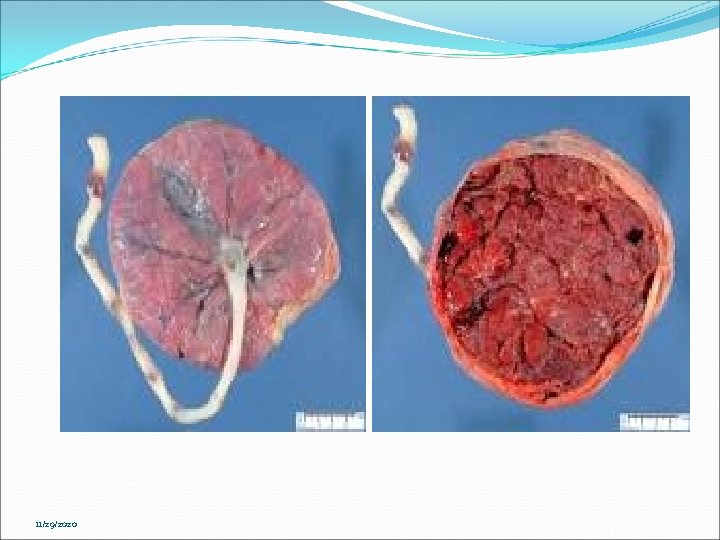
The placenta Structure of the mature placenta Maternal surface lies next to the uterus on inspection, chorionic villi are arranged in lobes/cotyledons – 20 in number – 200 lobules. The groove separating the lobes are sulci dark – red color, rough surface Fetal surface, faces the baby. Bluish gray colour, smooth, shiny surface. Umbilical cord inserted in the fetal surface usually in the centre Blood vessels seen radiating from the cord The amniotic membranes covers the fetal surface. AL Nuaim 11/29/2020
11/29/2020
Structure of the mature placenta Flat, Roughly circular 22 cm in Diameter 2 cm thick in the centre Weight: 1/6 of the baby’s weight AL Nuaim 11/29/2020
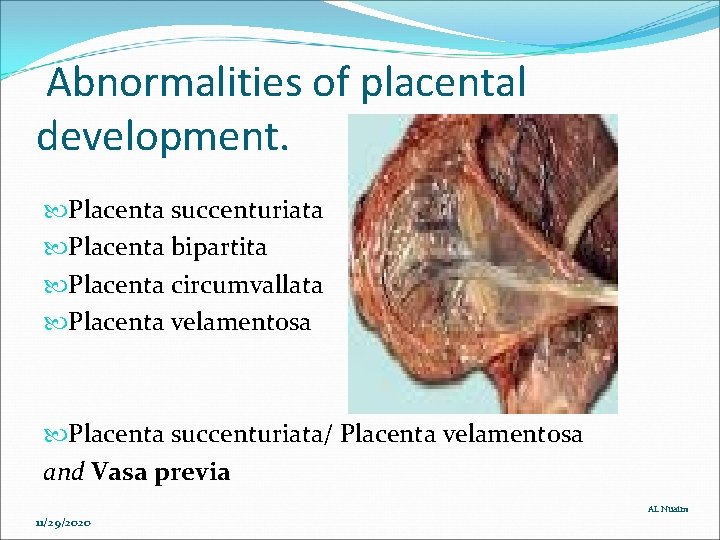
Abnormalities of placental development. Placenta succenturiata Placenta bipartita Placenta circumvallata Placenta velamentosa Placenta succenturiata/ Placenta velamentosa and Vasa previa 11/29/2020 AL Nuaim
Umbilical cord: At full term: 40 -50 cm long 1. 5 cm in diameter Twisted in appearance Two umbilical arteries One umbilical vein Wharton jelly q Abnormal insertion of the cord Ø Battledore insertion Ø Velamentous insertion AL Nuaim 11/29/2020
Fetal circulation How does the fetal circulatory system works? Two Major Events? ? ? ? AL Nuaim 11/29/2020
Fetal circulation Cardiovascular system Major variant are explained by: q the presence of umbilical-placental circulation and qabsence of significant pulmonary circulation. AL Nuaim 11/29/2020
11/29/2020
Fetal circulation The fetal circulatory system uses three shunts? ? ? Purpose of these shunts? ? ? AL Nuaim 11/29/2020
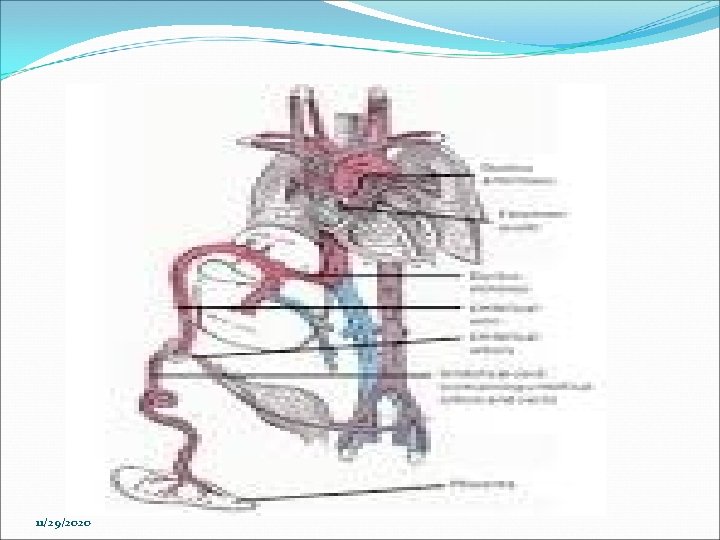
Continue The respiratory function of the placenta requires that oxygenated blood be returned via the umbilical vein and into the fetal circulation. High venous return from the placenta (oxygenated blood O 2 saturation 70 -80%) through the umbilical vein. This maintains the right-left shunt through the foramen ovale Delivers most oxygenated blood to fetal heart and brain. AL Nuaim 11/29/2020
Continue Placenta -umbilical vein- ductus venosus, Most of the blood into the inferior vena cava (IVC), this mixes with returning non oxygenated blood from the lower limbs and kidney, liver. However, only partial mixing of the two streams. Most of the oxygenated blood is directed to the crista dividens at the upper end of the inferior vena cava into the right atrium through the foramen ovale and thus into the left atrium and hence to the left ventricles and ascending aorta to be directed to the brain, heart and upper extremities. AL Nuaim 11/29/2020
The remainder of the blood from the superior vena cava mixes with that of IVC and passes directly to the right ventricle. 10% of it goes through the pulmonary artery to the lung. Most of this enters the systemic circulation via the ductus arteriosus and into the descending aorta beyond the vessels supplying the head, It supplies the viscera and lower limbs It then passes into the umbilical arteries (branches of left and right internal iliac arteries) High pulomary vascular resistance maintains the right-left shunt through the ductus arteriosus. AL Nuaim 11/29/2020
At birth Blood circulation after birth, The closure of the shunts; Ø Ductus arteriosus Ø Foramen ovale o Completes the transition of fetal circulation to newborn circulation AL Nuaim 11/29/2020
q Umbilical vessels contract Cessation of umbilical blood flow causes a fall in pressure in the right atrium. The foramen ovale is a valvular opening, the valve functioning from the right to left. The left atrial pressure rises and thus closure of the foramen ovula. q Breathing Ventilation of the lung helps to create a negative thoracic pressure, this opens the pulmonary circulation and thus diverts blood from ductus arteriosus which then gradually closes. q What maintains patency of ductus arteriosus in utero? AL Nuaim 11/29/2020