
Anatomy of Pituitary Gland Please view our Editing
- Slides: 14
Anatomy of Pituitary Gland Please view our Editing File before studying this lecture to check for any changes. Color Code Important Doctors Notes/Extra explanation
Objectives At the end of the lecture, students should be able to: ü Describe the position of the pituitary gland. ü List the structures related to the pituitary gland. ü Differentiate between the lobes of the gland. ü Describe the blood supply of pituitary gland & the hypophyseal portal system.
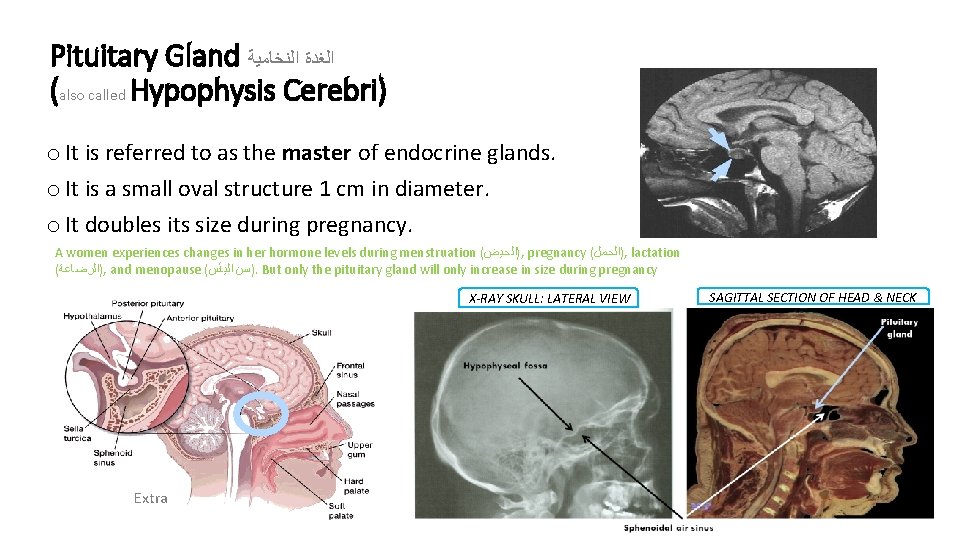
Pituitary Gland ﺍﻟﻐﺪﺓ ﺍﻟﻨﺨﺎﻣﻴﺔ (also called Hypophysis Cerebri) o It is referred to as the master of endocrine glands. o It is a small oval structure 1 cm in diameter. o It doubles its size during pregnancy. A women experiences changes in her hormone levels during menstruation ( )ﺍﻟﺤﻴﺾ , pregnancy ( )ﺍﻟﺤﻤﻞ , lactation ( )ﺍﻟﺮﺿﺎﻋﺔ , and menopause ( )ﺳﻦ ﺍﻟﻴﺄﺲ. But only the pituitary gland will only increase in size during pregnancy X-RAY SKULL: LATERAL VIEW Extra SAGITTAL SECTION OF HEAD & NECK
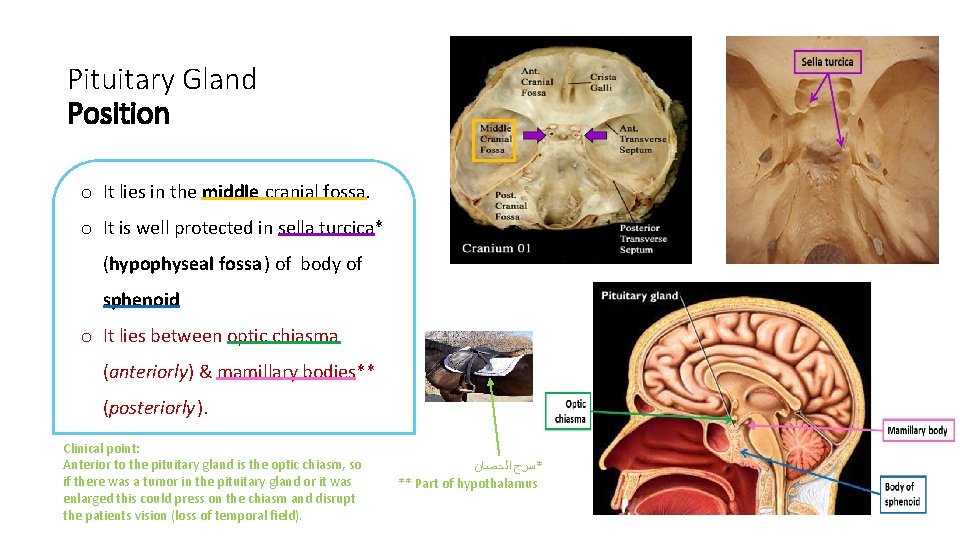
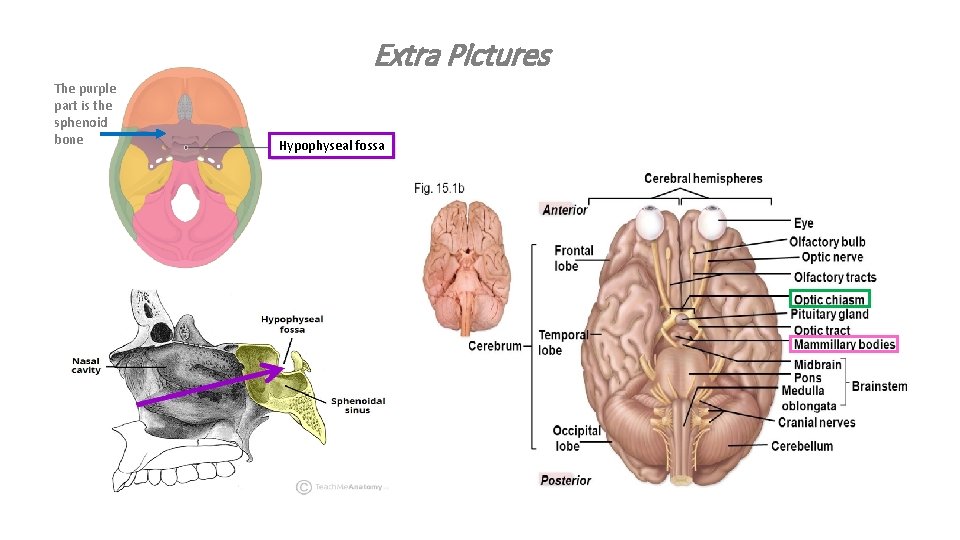
Pituitary Gland Position o It lies in the middle cranial fossa. o It is well protected in sella turcica* (hypophyseal fossa ) of body of sphenoid o It lies between optic chiasma (anteriorly) & mamillary bodies** (posteriorly). Clinical point: Anterior to the pituitary gland is the optic chiasm, so if there was a tumor in the pituitary gland or it was enlarged this could press on the chiasm and disrupt the patients vision (loss of temporal field). * ﺳ ﺮ ﺝ ﺍﻟ ﺤ ﺼ ﺎ ﻥ ** Part of hypothalamus
Extra Pictures The purple part is the sphenoid bone Hypophyseal fossa
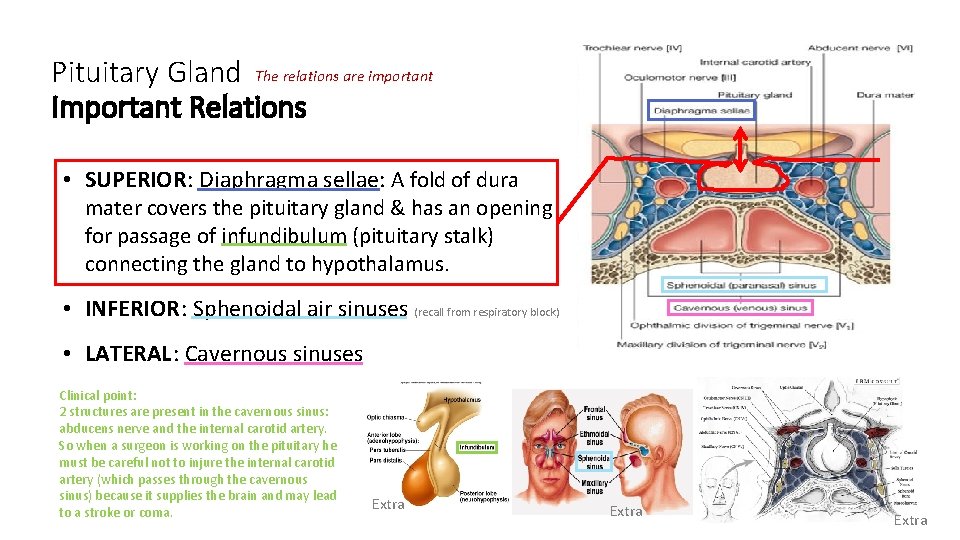
Pituitary Gland The relations are important Important Relations • SUPERIOR: Diaphragma sellae: A fold of dura mater covers the pituitary gland & has an opening for passage of infundibulum (pituitary stalk) connecting the gland to hypothalamus. • INFERIOR: Sphenoidal air sinuses (recall from respiratory block) • LATERAL: Cavernous sinuses Clinical point: 2 structures are present in the cavernous sinus: abducens nerve and the internal carotid artery. So when a surgeon is working on the pituitary he must be careful not to injure the internal carotid artery (which passes through the cavernous sinus) because it supplies the brain and may lead to a stroke or coma. Extra
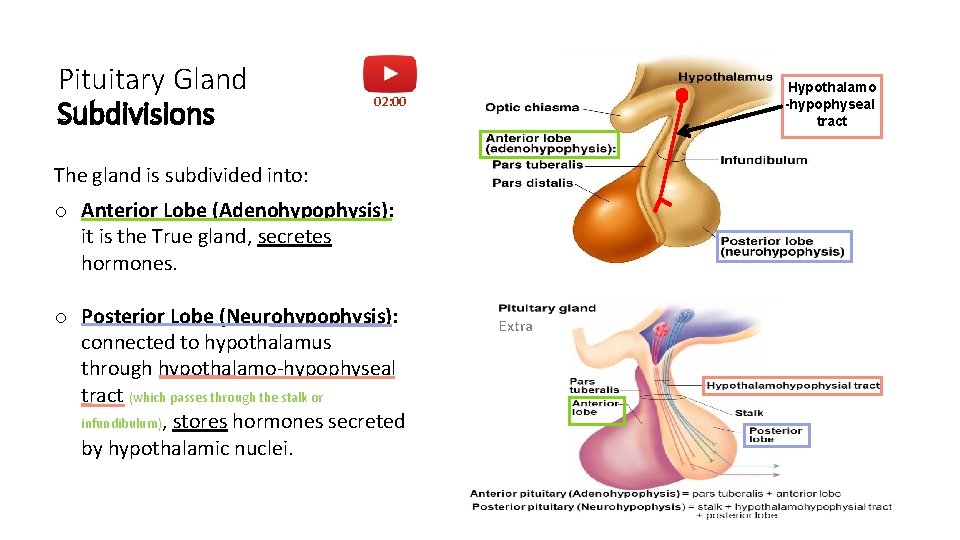
Pituitary Gland Subdivisions Hypothalamo -hypophyseal tract 02: 00 The gland is subdivided into: o Anterior Lobe (Adenohypophysis): it is the True gland, secretes hormones. o Posterior Lobe (Neurohypophysis): connected to hypothalamus through hypothalamo-hypophyseal tract (which passes through the stalk or infundibulum), stores hormones secreted by hypothalamic nuclei. Extra
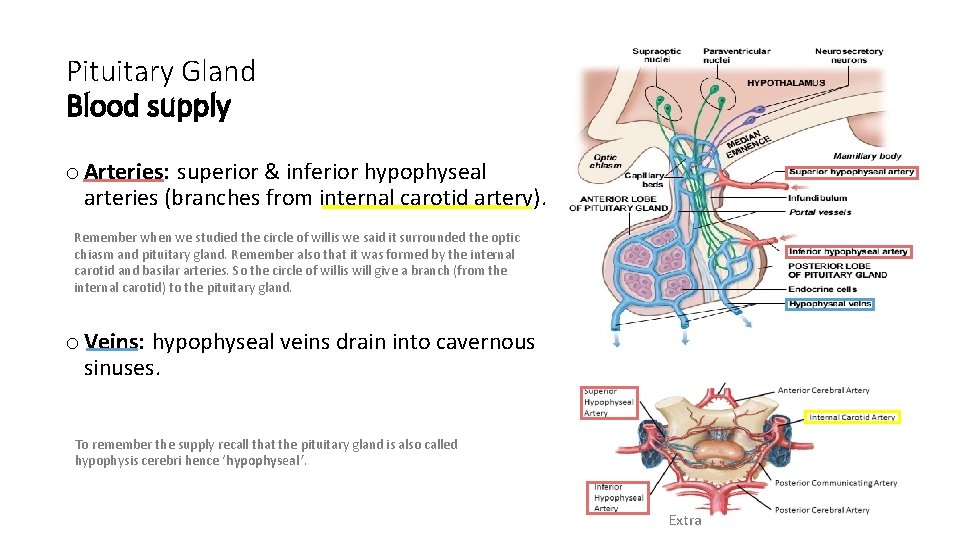
Pituitary Gland Blood supply o Arteries: superior & inferior hypophyseal arteries (branches from internal carotid artery). Remember when we studied the circle of willis we said it surrounded the optic chiasm and pituitary gland. Remember also that it was formed by the internal carotid and basilar arteries. So the circle of willis will give a branch (from the internal carotid) to the pituitary gland. o Veins: hypophyseal veins drain into cavernous sinuses. To remember the supply recall that the pituitary gland is also called hypophysis cerebri hence ‘hypophyseal’. Extra
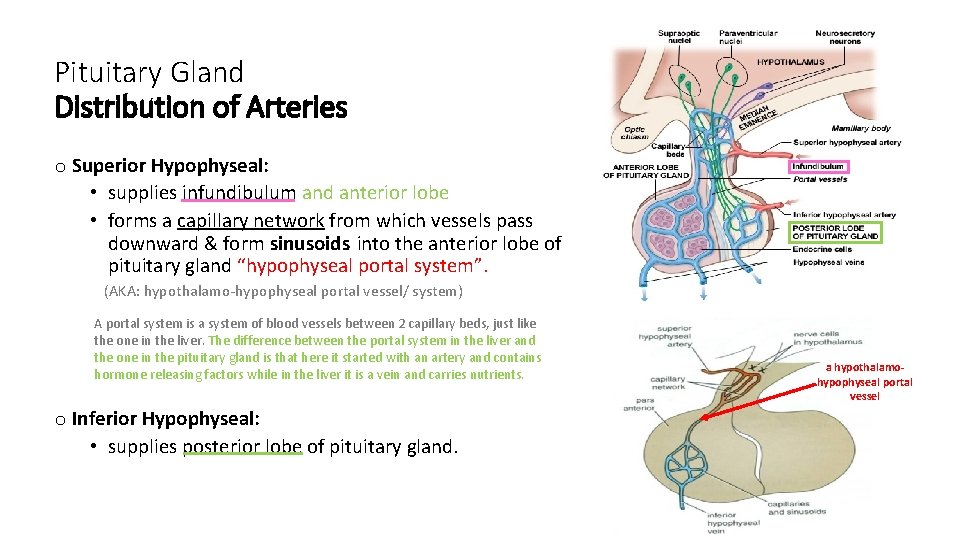
Pituitary Gland Distribution of Arteries o Superior Hypophyseal: • supplies infundibulum and anterior lobe • forms a capillary network from which vessels pass downward & form sinusoids into the anterior lobe of pituitary gland “hypophyseal portal system”. (AKA: hypothalamo-hypophyseal portal vessel/ system) A portal system is a system of blood vessels between 2 capillary beds, just like the one in the liver. The difference between the portal system in the liver and the one in the pituitary gland is that here it started with an artery and contains hormone releasing factors while in the liver it is a vein and carries nutrients. o Inferior Hypophyseal: • supplies posterior lobe of pituitary gland. a hypothalamohypophyseal portal vessel
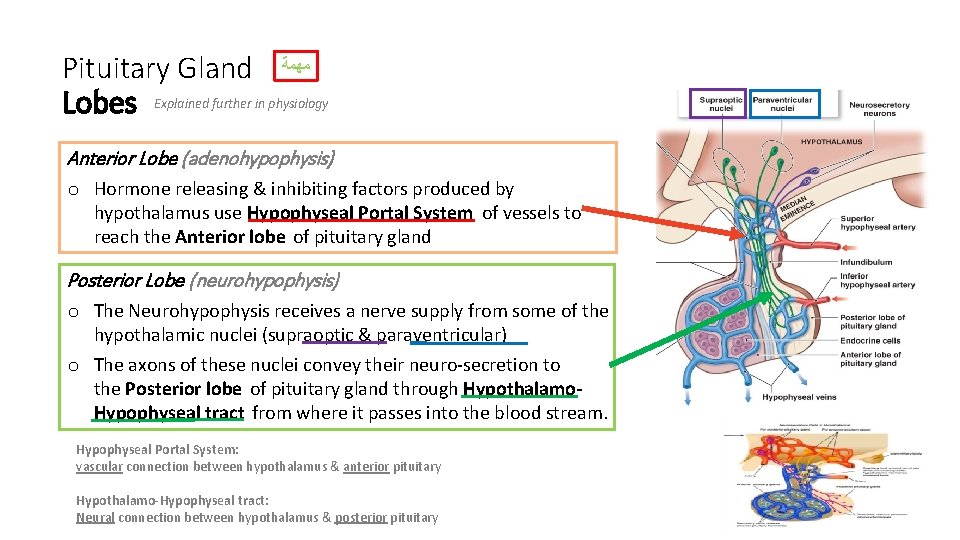
Pituitary Gland ﻣﻬﻤﺔ Lobes Explained further in physiology Anterior Lobe (adenohypophysis) o Hormone releasing & inhibiting factors produced by hypothalamus use Hypophyseal Portal System of vessels to reach the Anterior lobe of pituitary gland Posterior Lobe (neurohypophysis) o The Neurohypophysis receives a nerve supply from some of the hypothalamic nuclei (supraoptic & paraventricular) o The axons of these nuclei convey their neuro-secretion to the Posterior lobe of pituitary gland through Hypothalamo. Hypophyseal tract from where it passes into the blood stream. Hypophyseal Portal System: vascular connection between hypothalamus & anterior pituitary Hypothalamo-Hypophyseal tract: Neural connection between hypothalamus & posterior pituitary
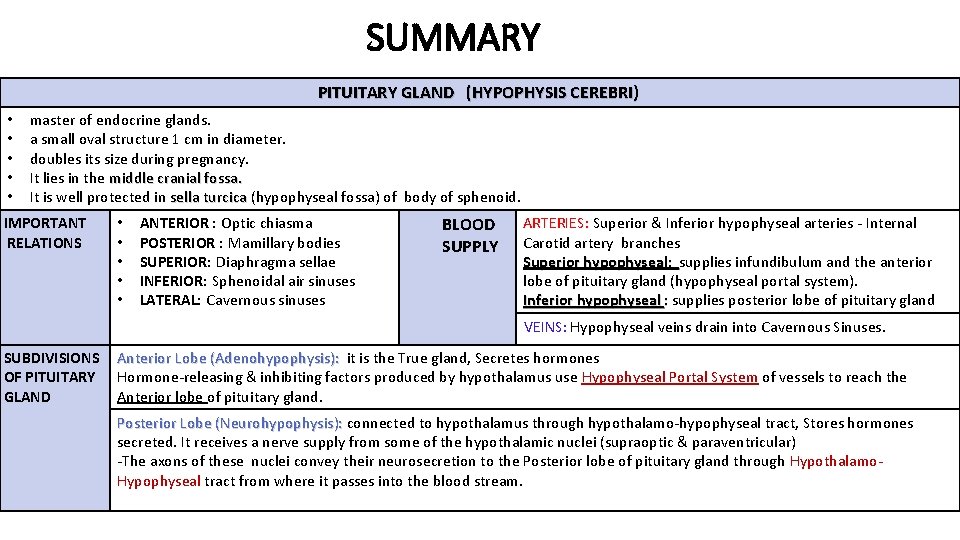
SUMMARY PITUITARY GLAND (HYPOPHYSIS CEREBRI) • • • master of endocrine glands. a small oval structure 1 cm in diameter. doubles its size during pregnancy. It lies in the middle cranial fossa. It is well protected in sella turcica (hypophyseal fossa) of body of sphenoid. IMPORTANT RELATIONS • • • ANTERIOR : Optic chiasma POSTERIOR : Mamillary bodies SUPERIOR: Diaphragma sellae INFERIOR: Sphenoidal air sinuses LATERAL: Cavernous sinuses BLOOD SUPPLY ARTERIES: Superior & Inferior hypophyseal arteries - Internal Carotid artery branches Superior hypophyseal: supplies infundibulum and the anterior lobe of pituitary gland (hypophyseal portal system). Inferior hypophyseal : supplies posterior lobe of pituitary gland VEINS: Hypophyseal veins drain into Cavernous Sinuses. SUBDIVISIONS OF PITUITARY GLAND Anterior Lobe (Adenohypophysis): it is the True gland, Secretes hormones Hormone-releasing & inhibiting factors produced by hypothalamus use Hypophyseal Portal System of vessels to reach the Anterior lobe of pituitary gland. Posterior Lobe (Neurohypophysis): connected to hypothalamus through hypothalamo-hypophyseal tract, Stores hormones secreted. It receives a nerve supply from some of the hypothalamic nuclei (supraoptic & paraventricular) -The axons of these nuclei convey their neurosecretion to the Posterior lobe of pituitary gland through Hypothalamo. Hypophyseal tract from where it passes into the blood stream.
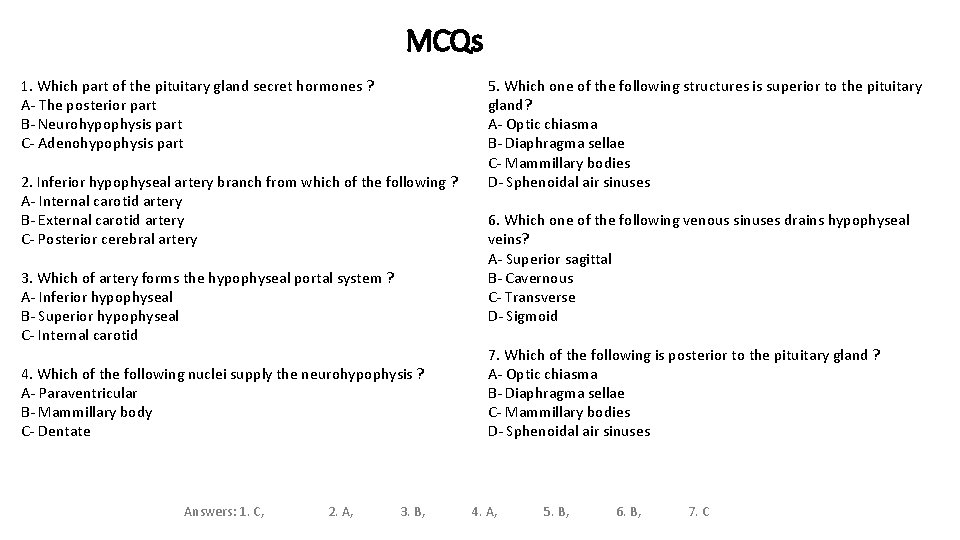
MCQs 1. Which part of the pituitary gland secret hormones ? A- The posterior part B- Neurohypophysis part C- Adenohypophysis part 2. Inferior hypophyseal artery branch from which of the following ? A- Internal carotid artery B- External carotid artery C- Posterior cerebral artery 3. Which of artery forms the hypophyseal portal system ? A- Inferior hypophyseal B- Superior hypophyseal C- Internal carotid 4. Which of the following nuclei supply the neurohypophysis ? A- Paraventricular B- Mammillary body C- Dentate Answers: 1. C, 2. A, 3. B, 5. Which one of the following structures is superior to the pituitary gland? A- Optic chiasma B- Diaphragma sellae C- Mammillary bodies D- Sphenoidal air sinuses 6. Which one of the following venous sinuses drains hypophyseal veins? A- Superior sagittal B- Cavernous C- Transverse D- Sigmoid 7. Which of the following is posterior to the pituitary gland ? A- Optic chiasma B- Diaphragma sellae C- Mammillary bodies D- Sphenoidal air sinuses 4. A, 5. B, 6. B, 7. C
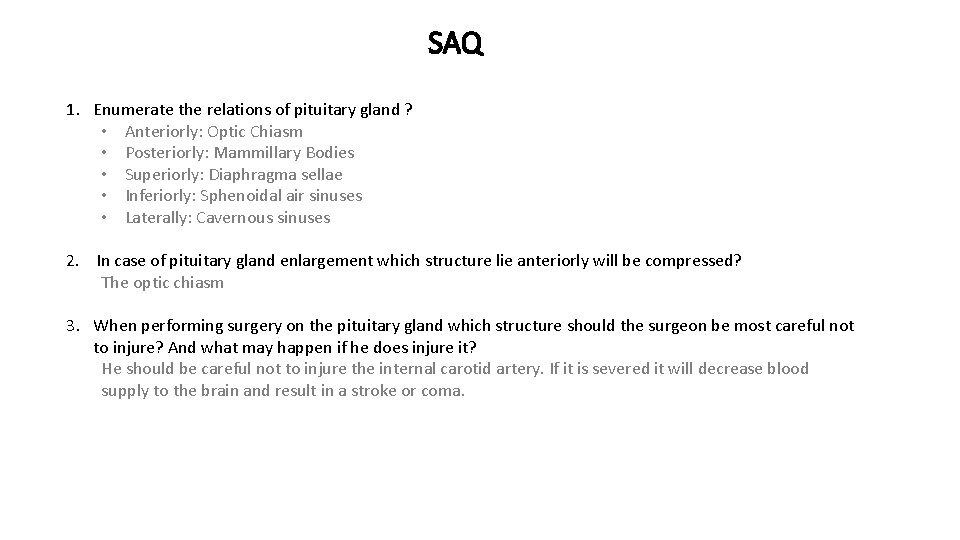
SAQ 1. Enumerate the relations of pituitary gland ? • Anteriorly: Optic Chiasm • Posteriorly: Mammillary Bodies • Superiorly: Diaphragma sellae • Inferiorly: Sphenoidal air sinuses • Laterally: Cavernous sinuses 2. In case of pituitary gland enlargement which structure lie anteriorly will be compressed? The optic chiasm 3. When performing surgery on the pituitary gland which structure should the surgeon be most careful not to injure? And what may happen if he does injure it? He should be careful not to injure the internal carotid artery. If it is severed it will decrease blood supply to the brain and result in a stroke or coma.
Leaders: Nawaf Al. Khudairy Jawaher Abanumy Feedback anatomyteam 436@gmail. com @anatomy 436 Members: Alanoud Abuhaimed Anwar Alajmi Ghaida Alsaeed Lama Alfawzan Lama Al. Tamimi Rawan Al. Wadee Safa Al-Osaimi Shatha Alghaihb Wejdan alzaid References: 1 - Girls’ & Boys’ Slides 2 - Greys Anatomy for Students 3 - Teach. Me. Anatomy. com