
Anatomy of Nose and PNS DR ABHISHEK BHARDWAJ
Anatomy of Nose and PNS DR. ABHISHEK BHARDWAJ

EMBRYOLOGY • Nose develops from frontonasal process which grows between primitive forebrain and the stomodaeum. • Frontonasal process gets divided into median nasal process and two lateral process.

• Olfactory placodes on the frontonasal process become depressed to form olfactory pits which later form nasal cavity.

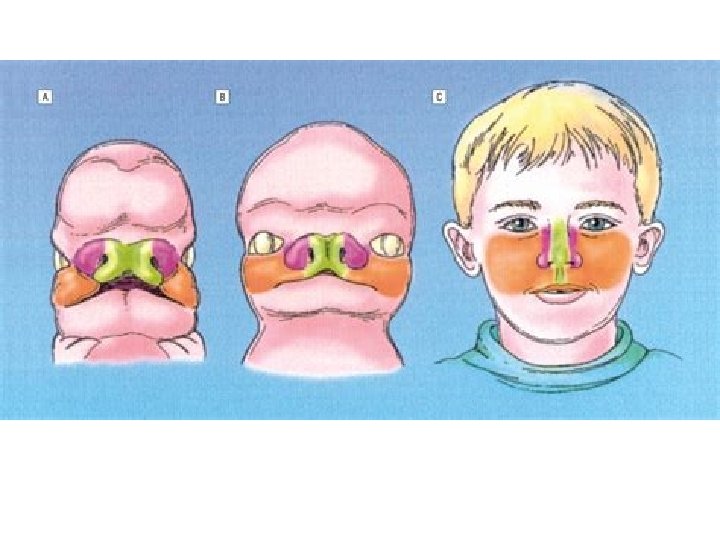

• Primitive nasal cavities are closed at their posterior ends by bucconasal membrane which ruptures and forms choanae. • Clinical significance: choanal atresia

• • • Maxillary sinus First sinus to appear Completely develops by 17 -18 years of age Sphenoid sinus , Frontal sinus Poorly developed at birth

EXTERNAL NOSE • External nose is shaped like a pyramid with its root up and base directed downwards. • Consists of osteocartilagenous framework covered by muscle and skin.

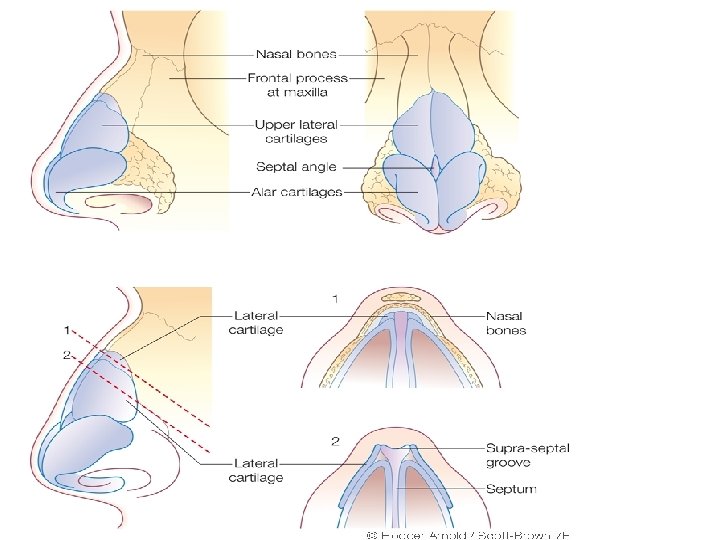
• • Osteocartilagenous framework: Upper 1/3 rd - bony Lower 2/3 rd – cartilagenous Bony framework a) Nasal bones b) Nasal processes of frontal bone c) Frontal processes of maxilla

• • • Cartilagenous framework a) Upper lateral cartilages b) Lower lateral cartilages (alar cartilages) c) Lesser cartilages (sesamoid cartilages) d) Septal cartilage
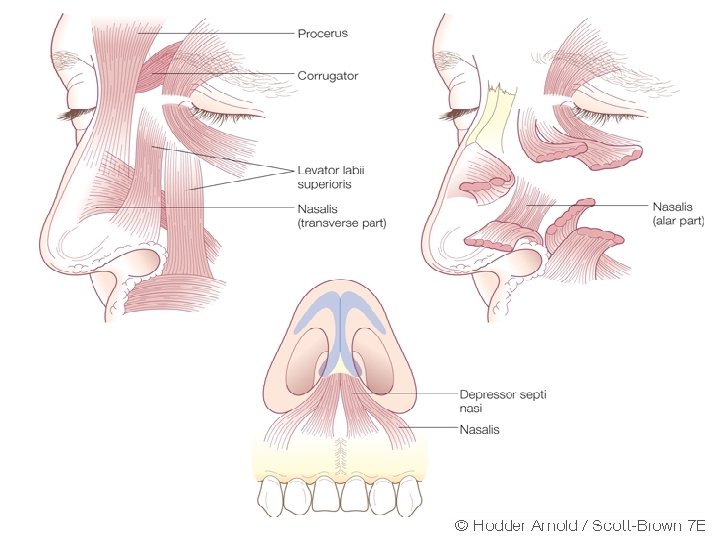
• • • Nasal musculature: a) Procerus b) Nasalis (transverse and alar part) c) Levator labi superioris alaque nasi d) Anterior and posterior dialator naris e) Depressor septi
• Nasal skin: • Over nasal bone and upper lateral cartilage is thin and freely mobile • On alar cartilages is thick and adherent and contains sebaceous glan
• Blood supply: facial and ophthalmic arteries and veins • Lymphatic drainage: preauricular and submandibular lymph nodes
INTERNAL NOSE • Divided into right and left nasal cavities by nasal septum. • Nasal cavity proper: bounded by lateral wall, medial wall, roof and a floor.
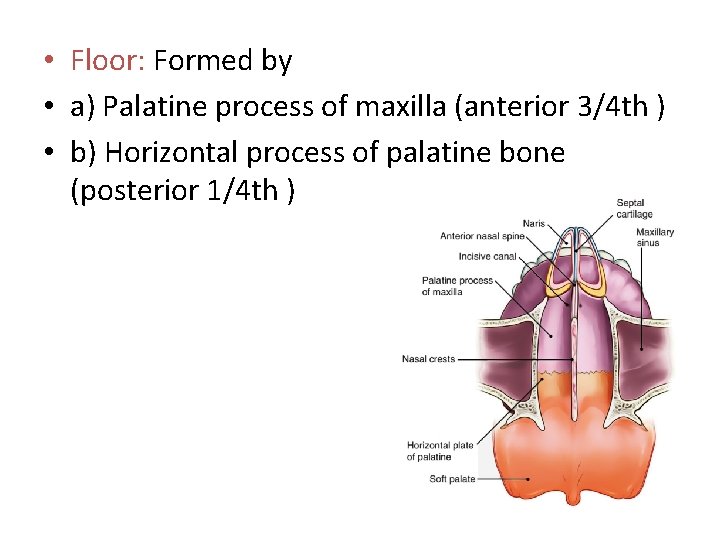
• Floor: Formed by • a) Palatine process of maxilla (anterior 3/4 th ) • b) Horizontal process of palatine bone (posterior 1/4 th )
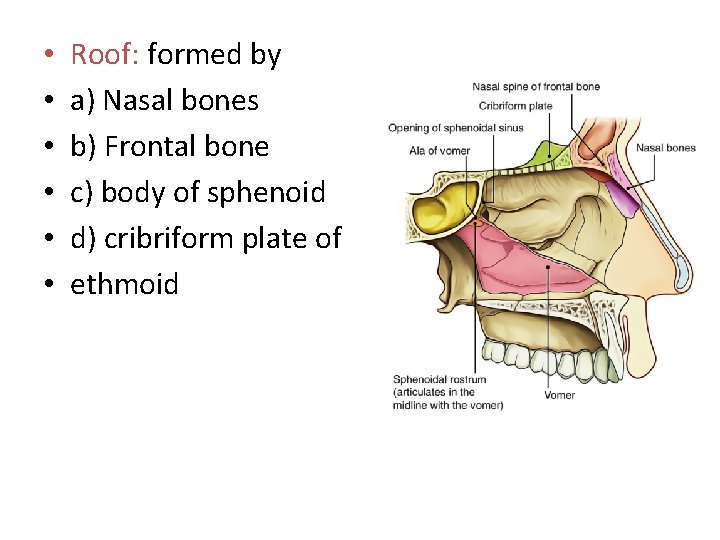
• • • Roof: formed by a) Nasal bones b) Frontal bone c) body of sphenoid d) cribriform plate of ethmoid

• Nasal septum consists of three parts • a) Columellar septum • b) Membranous septum (lies between columella and caudal border of septal cartilage) • c) Septum proper: consists of osteocartilagenous framework covered with nasal mucous membrane
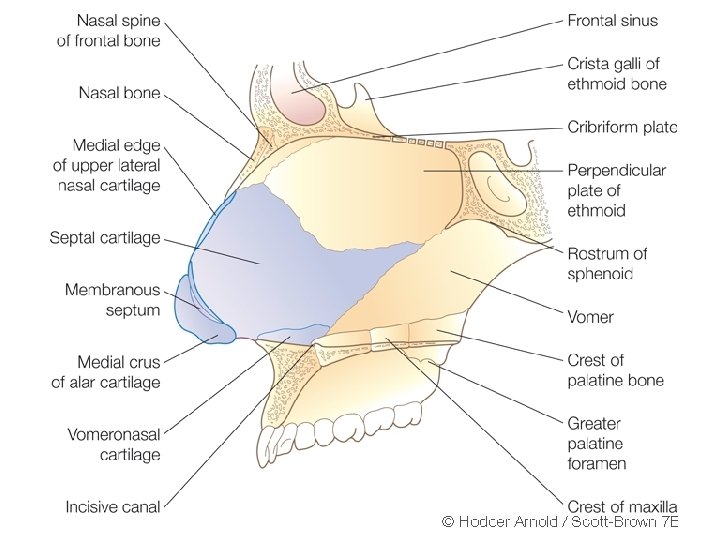
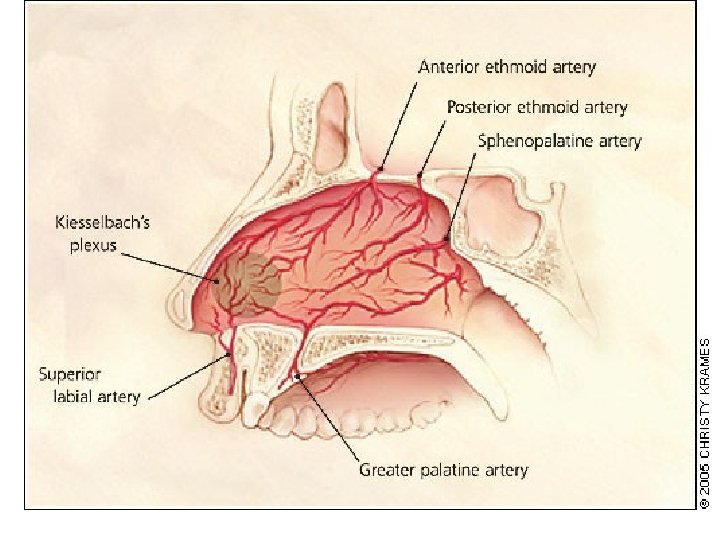
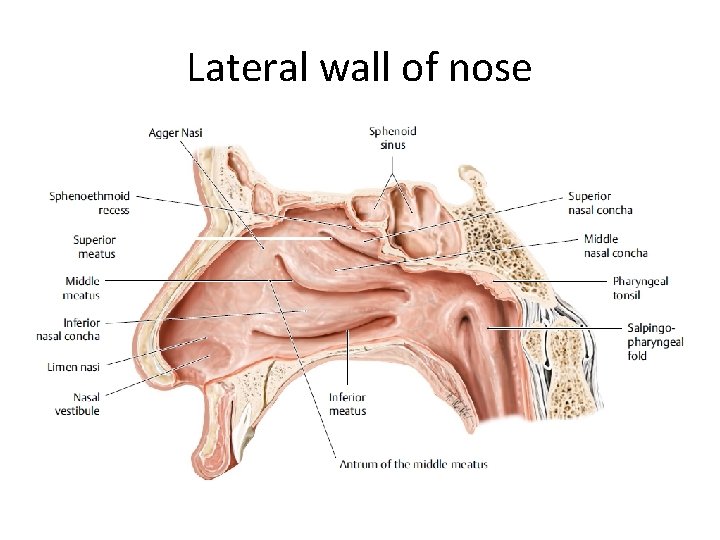
Lateral wall of nose
• Lateral wall is marked by three bony projections called turbinates or conchae • superior (part of ethmoid), • middle (part of ethmoid), • inferior (separate bone).
• Sometimes a fourth turbinate concha suprema may also be present. • Below and lateral to each turbinate is a corresponding meatus

• Inferior meatus- nasolacrimal duct opens in its anterior part. • Middle meatus- consists of bulla ethmoidalis, hiatus semilunaris, infundibulum. • Frontal, maxillary and anterior ethmoidal sinuses open into middle meatus.
• Superior meatus- posterior ethmoidal sinuses open into it. • Sphenoethmoidal recess- triangular fossa above the superior meatus. Sphenoidal sinus opens into it.
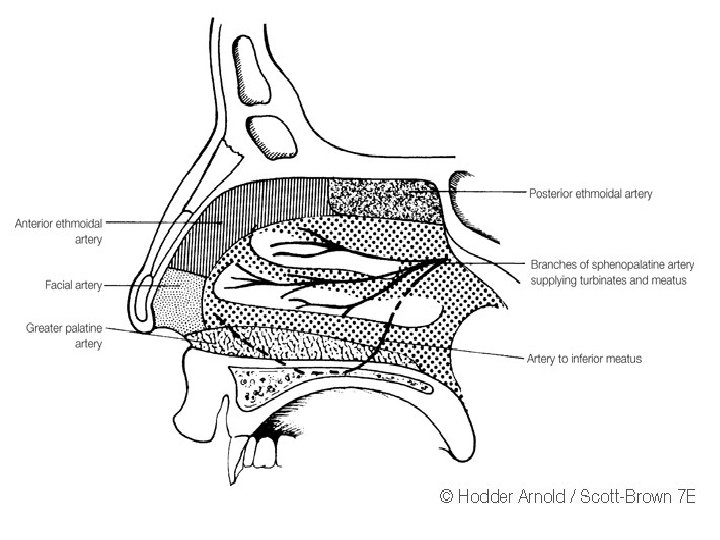
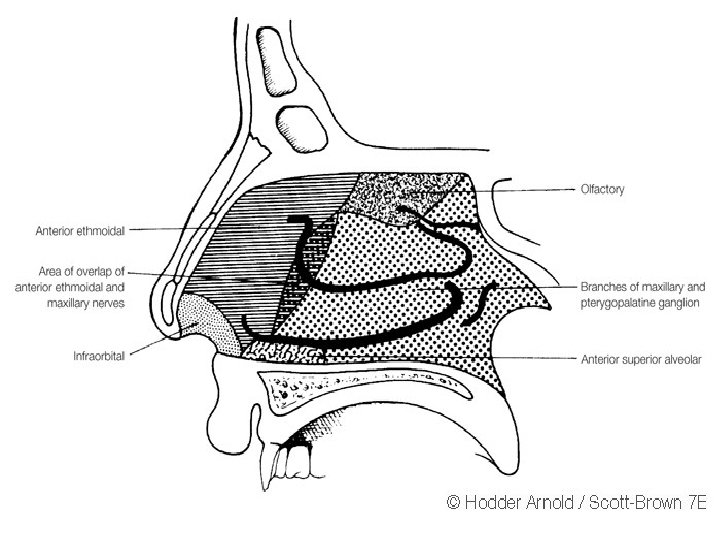
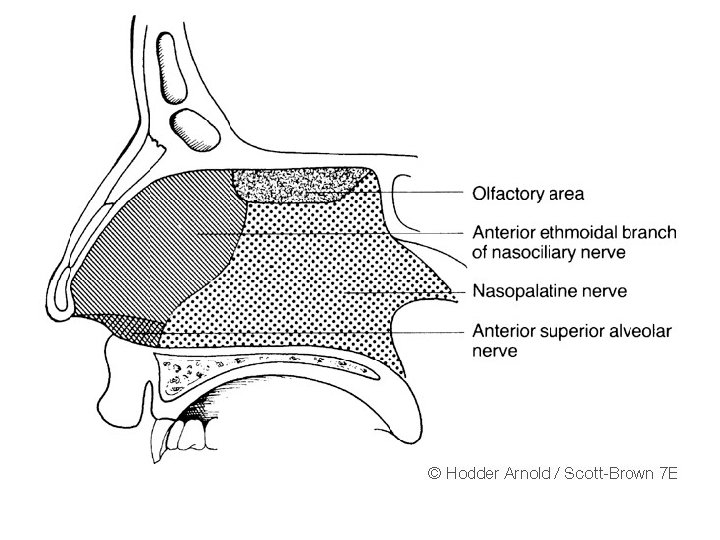
• Trigeminal nerve carries the common sensation via ophthalmic and maxillary divisions. • Special sensory (smell) carried via olfactory nerves.

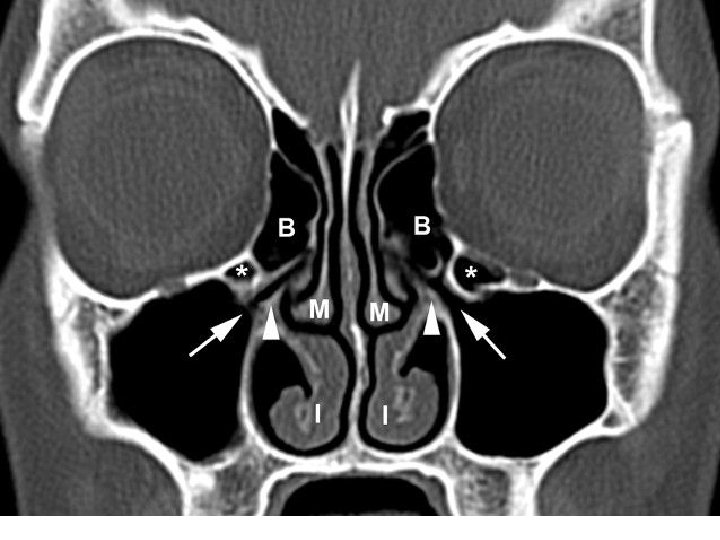
• OSTEOMEATAL COMPLEX • The middle meatus is the space below and lateral to the middle turbinate, and is often functionally referred to as the osteomeatal complex. • It contains the drainage pathways for the anterior ethmoids, the maxillary and the frontal sinuses.

• The middle meatus is the area that is most commonly involved in the pathophysiology of chronic rhinosinusitis.
• Bulla ethmoidalis • one of the most constant and largest of the anterior ethmoid air cells. • Hiatus semilunaris- hiatus semilunaris is a crescent shaped gap between the posterior free margin of the uncinate process and the anterior wall of the ethmoid bulla

• Ethmoidal infundibulum – • funnel-shaped passage through which the secretions from various anterior ethmoid cells, the maxillary sinus, and, in some cases, the frontal sinus are transported or channeled into the middle meatus.
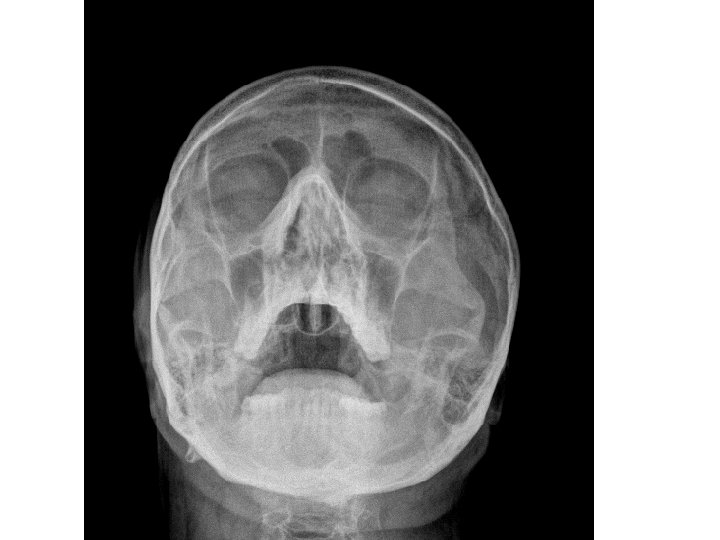
• • Maxillary sinus (Antrum of Highmore) Largest of the paranasal sinuses Pyramidal in shape with base towards lateral wall of nose and apex directed into zygomatic process
• Capacity- 10 -20 ML boundaries

THANK YOU
- Slides: 40