
Anatomy Of Eye Mohammad Ali A Sadiq M

- Slides: 26
Anatomy Of Eye Mohammad Ali A Sadiq, M. D F. C. P. S (Pk) F. P. O. S (UK) F. A. A. P. O. S (Harvard) Assistant Professor of Ophthalmology King Edward Medical University
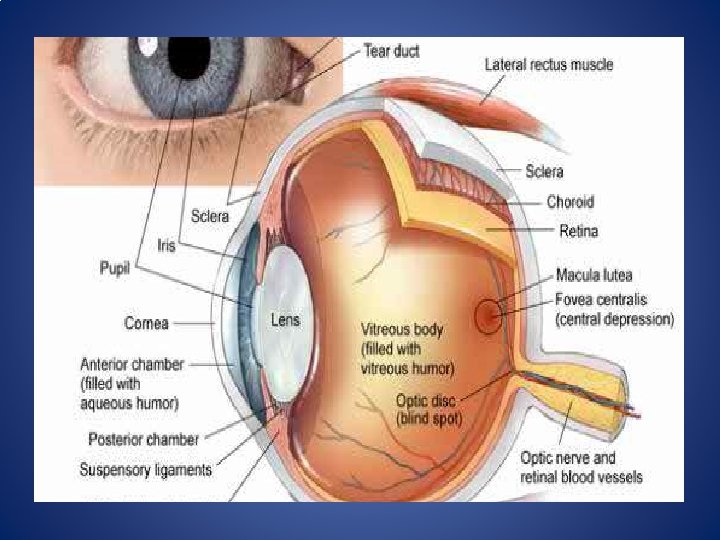
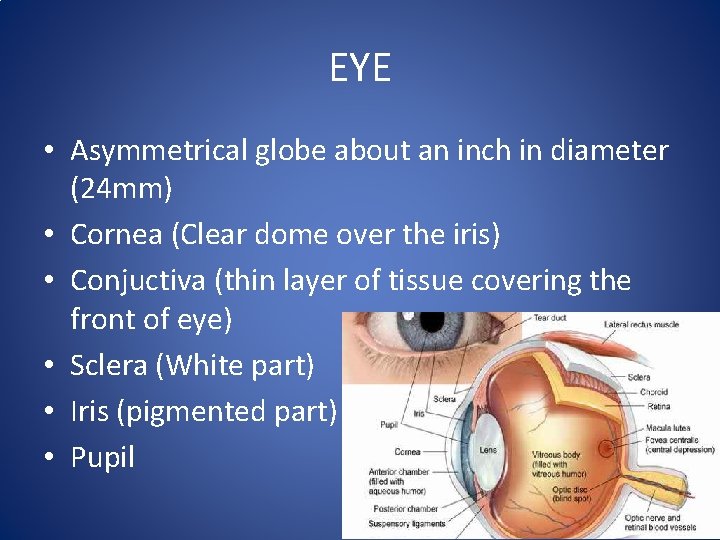
EYE • Asymmetrical globe about an inch in diameter (24 mm) • Cornea (Clear dome over the iris) • Conjuctiva (thin layer of tissue covering the front of eye) • Sclera (White part) • Iris (pigmented part) • Pupil
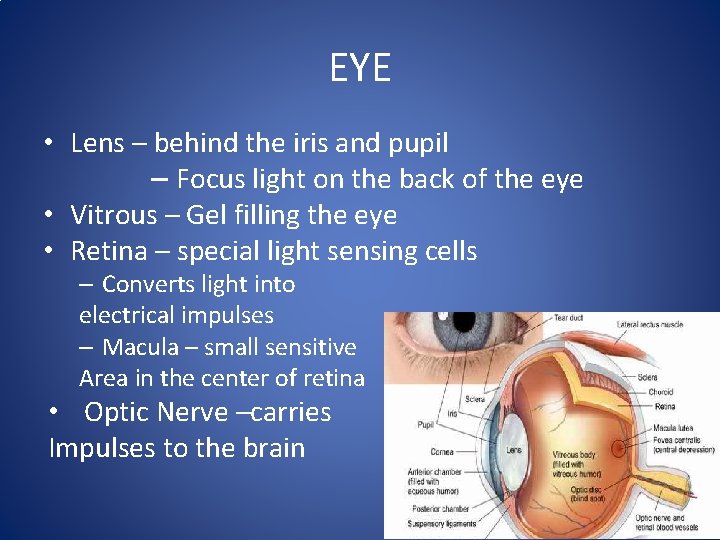
EYE • Lens – behind the iris and pupil – Focus light on the back of the eye • Vitrous – Gel filling the eye • Retina – special light sensing cells – Converts light into electrical impulses – Macula – small sensitive Area in the center of retina • Optic Nerve –carries Impulses to the brain
Eyelid • Thin fold of skin that covers and protects the human eye. • FUNCTIONS – Regularly spread the tears and other secretions of the eye surface. – Responsible for corneal protection – Responsbile for corneal nutrition – Lashes provide additional protection
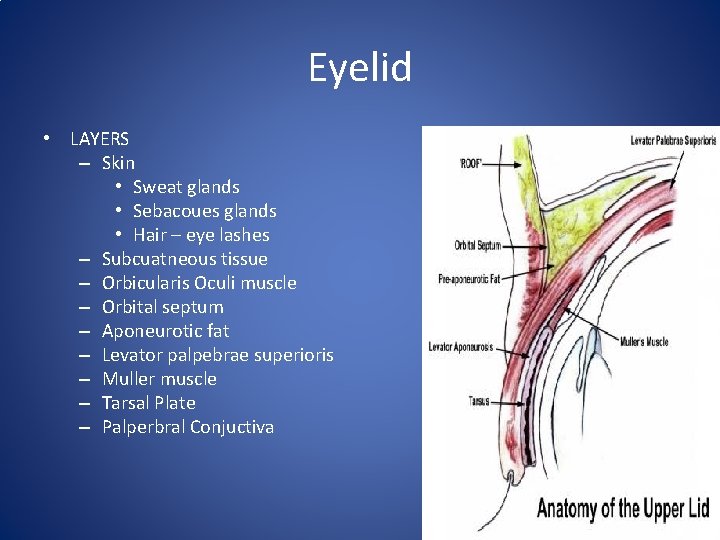
Eyelid • LAYERS – Skin • Sweat glands • Sebacoues glands • Hair – eye lashes – Subcuatneous tissue – Orbicularis Oculi muscle – Orbital septum – Aponeurotic fat – Levator palpebrae superioris – Muller muscle – Tarsal Plate – Palperbral Conjuctiva
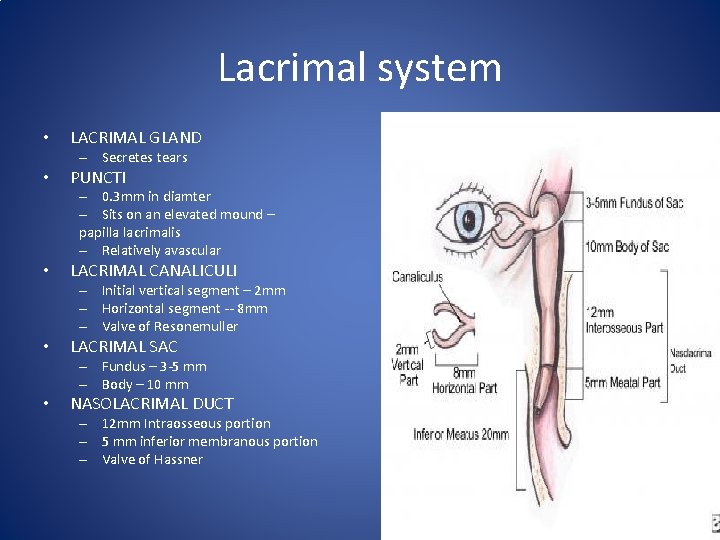
Lacrimal system • LACRIMAL GLAND – Secretes tears • PUNCTI – 0. 3 mm in diamter – Sits on an elevated mound – papilla lacrimalis – Relatively avascular • LACRIMAL CANALICULI – Initial vertical segment – 2 mm – Horizontal segment -- 8 mm – Valve of Resonemuller • LACRIMAL SAC – Fundus – 3 -5 mm – Body – 10 mm • NASOLACRIMAL DUCT – 12 mm Intraosseous portion – 5 mm inferior membranous portion – Valve of Hassner
CORNEA • Transparent from part of the eye covering the Iris, pupil and Anterior chamber • Accounts for Approx 2/3 rd of the refractive power of the eye (43 Diopters) • Completely avascular – recieves nutrients via diffusion from the tear film and aqueous humor • Unmyelinated nerve endings sensitive to
CORNEA • Diameter – 11. 5 mm • Thickness – 0. 5 -0. 6 mm in the center – 0. 6 -0. 8 mm in the periphery • Layers – Corneal Epithelium – non keratinized stratified sq cells – Bowmans Layer – Anterior limiting membrane (Type 1 collagen fibrils) – Corneal Stroma – regularly arranged collagen fibrils with keraotcytes (Type 1 collagen fibrils) – Descement’s membrane – Posterior limiting membrane (Type 1 and 4 collagen fibrils) – Corneal Endothelium simple squamous or low cuboidal monolayer
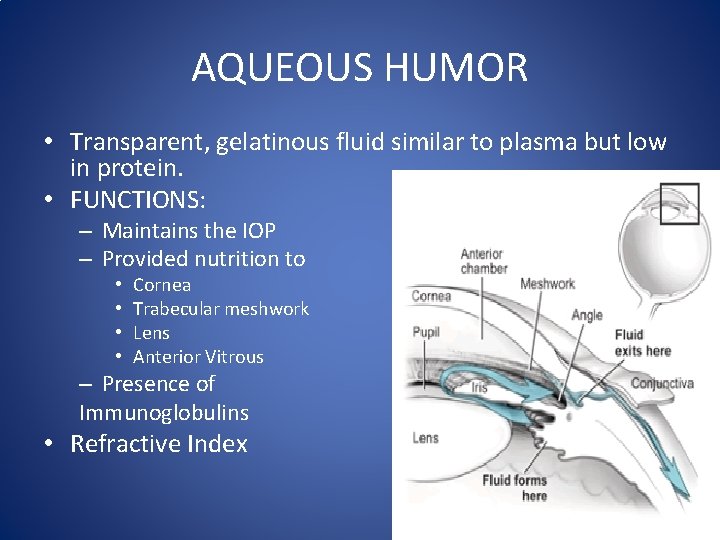
AQUEOUS HUMOR • Transparent, gelatinous fluid similar to plasma but low in protein. • FUNCTIONS: – Maintains the IOP – Provided nutrition to • • Cornea Trabecular meshwork Lens Anterior Vitrous – Presence of Immunoglobulins • Refractive Index
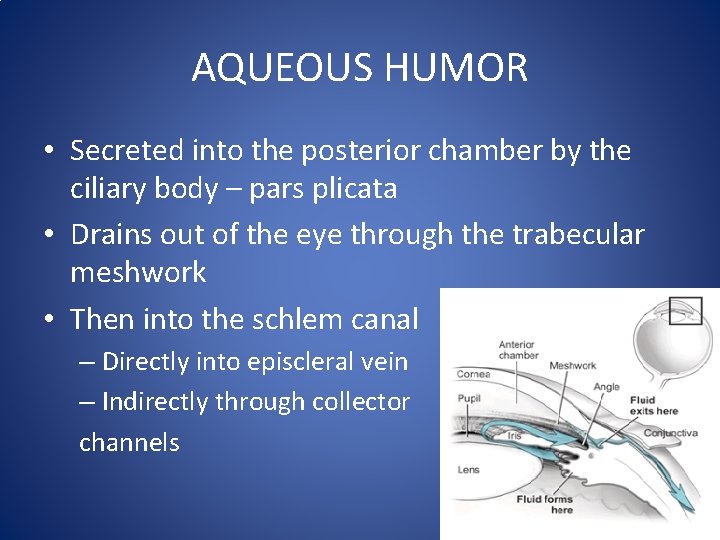
AQUEOUS HUMOR • Secreted into the posterior chamber by the ciliary body – pars plicata • Drains out of the eye through the trabecular meshwork • Then into the schlem canal – Directly into episcleral vein – Indirectly through collector channels
Conjuctiva • Lines the inside of the eyelids and covers the sclera • Non keratinized stratified epithelium with goblet cells • FUNCTION • Helps lubricate the eye by producing mucus and lacrimal gland • Contributes to immune surveillance of the eye
Conjuctiva • Palpebral or Tarsal conjuctiva – Lines the eyelid • Bulbar or Ocular Conjuctiva – Covers the eyeball over the sclera – Tightly bound to underlying sclera by Tenon’s capsule – Moves with eyeball movement • Fornix Conjuctiva – Junction between bulbar and Palpebral conjuctiva – Loose and flexible
Sclera • Forms the supporting wall of the eyeball • Continuous with the clear cornea • Thickest in the area surrounding the optic nerve • Thinnest at the insertion of the muscle
SCLERA • Three Divisions – Episclera • Loose connective tissue immediately beneath the conjuctiva – Sclera Proper • Dense white tissue that gives the area its colour – Lamina Fusca • Inner most zone made up of elastic fibres
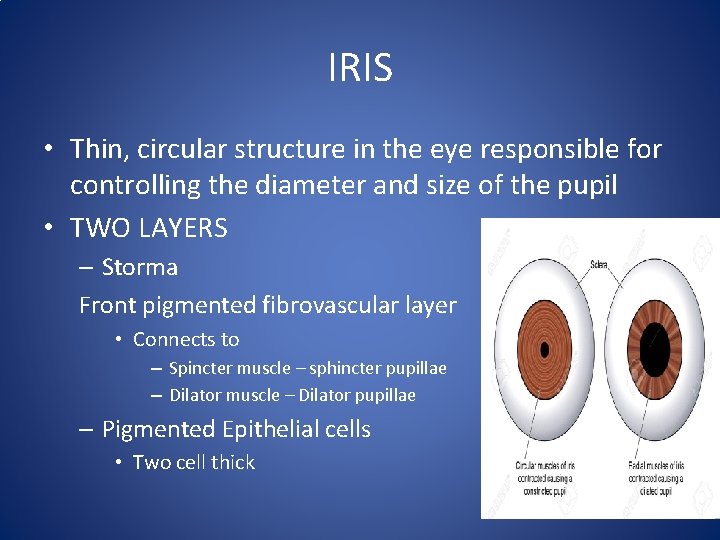
IRIS • Thin, circular structure in the eye responsible for controlling the diameter and size of the pupil • TWO LAYERS – Storma Front pigmented fibrovascular layer • Connects to – Spincter muscle – sphincter pupillae – Dilator muscle – Dilator pupillae – Pigmented Epithelial cells • Two cell thick
IRIS • Outer edge of the iris is attached to – Sclera – Anterior ciliary body • IRIS AND CILIARY BODY TOGETHER ARE KNOWN AS ANTERIOR UVEA • PORTIONS OF THE IRIS – Pupillary zone – inner region whose edge forms the boundary of the pupil – Cilliary Zone – rest if the iris that extends to its origin at the ciliary body – Collarette – region when the sphincter and dilator muscle overlap
LENS • Transparent bi-convex structure • Helps in refracting light (18 diopters) – one third of the eyes total power • Ability to change shape – Accomodation • Suspended in place by the suspensory ligaments • 10 mm in diameter. • Axial length of 4 mm
LENS • COMPONENTS OF LENS – LENS CAPSULE • Smooth transparent basement membrane • Elastic membrane composed of collagen (type 4) • Varies from 2 to 28 micrometers – thickest at the equator – LENS EPITHELIUM • • Anterior portion of the lens between the capsule and lens fibers Simple cuboidal epithelium Regulates most of the homostatic functions of the lens Progenitor for new lens fibers – LENS FIBERS • Bulk of the lens • Long, thin , transparent cells, firmly packed. • Diameters typically 4 -7 microns and length upto 12 mm
VITROUS • Clear gel filling the space between retina and the lens • Remains unchanged throughout life • Produced by cells in the non pigmented portion of the ciliary body • 98 -99% of the body is water • Strongly connected to the optic disc and the orra serrata • Loosely connected to the macula and blood vessels • As human ages, it liquefies and often collapses
CHOROID • Thin vascular layer between the sclera and the retina • Supplies blood to the retina and conducts arteries and nerves to other structures in the eye • FOUR LAYERS – Haller’s layer – outermost layer consisting of large blood vessels – Sattler’s layer – layer of medium diameter blood vessles – Choriocapillaris – layer of capillaries – Bruch’s membrane – Inner most layer of the choroid
RETINA • L atin word “rete” meaning net • Inner most, light sensitive layer of the eye • Light striking the retina initiates a cascade of chemical and electrical events that trigger a nerve impulse • PHOTORECEPTOR CELLS – RODS • Dim light • Black and white vision – CONES • Suuport day time vision • Colour perception – Ganglion cells • Reflexive response to bright daylight
RETINA • LAYERS OF RETINA – – – – – Inner Limiting membrane Nerve Fiber layer – axons of ganglion cell nuclei Ganglion cell layer Inner Plexiform layer – Contains synapses between bipolar axons and denrites of ganglion and amacrine cells Inner Nuclear Layer – contains the nuclei of amacrine cells Outer pelxiform layer – projections of rods and cones Outer nuclear layer – cell bodies of rods and cones External limiting membrane layer – layer that separates the inner segment portions of the photoreceptors from their cell nucleus Layer of rods and cones Retinal Pigment Epithelium - single layer of cuboidal cells. This is closest to the choroid.
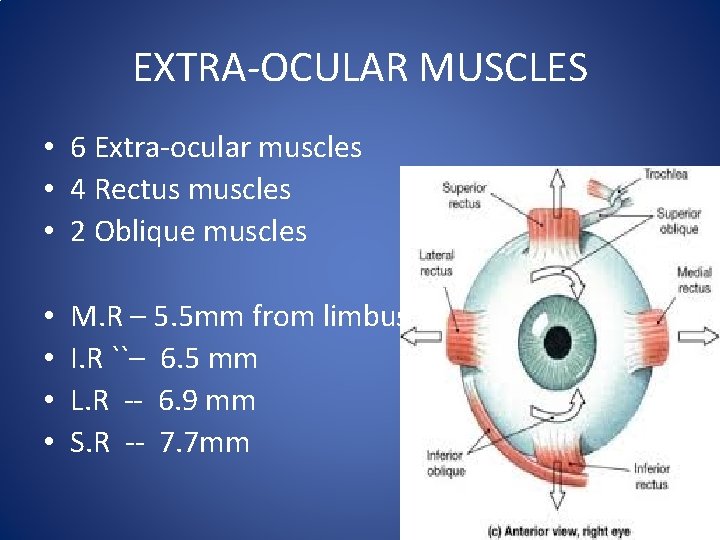
EXTRA-OCULAR MUSCLES • 6 Extra-ocular muscles • 4 Rectus muscles • 2 Oblique muscles • • M. R – 5. 5 mm from limbus I. R ``– 6. 5 mm L. R -- 6. 9 mm S. R -- 7. 7 mm
OPTIC NERVE • Extension of the brain • Energy transmission from retina to the brain • Subject to underdevelopment, damage. Inflammation • Over 1 million nerve fibers • Once it is severed, it cannot be reconnected
• • THANK YOU