
ANATOMY OF BIRDS TEKS 7 7 C TEKS
ANATOMY OF BIRDS TEKS 7. 7 (C) TEKS 7. 10 (A) (B) TEKS 7. 11 (B) TEKS 7. 12 (A)
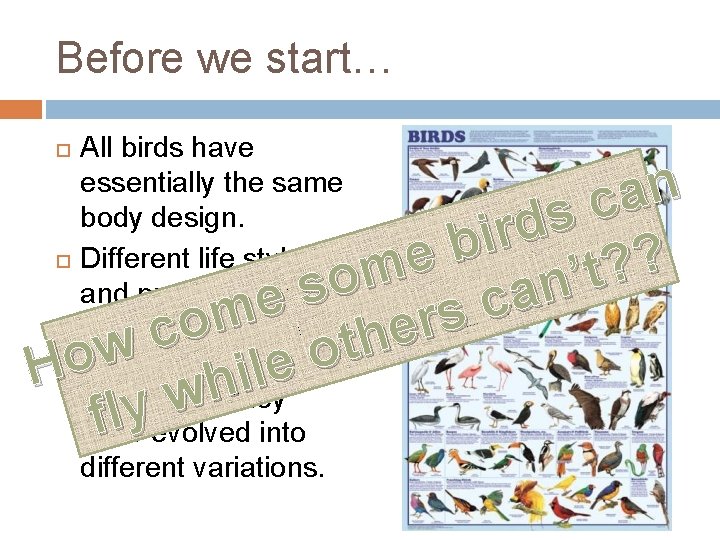
Before we start… All birds have essentially the same body design. Different life styles and pressures from the environment in which they live in means that they have evolved into different variations. n a c s d r i b e ? ? m t ’ o n s a e c m s r o e c h t w o Ho while fly
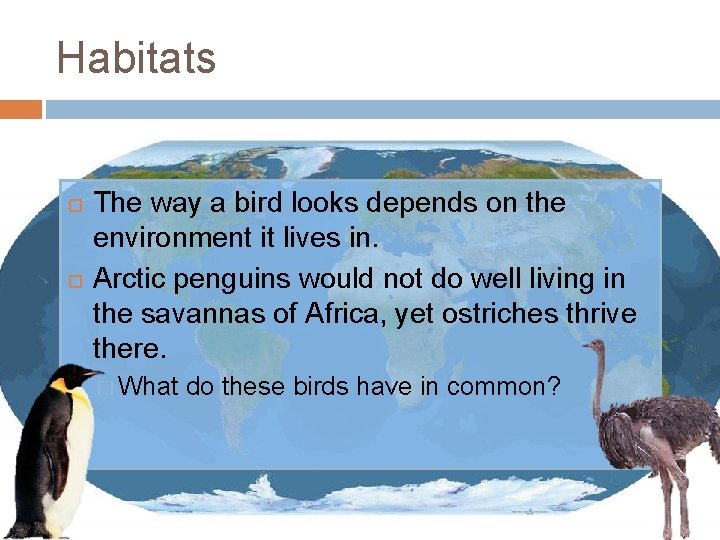
Habitats The way a bird looks depends on the environment it lives in. Arctic penguins would not do well living in the savannas of Africa, yet ostriches thrive there. � What do these birds have in common?
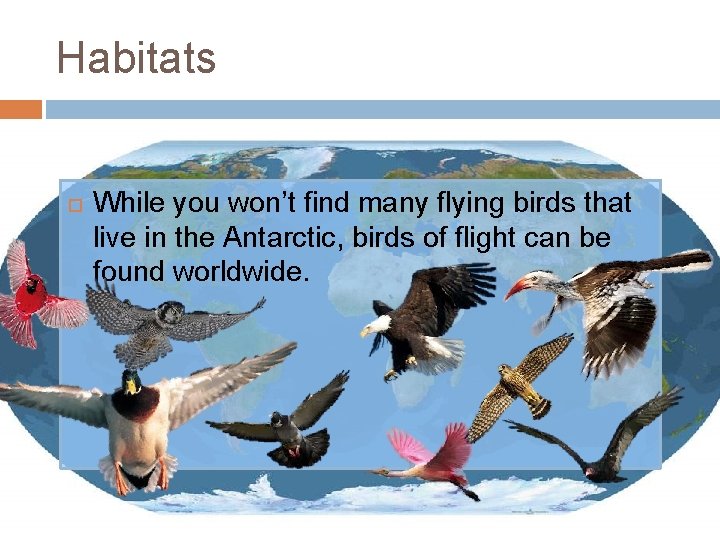
Habitats While you won’t find many flying birds that live in the Antarctic, birds of flight can be found worldwide.
Habitats Birds that can fly are usually found in places where there are many predators. Flying allows for them to escape becoming a meal, but also makes it easier for them to find their meal (especially for birds of prey such as owls, hawks, and eagles). Birds that cannot fly are found where there are few to no predators, so they don’t fly because they simply didn’t need to learn how to back in ancient history!
Habitats – Penguins vs Hawks Penguins Major populations of penguins are found in Antarctica, Argentina, Australia, Chile, New Zealand, and South Africa – Southern Hemisphere Prefers a coastal region with cold waters Hawks Wide spread across North America and even into South America Prefers a forest and field habitat with high trees or bluffs to perch
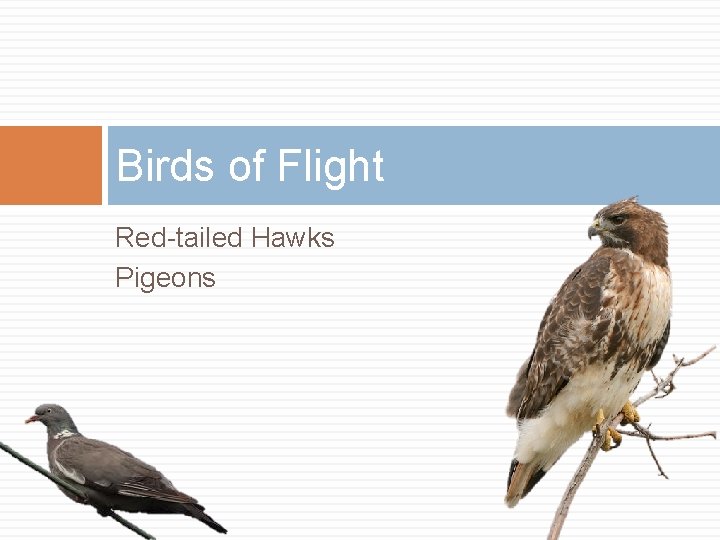
Birds of Flight Red-tailed Hawks Pigeons
How do birds fly? In order to fly, birds must be both light and strong. They have made several adaptations in order to be able to fly: � Skeletal system: lighter and bones are fused together � Respiratory system: larger and more efficient � Muscular system: red muscles (dark meat!) that get more oxygen are used for flight and are very powerful � Reproductive system: kept small until mating season � Feathers and wings
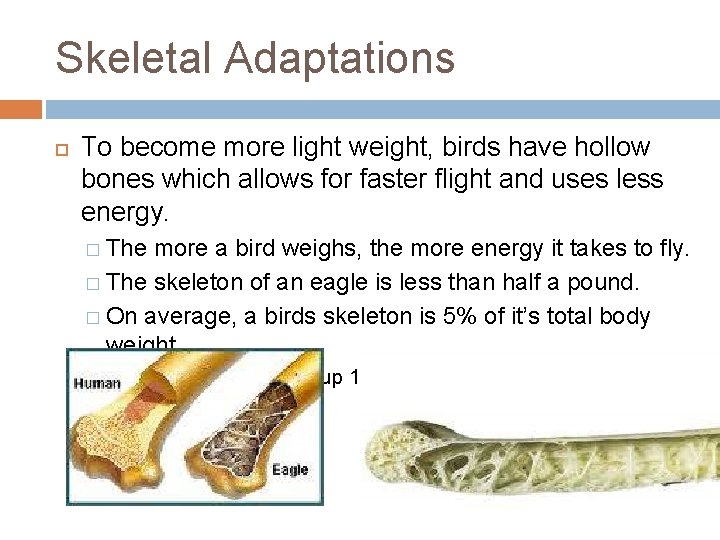
Skeletal Adaptations To become more light weight, birds have hollow bones which allows for faster flight and uses less energy. � The more a bird weighs, the more energy it takes to fly. � The skeleton of an eagle is less than half a pound. � On average, a birds skeleton is 5% of it’s total body weight. Our skeletons make up 15% of our total body weight!
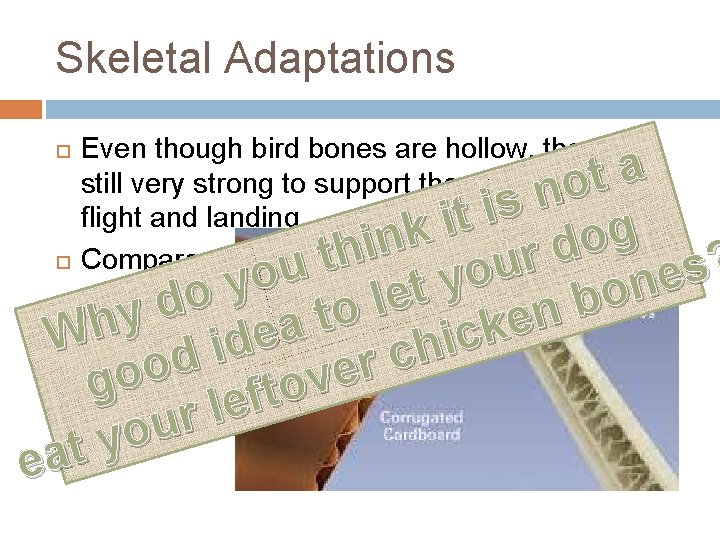
Skeletal Adaptations Even though bird bones are hollow, they are still very strong to support the demands of flight and landing. Compare: a t o n s i t i k g n o i d h t r ? u u s o o e y y n t o o e l b d o n y t e h a k e W c i d i h c d r o e o v g o t f e l r u o y eat
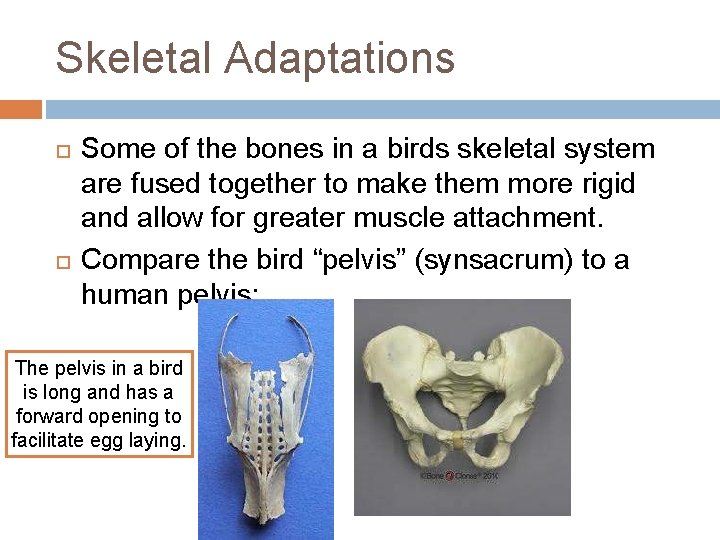
Skeletal Adaptations Some of the bones in a birds skeletal system are fused together to make them more rigid and allow for greater muscle attachment. Compare the bird “pelvis” (synsacrum) to a human pelvis: The pelvis in a bird is long and has a forward opening to facilitate egg laying.
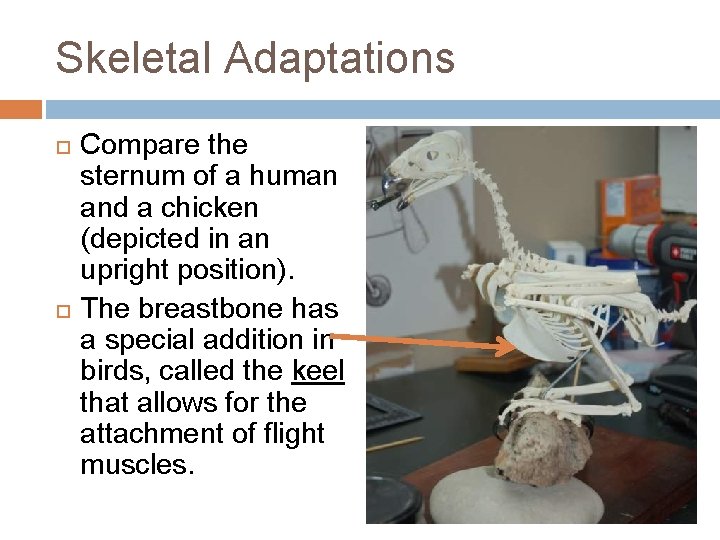
Skeletal Adaptations Compare the sternum of a human and a chicken (depicted in an upright position). The breastbone has a special addition in birds, called the keel that allows for the attachment of flight muscles.
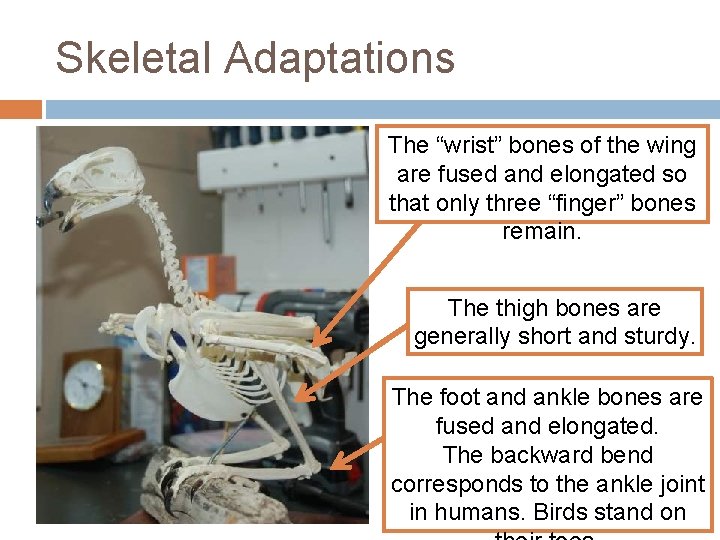
Skeletal Adaptations The “wrist” bones of the wing are fused and elongated so that only three “finger” bones remain. The thigh bones are generally short and sturdy. The foot and ankle bones are fused and elongated. The backward bend corresponds to the ankle joint in humans. Birds stand on
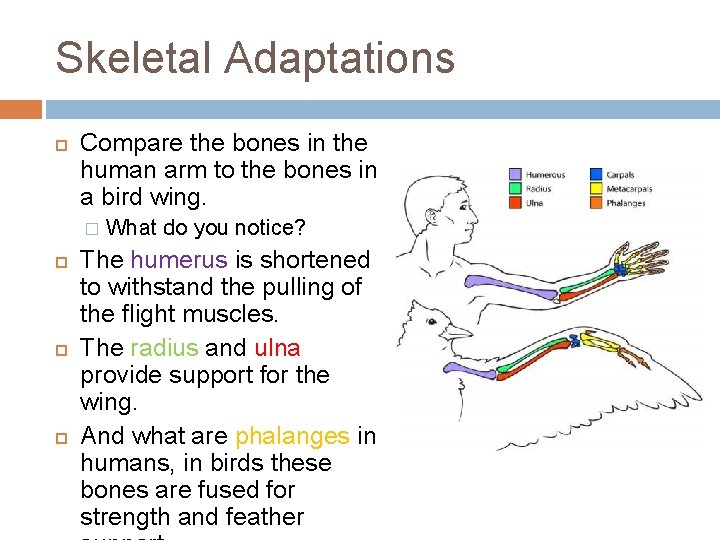
Skeletal Adaptations Compare the bones in the human arm to the bones in a bird wing. � What do you notice? The humerus is shortened to withstand the pulling of the flight muscles. The radius and ulna provide support for the wing. And what are phalanges in humans, in birds these bones are fused for strength and feather
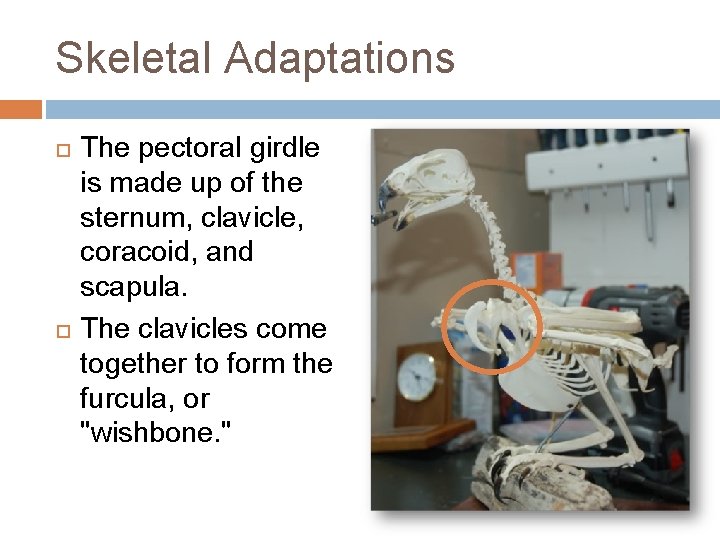
Skeletal Adaptations The pectoral girdle is made up of the sternum, clavicle, coracoid, and scapula. The clavicles come together to form the furcula, or "wishbone. "
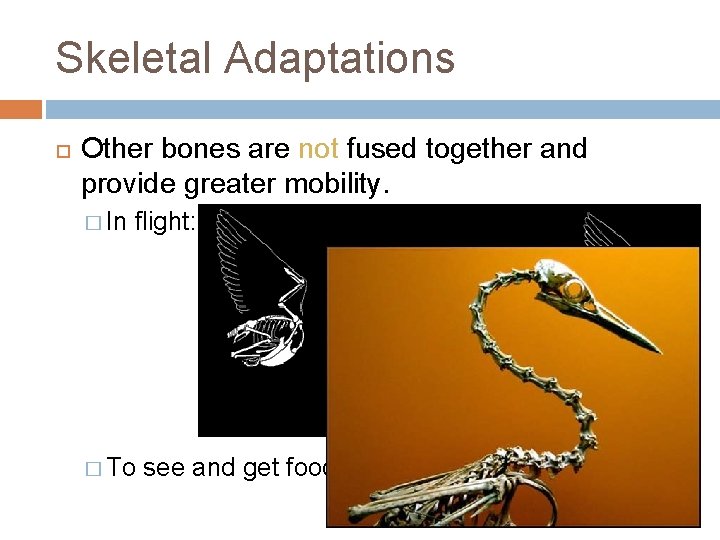
Skeletal Adaptations Other bones are not fused together and provide greater mobility. � In flight: � To see and get food:
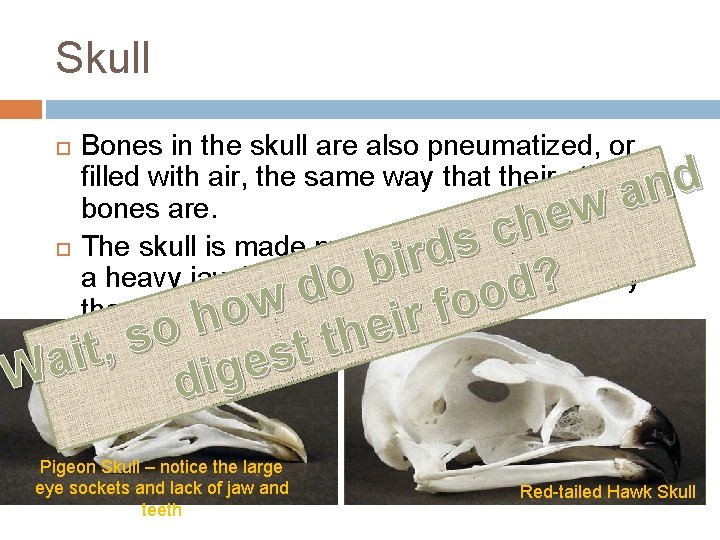
Skull Bones in the skull are also pneumatized, or filled with air, the same way that their other bones are. The skull is made more lightweight by lacking a heavy jaw bone and muscles, and also by the absence of teeth. d n a w e h c s d r i b ? o d d o w o f o r h i e o h s t , t t i s a e W dig Pigeon Skull – notice the large eye sockets and lack of jaw and teeth Red-tailed Hawk Skull
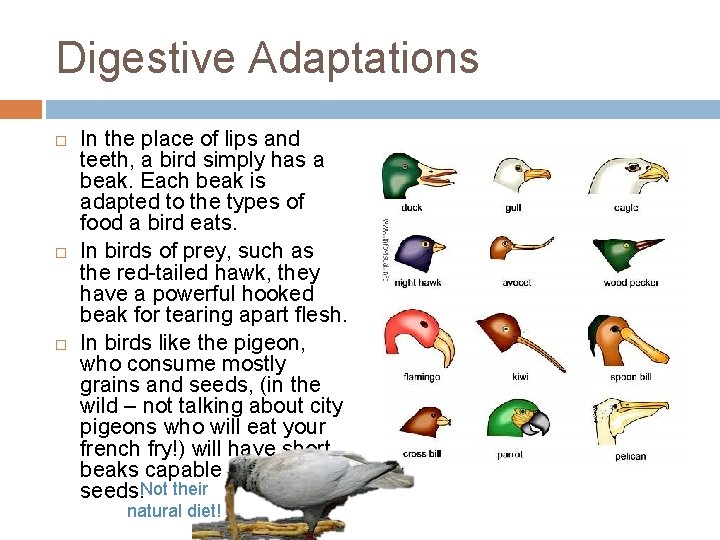
Digestive Adaptations In the place of lips and teeth, a bird simply has a beak. Each beak is adapted to the types of food a bird eats. In birds of prey, such as the red-tailed hawk, they have a powerful hooked beak for tearing apart flesh. In birds like the pigeon, who consume mostly grains and seeds, (in the wild – not talking about city pigeons who will eat your french fry!) will have short beaks capable of cracking seeds. Not their natural diet!
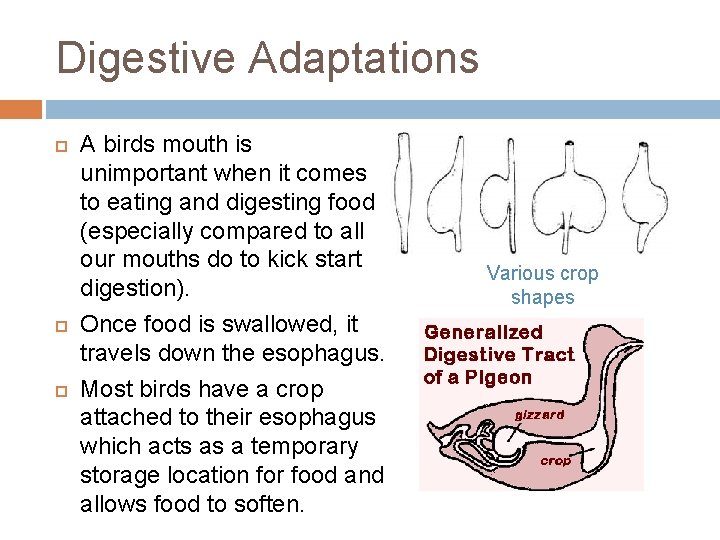
Digestive Adaptations A birds mouth is unimportant when it comes to eating and digesting food (especially compared to all our mouths do to kick start digestion). Once food is swallowed, it travels down the esophagus. Most birds have a crop attached to their esophagus which acts as a temporary storage location for food and allows food to soften. Various crop shapes
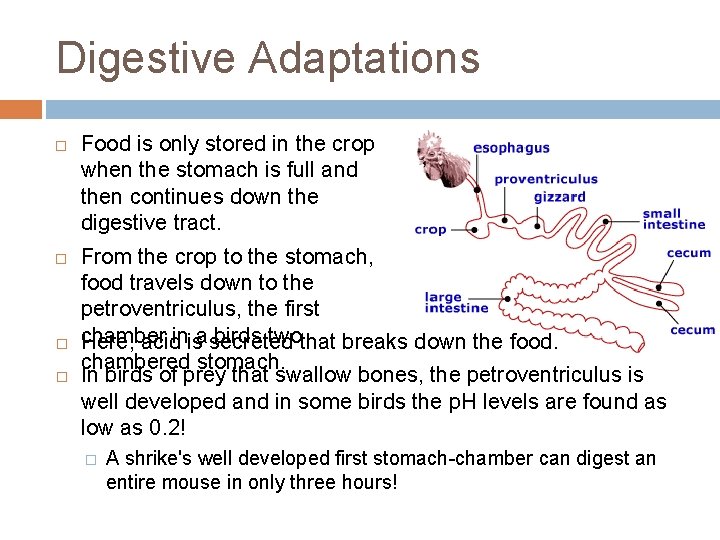
Digestive Adaptations Food is only stored in the crop when the stomach is full and then continues down the digestive tract. From the crop to the stomach, food travels down to the petroventriculus, the first chamber birds twothat breaks down the food. Here, acidinisa secreted chambered stomach. In birds of prey that swallow bones, the petroventriculus is well developed and in some birds the p. H levels are found as low as 0. 2! � A shrike's well developed first stomach-chamber can digest an entire mouse in only three hours!
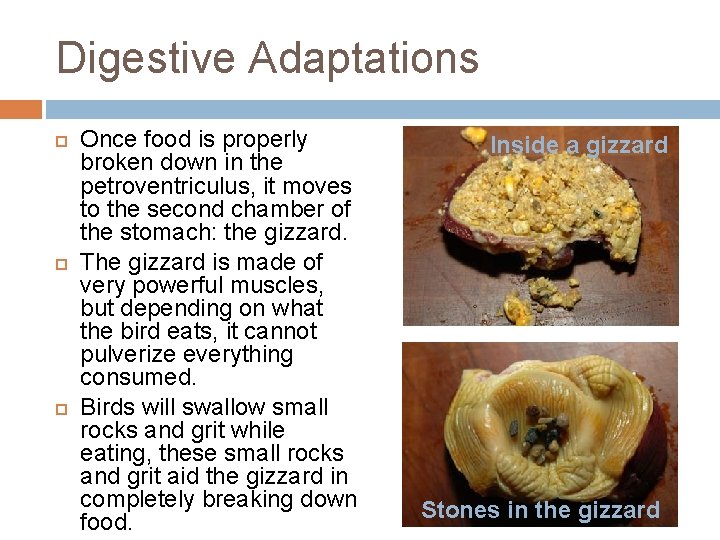
Digestive Adaptations Once food is properly broken down in the petroventriculus, it moves to the second chamber of the stomach: the gizzard. The gizzard is made of very powerful muscles, but depending on what the bird eats, it cannot pulverize everything consumed. Birds will swallow small rocks and grit while eating, these small rocks and grit aid the gizzard in completely breaking down food. Inside a gizzard Stones in the gizzard
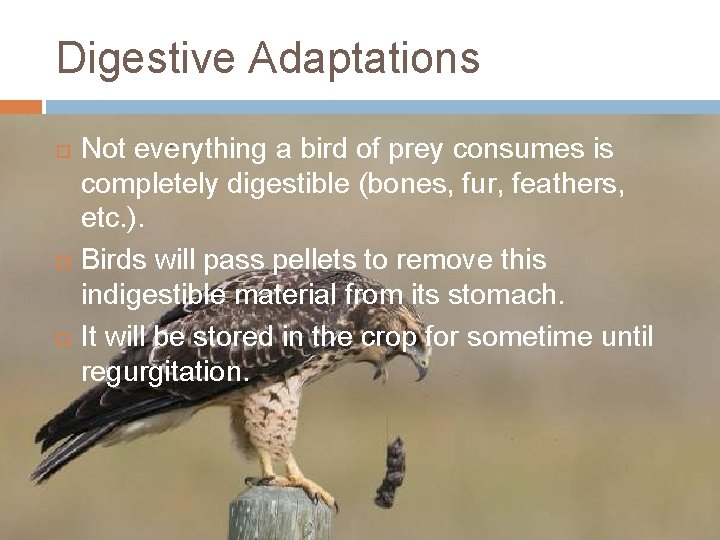
Digestive Adaptations Not everything a bird of prey consumes is completely digestible (bones, fur, feathers, etc. ). Birds will pass pellets to remove this indigestible material from its stomach. It will be stored in the crop for sometime until regurgitation.
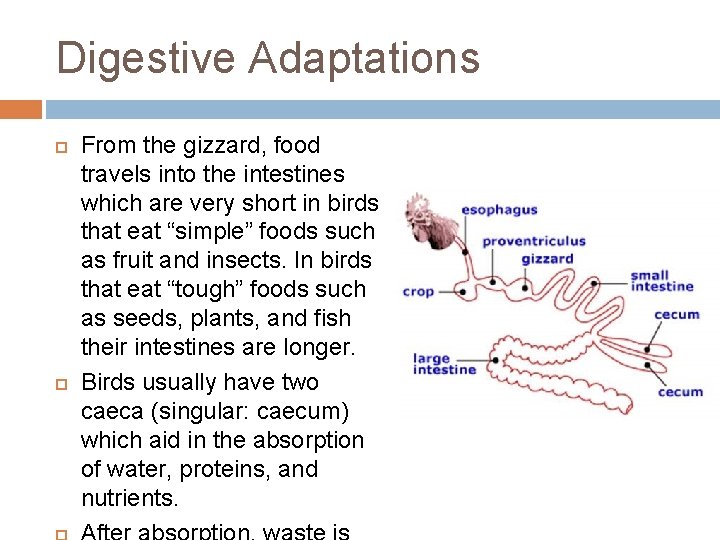
Digestive Adaptations From the gizzard, food travels into the intestines which are very short in birds that eat “simple” foods such as fruit and insects. In birds that eat “tough” foods such as seeds, plants, and fish their intestines are longer. Birds usually have two caeca (singular: caecum) which aid in the absorption of water, proteins, and nutrients.
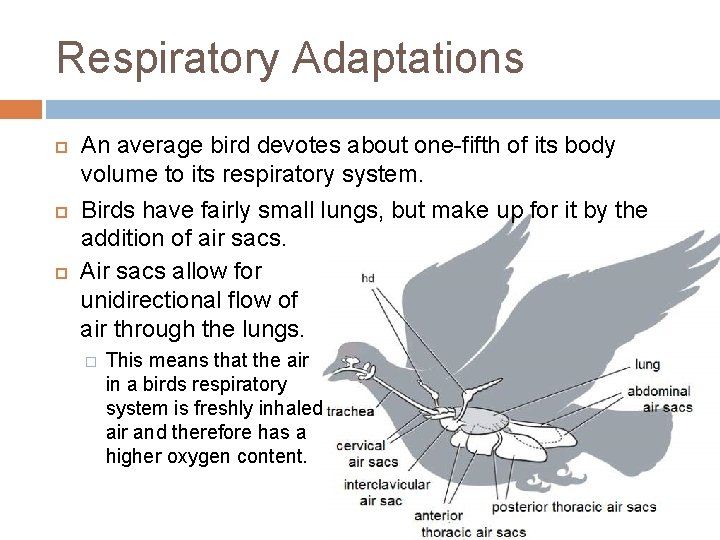
Respiratory Adaptations An average bird devotes about one-fifth of its body volume to its respiratory system. Birds have fairly small lungs, but make up for it by the addition of air sacs. Air sacs allow for unidirectional flow of air through the lungs. � This means that the air in a birds respiratory system is freshly inhaled air and therefore has a higher oxygen content.
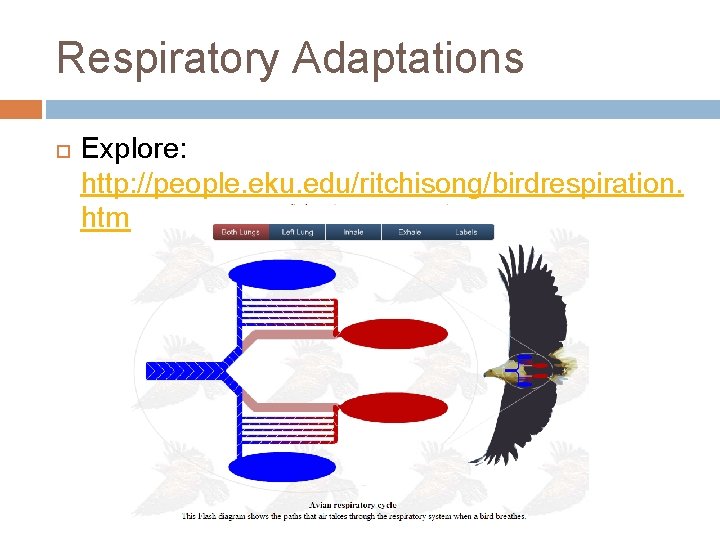
Respiratory Adaptations Explore: http: //people. eku. edu/ritchisong/birdrespiration. html
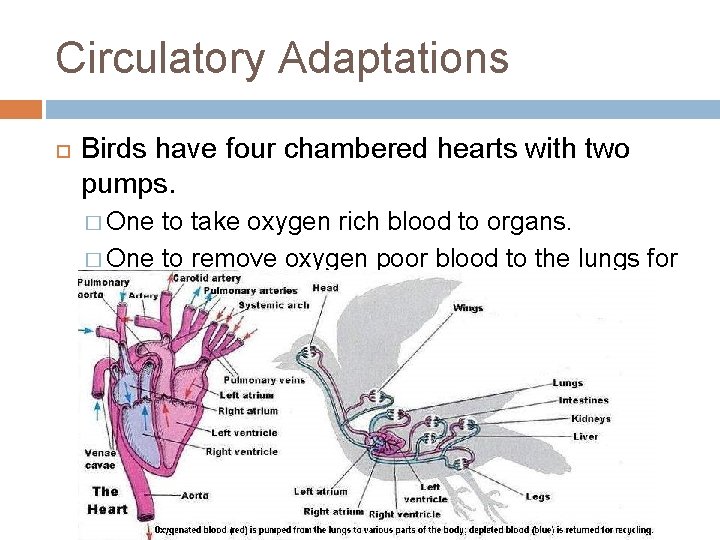
Circulatory Adaptations Birds have four chambered hearts with two pumps. � One to take oxygen rich blood to organs. � One to remove oxygen poor blood to the lungs for exhalation.
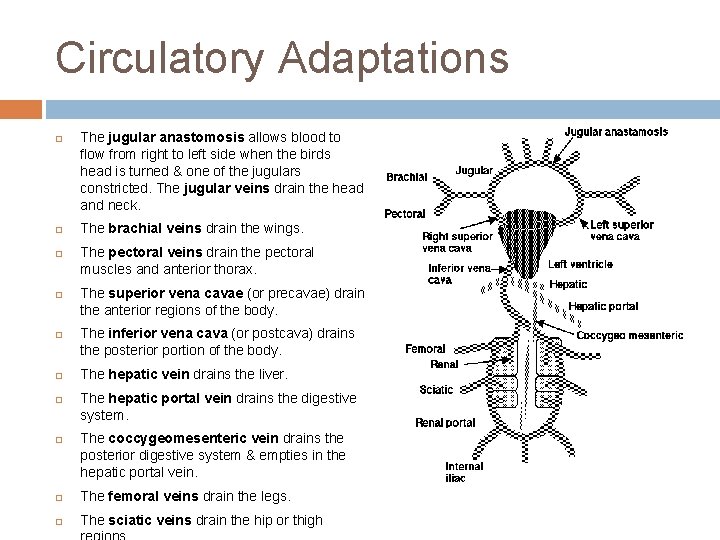
Circulatory Adaptations The jugular anastomosis allows blood to flow from right to left side when the birds head is turned & one of the jugulars constricted. The jugular veins drain the head and neck. The brachial veins drain the wings. The pectoral veins drain the pectoral muscles and anterior thorax. The superior vena cavae (or precavae) drain the anterior regions of the body. The inferior vena cava (or postcava) drains the posterior portion of the body. The hepatic vein drains the liver. The hepatic portal vein drains the digestive system. The coccygeomesenteric vein drains the posterior digestive system & empties in the hepatic portal vein. The femoral veins drain the legs. The sciatic veins drain the hip or thigh
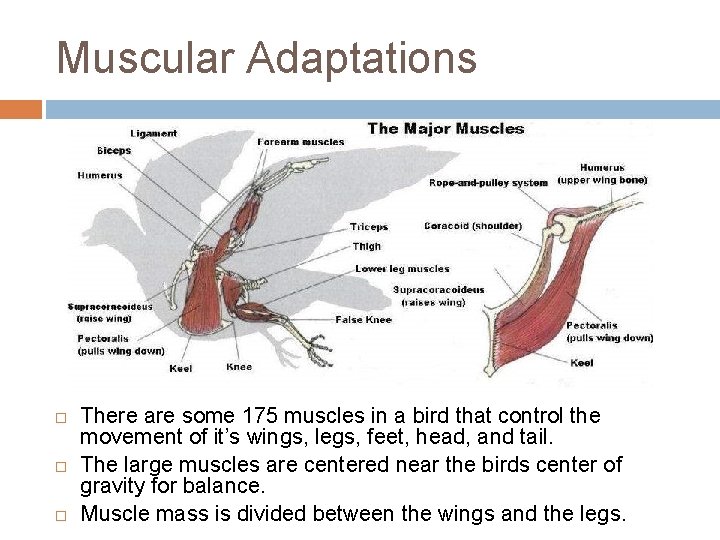
Muscular Adaptations There are some 175 muscles in a bird that control the movement of it’s wings, legs, feet, head, and tail. The large muscles are centered near the birds center of gravity for balance. Muscle mass is divided between the wings and the legs.
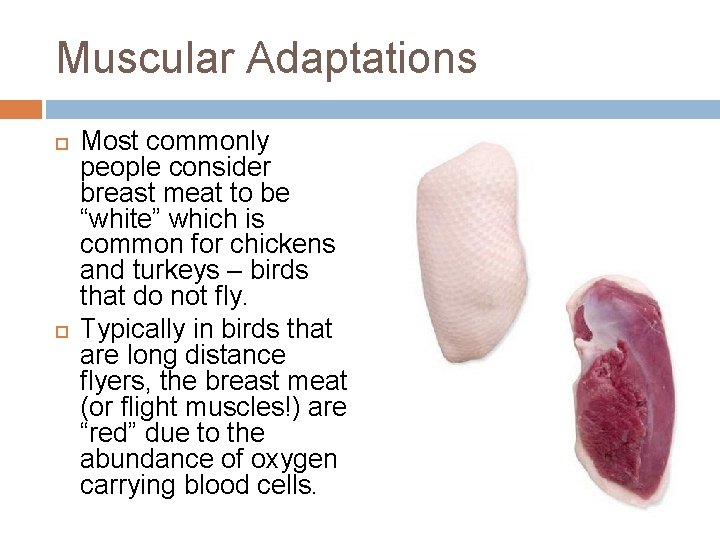
Muscular Adaptations Most commonly people consider breast meat to be “white” which is common for chickens and turkeys – birds that do not fly. Typically in birds that are long distance flyers, the breast meat (or flight muscles!) are “red” due to the abundance of oxygen carrying blood cells.
Muscular Adaptations To fly, a bird moves it’s wings up and down, not by using muscles that work in pairs (as in our arms and legs), but rather as part of a pulley system. �A muscle that connects to the chest pulls the wing up and down. Flight muscles are located in the breast area and are attached to the keel.
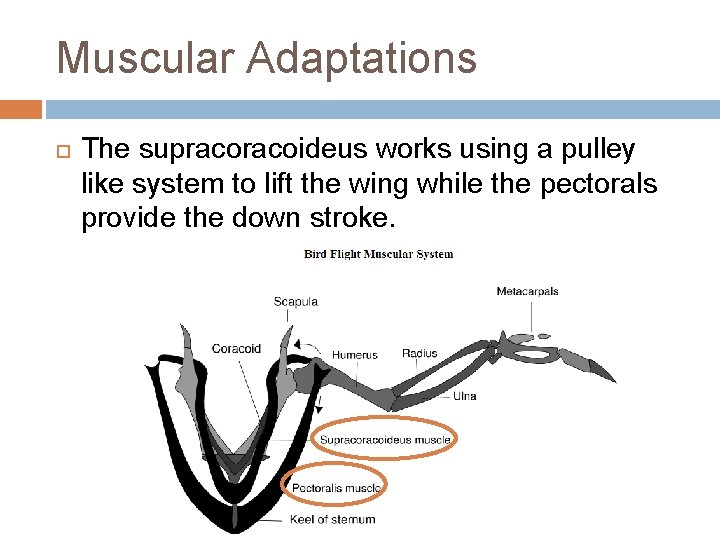
Muscular Adaptations The supracoideus works using a pulley like system to lift the wing while the pectorals provide the down stroke.
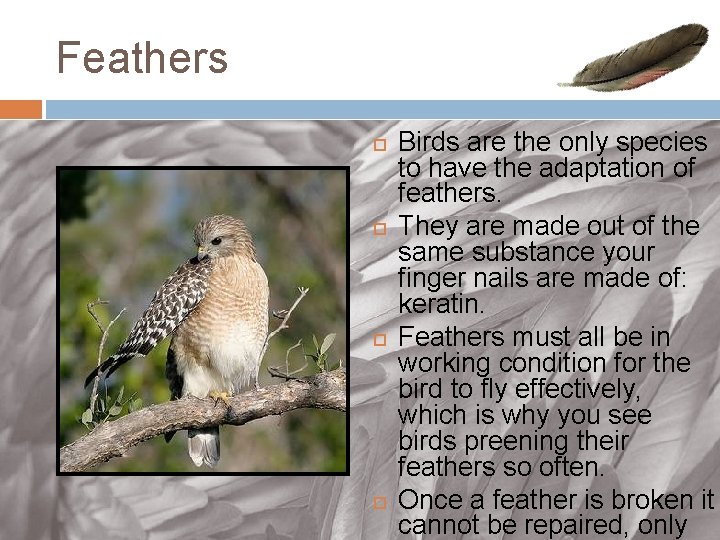
Feathers Birds are the only species to have the adaptation of feathers. They are made out of the same substance your finger nails are made of: keratin. Feathers must all be in working condition for the bird to fly effectively, which is why you see birds preening their feathers so often. Once a feather is broken it cannot be repaired, only
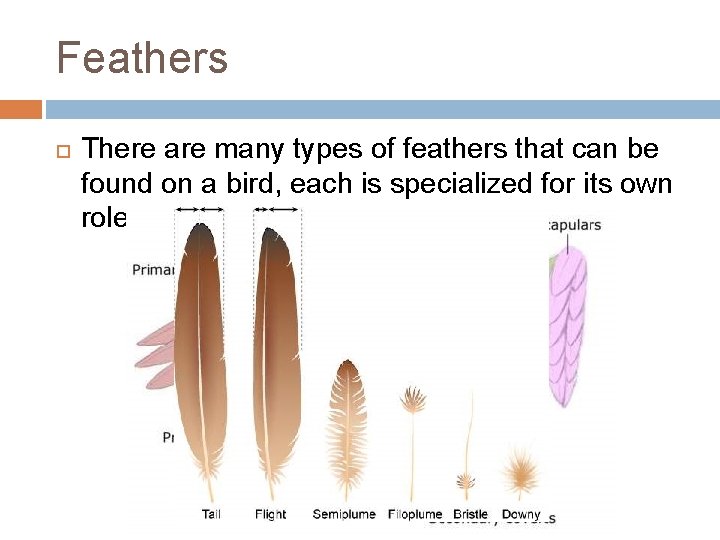
Feathers There are many types of feathers that can be found on a bird, each is specialized for its own role.
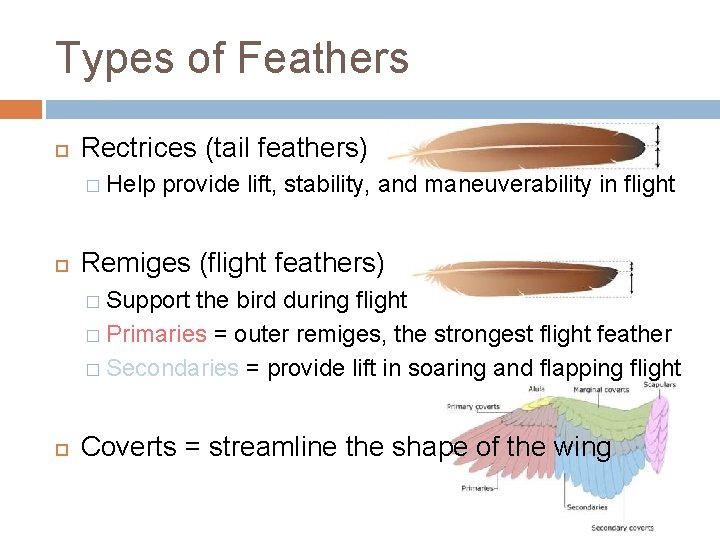
Types of Feathers Rectrices (tail feathers) � Help provide lift, stability, and maneuverability in flight Remiges (flight feathers) � Support the bird during flight � Primaries = outer remiges, the strongest flight feather � Secondaries = provide lift in soaring and flapping flight Coverts = streamline the shape of the wing
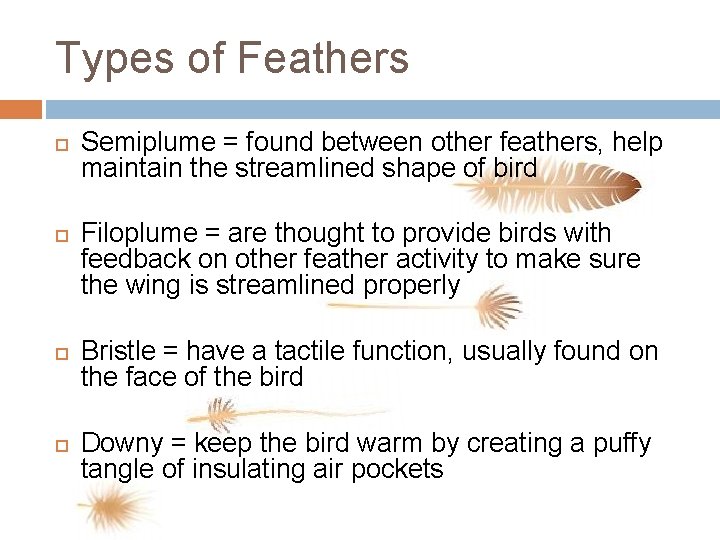
Types of Feathers Semiplume = found between other feathers, help maintain the streamlined shape of bird Filoplume = are thought to provide birds with feedback on other feather activity to make sure the wing is streamlined properly Bristle = have a tactile function, usually found on the face of the bird Downy = keep the bird warm by creating a puffy tangle of insulating air pockets
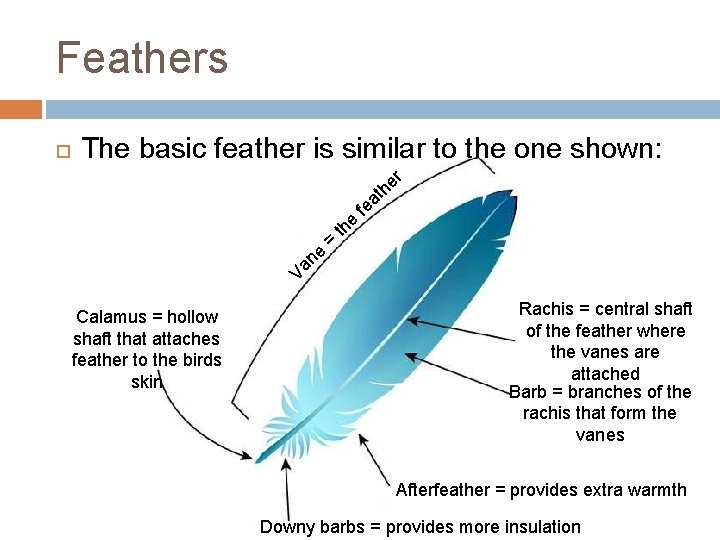
Feathers The basic feather is similar to the one shown: r e ne = th fe e th a Va Calamus = hollow shaft that attaches feather to the birds skin Rachis = central shaft of the feather where the vanes are attached Barb = branches of the rachis that form the vanes Afterfeather = provides extra warmth Downy barbs = provides more insulation
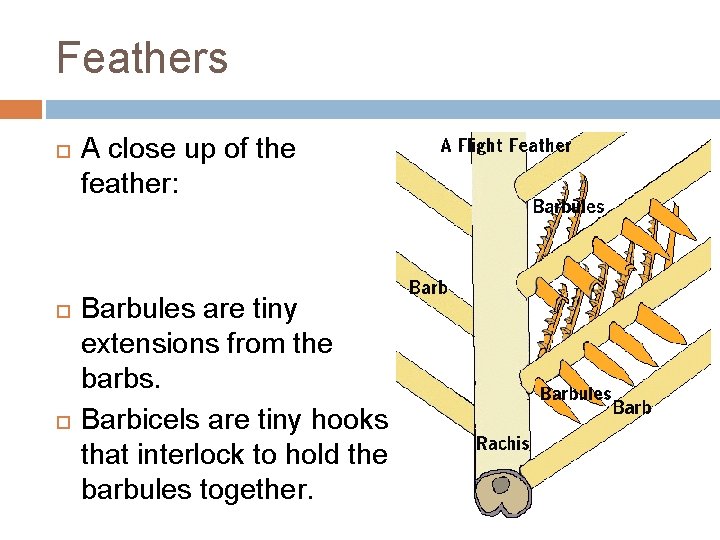
Feathers A close up of the feather: Barbules are tiny extensions from the barbs. Barbicels are tiny hooks that interlock to hold the barbules together.
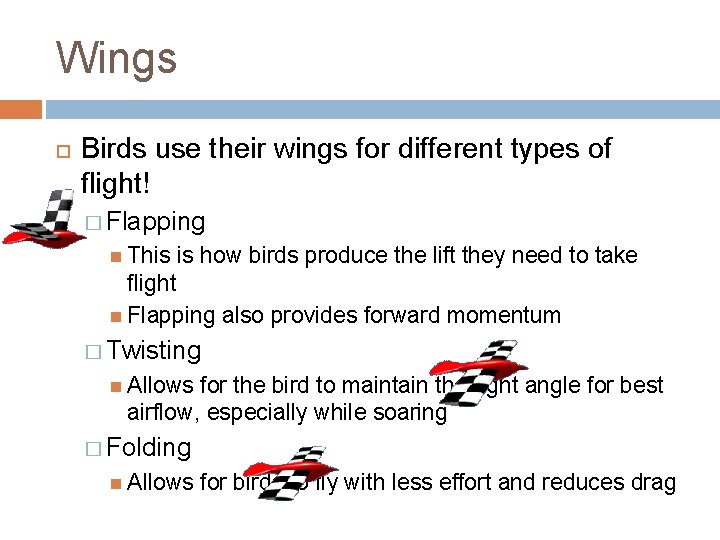
Wings Birds use their wings for different types of flight! � Flapping This is how birds produce the lift they need to take flight Flapping also provides forward momentum � Twisting Allows for the bird to maintain the right angle for best airflow, especially while soaring � Folding Allows for birds to fly with less effort and reduces drag
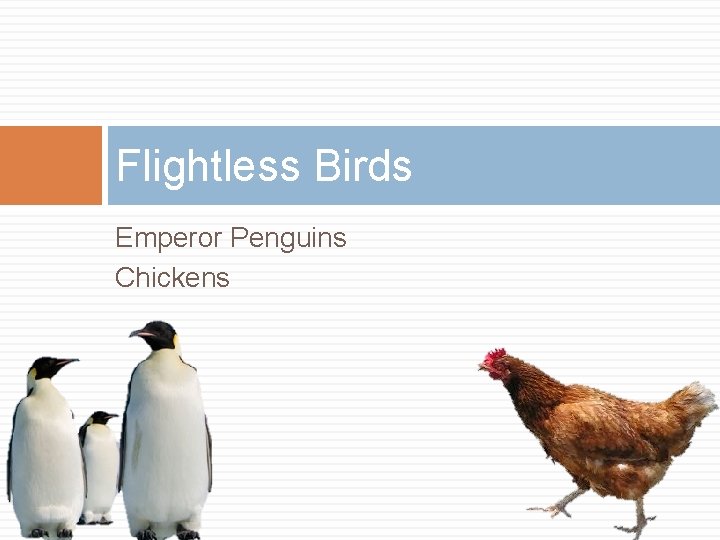
Flightless Birds Emperor Penguins Chickens
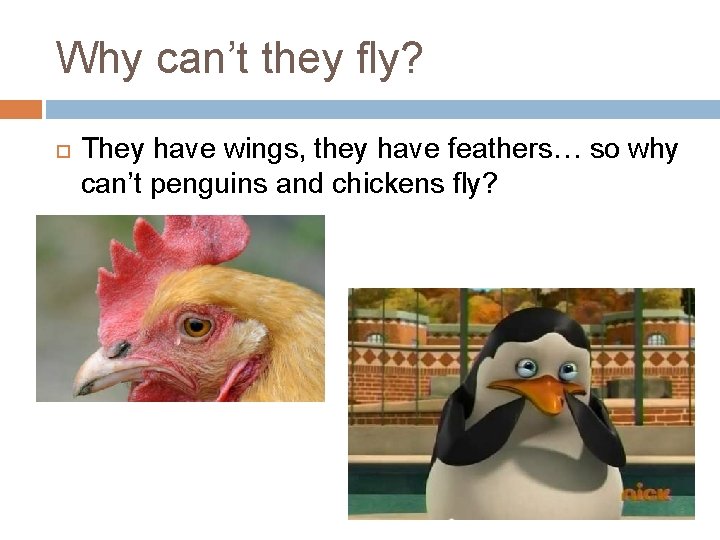
Why can’t they fly? They have wings, they have feathers… so why can’t penguins and chickens fly?
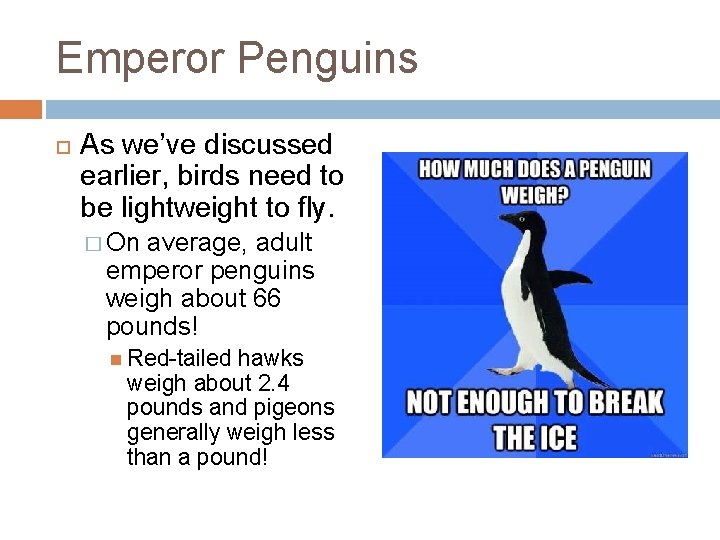
Emperor Penguins As we’ve discussed earlier, birds need to be lightweight to fly. � On average, adult emperor penguins weigh about 66 pounds! Red-tailed hawks weigh about 2. 4 pounds and pigeons generally weigh less than a pound!
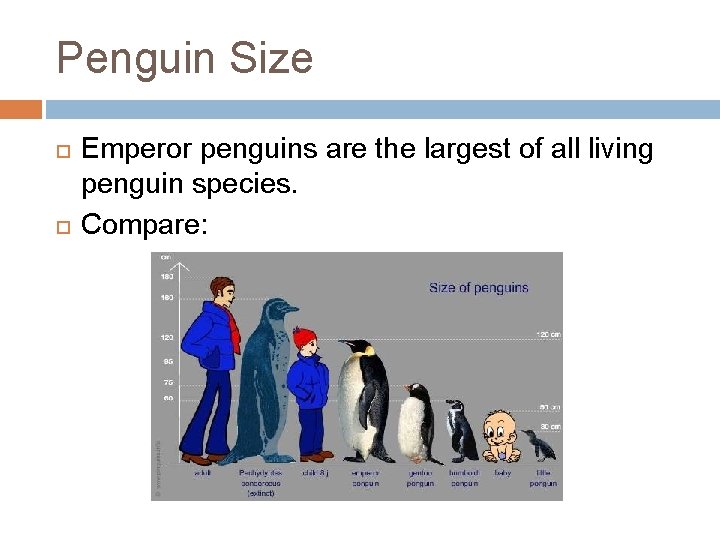
Penguin Size Emperor penguins are the largest of all living penguin species. Compare:
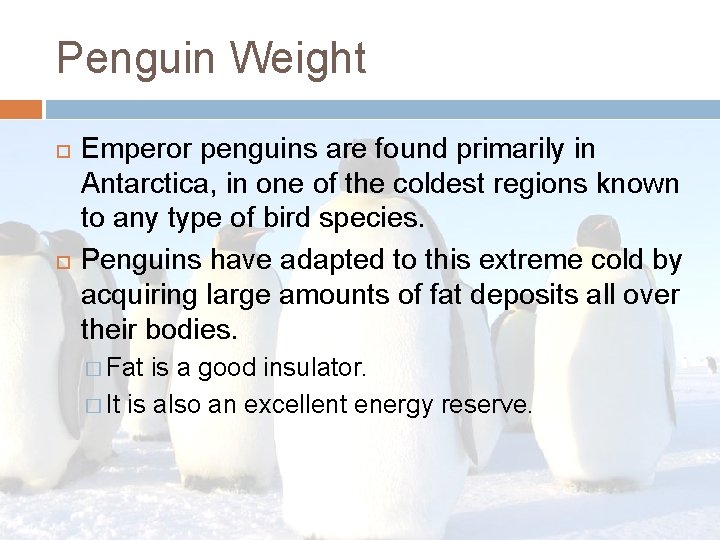
Penguin Weight Emperor penguins are found primarily in Antarctica, in one of the coldest regions known to any type of bird species. Penguins have adapted to this extreme cold by acquiring large amounts of fat deposits all over their bodies. � Fat is a good insulator. � It is also an excellent energy reserve.
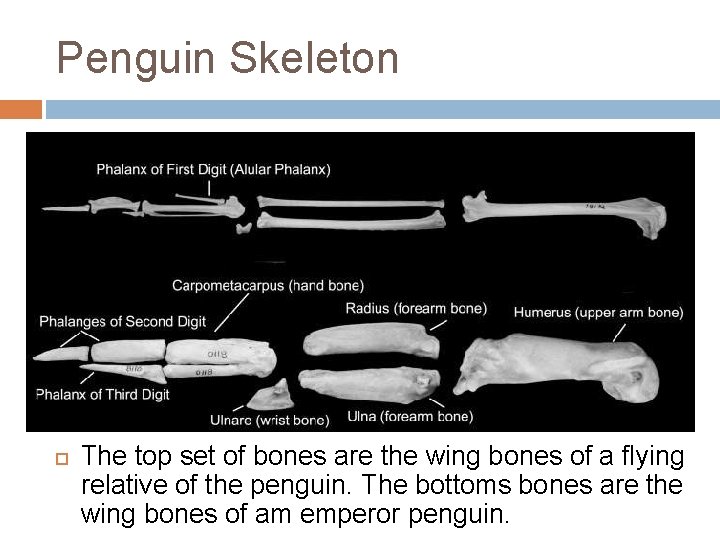
Penguin Skeleton Unlike birds of flight, penguin bones are solid and dense which help them by being better at diving and swimming in the ocean for their food. The top set of bones are the wing bones of a flying relative of the penguin. The bottoms bones are the wing bones of am emperor penguin.
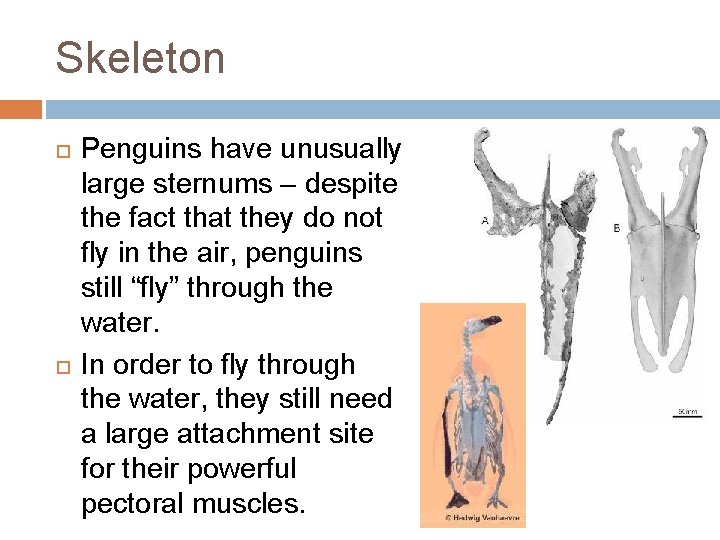
Skeleton Penguins have unusually large sternums – despite the fact that they do not fly in the air, penguins still “fly” through the water. In order to fly through the water, they still need a large attachment site for their powerful pectoral muscles.
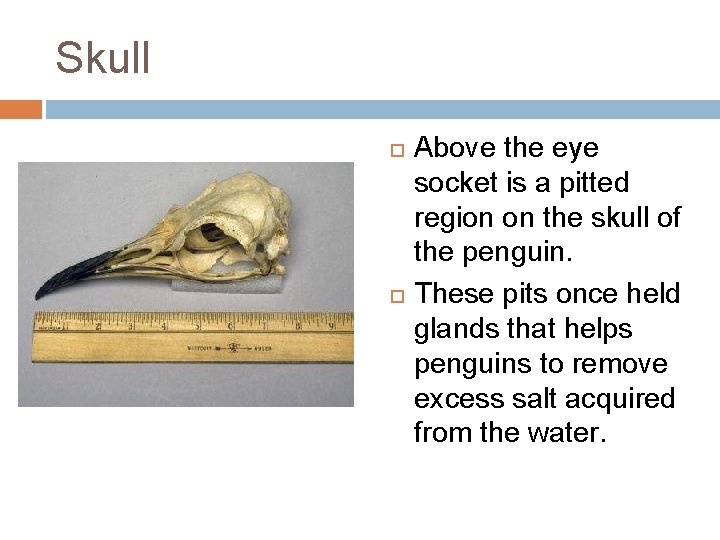
Skull Above the eye socket is a pitted region on the skull of the penguin. These pits once held glands that helps penguins to remove excess salt acquired from the water.
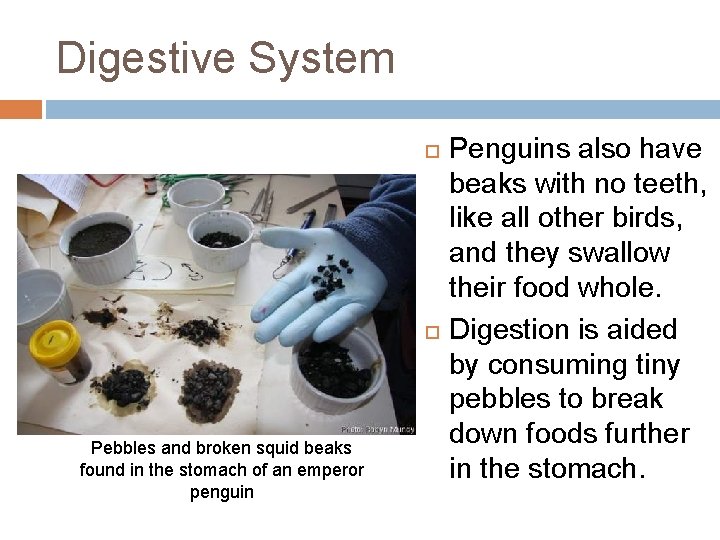
Digestive System Pebbles and broken squid beaks found in the stomach of an emperor penguin Penguins also have beaks with no teeth, like all other birds, and they swallow their food whole. Digestion is aided by consuming tiny pebbles to break down foods further in the stomach.
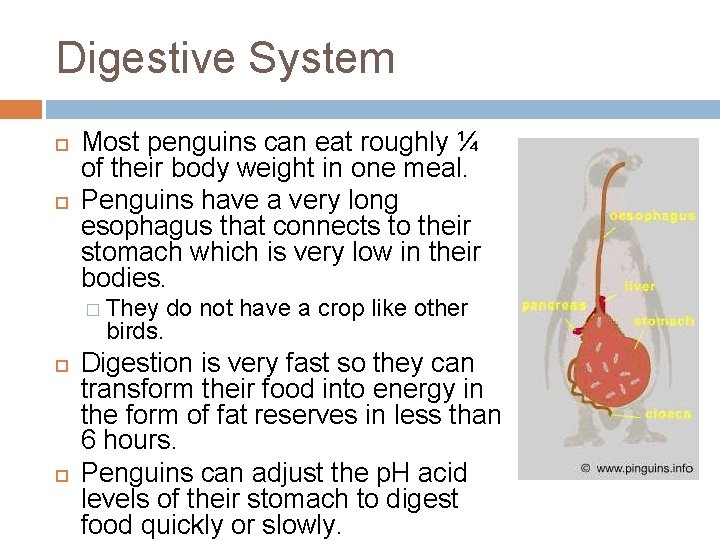
Digestive System Most penguins can eat roughly ¼ of their body weight in one meal. Penguins have a very long esophagus that connects to their stomach which is very low in their bodies. � They birds. do not have a crop like other Digestion is very fast so they can transform their food into energy in the form of fat reserves in less than 6 hours. Penguins can adjust the p. H acid levels of their stomach to digest food quickly or slowly.
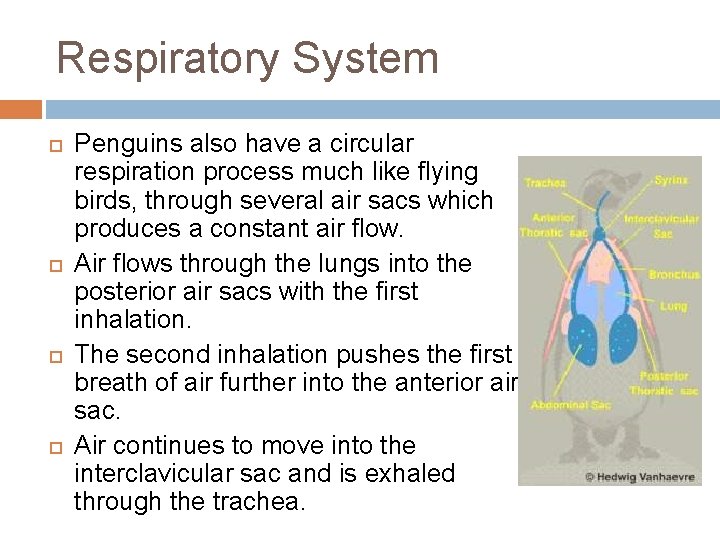
Respiratory System Penguins also have a circular respiration process much like flying birds, through several air sacs which produces a constant air flow. Air flows through the lungs into the posterior air sacs with the first inhalation. The second inhalation pushes the first breath of air further into the anterior air sac. Air continues to move into the interclavicular sac and is exhaled through the trachea.
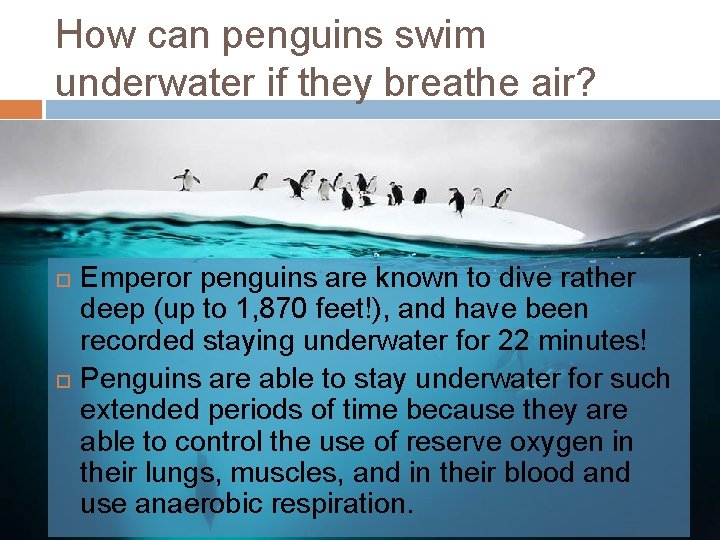
How can penguins swim underwater if they breathe air? Emperor penguins are known to dive rather deep (up to 1, 870 feet!), and have been recorded staying underwater for 22 minutes! Penguins are able to stay underwater for such extended periods of time because they are able to control the use of reserve oxygen in their lungs, muscles, and in their blood and use anaerobic respiration.
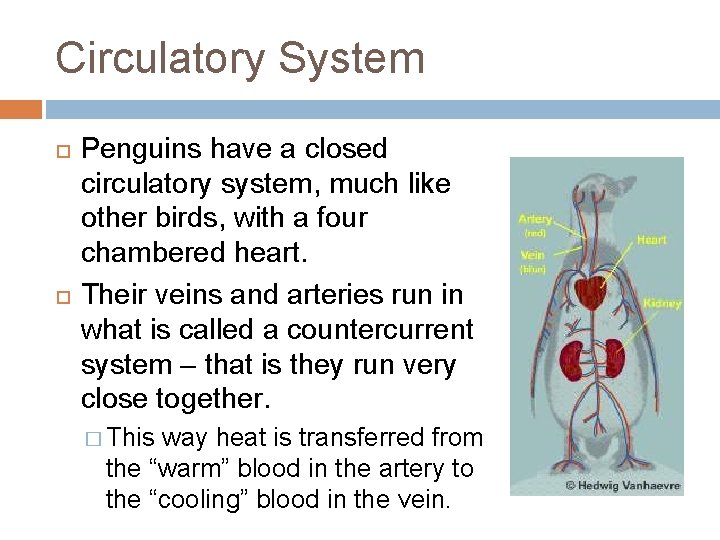
Circulatory System Penguins have a closed circulatory system, much like other birds, with a four chambered heart. Their veins and arteries run in what is called a countercurrent system – that is they run very close together. � This way heat is transferred from the “warm” blood in the artery to the “cooling” blood in the vein.
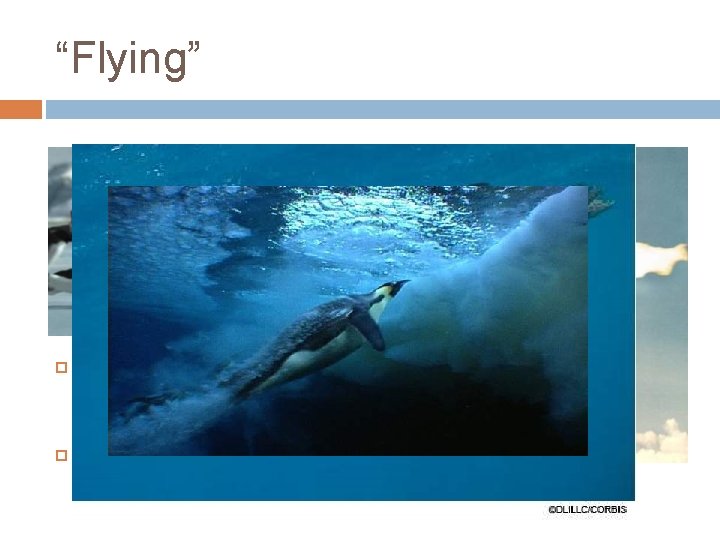
“Flying” Technically, penguins don’t “fly” in the typical sense. Rather they “fly” through the water.
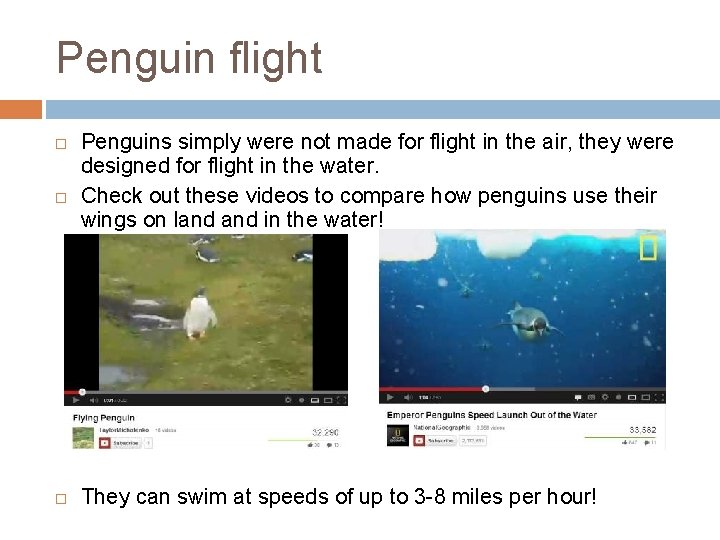
Penguin flight Penguins simply were not made for flight in the air, they were designed for flight in the water. Check out these videos to compare how penguins use their wings on land in the water! They can swim at speeds of up to 3 -8 miles per hour!
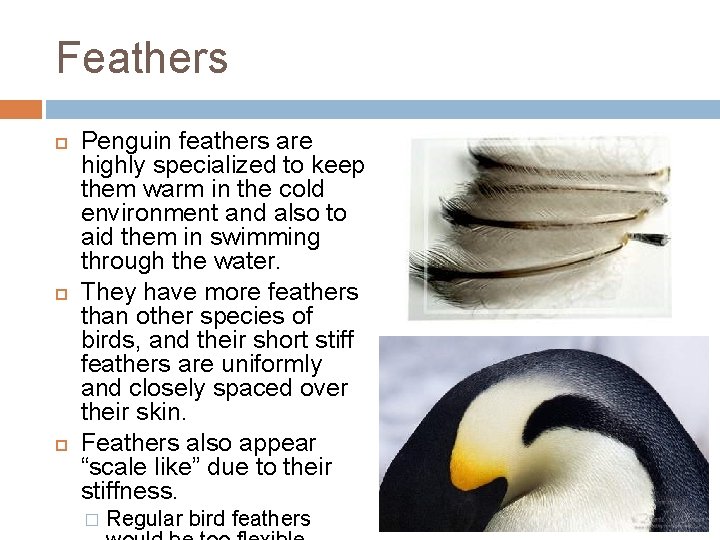
Feathers Penguin feathers are highly specialized to keep them warm in the cold environment and also to aid them in swimming through the water. They have more feathers than other species of birds, and their short stiff feathers are uniformly and closely spaced over their skin. Feathers also appear “scale like” due to their stiffness. � Regular bird feathers
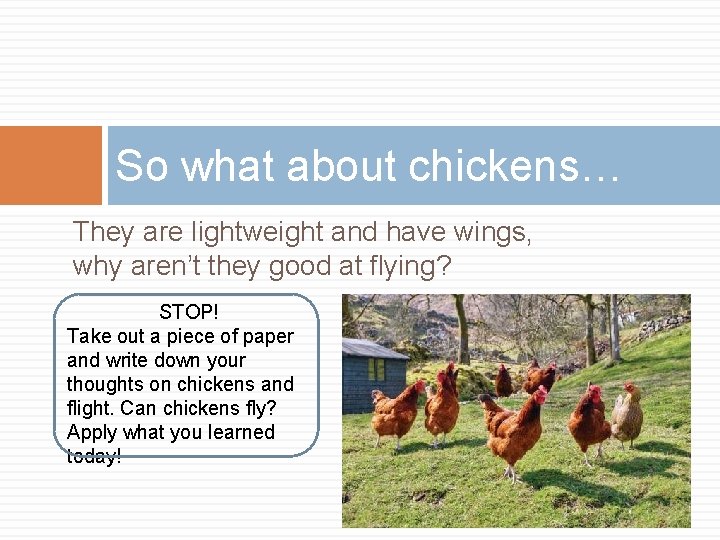
So what about chickens… They are lightweight and have wings, why aren’t they good at flying? STOP! Take out a piece of paper and write down your thoughts on chickens and flight. Can chickens fly? Apply what you learned today!
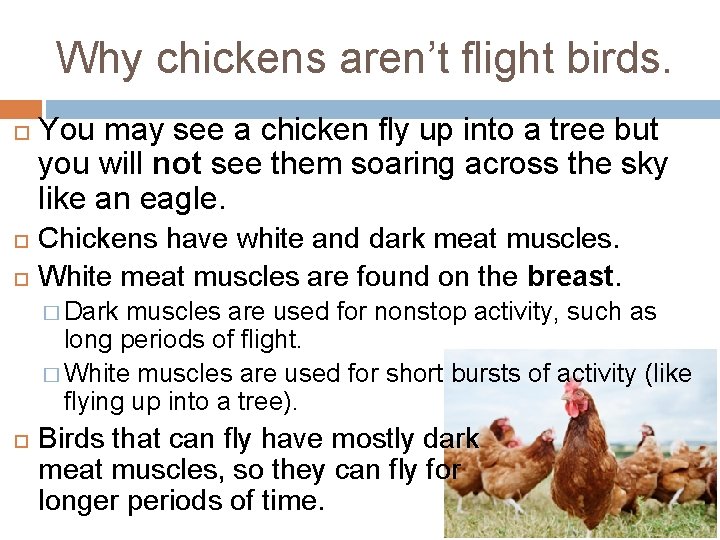
Why chickens aren’t flight birds. You may see a chicken fly up into a tree but you will not see them soaring across the sky like an eagle. Chickens have white and dark meat muscles. White meat muscles are found on the breast. � Dark muscles are used for nonstop activity, such as long periods of flight. � White muscles are used for short bursts of activity (like flying up into a tree). Birds that can fly have mostly dark meat muscles, so they can fly for longer periods of time.
- Slides: 56