
ANATOMY OF BASIC STATISTICAL TERMS AND THEIR RELATIONSHIPS
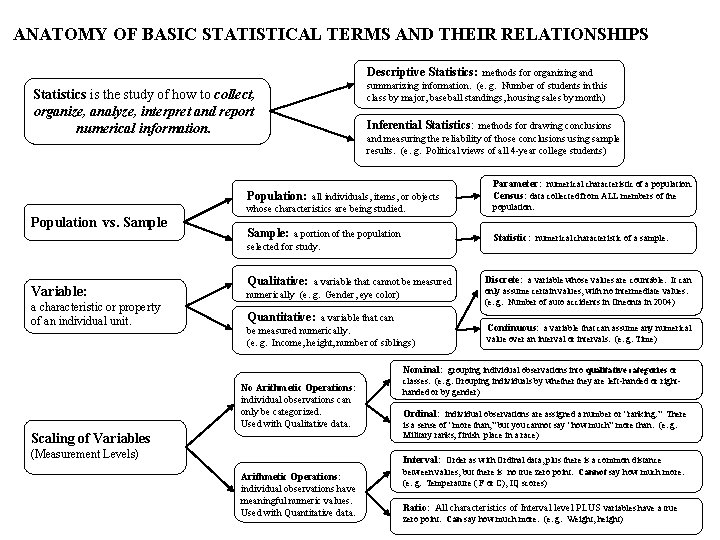
ANATOMY OF BASIC STATISTICAL TERMS AND THEIR RELATIONSHIPS Descriptive Statistics: methods for organizing and Statistics is the study of how to collect, organize, analyze, interpret and report numerical information. summarizing information. (e. g. Number of students in this class by major, baseball standings, housing sales by month) Inferential Statistics: methods for drawing conclusions and measuring the reliability of those conclusions using sample results. (e. g. Political views of all 4 -year college students) Population: all individuals, items, or objects Population vs. Sample whose characteristics are being studied. population. Sample: a portion of the population Statistic: numerical characteristic of a sample. selected for study. Variable: a characteristic or property of an individual unit. Parameter: numerical characteristic of a population. Census: data collected from ALL members of the Qualitative: a variable that cannot be measured numerically (e. g. Gender, eye color) Quantitative: a variable that can be measured numerically. (e. g. Income, height, number of siblings) Discrete: a variable whose values are countable. It can only assume certain values, with no intermediate values. (e. g. Number of auto accidents in Oneonta in 2004) Continuous: a variable that can assume any numerical value over an interval or intervals. (e. g. Time) Nominal: grouping individual observations into qualitative categories or No Arithmetic Operations: individual observations can only be categorized. Used with Qualitative data. Scaling of Variables (Measurement Levels) classes. (e. g. Grouping individuals by whether they are left-handed or righthanded or by gender) Ordinal: individual observations are assigned a number or “ranking. ” There is a sense of “more than, ” but you cannot say “how much” more than. (e. g. Military ranks; finish place in a race) Interval: Order as with Ordinal data, plus there is a common distance Arithmetic Operations: individual observations have meaningful numeric values. Used with Quantitative data. between values, but there is no true zero point. Cannot say how much more. (e. g. Temperature ( F or C), IQ scores) Ratio: All characteristics of Interval level PLUS variables have a true zero point. Can say how much more. (e. g. Weight, height)
- Slides: 1