
Anatomy of a Manuscript Types of Manuscripts Full

- Slides: 36
Anatomy of a Manuscript
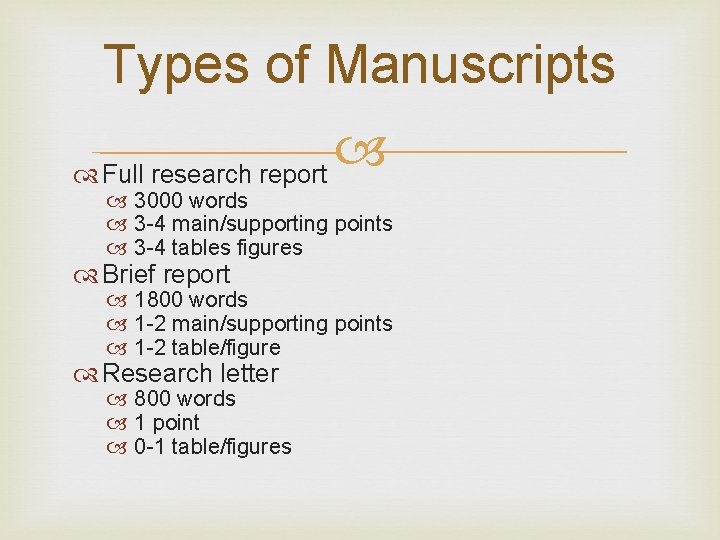
Types of Manuscripts Full research report 3000 words 3 -4 main/supporting points 3 -4 tables figures Brief report 1800 words 1 -2 main/supporting points 1 -2 table/figure Research letter 800 words 1 point 0 -1 table/figures
Types of Manuscripts Review Article Editorial Case report
Anatomy of a Manuscript Title page Abstract Introduction Methods Results Tables/Figures Discussion Acknowledgements
Which to write first? Title page Abstract Introduction Methods Results Tables/Figures Discussion Acknowledgements
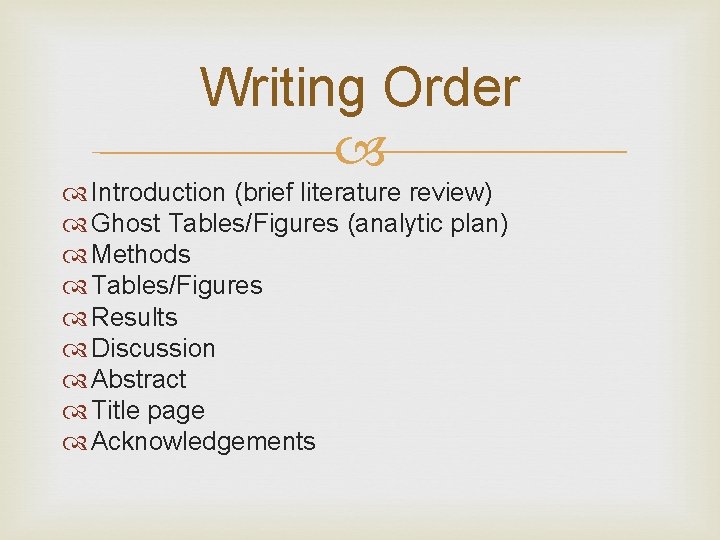
Writing Order Introduction (brief literature review) Ghost Tables/Figures (analytic plan) Methods Tables/Figures Results Discussion Abstract Title page Acknowledgements
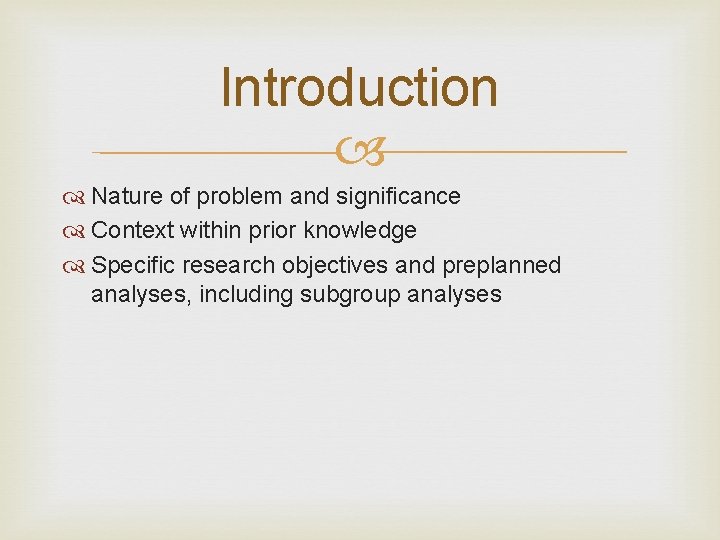
Introduction Nature of problem and significance Context within prior knowledge Specific research objectives and preplanned analyses, including subgroup analyses
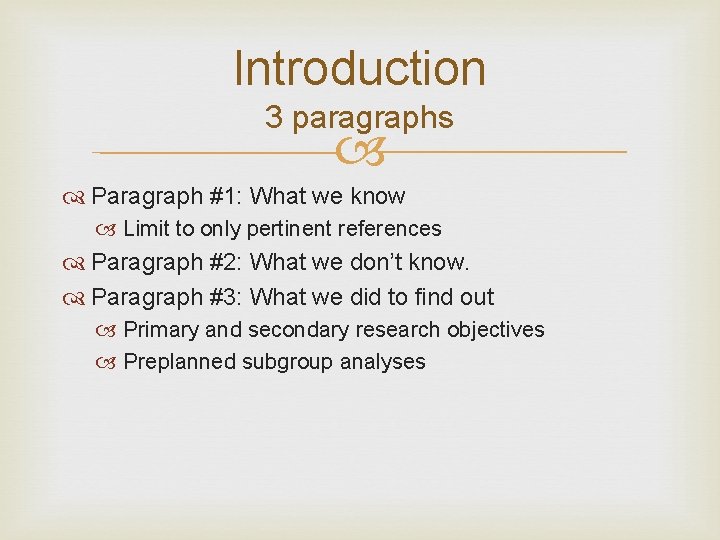
Introduction 3 paragraphs Paragraph #1: What we know Limit to only pertinent references Paragraph #2: What we don’t know. Paragraph #3: What we did to find out Primary and secondary research objectives Preplanned subgroup analyses
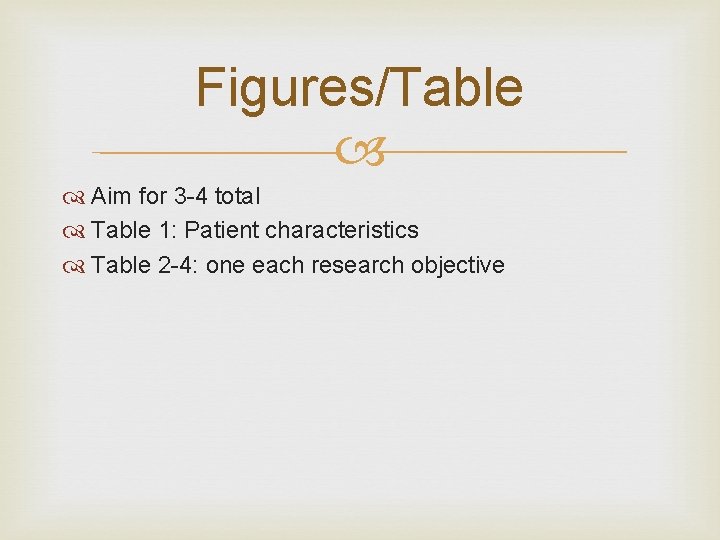
Figures/Table Aim for 3 -4 total Table 1: Patient characteristics Table 2 -4: one each research objective
Tables Purpose Concise display of info Provide several levels of detail Reduces length of text Restrict table/figures to explain argument and assess report
Tables Double space on single page Number consecutively in order of first citation in text Title should summarize data Do not use horizontal lines Give each column a brief/abbreviated heading Footnote explanatory matter Identify statistical measures of variation Double space legend on separate page
Figures Number consecutively according to order cited High resolution images Letters numbers and symbols need to be clear and sufficient size Include titles and detailed explanations in legend rather than figure Double space legend on separate page
Methods Study design Subject selection Source population Inclusion criteria Exclusion criteria Rationale for inclusion/exclusion criteria
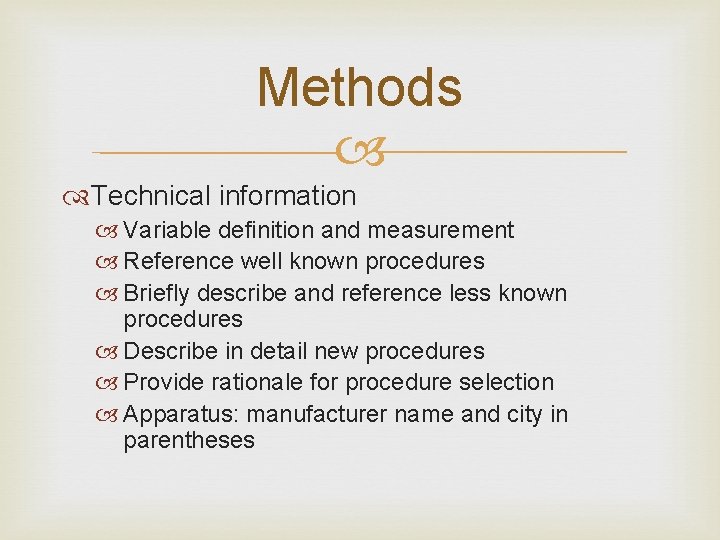
Methods Technical information Variable definition and measurement Reference well known procedures Briefly describe and reference less known procedures Describe in detail new procedures Provide rationale for procedure selection Apparatus: manufacturer name and city in parentheses
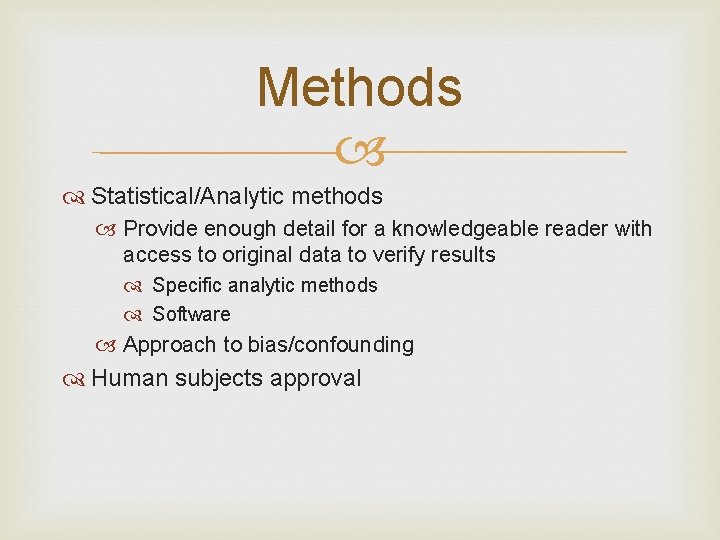
Methods Statistical/Analytic methods Provide enough detail for a knowledgeable reader with access to original data to verify results Specific analytic methods Software Approach to bias/confounding Human subjects approval
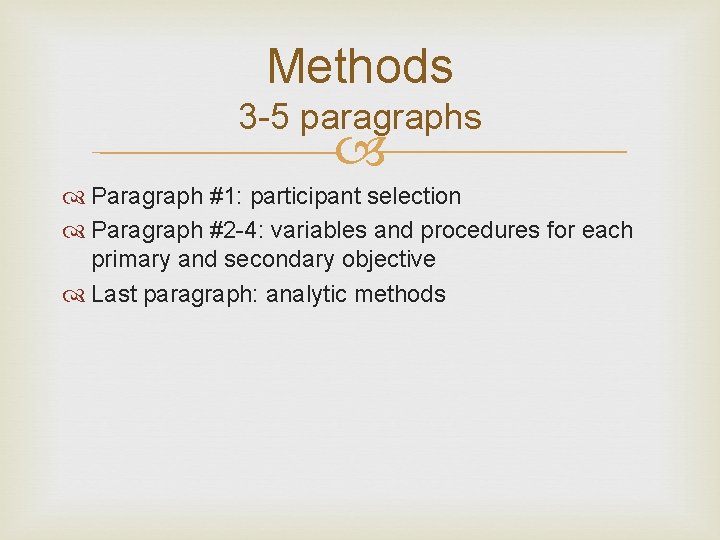
Methods 3 -5 paragraphs Paragraph #1: participant selection Paragraph #2 -4: variables and procedures for each primary and secondary objective Last paragraph: analytic methods
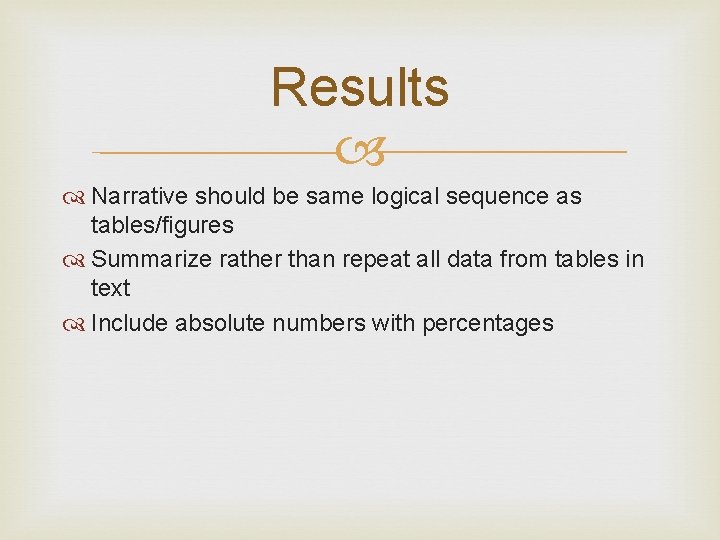
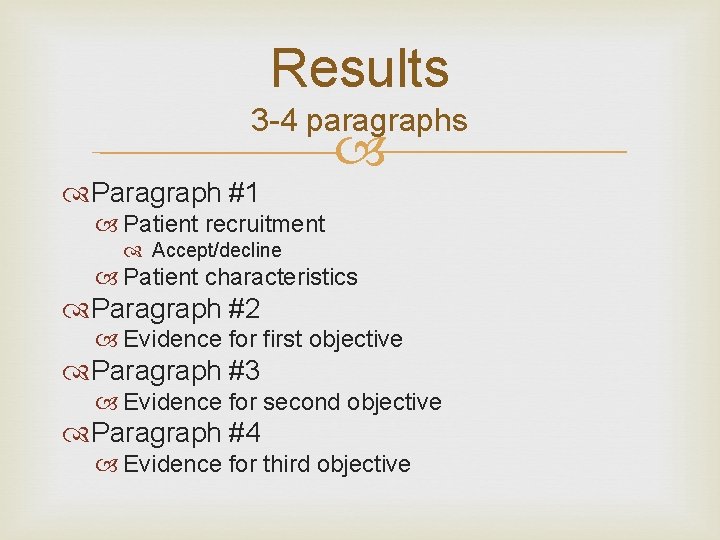
Results Narrative should be same logical sequence as tables/figures Summarize rather than repeat all data from tables in text Include absolute numbers with percentages
Results 3 -4 paragraphs Paragraph #1 Patient recruitment Accept/decline Patient characteristics Paragraph #2 Evidence for first objective Paragraph #3 Evidence for second objective Paragraph #4 Evidence for third objective
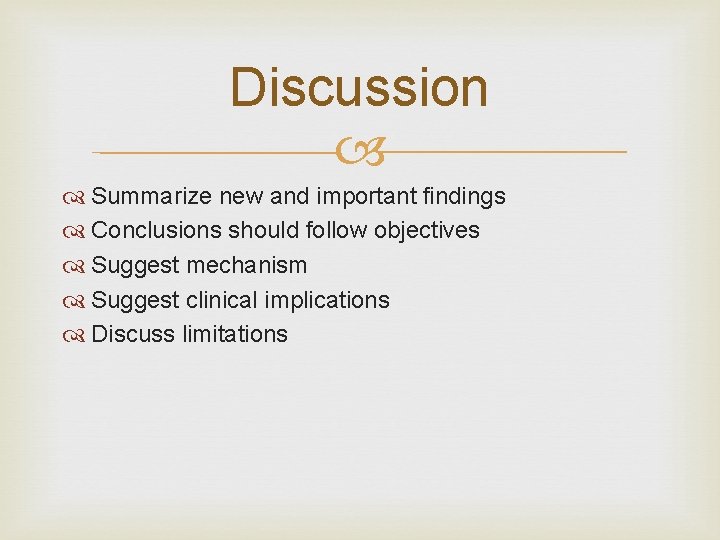
Discussion Summarize new and important findings Conclusions should follow objectives Suggest mechanism Suggest clinical implications Discuss limitations
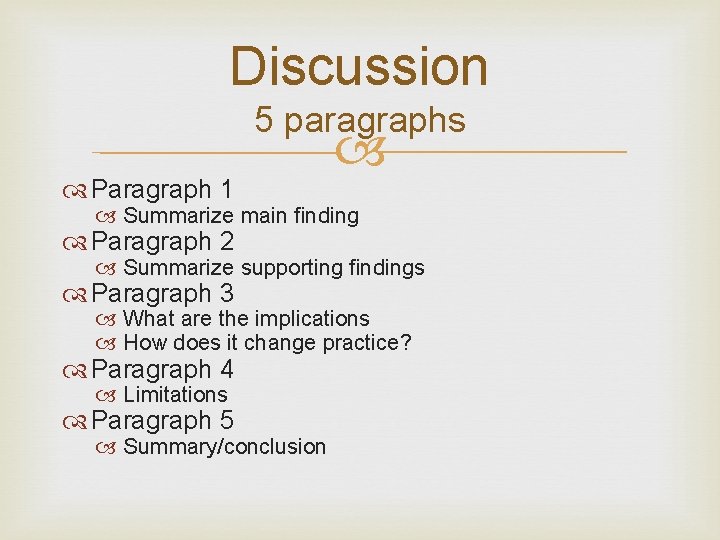
Discussion 5 paragraphs Paragraph 1 Summarize main finding Paragraph 2 Summarize supporting findings Paragraph 3 What are the implications How does it change practice? Paragraph 4 Limitations Paragraph 5 Summary/conclusion
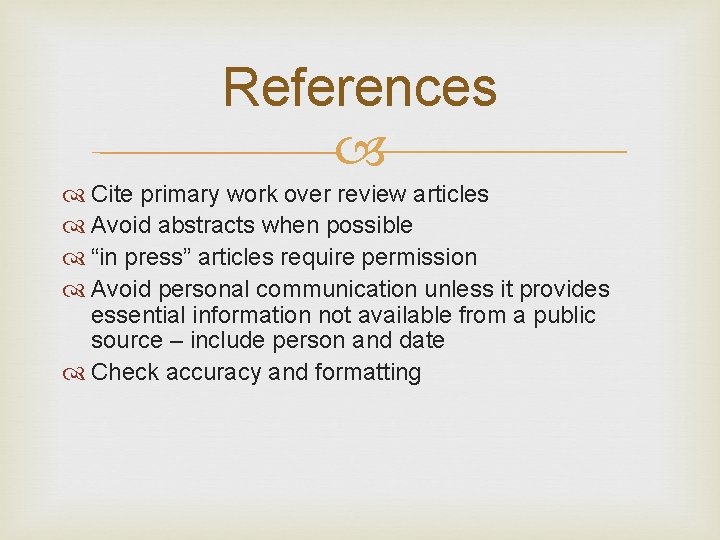
References Cite primary work over review articles Avoid abstracts when possible “in press” articles require permission Avoid personal communication unless it provides essential information not available from a public source – include person and date Check accuracy and formatting
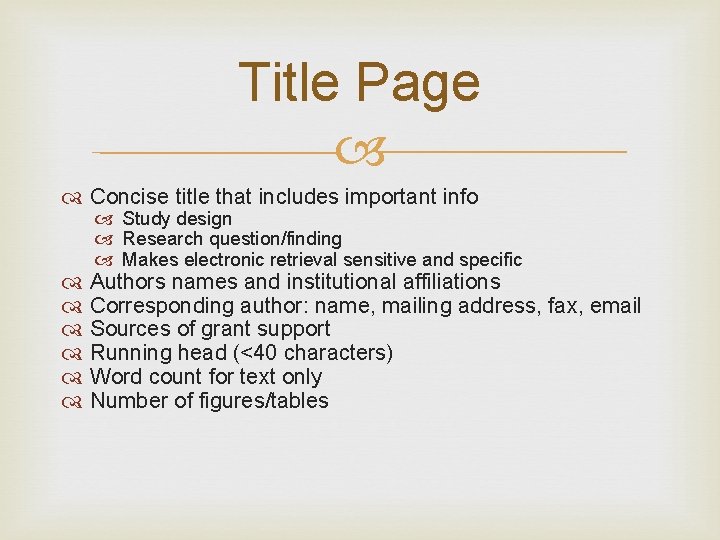
Title Page Concise title that includes important info Study design Research question/finding Makes electronic retrieval sensitive and specific Authors names and institutional affiliations Corresponding author: name, mailing address, fax, email Sources of grant support Running head (<40 characters) Word count for text only Number of figures/tables
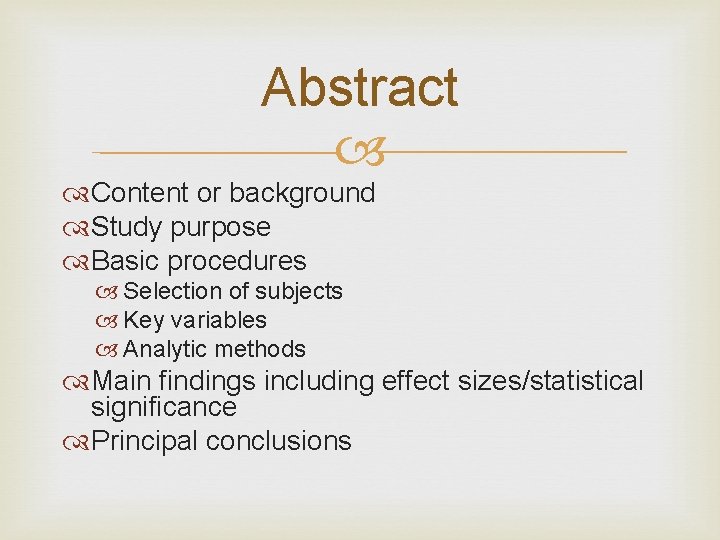
Abstract Content or background Study purpose Basic procedures Selection of subjects Key variables Analytic methods Main findings including effect sizes/statistical significance Principal conclusions
Key Words 3 -10 works that capture main topics for indexing
Abbreviations Only standard abbreviations ARV or ART Use full term, then abbreviation in parentheses after first use
Acknowledgement Individuals who made essential contributions Funding source
Cover letter Format of article Brief summary of finding Statement of non-redundancy of submission of publication Conflict of interest Read and approved by all authors Contact info for corresponding author
Authorship Criteria Substantial contribution to Conception and design, or Acquisition of data, or Analysis and interpretation Drafting and critical revision of manuscript for intellectual content Final approval of submitted version
Authorship Order First author Design/conceive the study Writes first draft Partners with last author for subsequent drafts Last author Usually experienced investigator who partners with first author in interpretation, analysis, and writing Second author Major contribution Third author Important contributions Middle authors Everyone else who qualifies for authorship
Corresponding Author Usually first or senior author Submits manuscript Corresponds with publisher/editor Revision Gallies Receives subsequent correspondence from outside investigators
Conflict of Interest Financial or personal relationship that inappropriately influences author, reviewer or editor Employment consultancies, stock ownership, expert testimony Same institution, relative, mentor, student, academic adversary All potentially perceived rather than just actual conflicts should be disclosed
Redundant Publication Substantial overlap with another manuscript in print or electronic media Preliminary reporting to media, government agencies or manufactures violates editorial policy of many journals Related work should be referred to and referenced Consider including copies of related material Does not apply to presentations at scientific conferences
Embargo Defined date of release of published information Determined by publisher Creates level playing field amongst news agencies Minimizes chaos of economically charged findings
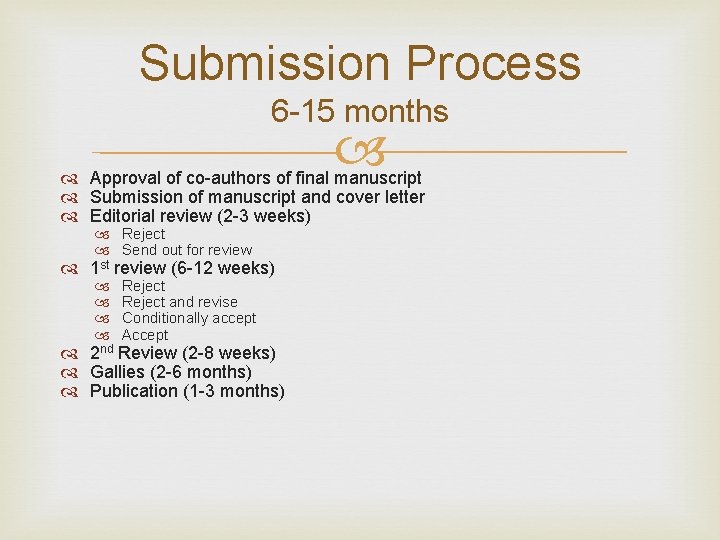
Submission Process 6 -15 months Approval of co-authors of final manuscript Submission of manuscript and cover letter Editorial review (2 -3 weeks) Reject Send out for review 1 st review (6 -12 weeks) Reject and revise Conditionally accept Accept 2 nd Review (2 -8 weeks) Gallies (2 -6 months) Publication (1 -3 months)
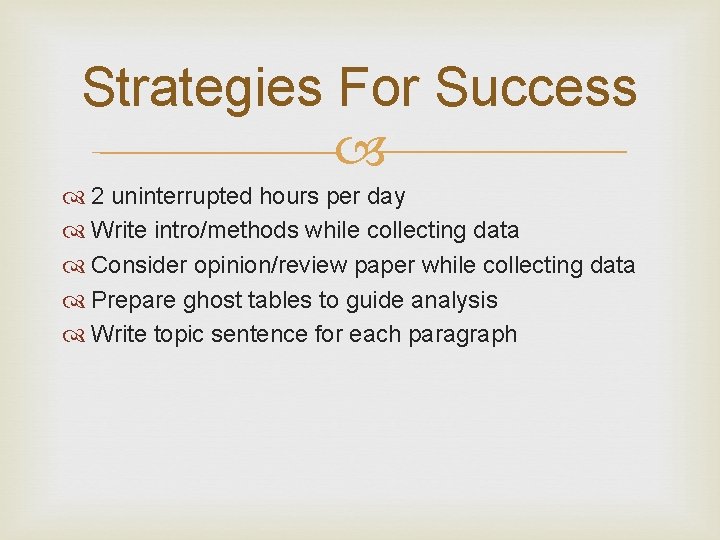
Strategies For Success 2 uninterrupted hours per day Write intro/methods while collecting data Consider opinion/review paper while collecting data Prepare ghost tables to guide analysis Write topic sentence for each paragraph
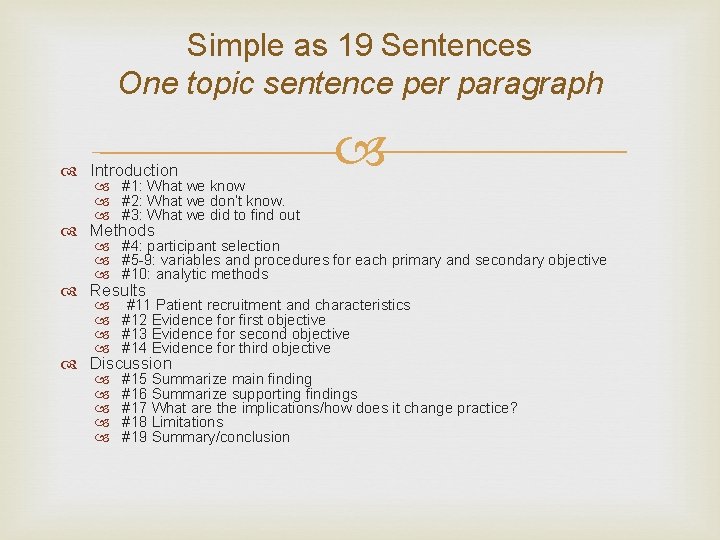
Simple as 19 Sentences One topic sentence per paragraph Introduction #1: What we know #2: What we don’t know. #3: What we did to find out Methods #4: participant selection #5 -9: variables and procedures for each primary and secondary objective #10: analytic methods Results #11 Patient recruitment and characteristics #12 Evidence for first objective #13 Evidence for second objective #14 Evidence for third objective Discussion #15 Summarize main finding #16 Summarize supporting findings #17 What are the implications/how does it change practice? #18 Limitations #19 Summary/conclusion