
ANATOMY OF A BOXPLOT Modified Boxplots present the
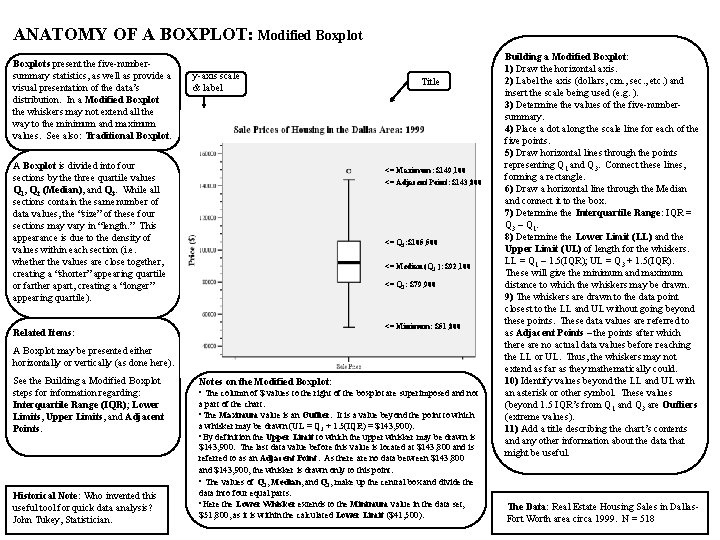
ANATOMY OF A BOXPLOT: Modified Boxplots present the five-numbersummary statistics, as well as provide a visual presentation of the data’s distribution. In a Modified Boxplot the whiskers may not extend all the way to the minimum and maximum values. See also: Traditional Boxplot. y-axis scale & label A Boxplot is divided into four sections by the three quartile values Q 1, Q 2 (Median), and Q 3. While all sections contain the same number of data values, the “size” of these four sections may vary in “length. ” This appearance is due to the density of values within each section (i. e. whether the values are close together, creating a “shorter” appearing quartile or farther apart, creating a “longer” appearing quartile). Title <= Maximum: $149, 100 <= Adjacent Point: $143, 800 <= Q 3: $105, 500 <= Median (Q 2 ): $92, 100 <= Q 1: $79, 900 <= Minimum: $51, 800 Related Items: A Boxplot may be presented either horizontally or vertically (as done here). See the Building a Modified Boxplot steps for information regarding: Interquartile Range (IQR); Lower Limits, Upper Limits, and Adjacent Points. Historical Note: Who invented this useful tool for quick data analysis? John Tukey, Statistician. Notes on the Modified Boxplot: • The column of $ values to the right of the boxplot are superimposed and not a part of the chart. • The Maximum value is an Outlier. It is a value beyond the point to which a whisker may be drawn (UL = Q 3 + 1. 5(IQR) = $143, 900). • By definition the Upper Limit to which the upper whisker may be drawn is $143, 900. The last data value before this value is located at $143, 800 and is referred to as an Adjacent Point. As there are no data between $143, 800 and $143, 900, the whisker is drawn only to this point. • The values of Q 1, Median, and Q 3, make up the central box and divide the data into four equal parts. • Here the Lower Whisker extends to the Minimum value in the data set, $51, 800, as it is within the calculated Lower Limit ($41, 500). Building a Modified Boxplot: 1) Draw the horizontal axis. 2) Label the axis (dollars, cm. , sec. , etc. ) and insert the scale being used (e. g. ). 3) Determine the values of the five-numbersummary. 4) Place a dot along the scale line for each of the five points. 5) Draw horizontal lines through the points representing Q 1 and Q 3. Connect these lines, forming a rectangle. 6) Draw a horizontal line through the Median and connect it to the box. 7) Determine the Interquartile Range: IQR = Q 3 – Q 1. 8) Determine the Lower Limit (LL) and the Upper Limit (UL) of length for the whiskers. LL = Q 1 – 1. 5(IQR); UL = Q 3 + 1. 5(IQR). These will give the minimum and maximum distance to which the whiskers may be drawn. 9) The whiskers are drawn to the data point closest to the LL and UL without going beyond these points. These data values are referred to as Adjacent Points – the points after which there are no actual data values before reaching the LL or UL. Thus, the whiskers may not extend as far as they mathematically could. 10) Identify values beyond the LL and UL with an asterisk or other symbol. These values (beyond 1. 5 IQR’s from Q 1 and Q 3 are Outliers (extreme values). 11) Add a title describing the chart’s contents and any other information about the data that might be useful. The Data: Real Estate Housing Sales in Dallas. Fort Worth area circa 1999. N = 518
- Slides: 1