
Anatomy Muscles Flashcards Origins and Insertions Intended for









- Slides: 115
Anatomy Muscles Flashcards Origins and Insertions Intended for entry level anatomy students
Intended to be viewed as full-screen…. select full-screen, and use “Page Down” to scroll through individual “flashcards” ! Anatomy Muscles Flashcards Origins and Insertions
Anatomy Muscles Flashcards Origins and Insertions Note: Learn origins and insertions of each muscle well. This is why the bony landmarks are so important. Do not memorize the function of muscles ! Muscles contract only linearly. Thus, to know the origin and insertion of a muscle is to know the function.
Anatomy Muscles Flashcards Origins and Insertions Note: Every muscle has a multitude of actions. Listed are the primary actions of each muscle !
Anatomy Muscles Flashcards Origins and Insertions Presented in Three Parts: I – Muscles of Face, head, neck, thorax, and abdomen II – Muscles of the upper extremity III – Muscles of the lower extremity
Anatomy Muscles Flashcards Origins and Insertions Each card is a set of three: The first asks to identify the muscle. The next provides the clues. The third gives the name of the muscle.
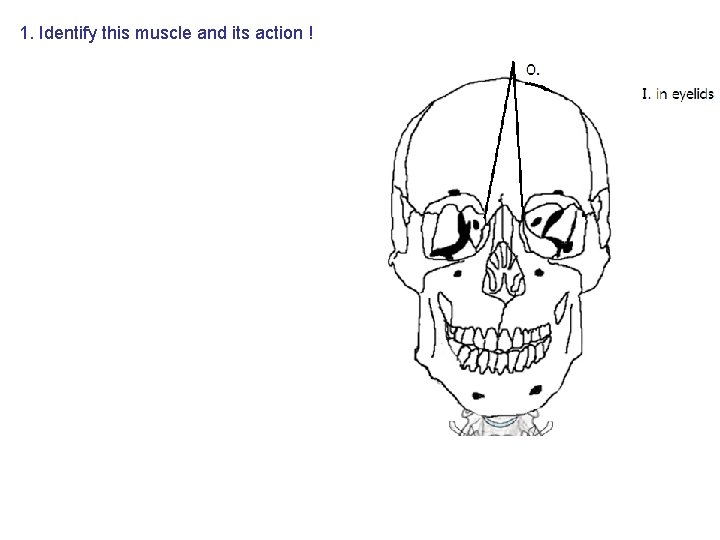
1. Identify this muscle and its action !
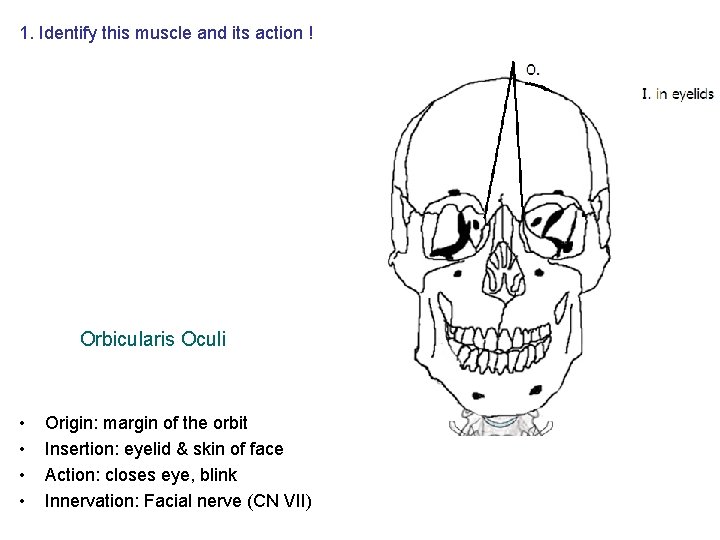
1. Identify this muscle and its action ! Orbicularis Oculi • • Origin: margin of the orbit Insertion: eyelid & skin of face Action: closes eye, blink Innervation: Facial nerve (CN VII)
2. Identify this muscle and its action !
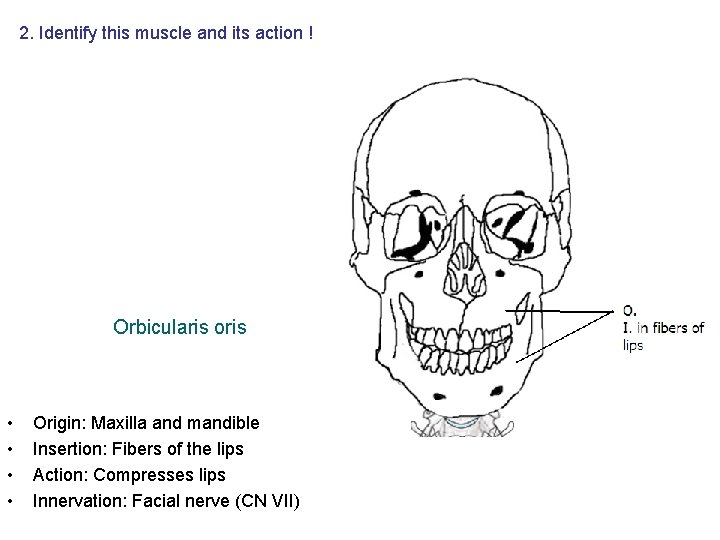
2. Identify this muscle and its action ! Orbicularis oris • • Origin: Maxilla and mandible Insertion: Fibers of the lips Action: Compresses lips Innervation: Facial nerve (CN VII)
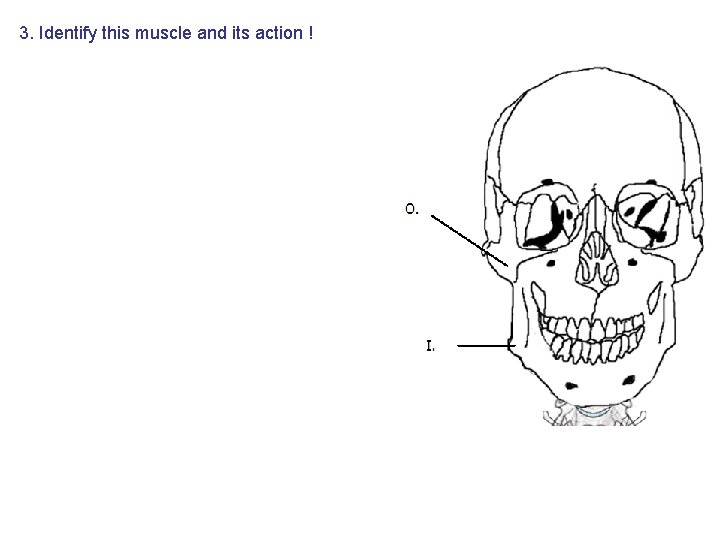
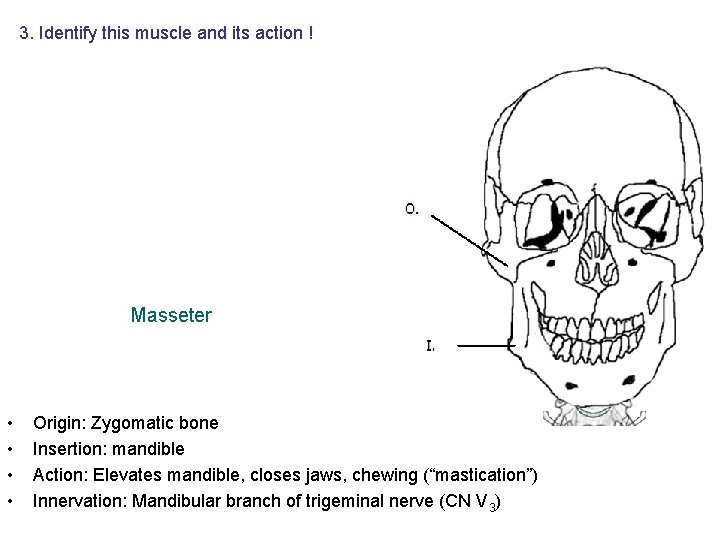
3. Identify this muscle and its action !
3. Identify this muscle and its action ! • • Origin: Zygomatic bone Insertion: mandible Action: Elevates mandible, closes jaws, chewing (“mastication”) Innervation: Mandibular branch of trigeminal nerve (CN V 3)
3. Identify this muscle and its action ! Masseter • • Origin: Zygomatic bone Insertion: mandible Action: Elevates mandible, closes jaws, chewing (“mastication”) Innervation: Mandibular branch of trigeminal nerve (CN V 3)
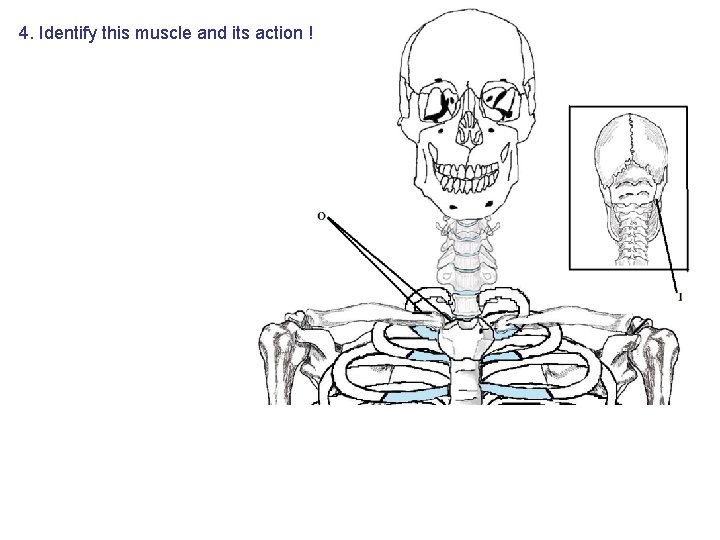
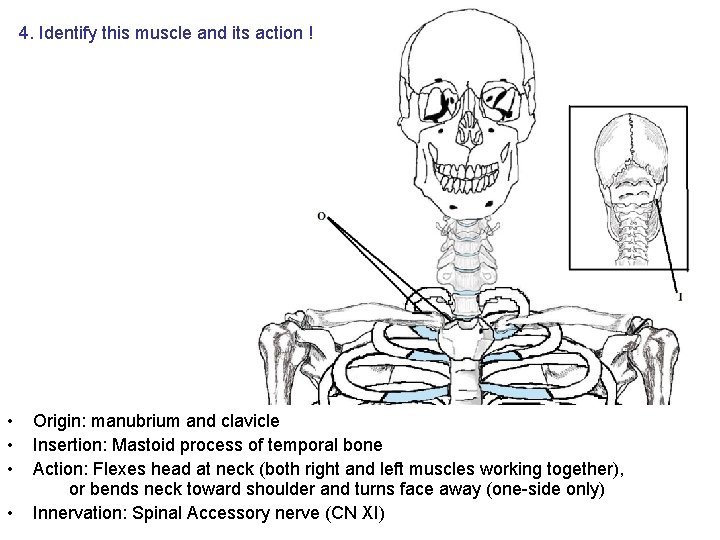
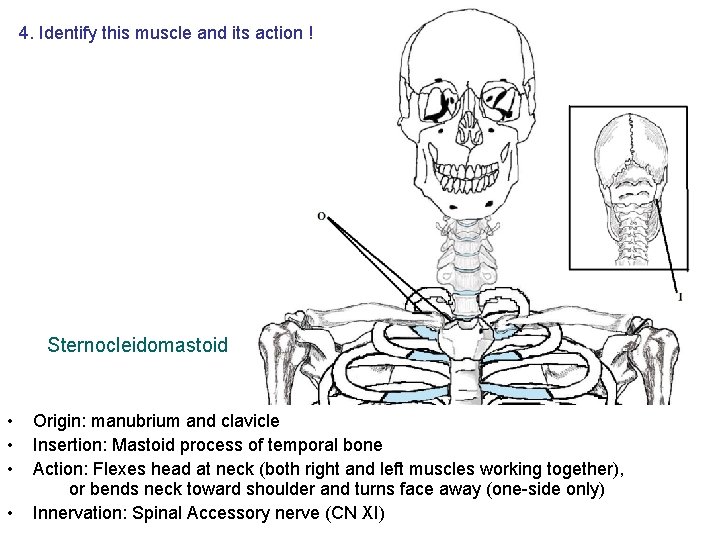
4. Identify this muscle and its action !
4. Identify this muscle and its action ! • • Origin: manubrium and clavicle Insertion: Mastoid process of temporal bone Action: Flexes head at neck (both right and left muscles working together), or bends neck toward shoulder and turns face away (one-side only) Innervation: Spinal Accessory nerve (CN XI)
4. Identify this muscle and its action ! Sternocleidomastoid • • Origin: manubrium and clavicle Insertion: Mastoid process of temporal bone Action: Flexes head at neck (both right and left muscles working together), or bends neck toward shoulder and turns face away (one-side only) Innervation: Spinal Accessory nerve (CN XI)
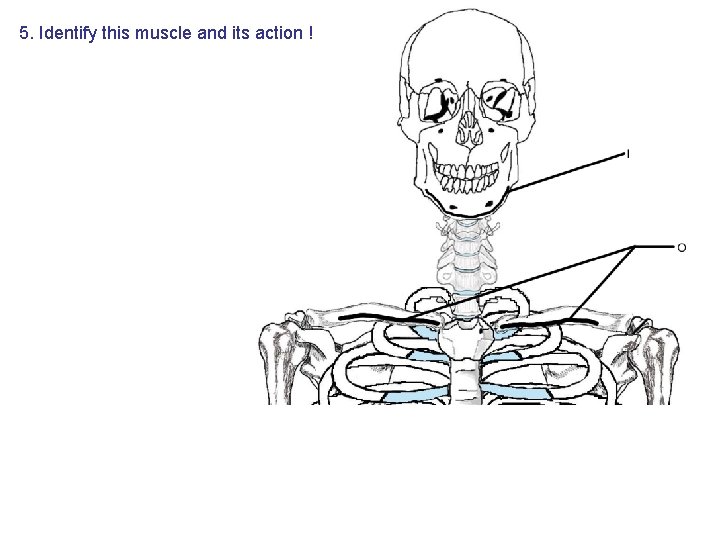
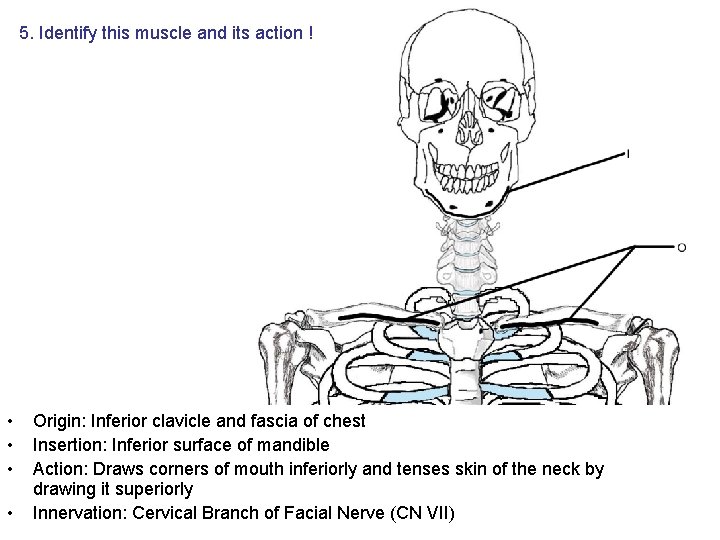
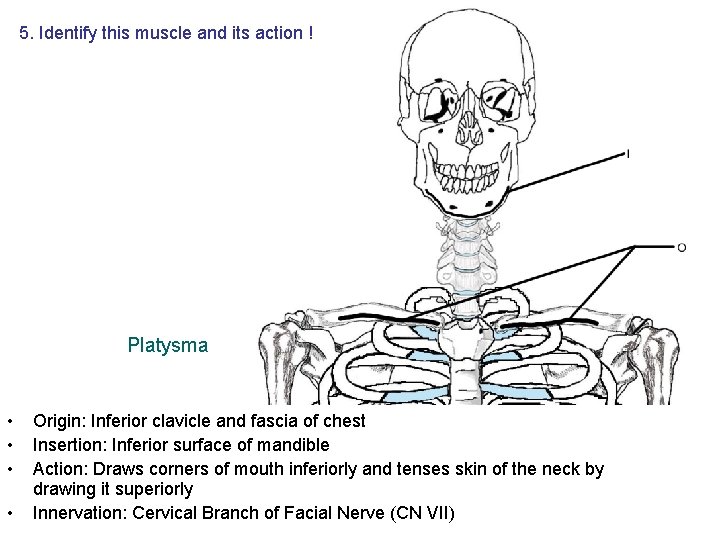
5. Identify this muscle and its action !
5. Identify this muscle and its action ! • • Origin: Inferior clavicle and fascia of chest Insertion: Inferior surface of mandible Action: Draws corners of mouth inferiorly and tenses skin of the neck by drawing it superiorly Innervation: Cervical Branch of Facial Nerve (CN VII)
5. Identify this muscle and its action ! Platysma • • Origin: Inferior clavicle and fascia of chest Insertion: Inferior surface of mandible Action: Draws corners of mouth inferiorly and tenses skin of the neck by drawing it superiorly Innervation: Cervical Branch of Facial Nerve (CN VII)
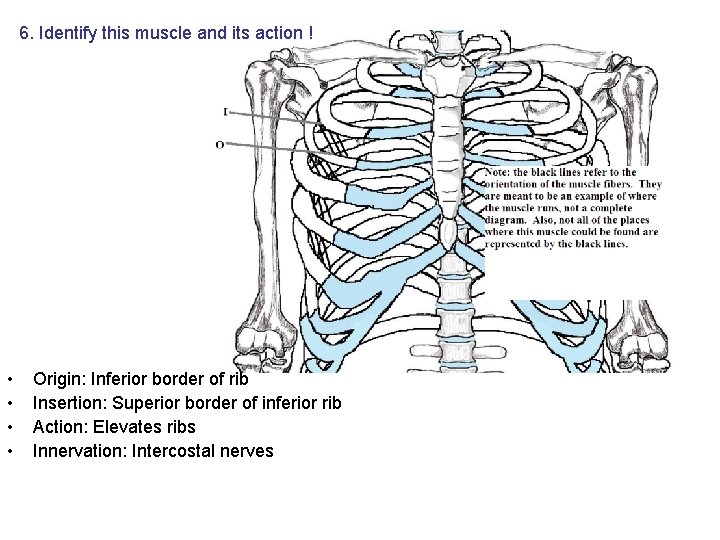
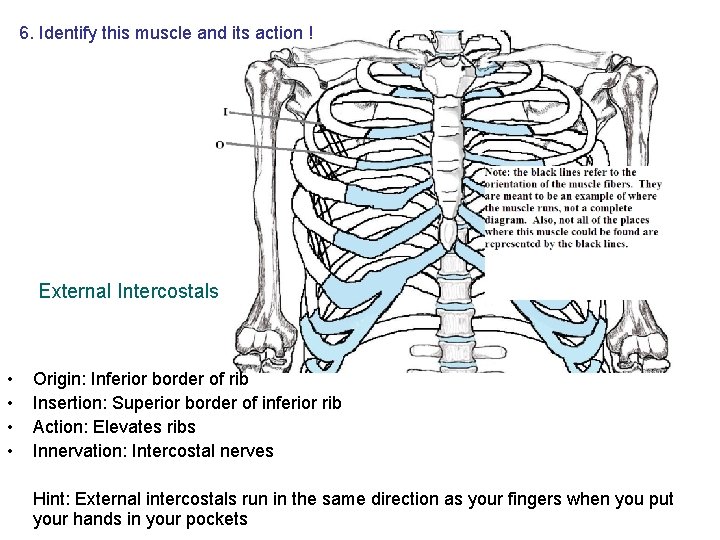
6. Identify this muscle and its action !
6. Identify this muscle and its action ! • • Origin: Inferior border of rib Insertion: Superior border of inferior rib Action: Elevates ribs Innervation: Intercostal nerves
6. Identify this muscle and its action ! External Intercostals • • Origin: Inferior border of rib Insertion: Superior border of inferior rib Action: Elevates ribs Innervation: Intercostal nerves Hint: External intercostals run in the same direction as your fingers when you put your hands in your pockets
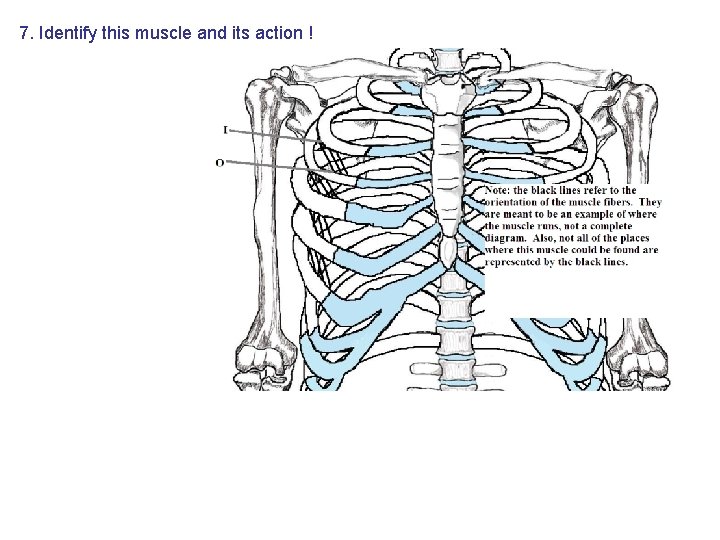
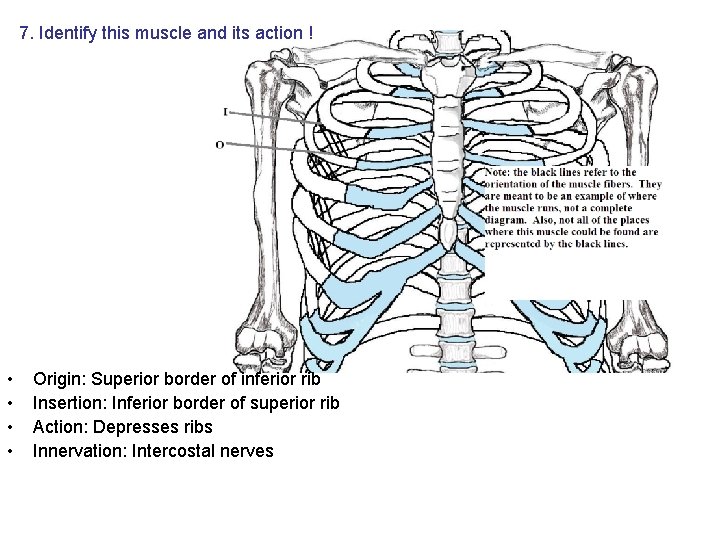
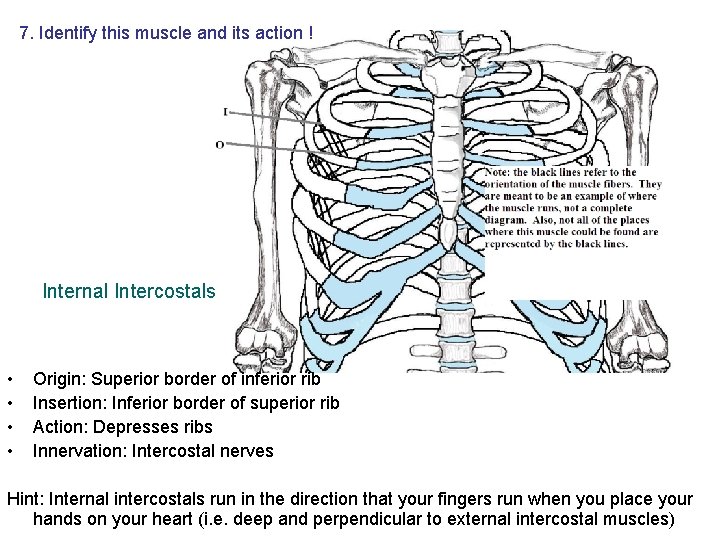
7. Identify this muscle and its action !
7. Identify this muscle and its action ! • • Origin: Superior border of inferior rib Insertion: Inferior border of superior rib Action: Depresses ribs Innervation: Intercostal nerves
7. Identify this muscle and its action ! Internal Intercostals • • Origin: Superior border of inferior rib Insertion: Inferior border of superior rib Action: Depresses ribs Innervation: Intercostal nerves Hint: Internal intercostals run in the direction that your fingers run when you place your hands on your heart (i. e. deep and perpendicular to external intercostal muscles)
8. Identify this muscle and its action ! Origin: originates on the inferior border of the rib cage Insertion: inserts on the central tendon. Action: Flattens when it contracts to increase area of thorax and inflate lungs. Innervation: Phrenic nerve (C 3, 4, 5)
8. Identify this muscle and its action ! Origin: originates on the inferior border of the rib cage Insertion: inserts on the central tendon. Action: Flattens when it contracts to increase area of thorax and inflate lungs. Innervation: Phrenic nerve (C 3, 4, 5) Respiratory Diaphragm
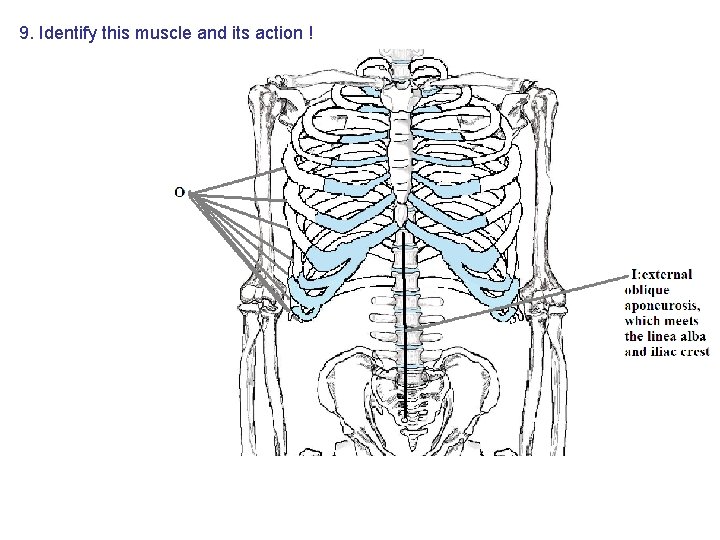
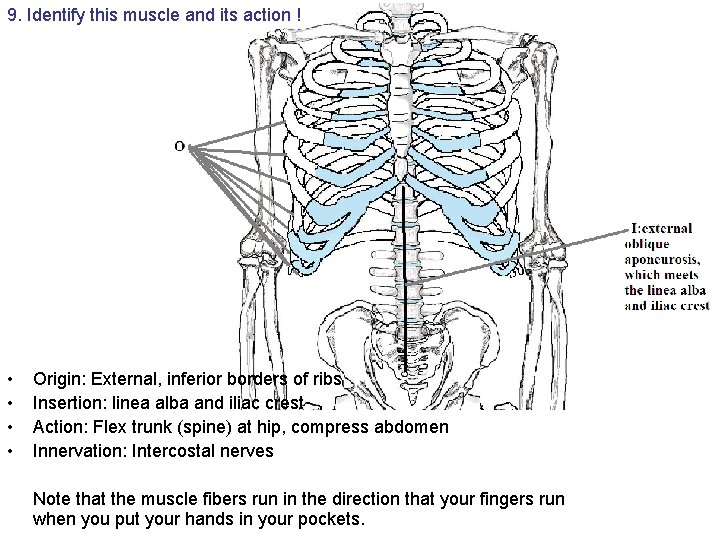
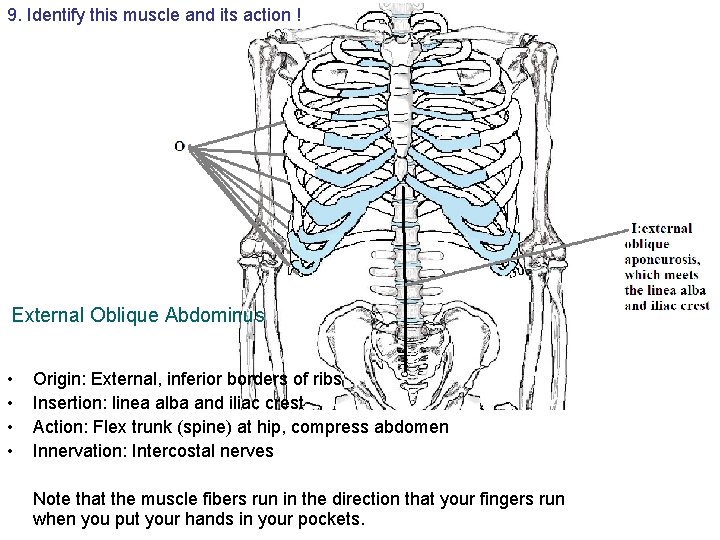
9. Identify this muscle and its action !
9. Identify this muscle and its action ! • • Origin: External, inferior borders of ribs Insertion: linea alba and iliac crest Action: Flex trunk (spine) at hip, compress abdomen Innervation: Intercostal nerves Note that the muscle fibers run in the direction that your fingers run when you put your hands in your pockets.
9. Identify this muscle and its action ! External Oblique Abdominus • • Origin: External, inferior borders of ribs Insertion: linea alba and iliac crest Action: Flex trunk (spine) at hip, compress abdomen Innervation: Intercostal nerves Note that the muscle fibers run in the direction that your fingers run when you put your hands in your pockets.
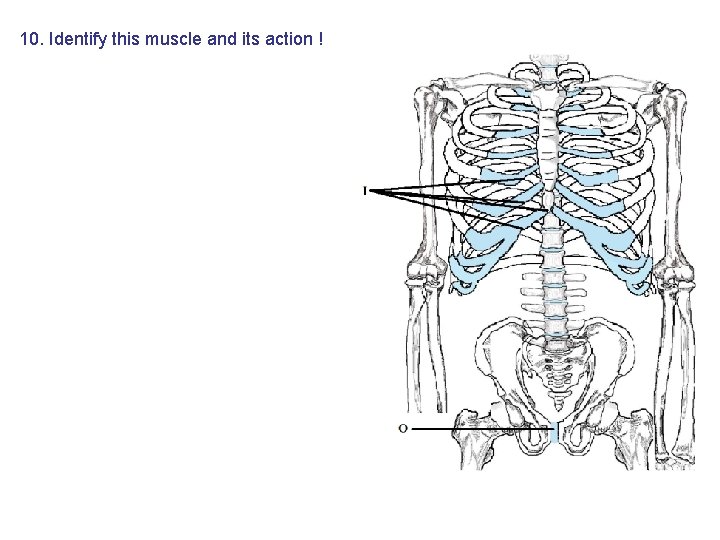
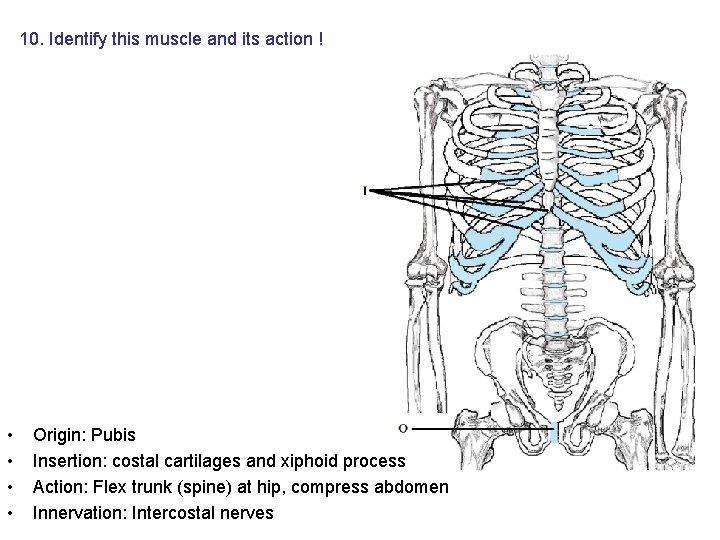
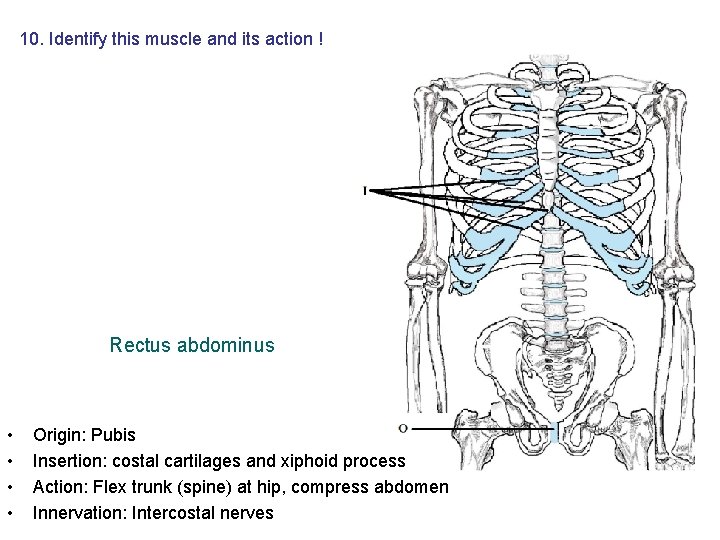
10. Identify this muscle and its action !
10. Identify this muscle and its action ! • • Origin: Pubis Insertion: costal cartilages and xiphoid process Action: Flex trunk (spine) at hip, compress abdomen Innervation: Intercostal nerves
10. Identify this muscle and its action ! Rectus abdominus • • Origin: Pubis Insertion: costal cartilages and xiphoid process Action: Flex trunk (spine) at hip, compress abdomen Innervation: Intercostal nerves
Anatomy Muscles Flashcards Origins and Insertions Presented in Three Parts: I – Muscles of Face, head, neck, thorax, and abdomen II – Muscles of the upper extremity III – Muscles of the lower extremity
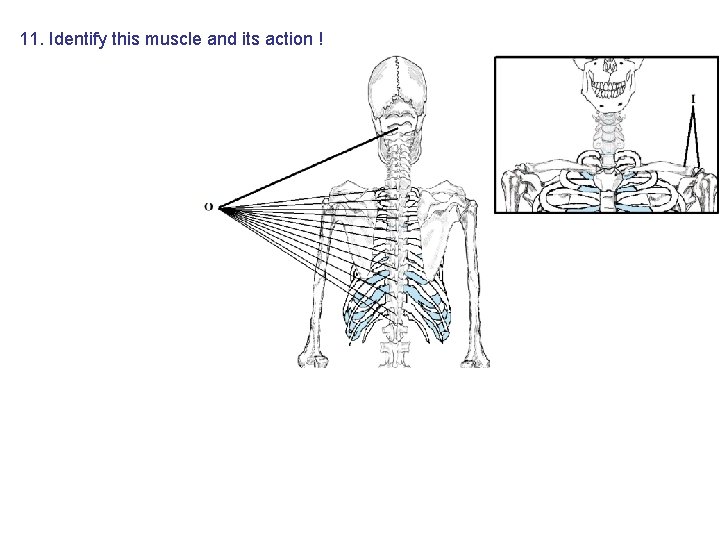
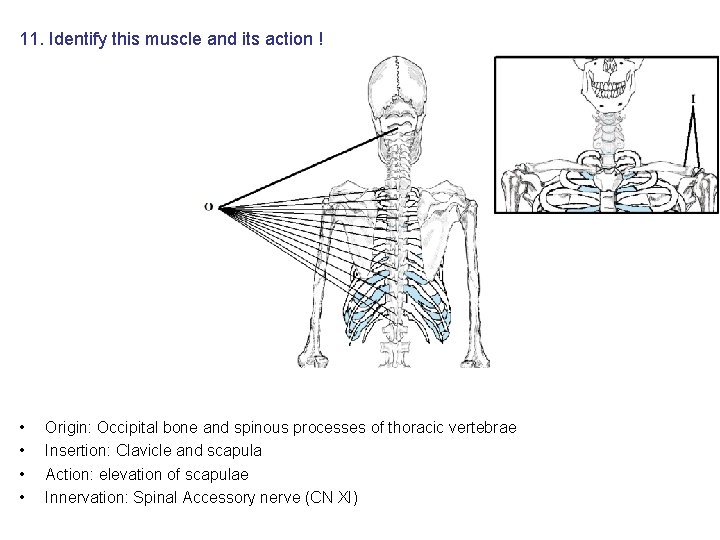
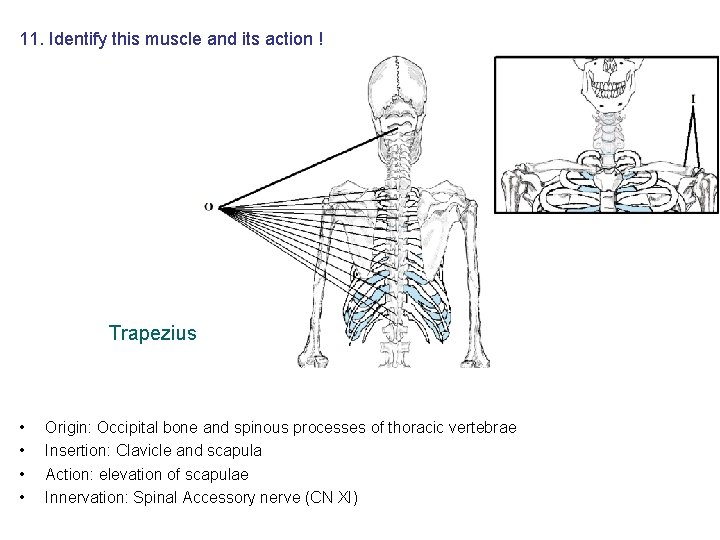
11. Identify this muscle and its action !
11. Identify this muscle and its action ! • • Origin: Occipital bone and spinous processes of thoracic vertebrae Insertion: Clavicle and scapula Action: elevation of scapulae Innervation: Spinal Accessory nerve (CN XI)
11. Identify this muscle and its action ! Trapezius • • Origin: Occipital bone and spinous processes of thoracic vertebrae Insertion: Clavicle and scapula Action: elevation of scapulae Innervation: Spinal Accessory nerve (CN XI)
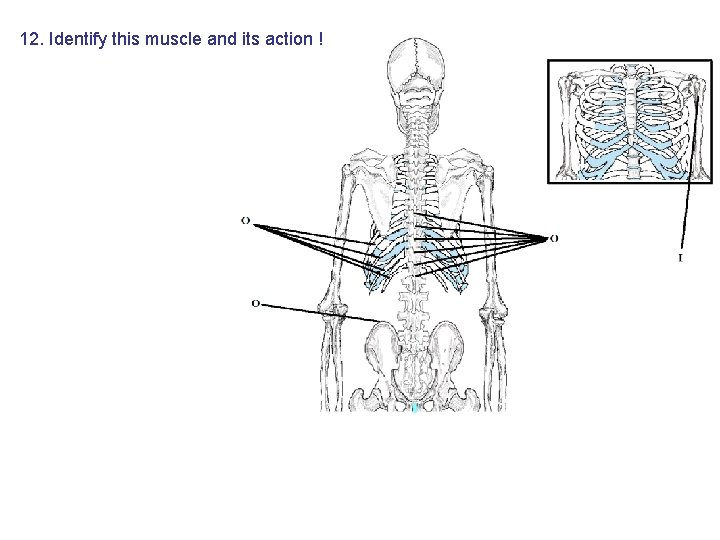
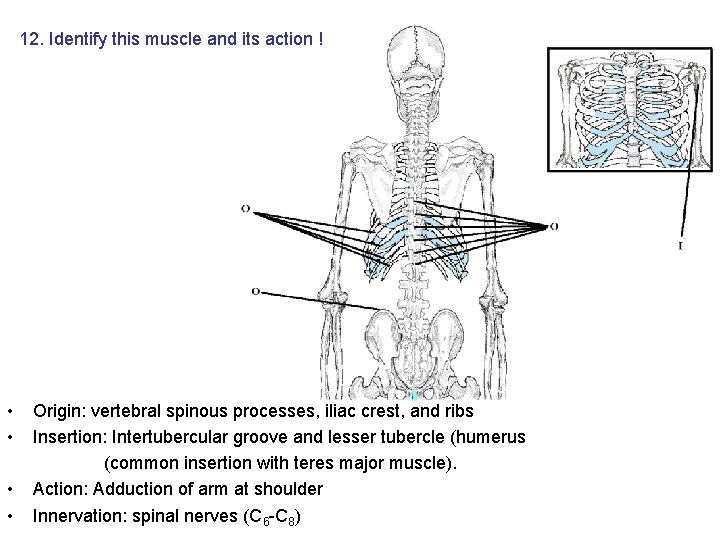
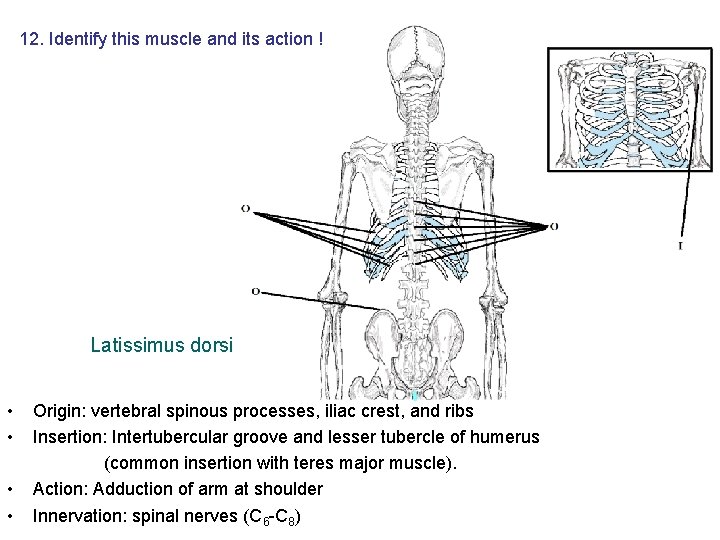
12. Identify this muscle and its action !
12. Identify this muscle and its action ! • • Origin: vertebral spinous processes, iliac crest, and ribs Insertion: Intertubercular groove and lesser tubercle (humerus (common insertion with teres major muscle). Action: Adduction of arm at shoulder Innervation: spinal nerves (C 6 -C 8)
12. Identify this muscle and its action ! Latissimus dorsi • • Origin: vertebral spinous processes, iliac crest, and ribs Insertion: Intertubercular groove and lesser tubercle of humerus (common insertion with teres major muscle). Action: Adduction of arm at shoulder Innervation: spinal nerves (C 6 -C 8)
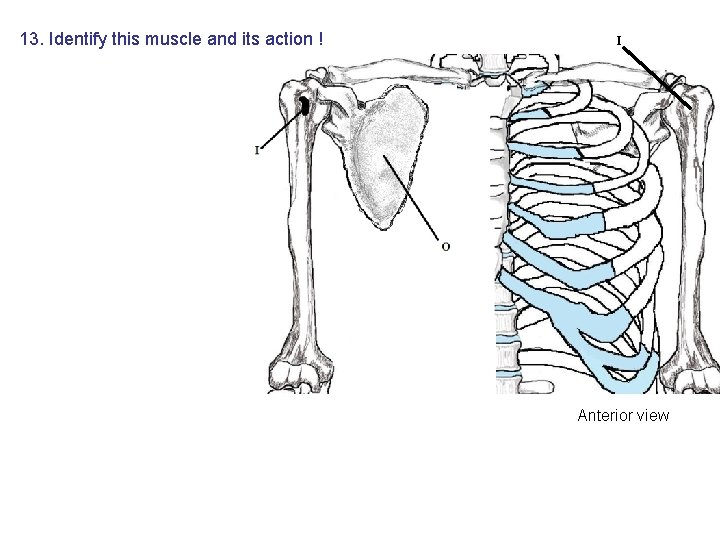
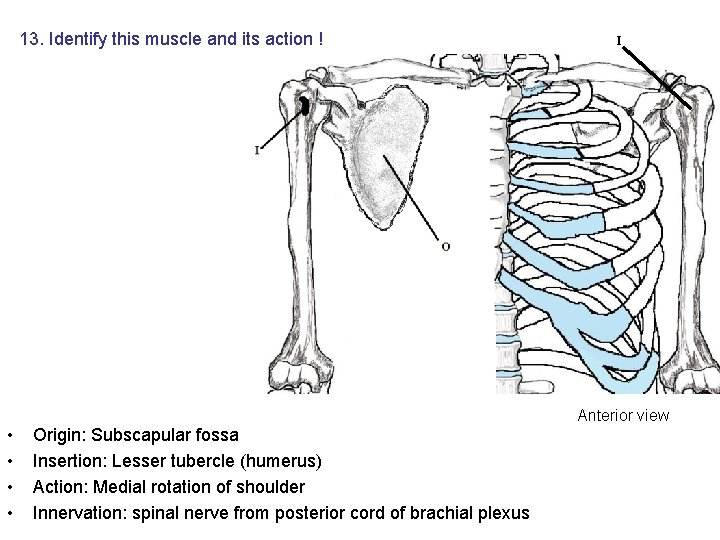
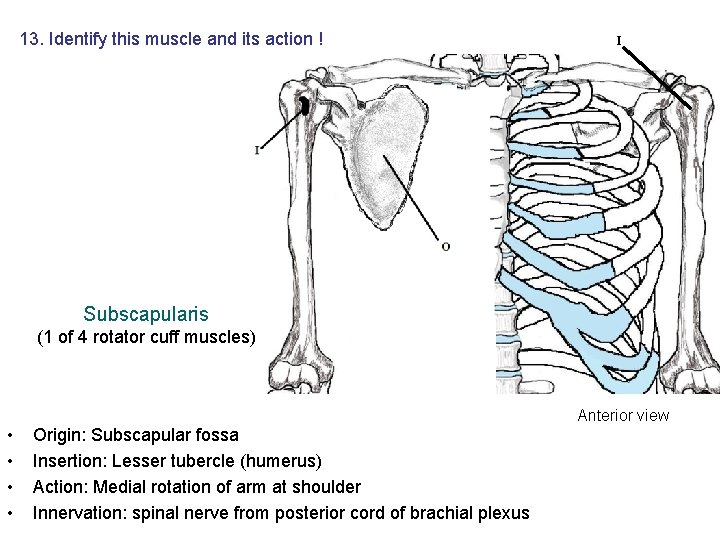
13. Identify this muscle and its action ! I Anterior view
13. Identify this muscle and its action ! • • Origin: Subscapular fossa Insertion: Lesser tubercle (humerus) Action: Medial rotation of shoulder Innervation: spinal nerve from posterior cord of brachial plexus I Anterior view
13. Identify this muscle and its action ! I Subscapularis (1 of 4 rotator cuff muscles) • • Origin: Subscapular fossa Insertion: Lesser tubercle (humerus) Action: Medial rotation of arm at shoulder Innervation: spinal nerve from posterior cord of brachial plexus Anterior view
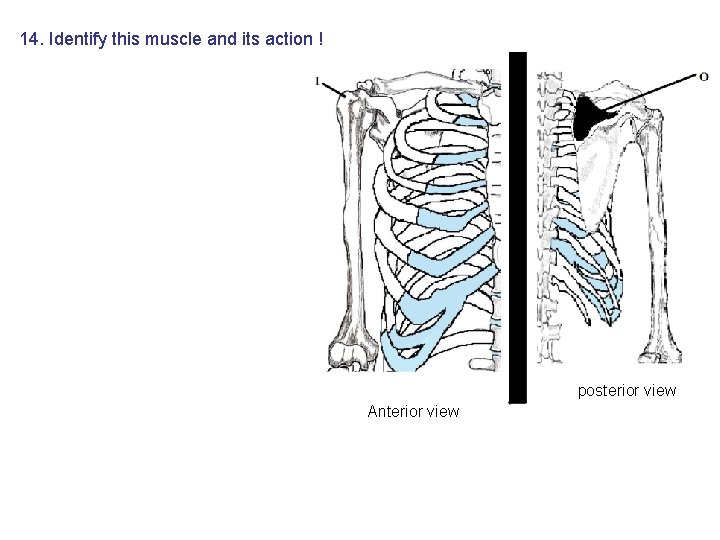
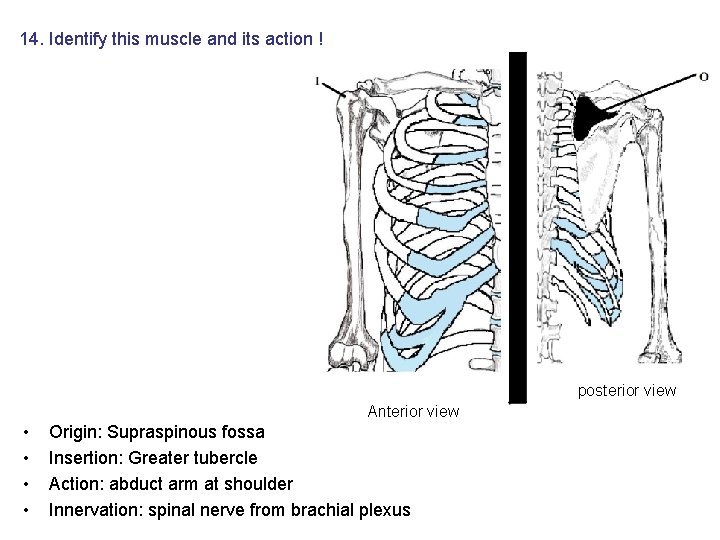
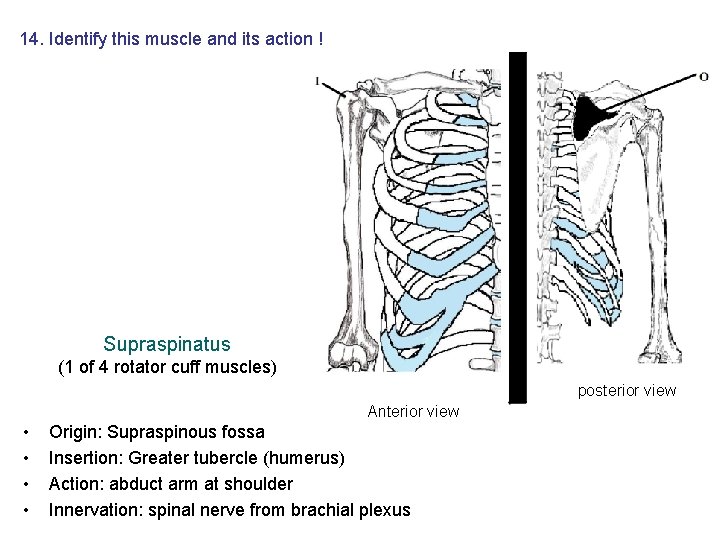
14. Identify this muscle and its action ! posterior view Anterior view
14. Identify this muscle and its action ! posterior view Anterior view • • Origin: Supraspinous fossa Insertion: Greater tubercle Action: abduct arm at shoulder Innervation: spinal nerve from brachial plexus
14. Identify this muscle and its action ! Supraspinatus (1 of 4 rotator cuff muscles) posterior view Anterior view • • Origin: Supraspinous fossa Insertion: Greater tubercle (humerus) Action: abduct arm at shoulder Innervation: spinal nerve from brachial plexus
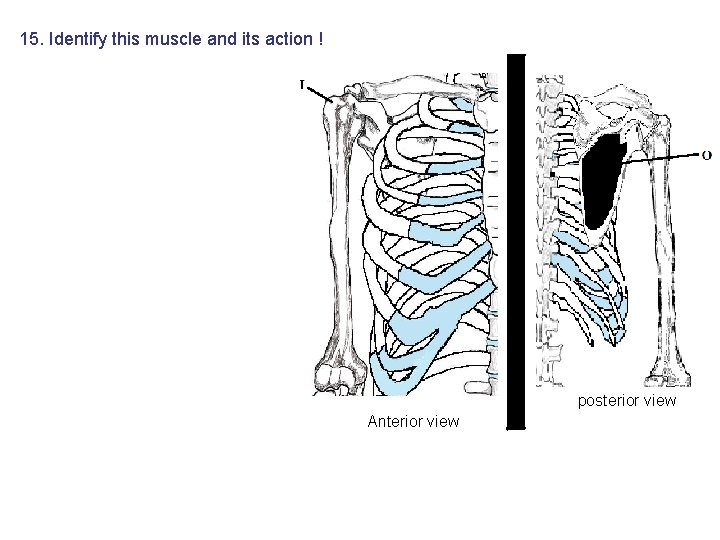
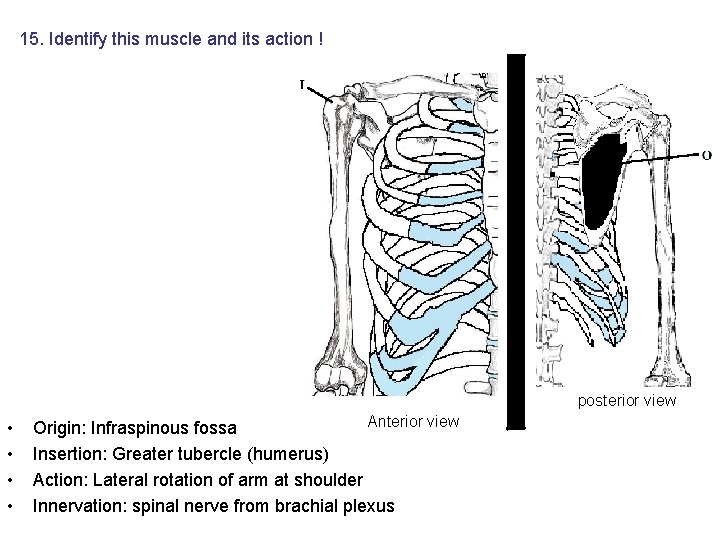
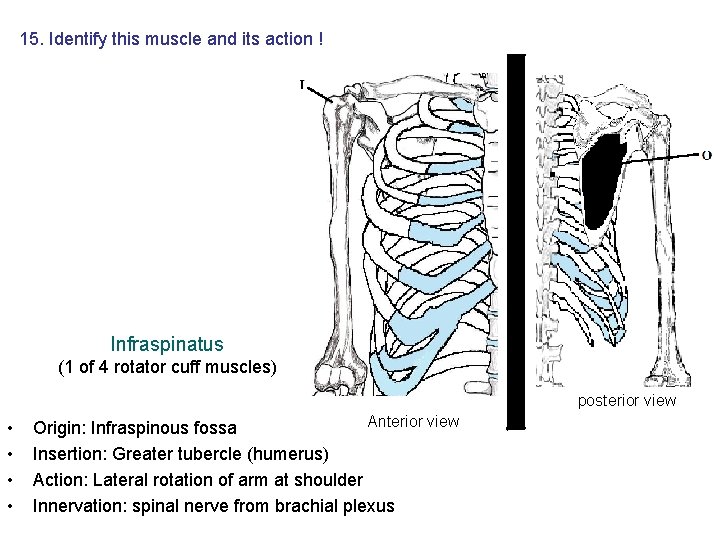
15. Identify this muscle and its action ! posterior view Anterior view
15. Identify this muscle and its action ! posterior view • • Anterior view Origin: Infraspinous fossa Insertion: Greater tubercle (humerus) Action: Lateral rotation of arm at shoulder Innervation: spinal nerve from brachial plexus
15. Identify this muscle and its action ! Infraspinatus (1 of 4 rotator cuff muscles) posterior view • • Anterior view Origin: Infraspinous fossa Insertion: Greater tubercle (humerus) Action: Lateral rotation of arm at shoulder Innervation: spinal nerve from brachial plexus
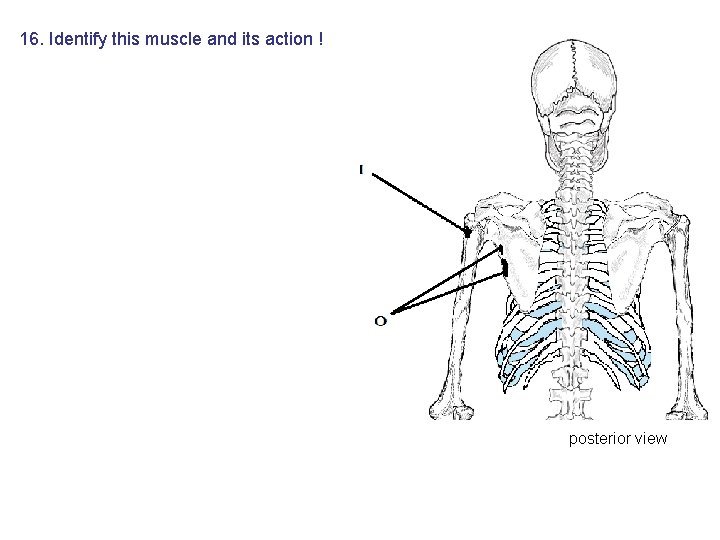
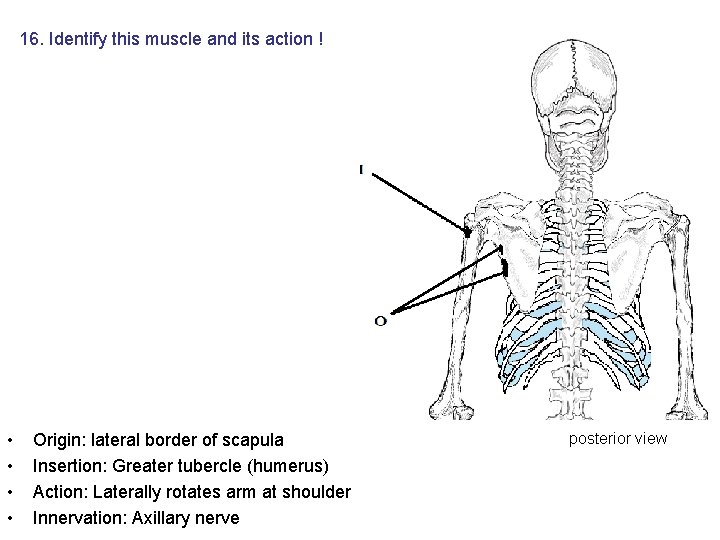
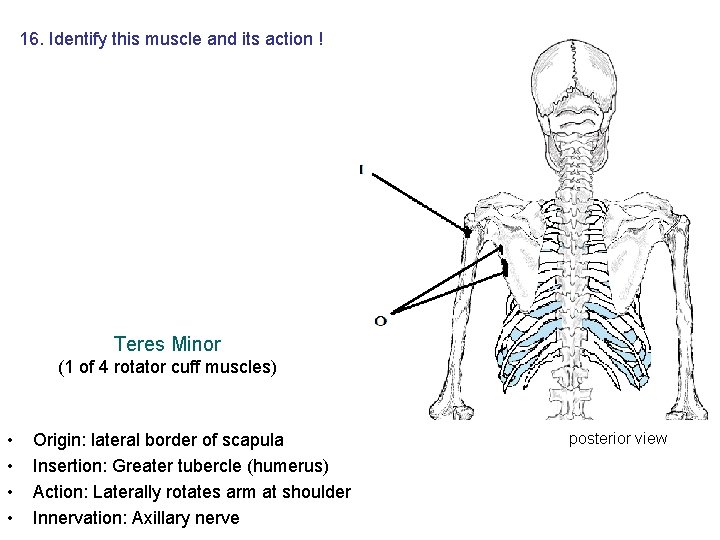
16. Identify this muscle and its action ! posterior view
16. Identify this muscle and its action ! • • Origin: lateral border of scapula Insertion: Greater tubercle (humerus) Action: Laterally rotates arm at shoulder Innervation: Axillary nerve posterior view
16. Identify this muscle and its action ! Teres Minor (1 of 4 rotator cuff muscles) • • Origin: lateral border of scapula Insertion: Greater tubercle (humerus) Action: Laterally rotates arm at shoulder Innervation: Axillary nerve posterior view
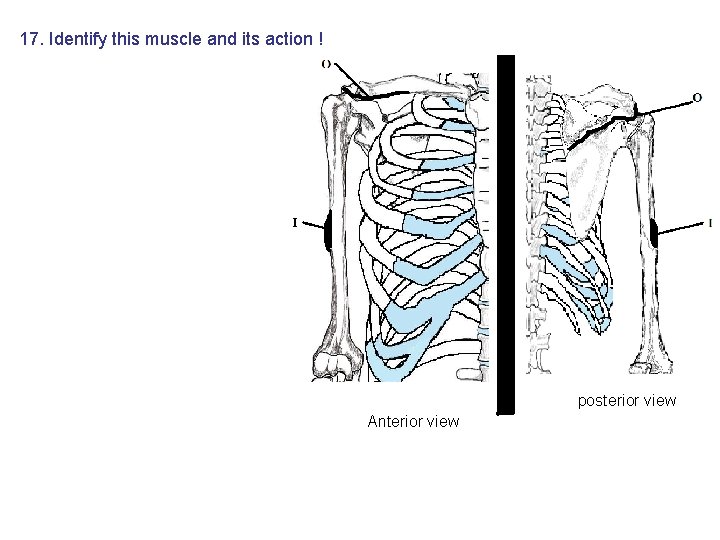
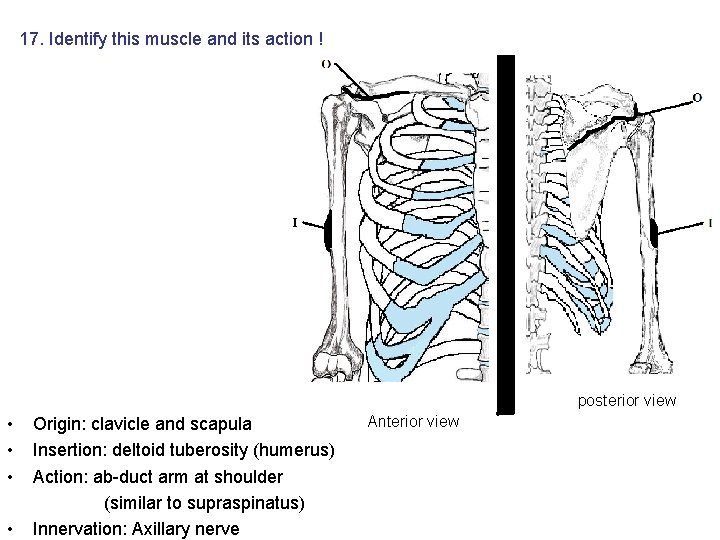
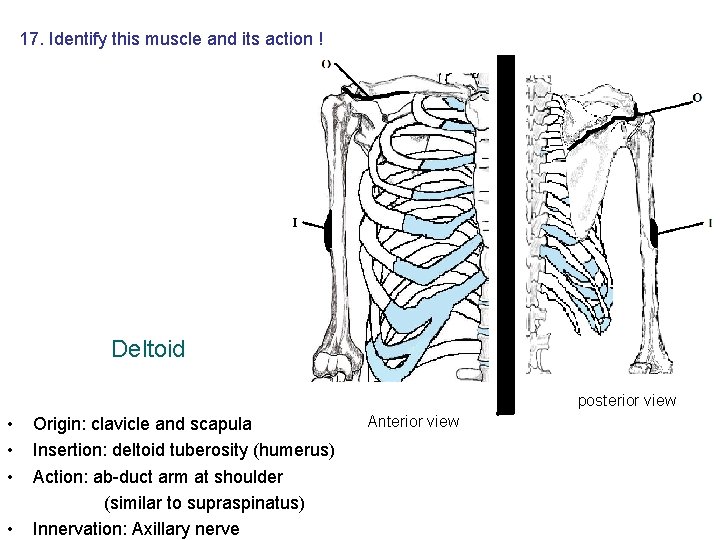
17. Identify this muscle and its action ! posterior view Anterior view
17. Identify this muscle and its action ! posterior view • • Origin: clavicle and scapula Insertion: deltoid tuberosity (humerus) Action: ab-duct arm at shoulder (similar to supraspinatus) Innervation: Axillary nerve Anterior view
17. Identify this muscle and its action ! Deltoid posterior view • • Origin: clavicle and scapula Insertion: deltoid tuberosity (humerus) Action: ab-duct arm at shoulder (similar to supraspinatus) Innervation: Axillary nerve Anterior view
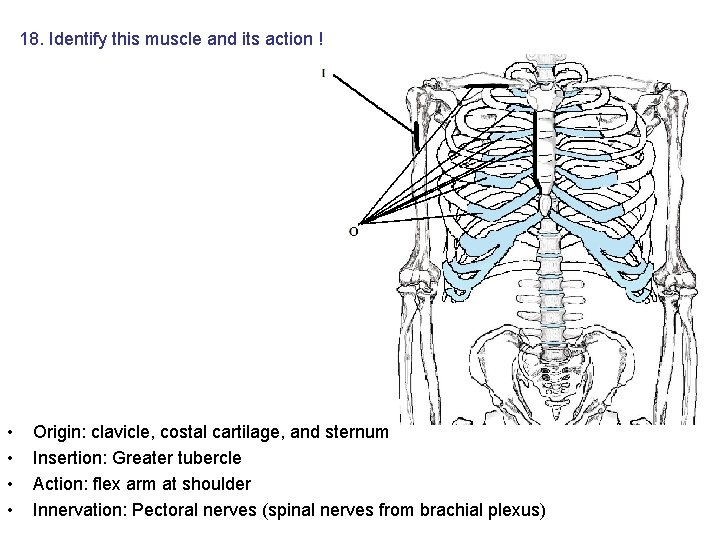
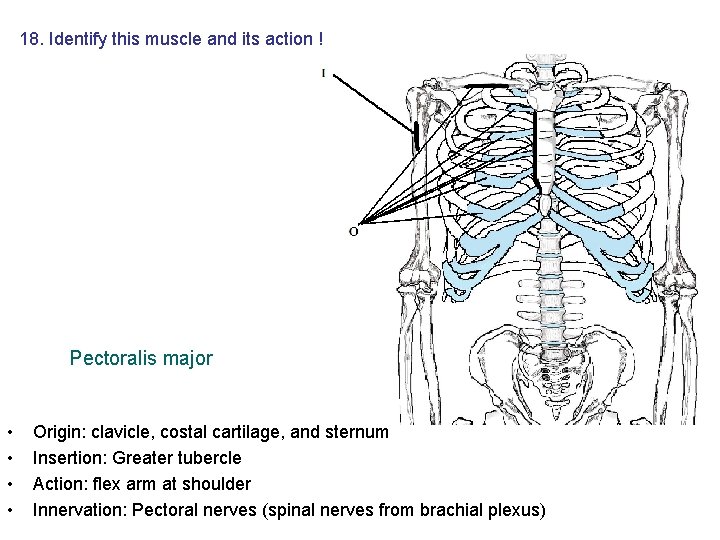
18. Identify this muscle and its action !
18. Identify this muscle and its action ! • • Origin: clavicle, costal cartilage, and sternum Insertion: Greater tubercle Action: flex arm at shoulder Innervation: Pectoral nerves (spinal nerves from brachial plexus)
18. Identify this muscle and its action ! Pectoralis major • • Origin: clavicle, costal cartilage, and sternum Insertion: Greater tubercle Action: flex arm at shoulder Innervation: Pectoral nerves (spinal nerves from brachial plexus)
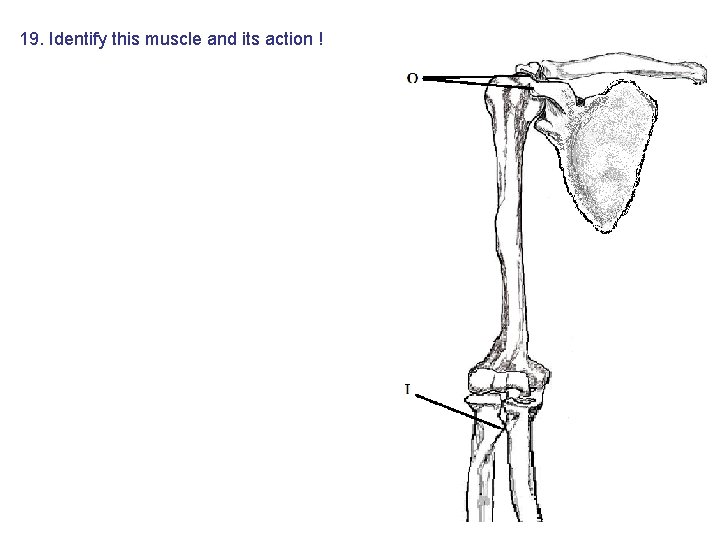
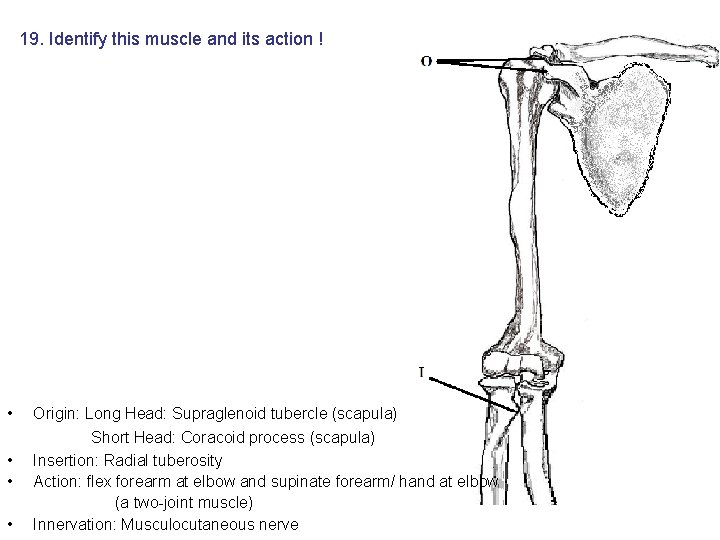
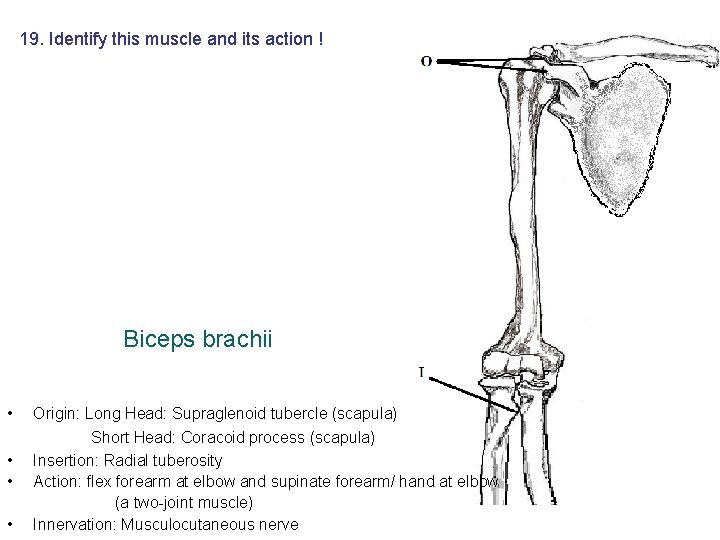
19. Identify this muscle and its action !
19. Identify this muscle and its action ! • • Origin: Long Head: Supraglenoid tubercle (scapula) Short Head: Coracoid process (scapula) Insertion: Radial tuberosity Action: flex forearm at elbow and supinate forearm/ hand at elbow (a two-joint muscle) Innervation: Musculocutaneous nerve
19. Identify this muscle and its action ! Biceps brachii • • Origin: Long Head: Supraglenoid tubercle (scapula) Short Head: Coracoid process (scapula) Insertion: Radial tuberosity Action: flex forearm at elbow and supinate forearm/ hand at elbow (a two-joint muscle) Innervation: Musculocutaneous nerve
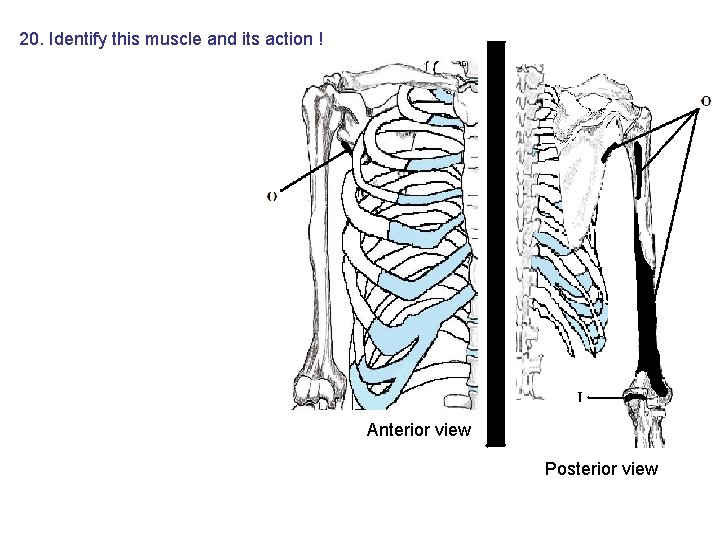
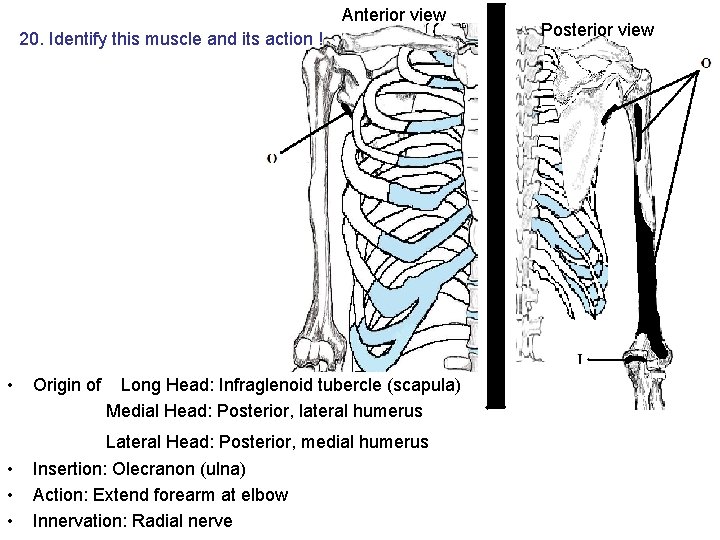
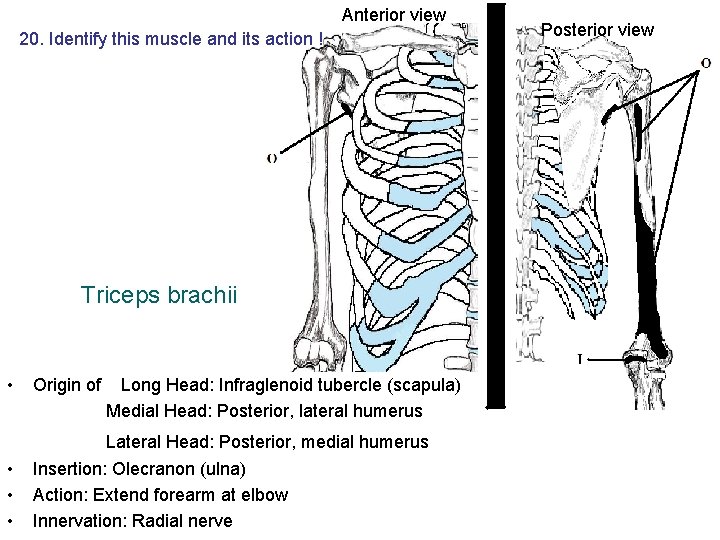
20. Identify this muscle and its action ! Anterior view Posterior view
Anterior view 20. Identify this muscle and its action ! • Origin of Long Head: Infraglenoid tubercle (scapula) Medial Head: Posterior, lateral humerus Lateral Head: Posterior, medial humerus • • • Insertion: Olecranon (ulna) Action: Extend forearm at elbow Innervation: Radial nerve Posterior view
Anterior view 20. Identify this muscle and its action ! Triceps brachii • Origin of Long Head: Infraglenoid tubercle (scapula) Medial Head: Posterior, lateral humerus Lateral Head: Posterior, medial humerus • • • Insertion: Olecranon (ulna) Action: Extend forearm at elbow Innervation: Radial nerve Posterior view
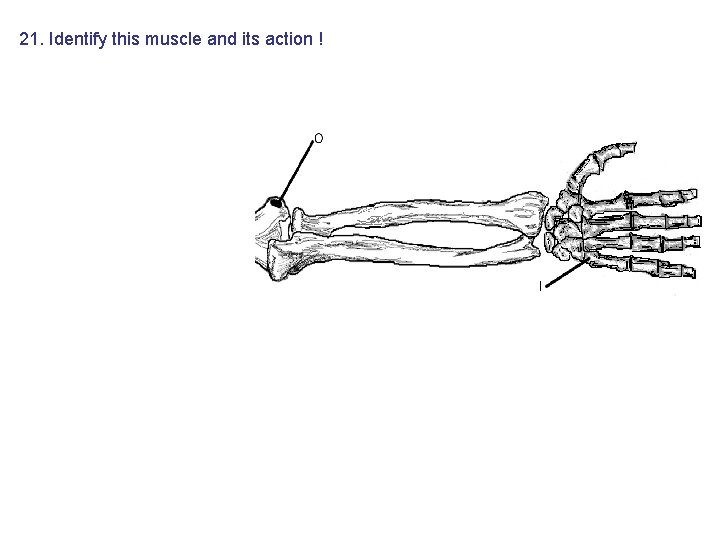
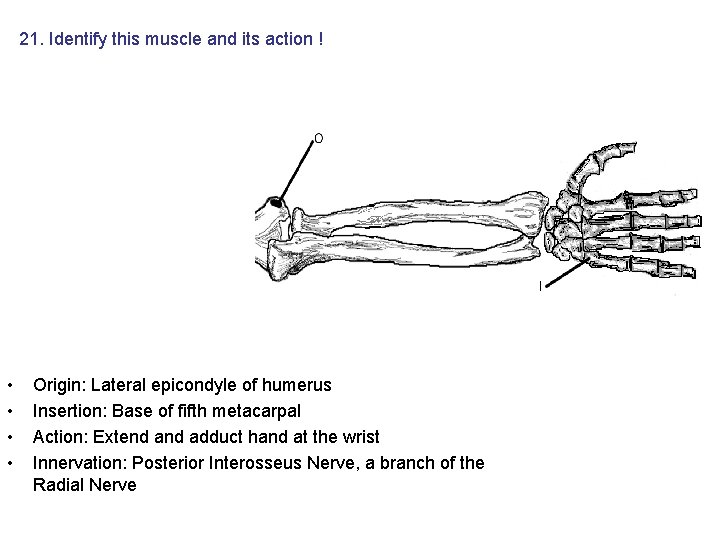
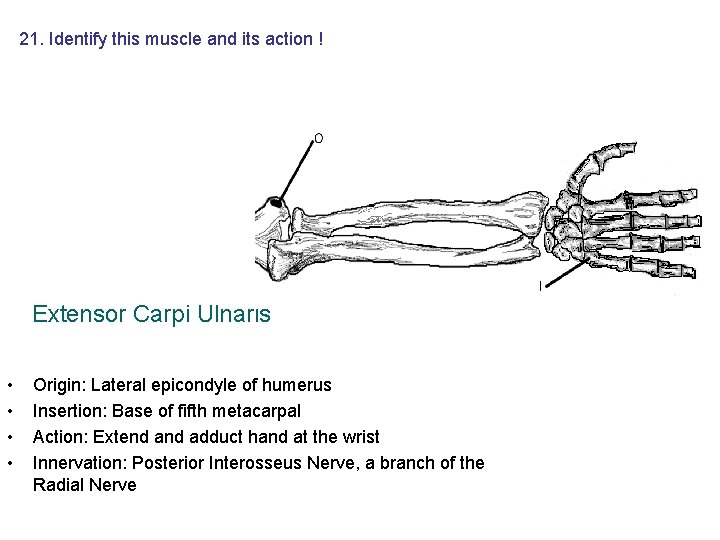
21. Identify this muscle and its action !
21. Identify this muscle and its action ! • • Origin: Lateral epicondyle of humerus Insertion: Base of fifth metacarpal Action: Extend adduct hand at the wrist Innervation: Posterior Interosseus Nerve, a branch of the Radial Nerve
21. Identify this muscle and its action ! Extensor Carpi Ulnaris • • Origin: Lateral epicondyle of humerus Insertion: Base of fifth metacarpal Action: Extend adduct hand at the wrist Innervation: Posterior Interosseus Nerve, a branch of the Radial Nerve
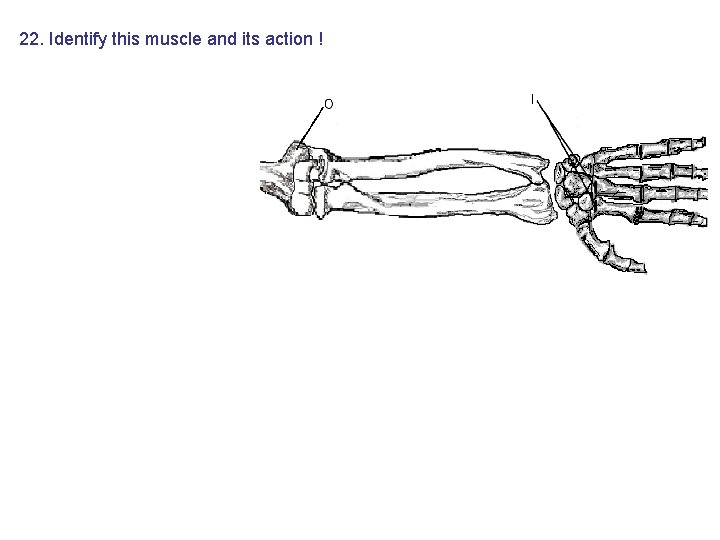
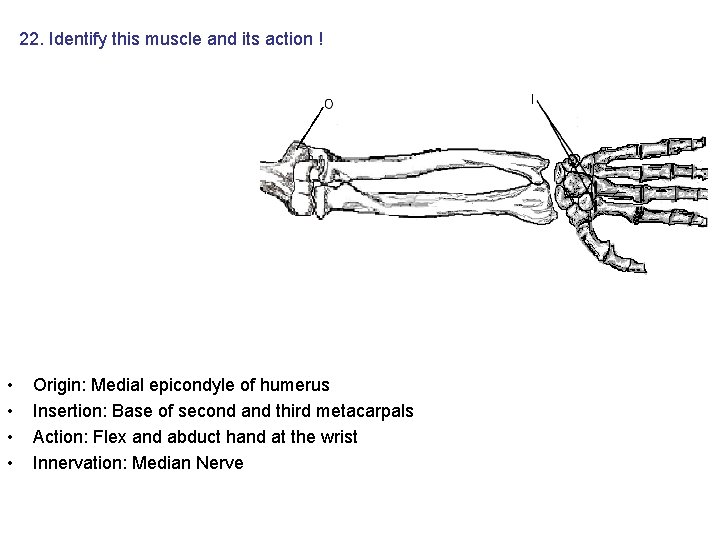
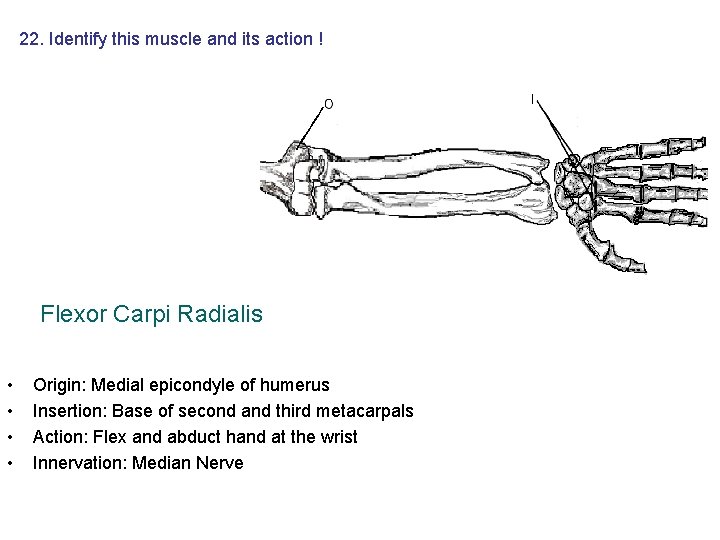
22. Identify this muscle and its action !
22. Identify this muscle and its action ! • • Origin: Medial epicondyle of humerus Insertion: Base of second and third metacarpals Action: Flex and abduct hand at the wrist Innervation: Median Nerve
22. Identify this muscle and its action ! Flexor Carpi Radialis • • Origin: Medial epicondyle of humerus Insertion: Base of second and third metacarpals Action: Flex and abduct hand at the wrist Innervation: Median Nerve
Anatomy Muscles Flashcards Origins and Insertions Presented in Three Parts: I – Muscles of Face, head, neck, thorax, and abdomen II – Muscles of the upper extremity III – Muscles of the lower extremity
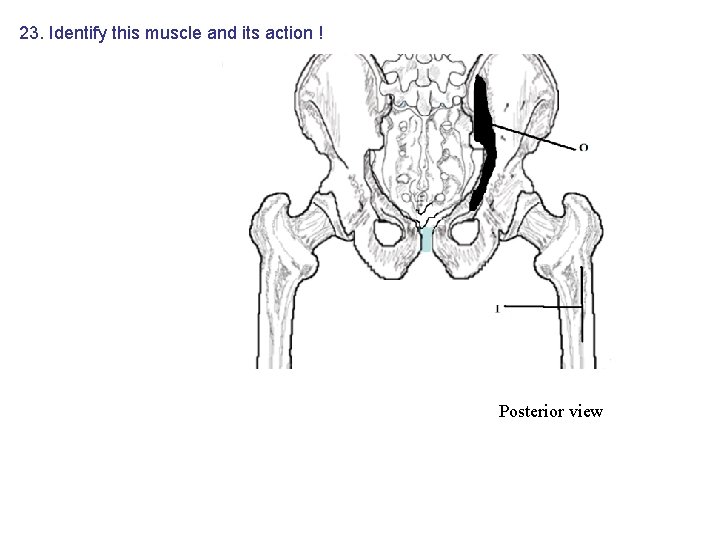
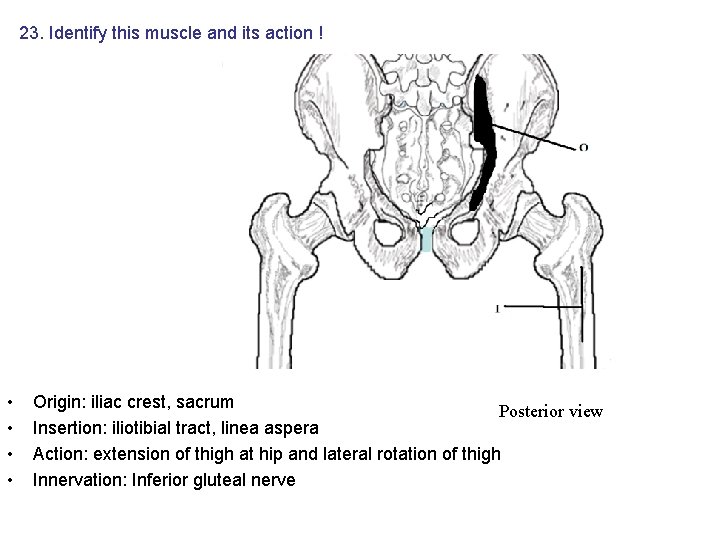
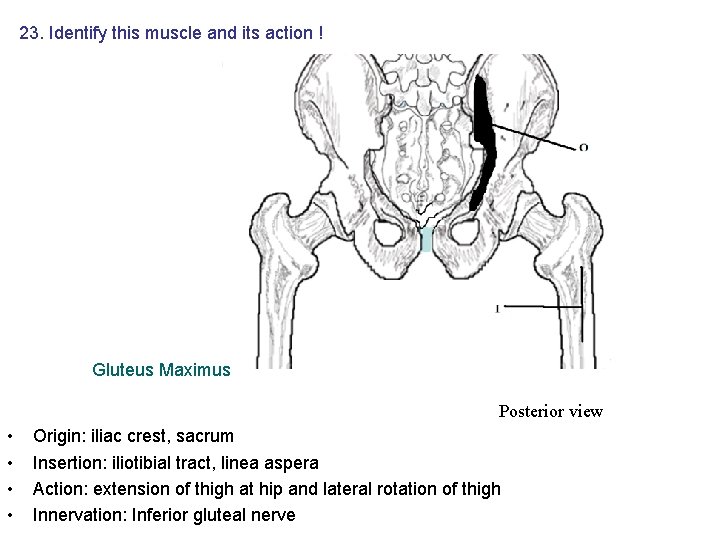
23. Identify this muscle and its action ! Posterior view
23. Identify this muscle and its action ! • • Origin: iliac crest, sacrum Posterior view Insertion: iliotibial tract, linea aspera Action: extension of thigh at hip and lateral rotation of thigh Innervation: Inferior gluteal nerve
23. Identify this muscle and its action ! Gluteus Maximus Posterior view • • Origin: iliac crest, sacrum Insertion: iliotibial tract, linea aspera Action: extension of thigh at hip and lateral rotation of thigh Innervation: Inferior gluteal nerve
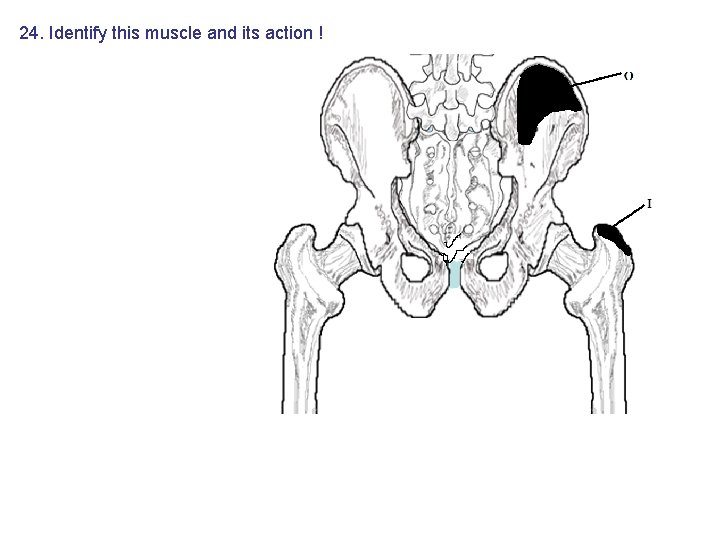
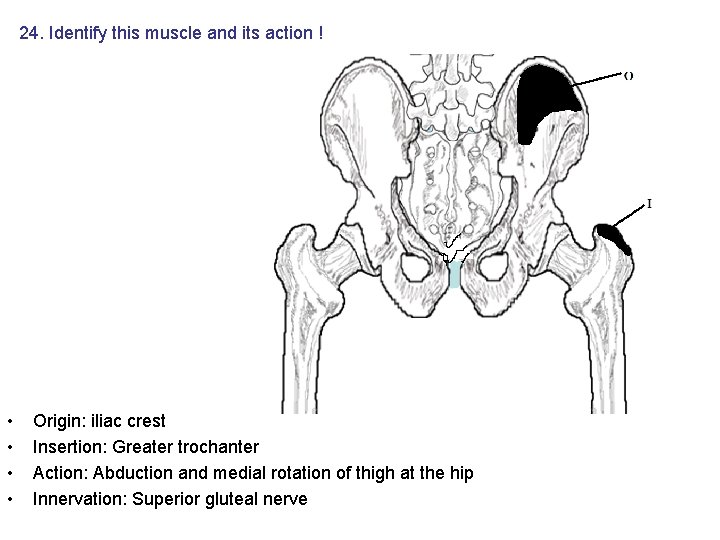
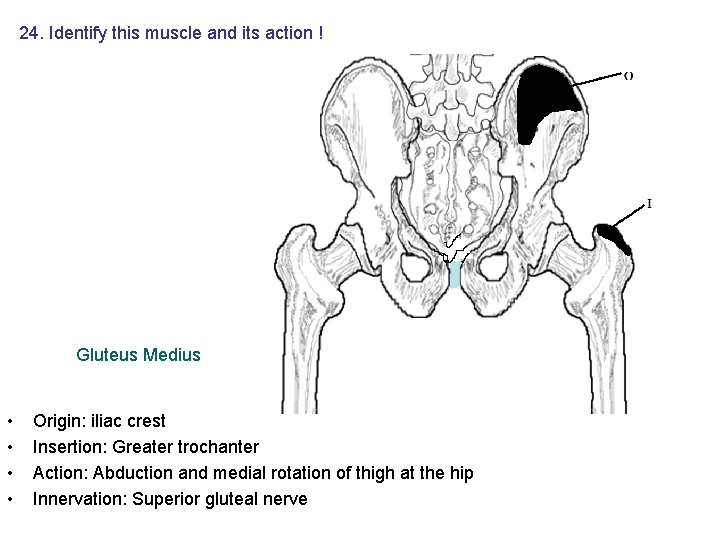
24. Identify this muscle and its action !
24. Identify this muscle and its action ! • • Origin: iliac crest Insertion: Greater trochanter Action: Abduction and medial rotation of thigh at the hip Innervation: Superior gluteal nerve
24. Identify this muscle and its action ! Gluteus Medius • • Origin: iliac crest Insertion: Greater trochanter Action: Abduction and medial rotation of thigh at the hip Innervation: Superior gluteal nerve
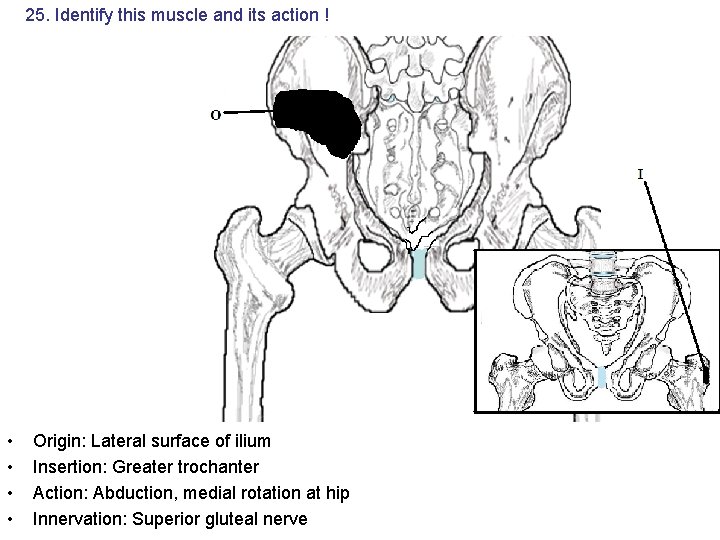
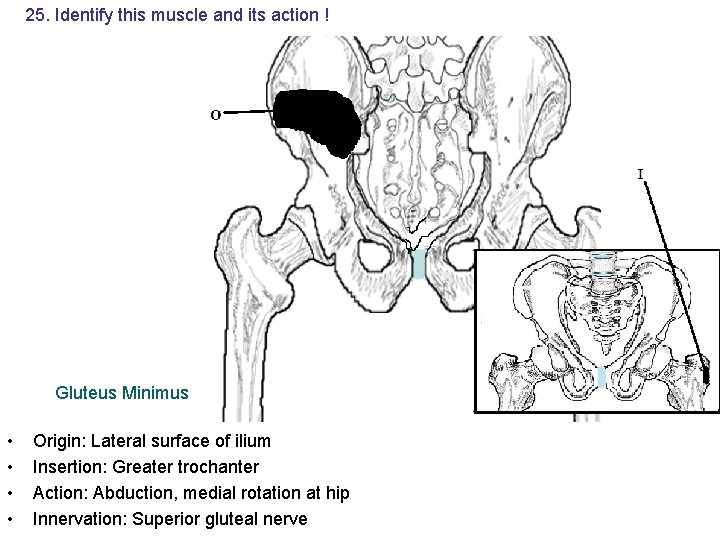
25. Identify this muscle and its action !
25. Identify this muscle and its action ! • • Origin: Lateral surface of ilium Insertion: Greater trochanter Action: Abduction, medial rotation at hip Innervation: Superior gluteal nerve
25. Identify this muscle and its action ! Gluteus Minimus • • Origin: Lateral surface of ilium Insertion: Greater trochanter Action: Abduction, medial rotation at hip Innervation: Superior gluteal nerve
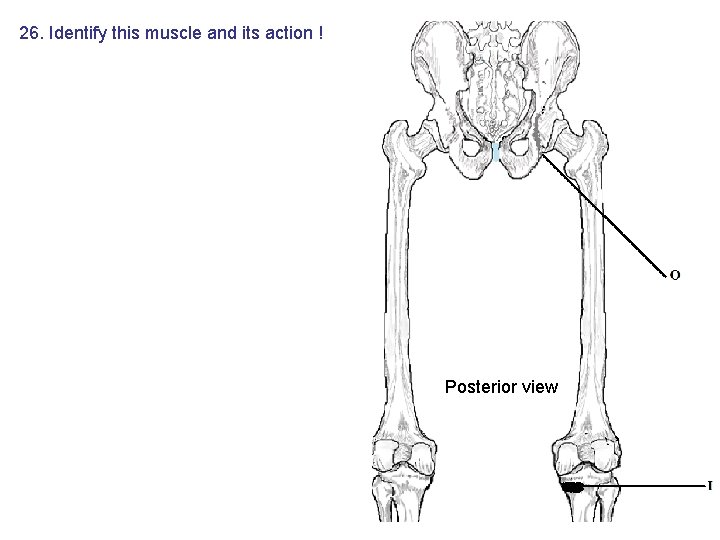
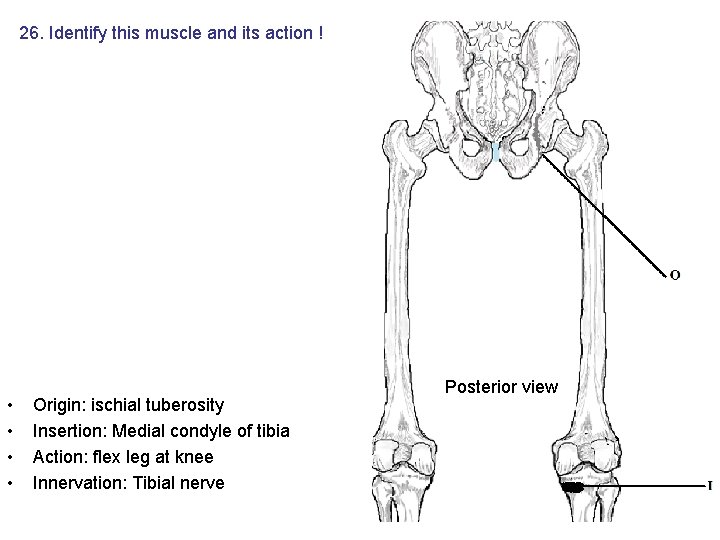
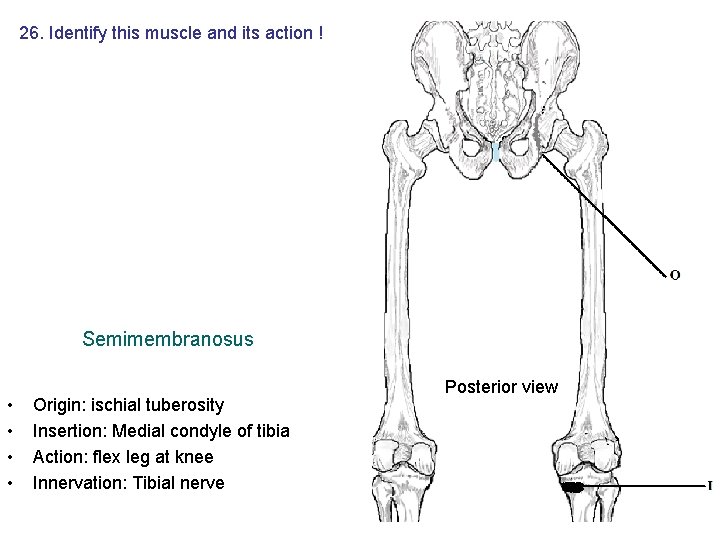
26. Identify this muscle and its action ! Posterior view
26. Identify this muscle and its action ! • • Origin: ischial tuberosity Insertion: Medial condyle of tibia Action: flex leg at knee Innervation: Tibial nerve Posterior view
26. Identify this muscle and its action ! Semimembranosus • • Origin: ischial tuberosity Insertion: Medial condyle of tibia Action: flex leg at knee Innervation: Tibial nerve Posterior view
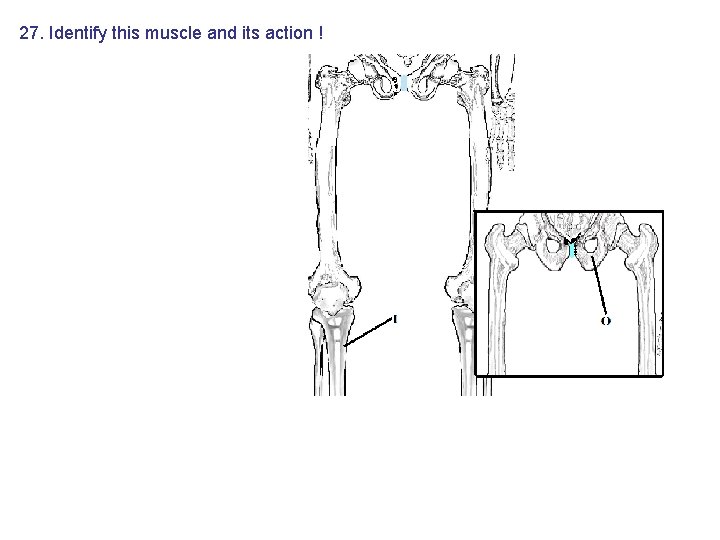
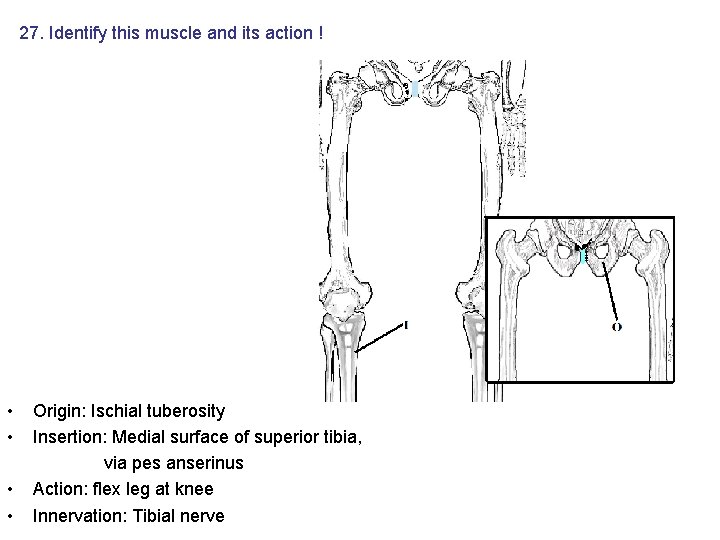
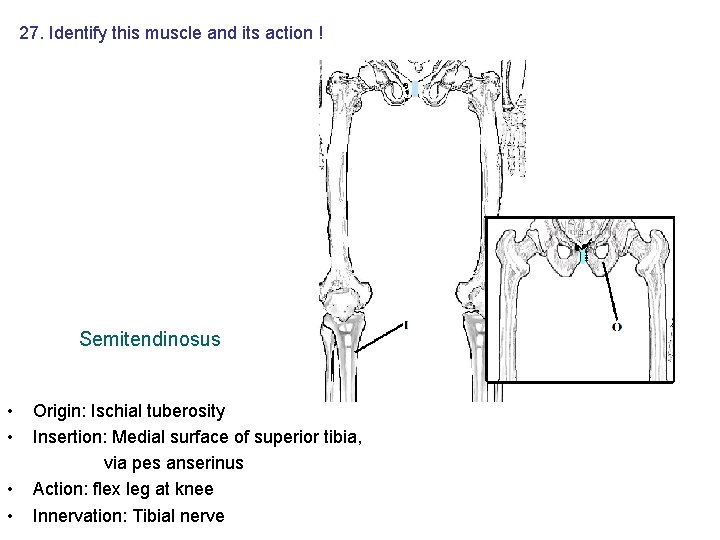
27. Identify this muscle and its action !
27. Identify this muscle and its action ! • • Origin: Ischial tuberosity Insertion: Medial surface of superior tibia, via pes anserinus Action: flex leg at knee Innervation: Tibial nerve
27. Identify this muscle and its action ! Semitendinosus • • Origin: Ischial tuberosity Insertion: Medial surface of superior tibia, via pes anserinus Action: flex leg at knee Innervation: Tibial nerve
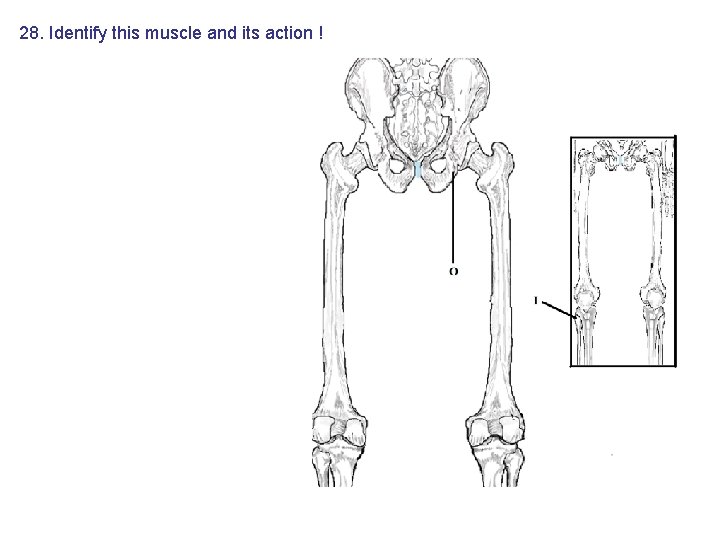
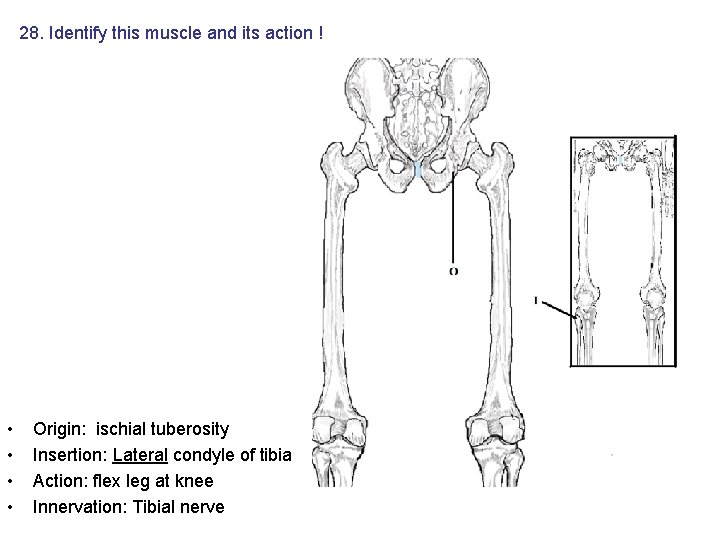
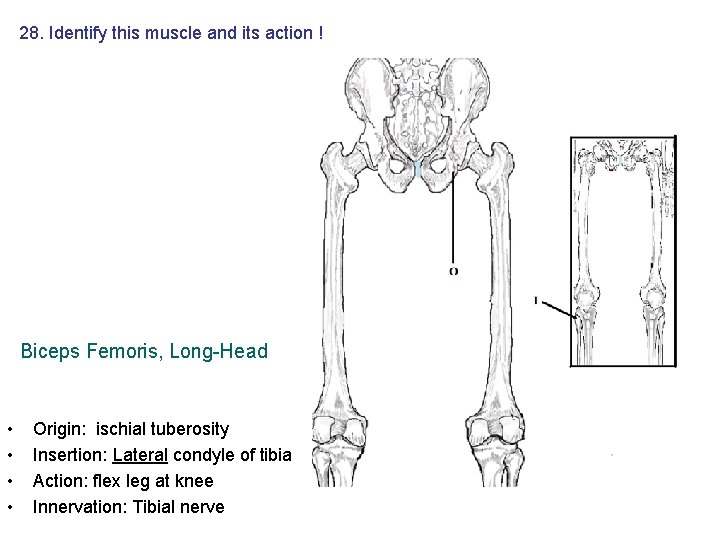
28. Identify this muscle and its action !
28. Identify this muscle and its action ! • • Origin: ischial tuberosity Insertion: Lateral condyle of tibia Action: flex leg at knee Innervation: Tibial nerve
28. Identify this muscle and its action ! Biceps Femoris, Long-Head • • Origin: ischial tuberosity Insertion: Lateral condyle of tibia Action: flex leg at knee Innervation: Tibial nerve
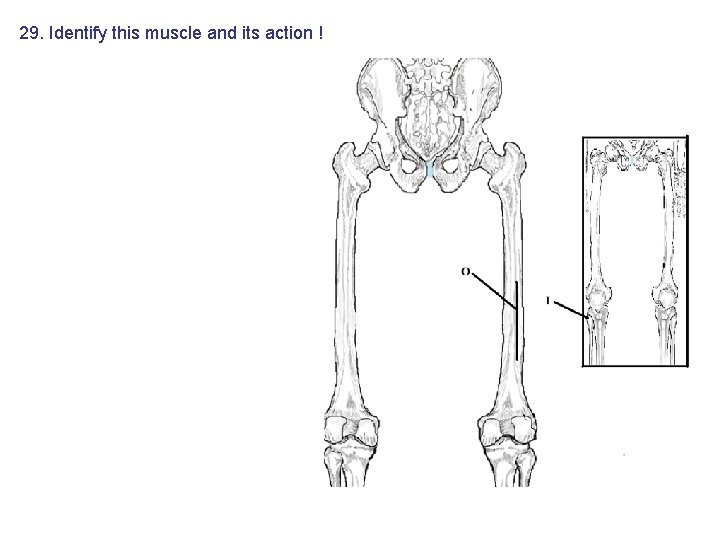
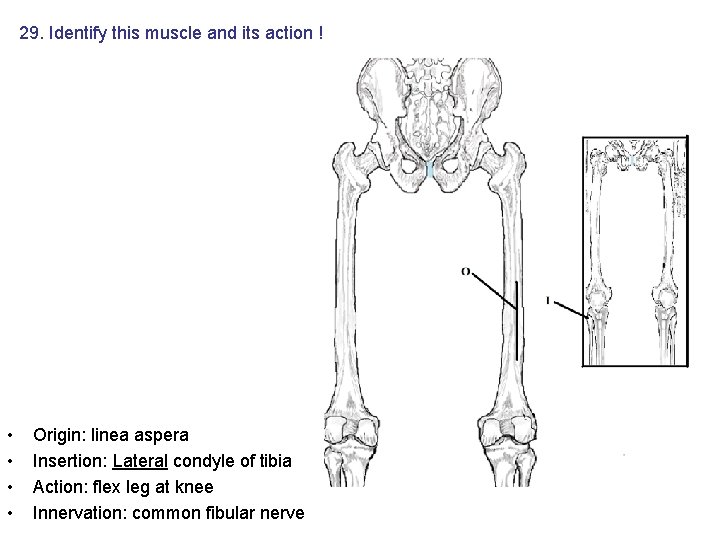
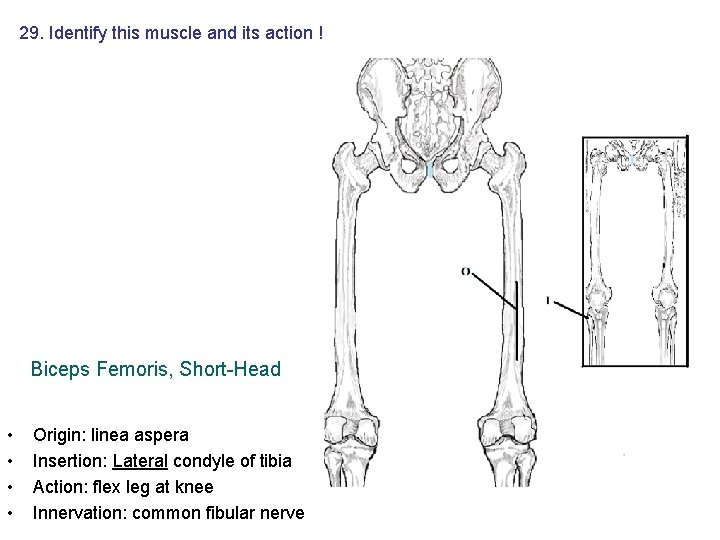
29. Identify this muscle and its action !
29. Identify this muscle and its action ! • • Origin: linea aspera Insertion: Lateral condyle of tibia Action: flex leg at knee Innervation: common fibular nerve
29. Identify this muscle and its action ! Biceps Femoris, Short-Head • • Origin: linea aspera Insertion: Lateral condyle of tibia Action: flex leg at knee Innervation: common fibular nerve
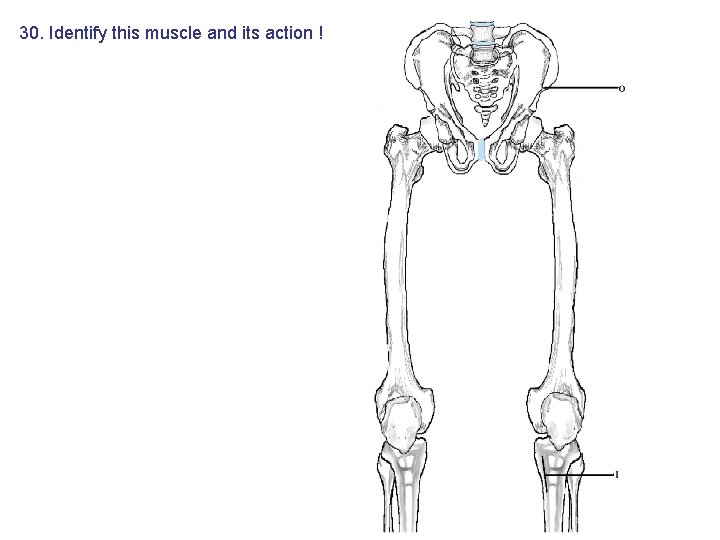
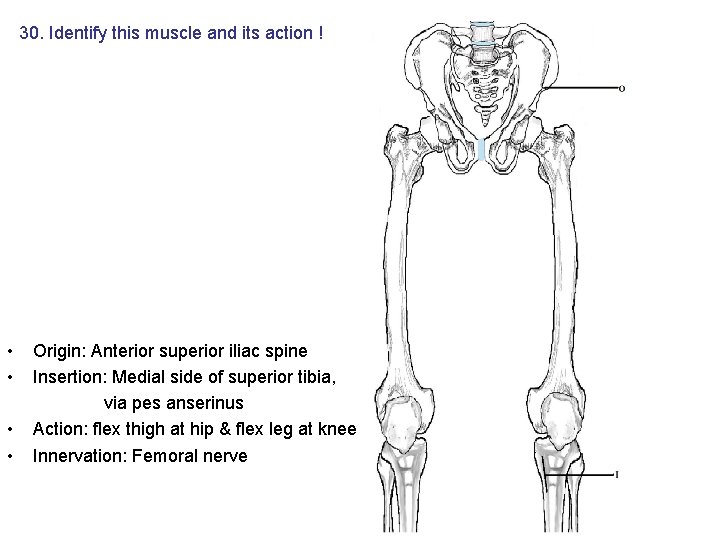
30. Identify this muscle and its action !
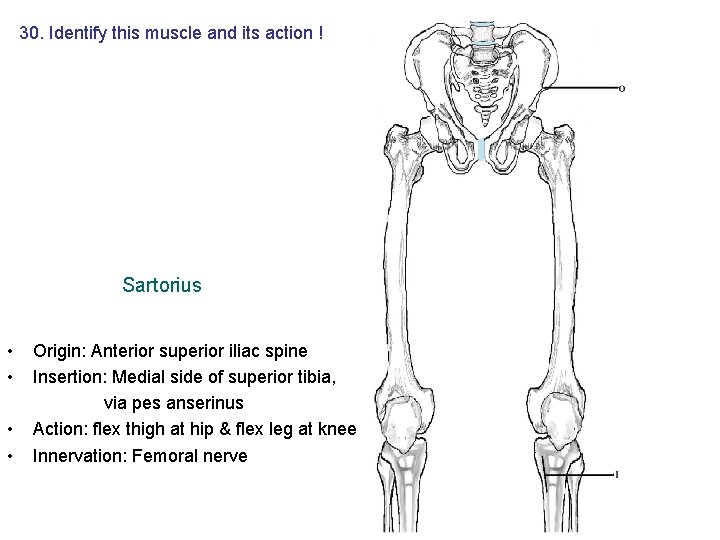
30. Identify this muscle and its action ! • • Origin: Anterior superior iliac spine Insertion: Medial side of superior tibia, via pes anserinus Action: flex thigh at hip & flex leg at knee Innervation: Femoral nerve
30. Identify this muscle and its action ! Sartorius • • Origin: Anterior superior iliac spine Insertion: Medial side of superior tibia, via pes anserinus Action: flex thigh at hip & flex leg at knee Innervation: Femoral nerve
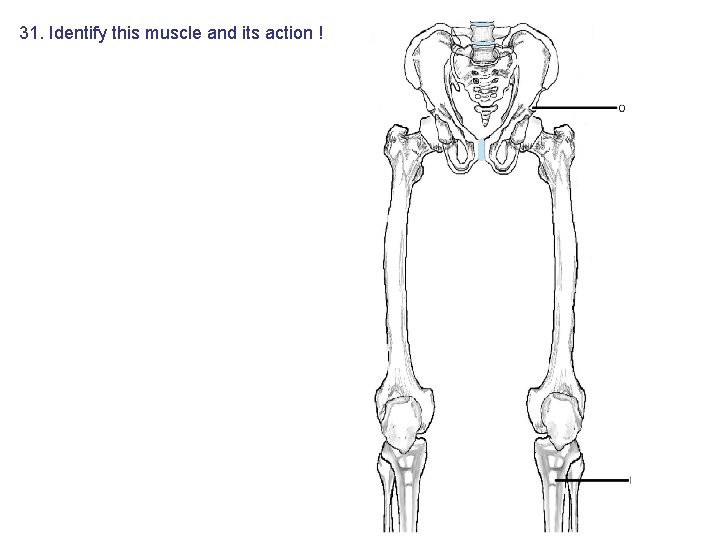
31. Identify this muscle and its action !
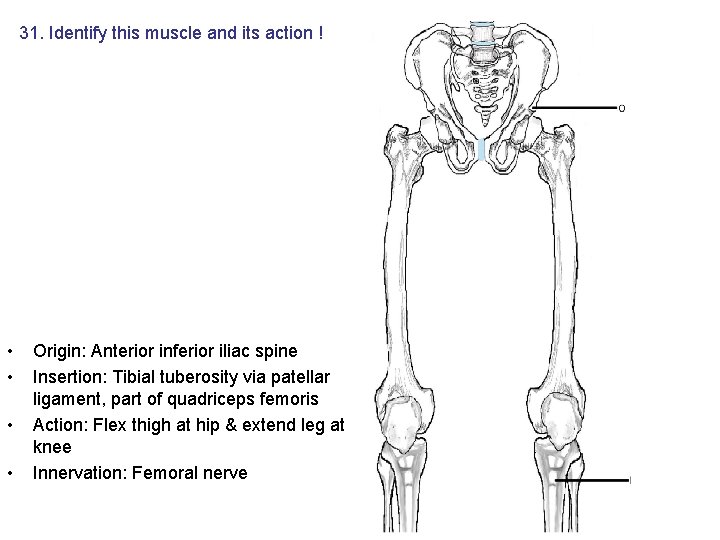
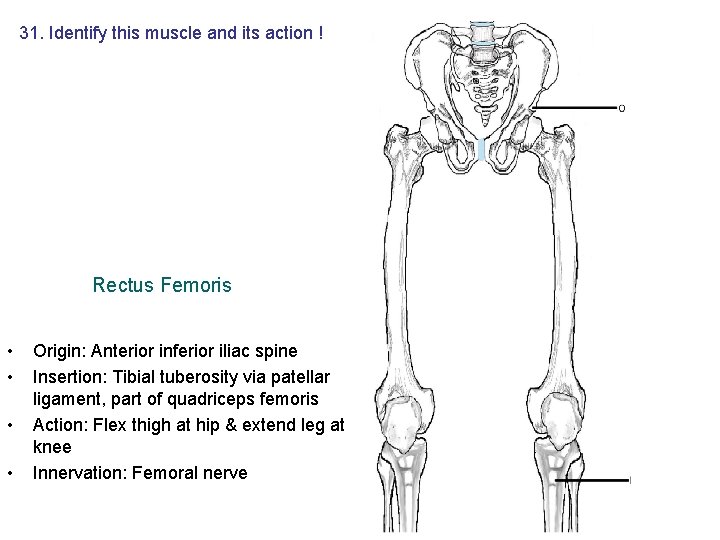
31. Identify this muscle and its action ! • • Origin: Anterior inferior iliac spine Insertion: Tibial tuberosity via patellar ligament, part of quadriceps femoris Action: Flex thigh at hip & extend leg at knee Innervation: Femoral nerve
31. Identify this muscle and its action ! Rectus Femoris • • Origin: Anterior inferior iliac spine Insertion: Tibial tuberosity via patellar ligament, part of quadriceps femoris Action: Flex thigh at hip & extend leg at knee Innervation: Femoral nerve
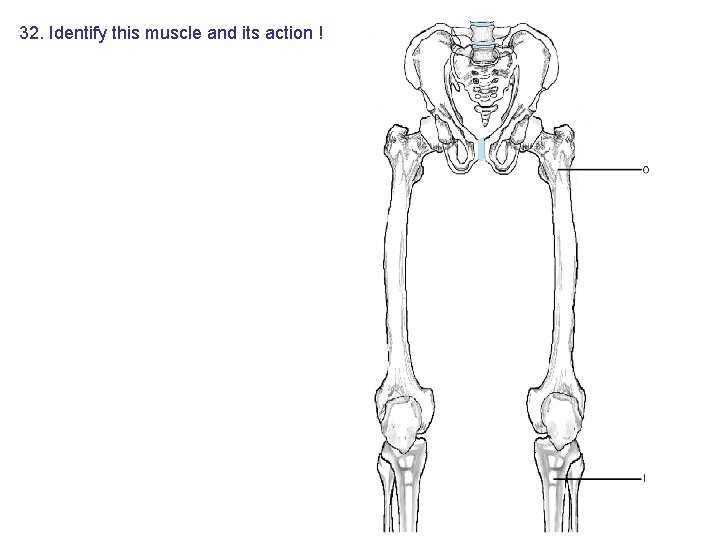
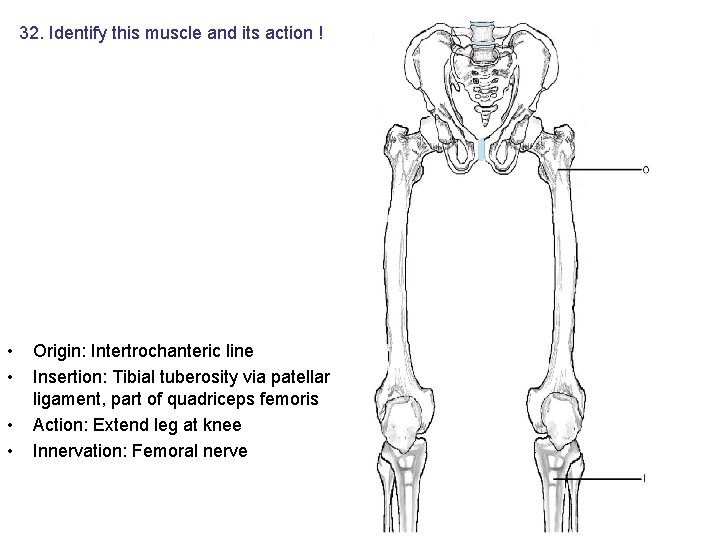
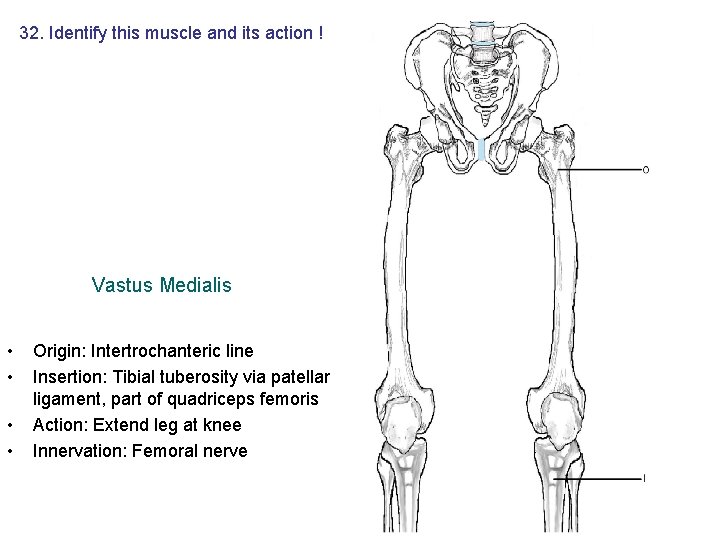
32. Identify this muscle and its action !
32. Identify this muscle and its action ! • • Origin: Intertrochanteric line Insertion: Tibial tuberosity via patellar ligament, part of quadriceps femoris Action: Extend leg at knee Innervation: Femoral nerve
32. Identify this muscle and its action ! Vastus Medialis • • Origin: Intertrochanteric line Insertion: Tibial tuberosity via patellar ligament, part of quadriceps femoris Action: Extend leg at knee Innervation: Femoral nerve
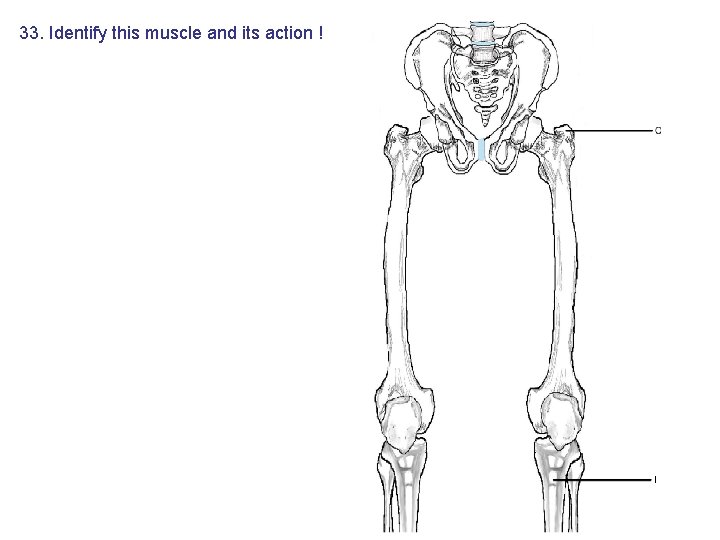
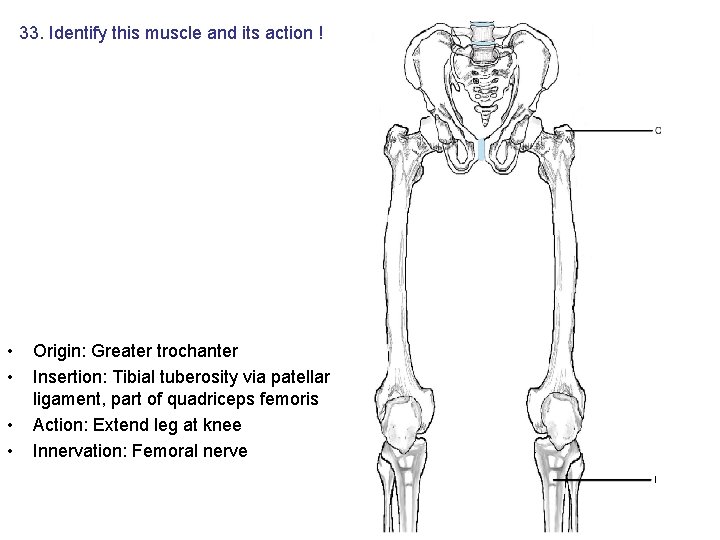
33. Identify this muscle and its action !
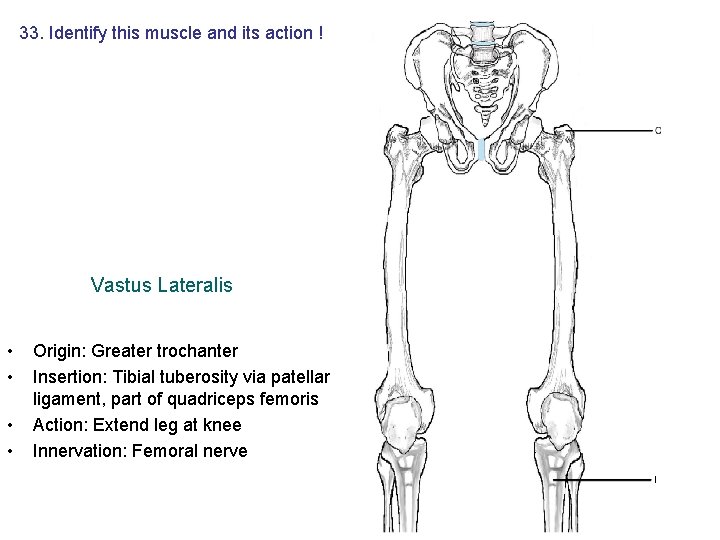
33. Identify this muscle and its action ! • • Origin: Greater trochanter Insertion: Tibial tuberosity via patellar ligament, part of quadriceps femoris Action: Extend leg at knee Innervation: Femoral nerve
33. Identify this muscle and its action ! Vastus Lateralis • • Origin: Greater trochanter Insertion: Tibial tuberosity via patellar ligament, part of quadriceps femoris Action: Extend leg at knee Innervation: Femoral nerve
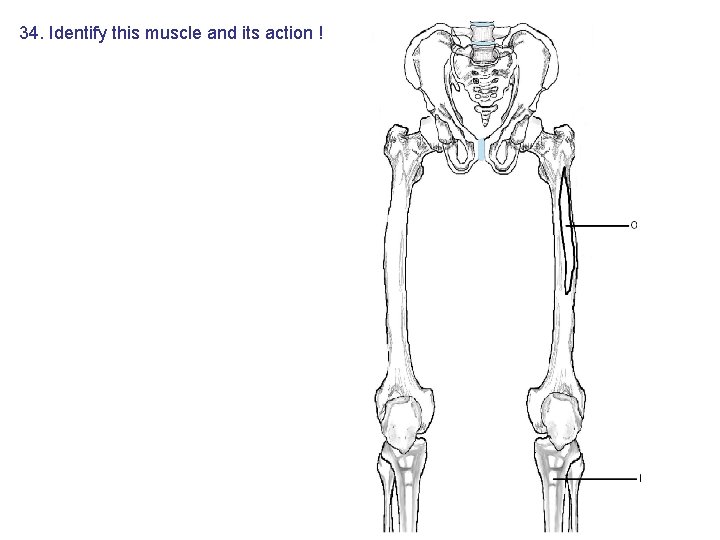
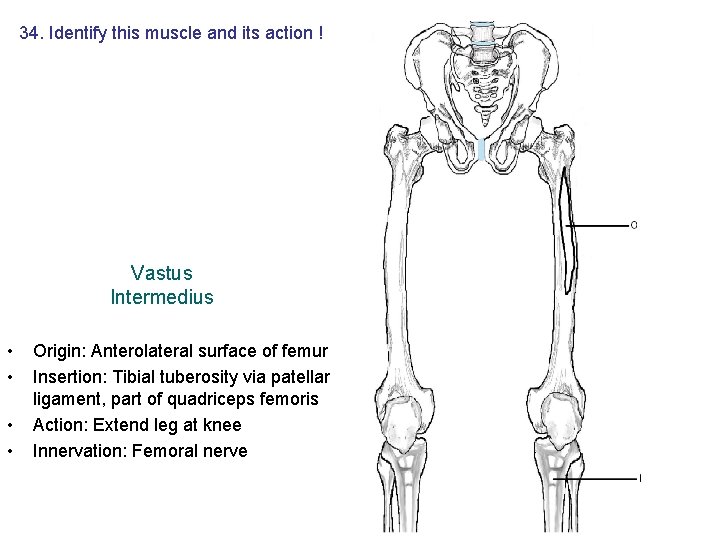
34. Identify this muscle and its action !
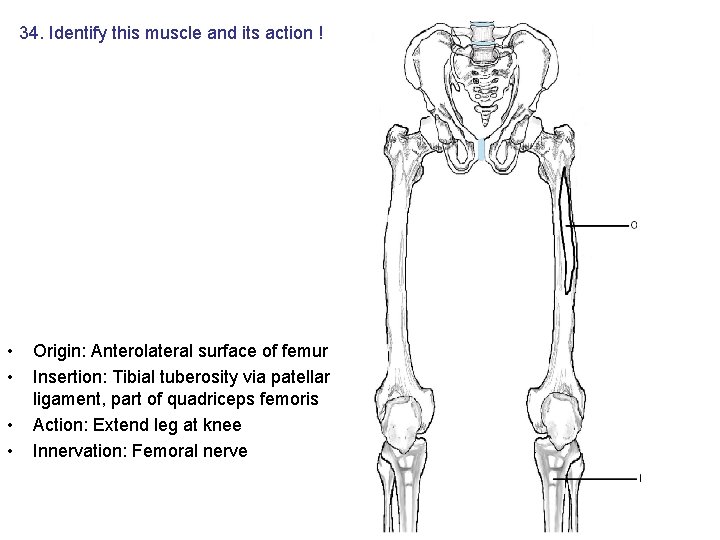
34. Identify this muscle and its action ! • • Origin: Anterolateral surface of femur Insertion: Tibial tuberosity via patellar ligament, part of quadriceps femoris Action: Extend leg at knee Innervation: Femoral nerve
34. Identify this muscle and its action ! Vastus Intermedius • • Origin: Anterolateral surface of femur Insertion: Tibial tuberosity via patellar ligament, part of quadriceps femoris Action: Extend leg at knee Innervation: Femoral nerve
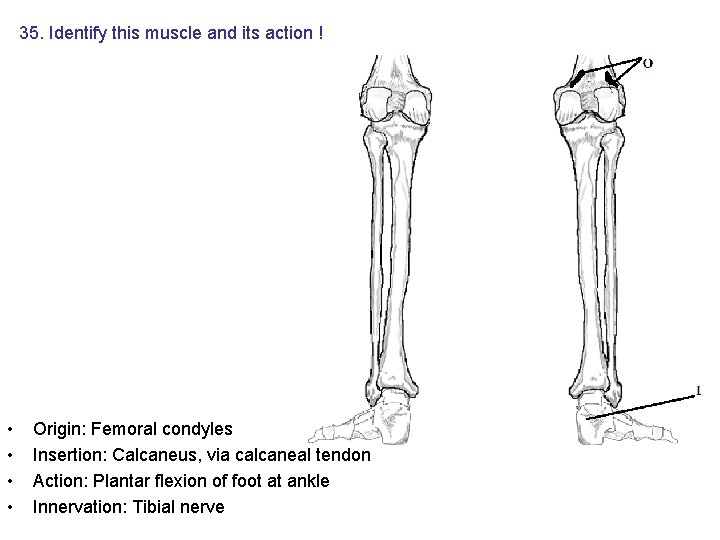
35. Identify this muscle and its action !
35. Identify this muscle and its action ! • • Origin: Femoral condyles Insertion: Calcaneus, via calcaneal tendon Action: Plantar flexion of foot at ankle Innervation: Tibial nerve
35. Identify this muscle and its action ! Gastrocnemius • • Origin: Femoral condyles Insertion: Calcaneus, via calcaneal tendon Action: Plantar flexion of foot at ankle Innervation: Tibial nerve
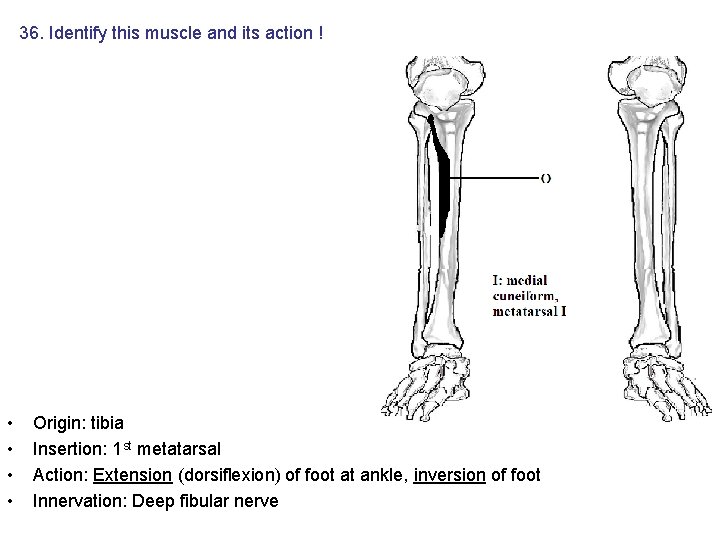
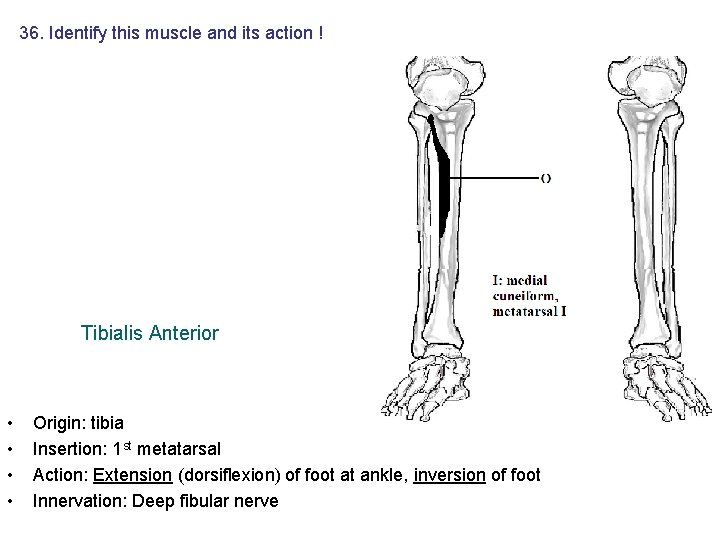
36. Identify this muscle and its action !
36. Identify this muscle and its action ! • • Origin: tibia Insertion: 1 st metatarsal Action: Extension (dorsiflexion) of foot at ankle, inversion of foot Innervation: Deep fibular nerve
36. Identify this muscle and its action ! Tibialis Anterior • • Origin: tibia Insertion: 1 st metatarsal Action: Extension (dorsiflexion) of foot at ankle, inversion of foot Innervation: Deep fibular nerve
Structures that you should study! • Flexor and extensor retinacula (of wrist and ankle) Without these, muscle tendons would “bow-string” and make it very difficult to perform their function.
This project was made possible by: Rachel Uppgaard (Human Anatomy TA, 2007 - present) and artwork by Jimmy Chue-mai Yang (TA, 2005 -2006)