
ANATOMY AND PHYSIOLOGY OF PARATHYROID GLAND DEVELOPMENT The

- Slides: 25
ANATOMY AND PHYSIOLOGY OF PARATHYROID GLAND
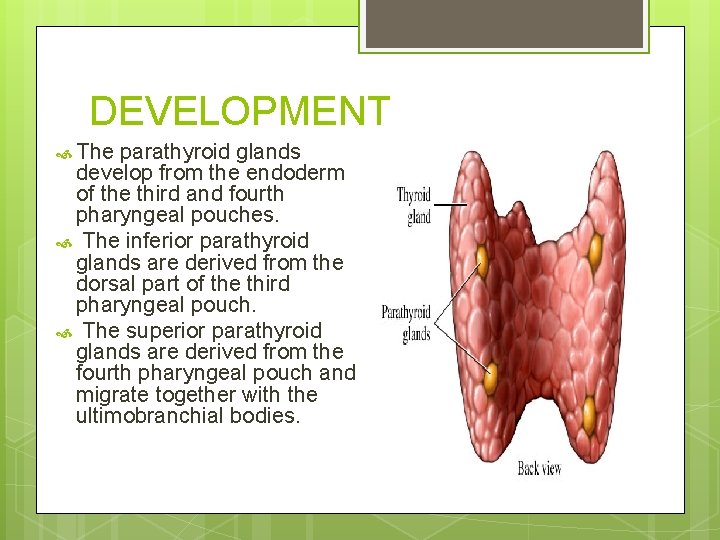
DEVELOPMENT The parathyroid glands develop from the endoderm of the third and fourth pharyngeal pouches. The inferior parathyroid glands are derived from the dorsal part of the third pharyngeal pouch. The superior parathyroid glands are derived from the fourth pharyngeal pouch and migrate together with the ultimobranchial bodies.
NUMBER AND SIZE Typically they are 4 in number. Size-5 mm in length , 3 mm in width and 1 -2 mm in depth. Lower glands are heavier than the upper glands. Maximum weight of normal gland vary within 8. 2 to 78 mg.
SHAPE The inelasticity of the parathyroid gland accounts for its variation in shape and contour. Subcapsular glands located at the upper pole of the thyroid gland have a tendency to be flattened, whereas glands in the cricothyroidal region and intrathymic region appear more oval and spherical in shape. Occasionally a gland is bean , sausage or rod shaped.
Macroscopic appearance and consistency Varies from light yellow to reddish brown. In children it appears as salmon pink because of the lower fat content. They are ususally soft, pliable and with a smooth surface.
Microscopic appearance Gland has a thin connective tissue capsule and septae which divide it into lobules. Cells-chief cells, oxyphil cells. Chief cells-synthesize PTH. Chief cell are arranged into columns surrounded by sinusoidal capillaries responsible for transporting PTH from the gland.
Anatomical location Great variation exists in the final anatomical location of the gland. Attributed to the comlex migratory pathway and embryological development with other glands.
ARTERIAL SUPPLY The inferior parathyroid gland is supplied by the inferior thyroid artery from the thyrocervical trunk. The superior parathyroid gland is also usually supplied by the inferior thyroid artery or by an anastomotic branch between the inferior thyroid and the superior thyroid artery. Venous drainage –via thyroid venous plexus. INERVATION-nerve supply is adrenergic from the sympathetic system.
PHYSIOLOGY Main function of parathyriod gland is calcium homeostasis. Secretes PTH. Low calcium levels stimulate parathyroid gland to secrete PTH causes bone resorption and 1, 25 dihydroxy vitamin D 3 synthesis in the proximal convoluted tubules of the kidney.
CALCIUM HOMEOSTASIS The parathyroid cells rely on a G-protein-coupled membrane receptor designated the calcium-sensing receptor (CASR), to regulate PTH secretion by sensing extracellular calcium levels PTH secretion also is stimulated by low levels of 1, 25 -dihydroxy vitamin D.
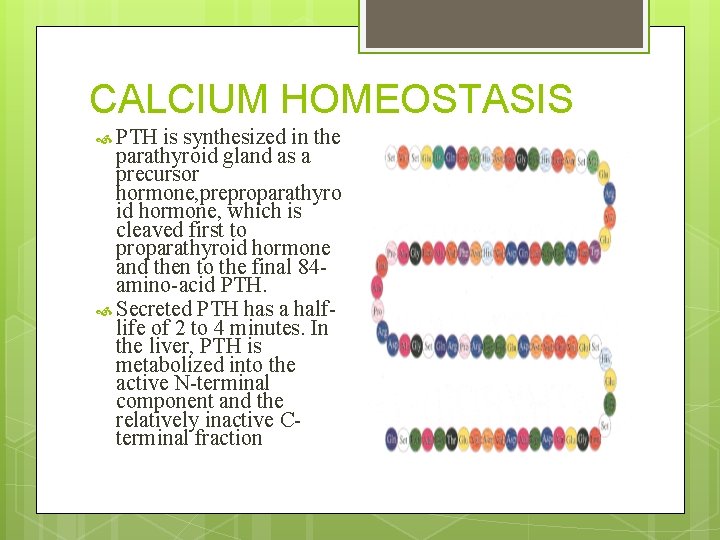
CALCIUM HOMEOSTASIS PTH is synthesized in the parathyroid gland as a precursor hormone, preproparathyro id hormone, which is cleaved first to proparathyroid hormone and then to the final 84 amino-acid PTH. Secreted PTH has a halflife of 2 to 4 minutes. In the liver, PTH is metabolized into the active N-terminal component and the relatively inactive Cterminal fraction
CALCIUM HOMEOSTASI The calcium-sensing receptor (CASR) is expressed on the surface of the parathyroid cell and senses fluctuations in the concentration of extracellular calcium. Increased PTH secretion leads to an increase in serum calcium levels by increasing bone resorption and enhancing renal calcium reabsorption. PTH also stimulates renal 1 - Hydroxylase activity, leading to an increase in 1, 25 -dihydroxy vitamin D, which also exerts a negative feedback on PTH secretion
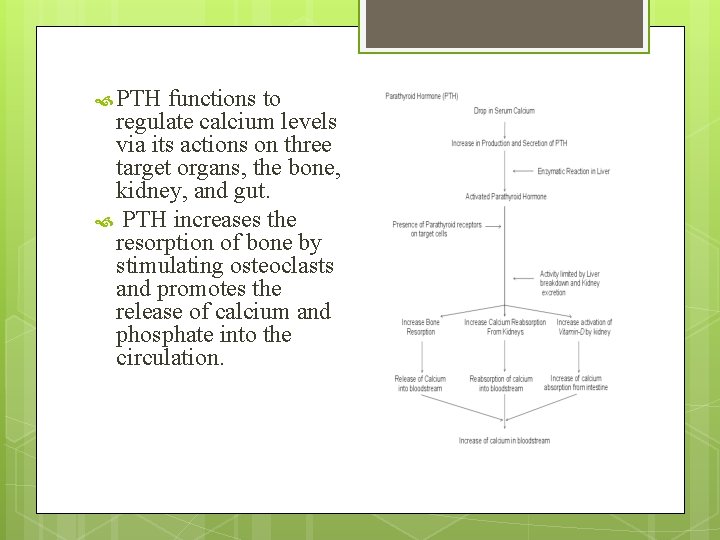
PTH functions to regulate calcium levels via its actions on three target organs, the bone, kidney, and gut. PTH increases the resorption of bone by stimulating osteoclasts and promotes the release of calcium and phosphate into the circulation.
CALCIUM HOMEOSTASIS At the kidney, PTH acts to limit calcium excretion at the distal convoluted tubule via an active transport mechanism. PTH also inhibits phosphate reabsorption (at the Proximal convoluted tubule) and bicarbonate reabsorption. PTH and hypophosphatemia also enhance 1 hydroxylation of 25 -Hydroxyvitamin D, which is responsible for its indirect effect of increasing intestinal calcium absorption.
HYPERPARATHYROIDISM Primary hyperparathyroidism is characterized by increased parathyroid cell proliferation and PTH secretion which is independent of calcium levels. Etiology unknown, but radiation exposure, and lithium implicated, associated with MEN 1, and MEN 2 A
HYPERPARATHYROIDISM Kidney stones, painful bones, abdominal groans, and fatigue Kidney stones- calcium phosphate and oxalate Osteopenia, osteoporosis, and osteitis fibrosa cystica. Increased bone turnover can usually be determined by documenting an elevated blood alkaline phosphatase level. Peptic ulcer disease, pancreatitis Psychiatric manifestations such as depression, anxiety.
SECONDARY HYPERPARATHYROIDISM In pts with chronic renal failure Deficiency of 1, 25 -dihydroxy vitamin D as a result of loss of renal tissue, low calcium intake, decreased calcium absorption, and abnormal parathyroid cell response Normally treated medically
TERTIARY HYPERPARATHYROIDISM Long standing renal failure s/p renal transplant autonomous parathyroid gland function. Can cause problems similar to primary hyperparathyroidism Operative intervention symptomatic disease autonomous PTH secretion persists for more than 1 year after a successful transplant subtotal or total parathyroidectomy with autotransplantation
1. Parathyroid glands develop from a) Ectoderm of third and fourth pharyngeal pouches b) Mesoderm of third and fourth pharyngeal pouches c) Endoderm of third and fourth pharyngeal pouches d) none
2. Typically parathyroid glands how many in number a) 6 b) 4 c) 8 d) 10
3. Microscopically which cells mostly found in the parathyroid glands a) Chief cells b) Oxyphil cells c) Both d) None
4. PTH secretion is stimulated by a) Low calcium levels in blood b) High calcium levels in blood c) Low levels of 1, 25 dihydroxy vit D d) High levels of 1, 25 dihydroxy vit D
5. Inferior thyroid artery is a branch of a) Internal carotid b) External carotid c) Thyrocervical trunk d) none
Thank you