
ANATOMY AND PHYSIOLOGY OF KIDNEY DR Abd Elkader
ANATOMY AND PHYSIOLOGY OF KIDNEY DR Abd Elkader Elhashimy
INTRODUCTION: • The kidneys excrete the end products of metabolism and excess water. • Both of these actions are essential to the control of concentrations of various substances in the body fluids, e. g. maintaining electrolyte and water balance approximately constant in the tissue fluids. The kidneys also have endocrine functions producing and releasing erythropoietin which affects red blood cell formation, renin which influences blood pressure, 1, 25 hydroxycholecalciferol, which is involved in the control of calcium metabolism and is a derivative of vitamin D, and perhaps modifies the action of the parathyroid hormone, and various other soluble factors with metabolic actions.
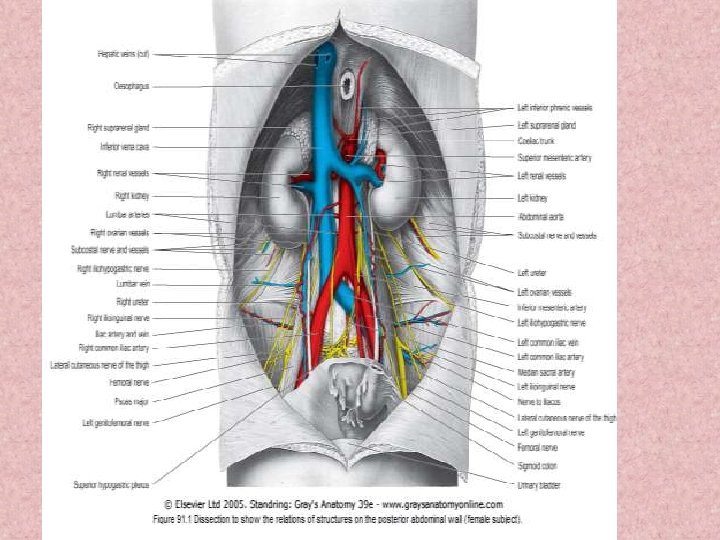
Anatomy of Kidney • Reddish-brown IN COLOR. • They are situated posteriorly behind the peritoneum on each side of the vertebral column and are surrounded by adipose tissue. • Superiorly - upper border of the twelfth thoracic vertebra, • Inferiorly - third lumbar vertebra. • The right is usually slightly inferior to the left, probably reflecting its relationship to the liver. • The long axis of each kidney is directed inferolaterally and the transverse axis posteromedially. • The transpyloric plane passes through the superior part of the right renal hilum and the inferior part of the left KIDNEY.

Gerotas fascia: The kidneys and adrenal glands, including the perirenal fat surrounding them, are enclosed by a condensed, membranous layer of renal (Gerota) fascia, which continues medially to fuse with the contralateral side.
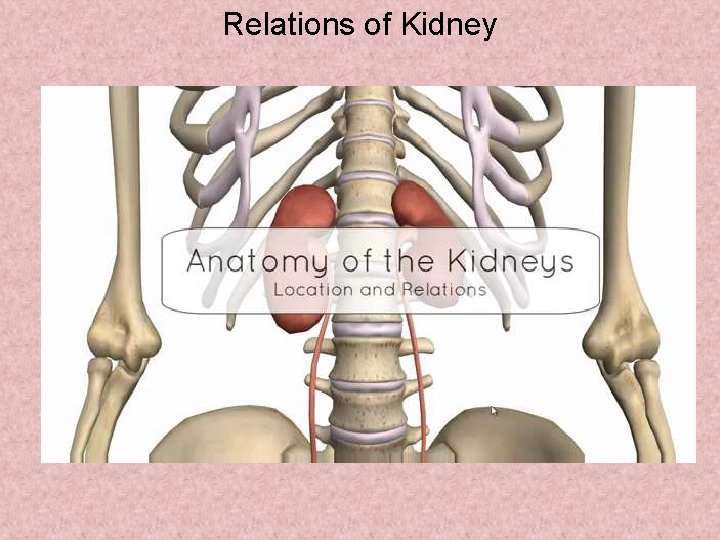
Relations of Kidney

Relations of Kidneys Anterior relations

• Posterior relations
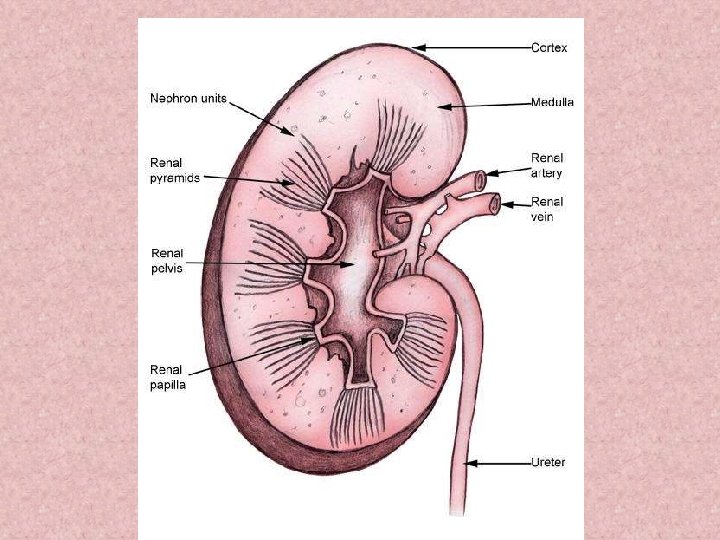
Vasculature of Kidney • The kidneys receive approximately 20% of the cardiac output even though it accounts for only 1% of TBW. The blood supply to the kidneys arises from the paired renal arteries at the level of L 2. They enter into the renal hilum, the passageway into the kidney, with the renal vein anteriorly; the renal artery; and the renal pelvis posteriorly. • The first branch off of the renal artery is the inferior suprarenal artery. The renal artery then branches off into 5 segmental branches.
• Posterior segmental artery supplies most of the posterior kidney, with the exception of the lower pole. • Anterior branches are the superior segmental artery, anterior inferior segmental artery, and inferior segmental artery. • These arteries branch into interlobar arteries, which travel in a parallel fashion in between the major calyces and then branch further into arcuate arteries that run within the cortex across the bases of the renal pyramids.
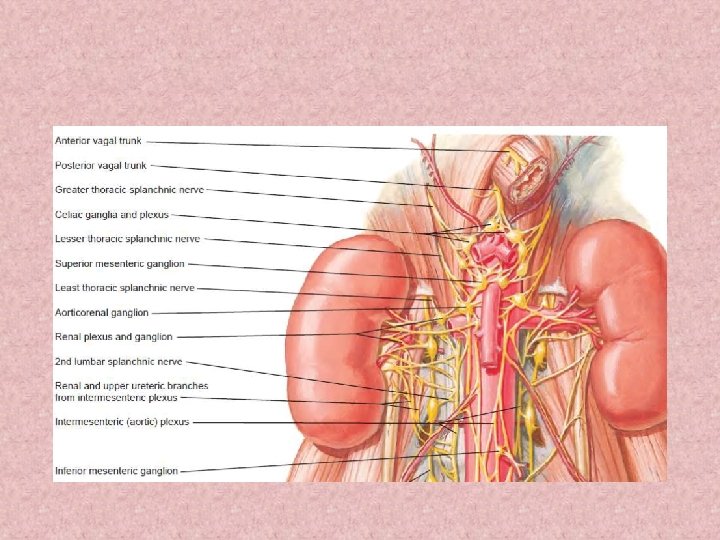
Innervation of the Kidney • • The kidney can function well without neurologic control, as evidenced by the successful function of transplanted kidneys on the Expert Consult website). Sympathetic preganglionic nerves originate from the 8 th thoracic through 1 st lumbar spinal segments, with contributions mainly from the celiac plexus and a lesser contribution from the greater splanchnic, intermesenteric, and superior hypogastric plexuses.
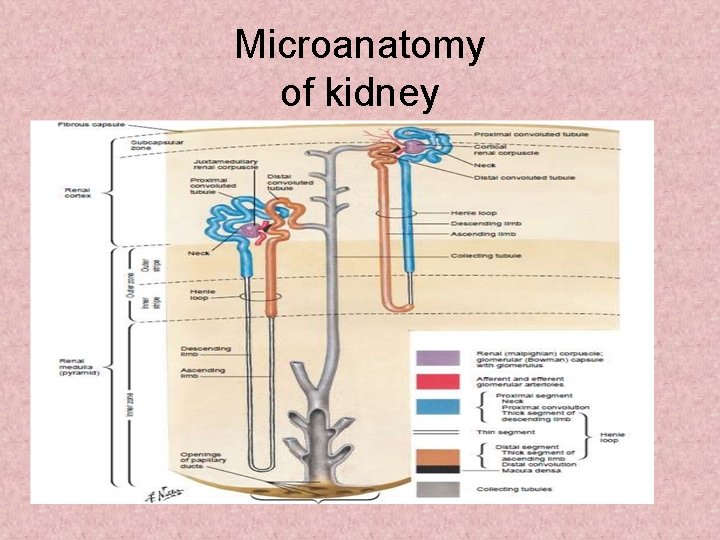
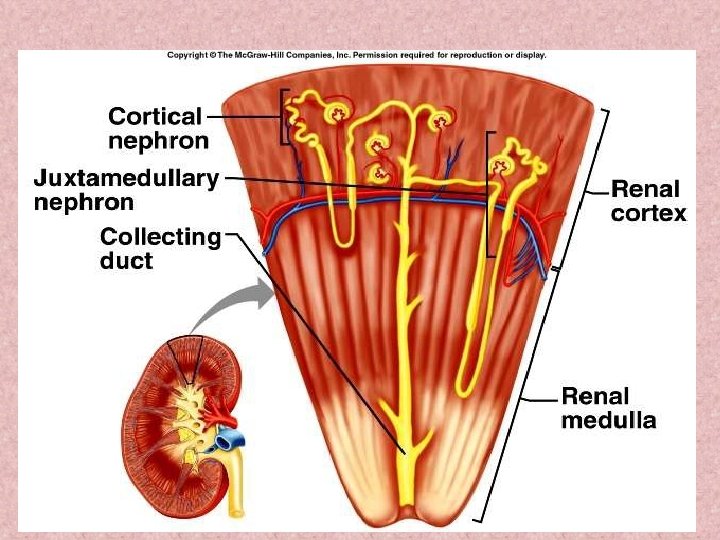
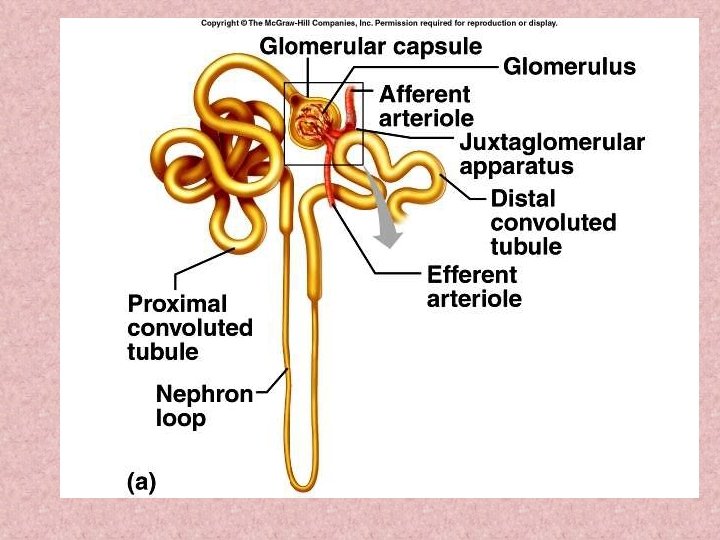
Microanatomy of kidney
Functions of Kidney • Excretion of metabolic waste products and foreign chemicals • Regulation of water and electrolyte balances • Regulation of body fluid osmolality and electrolyte concentrations • Regulation of arterial pressure • Regulation of acid-base balance • Regulation of erythrocyte production • Secretion, metabolism, and excretion of hormones • Gluconeogenesis
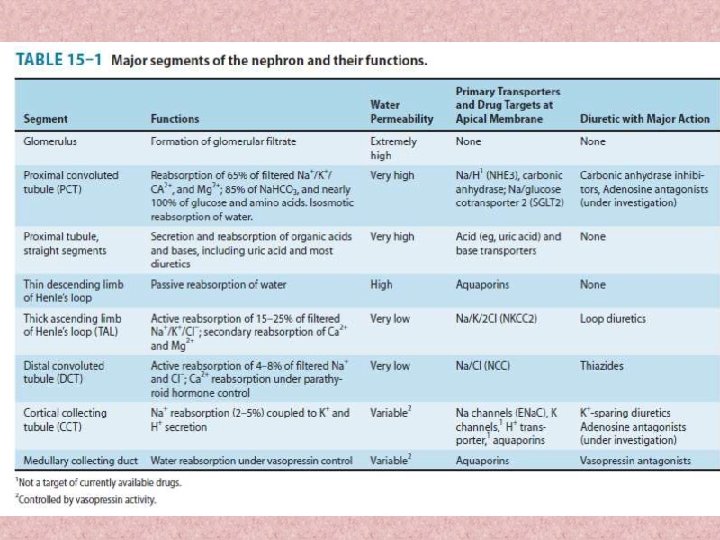
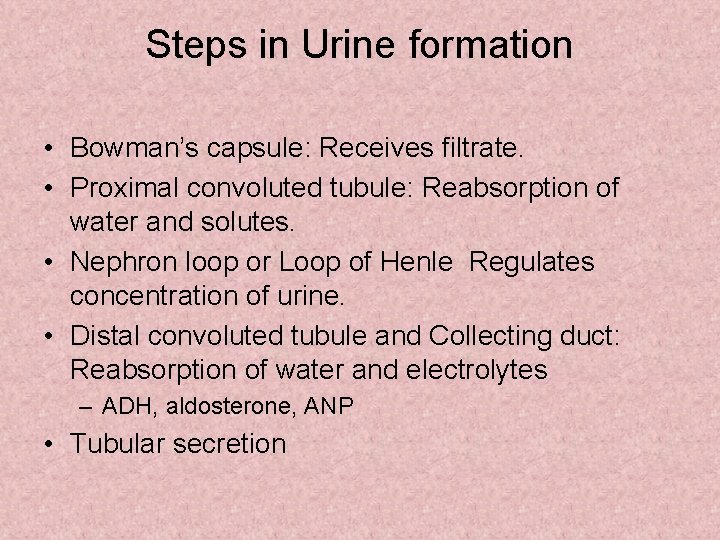
Steps in Urine formation • Bowman’s capsule: Receives filtrate. • Proximal convoluted tubule: Reabsorption of water and solutes. • Nephron loop or Loop of Henle Regulates concentration of urine. • Distal convoluted tubule and Collecting duct: Reabsorption of water and electrolytes – ADH, aldosterone, ANP • Tubular secretion
Glomerular Filtration Rate Volume of plasma filtered / unit time Approx. 180 L /day Urine output is about 1 - 2 L /day About 99% of filtrate is reabsorbed
Tubular reabsorption • Water, glucose, amino acids, urea, ions. • Sodium diffuses into cell; actively pumped out– drawing water with it. • A. By end of proximal tubule have reabsorbed: – 60 - 70% of water and sodium. – about 100% of glucose and amino acids. – 90 % of K+, bicarb, Ca++, uric acid. • Transport maximum – maximum amount of a substance that can be absorbed per unit time. • Renal threshold – plasma conc. of a substance • at which it exceeds Tm.
Tubular secretion • A. In addition to reabsorption, also have tubular secretion – substances move from peritubular capillaries into tubules – a second chance to remove substances from blood
Loop of Henle • Responsible for producing a concentrated urine by forming a concentration gradient within the medulla of kidney. When ADH is present, water is reabsorbed and urine is concentrated.
Distal convoluted tubule and collecting ducts • • What happens here depends on ADH Aldosterone affects Na+ and K+ ADH: facultative water reabsorption Parathyroid hormone: increases Ca++ reabsorption
- Slides: 24