
Analyzing Transactions Debits and Credits Using TAccounts Accounting

Analyzing Transactions Debits and Credits Using T-Accounts

Accounting Equation Assets = Liabilities + Owner’s Equity � Left Side � Right Side

T Account Left Side � Debit Side Right Side � Credit Side
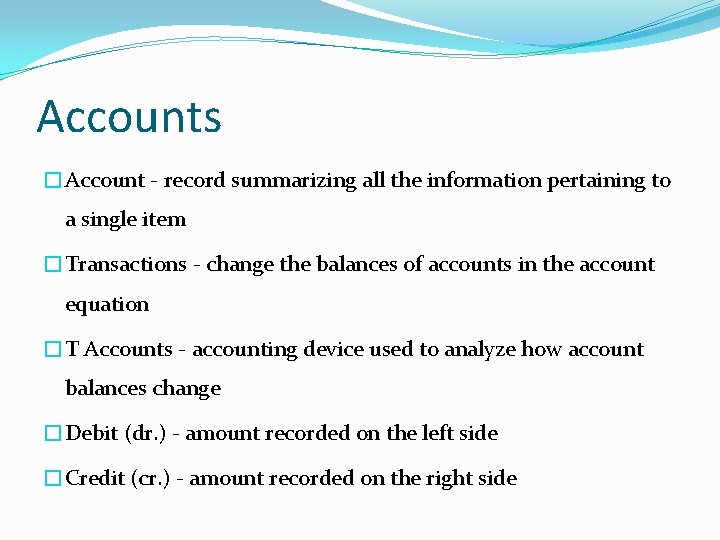
Accounts �Account - record summarizing all the information pertaining to a single item �Transactions - change the balances of accounts in the account equation �T Accounts - accounting device used to analyze how account balances change �Debit (dr. ) - amount recorded on the left side �Credit (cr. ) - amount recorded on the right side
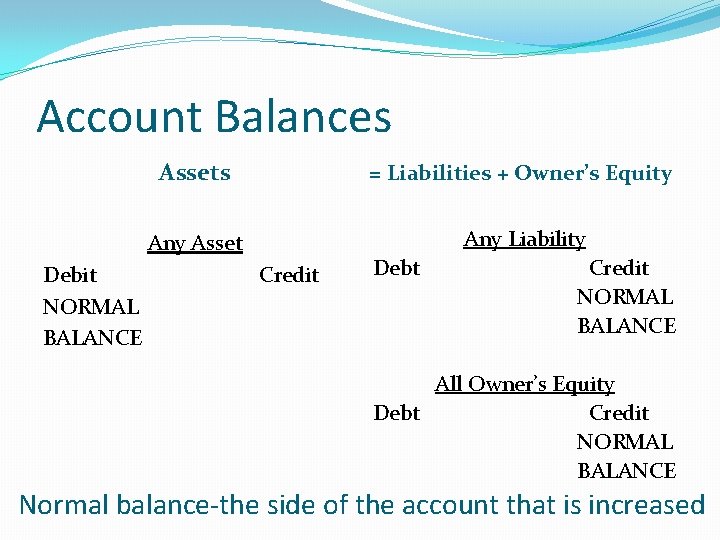
Account Balances Debit NORMAL BALANCE Assets = Liabilities + Owner’s Equity Any Asset Any Liability Credit Debt Credit NORMAL BALANCE All Owner’s Equity Debt Credit NORMAL BALANCE Normal balance-the side of the account that is increased
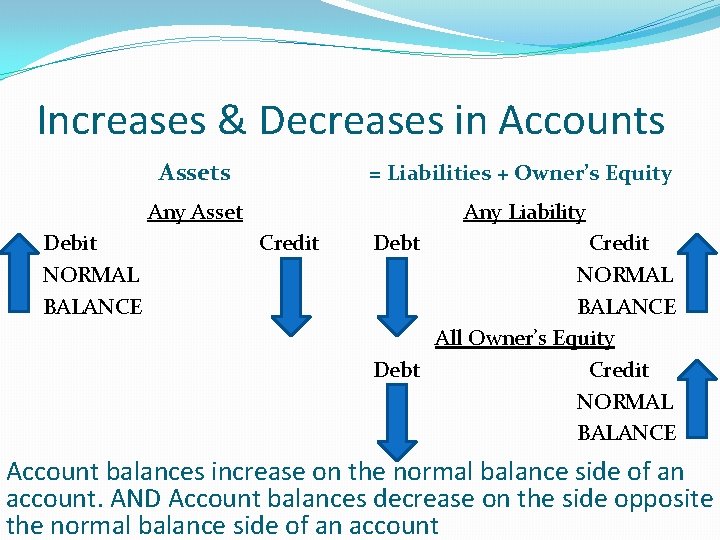
Increases & Decreases in Accounts Debit NORMAL BALANCE Assets = Liabilities + Owner’s Equity Any Asset Any Liability Credit Debt Credit NORMAL BALANCE All Owner’s Equity Debt Credit NORMAL BALANCE Account balances increase on the normal balance side of an account. AND Account balances decrease on the side opposite the normal balance side of an account

? ’s for analyzing a transaction into debit and credit parts Steps Which accounts are affected? How is each account classified? 1. 2. • Asset? Liability? Owner’s Equity? How is each classification changed? 3. • Increased or Decreased? How is each amount entered in the accounts? 4. • • • Assets increase on the debit side (left) and decrease on the credit side (right) Liabilities increase on the credit side (right) and decrease on the debit side (left) Owner’s Equity increase on the credit side (right) and decrease on the debit side (left)

Journalizing Transactions
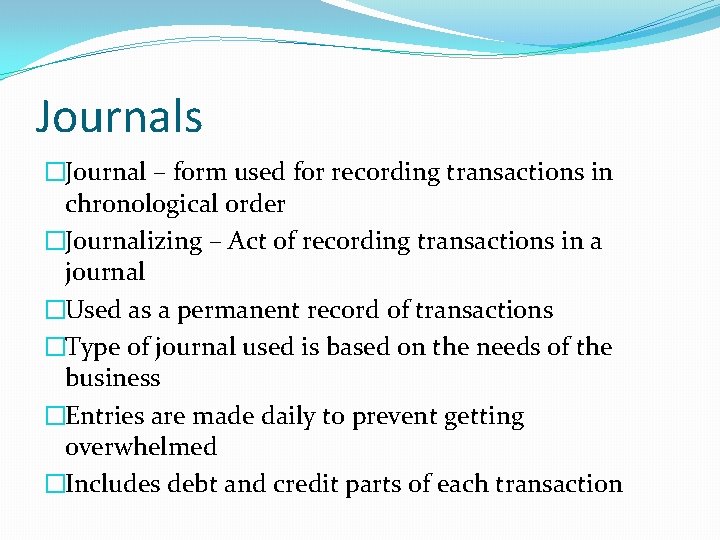
Journals �Journal – form used for recording transactions in chronological order �Journalizing – Act of recording transactions in a journal �Used as a permanent record of transactions �Type of journal used is based on the needs of the business �Entries are made daily to prevent getting overwhelmed �Includes debt and credit parts of each transaction
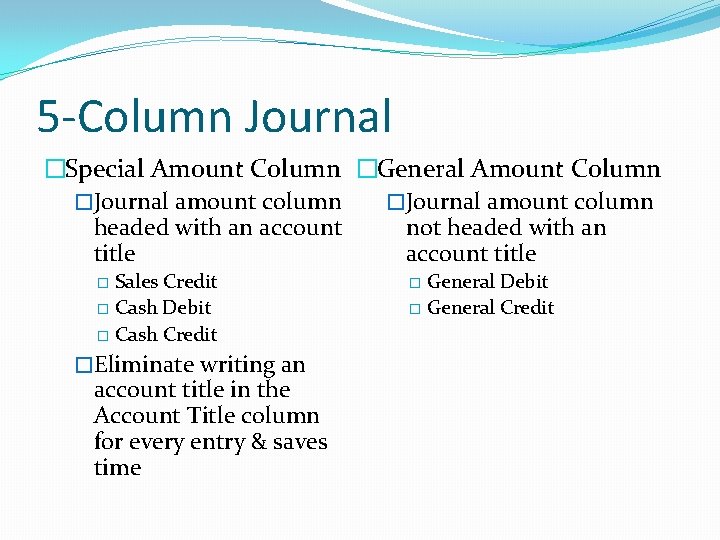
5 -Column Journal �Special Amount Column �General Amount Column �Journal amount column headed with an account not headed with an title account title Sales Credit � Cash Debit � Cash Credit � �Eliminate writing an account title in the Account Title column for every entry & saves time General Debit � General Credit �
Double-Entry Accounting �Double-entry account – the recording of debit and credit parts of a transaction �Entry – Information for each transaction recorded in a journal �Each transaction effects at least two accounts �Debt and credit parts are recorded, reflecting the dual effect of each transaction �Assures that debits equals credits
Source Documents �Business document from which information is obtained for a journal entry �Describes the transaction and proves it did occur �Accounting Concept: Objective Evidence �Examples: checks, sales invoices, receipts, calculator tapes, memorandums
Source Documents Checks Sales Invoices �Business form ordering a bank to pay cash from a bank account �Invoice used as a source document for recording a sale on account �Invoices - form describing the goods or services sold, the quantity, and the price �Prepared in duplicate with original for customer & copy used as source document for the sales transaction �Numbered in sequence � Pre-numbered to help account for all checks �Check stub – record of information on a check � Prepared at the same time as the check
Source Documents Receipts Memorandum �Business form giving written acknowledgment for cash received �Pre-numbered to account for all receipts �Source document for cash received from transactions other than sales �Form with brief message written to describe transaction �Used when no other source document is prepared or additional explanation is needed for a transaction �Pre-numbered
Source Documents Calculator Tapes �Totaled amount of cash received from sales for each day �Generally computer generated from company system �Saves time & space by recording only one entry for day instead of every sale individually
Journalizing Transactions �Steps 1. Date – write the date in the date column • 1 st entry on the journal page includes month year, month & year will not be recorded again on the same page 2. Debt 3. Credit 4. Source Document
- Slides: 16