
Analyzing the forces within transtibial prosthetic sockets and
Analyzing the forces within transtibial prosthetic sockets and design of an improved force minimizing socket Christine Bronikowski, Amanda Chen, Jared Mulford, Amy Ostrowski Advisor: Aaron Fitzsimmons, The Surgical Clinic
Problem Statement l Lack of research in the socket interface between the artificial limb and the residual limb, specifically force profiles l Majority of the research focused on components with higher potential financial gains l Problems with skin irritation, varying degrees of pain, tissue breakdown, pressure ulcerations, and resultant infections at the socket interface develop
Project Goals l l Acquire accurate measurements of the forces acting on the residual limb of an amputee during various movements Determine areas of highest force Design a socket system in which the forces are optimally distributed throughout the crosssection of the surface between the residual limb and socket Increase overall patient comfort
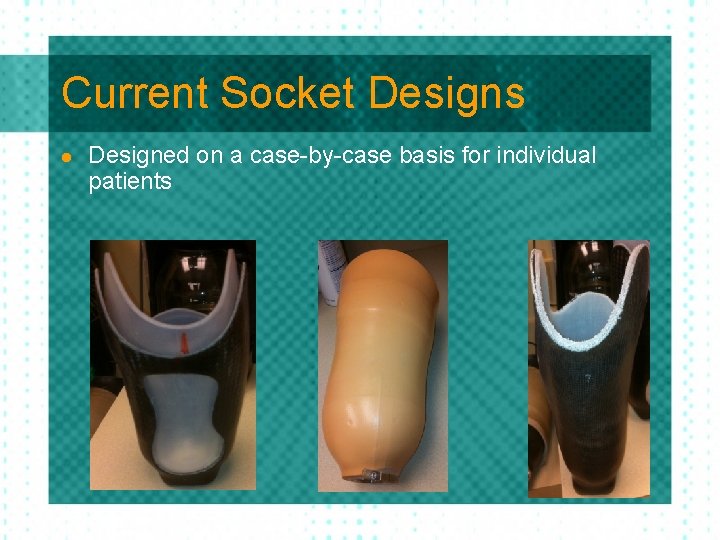
Current Socket Designs l Designed on a case-by-case basis for individual patients
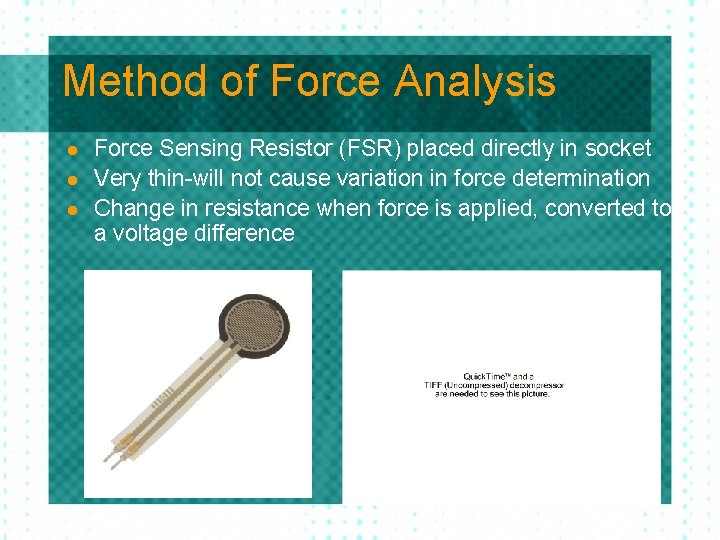
Method of Force Analysis l l l Force Sensing Resistor (FSR) placed directly in socket Very thin-will not cause variation in force determination Change in resistance when force is applied, converted to a voltage difference
Current Work l Circuit design: current to voltage converter
Design/Safety Considerations l l Sensitivity/saturation of FSR may not be within desired force range Wire thickness: thin enough to prevent interference with force data l l Thick enough to not break during movement/walking FSR-wire connection: must be durable due to movement of limb l Low temperature solder: must not melt FSR plastic
Future Work l l Insertion of ~15 FSRs into limb-socket interface of “model” patient, Cody l Test run: determine if FSR saturates, stays intact, comfort and safety of Cody Repeat with ~10 patients l Rotate FSRs within socket to cover entire area l Test multiple surfaces (incline, flat, stair) Analyze results, determine location of maximum force Design and develop a new socket: provide more flexibility in areas of greatest force
Determination of Success l l Design is patient-driven Survey and level of comfort pre and post new socket
References
- Slides: 10