
Analyzing Reliability and Validity in Outcomes Assessment Part
Analyzing Reliability and Validity in Outcomes Assessment (Part 1) Robert Lingard and Deborah K. van Alphen California State University, Northridge
Overview n Introduction n Fundamental Concepts n Group Problem n Statistical Preliminaries n Software Tools n Probability n Inferential Statistics n Hypothesis Testing n Summary April 15 - 17, 2010 Lingard & van Alphen 2
Introduction – Basic Questions n How can we make assessment easier? Minimize the effort required to collect data n n How can we design an assessment to provide useful information? n n Use tools to evaluate the approach How can we learn more from the assessment results we obtain? n Use tools to interpret quantitative data April 15 - 17, 2010 Lingard & van Alphen 3
Making Assessment Easier n n n Depend on assessments at the College or University level. Assess existing student work rather than creating or acquiring separate instruments. Measure only a sample of the population to be assessed. April 15 - 17, 2010 Lingard & van Alphen 4
Designing Assessments to Produce Useful Information n How should the students or student work to be measured be selected? Is the assessment approach stable and consistent? Does the assessment instrument measure what is intended to be assessed? April 15 - 17, 2010 Lingard & van Alphen 5
Learning More from Assessment Results n n Was the sample used representative and large enough? Were the instrument and process utilized dependable? Were the results obtained meaningful? Is a difference between two results significant? April 15 - 17, 2010 Lingard & van Alphen 6
Fundamental Concepts n n Sampling Reliability Validity Correlation April 15 - 17, 2010 Lingard & van Alphen 7
Definition of Terms Related to Sampling n n n Data: Observations (test scores, survey responses) that have been collected Population: Complete collection of all elements to be studied (e. g. , all students in the program being assessed) Sample: Subset of elements selected from a population Parameter: A numerical measurement of a population Statistic: A numerical measurement describing some characteristic of a sample April 15 - 17, 2010 Lingard & van Alphen 8
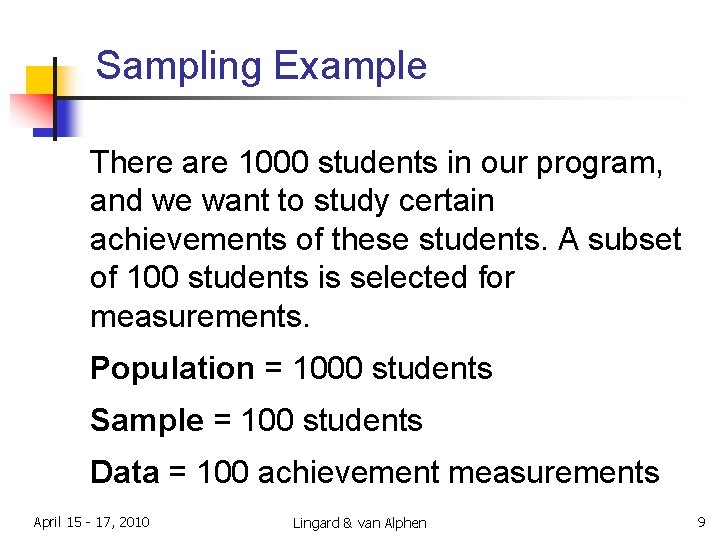
Sampling Example There are 1000 students in our program, and we want to study certain achievements of these students. A subset of 100 students is selected for measurements. Population = 1000 students Sample = 100 students Data = 100 achievement measurements April 15 - 17, 2010 Lingard & van Alphen 9
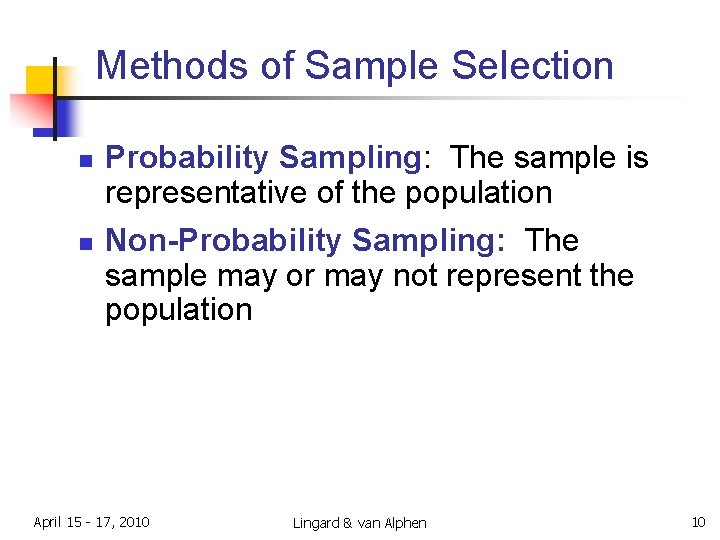
Methods of Sample Selection n n Probability Sampling: The sample is representative of the population Non-Probability Sampling: The sample may or may not represent the population April 15 - 17, 2010 Lingard & van Alphen 10
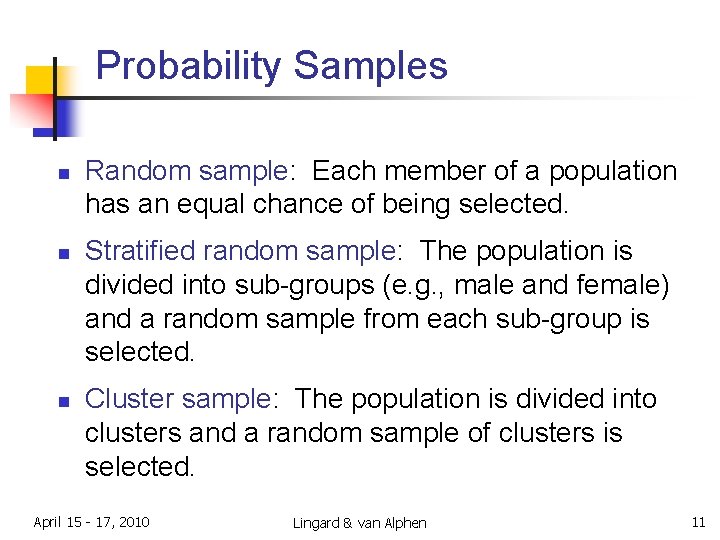
Probability Samples n n n Random sample: Each member of a population has an equal chance of being selected. Stratified random sample: The population is divided into sub-groups (e. g. , male and female) and a random sample from each sub-group is selected. Cluster sample: The population is divided into clusters and a random sample of clusters is selected. April 15 - 17, 2010 Lingard & van Alphen 11
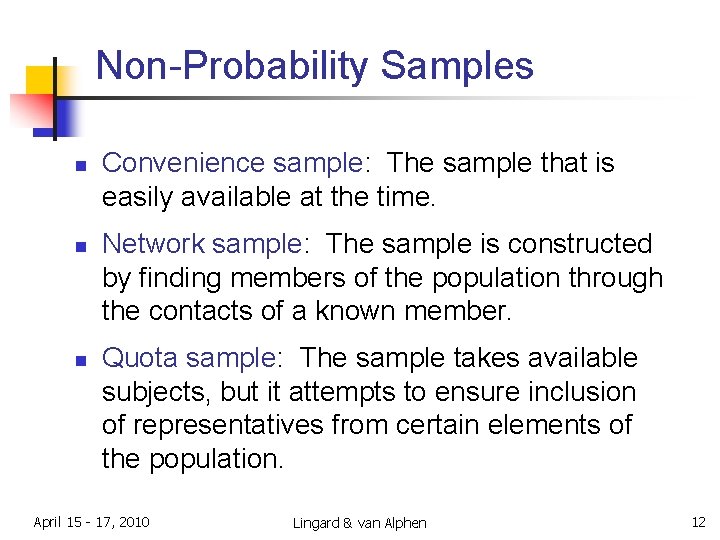
Non-Probability Samples n n n Convenience sample: The sample that is easily available at the time. Network sample: The sample is constructed by finding members of the population through the contacts of a known member. Quota sample: The sample takes available subjects, but it attempts to ensure inclusion of representatives from certain elements of the population. April 15 - 17, 2010 Lingard & van Alphen 12
Problems with Sampling n n n The sample may not be representative of the population. The sample may be too small to provide valid results. It may be difficult to obtain the desired sample. April 15 - 17, 2010 Lingard & van Alphen 13
Reliability and Validity n n Reliability refers to the stability, repeatability, and consistency of an assessment instrument. (i. e. , how good are the operational metrics and the measurement data). Validity refers to whether the measurement really measures what it was intended to measure (i. e. , the extent to which an empirical measure reflects the real meaning of the concept under consideration). April 15 - 17, 2010 Lingard & van Alphen 14
Reliability n n n Tests of stability: If an instrument can be used on the same individual more than once and achieve the same results, it is stable. Tests of repeatability: If different observers using the same instrument report the same results, the instrument is repeatable. Tests of internal consistency: If all parts of the instrument measure the same concept, it is internally consistent. April 15 - 17, 2010 Lingard & van Alphen 15
Validity n Self-evident measures: Does the instrument appear to measure what it is supposed to measure. n n Face validity: “It looks all right on the face of it. ” Content validity: The validity is estimated from a review of literature on the topic or through consultation with experts. April 15 - 17, 2010 Lingard & van Alphen 16
Validity (Cont’d) n Pragmatic measures: These test the practical value of a particular instrument. n n n Concurrent validity: The results have high correlation with an established measurement. Predictive validity: The results predicted actually occur. Construct validity: When what you are attempting to measure is not directly observable, and the results correlate with a number of instruments attempting to measure the same construct. April 15 - 17, 2010 Lingard & van Alphen 17
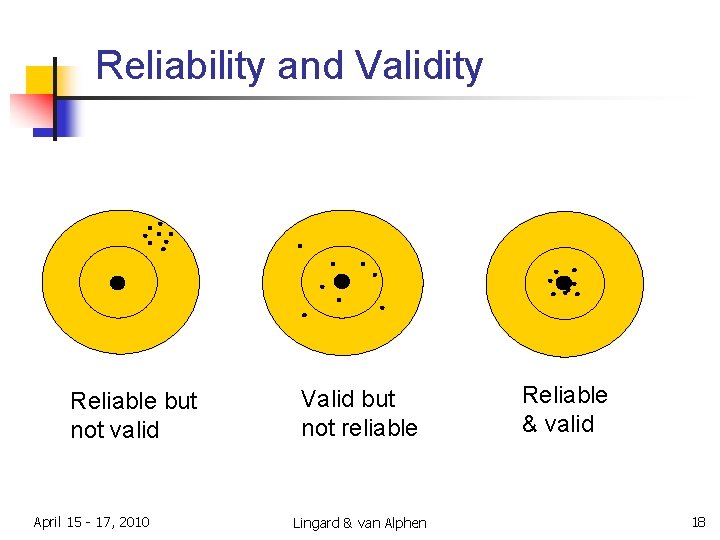
Reliability and Validity Reliable but not valid April 15 - 17, 2010 Valid but not reliable Lingard & van Alphen Reliable & valid 18
Correlation n Correlation is probably the most widely used statistical method to assess relationships among observational data. Correlation can show whether and how strongly two sets of observational data are related. Can be used to show reliability or validity by attempting to correlate the results from different assessments of the same outcome. April 15 - 17, 2010 Lingard & van Alphen 19
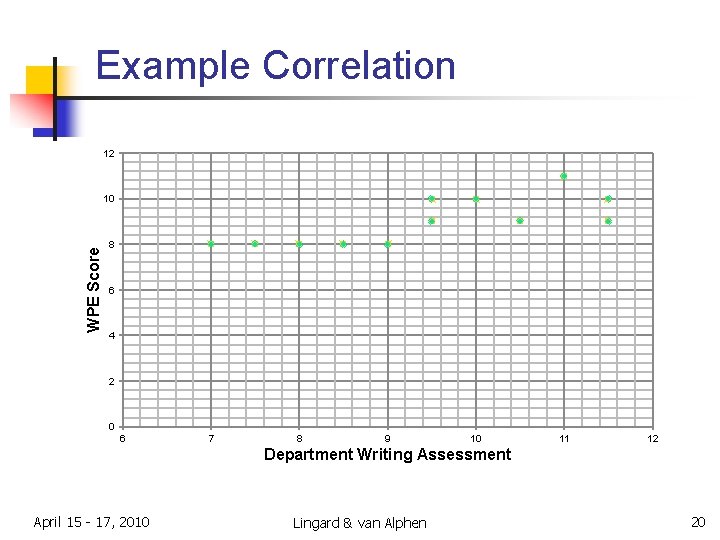
Example Correlation 12 WPE Score 10 8 6 4 2 0 6 7 8 9 10 11 12 Department Writing Assessment April 15 - 17, 2010 Lingard & van Alphen 20

Group Problem n n Assume your goal is to assess the written communication skills of students in your program. (Assume the number of students in the program is large and that you already have a rubric to use in assessing student writing. ) Working with your group devise an approach to accomplish this task. April 15 - 17, 2010 Lingard & van Alphen 21
Group Problem (Cont’d) n n n Specifically, who would you assess and what student produced work items would you evaluate, i. e. , how would you construct an appropriate sample of students (or student work) to assess? Identify any concerns or potential difficulties with your plan, including issues of reliability or validity. What questions are you likely to have regarding the interpretation of results once the assessment is completed? April 15 - 17, 2010 Lingard & van Alphen 22
Objective of This Presentation n Show statistical analysis can be used to: n n Simplify assessment using sampling Measure reliability of assessment instruments and approaches Measure validity of assessment results Quantify program improvements through comparison of assessment results April 15 - 17, 2010 Lingard & van Alphen 23
Basic Statistical Concepts n n n Central tendency for data Frequency distribution of data Variation among data April 15 - 17, 2010 Lingard & van Alphen 24
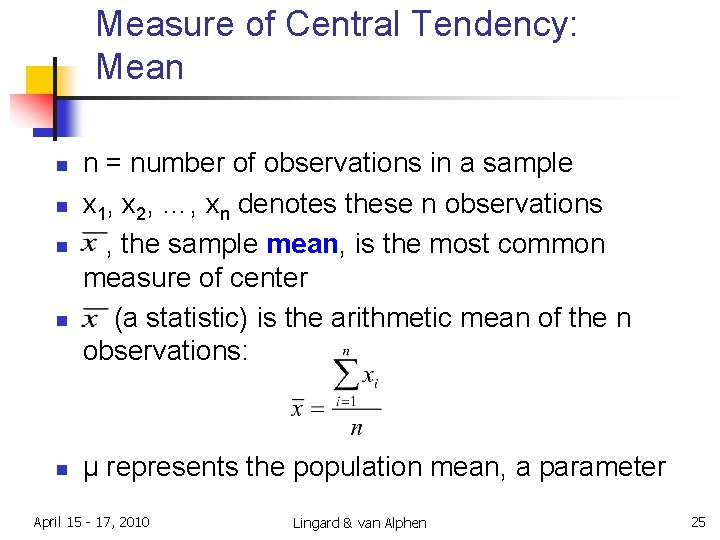
Measure of Central Tendency: Mean n n n = number of observations in a sample x 1, x 2, …, xn denotes these n observations , the sample mean, is the most common measure of center (a statistic) is the arithmetic mean of the n observations: µ represents the population mean, a parameter April 15 - 17, 2010 Lingard & van Alphen 25
Frequency Distribution of Data The tabulation of raw data obtained by dividing the data into groups of some size and computing the number of data elements falling within each pair of group boundaries April 15 - 17, 2010 Lingard & van Alphen 26
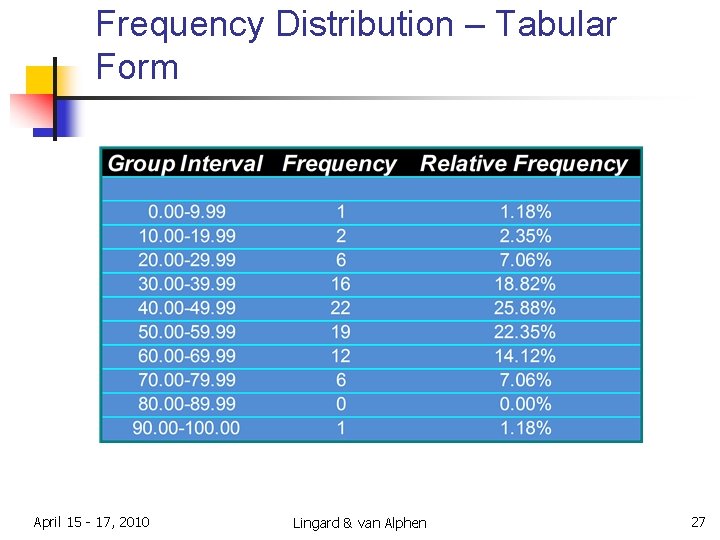
Frequency Distribution – Tabular Form April 15 - 17, 2010 Lingard & van Alphen 27
Histogram n A histogram is a graphical display of statistical information that uses rectangles to show the frequency of data items in successive numerical intervals of equal size. In the most common form of histogram, the independent variable is plotted along the horizontal axis and the dependent variable is plotted along the vertical axis. April 15 - 17, 2010 Lingard & van Alphen 28
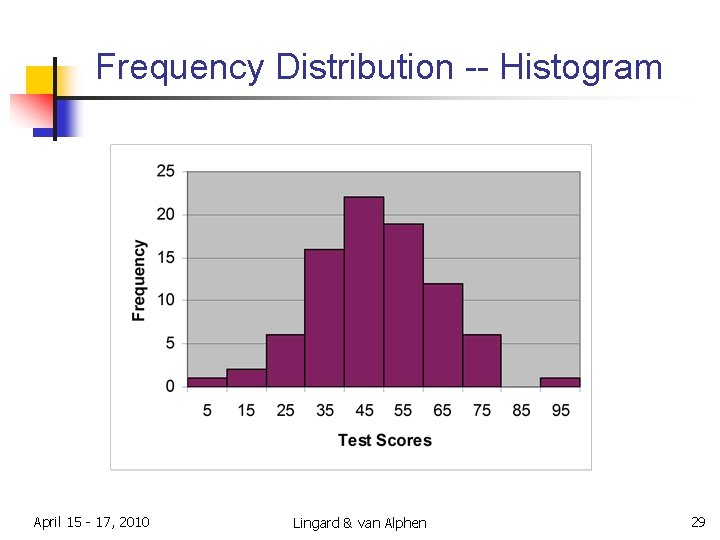
Frequency Distribution -- Histogram April 15 - 17, 2010 Lingard & van Alphen 29
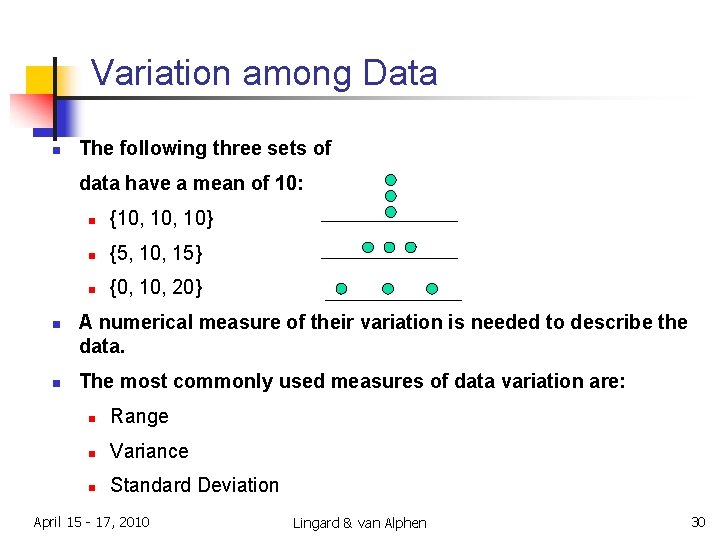
Variation among Data n The following three sets of data have a mean of 10: n n n {10, 10} n {5, 10, 15} n {0, 10, 20} A numerical measure of their variation is needed to describe the data. The most commonly used measures of data variation are: n Range n Variance n Standard Deviation April 15 - 17, 2010 Lingard & van Alphen 30
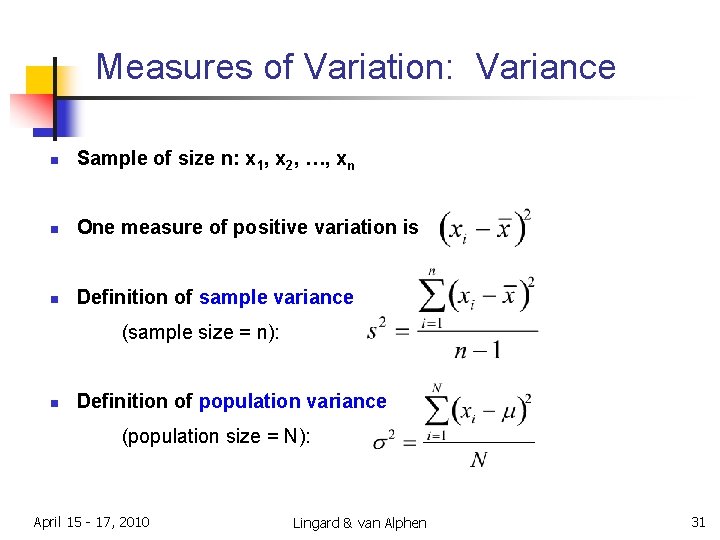
Measures of Variation: Variance n Sample of size n: x 1, x 2, …, xn n One measure of positive variation is n Definition of sample variance (sample size = n): n Definition of population variance (population size = N): April 15 - 17, 2010 Lingard & van Alphen 31
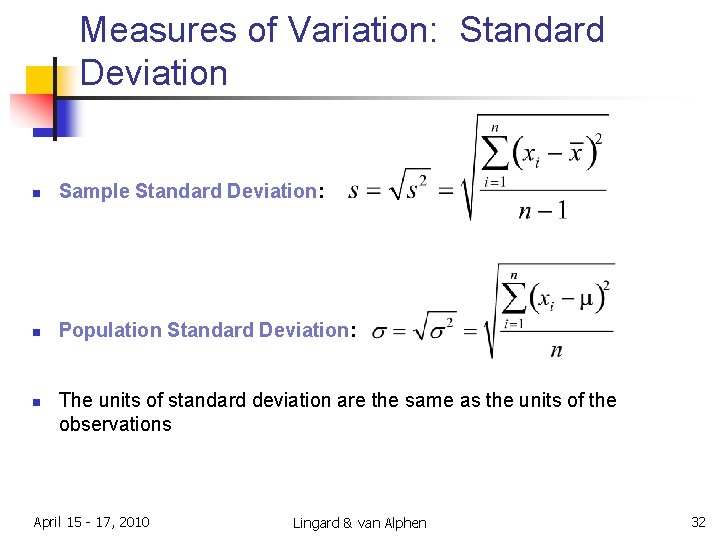
Measures of Variation: Standard Deviation n Sample Standard Deviation: n Population Standard Deviation: n The units of standard deviation are the same as the units of the observations April 15 - 17, 2010 Lingard & van Alphen 32
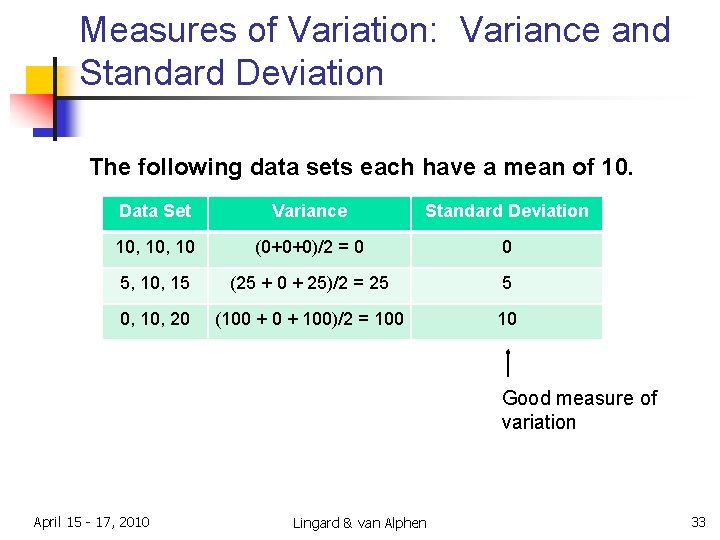
Measures of Variation: Variance and Standard Deviation The following data sets each have a mean of 10. Data Set Variance Standard Deviation 10, 10 (0+0+0)/2 = 0 0 5, 10, 15 (25 + 0 + 25)/2 = 25 5 0, 10, 20 (100 + 100)/2 = 100 10 Good measure of variation April 15 - 17, 2010 Lingard & van Alphen 33
Analyzing Reliability and Validity in Outcomes Assessment (Part 2) Robert Lingard and Deborah K. van Alphen California State University, Northridge
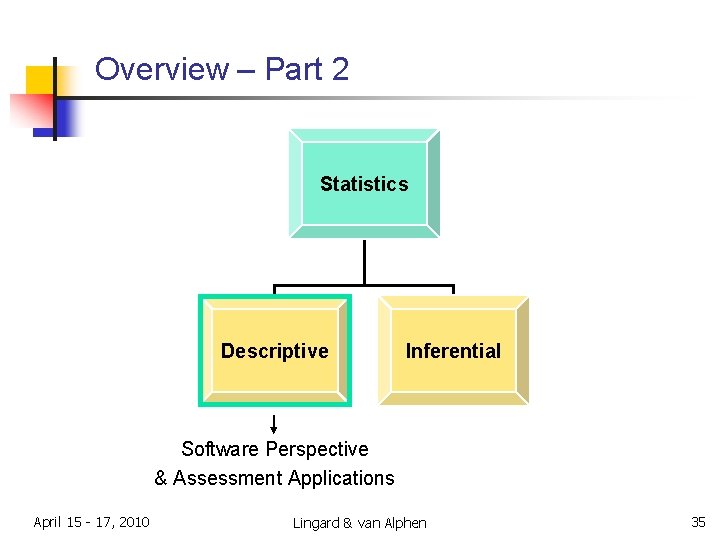
Overview – Part 2 Statistics Descriptive Inferential Software Perspective & Assessment Applications April 15 - 17, 2010 Lingard & van Alphen 35
Software Tools for Statistical Analysis n MATLAB, with the Statistics Toolbox n n n “MATrix LABoratory, ” produced by The Mathworks, Inc. Complete package includes many math functions, visualization tools, and special-purpose toolboxes Excel, with the Add-In: Analysis Toolpak n n Part of Microsoft Office Suite Other choices: Minitab, SPSS, Mathematica, … April 15 - 17, 2010 Lingard & van Alphen 36
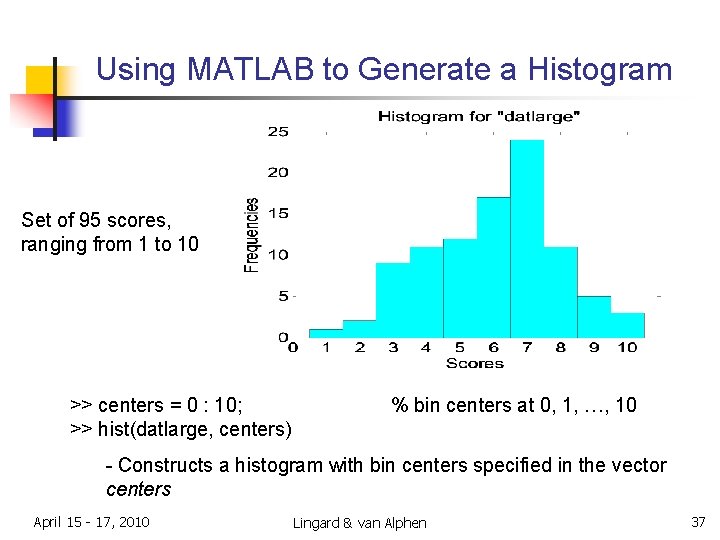
Using MATLAB to Generate a Histogram Set of 95 scores, ranging from 1 to 10 >> centers = 0 : 10; >> hist(datlarge, centers) % bin centers at 0, 1, …, 10 - Constructs a histogram with bin centers specified in the vector centers April 15 - 17, 2010 Lingard & van Alphen 37
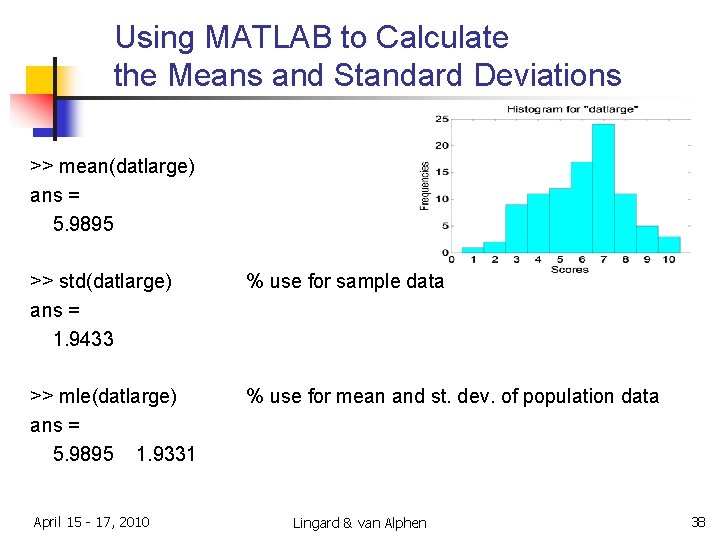
Using MATLAB to Calculate the Means and Standard Deviations >> mean(datlarge) ans = 5. 9895 >> std(datlarge) ans = 1. 9433 % use for sample data >> mle(datlarge) ans = 5. 9895 1. 9331 % use for mean and st. dev. of population data April 15 - 17, 2010 Lingard & van Alphen 38
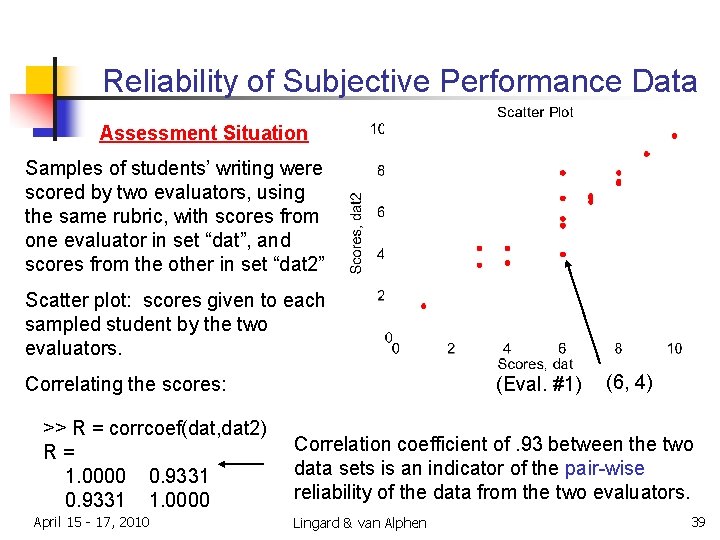
Reliability of Subjective Performance Data Assessment Situation Samples of students’ writing were scored by two evaluators, using the same rubric, with scores from one evaluator in set “dat”, and scores from the other in set “dat 2” Scatter plot: scores given to each sampled student by the two evaluators. (Eval. #1) Correlating the scores: >> R = corrcoef(dat, dat 2) R= 1. 0000 0. 9331 1. 0000 April 15 - 17, 2010 (6, 4) Correlation coefficient of. 93 between the two data sets is an indicator of the pair-wise reliability of the data from the two evaluators. Lingard & van Alphen 39
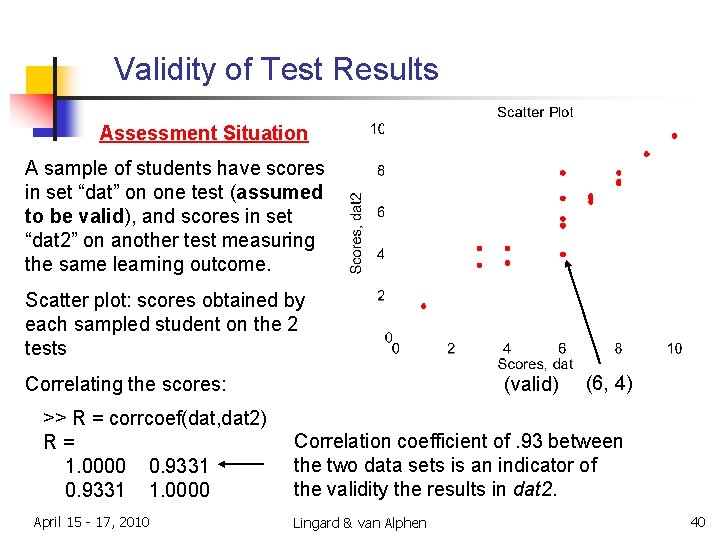
Validity of Test Results Assessment Situation A sample of students have scores in set “dat” on one test (assumed to be valid), and scores in set “dat 2” on another test measuring the same learning outcome. Scatter plot: scores obtained by each sampled student on the 2 tests (valid) Correlating the scores: >> R = corrcoef(dat, dat 2) R= 1. 0000 0. 9331 1. 0000 April 15 - 17, 2010 (6, 4) Correlation coefficient of. 93 between the two data sets is an indicator of the validity the results in dat 2. Lingard & van Alphen 40
Overview Probability Statistics Descriptive April 15 - 17, 2010 Inferential Lingard & van Alphen 41
Random Variables (RV’s) n Intuitive Definition: A random variable is a variable whose value is determined by the outcome of an experiment. n Often denoted by a capital bold letter, say X n Example: n The scores on an embedded assessment test question April 15 - 17, 2010 Lingard & van Alphen 42
Probability - Notation n n Notation: P(…. ) denotes the probability of the event described in the parentheses Example n If X is the RV denoting the scores on an embedded assessment test question n P(X > 8) denotes the probability of a student obtaining a score greater than 8 April 15 - 17, 2010 Lingard & van Alphen 43
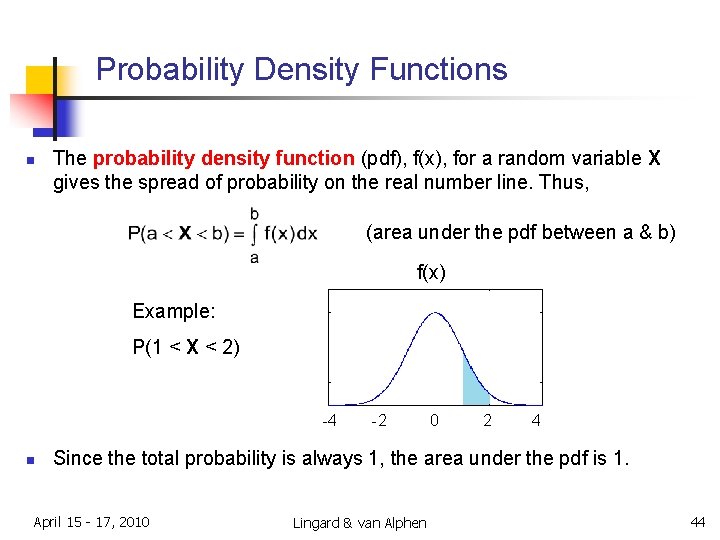
Probability Density Functions n The probability density function (pdf), f(x), for a random variable X gives the spread of probability on the real number line. Thus, (area under the pdf between a & b) f(x) Example: P(1 < X < 2) -4 n -2 0 2 4 Since the total probability is always 1, the area under the pdf is 1. April 15 - 17, 2010 Lingard & van Alphen 44
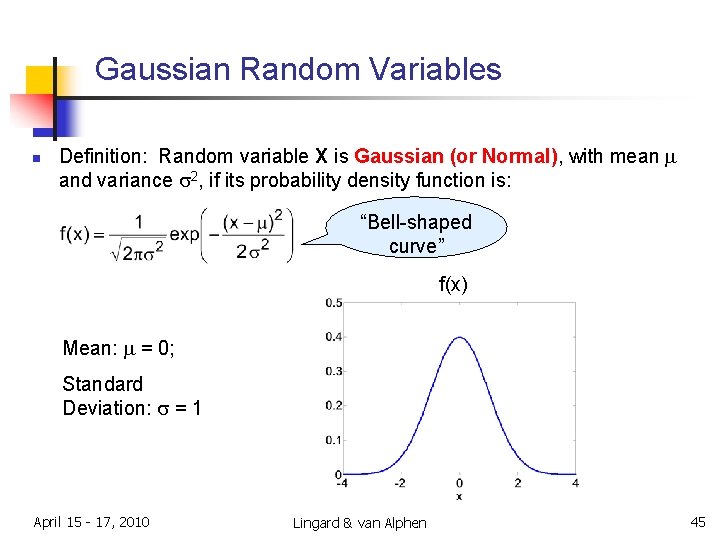
Gaussian Random Variables n Definition: Random variable X is Gaussian (or Normal), with mean m and variance s 2, if its probability density function is: “Bell-shaped curve” f(x) Mean: m = 0; Standard Deviation: s = 1 April 15 - 17, 2010 Lingard & van Alphen 45
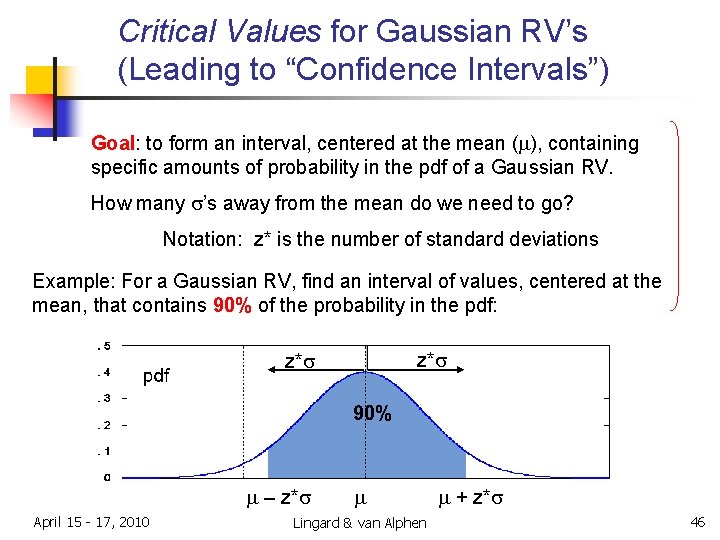
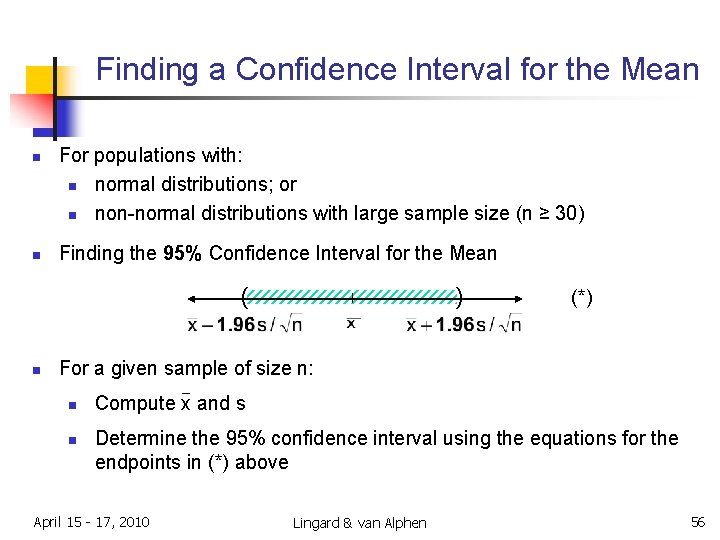
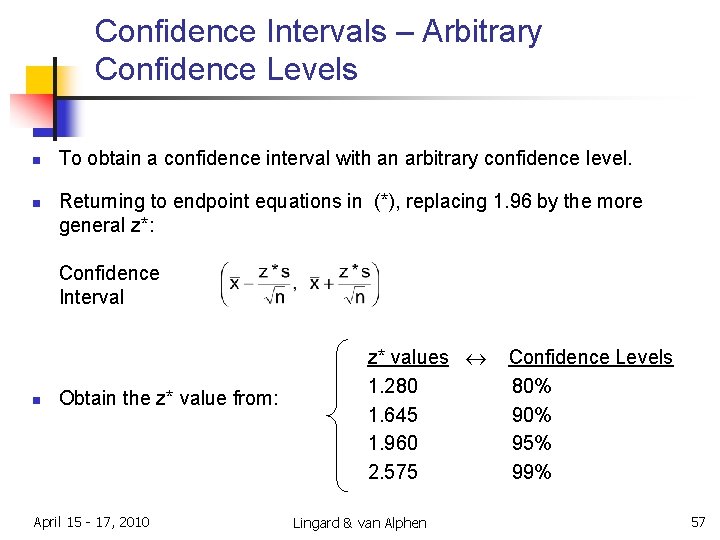
Critical Values for Gaussian RV’s (Leading to “Confidence Intervals”) Goal: to form an interval, centered at the mean (m), containing specific amounts of probability in the pdf of a Gaussian RV. How many s’s away from the mean do we need to go? Notation: z* is the number of standard deviations Example: For a Gaussian RV, find an interval of values, centered at the mean, that contains 90% of the probability in the pdf: z*s 90% m – z*s April 15 - 17, 2010 m Lingard & van Alphen m + z*s 46
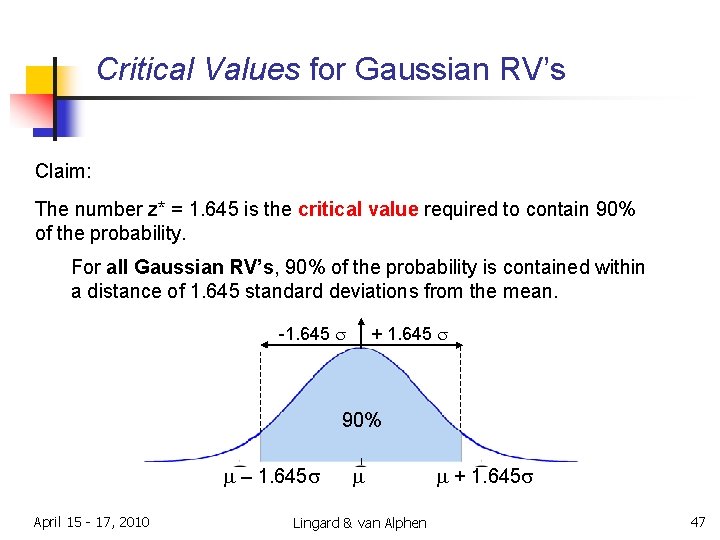
Critical Values for Gaussian RV’s Claim: The number z* = 1. 645 is the critical value required to contain 90% of the probability. For all Gaussian RV’s, 90% of the probability is contained within a distance of 1. 645 standard deviations from the mean. -1. 645 s + 1. 645 s 90% m – 1. 645 s April 15 - 17, 2010 m Lingard & van Alphen m + 1. 645 s 47
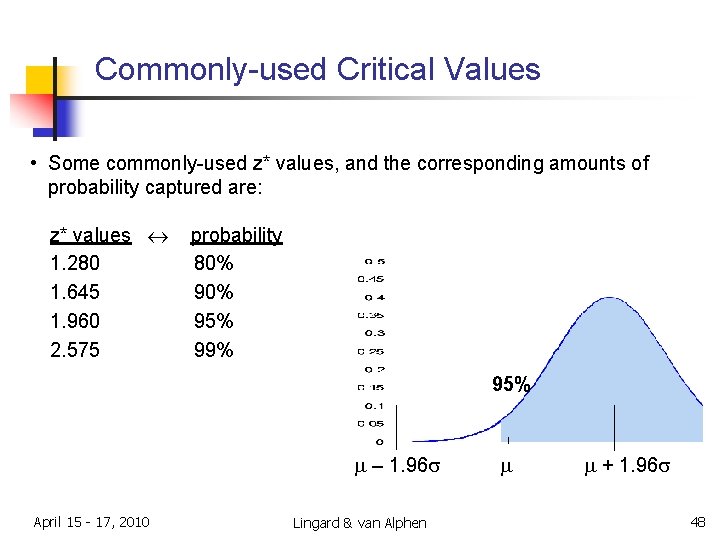
Commonly-used Critical Values • Some commonly-used z* values, and the corresponding amounts of probability captured are: z* values 1. 280 1. 645 1. 960 2. 575 probability 80% 95% 99% 95% m – 1. 96 s April 15 - 17, 2010 Lingard & van Alphen m m + 1. 96 s 48
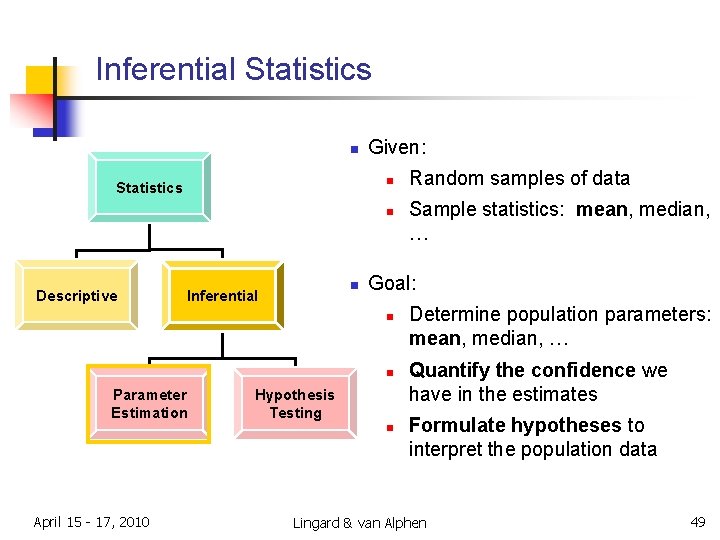
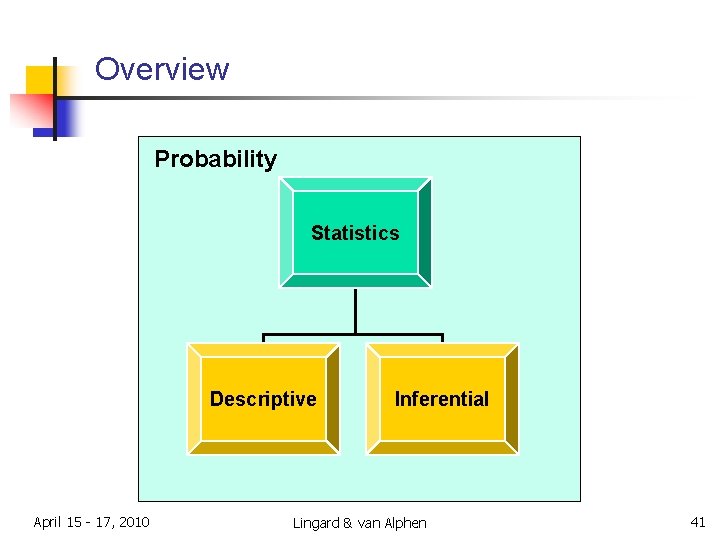
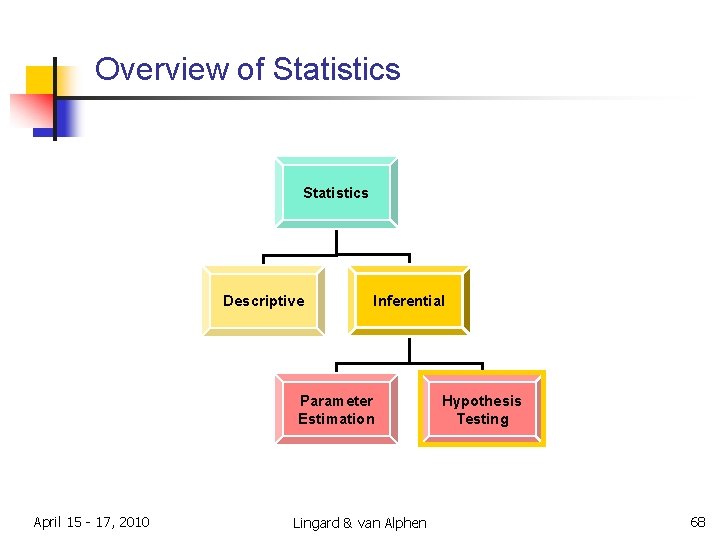
Inferential Statistics n Given: n Statistics n Descriptive n Inferential n Hypothesis Testing n April 15 - 17, 2010 Sample statistics: mean, median, … Goal: n Parameter Estimation Random samples of data Determine population parameters: mean, median, … Quantify the confidence we have in the estimates Formulate hypotheses to interpret the population data Lingard & van Alphen 49
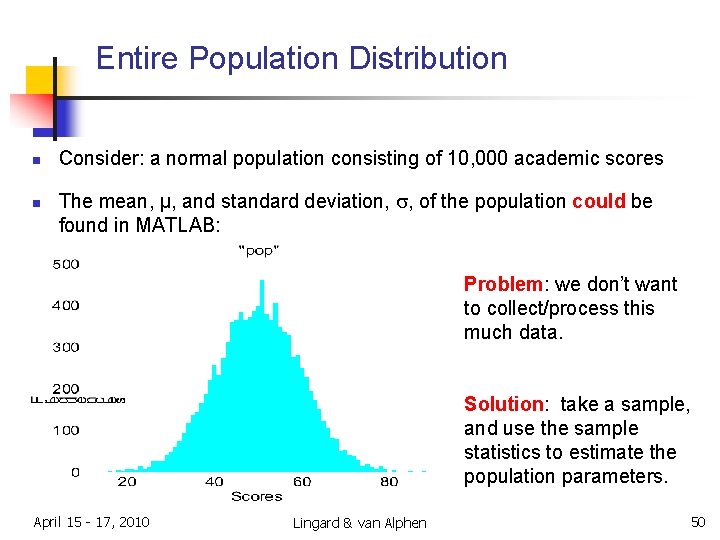
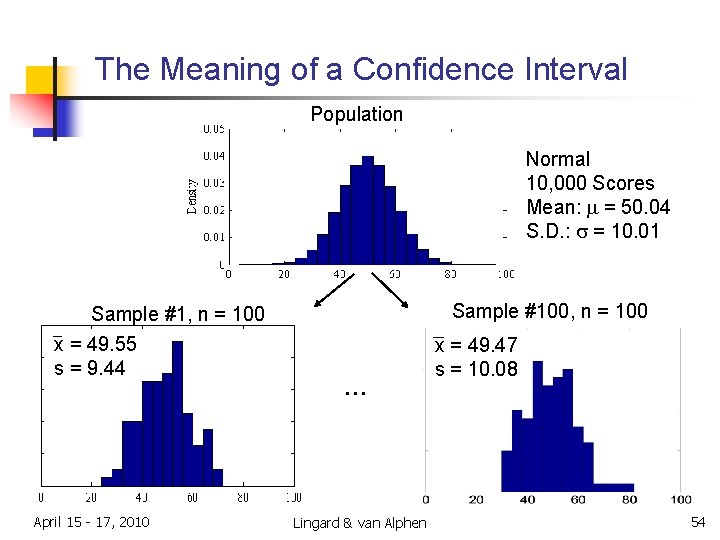
Entire Population Distribution n n Consider: a normal population consisting of 10, 000 academic scores The mean, µ, and standard deviation, s, of the population could be found in MATLAB: Problem: we don’t want to collect/process this much data. Solution: take a sample, and use the sample statistics to estimate the population parameters. April 15 - 17, 2010 Lingard & van Alphen 50
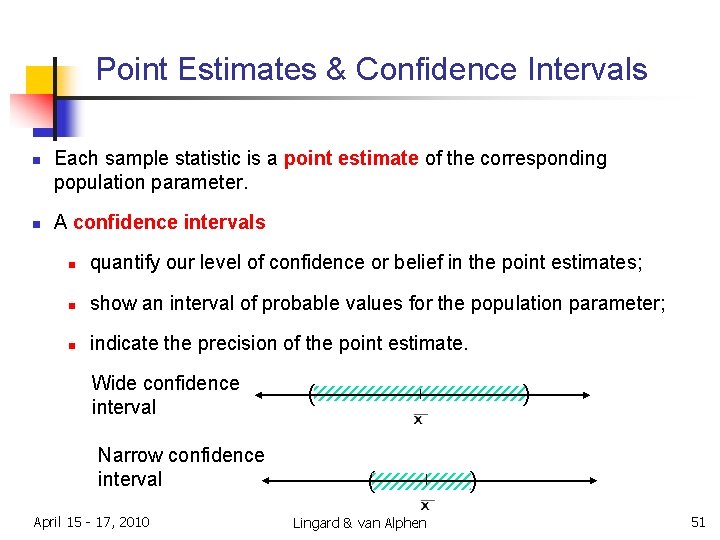
Point Estimates & Confidence Intervals n n Each sample statistic is a point estimate of the corresponding population parameter. A confidence intervals n quantify our level of confidence or belief in the point estimates; n show an interval of probable values for the population parameter; n indicate the precision of the point estimate. Wide confidence interval Narrow confidence interval April 15 - 17, 2010 ( ) ( Lingard & van Alphen ) 51
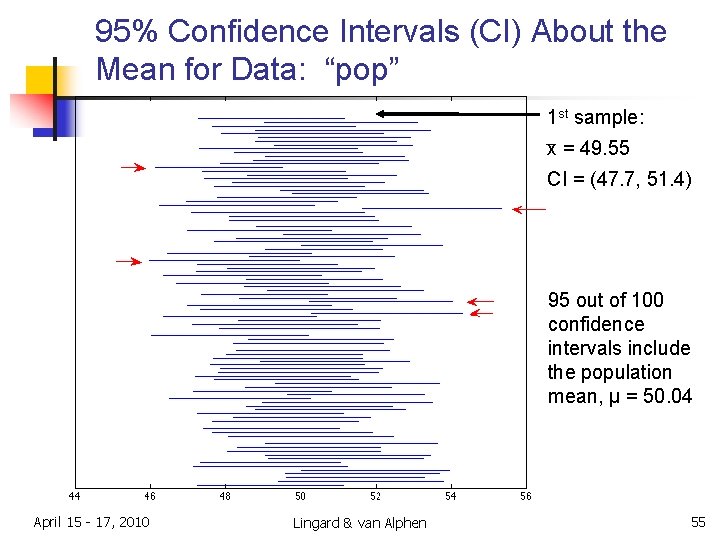
Confidence Intervals and Levels n Confidence level, %: A measure of the degree of reliability of the confidence interval n n A confidence level of 95% implies that 95% of all samples (taken from the population) would produce an interval that includes the population parameter being estimated Intuitively: the higher the confidence level, the more likely that the population parameter lies within the interval. April 15 - 17, 2010 Lingard & van Alphen 52
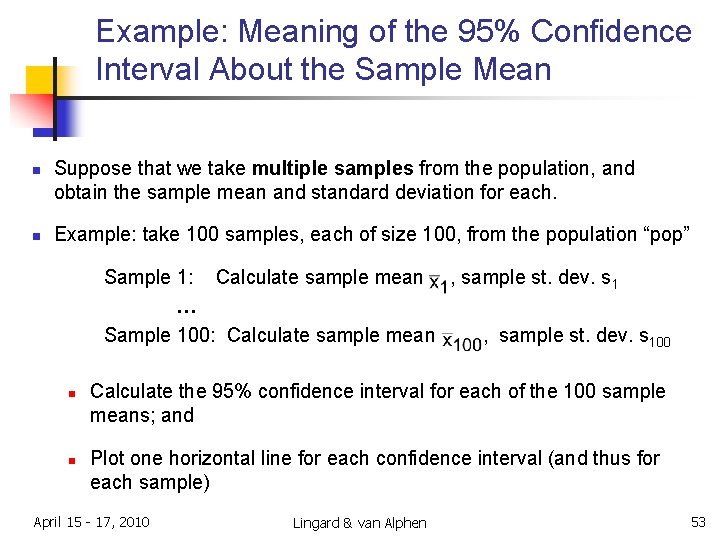
Example: Meaning of the 95% Confidence Interval About the Sample Mean n n Suppose that we take multiple samples from the population, and obtain the sample mean and standard deviation for each. Example: take 100 samples, each of size 100, from the population “pop” Sample 1: Calculate sample mean , sample st. dev. s 1 … Sample 100: Calculate sample mean , sample st. dev. s 100 n n Calculate the 95% confidence interval for each of the 100 sample means; and Plot one horizontal line for each confidence interval (and thus for each sample) April 15 - 17, 2010 Lingard & van Alphen 53
The Meaning of a Confidence Interval Population Normal 10, 000 Scores Mean: m = 50. 04 S. D. : s = 10. 01 Sample #100, n = 100 Sample #1, n = 100 x = 49. 55 s = 9. 44 April 15 - 17, 2010 … Lingard & van Alphen x = 49. 47 s = 10. 08 54
95% Confidence Intervals (CI) About the Mean for Data: “pop” 1 st sample: x = 49. 55 CI = (47. 7, 51. 4) 95 out of 100 confidence intervals include the population mean, µ = 50. 04 April 15 - 17, 2010 Lingard & van Alphen 55
Finding a Confidence Interval for the Mean n n For populations with: n normal distributions; or n non-normal distributions with large sample size (n ≥ 30) Finding the 95% Confidence Interval for the Mean ( n ) (*) For a given sample of size n: n n Compute x and s Determine the 95% confidence interval using the equations for the endpoints in (*) above April 15 - 17, 2010 Lingard & van Alphen 56
Confidence Intervals – Arbitrary Confidence Levels n n To obtain a confidence interval with an arbitrary confidence level. Returning to endpoint equations in (*), replacing 1. 96 by the more general z*: Confidence Interval n Obtain the z* value from: April 15 - 17, 2010 z* values 1. 280 1. 645 1. 960 2. 575 Lingard & van Alphen Confidence Levels 80% 95% 99% 57
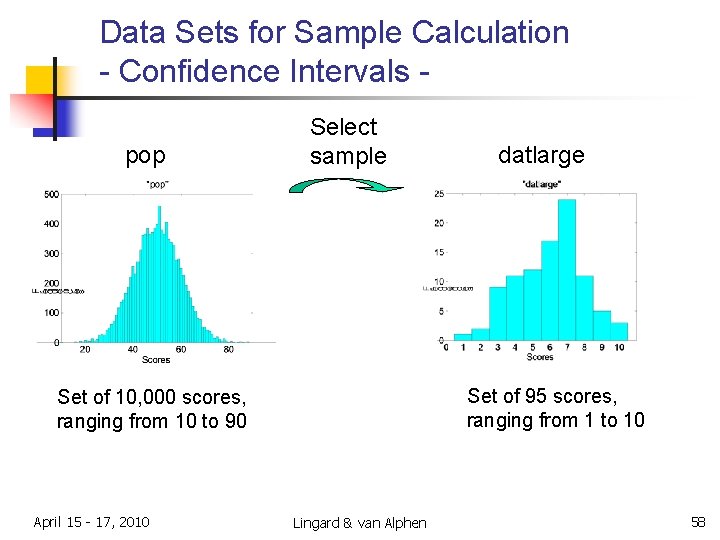
Data Sets for Sample Calculation - Confidence Intervals pop Select sample Set of 95 scores, ranging from 1 to 10 Set of 10, 000 scores, ranging from 10 to 90 April 15 - 17, 2010 datlarge Lingard & van Alphen 58
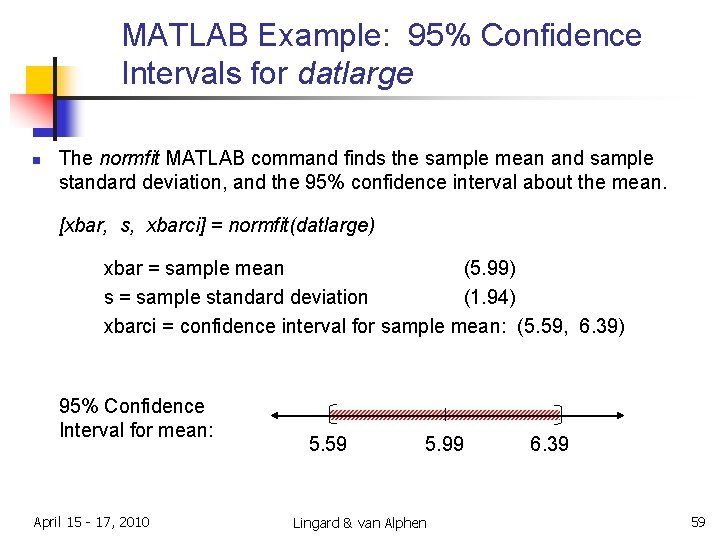
MATLAB Example: 95% Confidence Intervals for datlarge n The normfit MATLAB command finds the sample mean and sample standard deviation, and the 95% confidence interval about the mean. [xbar, s, xbarci] = normfit(datlarge) xbar = sample mean (5. 99) s = sample standard deviation (1. 94) xbarci = confidence interval for sample mean: (5. 59, 6. 39) 95% Confidence Interval for mean: April 15 - 17, 2010 5. 59 5. 99 Lingard & van Alphen 6. 39 59
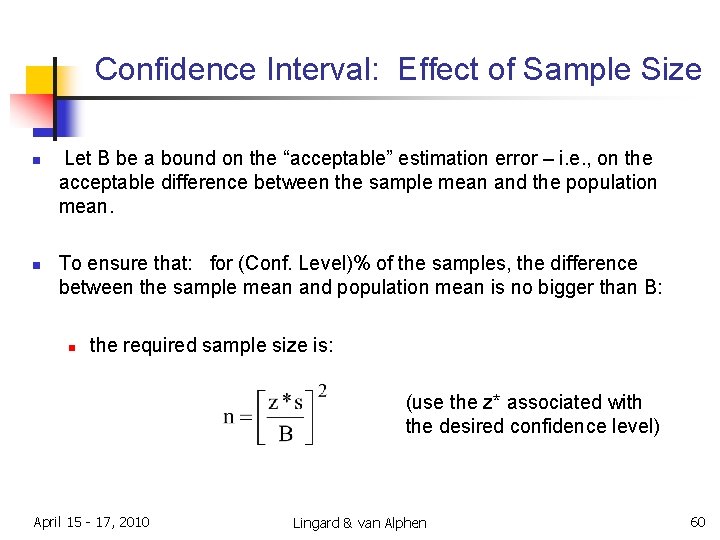
Confidence Interval: Effect of Sample Size n n Let B be a bound on the “acceptable” estimation error – i. e. , on the acceptable difference between the sample mean and the population mean. To ensure that: for (Conf. Level)% of the samples, the difference between the sample mean and population mean is no bigger than B: n the required sample size is: (use the z* associated with the desired confidence level) April 15 - 17, 2010 Lingard & van Alphen 60
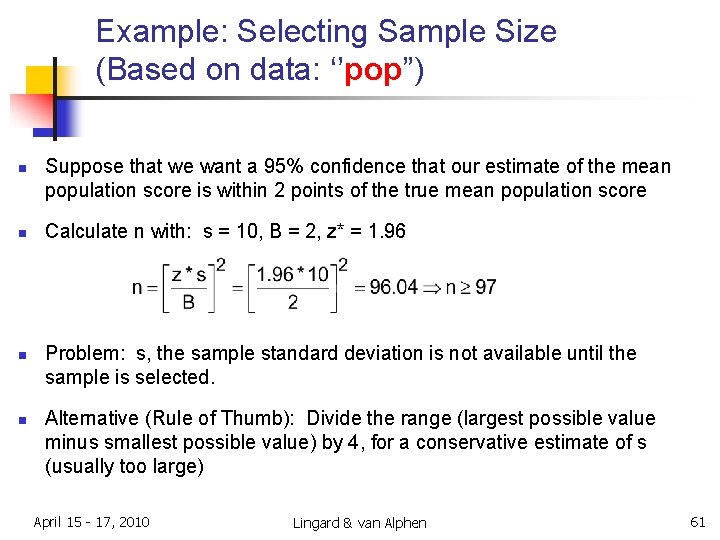
Example: Selecting Sample Size (Based on data: ‘’pop”) n n Suppose that we want a 95% confidence that our estimate of the mean population score is within 2 points of the true mean population score Calculate n with: s = 10, B = 2, z* = 1. 96 Problem: s, the sample standard deviation is not available until the sample is selected. Alternative (Rule of Thumb): Divide the range (largest possible value minus smallest possible value) by 4, for a conservative estimate of s (usually too large) April 15 - 17, 2010 Lingard & van Alphen 61
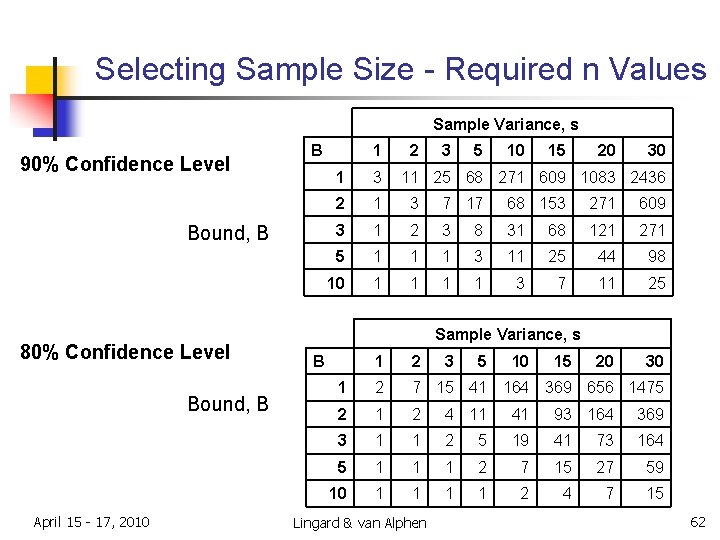
Selecting Sample Size - Required n Values Sample Variance, s 90% Confidence Level B Bound, B 80% Confidence Level Bound, B April 15 - 17, 2010 1 2 3 5 10 15 20 30 1 3 11 25 68 271 609 1083 2436 2 1 3 7 17 68 153 271 609 3 1 2 3 8 31 68 121 271 5 1 1 1 3 11 25 44 98 10 1 1 3 7 11 25 20 30 Sample Variance, s B 1 2 7 15 41 164 369 656 1475 2 1 2 4 11 41 93 164 369 3 1 1 2 5 19 41 73 164 5 1 1 1 2 7 15 27 59 10 1 1 2 4 7 15 Lingard & van Alphen 3 5 10 15 62
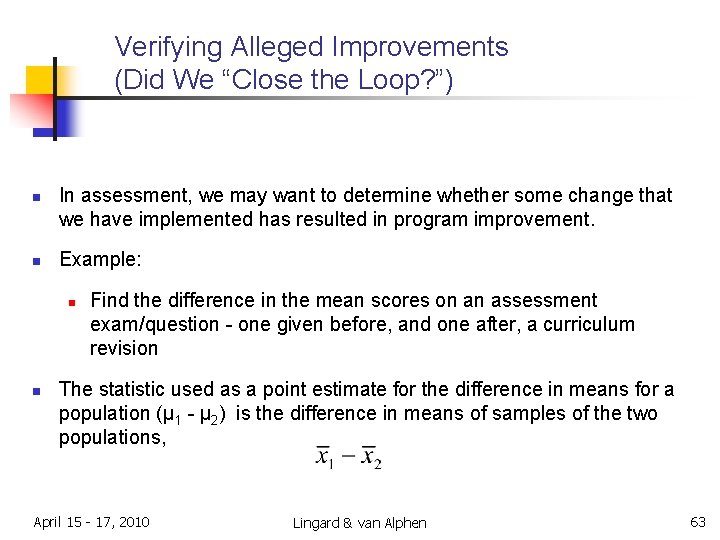
Verifying Alleged Improvements (Did We “Close the Loop? ”) n n In assessment, we may want to determine whether some change that we have implemented has resulted in program improvement. Example: n n Find the difference in the mean scores on an assessment exam/question - one given before, and one after, a curriculum revision The statistic used as a point estimate for the difference in means for a population (µ 1 - µ 2) is the difference in means of samples of the two populations, April 15 - 17, 2010 Lingard & van Alphen 63
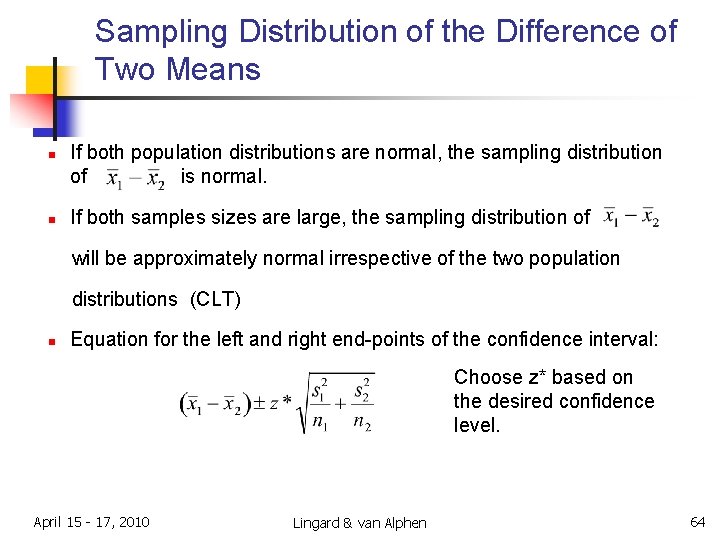
Sampling Distribution of the Difference of Two Means n n If both population distributions are normal, the sampling distribution of is normal. If both samples sizes are large, the sampling distribution of will be approximately normal irrespective of the two population distributions (CLT) n Equation for the left and right end-points of the confidence interval: Choose z* based on the desired confidence level. April 15 - 17, 2010 Lingard & van Alphen 64
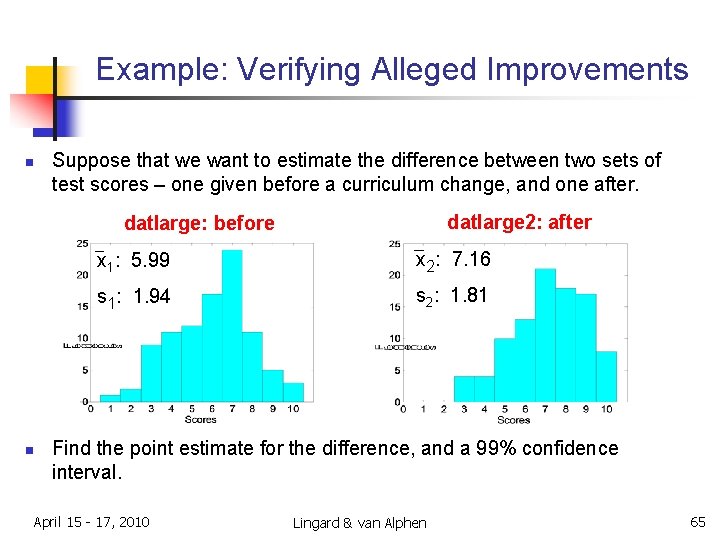
Example: Verifying Alleged Improvements n Suppose that we want to estimate the difference between two sets of test scores – one given before a curriculum change, and one after. datlarge 2: after datlarge: before n x 1: 5. 99 x 2: 7. 16 s 1: 1. 94 s 2: 1. 81 Find the point estimate for the difference, and a 99% confidence interval. April 15 - 17, 2010 Lingard & van Alphen 65
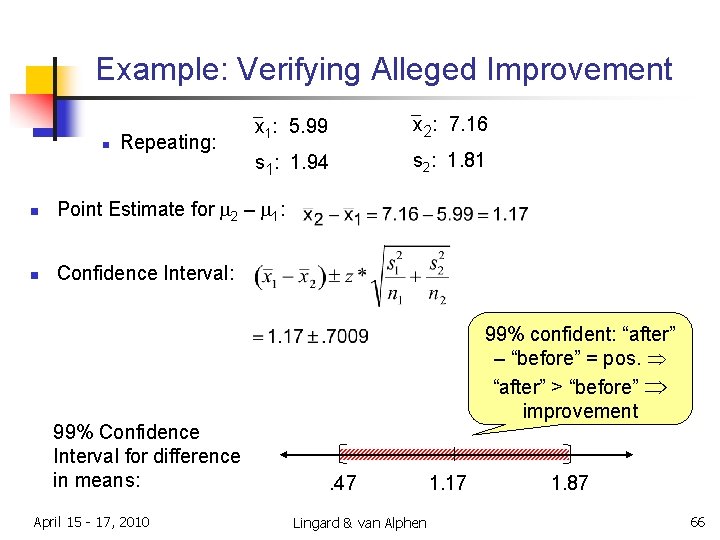
Example: Verifying Alleged Improvement n Repeating: x 1: 5. 99 x 2: 7. 16 s 1: 1. 94 s 2: 1. 81 n Point Estimate for m 2 – m 1: n Confidence Interval: 99% Confidence Interval for difference in means: April 15 - 17, 2010 99% confident: “after” – “before” = pos. “after” > “before” improvement. 47 Lingard & van Alphen 1. 17 1. 87 66
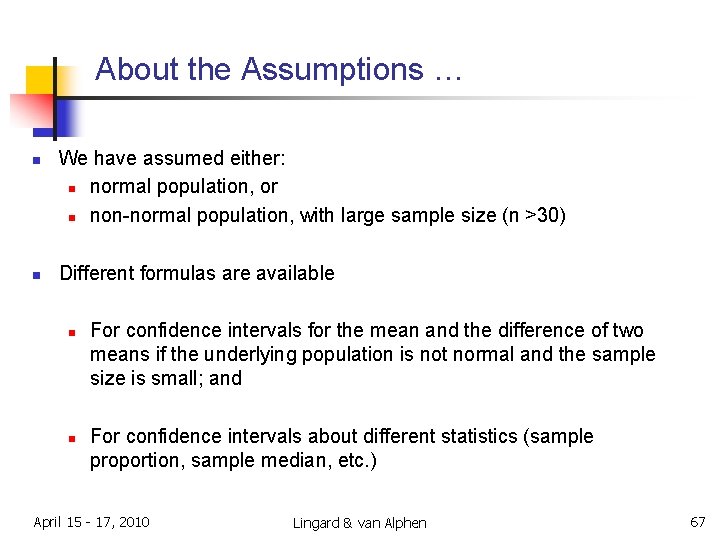
About the Assumptions … n n We have assumed either: n normal population, or n non-normal population, with large sample size (n >30) Different formulas are available n n For confidence intervals for the mean and the difference of two means if the underlying population is not normal and the sample size is small; and For confidence intervals about different statistics (sample proportion, sample median, etc. ) April 15 - 17, 2010 Lingard & van Alphen 67
Overview of Statistics Descriptive Inferential Parameter Estimation April 15 - 17, 2010 Lingard & van Alphen Hypothesis Testing 68
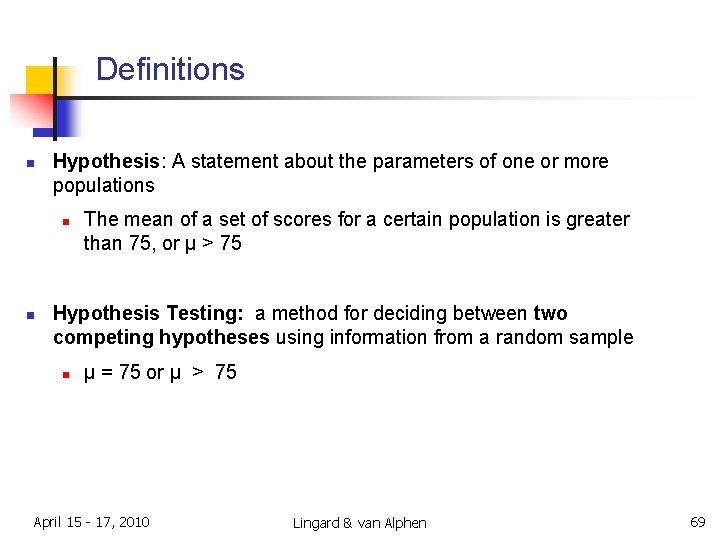
Definitions n Hypothesis: A statement about the parameters of one or more populations n n The mean of a set of scores for a certain population is greater than 75, or µ > 75 Hypothesis Testing: a method for deciding between two competing hypotheses using information from a random sample n µ = 75 or µ > 75 April 15 - 17, 2010 Lingard & van Alphen 69
The Null and Alternative Hypotheses n Null Hypothesis (H 0) n n n Statement that the value of a population parameter is equal to some claimed value. Assertion that is initially assumed to be true (based on prior belief/measurement) Alternative Hypothesis (Ha) n Statement that the population parameter has a value that differs from that claimed by the null hypothesis, H 0. April 15 - 17, 2010 Lingard & van Alphen 70
Decision Making About the Hypotheses n n Decision: to reject or accept H 0 If the data is “consistent” with the H 0, we conclude H 0 is true. n n n Otherwise: we conclude H 0 is false. The data has to be very inconsistent with H 0 (highly unlikely) to warrant rejecting H 0. Criminal Trial Analogy: H 0 - The defendant is innocent. n The jury assumes the defendant is innocent until proven guilty. n The jury rejects H 0 only if there is compelling evidence against it. April 15 - 17, 2010 Lingard & van Alphen 71
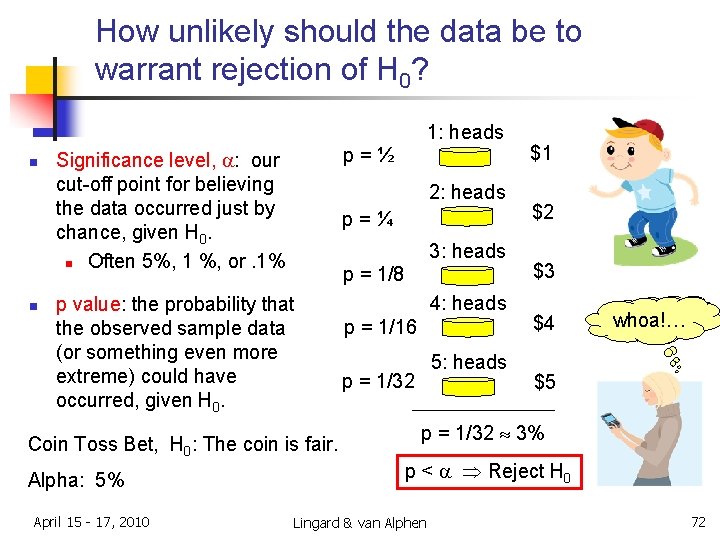
How unlikely should the data be to warrant rejection of H 0? 1: heads n n p=½ Significance level, a: our cut-off point for believing the data occurred just by chance, given H 0. n Often 5%, 1 %, or. 1% 2: heads p=¼ 3: heads p = 1/8 p value: the probability that the observed sample data (or something even more extreme) could have occurred, given H 0. Coin Toss Bet, H 0: The coin is fair. Alpha: 5% April 15 - 17, 2010 4: heads p = 1/16 5: heads p = 1/32 $1 $2 $3 $4 hmm… whoa!… $5 p = 1/32 3% p < a Reject H 0 Lingard & van Alphen 72
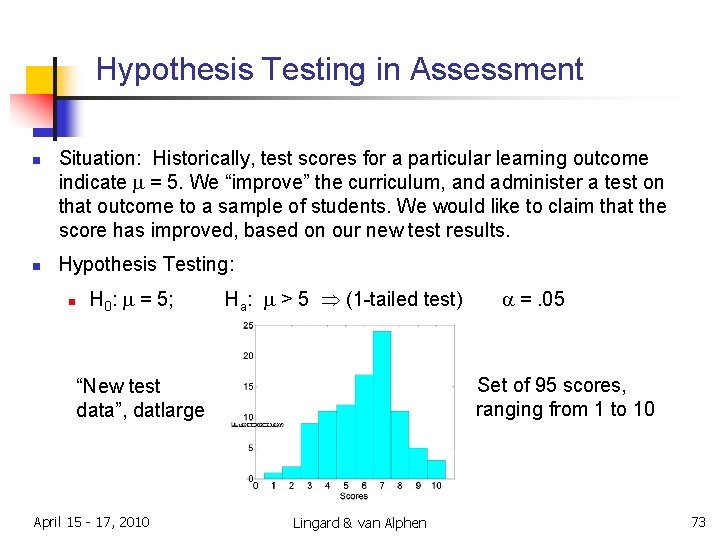
Hypothesis Testing in Assessment n n Situation: Historically, test scores for a particular learning outcome indicate m = 5. We “improve” the curriculum, and administer a test on that outcome to a sample of students. We would like to claim that the score has improved, based on our new test results. Hypothesis Testing: n H 0: m = 5; Ha: m > 5 (1 -tailed test) Set of 95 scores, ranging from 1 to 10 “New test data”, datlarge April 15 - 17, 2010 a =. 05 Lingard & van Alphen 73
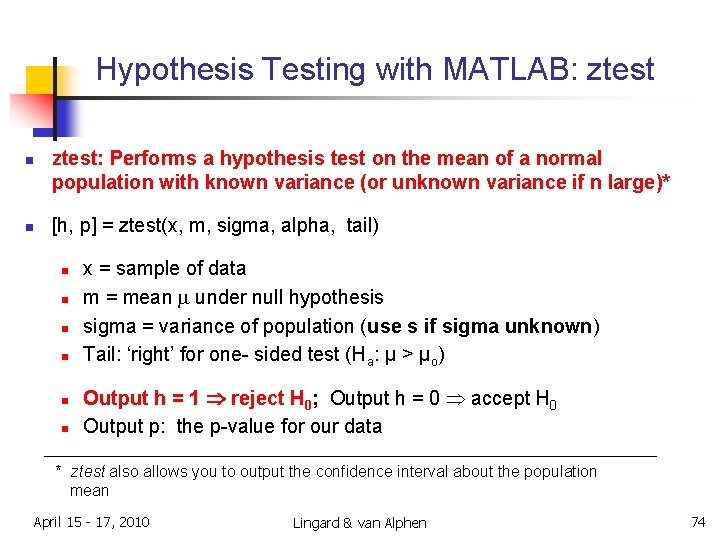
Hypothesis Testing with MATLAB: ztest n n ztest: Performs a hypothesis test on the mean of a normal population with known variance (or unknown variance if n large)* [h, p] = ztest(x, m, sigma, alpha, tail) n n n x = sample of data m = mean m under null hypothesis sigma = variance of population (use s if sigma unknown) Tail: ‘right’ for one- sided test (Ha: µ > µo) Output h = 1 reject H 0; Output h = 0 accept H 0 Output p: the p-value for our data * ztest also allows you to output the confidence interval about the population mean April 15 - 17, 2010 Lingard & van Alphen 74
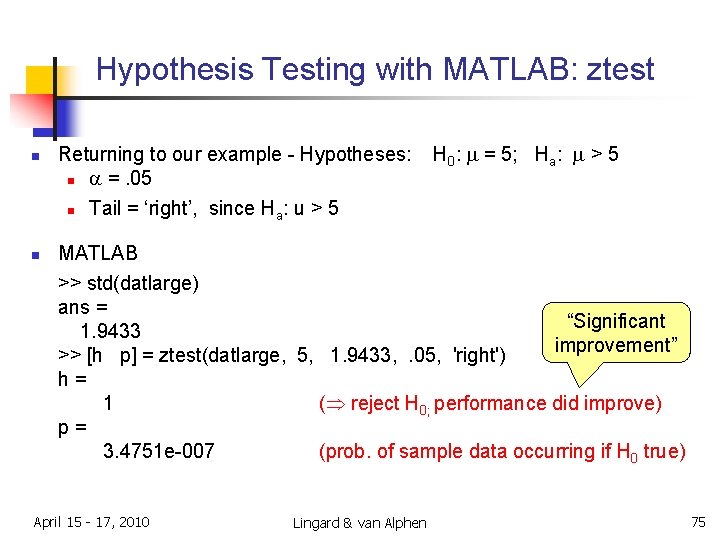
Hypothesis Testing with MATLAB: ztest n n Returning to our example - Hypotheses: n a =. 05 n Tail = ‘right’, since Ha: u > 5 H 0: m = 5; Ha: m > 5 MATLAB >> std(datlarge) ans = “Significant 1. 9433 improvement” >> [h p] = ztest(datlarge, 5, 1. 9433, . 05, 'right') h= 1 ( reject H 0; performance did improve) p= 3. 4751 e-007 (prob. of sample data occurring if H 0 true) April 15 - 17, 2010 Lingard & van Alphen 75
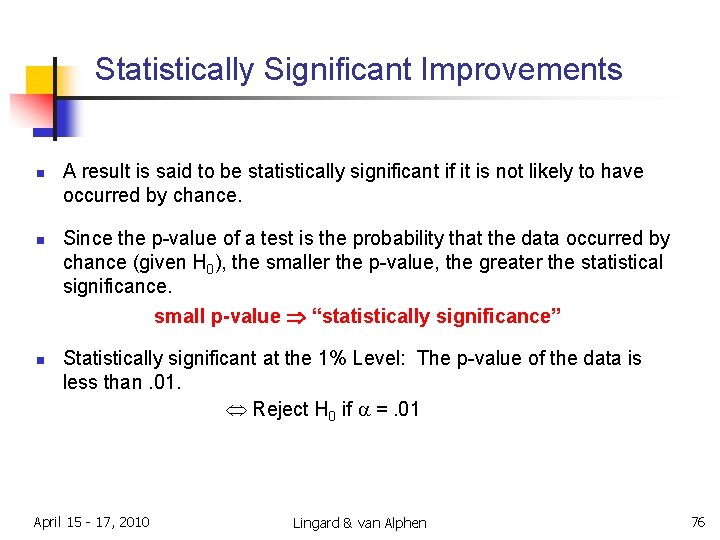
Statistically Significant Improvements n n A result is said to be statistically significant if it is not likely to have occurred by chance. Since the p-value of a test is the probability that the data occurred by chance (given H 0), the smaller the p-value, the greater the statistical significance. small p-value “statistically significance” n Statistically significant at the 1% Level: The p-value of the data is less than. 01. Reject H 0 if a =. 01 April 15 - 17, 2010 Lingard & van Alphen 76
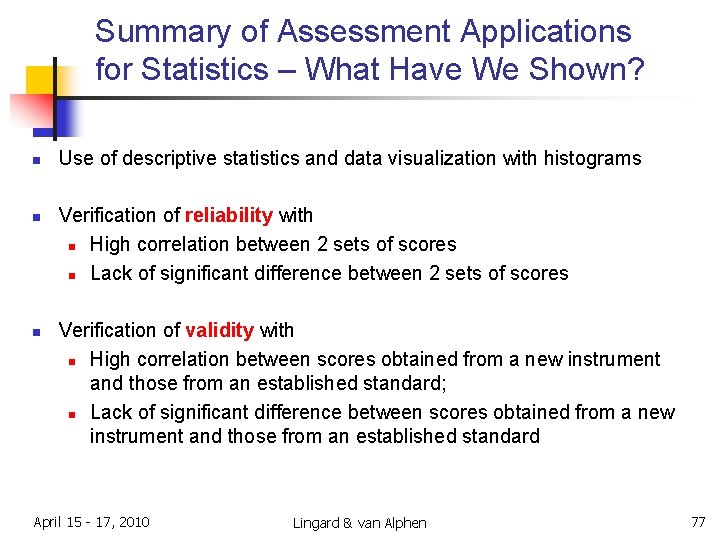
Summary of Assessment Applications for Statistics – What Have We Shown? n n n Use of descriptive statistics and data visualization with histograms Verification of reliability with n High correlation between 2 sets of scores n Lack of significant difference between 2 sets of scores Verification of validity with n High correlation between scores obtained from a new instrument and those from an established standard; n Lack of significant difference between scores obtained from a new instrument and those from an established standard April 15 - 17, 2010 Lingard & van Alphen 77
Summary of Assessment Applications for Statistics n n n Simplifying Program Assessment with Sampling n Choosing an appropriate sample size for estimating the mean n Finding confidence levels for the (point) estimate Claiming Improvement – estimates of the difference in means n Finding confidence levels for the (point) estimate n Determining whether the difference is significant Applications discussed in the context of test scores also occur in the context of surveys April 15 - 17, 2010 Lingard & van Alphen 78
Questions? ? ? & Contact Information n Email: rlingard@csun. edu (Bob Lingard) dvanalphen@csun. edu (Debbie van Alphen) “Not everything that counts can be counted, and not everything that can be counted counts. ” (Sign hanging in Einstein's office at Princeton) “ 98% of all statistics are made up. ” ~Author Unknown April 15 - 17, 2010 Lingard & van Alphen 79
- Slides: 79