
Analyzing OS Fingerprints using Neural Networks and Statistical












- Slides: 49
Analyzing OS Fingerprints using Neural Networks and Statistical Machinery Javier Burroni - Carlos Sarraute Core Security Technologies EUSec. West/core 06 conference Analyzing OS Fingerprints using Neural Networks and Statistical Machinery – Javier Burroni, Carlos Sarraute – Core Security Technologies
OUTLINE 1. Introduction 2. DCE-RPC Endpoint mapper 3. OS Detection based on Nmap signatures 4. Dimension reduction and training Analyzing OS Fingerprints using Neural Networks and Statistical Machinery – Javier Burroni, Carlos Sarraute – Core Security Technologies
1. Introduction 2. DCE-RPC Endpoint mapper 3. OS Detection based on Nmap signatures 4. Dimension reduction and training Analyzing OS Fingerprints using Neural Networks and Statistical Machinery – Javier Burroni, Carlos Sarraute – Core Security Technologies
OS Identification § OS Identification = OS Detection = OS Fingerprinting § Crucial step of the penetration testing process – actively send test packets and study host response § First generation: analysis of differences between TCP/IP stack implementations § Next generation: analysis of application layer data (DCE RPC endpoints) – to refine detection of Windows versions / editions / service packs Analyzing OS Fingerprints using Neural Networks and Statistical Machinery – Javier Burroni, Carlos Sarraute – Core Security Technologies
Limitations of OS Fingerprinting tools § Some variation of “best fit” algorithm is used to analyze the information – will not work in non standard situations – inability to extract key elements § Our proposal: – focus on the technique used to analyze the data – we have developed tools using neural networks – successfully integrated into commercial software Analyzing OS Fingerprints using Neural Networks and Statistical Machinery – Javier Burroni, Carlos Sarraute – Core Security Technologies
1. Introduction 2. DCE-RPC Endpoint mapper 3. OS Detection based on Nmap signatures 4. Dimension reduction and training Analyzing OS Fingerprints using Neural Networks and Statistical Machinery – Javier Burroni, Carlos Sarraute – Core Security Technologies
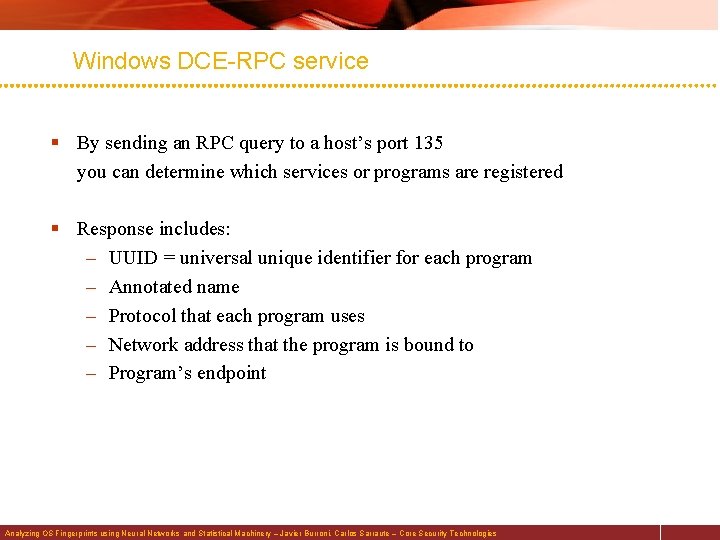
Windows DCE-RPC service § By sending an RPC query to a host’s port 135 you can determine which services or programs are registered § Response includes: – UUID = universal unique identifier for each program – Annotated name – Protocol that each program uses – Network address that the program is bound to – Program’s endpoint Analyzing OS Fingerprints using Neural Networks and Statistical Machinery – Javier Burroni, Carlos Sarraute – Core Security Technologies
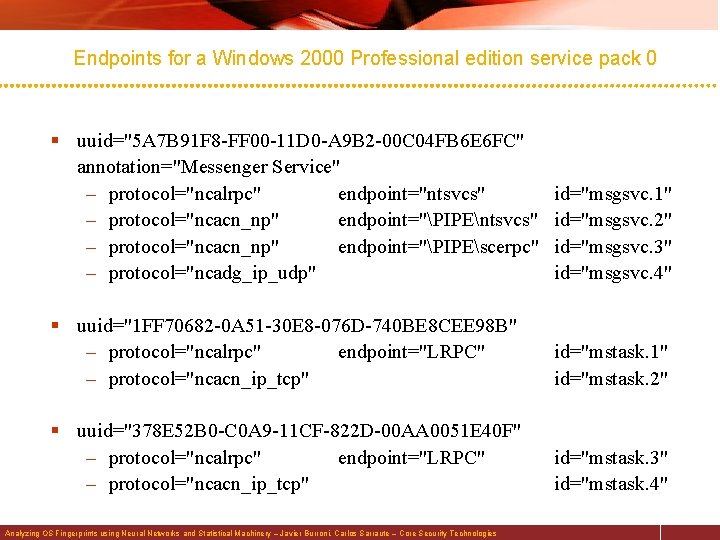
Endpoints for a Windows 2000 Professional edition service pack 0 § uuid="5 A 7 B 91 F 8 -FF 00 -11 D 0 -A 9 B 2 -00 C 04 FB 6 E 6 FC" annotation="Messenger Service" – protocol="ncalrpc" endpoint="ntsvcs" – protocol="ncacn_np" endpoint="PIPEscerpc" – protocol="ncadg_ip_udp" id="msgsvc. 1" id="msgsvc. 2" id="msgsvc. 3" id="msgsvc. 4" § uuid="1 FF 70682 -0 A 51 -30 E 8 -076 D-740 BE 8 CEE 98 B" – protocol="ncalrpc" endpoint="LRPC" – protocol="ncacn_ip_tcp" id="mstask. 1" id="mstask. 2" § uuid="378 E 52 B 0 -C 0 A 9 -11 CF-822 D-00 AA 0051 E 40 F" – protocol="ncalrpc" endpoint="LRPC" – protocol="ncacn_ip_tcp" id="mstask. 3" id="mstask. 4" Analyzing OS Fingerprints using Neural Networks and Statistical Machinery – Javier Burroni, Carlos Sarraute – Core Security Technologies
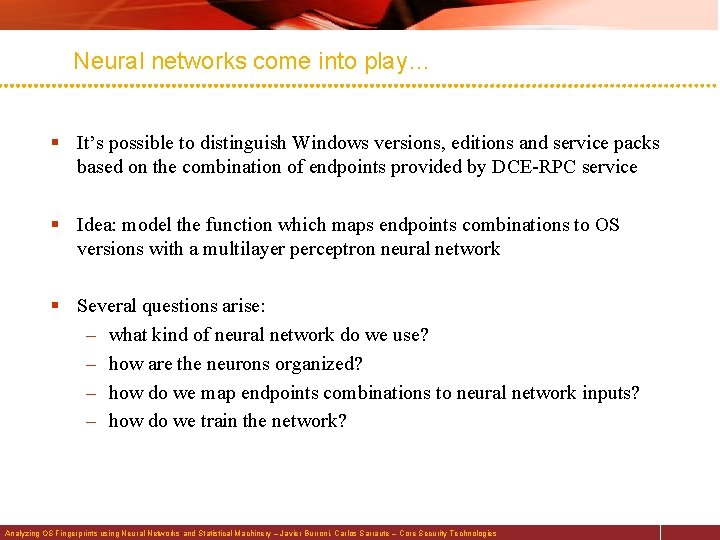
Neural networks come into play… § It’s possible to distinguish Windows versions, editions and service packs based on the combination of endpoints provided by DCE-RPC service § Idea: model the function which maps endpoints combinations to OS versions with a multilayer perceptron neural network § Several questions arise: – what kind of neural network do we use? – how are the neurons organized? – how do we map endpoints combinations to neural network inputs? – how do we train the network? Analyzing OS Fingerprints using Neural Networks and Statistical Machinery – Javier Burroni, Carlos Sarraute – Core Security Technologies
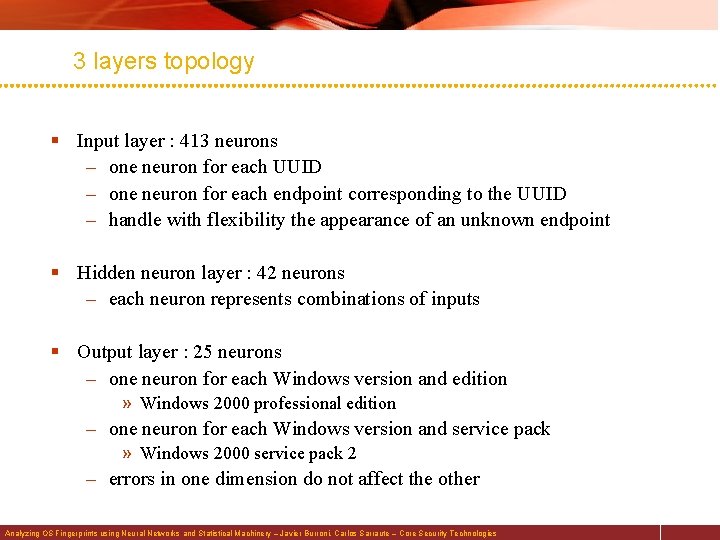
Multilayer Perceptron Neural Network 413 neurons 42 neurons 25 neurons Analyzing OS Fingerprints using Neural Networks and Statistical Machinery – Javier Burroni, Carlos Sarraute – Core Security Technologies
3 layers topology § Input layer : 413 neurons – one neuron for each UUID – one neuron for each endpoint corresponding to the UUID – handle with flexibility the appearance of an unknown endpoint § Hidden neuron layer : 42 neurons – each neuron represents combinations of inputs § Output layer : 25 neurons – one neuron for each Windows version and edition » Windows 2000 professional edition – one neuron for each Windows version and service pack » Windows 2000 service pack 2 – errors in one dimension do not affect the other Analyzing OS Fingerprints using Neural Networks and Statistical Machinery – Javier Burroni, Carlos Sarraute – Core Security Technologies
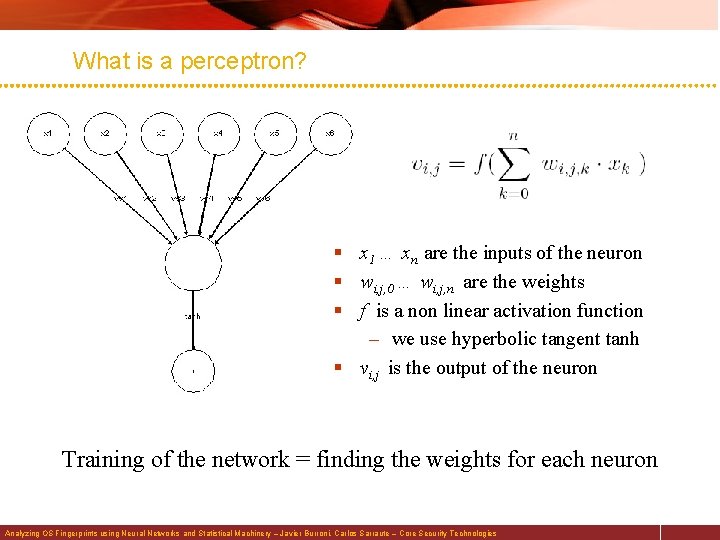
What is a perceptron? § x 1 … xn are the inputs of the neuron § wi, j, 0 … wi, j, n are the weights § f is a non linear activation function – we use hyperbolic tangent tanh § vi, j is the output of the neuron Training of the network = finding the weights for each neuron Analyzing OS Fingerprints using Neural Networks and Statistical Machinery – Javier Burroni, Carlos Sarraute – Core Security Technologies
Back propagation § Training by back-propagation: § for the output layer – given an expected output y 1 … ym – calculate an estimation of the error § this is propagated to the previous layers as: Analyzing OS Fingerprints using Neural Networks and Statistical Machinery – Javier Burroni, Carlos Sarraute – Core Security Technologies
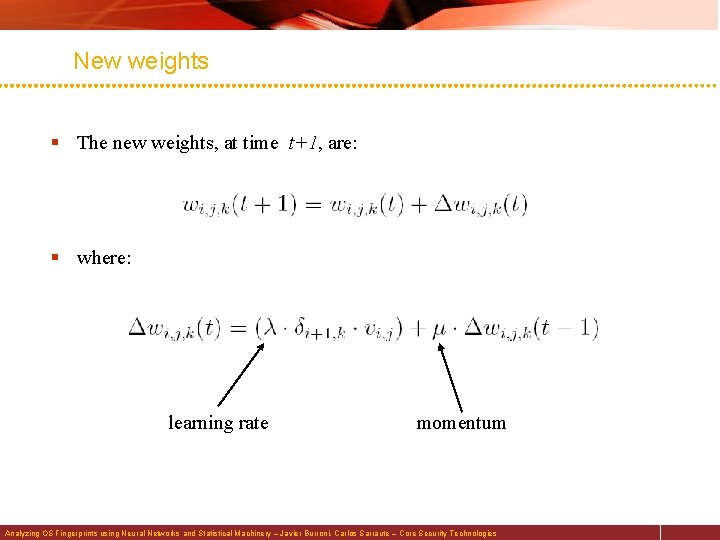
New weights § The new weights, at time t+1, are: § where: learning rate momentum Analyzing OS Fingerprints using Neural Networks and Statistical Machinery – Javier Burroni, Carlos Sarraute – Core Security Technologies
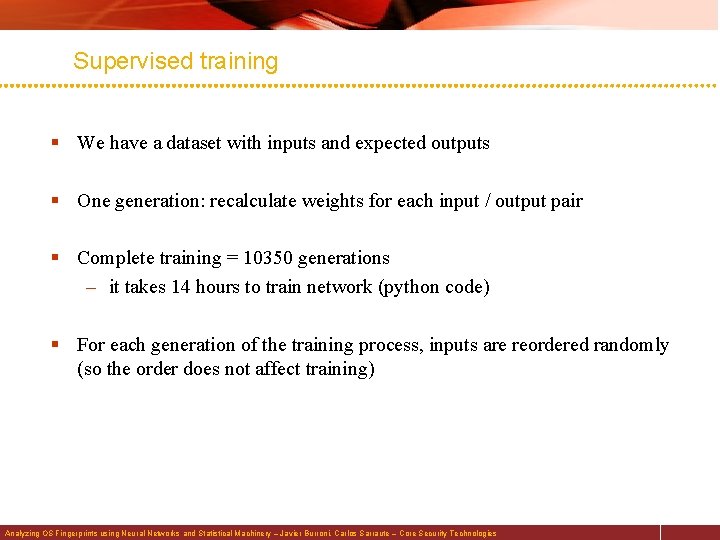
Supervised training § We have a dataset with inputs and expected outputs § One generation: recalculate weights for each input / output pair § Complete training = 10350 generations – it takes 14 hours to train network (python code) § For each generation of the training process, inputs are reordered randomly (so the order does not affect training) Analyzing OS Fingerprints using Neural Networks and Statistical Machinery – Javier Burroni, Carlos Sarraute – Core Security Technologies
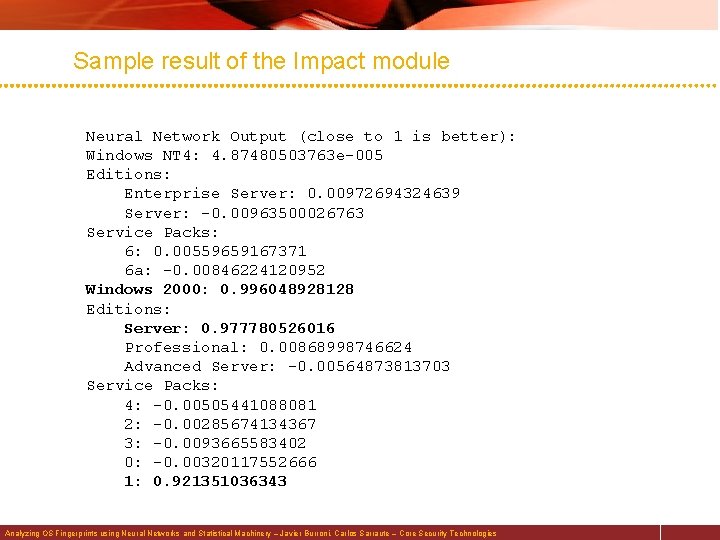
Sample result of the Impact module Neural Network Output (close to 1 is better): Windows NT 4: 4. 87480503763 e-005 Editions: Enterprise Server: 0. 00972694324639 Server: -0. 00963500026763 Service Packs: 6: 0. 00559659167371 6 a: -0. 00846224120952 Windows 2000: 0. 996048928128 Editions: Server: 0. 977780526016 Professional: 0. 00868998746624 Advanced Server: -0. 00564873813703 Service Packs: 4: -0. 00505441088081 2: -0. 00285674134367 3: -0. 0093665583402 0: -0. 00320117552666 1: 0. 921351036343 Analyzing OS Fingerprints using Neural Networks and Statistical Machinery – Javier Burroni, Carlos Sarraute – Core Security Technologies
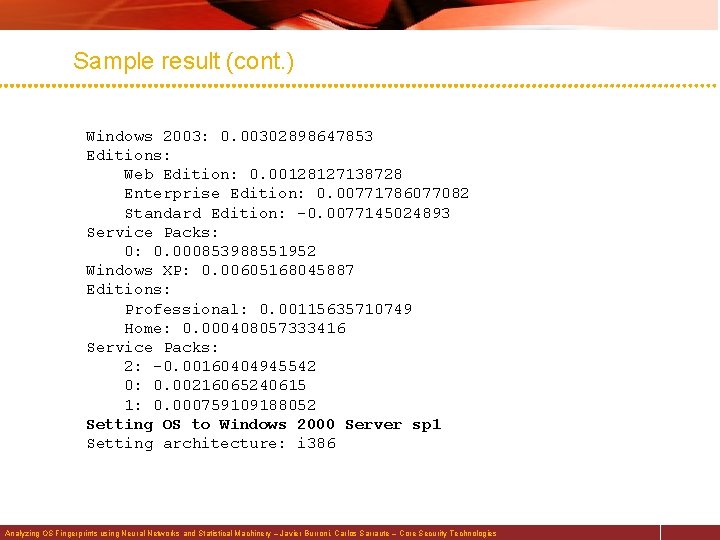
Sample result (cont. ) Windows 2003: 0. 00302898647853 Editions: Web Edition: 0. 00128127138728 Enterprise Edition: 0. 00771786077082 Standard Edition: -0. 0077145024893 Service Packs: 0: 0. 000853988551952 Windows XP: 0. 00605168045887 Editions: Professional: 0. 00115635710749 Home: 0. 000408057333416 Service Packs: 2: -0. 00160404945542 0: 0. 00216065240615 1: 0. 000759109188052 Setting OS to Windows 2000 Server sp 1 Setting architecture: i 386 Analyzing OS Fingerprints using Neural Networks and Statistical Machinery – Javier Burroni, Carlos Sarraute – Core Security Technologies
Result comparison § Results of our laboratory: Old DCE-RPC module DCE-RPC with neural networks Perfect matches 6 7 Partial matches 8 14 Mismatches 7 0 No match 2 2 Analyzing OS Fingerprints using Neural Networks and Statistical Machinery – Javier Burroni, Carlos Sarraute – Core Security Technologies
1. Introduction 2. DCE-RPC Endpoint mapper 3. OS Detection based on Nmap signatures 4. Dimension reduction and training Analyzing OS Fingerprints using Neural Networks and Statistical Machinery – Javier Burroni, Carlos Sarraute – Core Security Technologies
Nmap tests § Nmap is a network exploration tool and security scanner § includes OS detection based on the response of a host to 9 tests Test send packet to port with flags enabled T 1 TCP open TCP SYN, ECN-Echo T 2 TCP open TCP no flags T 3 TCP open TCP URG, PSH, SYN, FIN T 4 TCP open TCP ACK T 5 TCP closed TCP SYN T 6 TCP closed TCP ACK T 7 TCP closed TCP URG, PSH, FIN PU UDP closed UDP TSeq TCP * 6 open TCP SYN Analyzing OS Fingerprints using Neural Networks and Statistical Machinery – Javier Burroni, Carlos Sarraute – Core Security Technologies
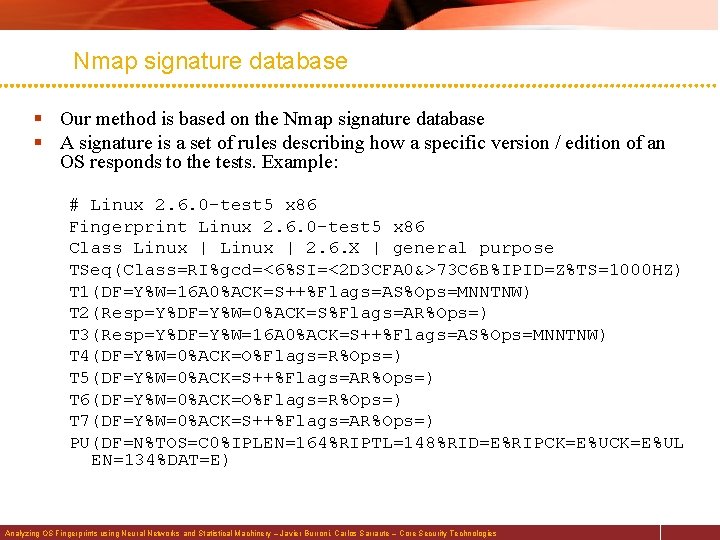
Nmap signature database § Our method is based on the Nmap signature database § A signature is a set of rules describing how a specific version / edition of an OS responds to the tests. Example: # Linux 2. 6. 0 -test 5 x 86 Fingerprint Linux 2. 6. 0 -test 5 x 86 Class Linux | 2. 6. X | general purpose TSeq(Class=RI%gcd=<6%SI=<2 D 3 CFA 0&>73 C 6 B%IPID=Z%TS=1000 HZ) T 1(DF=Y%W=16 A 0%ACK=S++%Flags=AS%Ops=MNNTNW) T 2(Resp=Y%DF=Y%W=0%ACK=S%Flags=AR%Ops=) T 3(Resp=Y%DF=Y%W=16 A 0%ACK=S++%Flags=AS%Ops=MNNTNW) T 4(DF=Y%W=0%ACK=O%Flags=R%Ops=) T 5(DF=Y%W=0%ACK=S++%Flags=AR%Ops=) T 6(DF=Y%W=0%ACK=O%Flags=R%Ops=) T 7(DF=Y%W=0%ACK=S++%Flags=AR%Ops=) PU(DF=N%TOS=C 0%IPLEN=164%RIPTL=148%RID=E%RIPCK=E%UL EN=134%DAT=E) Analyzing OS Fingerprints using Neural Networks and Statistical Machinery – Javier Burroni, Carlos Sarraute – Core Security Technologies
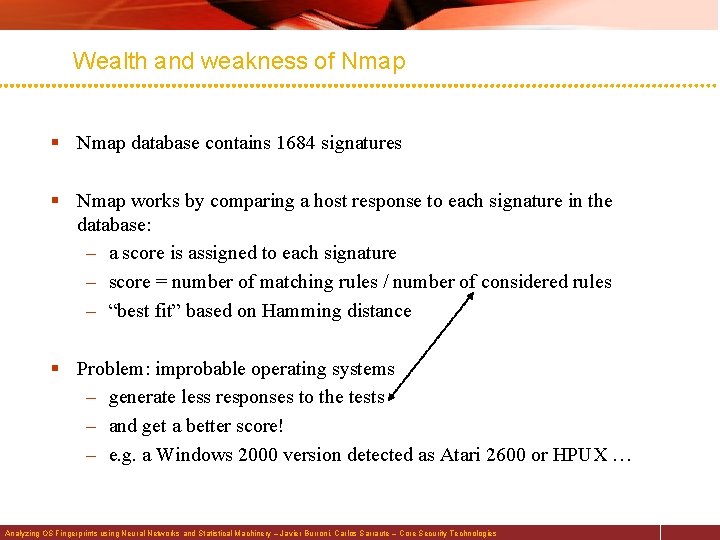
Wealth and weakness of Nmap § Nmap database contains 1684 signatures § Nmap works by comparing a host response to each signature in the database: – a score is assigned to each signature – score = number of matching rules / number of considered rules – “best fit” based on Hamming distance § Problem: improbable operating systems – generate less responses to the tests – and get a better score! – e. g. a Windows 2000 version detected as Atari 2600 or HPUX … Analyzing OS Fingerprints using Neural Networks and Statistical Machinery – Javier Burroni, Carlos Sarraute – Core Security Technologies
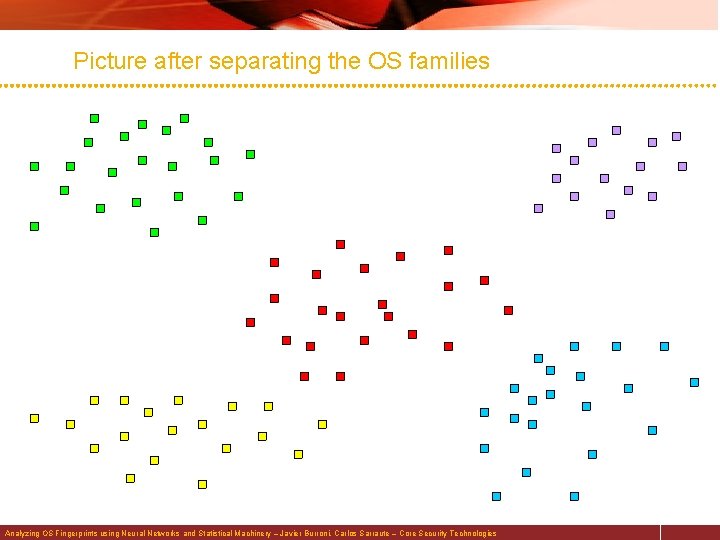
Symbolic representation of the OS space § The space of host responses has 560 dimensions § Colors represents different OS families Analyzing OS Fingerprints using Neural Networks and Statistical Machinery – Javier Burroni, Carlos Sarraute – Core Security Technologies
Picture after filtering irrelevant OS § OS detection is a step of the penetration test process – we only want to detect Windows, Linux, Solaris, Open. BSD, Free. BSD, Net. BSD Analyzing OS Fingerprints using Neural Networks and Statistical Machinery – Javier Burroni, Carlos Sarraute – Core Security Technologies
Picture after separating the OS families Analyzing OS Fingerprints using Neural Networks and Statistical Machinery – Javier Burroni, Carlos Sarraute – Core Security Technologies
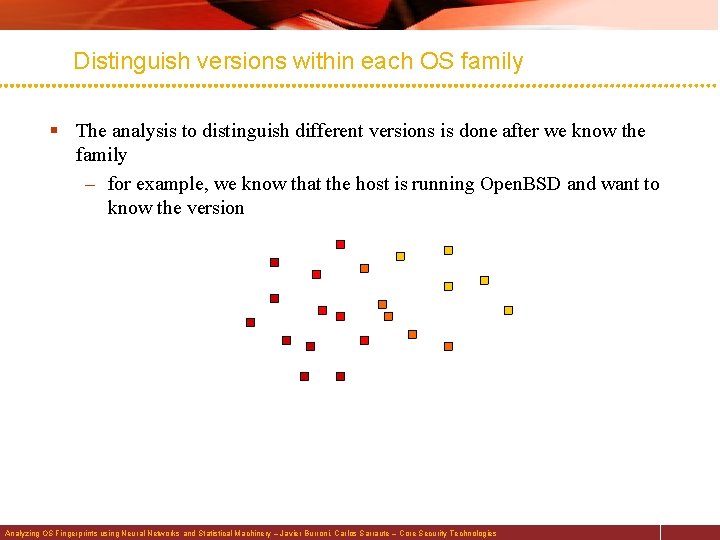
Distinguish versions within each OS family § The analysis to distinguish different versions is done after we know the family – for example, we know that the host is running Open. BSD and want to know the version Analyzing OS Fingerprints using Neural Networks and Statistical Machinery – Javier Burroni, Carlos Sarraute – Core Security Technologies
Hierarchical Network Structure § Analyze the responses with different neural networks § Each analysis is conditionned by the results of the previous analysis relevant not relevant Windows DCE-RPC endpoint Linux kernel version Solaris version Open. BSD version Free. BSD version Net. BSD version Analyzing OS Fingerprints using Neural Networks and Statistical Machinery – Javier Burroni, Carlos Sarraute – Core Security Technologies
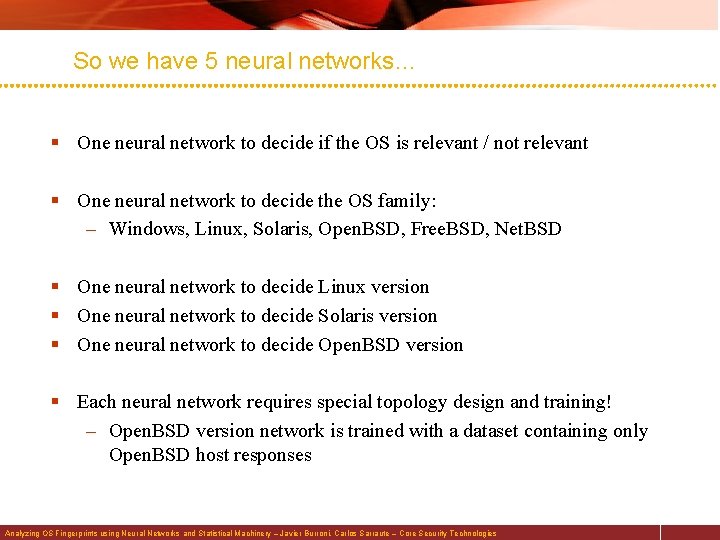
So we have 5 neural networks… § One neural network to decide if the OS is relevant / not relevant § One neural network to decide the OS family: – Windows, Linux, Solaris, Open. BSD, Free. BSD, Net. BSD § One neural network to decide Linux version § One neural network to decide Solaris version § One neural network to decide Open. BSD version § Each neural network requires special topology design and training! – Open. BSD version network is trained with a dataset containing only Open. BSD host responses Analyzing OS Fingerprints using Neural Networks and Statistical Machinery – Javier Burroni, Carlos Sarraute – Core Security Technologies
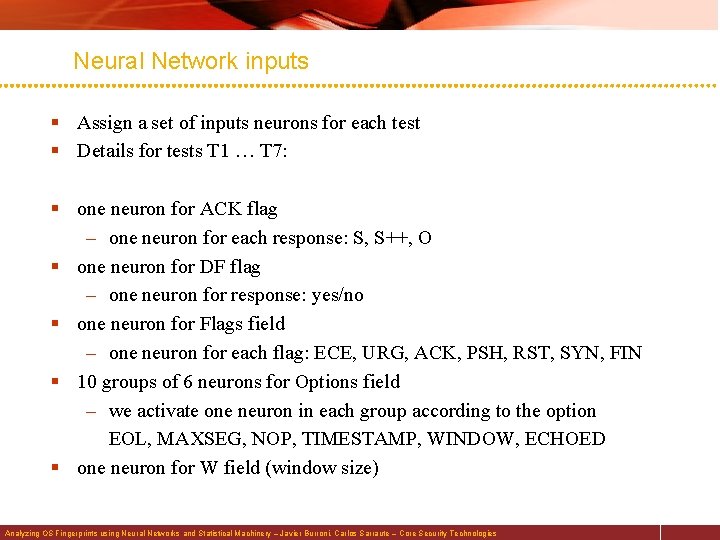
Neural Network inputs § Assign a set of inputs neurons for each test § Details for tests T 1 … T 7: § one neuron for ACK flag – one neuron for each response: S, S++, O § one neuron for DF flag – one neuron for response: yes/no § one neuron for Flags field – one neuron for each flag: ECE, URG, ACK, PSH, RST, SYN, FIN § 10 groups of 6 neurons for Options field – we activate one neuron in each group according to the option EOL, MAXSEG, NOP, TIMESTAMP, WINDOW, ECHOED § one neuron for W field (window size) Analyzing OS Fingerprints using Neural Networks and Statistical Machinery – Javier Burroni, Carlos Sarraute – Core Security Technologies
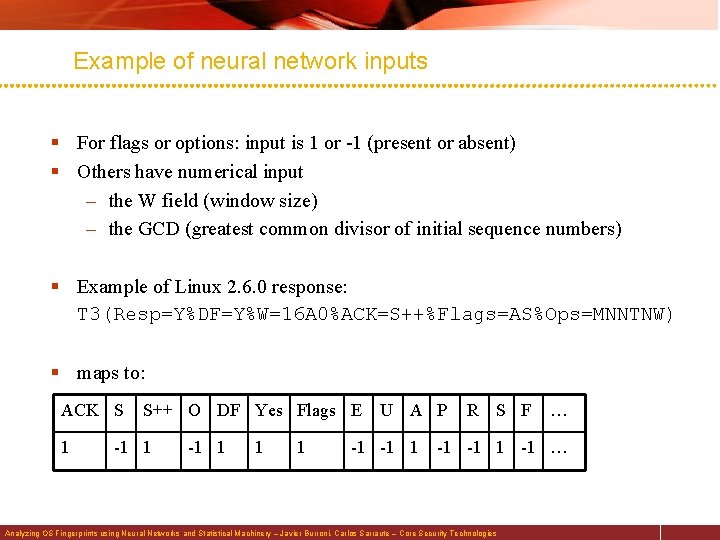
Example of neural network inputs § For flags or options: input is 1 or -1 (present or absent) § Others have numerical input – the W field (window size) – the GCD (greatest common divisor of initial sequence numbers) § Example of Linux 2. 6. 0 response: T 3(Resp=Y%DF=Y%W=16 A 0%ACK=S++%Flags=AS%Ops=MNNTNW) § maps to: ACK S 1 S++ O DF Yes Flags E -1 1 1 1 U A P -1 -1 1 R S F … -1 -1 … Analyzing OS Fingerprints using Neural Networks and Statistical Machinery – Javier Burroni, Carlos Sarraute – Core Security Technologies
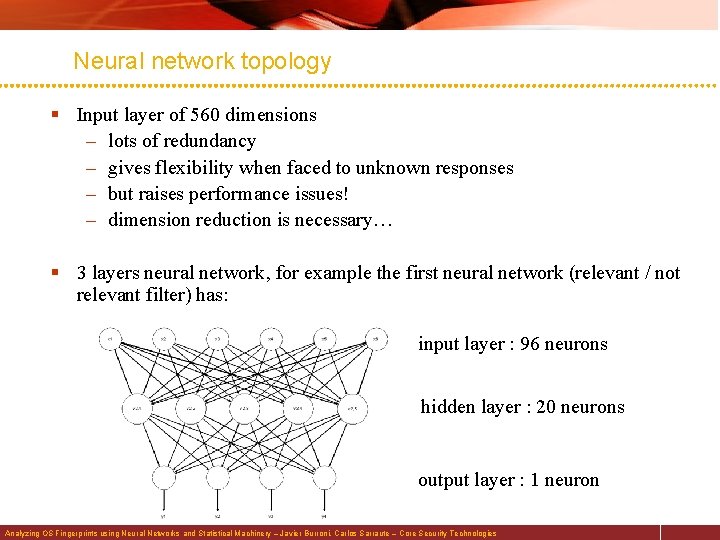
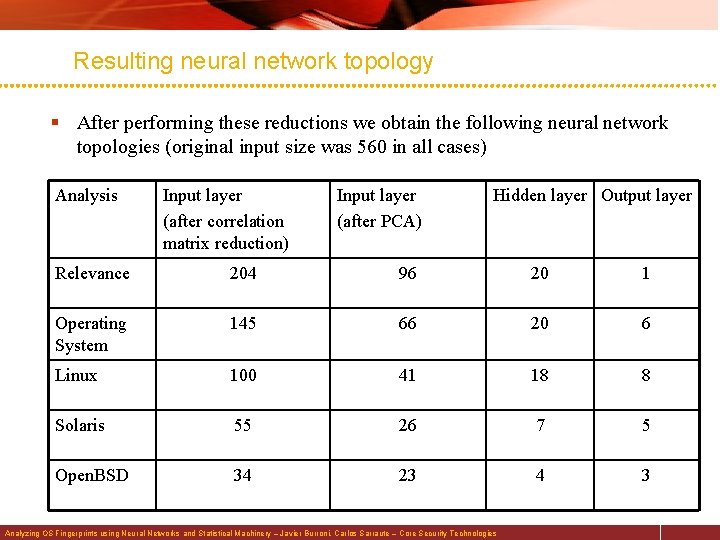
Neural network topology § Input layer of 560 dimensions – lots of redundancy – gives flexibility when faced to unknown responses – but raises performance issues! – dimension reduction is necessary… § 3 layers neural network, for example the first neural network (relevant / not relevant filter) has: input layer : 96 neurons hidden layer : 20 neurons output layer : 1 neuron Analyzing OS Fingerprints using Neural Networks and Statistical Machinery – Javier Burroni, Carlos Sarraute – Core Security Technologies
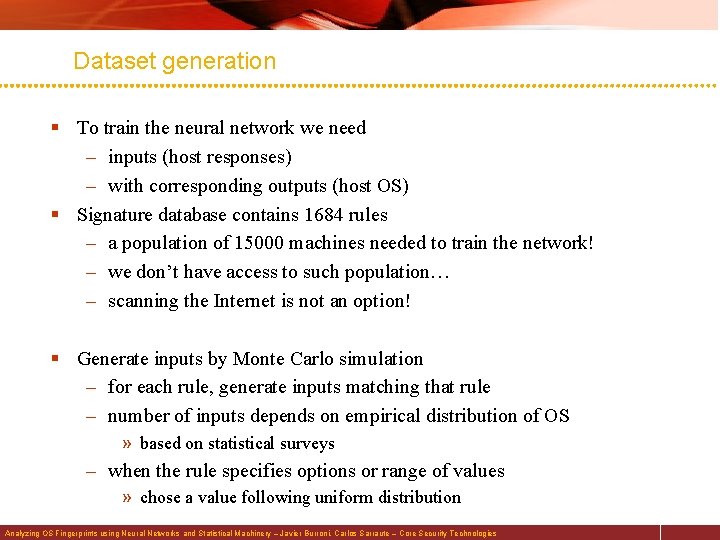
Dataset generation § To train the neural network we need – inputs (host responses) – with corresponding outputs (host OS) § Signature database contains 1684 rules – a population of 15000 machines needed to train the network! – we don’t have access to such population… – scanning the Internet is not an option! § Generate inputs by Monte Carlo simulation – for each rule, generate inputs matching that rule – number of inputs depends on empirical distribution of OS » based on statistical surveys – when the rule specifies options or range of values » chose a value following uniform distribution Analyzing OS Fingerprints using Neural Networks and Statistical Machinery – Javier Burroni, Carlos Sarraute – Core Security Technologies
1. Introduction 2. DCE-RPC Endpoint mapper 3. OS Detection based on Nmap signatures 4. Dimension reduction and training Analyzing OS Fingerprints using Neural Networks and Statistical Machinery – Javier Burroni, Carlos Sarraute – Core Security Technologies
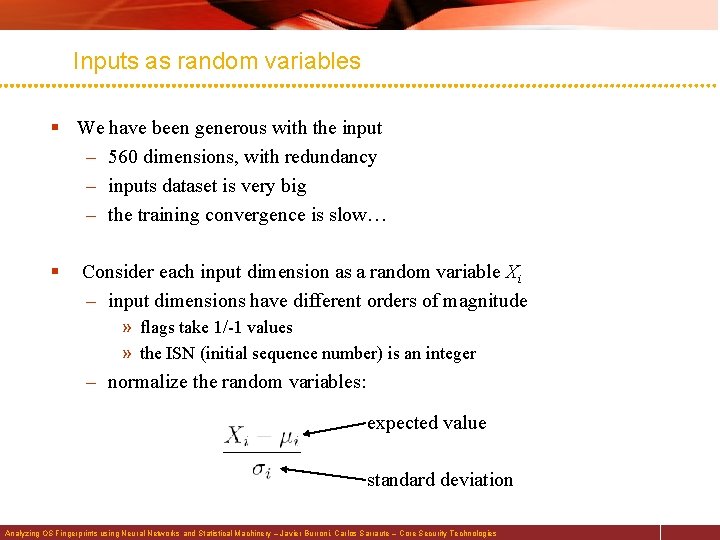
Inputs as random variables § We have been generous with the input – 560 dimensions, with redundancy – inputs dataset is very big – the training convergence is slow… § Consider each input dimension as a random variable Xi – input dimensions have different orders of magnitude » flags take 1/-1 values » the ISN (initial sequence number) is an integer – normalize the random variables: expected value standard deviation Analyzing OS Fingerprints using Neural Networks and Statistical Machinery – Javier Burroni, Carlos Sarraute – Core Security Technologies
Correlation matrix § We compute the correlation matrix R: § After normalization this is simply: expected value § The correlation is a dimensionless measure of statistical dependence – closer to 1 or -1 indicates higher dependence – linear dependent columns of R indicate dependent variables – we keep one and eliminate the others – constants have zero variance and are also eliminated Analyzing OS Fingerprints using Neural Networks and Statistical Machinery – Javier Burroni, Carlos Sarraute – Core Security Technologies
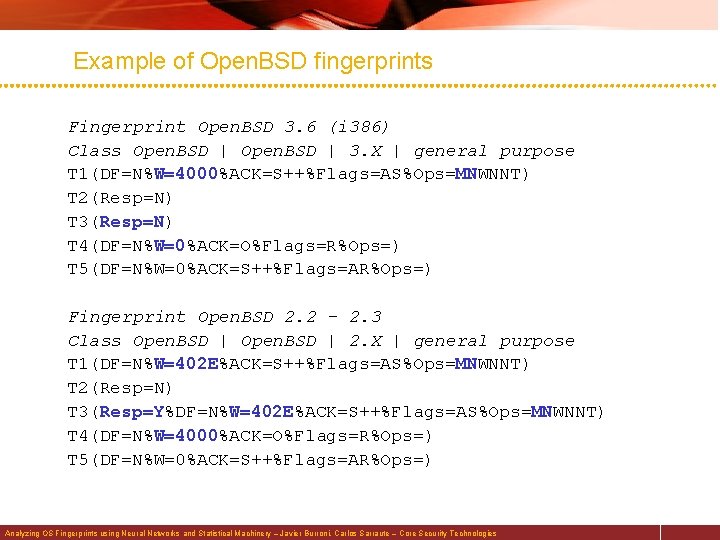
Example of Open. BSD fingerprints Fingerprint Open. BSD 3. 6 (i 386) Class Open. BSD | 3. X | general purpose T 1(DF=N%W=4000%ACK=S++%Flags=AS%Ops=MNWNNT) T 2(Resp=N) T 3(Resp=N) T 4(DF=N%W=0%ACK=O%Flags=R%Ops=) T 5(DF=N%W=0%ACK=S++%Flags=AR%Ops=) Fingerprint Open. BSD 2. 2 - 2. 3 Class Open. BSD | 2. X | general purpose T 1(DF=N%W=402 E%ACK=S++%Flags=AS%Ops=MNWNNT) T 2(Resp=N) T 3(Resp=Y%DF=N%W=402 E%ACK=S++%Flags=AS%Ops=MNWNNT) T 4(DF=N%W=4000%ACK=O%Flags=R%Ops=) T 5(DF=N%W=0%ACK=S++%Flags=AR%Ops=) Analyzing OS Fingerprints using Neural Networks and Statistical Machinery – Javier Burroni, Carlos Sarraute – Core Security Technologies
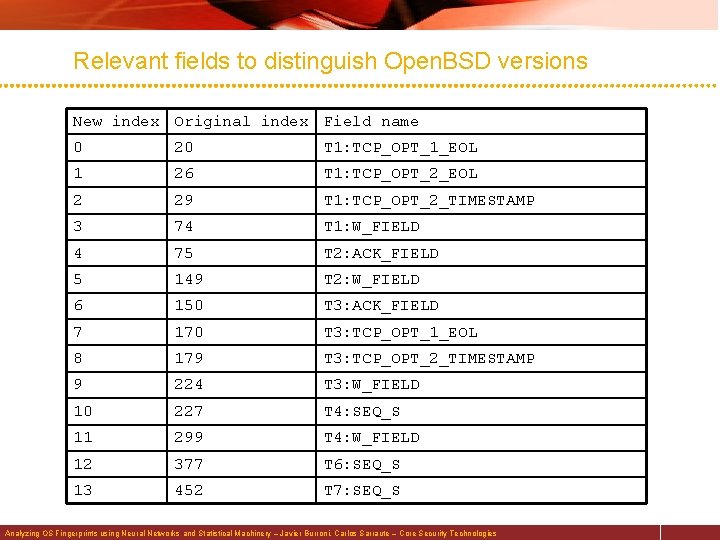
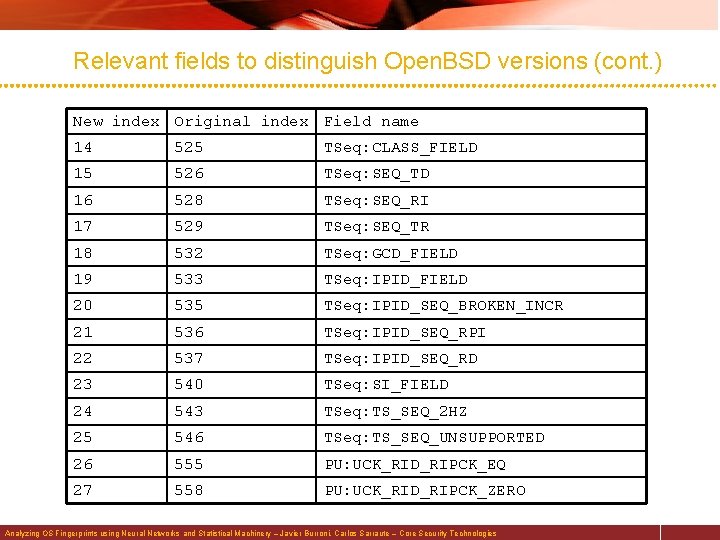
Relevant fields to distinguish Open. BSD versions New index Original index Field name 0 20 T 1: TCP_OPT_1_EOL 1 26 T 1: TCP_OPT_2_EOL 2 29 T 1: TCP_OPT_2_TIMESTAMP 3 74 T 1: W_FIELD 4 75 T 2: ACK_FIELD 5 149 T 2: W_FIELD 6 150 T 3: ACK_FIELD 7 170 T 3: TCP_OPT_1_EOL 8 179 T 3: TCP_OPT_2_TIMESTAMP 9 224 T 3: W_FIELD 10 227 T 4: SEQ_S 11 299 T 4: W_FIELD 12 377 T 6: SEQ_S 13 452 T 7: SEQ_S Analyzing OS Fingerprints using Neural Networks and Statistical Machinery – Javier Burroni, Carlos Sarraute – Core Security Technologies
Relevant fields to distinguish Open. BSD versions (cont. ) New index Original index Field name 14 525 TSeq: CLASS_FIELD 15 526 TSeq: SEQ_TD 16 528 TSeq: SEQ_RI 17 529 TSeq: SEQ_TR 18 532 TSeq: GCD_FIELD 19 533 TSeq: IPID_FIELD 20 535 TSeq: IPID_SEQ_BROKEN_INCR 21 536 TSeq: IPID_SEQ_RPI 22 537 TSeq: IPID_SEQ_RD 23 540 TSeq: SI_FIELD 24 543 TSeq: TS_SEQ_2 HZ 25 546 TSeq: TS_SEQ_UNSUPPORTED 26 555 PU: UCK_RID_RIPCK_EQ 27 558 PU: UCK_RID_RIPCK_ZERO Analyzing OS Fingerprints using Neural Networks and Statistical Machinery – Javier Burroni, Carlos Sarraute – Core Security Technologies
Principal Component Analysis (PCA) § Further reduction involves Principal Component Analysis (PCA) § Idea: compute a new basis (coordinates system) of the input space – the greatest variance of any projection of the dataset in a subspace of k dimensions – comes by projecting to the first k basis vectors § PCA algorithm: – compute eigenvectors and eigenvalues of R – sort by decreasing eigenvalue – keep first k vectors to project the data – parameter k chosen to keep 98% of total variance Analyzing OS Fingerprints using Neural Networks and Statistical Machinery – Javier Burroni, Carlos Sarraute – Core Security Technologies
Idea of Principal Component Analysis § Keep the dimensions which have higher variance – higher eigenvalues of the Correlation Matrix Analyzing OS Fingerprints using Neural Networks and Statistical Machinery – Javier Burroni, Carlos Sarraute – Core Security Technologies
Resulting neural network topology § After performing these reductions we obtain the following neural network topologies (original input size was 560 in all cases) Analysis Input layer (after correlation matrix reduction) Input layer (after PCA) Hidden layer Output layer Relevance 204 96 20 1 Operating System 145 66 20 6 Linux 100 41 18 8 Solaris 55 26 7 5 Open. BSD 34 23 4 3 Analyzing OS Fingerprints using Neural Networks and Statistical Machinery – Javier Burroni, Carlos Sarraute – Core Security Technologies
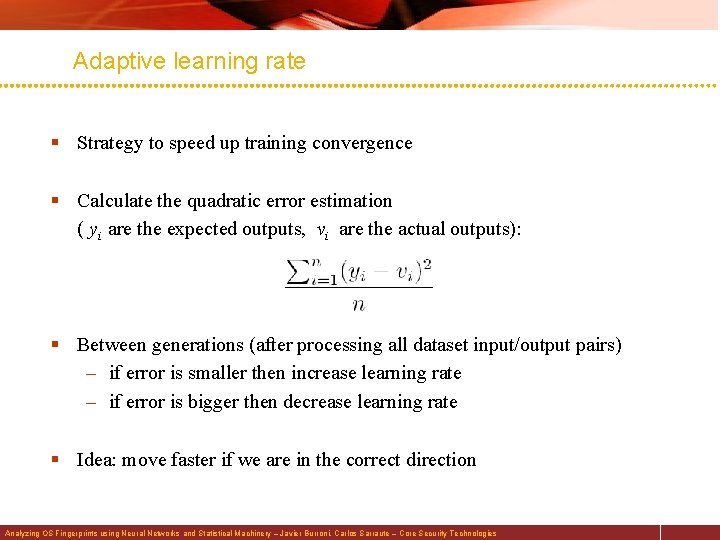
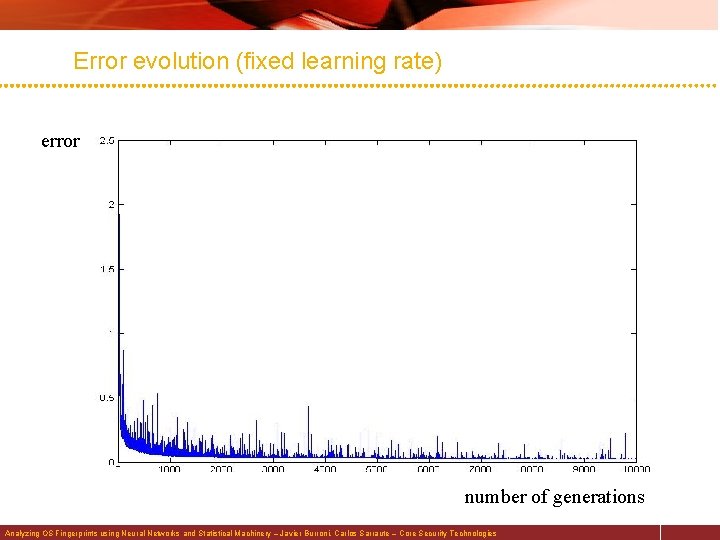
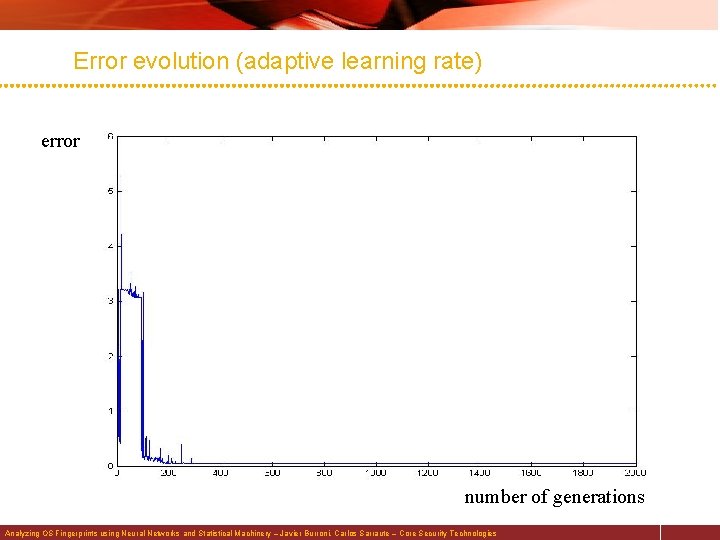
Adaptive learning rate § Strategy to speed up training convergence § Calculate the quadratic error estimation ( yi are the expected outputs, vi are the actual outputs): § Between generations (after processing all dataset input/output pairs) – if error is smaller then increase learning rate – if error is bigger then decrease learning rate § Idea: move faster if we are in the correct direction Analyzing OS Fingerprints using Neural Networks and Statistical Machinery – Javier Burroni, Carlos Sarraute – Core Security Technologies
Error evolution (fixed learning rate) error number of generations Analyzing OS Fingerprints using Neural Networks and Statistical Machinery – Javier Burroni, Carlos Sarraute – Core Security Technologies
Error evolution (adaptive learning rate) error number of generations Analyzing OS Fingerprints using Neural Networks and Statistical Machinery – Javier Burroni, Carlos Sarraute – Core Security Technologies
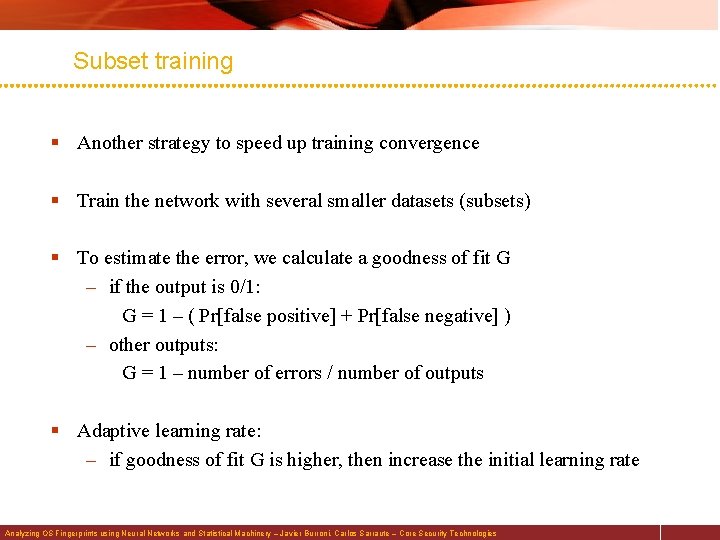
Subset training § Another strategy to speed up training convergence § Train the network with several smaller datasets (subsets) § To estimate the error, we calculate a goodness of fit G – if the output is 0/1: G = 1 – ( Pr[false positive] + Pr[false negative] ) – other outputs: G = 1 – number of errors / number of outputs § Adaptive learning rate: – if goodness of fit G is higher, then increase the initial learning rate Analyzing OS Fingerprints using Neural Networks and Statistical Machinery – Javier Burroni, Carlos Sarraute – Core Security Technologies
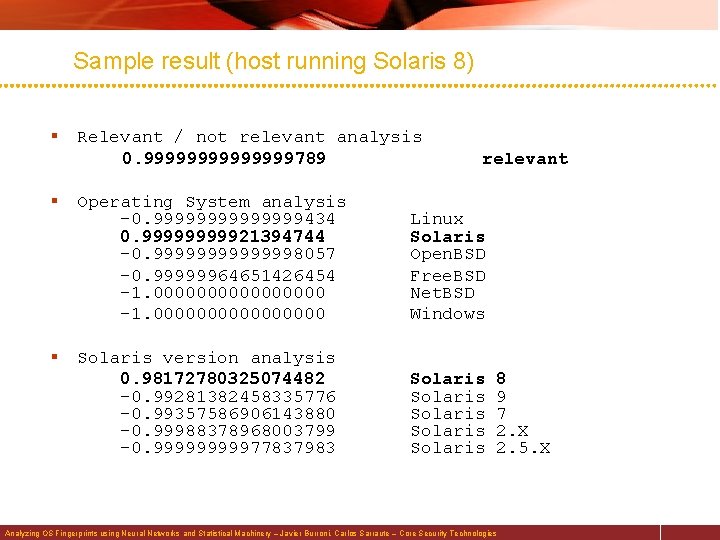
Sample result (host running Solaris 8) § Relevant / not relevant analysis 0. 9999999789 relevant § Operating System analysis -0. 9999999434 0. 9999921394744 -0. 99999998057 -0. 99999964651426454 -1. 0000000000000000 Linux Solaris Open. BSD Free. BSD Net. BSD Windows § Solaris version analysis 0. 98172780325074482 -0. 99281382458335776 -0. 99357586906143880 -0. 99988378968003799 -0. 9999977837983 Solaris Solaris 8 9 7 2. X 2. 5. X Analyzing OS Fingerprints using Neural Networks and Statistical Machinery – Javier Burroni, Carlos Sarraute – Core Security Technologies
Ideas for future work 1 § Analyze the key elements of the Nmap tests – given by the analysis of the final weights – given by Correlation matrix reduction – given by Principal Component Analysis § Optimize Nmap to generate less traffic § Add noise and firewall filtering – detect firewall presence – identify different firewalls – make more robust tests Analyzing OS Fingerprints using Neural Networks and Statistical Machinery – Javier Burroni, Carlos Sarraute – Core Security Technologies
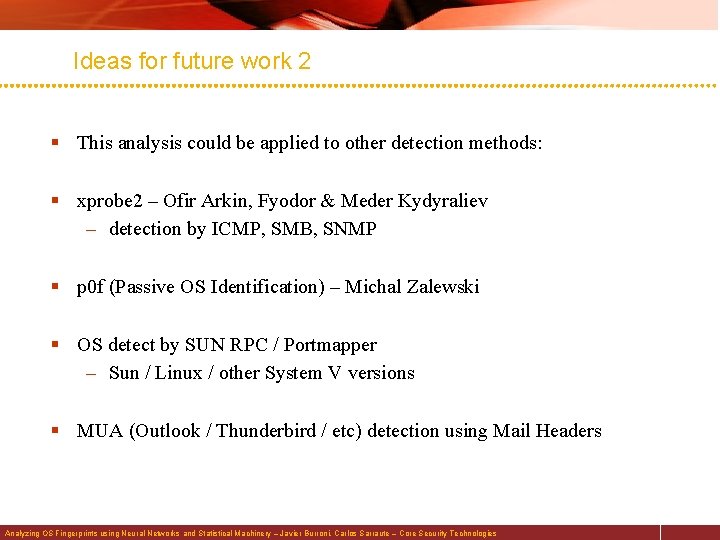
Ideas for future work 2 § This analysis could be applied to other detection methods: § xprobe 2 – Ofir Arkin, Fyodor & Meder Kydyraliev – detection by ICMP, SMB, SNMP § p 0 f (Passive OS Identification) – Michal Zalewski § OS detect by SUN RPC / Portmapper – Sun / Linux / other System V versions § MUA (Outlook / Thunderbird / etc) detection using Mail Headers Analyzing OS Fingerprints using Neural Networks and Statistical Machinery – Javier Burroni, Carlos Sarraute – Core Security Technologies
Thank you! § For more information about this project: http: //www. coresecurity. com/corelabs/projects/ § Contact us if you have questions, comments or if you want to look at the source code of the tools we wrote for this research: Javier. Burroni at coresecurity com Carlos. Sarraute at coresecurity com Analyzing OS Fingerprints using Neural Networks and Statistical Machinery – Javier Burroni, Carlos Sarraute – Core Security Technologies