
Analyzing Learners Context Instructional Design Analysis Phase Unit
- Slides: 27
Analyzing Learners & Context Instructional Design : Analysis Phase Unit 1, Session 4 1
Review: n Do a Needs Assessment to identify instructional goals Unit 1, Session 4 2
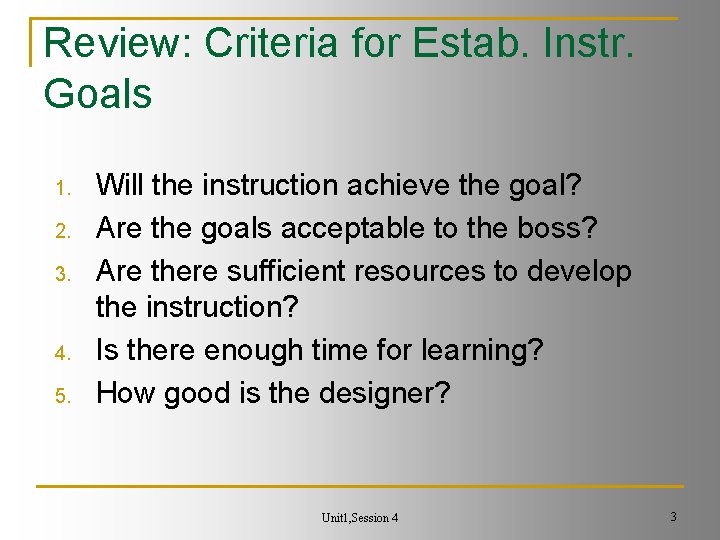
Review: Criteria for Estab. Instr. Goals 1. 2. 3. 4. 5. Will the instruction achieve the goal? Are the goals acceptable to the boss? Are there sufficient resources to develop the instruction? Is there enough time for learning? How good is the designer? Unit 1, Session 4 3
Review: Set a Goal What do we want the learners to be able to do? Unit 1, Session 4 4
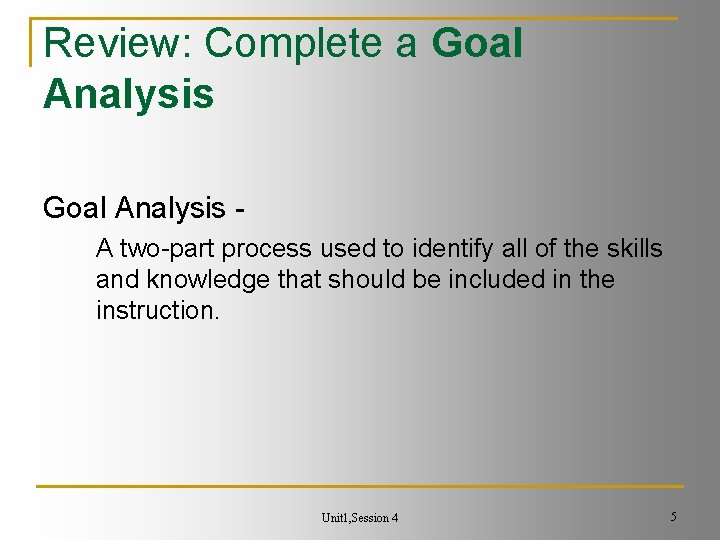
Review: Complete a Goal Analysis A two-part process used to identify all of the skills and knowledge that should be included in the instruction. Unit 1, Session 4 5
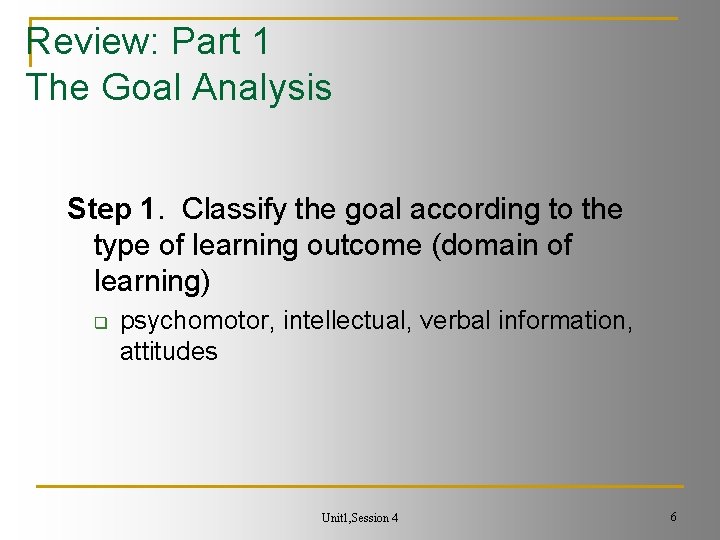
Review: Part 1 The Goal Analysis Step 1. Classify the goal according to the type of learning outcome (domain of learning) q psychomotor, intellectual, verbal information, attitudes Unit 1, Session 4 6
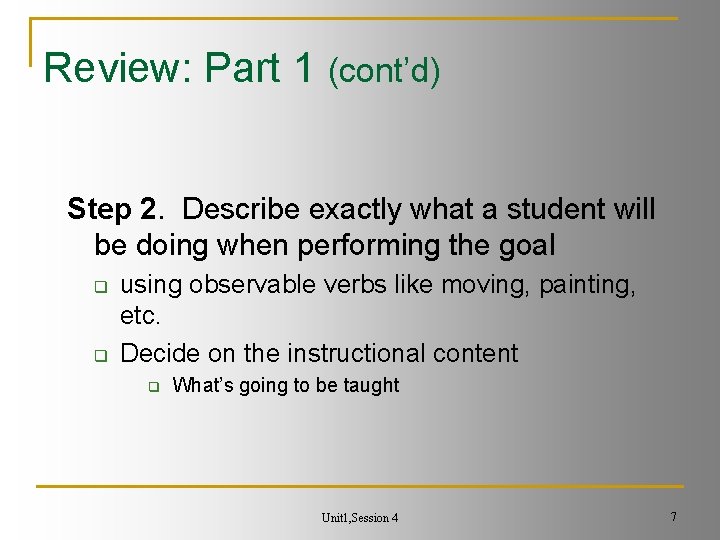
Review: Part 1 (cont’d) Step 2. Describe exactly what a student will be doing when performing the goal q q using observable verbs like moving, painting, etc. Decide on the instructional content q What’s going to be taught Unit 1, Session 4 7
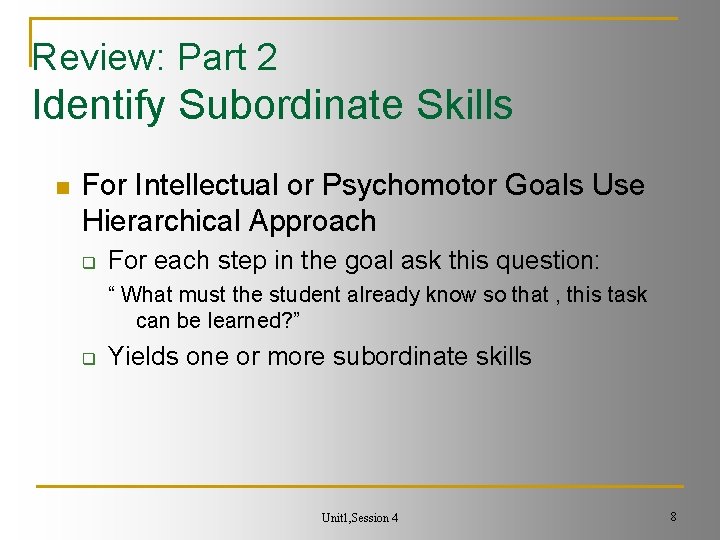
Review: Part 2 Identify Subordinate Skills n For Intellectual or Psychomotor Goals Use Hierarchical Approach q For each step in the goal ask this question: “ What must the student already know so that , this task can be learned? ” q Yields one or more subordinate skills Unit 1, Session 4 8
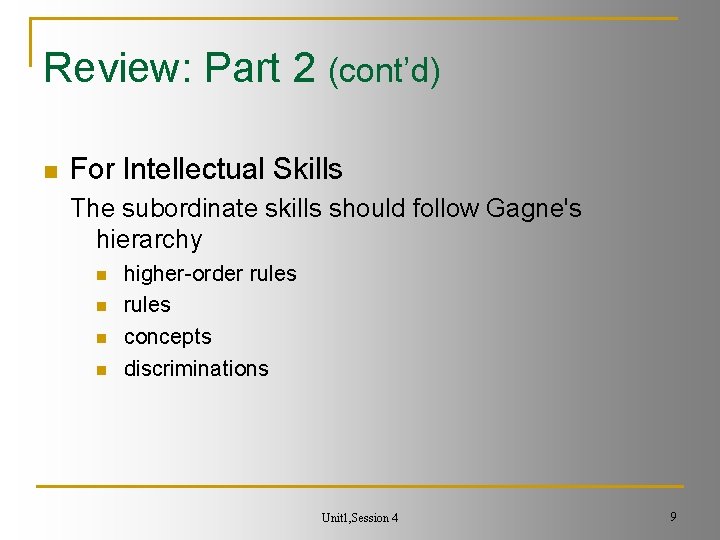
Review: Part 2 (cont’d) n For lntellectual Skills The subordinate skills should follow Gagne's hierarchy n n higher-order rules concepts discriminations Unit 1, Session 4 9
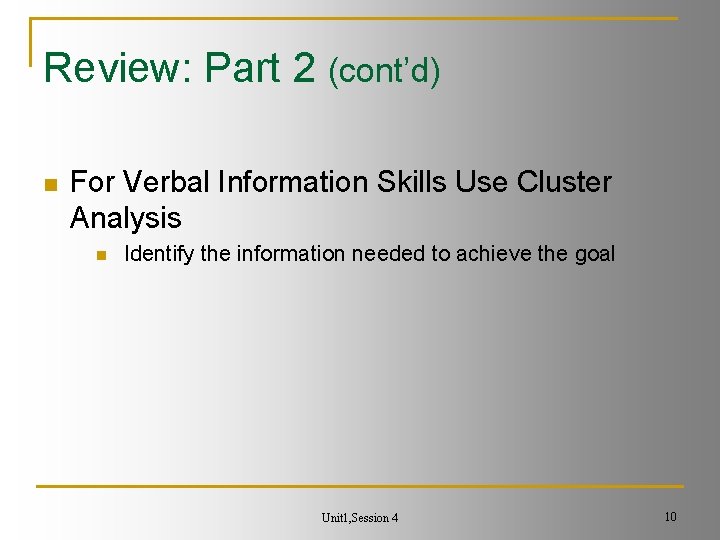
Review: Part 2 (cont’d) n For Verbal Information Skills Use Cluster Analysis n Identify the information needed to achieve the goal Unit 1, Session 4 10
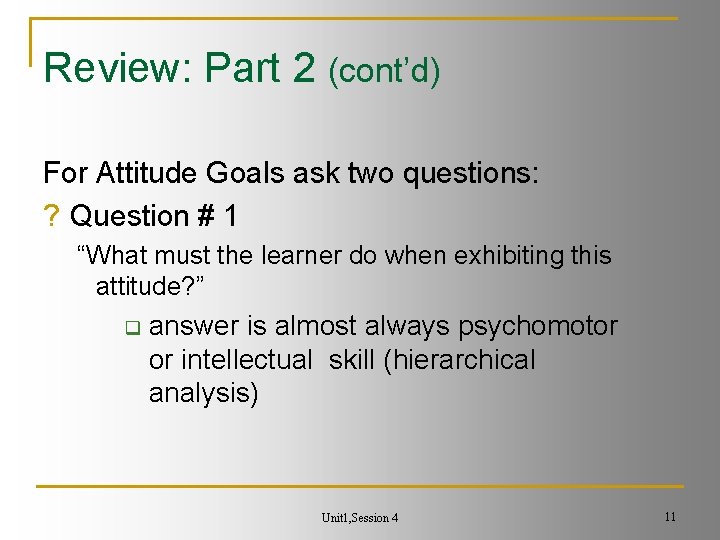
Review: Part 2 (cont’d) For Attitude Goals ask two questions: ? Question # 1 “What must the learner do when exhibiting this attitude? ” q answer is almost always psychomotor or intellectual skill (hierarchical analysis) Unit 1, Session 4 11
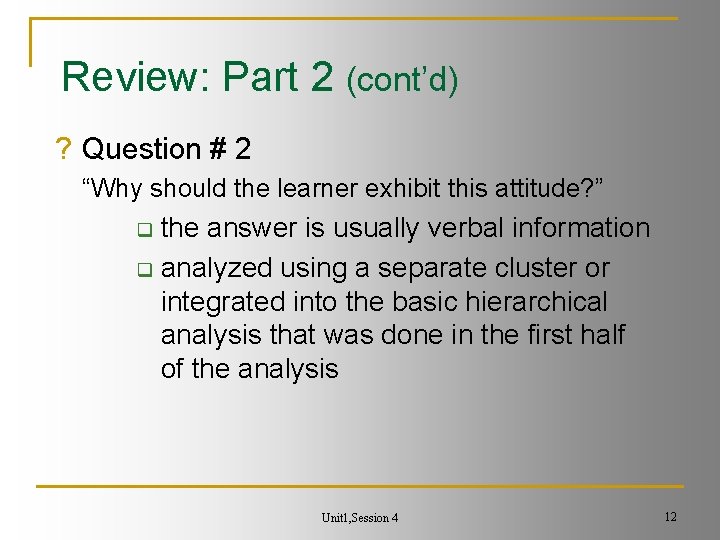
Review: Part 2 (cont’d) ? Question # 2 “Why should the learner exhibit this attitude? ” the answer is usually verbal information q analyzed using a separate cluster or integrated into the basic hierarchical analysis that was done in the first half of the analysis q Unit 1, Session 4 12
Review: Part 2 (cont’d) n Entry Behaviors Identify steps in the procedure for relevant entry behaviors and modify procedural and goal analyses as necessary. Unit 1, Session 4 13
New Content - Analyzing Learners n Synonyms: q q “Target Population” “Target Audience” Unit 1, Session 4 14
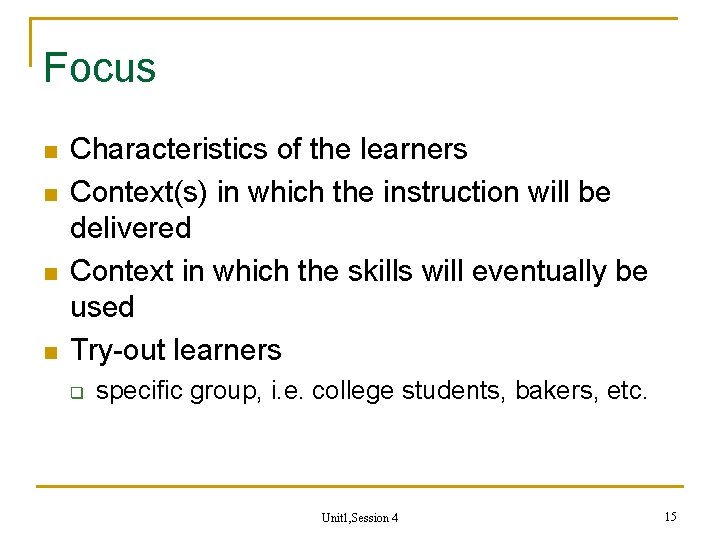
Focus n n Characteristics of the learners Context(s) in which the instruction will be delivered Context in which the skills will eventually be used Try-out learners q specific group, i. e. college students, bakers, etc. Unit 1, Session 4 15
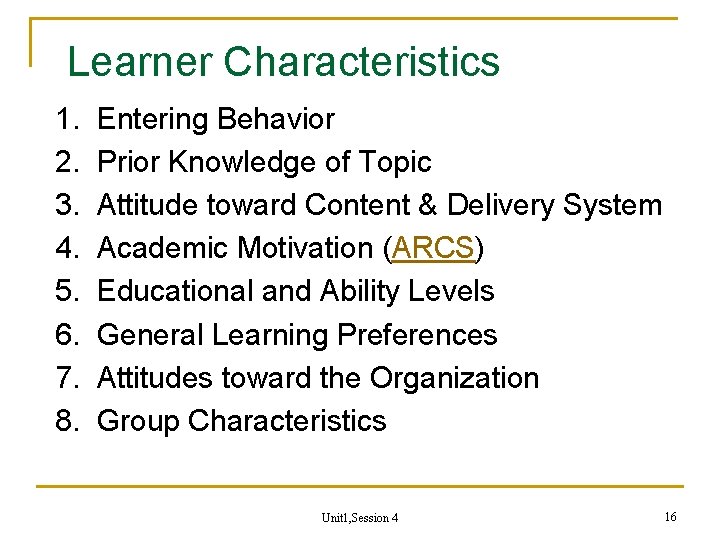
Learner Characteristics 1. 2. 3. 4. 5. 6. 7. 8. Entering Behavior Prior Knowledge of Topic Attitude toward Content & Delivery System Academic Motivation (ARCS) Educational and Ability Levels General Learning Preferences Attitudes toward the Organization Group Characteristics Unit 1, Session 4 16
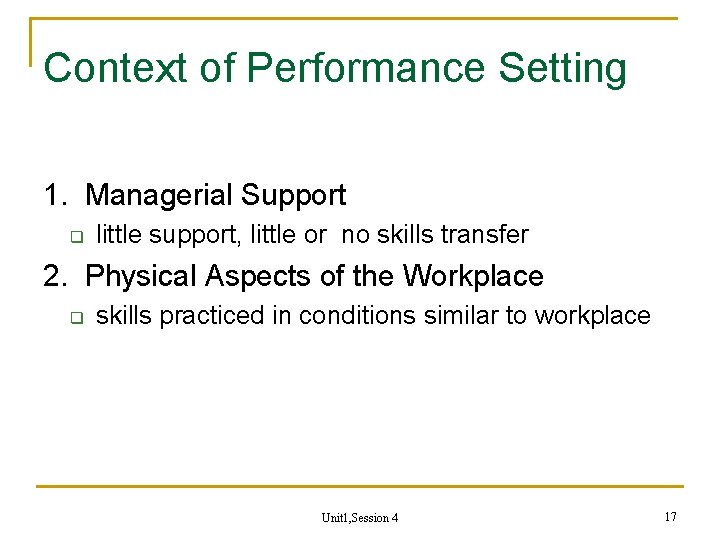
Context of Performance Setting 1. Managerial Support q little support, little or no skills transfer 2. Physical Aspects of the Workplace q skills practiced in conditions similar to workplace Unit 1, Session 4 17
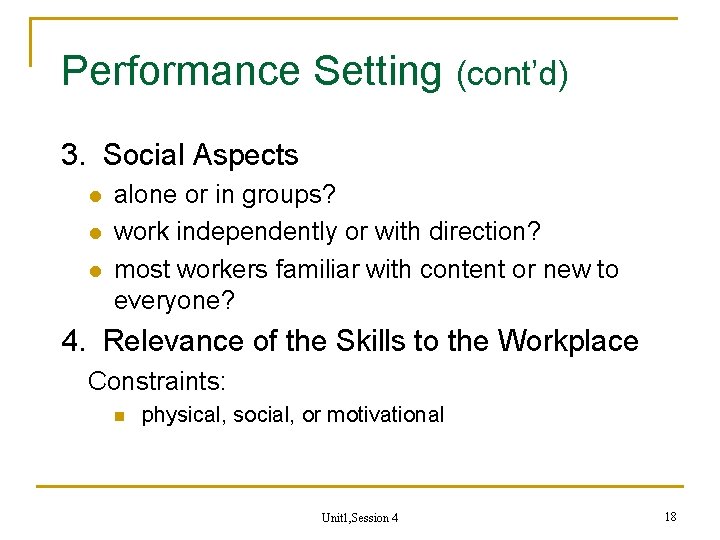
Performance Setting (cont’d) 3. Social Aspects alone or in groups? work independently or with direction? most workers familiar with content or new to everyone? 4. Relevance of the Skills to the Workplace Constraints: n physical, social, or motivational Unit 1, Session 4 18
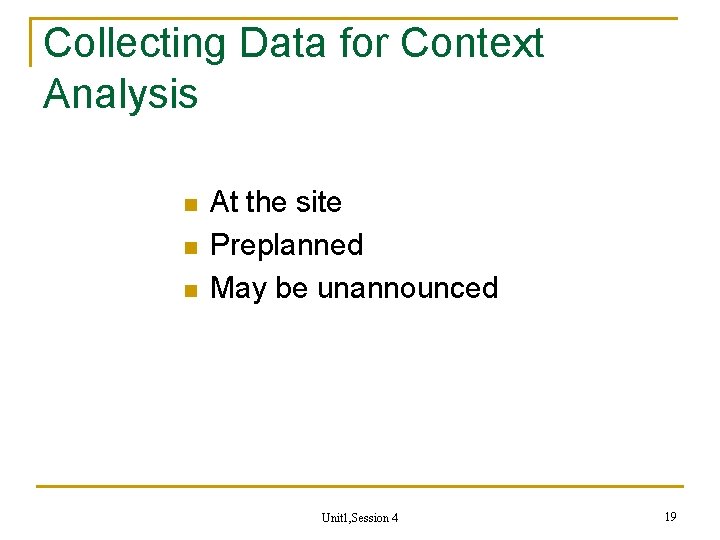
Collecting Data for Context Analysis n n n At the site Preplanned May be unannounced Unit 1, Session 4 19
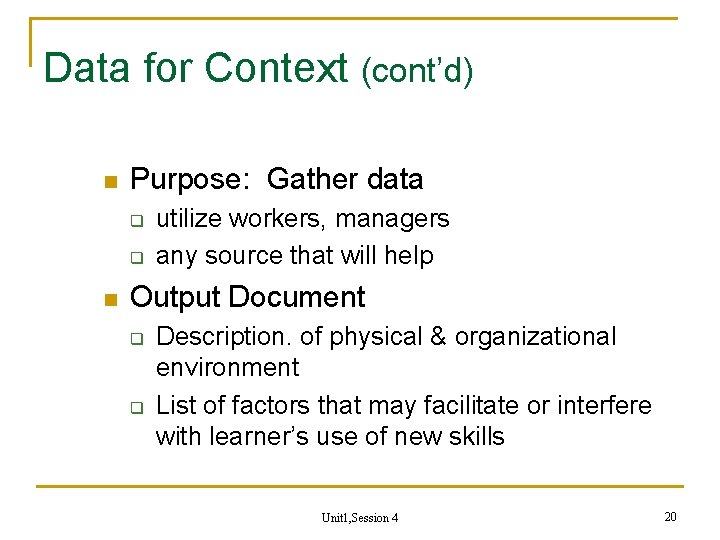
Data for Context (cont’d) n Purpose: Gather data q q n utilize workers, managers any source that will help Output Document q q Description. of physical & organizational environment List of factors that may facilitate or interfere with learner’s use of new skills Unit 1, Session 4 20
Context of Learning Environment n Determining “what is” and “what should be” q facilities, equipment, & resources Unit 1, Session 4 21
Learning Environment (cont’d) The “Cover Your Butt” phase, determine: ? is the site compatible with the instructional mandates? ? is the instructional area adaptable to simulate workplace performance? ? is the site adaptable for using a variety of instructional training delivery approaches? ? what are the constraints present that may affect the design & delivery of instruction? Unit 1, Session 4 22
Collecting Data from Learning Environment n n Similar to analysis of workplace Purpose is to identify : q q available facilities limitations of the settings Unit 1, Session 4 23
Data from Learning Environment (cont’d) n Procedure: q q q visit one or more sites interview instructors, managers and learners have prepared questions obtain information about workers’ use of site determine site limitations Unit 1, Session 4 24
Data From Learning Environment (cont’d) n Output q q description of the extent to which the site can be used to deliver training on skills that will be required for transfer list of any limitations Unit 1, Session 4 25
Evaluation & Revision of the Instructional Analysis n One-on-one review of Instructional Analysis with learners q q hear yourself explaining steps in the analysis gauge learner reaction Unit 1, Session 4 26
Summary n In this session , we covered: q q q n the analysis of learners performance context and learning context The next step is writing appropriate performance objectives Unit 1, Session 4 27