
Analyzing Financial Statements Chapter 14 Copyright 2007 by
Analyzing Financial Statements Chapter 14 Copyright © 2007 by The Mc. Graw-Hill Companies, Inc. All rights reserved.
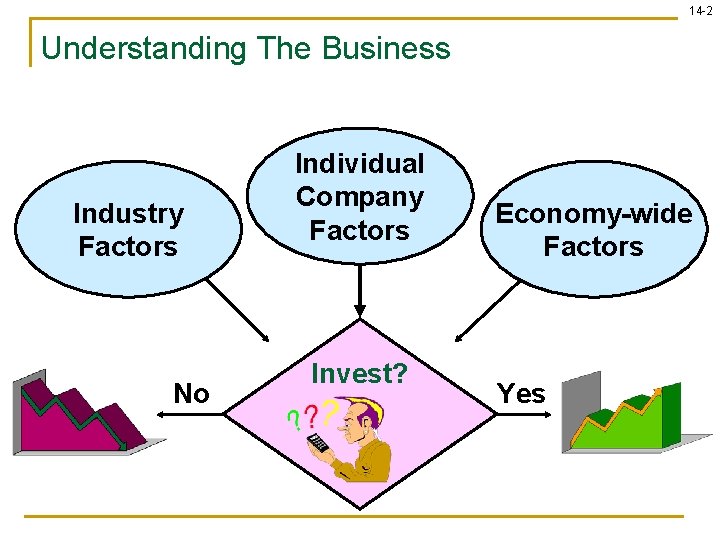
14 -2 Understanding The Business Industry Factors No Individual Company Factors Invest? Economy-wide Factors Yes

14 -3 Understanding The Business Return on an equity security investment Increase in share price Dividends Investors
14 -4 Learning Objectives Explain how a company’s business strategy affects financial analysis.
14 -5 Understanding a Company’s Strategy I need to know the company’s policies on product differentiation, pricing, and cost control to make my financial analysis more meaningful.
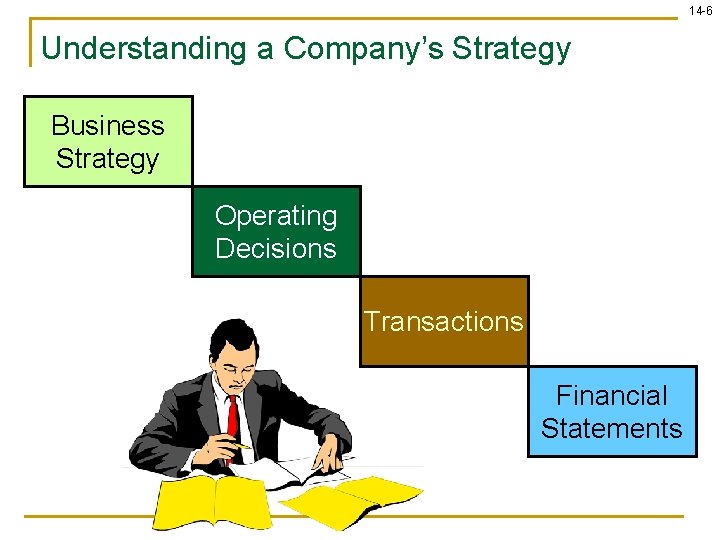
14 -6 Understanding a Company’s Strategy Business Strategy Operating Decisions Transactions Financial Statements
14 -7 Learning Objectives Discuss how analysts use financial statements.
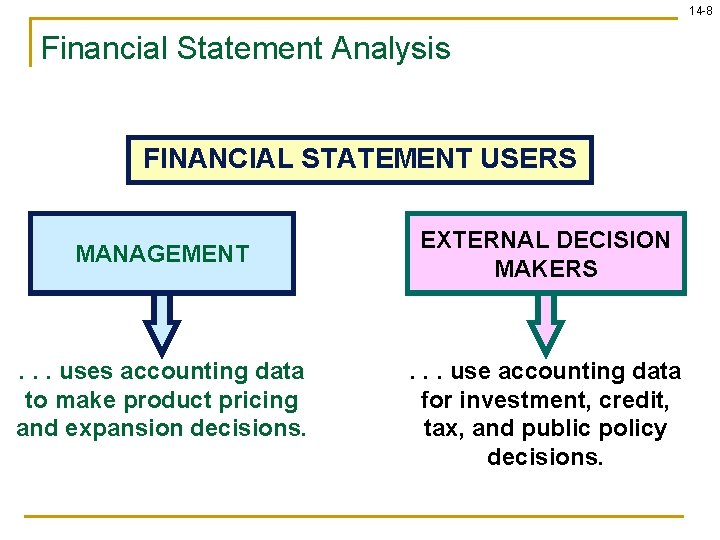
14 -8 Financial Statement Analysis FINANCIAL STATEMENT USERS MANAGEMENT . . . uses accounting data to make product pricing and expansion decisions. EXTERNAL DECISION MAKERS . . . use accounting data for investment, credit, tax, and public policy decisions.
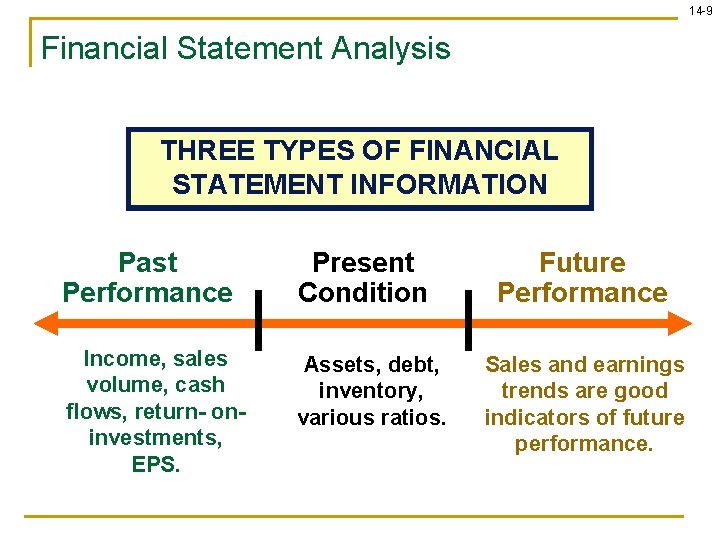
14 -9 Financial Statement Analysis THREE TYPES OF FINANCIAL STATEMENT INFORMATION Past Performance Present Condition Income, sales volume, cash flows, return- oninvestments, EPS. Assets, debt, inventory, various ratios. Future Performance Sales and earnings trends are good indicators of future performance.
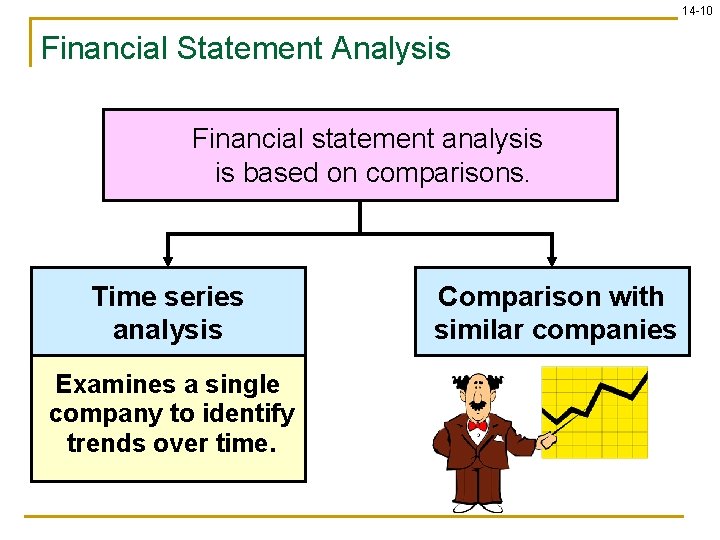
14 -10 Financial Statement Analysis Financial statement analysis is based on comparisons. Time series analysis Examines a single company to identify trends over time. Comparison with similar companies
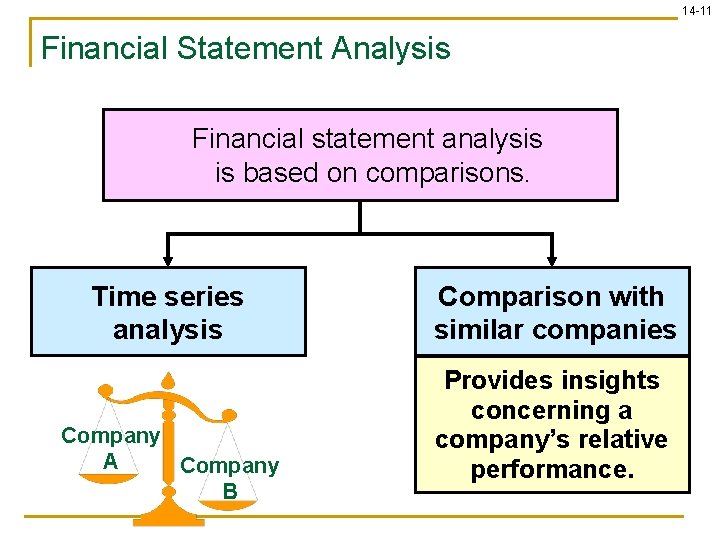
14 -11 Financial Statement Analysis Financial statement analysis is based on comparisons. Time series analysis Company A Company B Comparison with similar companies Provides insights concerning a company’s relative performance.
14 -12 Ratio and Percentage Analyses Ratio analysis, or percentage analysis, is used to express the proportionate relationship between two different amounts.
14 -13 Learning Objectives Compute and interpret component percentages.
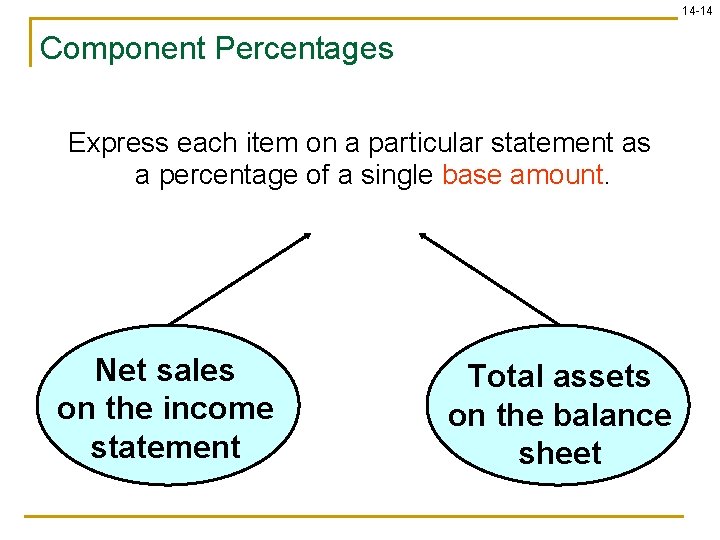
14 -14 Component Percentages Express each item on a particular statement as a percentage of a single base amount. Net sales on the income statement Total assets on the balance sheet
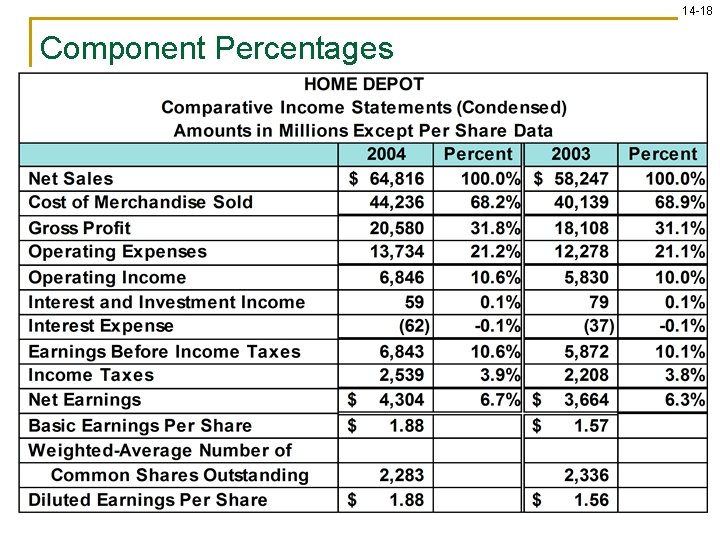
14 -15 Component Percentages The comparative income statements of Home Depot for 2004 and 2003 appear on the next slide. Prepare component percentage income statements where net sales equal 100%. Home Depot
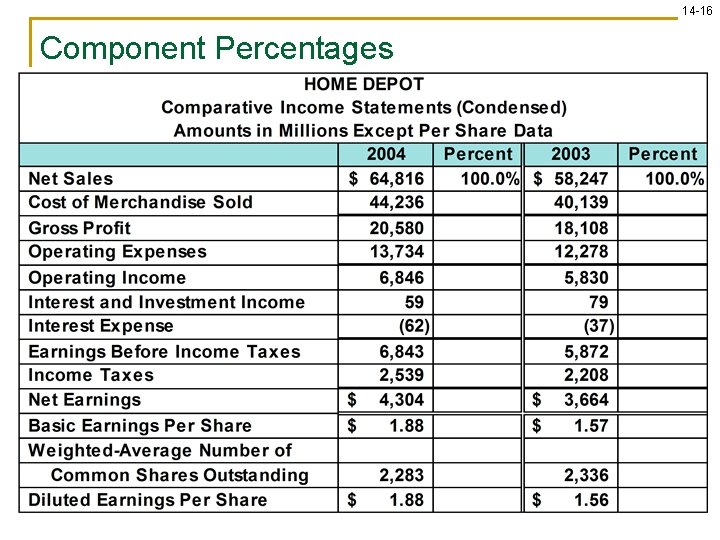
14 -16 Component Percentages
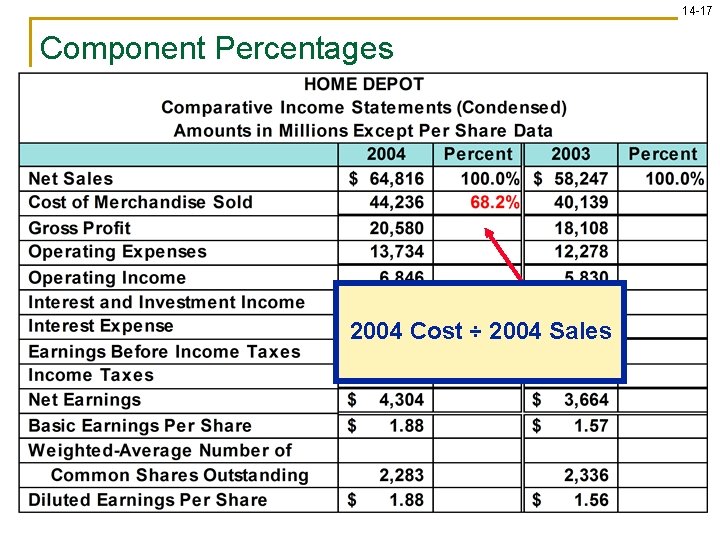
14 -17 Component Percentages 2004 Cost ÷ 2004 Sales
14 -18 Component Percentages
14 -19 Now, let’s look at some commonly used ratios.
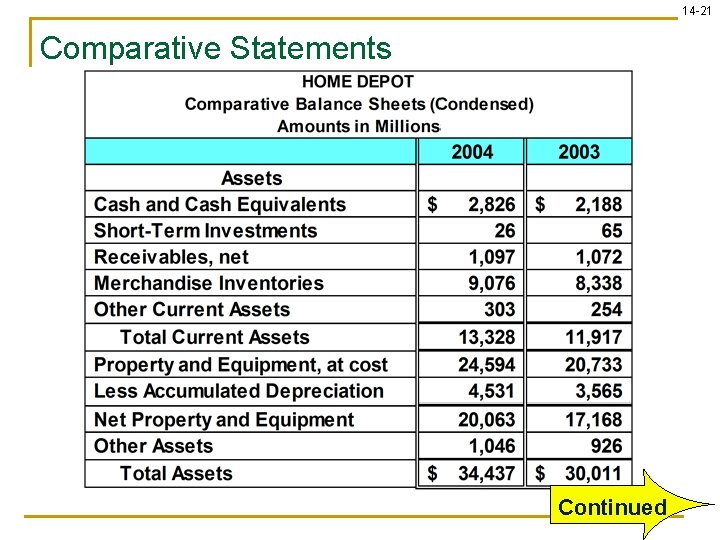
14 -20 Commonly Used Ratios The 2004 and 2003 balance sheets for Home Depot are presented next. We will be referring to these financial statements throughout the ratio analyses. Home Depot
14 -21 Comparative Statements Continued
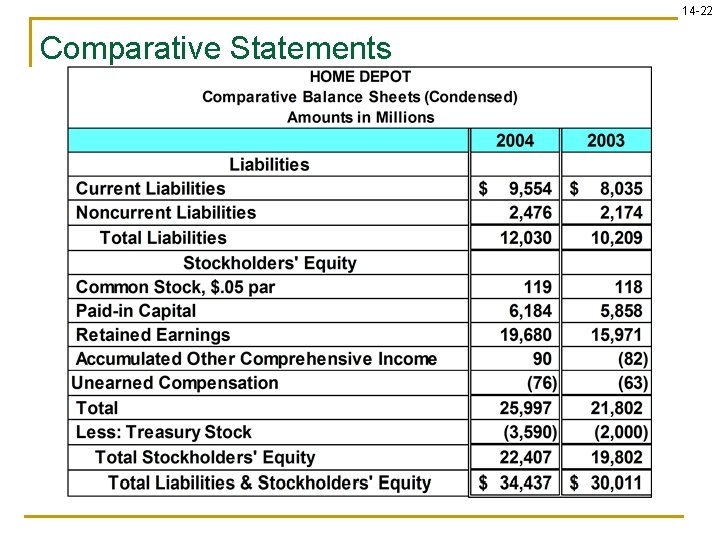
14 -22 Comparative Statements
14 -23 Learning Objectives Compute and interpret profitability ratios.
14 -24 Tests of Profitability is a primary measure of the overall success of a company. Now, let’s look at the profitability ratios for Home Depot for 2004. Home Depot
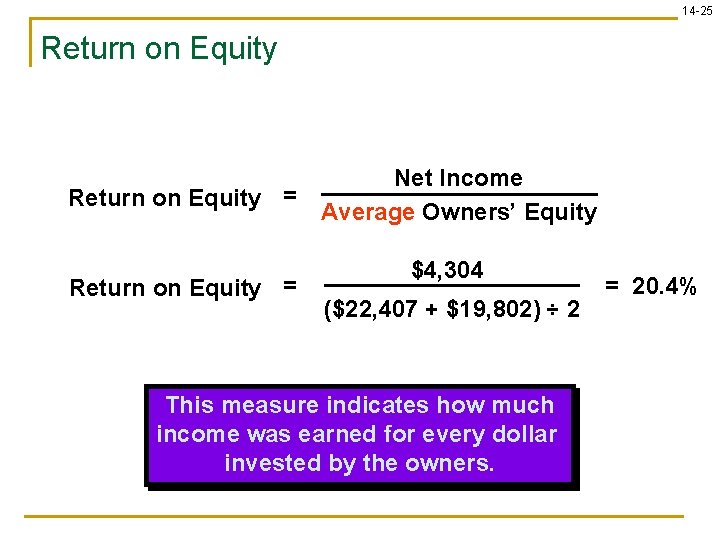
14 -25 Return on Equity = Net Income Average Owners’ Equity $4, 304 ($22, 407 + $19, 802) ÷ 2 This measure indicates how much income was earned for every dollar invested by the owners. = 20. 4%
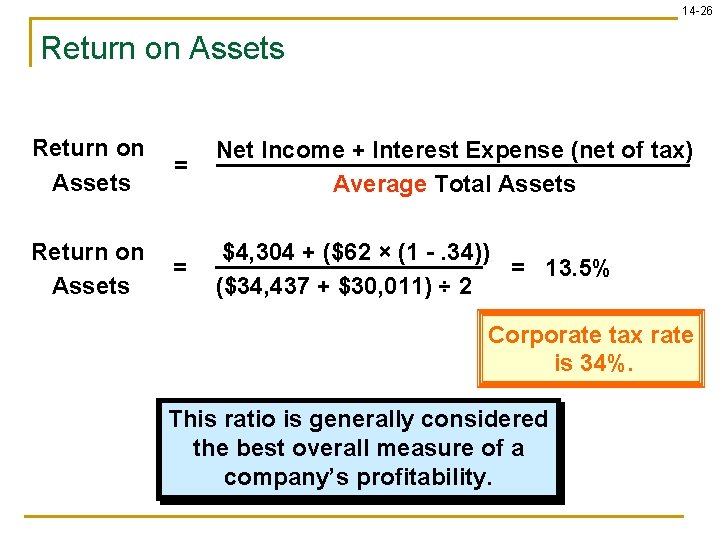
14 -26 Return on Assets = Net Income + Interest Expense (net of tax) Average Total Assets = $4, 304 + ($62 × (1 -. 34)) = 13. 5% ($34, 437 + $30, 011) ÷ 2 Corporate tax rate is 34%. This ratio is generally considered the best overall measure of a company’s profitability.
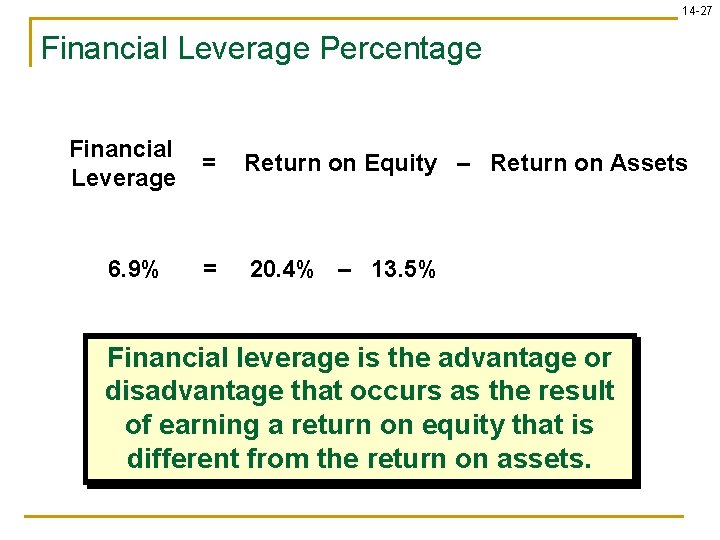
14 -27 Financial Leverage Percentage Financial Leverage 6. 9% = Return on Equity – Return on Assets = 20. 4% – 13. 5% Financial leverage is the advantage or disadvantage that occurs as the result of earning a return on equity that is different from the return on assets.
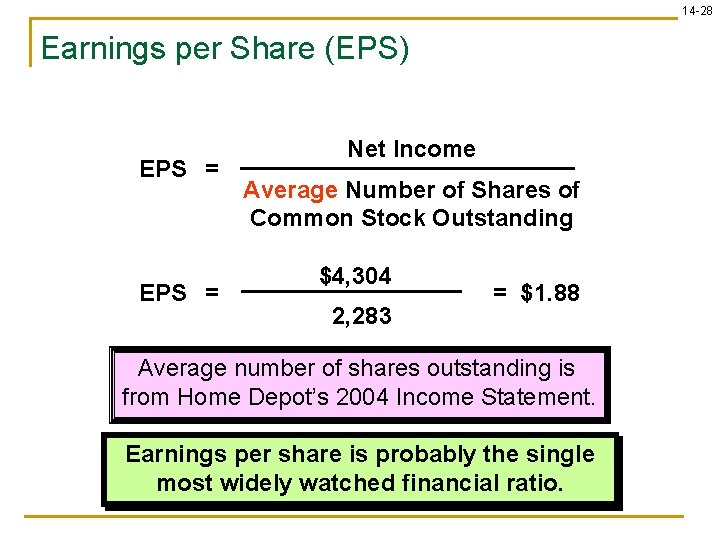
14 -28 Earnings per Share (EPS) EPS = Net Income Average Number of Shares of Common Stock Outstanding $4, 304 2, 283 = $1. 88 Average number of shares outstanding is from Home Depot’s 2004 Income Statement. Earnings per share is probably the single most widely watched financial ratio.
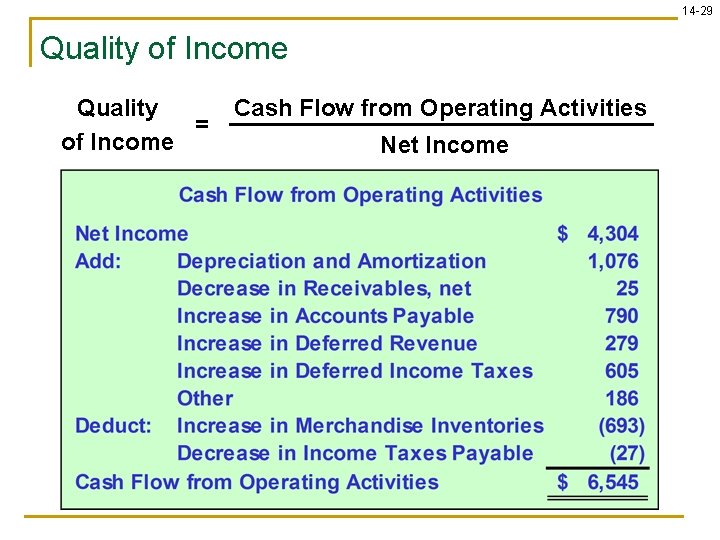
14 -29 Quality of Income Quality = of Income Cash Flow from Operating Activities Net Income
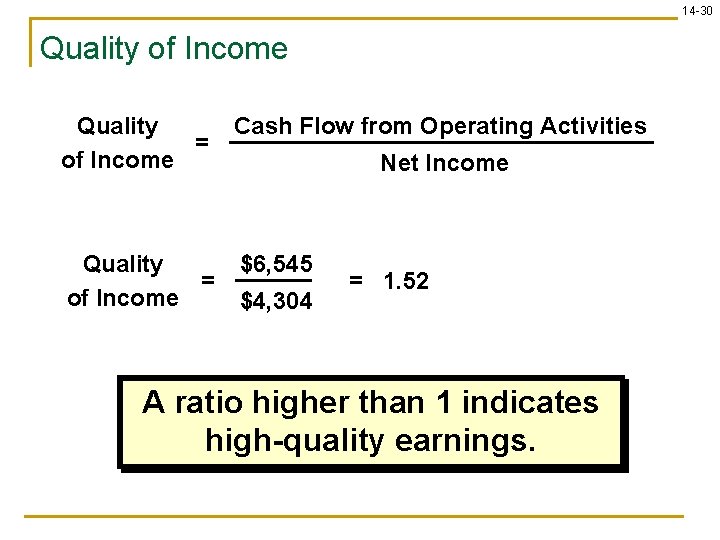
14 -30 Quality of Income Quality = of Income Cash Flow from Operating Activities Quality = of Income $6, 545 Net Income $4, 304 = 1. 52 A ratio higher than 1 indicates high-quality earnings.
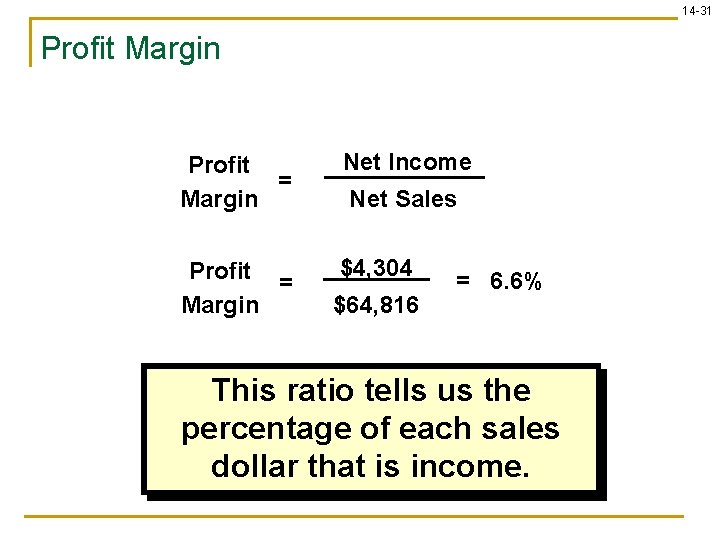
14 -31 Profit Margin Profit = Margin Net Income Profit = Margin $4, 304 Net Sales $64, 816 = 6. 6% This ratio tells us the percentage of each sales dollar that is income.
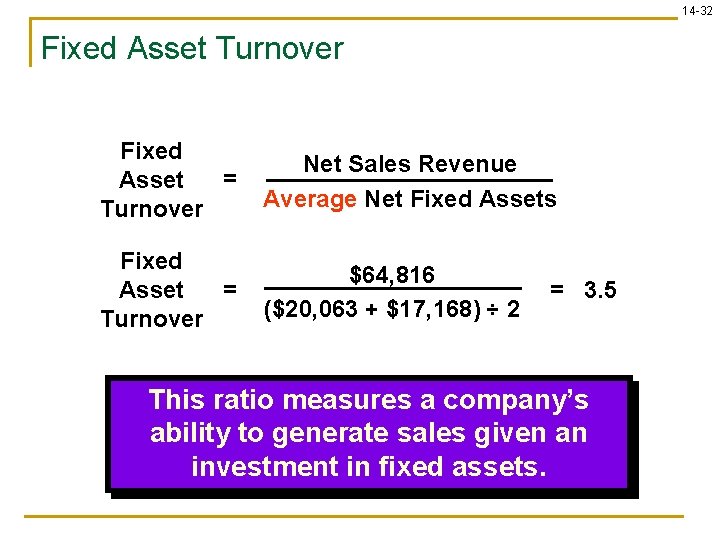
14 -32 Fixed Asset Turnover Fixed = Asset Turnover Net Sales Revenue Average Net Fixed Assets Fixed = Asset Turnover $64, 816 ($20, 063 + $17, 168) ÷ 2 = 3. 5 This ratio measures a company’s ability to generate sales given an investment in fixed assets.
14 -33 Learning Objectives Compute and interpret liquidity ratios.
14 -34 Tests of Liquidity Tests of liquidity focus on the relationship between current assets and current liabilities. Now, let’s look at the liquidity ratios for Home Depot for 2004. Home Depot
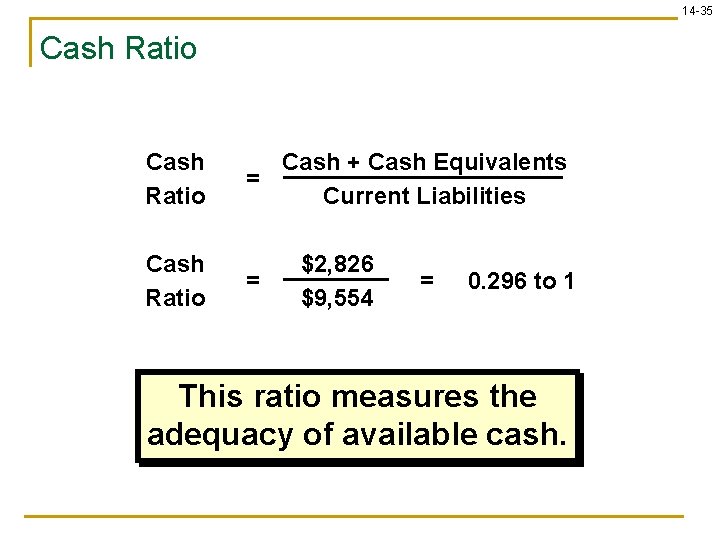
14 -35 Cash Ratio Cash + Cash Equivalents = Current Liabilities = $2, 826 $9, 554 = 0. 296 to 1 This ratio measures the adequacy of available cash.
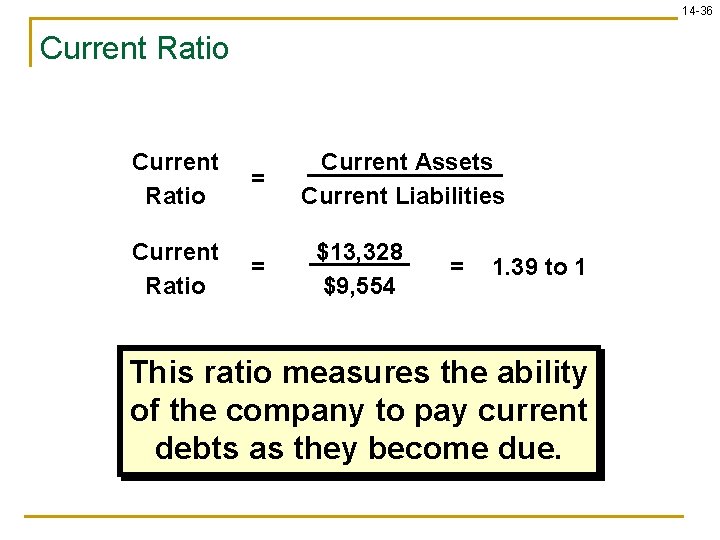
14 -36 Current Ratio = = Current Assets Current Liabilities $13, 328 $9, 554 = 1. 39 to 1 This ratio measures the ability of the company to pay current debts as they become due.
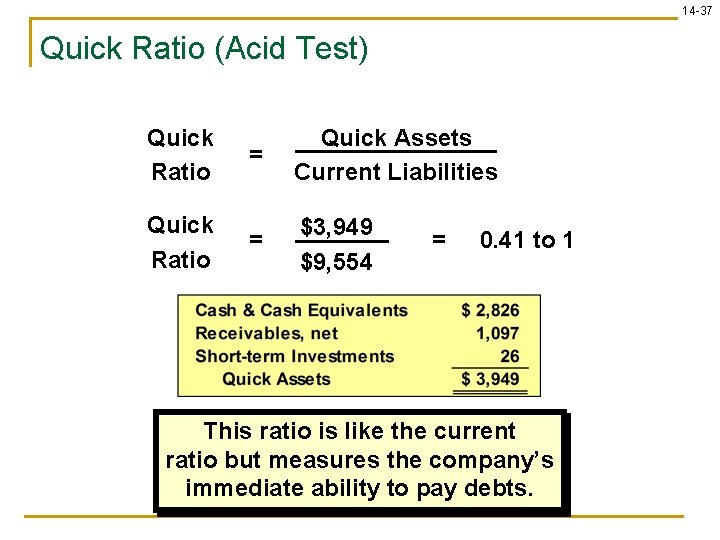
14 -37 Quick Ratio (Acid Test) Quick Ratio = Quick Assets Current Liabilities = $3, 949 $9, 554 = 0. 41 to 1 This ratio is like the current ratio but measures the company’s immediate ability to pay debts.
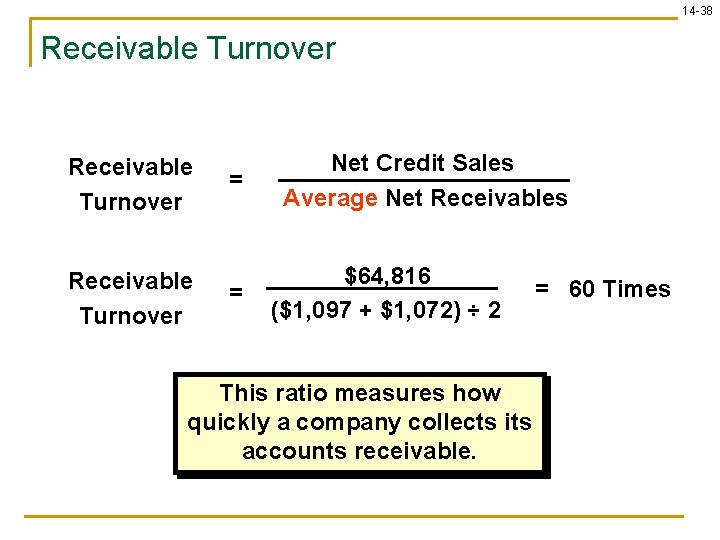
14 -38 Receivable Turnover = = Net Credit Sales Average Net Receivables $64, 816 ($1, 097 + $1, 072) ÷ 2 This ratio measures how quickly a company collects its accounts receivable. = 60 Times
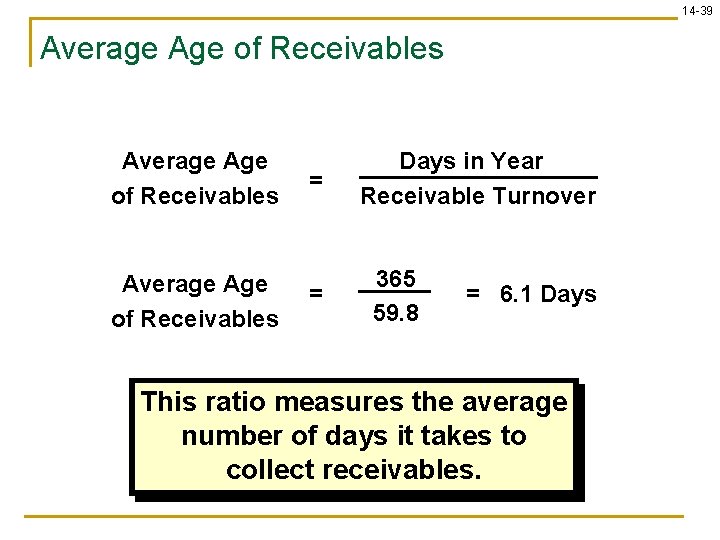
14 -39 Average Age of Receivables = = Days in Year Receivable Turnover 365 59. 8 = 6. 1 Days This ratio measures the average number of days it takes to collect receivables.
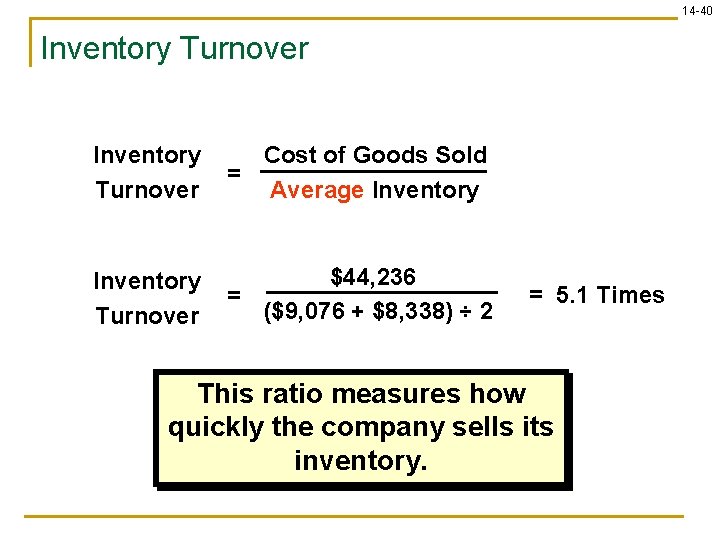
14 -40 Inventory Turnover Cost of Goods Sold = Average Inventory Turnover $44, 236 = ($9, 076 + $8, 338) ÷ 2 = 5. 1 Times This ratio measures how quickly the company sells its inventory.
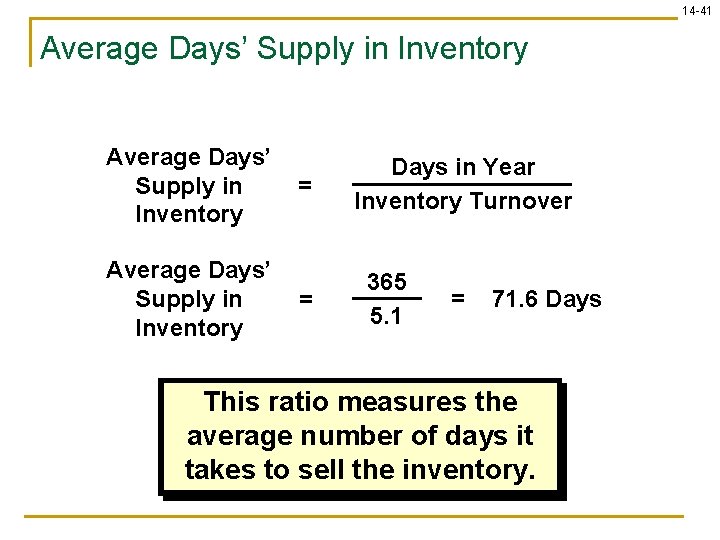
14 -41 Average Days’ Supply in Inventory = = Days in Year Inventory Turnover 365 5. 1 = 71. 6 Days This ratio measures the average number of days it takes to sell the inventory.
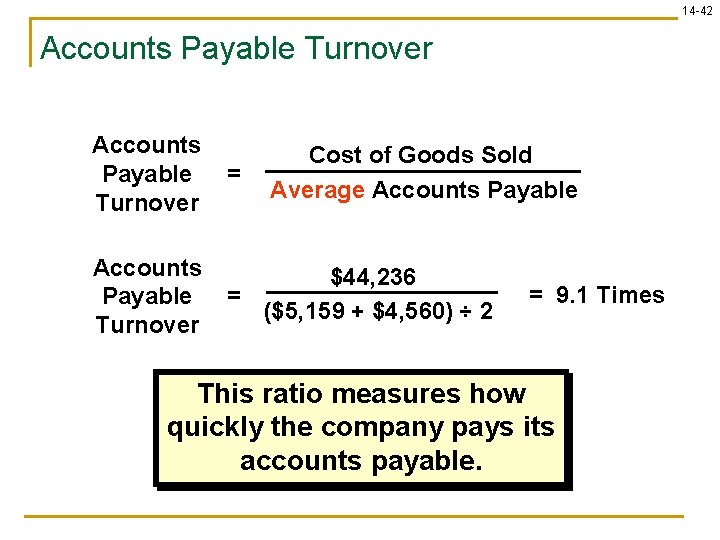
14 -42 Accounts Payable Turnover = Accounts Payable Turnover $44, 236 = ($5, 159 + $4, 560) ÷ 2 Cost of Goods Sold Average Accounts Payable = 9. 1 Times This ratio measures how quickly the company pays its accounts payable.
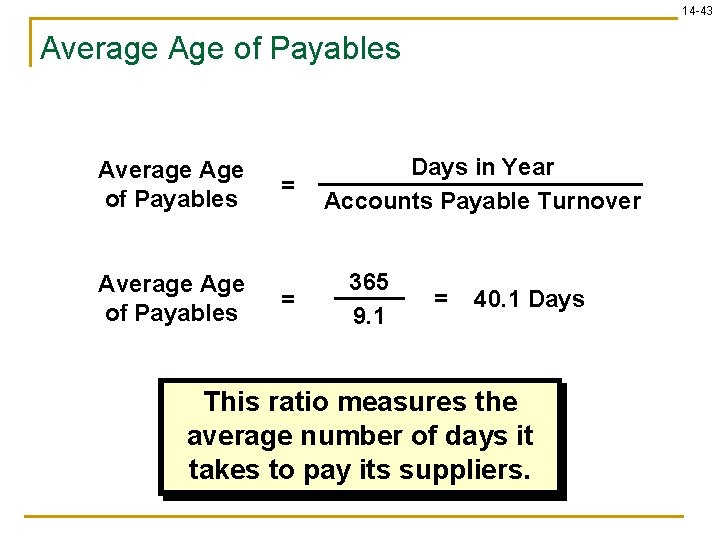
14 -43 Average Age of Payables = = Days in Year Accounts Payable Turnover 365 9. 1 = 40. 1 Days This ratio measures the average number of days it takes to pay its suppliers.
14 -44 Learning Objectives Compute and interpret solvency ratios.
14 -45 Tests of Solvency Tests of solvency measure a company’s ability to meet its long-term obligations. Now, let’s look at the solvency ratios for Home Depot for 2004. Home Depot
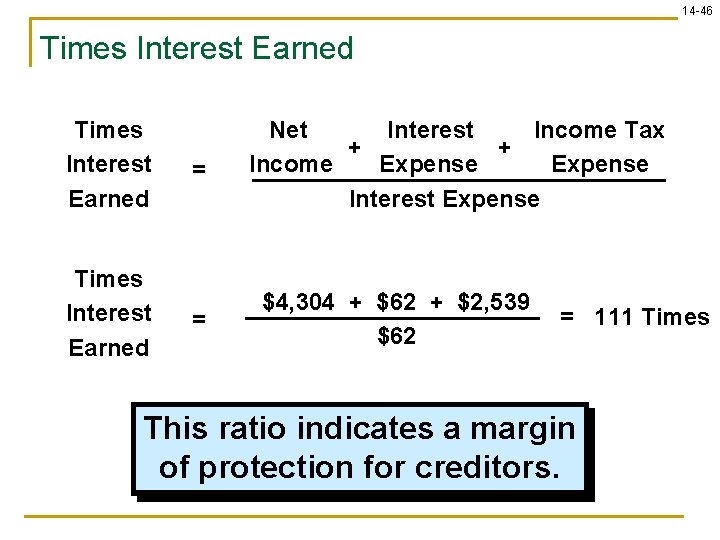
14 -46 Times Interest Earned = = Net Interest Income Tax + + Income Expense Interest Expense $4, 304 + $62 + $2, 539 $62 = 111 Times This ratio indicates a margin of protection for creditors.
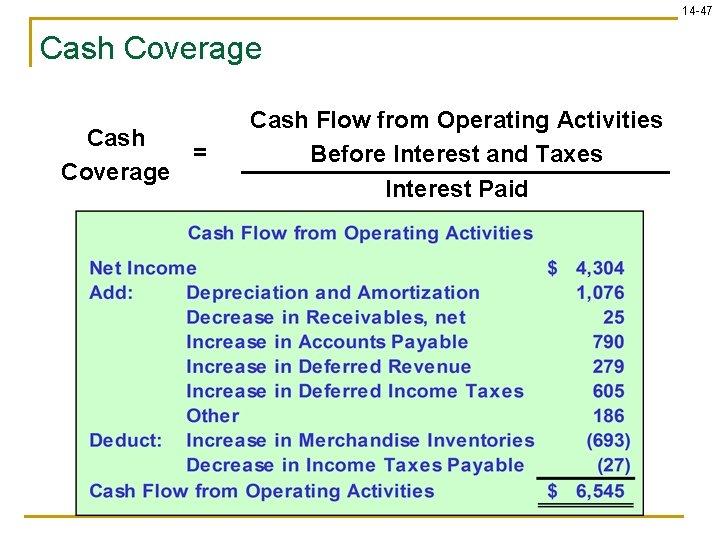
14 -47 Cash Coverage Cash = Coverage Cash Flow from Operating Activities Before Interest and Taxes Interest Paid
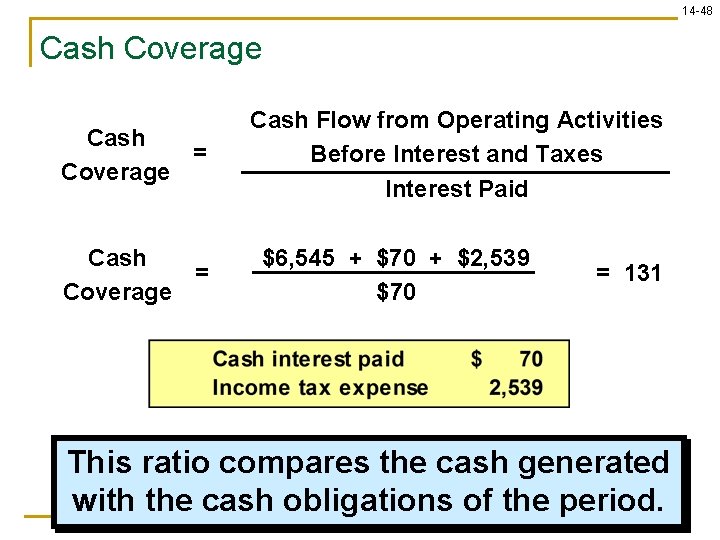
14 -48 Cash Coverage Cash = Coverage Cash Flow from Operating Activities Before Interest and Taxes Interest Paid $6, 545 + $70 + $2, 539 $70 = 131 This ratio compares the cash generated with the cash obligations of the period.
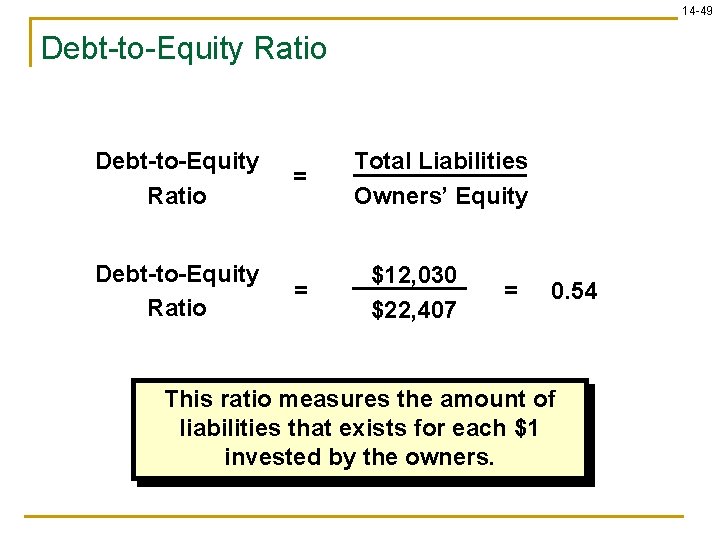
14 -49 Debt-to-Equity Ratio = = Total Liabilities Owners’ Equity $12, 030 $22, 407 = 0. 54 This ratio measures the amount of liabilities that exists for each $1 invested by the owners.
14 -50 Learning Objectives Compute and interpret market test ratios.
14 -51 Market Tests Market tests relate the current market price of a share of stock to an indicator of the return that might accrue to the investor. Now, let’s look at the market tests for Home Depot for 2004. Home Depot
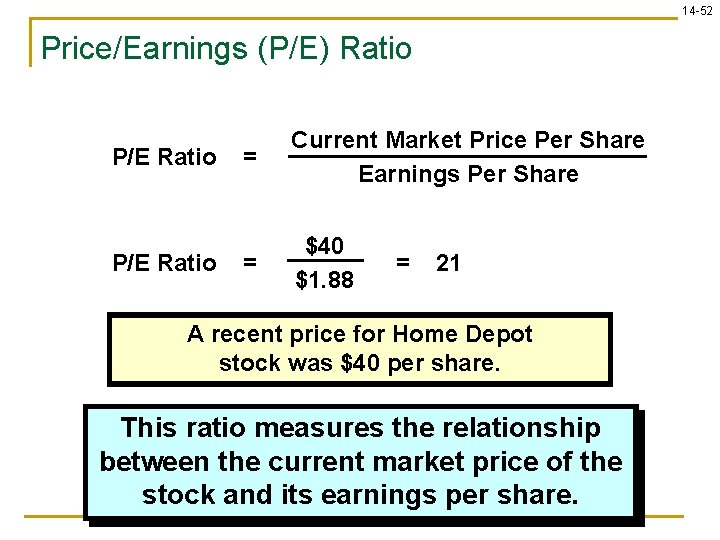
14 -52 Price/Earnings (P/E) Ratio P/E Ratio = Current Market Price Per Share Earnings Per Share = $40 $1. 88 = 21 A recent price for Home Depot stock was $40 per share. This ratio measures the relationship between the current market price of the stock and its earnings per share.
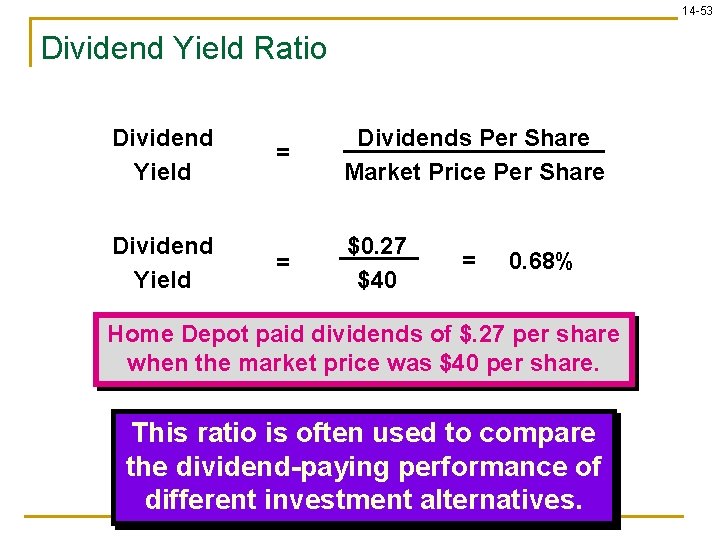
14 -53 Dividend Yield Ratio Dividend Yield = Dividends Per Share Market Price Per Share = $0. 27 $40 = 0. 68% Home Depot paid dividends of $. 27 per share when the market price was $40 per share. This ratio is often used to compare the dividend-paying performance of different investment alternatives.
14 -54 Interpreting Ratios may be interpreted by comparison with ratios of other companies or with industry average ratios. Ratios may vary because of the company’s industry characteristics, nature of operations, size, and accounting policies.
14 -55 Other Financial Information In addition to financial ratios, special factors might affect company analysis: l Rapid growth. l Uneconomical expansion. l Subjective factors.
14 -56 Efficient Markets A securities market in which prices fully reflect available information is called an efficient market. In an efficient market, a company’s stock reacts quickly when new, relevant information is released about the company.

14 -57 End of Chapter 14
- Slides: 57