
Analyzing Film With A Focus Alienation Effect Thesis


- Slides: 20
Analyzing Film (With A Focus Alienation Effect) Thesis Building, Secondary Source Integration and Application Dr. Morse Winter 2016 “War”
Today’s Goals � Timestamp (Frankenheimer 1: 32: 01 -1: 34: 15) first time – then just timestamp � Reminders about Blog/Blog Site � Lecture Review – Set up Homeland Scene Group Analysis � Scene Analysis Practice Media Force Agency Knowledge/Truth – Alienation Effect � Secondary Source Excerpts – Paraphrase and Application
Blog Site Due by Wednesday, Week 10 �A few reminders about the blogs: Informal, personal writing persona and ethos Recognize multiple perspectives – challenge but don’t exclude Click Here ▪ Connections to Course Materials but also to world outside of Core Space for Exploration – hyperlinks, embedded image/video ▪ Include captions with meaningful information Click Here ▪ Integrate image/video into blog Click Here Titles Should be Meaningful and Capture Reader Interest Acknowledge contributing sources (hyperlinks or Works Cited at End) Blog/Site Identity – Dialogue Between Posts? Aesthetic Consistency and Visual Interest
Arabian Street Artists “Hack” Homeland � http: //www. hebaamin. com/arabian-street-artists-bomb-homeland-why- we-hacked-an-award-winning-series/ As member Heba Amin writes: The set decoration had to be completed in two days, for filming on the third. Set designers were too frantic to pay any attention to us; they were busy constructing a hyper-realistic set that addressed everything from the plastic laundry pins to the frayed edges of outdoor plastic curtains. It looked very Middle Eastern and the summer sun and heat helped heighten that illusion. The content of what was written on the walls, however, was of no concern. In their eyes, Arabic script is merely a supplementary visual that completes the horror-fantasy of the Middle East, a poster image dehumanizing an entire region to human-less figures in black burkas and moreover, this season, to refugees.
Lecture Quiz – 15 minutes – 30 points LP 1. According to lecture, in what 3 specific ways is The Manchurian Candidate similar to Homeland? (provide examples and explain significance in your answer) 2. To what do the terms Infotainment/Militainment refer, and what do they tell us about a new “theater of war”? 3. What does “blowback” refer to, and how does it contribute to the “War on Terror”?
Application of “Agency” and “Alienation Effect” �Many thesis statements are working with knowledge control as a kind of force that limits or restricts agency in some form. �This reveals a message to viewer about the dangers of surrendering agency – civic responsibility to question what mediated to us
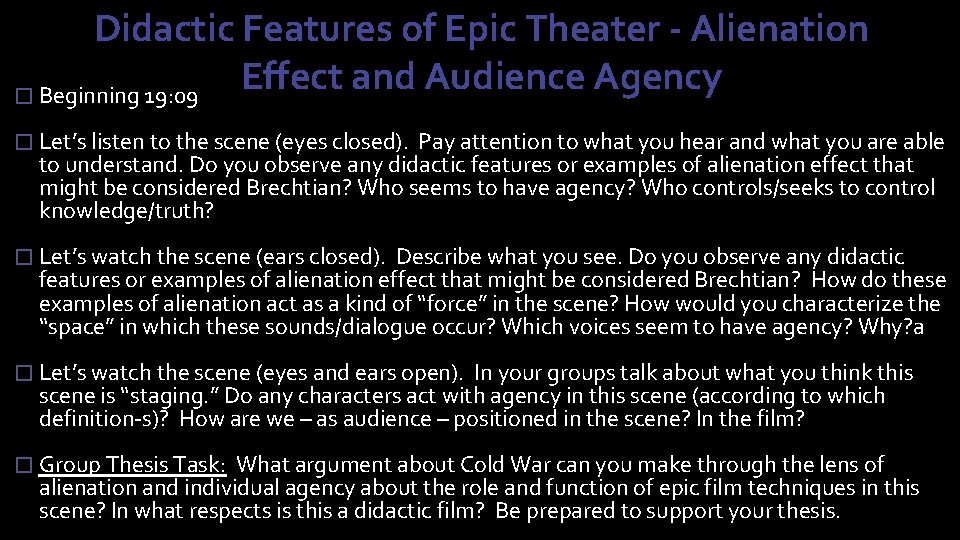
Didactic Features of Epic Theater - Alienation Effect and Audience Agency � Beginning 19: 09 � Let’s listen to the scene (eyes closed). Pay attention to what you hear and what you are able to understand. Do you observe any didactic features or examples of alienation effect that might be considered Brechtian? Who seems to have agency? Who controls/seeks to control knowledge/truth? � Let’s watch the scene (ears closed). Describe what you see. Do you observe any didactic features or examples of alienation effect that might be considered Brechtian? How do these examples of alienation act as a kind of “force” in the scene? How would you characterize the “space” in which these sounds/dialogue occur? Which voices seem to have agency? Why? a � Let’s watch the scene (eyes and ears open). In your groups talk about what you think this scene is “staging. ” Do any characters act with agency in this scene (according to which definition-s)? How are we – as audience – positioned in the scene? In the film? � Group Thesis Task: What argument about Cold War can you make through the lens of alienation and individual agency about the role and function of epic film techniques in this scene? In what respects is this a didactic film? Be prepared to support your thesis.
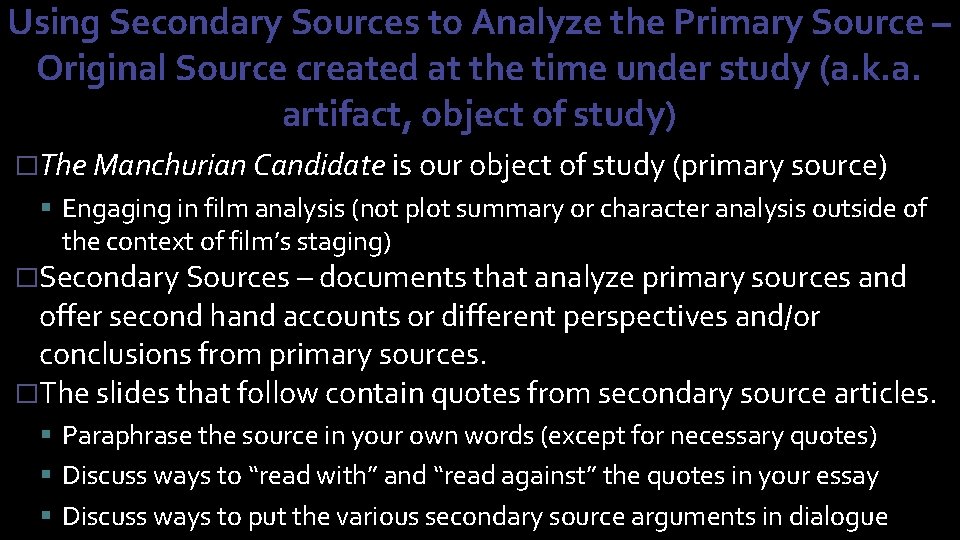
Using Secondary Sources to Analyze the Primary Source – Original Source created at the time under study (a. k. a. artifact, object of study) �The Manchurian Candidate is our object of study (primary source) Engaging in film analysis (not plot summary or character analysis outside of the context of film’s staging) �Secondary Sources – documents that analyze primary sources and offer second hand accounts or different perspectives and/or conclusions from primary sources. �The slides that follow contain quotes from secondary source articles. Paraphrase the source in your own words (except for necessary quotes) Discuss ways to “read with” and “read against” the quotes in your essay Discuss ways to put the various secondary source arguments in dialogue
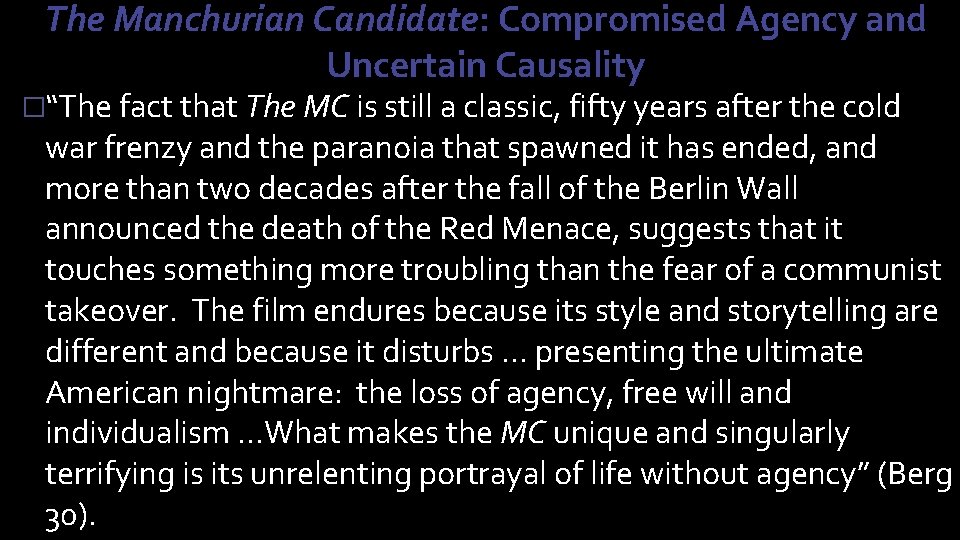
The Manchurian Candidate: Compromised Agency and Uncertain Causality �“The fact that The MC is still a classic, fifty years after the cold war frenzy and the paranoia that spawned it has ended, and more than two decades after the fall of the Berlin Wall announced the death of the Red Menace, suggests that it touches something more troubling than the fear of a communist takeover. The film endures because its style and storytelling are different and because it disturbs … presenting the ultimate American nightmare: the loss of agency, free will and individualism …What makes the MC unique and singularly terrifying is its unrelenting portrayal of life without agency” (Berg 30).
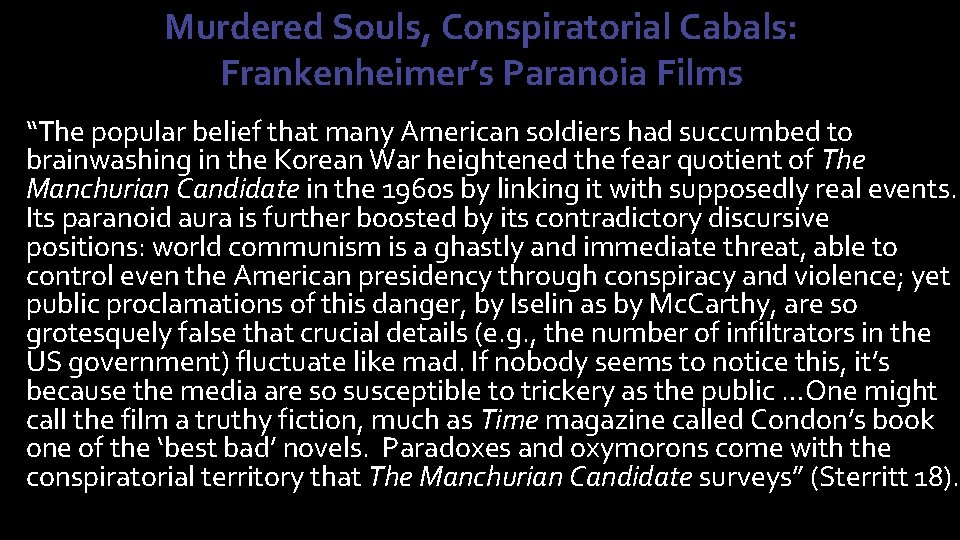
Murdered Souls, Conspiratorial Cabals: Frankenheimer’s Paranoia Films “The popular belief that many American soldiers had succumbed to brainwashing in the Korean War heightened the fear quotient of The Manchurian Candidate in the 1960 s by linking it with supposedly real events. Its paranoid aura is further boosted by its contradictory discursive positions: world communism is a ghastly and immediate threat, able to control even the American presidency through conspiracy and violence; yet public proclamations of this danger, by Iselin as by Mc. Carthy, are so grotesquely false that crucial details (e. g. , the number of infiltrators in the US government) fluctuate like mad. If nobody seems to notice this, it’s because the media are so susceptible to trickery as the public …One might call the film a truthy fiction, much as Time magazine called Condon’s book one of the ‘best bad’ novels. Paradoxes and oxymorons come with the conspiratorial territory that The Manchurian Candidate surveys” (Sterritt 18).
A Culture of Contradiction: Affluence and Society (The M. C. and Cold War America) “But so too was this a period when, ironically, the ‘private’ took on an increasingly public significance. If the ‘fight against communism settles into the cultural bones’ of the nation … the very marrow of this emergent Cold War politics was in the ‘private’ realm of motherhood, family values, and procreative heterosexuality as at once the creation and the rigorous defense of a new, patriotic ‘normal’ … ‘Domesticity was not so much a retreat from public affairs as an expression of one’s citizenship. ’ The Cold War battlefield extended outward to every corner of the globe, but also inward to the hearth and home: private sanctity was public duty. In this connection one of the greatest ‘national security’ threats on the scene … was the overweening American ‘mom, ’ whose smothering protectiveness threatened to neuter an entire generation of American boys” (Gonzalez 37).
Homeland Worksheet: Part One 1. How does the depiction of Nicholas Brody’s transformation from war prisoner to war hero set the stage for intrigue about his true identity and role in the tv series? q 2. Which characters in today’s episode are represented as “others”? To whom, and in what way, are they “other”? How does this othering establish a tension for the audience between “real” and “constructed” identities? 3. How is “spectacle” performed in this episode? Who has a stake in it? To what end? 4. How does Carrie’s bipolar disorder complicate her role in the story, our relation to her, and our perception or understanding of the show’s message? How does the genre and performance of Jazz music function in Carrie’s daily life? 5. In what ways does this television series grant us (audience) agency and invite us to participate in or reflect about the events in the story? In comparison to the M. C. ?
Scene Analysis �Group Scene Analysis: In your groups analyze your assigned scene by discussing which of the below tropes shape meaning or promote a particular message in the episode. Also, answer the accompanying questions and gather specific evidence to show filmic elements operate in the scene. �Surveillance/Visibility �Truth/The Real �Dramatic Irony �“Construction” �Agency Otherness/Othering Alienation/Distancing Memory/Remembering Media Convergence Reliability Violence Identity Secrecy
Group Scene Analysis http: //www. cinemablend. com/television/Homeland-Series-Premiere-Watch-Full. First-Episode-Showtime-Drama-Early-35053. html �All Groups: Opening Act “Carrie Matheson goes to the prison” (Chapter 1) �How are we introduced to the series in the opening scene? �How is “urgency” performed? �How are “boundaries” set up and represented in the scene? �What is the central message or goal of this opening chapter?
Group Scene Analysis �Group 1: Second Scene “ 10 months later Carrie back in Washington” (Chapter 2 – 3: 14) �What do we learn about Carrie from her apartment and her use of this private space? �How are items in her living space revealed to us through editing choices and how do these details inform or construct her identity? (items on the walls, clothing, the ring, inventory of bathroom medicine cabinet, unpacked boxes, etc. )
Group Scene Analysis �Group 2: “Carrie Watches Brody’s Sexual Encounter with his Wife” (Chapter 7 – 26: 57) �What roles do surveillance and looking play in the scene? �In what ways is this scene defined or characterized by violence? �(For example: How does the wife’s relation to her husband change when he reveals his “tortured body”? )
Group Scene Analysis �Group 3: “Carrie Can’t Decide What to Wear” (Chapter 10 – 44: 56) �How do the different clothes Carrie puts on characterize an internal struggle she is having? �What role does music play in this scene?
Group Scene Analysis �Group 4: “Watching Brody Barbecue through the Window” (Chapter 10 – 46: 28) �Contrast the two different conversations depicted in the scene. How would you characterize the non-verbal interaction between Brody and his wife?
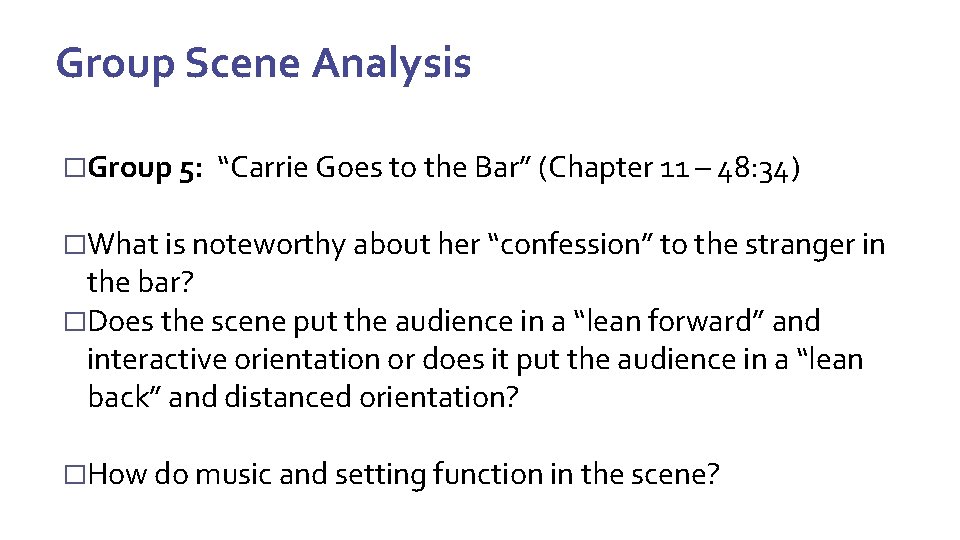
Group Scene Analysis �Group 5: “Carrie Goes to the Bar” (Chapter 11 – 48: 34) �What is noteworthy about her “confession” to the stranger in the bar? �Does the scene put the audience in a “lean forward” and interactive orientation or does it put the audience in a “lean back” and distanced orientation? �How do music and setting function in the scene?
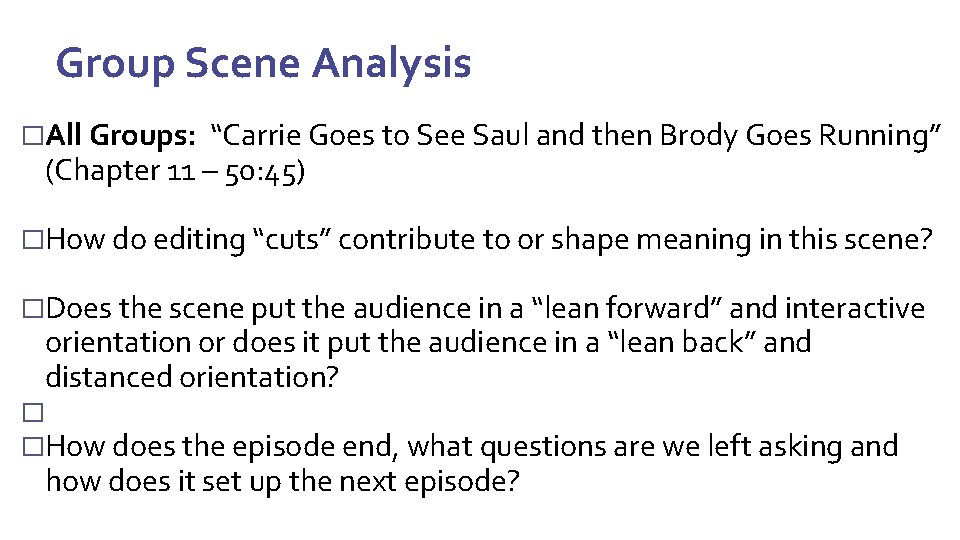
Group Scene Analysis �All Groups: “Carrie Goes to See Saul and then Brody Goes Running” (Chapter 11 – 50: 45) �How do editing “cuts” contribute to or shape meaning in this scene? �Does the scene put the audience in a “lean forward” and interactive orientation or does it put the audience in a “lean back” and distanced orientation? � �How does the episode end, what questions are we left asking and how does it set up the next episode?