
Analyzing Data Unit 3 Statistics Common Core Standard
- Slides: 18
Analyzing Data Unit 3 Statistics Common Core Standard: S. ID. 1 Represent data with plots on the real number line (dot plots, histograms, and box plots)
The Big Idea Students are shown a jar of candy and have to guess the amount of pieces they think are in the jar. The class then uses the guesses in order to complete the task of making stem and leaf plots, line plots, histograms, and box-plots. 2
Resources/Materials Measures of Variation/Box –and-Whisker Plots worksheet 13. 5 Glencoe Algebra resources (create power pint to assist student's with “fill in the blanks” note sections) -See attached power point http: //www. brainpop. com/math/probability/mean medianmodeandrange/ 3
Math Practices: #4: Model with Mathematics #5: Use appropriate tools strategically #6 Attend to precision 4
13. 4/13. 5 Measures of Variation/ Box-and-Whisker Plots § Find the range of a set of data. § Find the quartiles and interquartile range of a set of data. § Organize and use data in box-and-whisker plots. § Organize and use data in parallel box-and-whisker plots. 5
How many pieces of candy do you think there are in the jar? ? ? Review of box plots, stem and leaf plots, and histograms. We will be making a box-and-whisker later! 6
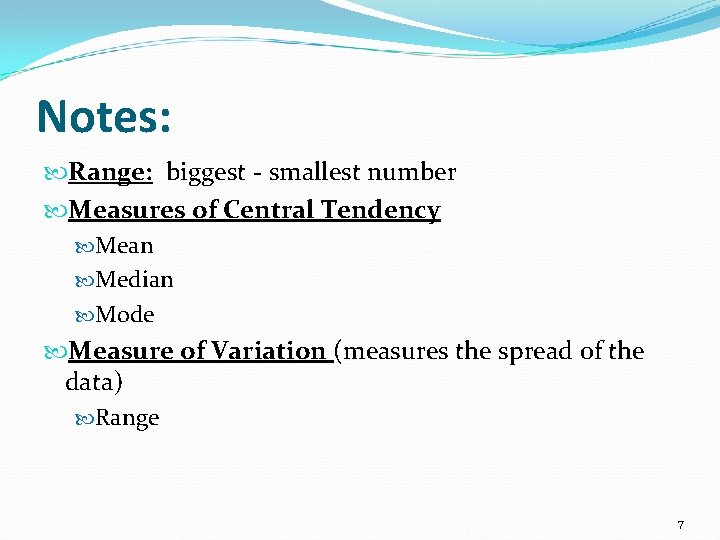
Notes: Range: biggest - smallest number Measures of Central Tendency Mean Median Mode Measure of Variation (measures the spread of the data) Range 7
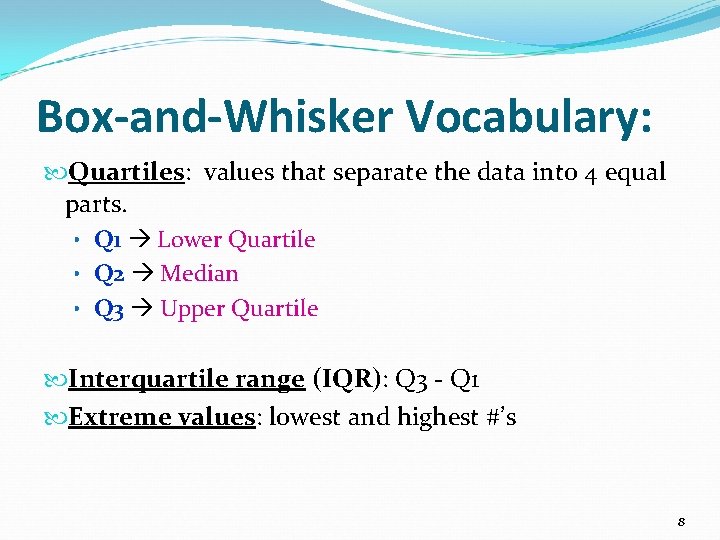
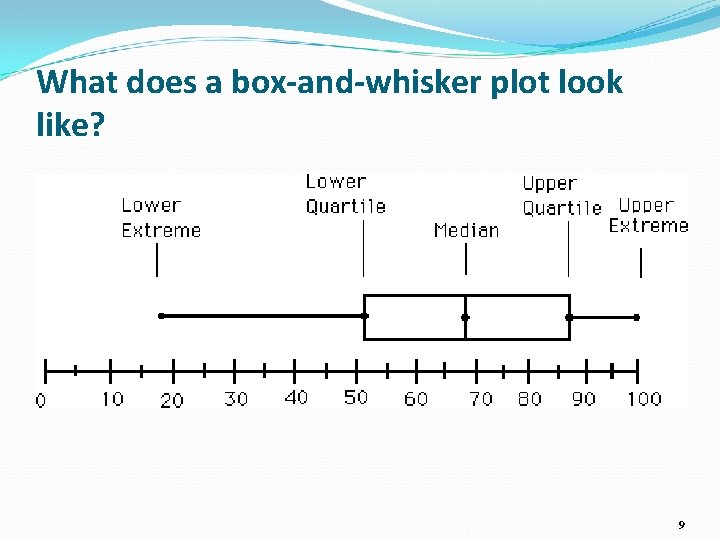
Box-and-Whisker Vocabulary: Quartiles: values that separate the data into 4 equal parts. • Q 1 Lower Quartile • Q 2 Median • Q 3 Upper Quartile Interquartile range (IQR): Q 3 - Q 1 Extreme values: lowest and highest #’s 8
What does a box-and-whisker plot look like? 9
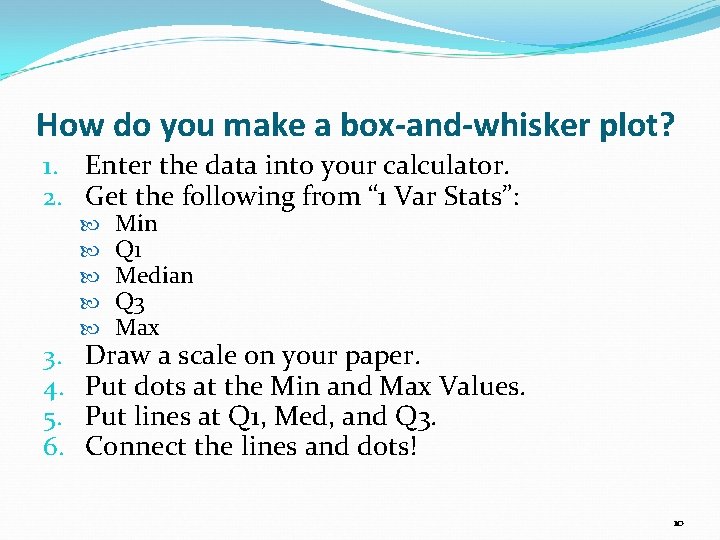
How do you make a box-and-whisker plot? 1. Enter the data into your calculator. 2. Get the following from “ 1 Var Stats”: 3. 4. 5. 6. Min Q 1 Median Q 3 Max Draw a scale on your paper. Put dots at the Min and Max Values. Put lines at Q 1, Med, and Q 3. Connect the lines and dots! 10
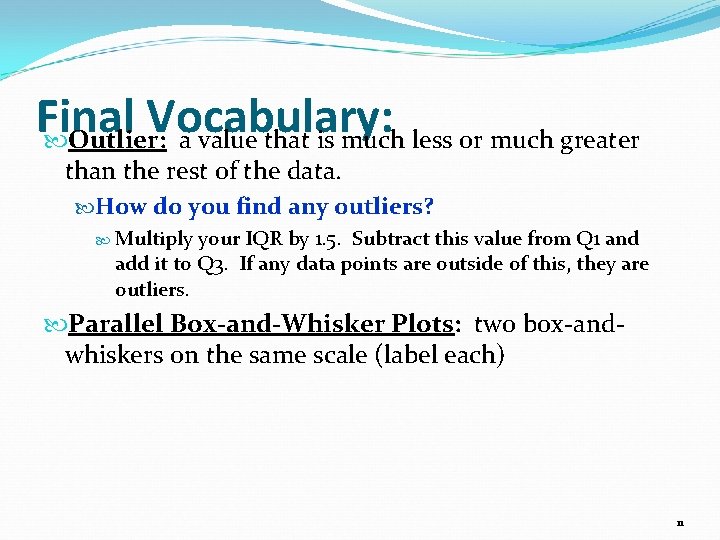
Final Vocabulary: Outlier: a value that is much less or much greater than the rest of the data. How do you find any outliers? Multiply your IQR by 1. 5. Subtract this value from Q 1 and add it to Q 3. If any data points are outside of this, they are outliers. Parallel Box-and-Whisker Plots: two box-andwhiskers on the same scale (label each) 11
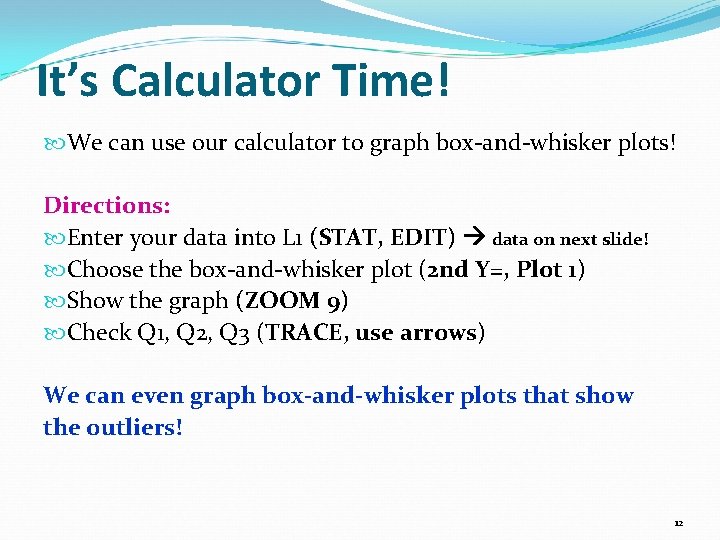
It’s Calculator Time! We can use our calculator to graph box-and-whisker plots! Directions: Enter your data into L 1 (STAT, EDIT) data on next slide! Choose the box-and-whisker plot (2 nd Y=, Plot 1) Show the graph (ZOOM 9) Check Q 1, Q 2, Q 3 (TRACE, use arrows) We can even graph box-and-whisker plots that show the outliers! 12
13. 4/13. 5 Measures of Variation/ Box-and-Whisker Plots §Find the quartiles and interquartile range of a set of data. § Organize and use data in box-and-whisker plots. § Organize and use data in parallel box-and-whisker plots. §Review all of the graphs we have learned in this unit. 13
Guided Practice Make parallel box-and-whisker plot of class data. Individual questions reviewing graphs 14
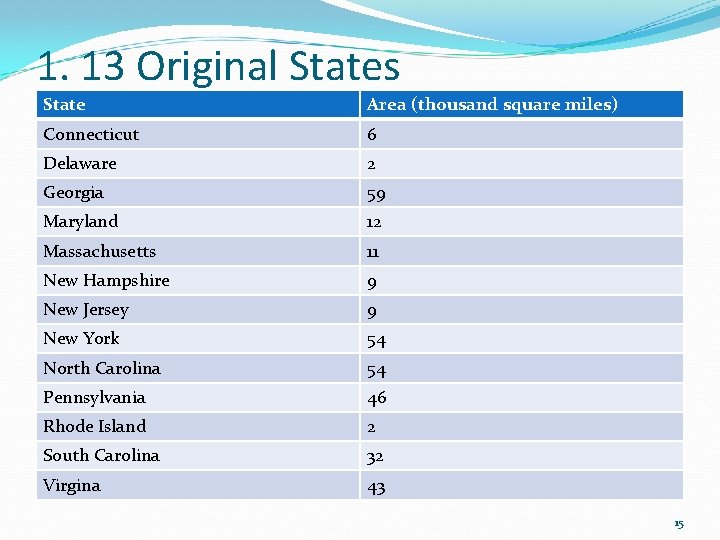
1. 13 Original States State Area (thousand square miles) Connecticut 6 Delaware 2 Georgia 59 Maryland 12 Massachusetts 11 New Hampshire 9 New Jersey 9 New York 54 North Carolina 54 Pennsylvania 46 Rhode Island 2 South Carolina 32 Virgina 43 15
2. Baseball Teams Create a double box-and-whisker plot given the number of wins in the 2004 and 2006 baseball seasons. 16
Individual Practice For #1 -4 use the “number of pieces of candy in the jar” class data For #5 -8 use the parallel box-and-whisker plot to answer the questions. For #9 -10 use the number of earthquakes to create the box-and-whisker and find outliers. For #11 -13 use the all-time record high temperature for the 50 states. 17
Extension: Tying Everything Together! Fruit Loops Activity! (worksheet and fruit loops) Review of all the graphs we have learned! 18