
ANALYZING CLINICAL QUESTIONS Turning Your PICO into a


- Slides: 12
ANALYZING CLINICAL QUESTIONS Turning Your PICO into a search strategy Shelly Warwick, MLS, Ph. D. 2013 – Permission is granted to reproduce and edit this work for non-commercial educational use as long as attribution is provided and the edited work is also available under the same terms of license.
After This Unit You Should be Able to: �State what does PICO and PICO(TT) stand for? �Explain how a PICO helps you create a search strategy? �Develop a PICO statement �Develop a search strategy to answer the question posed by the PICO
What is a “good” question ? �The key components of a good clinical question are: �Patient/Population/Problem �Intervention/Exposure �Comparison �Outcome �How do we look for answers? �Selecting the key components of a good question will help you develop an efficient and effective search strategy Richardson et al. The well-built clinical question: a key to evidence-based decisions. ACP Journal Club 1995; A-12 Counsell C. Formulating questions and locating primary studies for inclusion in systematic reviews. Ann Intern Med 1997; 127: 380 -7.
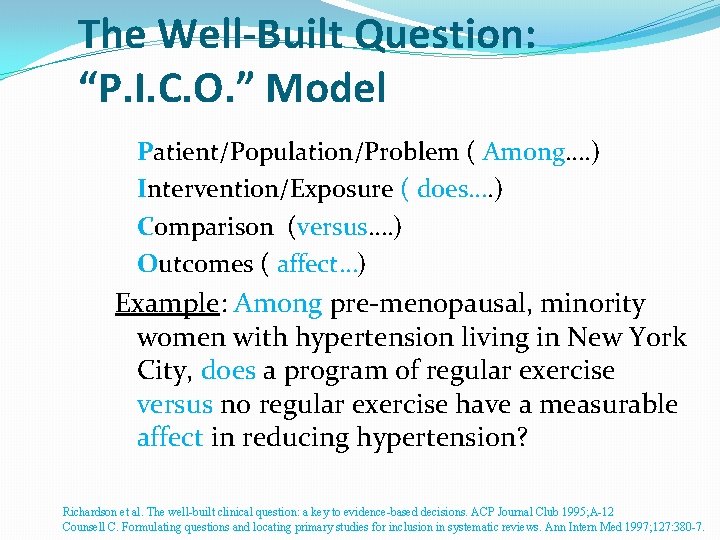
The Well-Built Question: “P. I. C. O. ” Model Patient/Population/Problem ( Among…. ) Intervention/Exposure ( does…. ) Comparison (versus…. ) Outcomes ( affect…) Example: Among pre-menopausal, minority women with hypertension living in New York City, does a program of regular exercise versus no regular exercise have a measurable affect in reducing hypertension? Richardson et al. The well-built clinical question: a key to evidence-based decisions. ACP Journal Club 1995; A-12 Counsell C. Formulating questions and locating primary studies for inclusion in systematic reviews. Ann Intern Med 1997; 127: 380 -7.
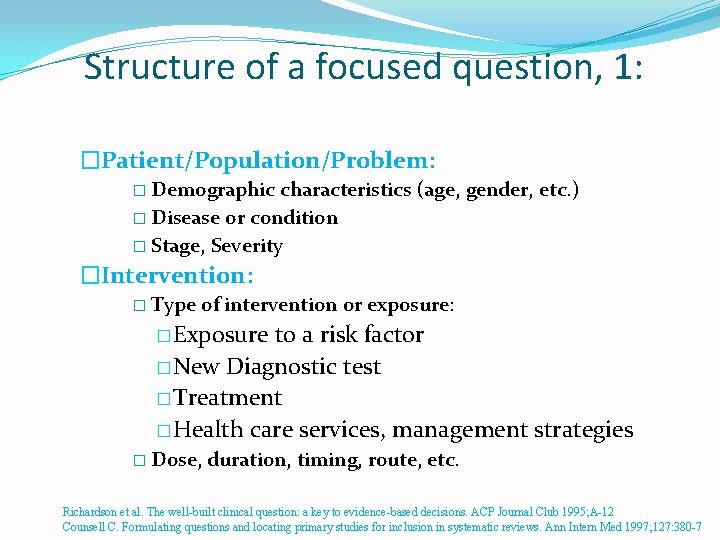
Structure of a focused question, 1: �Patient/Population/Problem: � Demographic characteristics (age, gender, etc. ) � Disease or condition � Stage, Severity �Intervention: � Type of intervention or exposure: �Exposure to a risk factor �New Diagnostic test �Treatment �Health care services, management strategies � Dose, duration, timing, route, etc. Richardson et al. The well-built clinical question: a key to evidence-based decisions. ACP Journal Club 1995; A-12 Counsell C. Formulating questions and locating primary studies for inclusion in systematic reviews. Ann Intern Med 1997; 127: 380 -7.
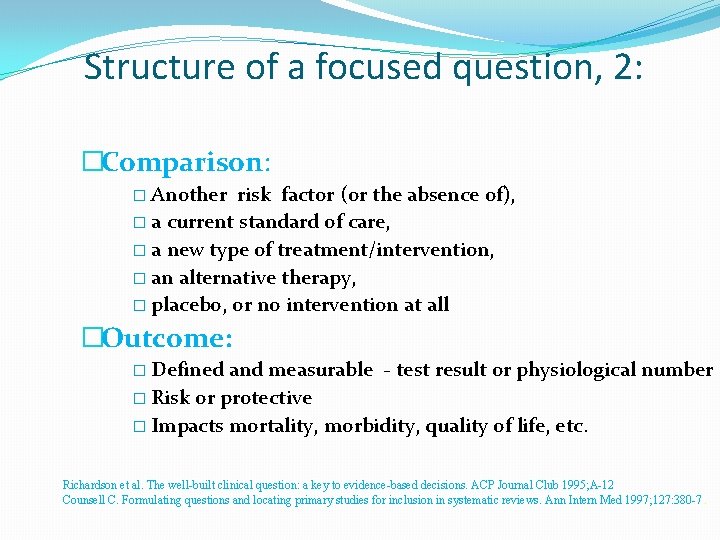
Structure of a focused question, 2: �Comparison: � Another risk factor (or the absence of), � a current standard of care, � a new type of treatment/intervention, � an alternative therapy, � placebo, or no intervention at all �Outcome: � Defined and measurable - test result or physiological number � Risk or protective � Impacts mortality, morbidity, quality of life, etc. Richardson et al. The well-built clinical question: a key to evidence-based decisions. ACP Journal Club 1995; A-12 Counsell C. Formulating questions and locating primary studies for inclusion in systematic reviews. Ann Intern Med 1997; 127: 380 -7.
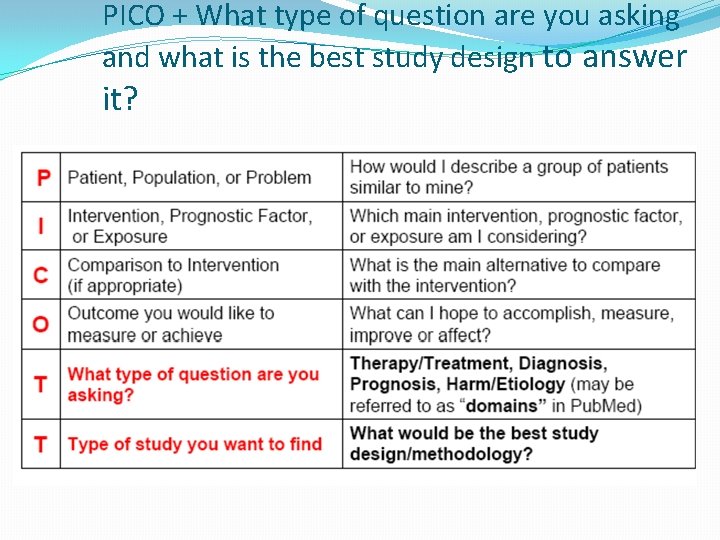
PICO + What type of question are you asking and what is the best study design to answer it?
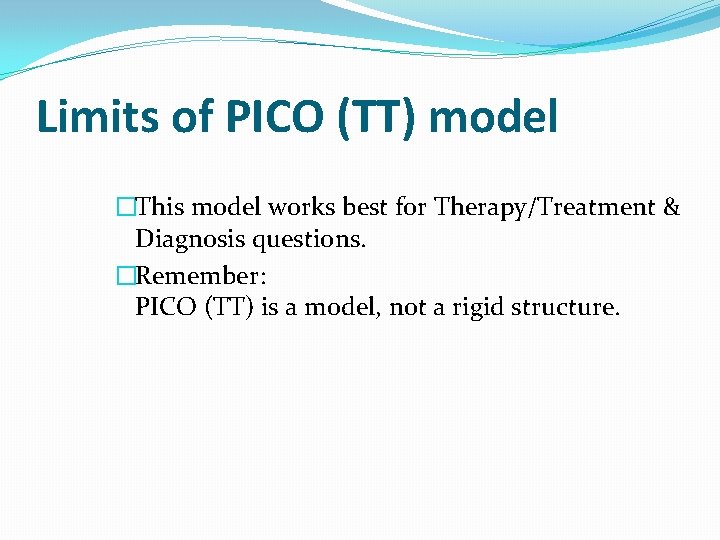
Limits of PICO (TT) model �This model works best for Therapy/Treatment & Diagnosis questions. �Remember: PICO (TT) is a model, not a rigid structure.
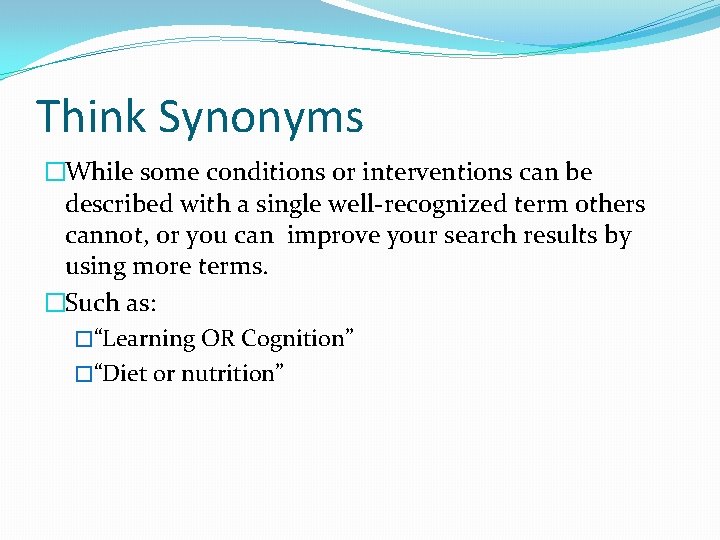
Think Synonyms �While some conditions or interventions can be described with a single well-recognized term others cannot, or you can improve your search results by using more terms. �Such as: �“Learning OR Cognition” �“Diet or nutrition”
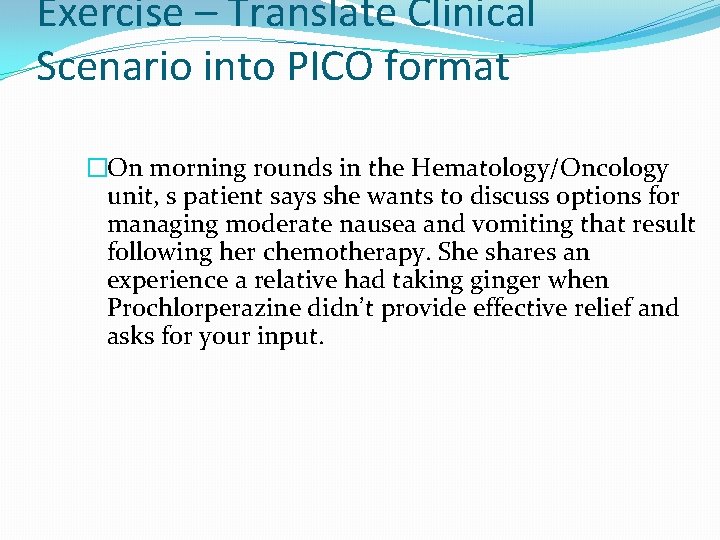
Exercise – Translate Clinical Scenario into PICO format �On morning rounds in the Hematology/Oncology unit, s patient says she wants to discuss options for managing moderate nausea and vomiting that result following her chemotherapy. She shares an experience a relative had taking ginger when Prochlorperazine didn’t provide effective relief and asks for your input.
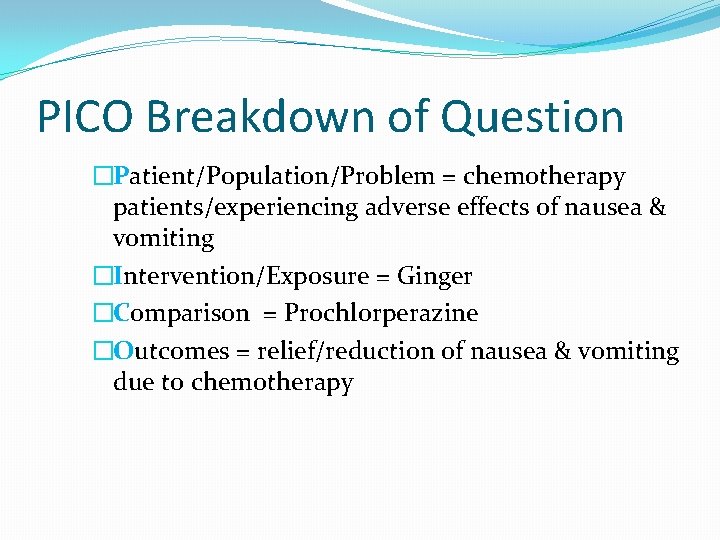
PICO Breakdown of Question �Patient/Population/Problem = chemotherapy patients/experiencing adverse effects of nausea & vomiting �Intervention/Exposure = Ginger �Comparison = Prochlorperazine �Outcomes = relief/reduction of nausea & vomiting due to chemotherapy
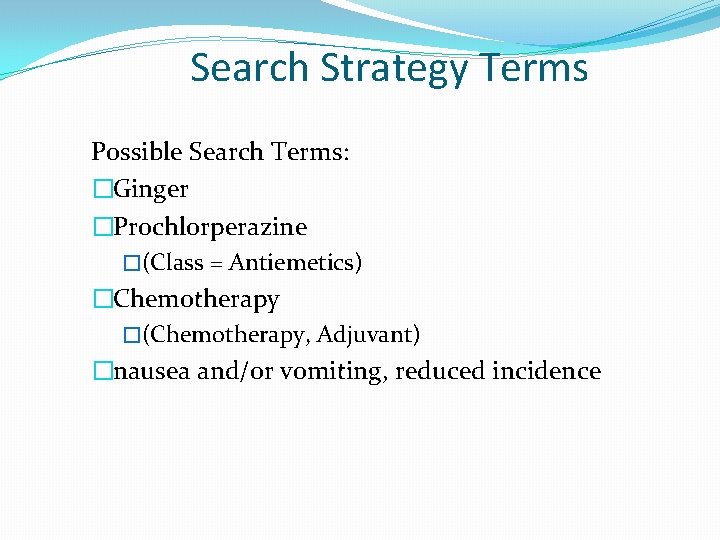
Search Strategy Terms Possible Search Terms: �Ginger �Prochlorperazine �(Class = Antiemetics) �Chemotherapy �(Chemotherapy, Adjuvant) �nausea and/or vomiting, reduced incidence