
Analyzing Behavior Part 1 Week 4 Functional Assessment
Analyzing Behavior: Part 1 Week 4: Functional Assessment
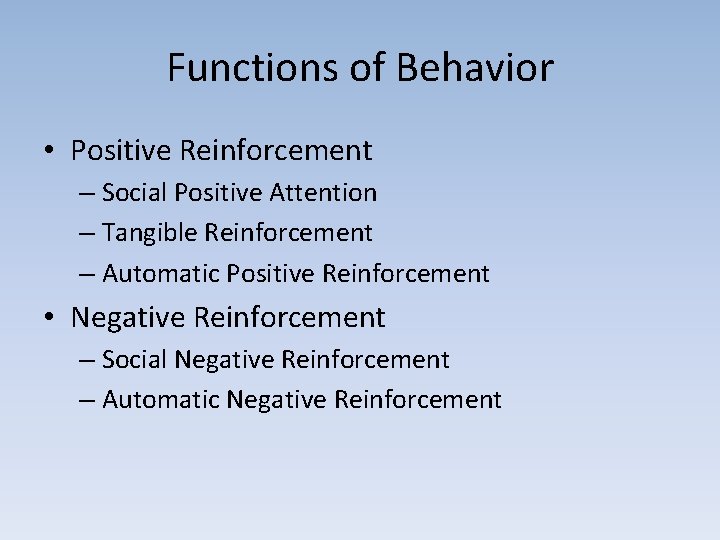
Functions of Behavior • Positive Reinforcement – Social Positive Attention – Tangible Reinforcement – Automatic Positive Reinforcement • Negative Reinforcement – Social Negative Reinforcement – Automatic Negative Reinforcement

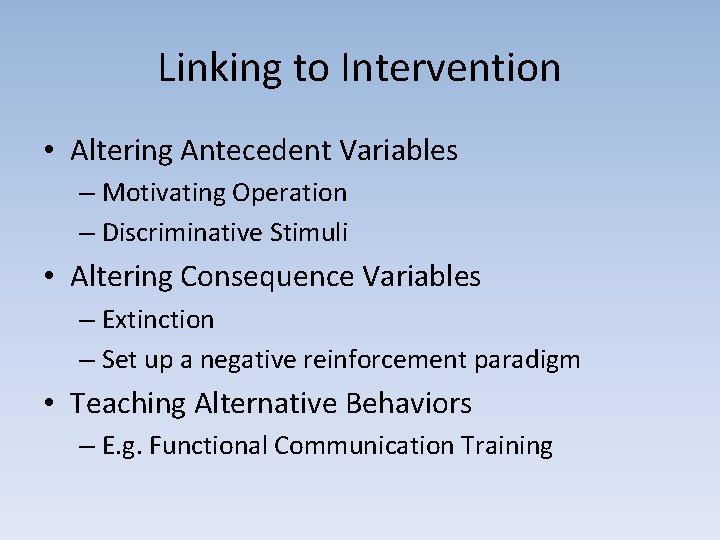
Linking to Intervention • Altering Antecedent Variables – Motivating Operation – Discriminative Stimuli • Altering Consequence Variables – Extinction – Set up a negative reinforcement paradigm • Teaching Alternative Behaviors – E. g. Functional Communication Training
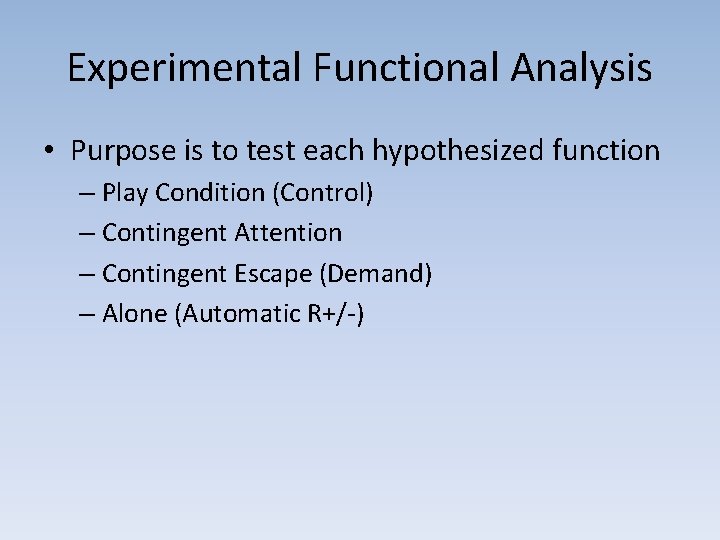
Experimental Functional Analysis • Purpose is to test each hypothesized function – Play Condition (Control) – Contingent Attention – Contingent Escape (Demand) – Alone (Automatic R+/-)
Limitations to EFA • • • Increasing undesirable behavior May lack face validity to lay person May not be useful for all behaviors Contrived not same as real environment Requires professional expertise
Direct Descriptive Functional Analysis • General Methods: A-B-C Logs, observations • Look for correlation of behavior and hypothesized function in natural environment • Conditional Probabilities – Proportion of occurrences of target behavior that were followed by specific hypothesized function. – Not strong agreement between C. P. ’s and E. F. A
Indirect Descriptive Functional Assessment • General Methods: Interviews & Rating Scales • Advantages: Convenient, initial Ho development • Limitations: Not direct
A B C • Let’s think about some of our own Behaviors • Let’s think about some behaviors of others – Consider the FBA flowchart on the “C” – We will discuss the “A” flowchart next week
Fu. BARS & FBA-Checklist • Assesses the quality of assessments of interfering Behavior. • Your Project will be graded using the Fu. BAR. – You will conduct a self-assessment • Fu. BARS & FBA-Checklist – I will conduct an external assessment • Fu. BARS
- Slides: 10