
Analyzing a Running Record An Instructional Module for


- Slides: 61
Analyzing a Running Record An Instructional Module for Reading Teachers
n What is a Running Record? n How is it used? n What information will it give me? n How do I go about analyzing a Running Record?
Anomalous momentum transport has been observed in Alcator C-Mod tokamak plasmas. The time evolution of core impurity toroidal rotation velocity profiles has been measured with a tangentially viewing crystal x-ray spectrometer array. Following the L-mode to EDA (enhanced D ) H-mode transition in both Ohmic and ion cyclotron range of frequencies heated discharges, the ensuing co-current toroidal rotation velocity, which is generated in the absence of any external momentum source, is observed to propagate in from the edge plasma to the core with a timescale of the order of the observed energy confinement time, but much less than the neoclassical momentum confinement time. The ensuing steady state toroidal rotation velocity profiles in EDA Hmode plasmas are relatively flat, with V ~ 50 km s-1, and the momentum transport can be simulated using a simple diffusion model.
What are you thinking?
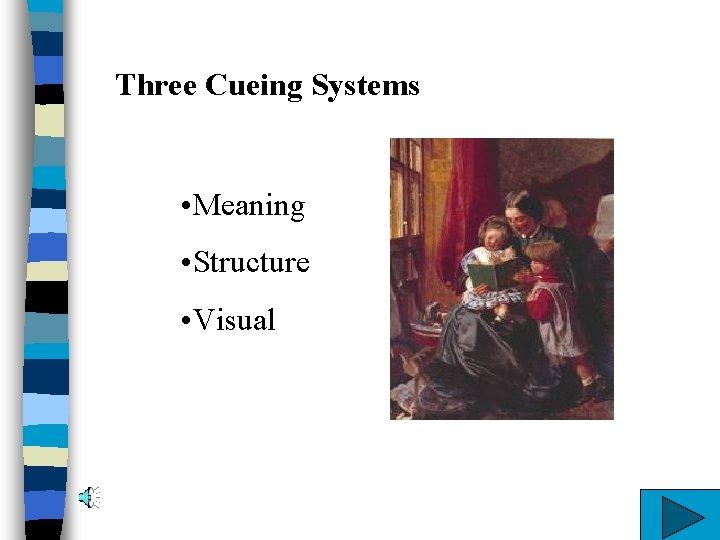
Three Cueing Systems • Meaning • Structure • Visual
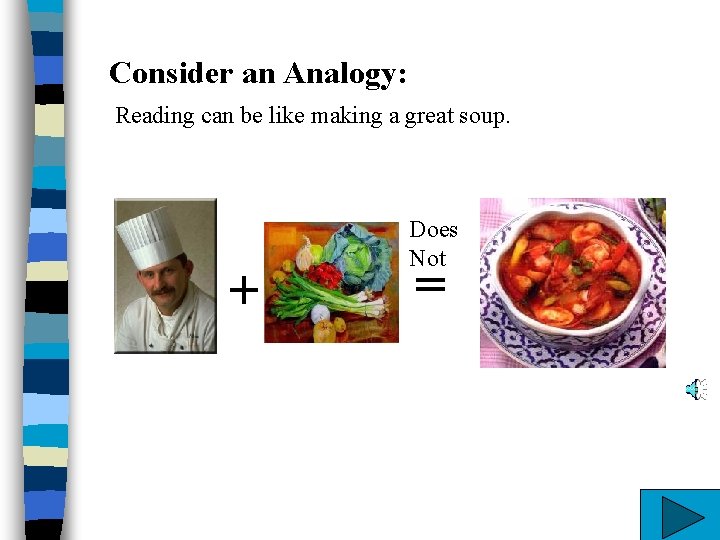
Consider an Analogy: Reading can be like making a great soup. + Does Not =
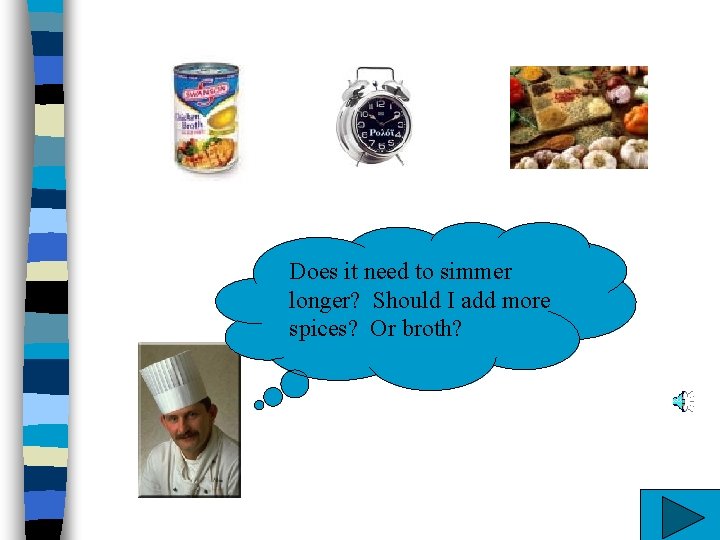
Does it need to simmer longer? Should I add more spices? Or broth?
Combined just right…
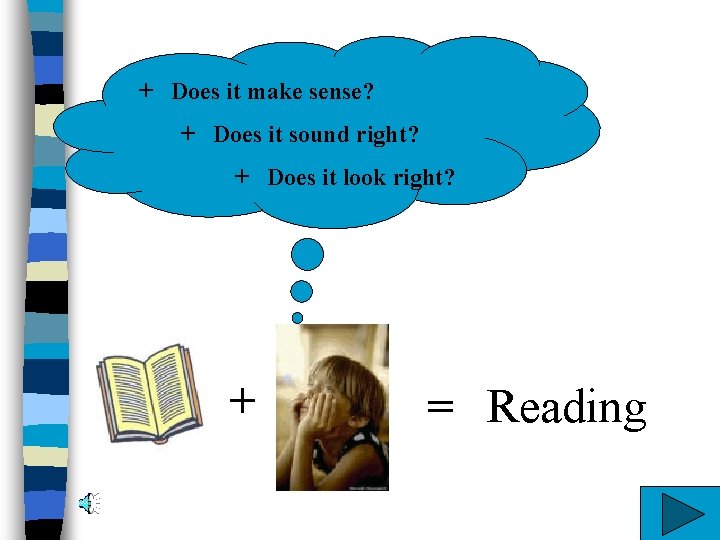
+ Does it make sense? + Does it sound right? + Does it look right? + = Reading
What is a Running Record? A running record is an assessment tool used to pinpoint which cueing systems a struggling reader is neglecting while reading.
Taking a Running Record The child reads a book or passage aloud. n The teacher uses a coding system of marking conventions to record the students words and actions while reading. n Afterwards the teacher analyzes the running record for types of errors or miscues. n Miscues and Self-Corrections are labeled Meaning, Visual, or Structure. n
What is considered an error? n The student substitutes another word for a word in the text n The student omits a word n The student inserts a word n The student has to be told a word by the person administering the running record
What is a Self-Correction? A self-correction is when a student has made an error but then fixed the error by reading it correctly.
Marking Conventions Click on the link below to view the marking conventions for running records. http: //www. msu. edu/~jonesreb/Marking Conven. doc
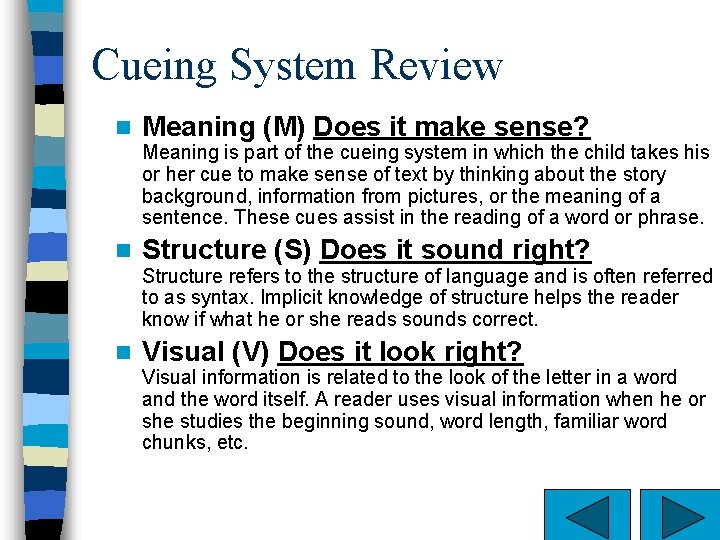
Cueing System Review n Meaning (M) Does it make sense? Meaning is part of the cueing system in which the child takes his or her cue to make sense of text by thinking about the story background, information from pictures, or the meaning of a sentence. These cues assist in the reading of a word or phrase. n Structure (S) Does it sound right? Structure refers to the structure of language and is often referred to as syntax. Implicit knowledge of structure helps the reader know if what he or she reads sounds correct. n Visual (V) Does it look right? Visual information is related to the look of the letter in a word and the word itself. A reader uses visual information when he or she studies the beginning sound, word length, familiar word chunks, etc.
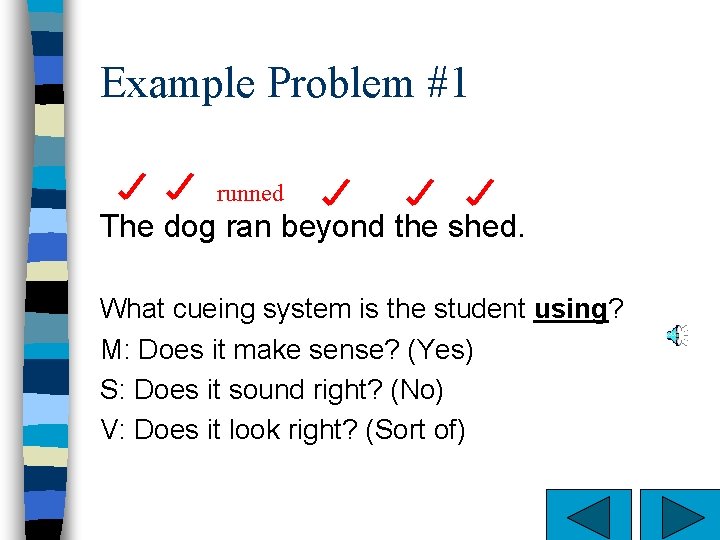
Example Problem #1 runned The dog ran beyond the shed. What cueing system is the student using? M: Does it make sense? (Yes) S: Does it sound right? (No) V: Does it look right? (Sort of)
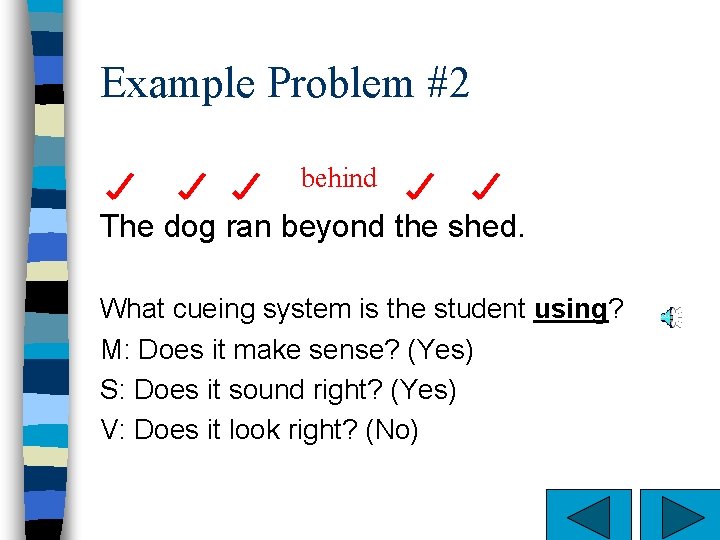
Example Problem #2 behind The dog ran beyond the shed. What cueing system is the student using? M: Does it make sense? (Yes) S: Does it sound right? (Yes) V: Does it look right? (No)
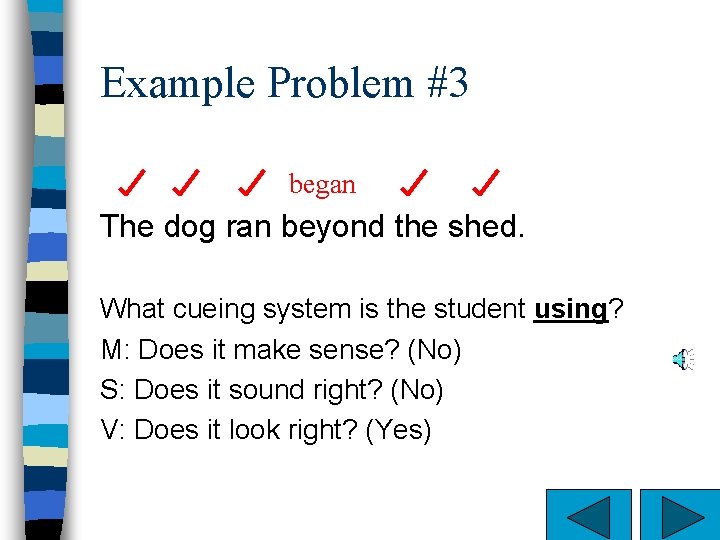
Example Problem #3 began The dog ran beyond the shed. What cueing system is the student using? M: Does it make sense? (No) S: Does it sound right? (No) V: Does it look right? (Yes)
Please Remember… When analyzing a miscue, use only the text up to the point of error to determine which cueing systems are being used. Anything beyond the miscue is information that will skew your analysis.
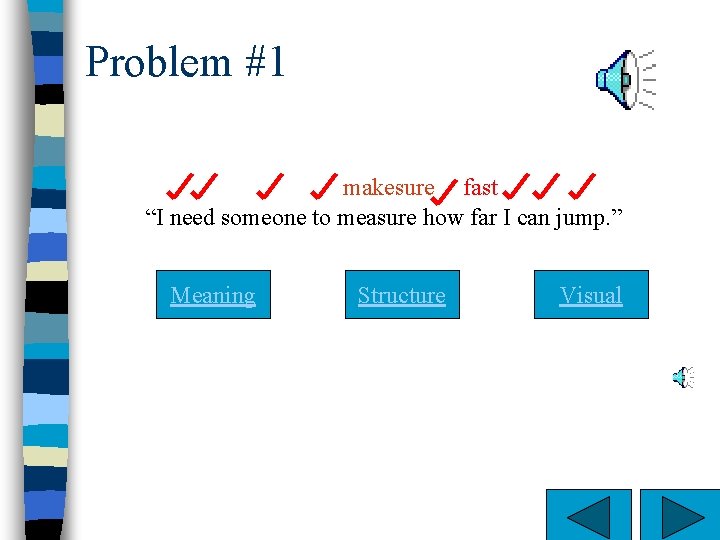
Problem #1 makesure fast “I need someone to measure how far I can jump. ” Meaning Structure Visual
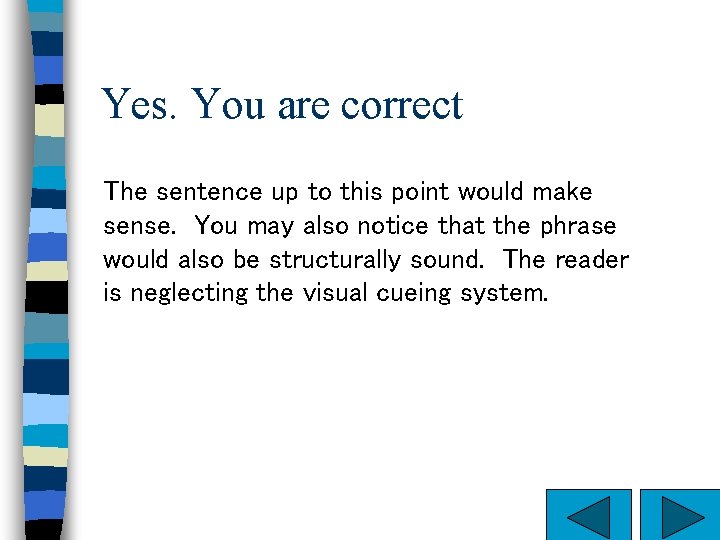
Yes. You are correct The sentence up to this point would make sense. You may also notice that the phrase would also be structurally sound. The reader is neglecting the visual cueing system.
Yes. You are correct The sentence up to this is structurally sound. You may also notice that the phrase also makes sense. The reader is neglecting the visual cueing system.
Sorry. Incorrect Choice. If you read up to the point of error, the phrase makes sense and is structurally sound. Please try again.
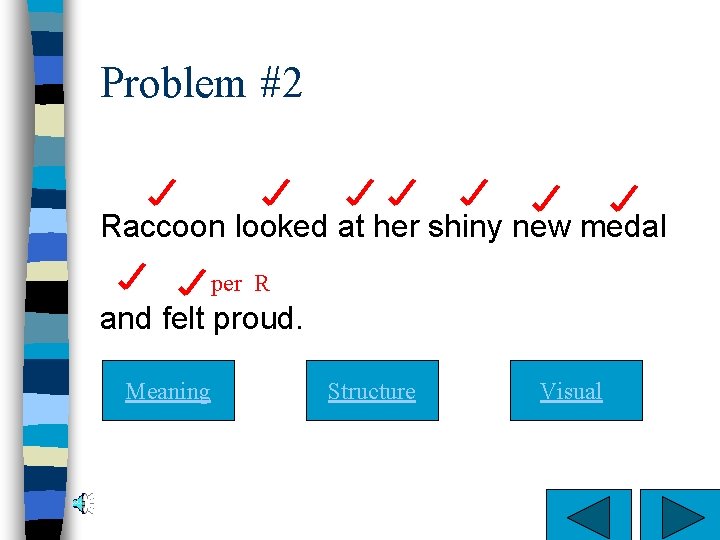
Problem #2 Raccoon looked at her shiny new medal per R and felt proud. Meaning Structure Visual
Yes. You are correct The reader is using the visual cueing and neglecting meaning and in essence structure as well.
Sorry. Incorrect Choice. If you read up to the point of error. The phrase does not make sense. Please try again.
Sorry. Incorrect Choice If you read up to the point of error. The phrase does not sound grammatically correct. Please try again.
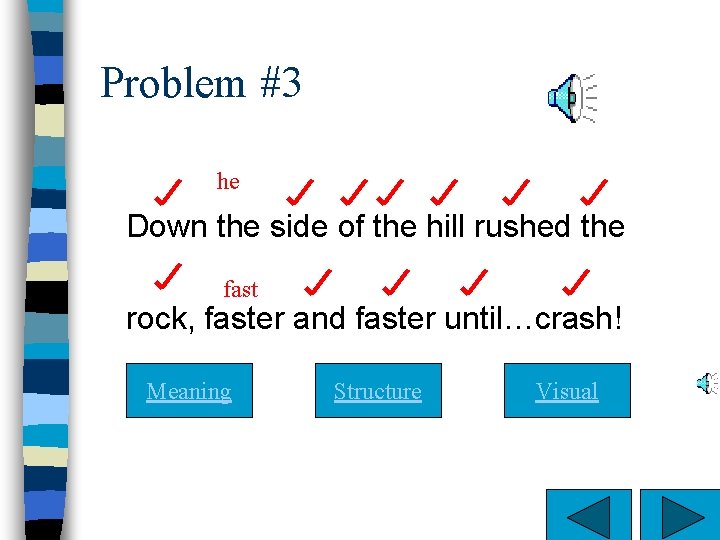
Problem #3 he Down the side of the hill rushed the fast rock, faster and faster until…crash! Meaning Structure Visual
Yes. You are correct The reader is using meaning up to this point. Please note that the phrase is also structurally sound. The reader is neglecting visual cues.
Yes. You are correct The reader is using structure up to this point. Please note that the phrase also makes sense. The reader is neglecting visual cues.
Sorry. Incorrect Choice. The reader is not using the visual cues provided. Please try again.
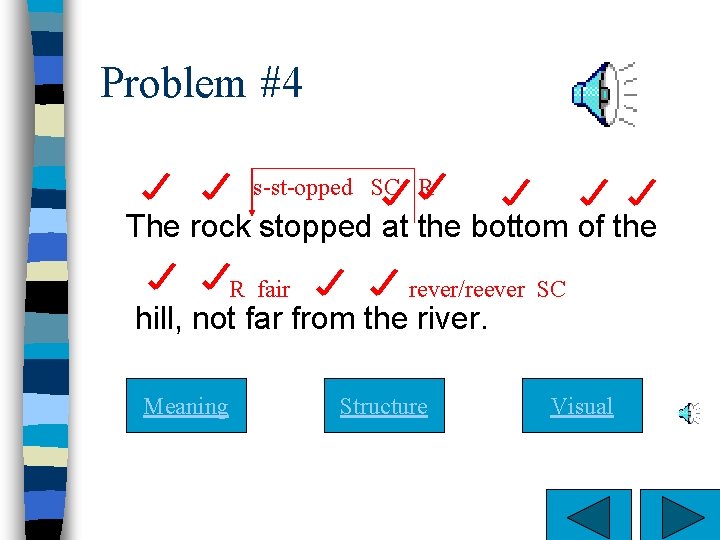
Problem #4 s-st-opped SC R The rock stopped at the bottom of the R fair rever/reever SC hill, not far from the river. Meaning Structure Visual
Yes. You are correct The reader is using visual cues and is not attending to meaning.
Sorry. Incorrect Choice. If you read up to the point of error. The phrase does not make sense. Please try again.
Sorry. Not the best choice. Structure is debatable here. However there is a more obvious choice. Please try again.
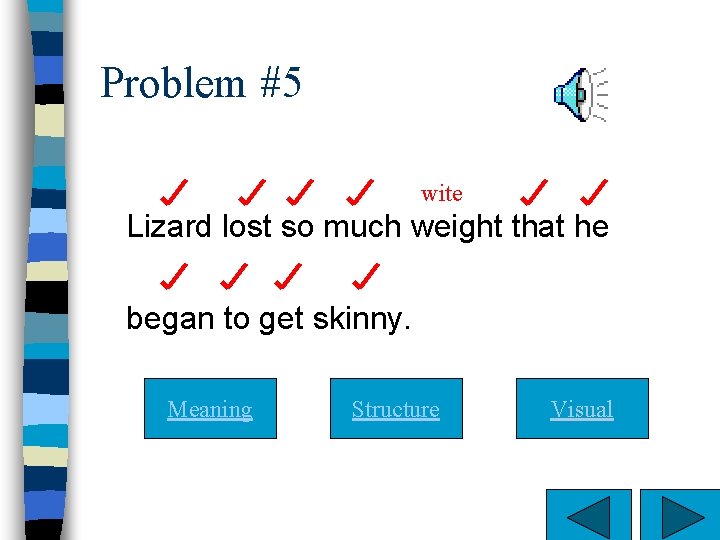
Problem #5 wite Lizard lost so much weight that he began to get skinny. Meaning Structure Visual
Sorry. Incorrect Choice. If you read up to the point of error. The phrase does not make sense. Please try again.
Sorry. Not the best choice Structure is debatable here. However there is a more obvious choice. Please try again.
Yes. You are correct The reader is using visual cues but not meaning. Structure is debatable in this example.
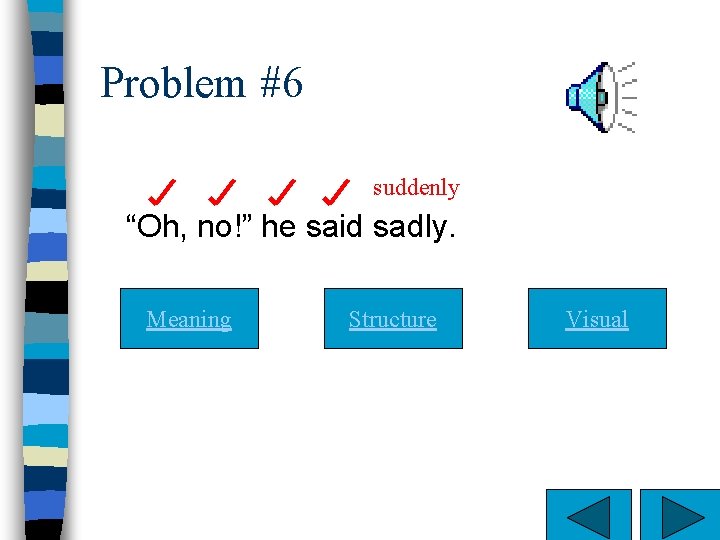
Problem #6 suddenly “Oh, no!” he said sadly. Meaning Structure Visual
Yes. You are correct The reader is using meaning up to this point. Please note that the phrase is also structurally sound. The reader is neglecting visual cues.
Yes. You are correct The reader is using structure up to this point. Please note that the phrase also makes sense. The reader is neglecting visual cues.
Sorry. Incorrect Choice. The reader is using some visual clues but is not attending to all the letters. Please try again.
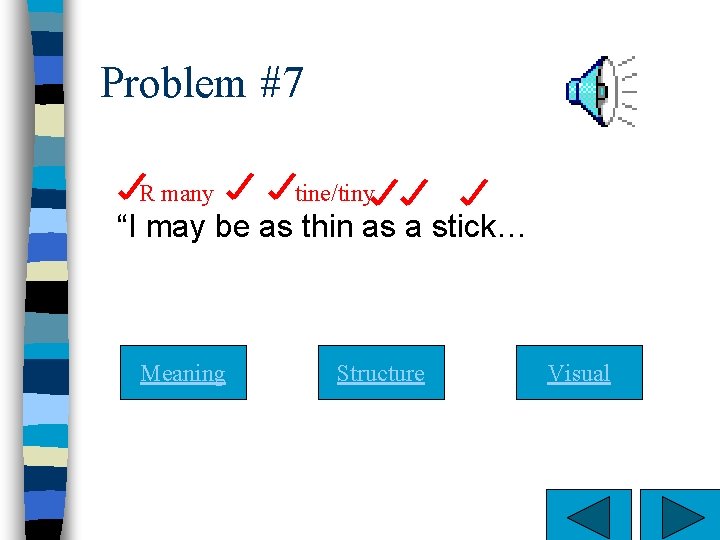
Problem #7 R many tine/tiny “I may be as thin as a stick… Meaning Structure Visual
Yes. You are correct The reader is using visual cues but not meaning or structure.
Sorry. Incorrect Choice. If you read up to the point of error, the phrase does not make sense. Please try again.
Sorry. Incorrect Choice. If you read up to the point of error, the phrase is not structurally sound. Please try again.
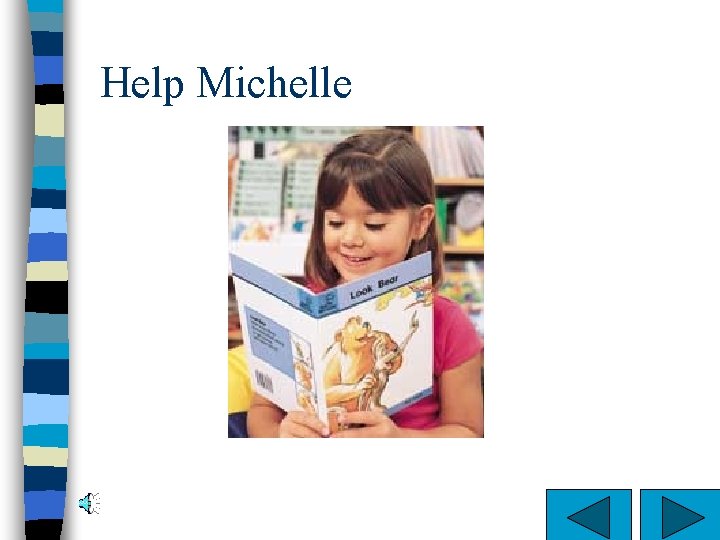
Help Michelle
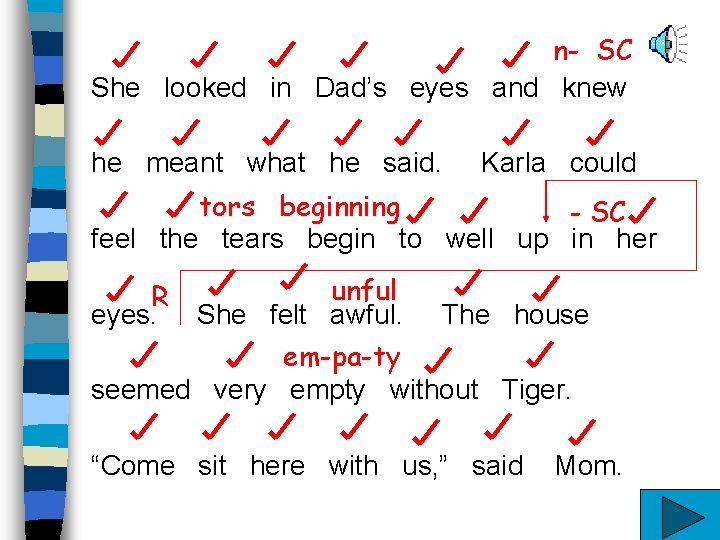
Instructions n Go to the following website to print out Michelle’s running record. http: //www. msu. edu/~jonesreb/Tiger. Print 1. doc
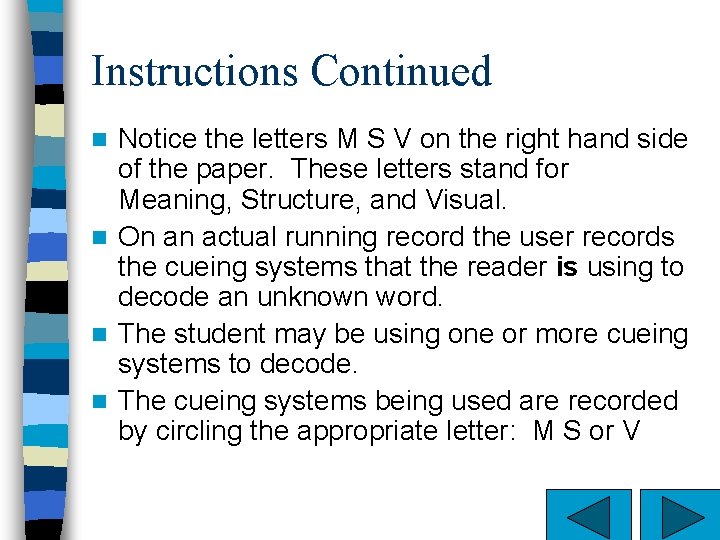
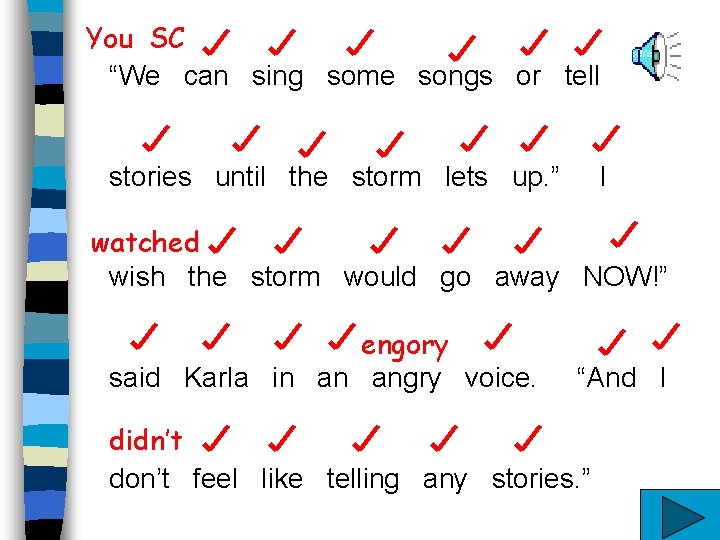
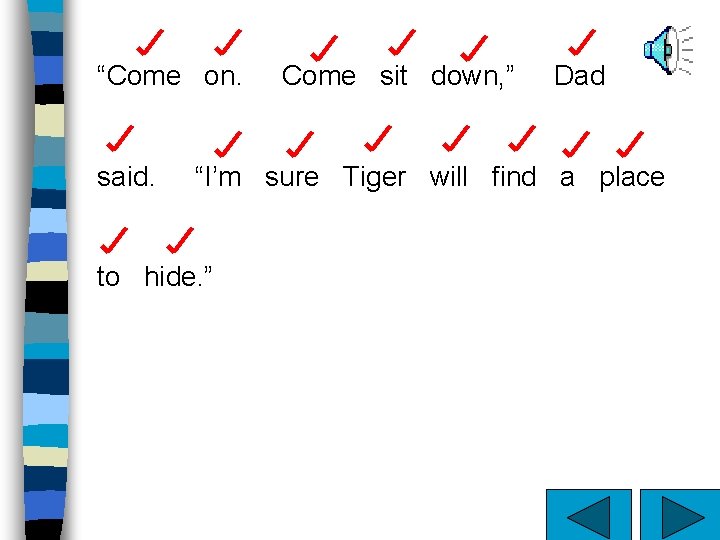
Instructions Continued Notice the letters M S V on the right hand side of the paper. These letters stand for Meaning, Structure, and Visual. n On an actual running record the user records the cueing systems that the reader is using to decode an unknown word. n The student may be using one or more cueing systems to decode. n The cueing systems being used are recorded by circling the appropriate letter: M S or V n
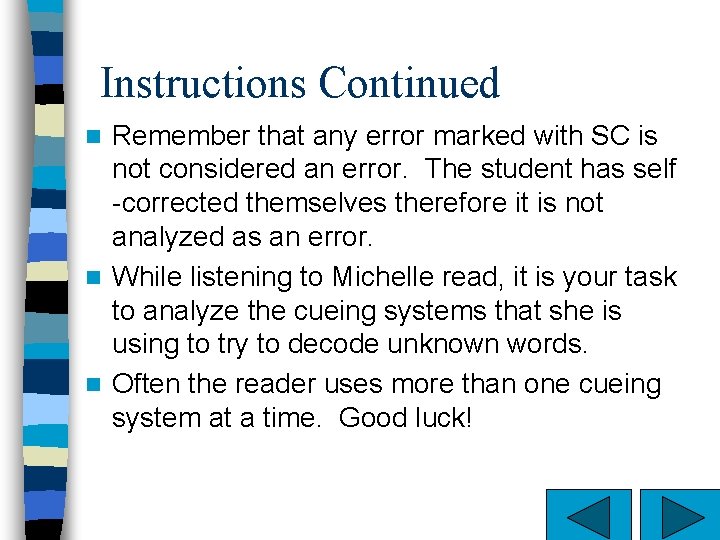
Instructions Continued Remember that any error marked with SC is not considered an error. The student has self -corrected themselves therefore it is not analyzed as an error. n While listening to Michelle read, it is your task to analyze the cueing systems that she is using to try to decode unknown words. n Often the reader uses more than one cueing system at a time. Good luck! n
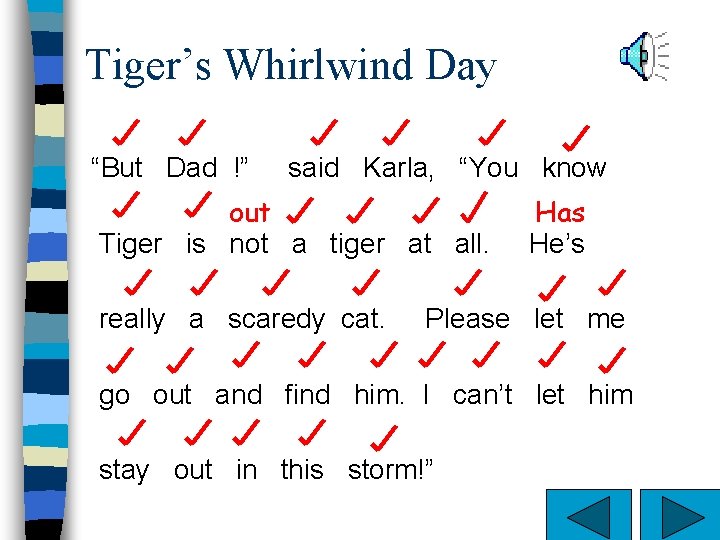
Tiger’s Whirlwind Day “But Dad !” said Karla, “You know out Tiger is not a tiger at all. really a scaredy cat. Has He’s Please let me go out and find him. I can’t let him stay out in this storm!”
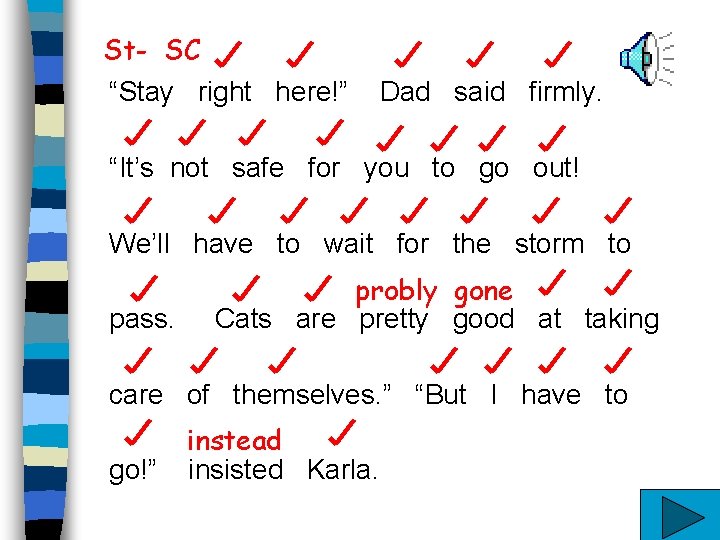
St- SC “Stay right here!” Dad said firmly. “It’s not safe for you to go out! We’ll have to wait for the storm to pass. probly gone Cats are pretty good at taking care of themselves. ” “But I have to go!” instead insisted Karla.
n- SC She looked in Dad’s eyes and knew he meant what he said. Karla could tors beginning - SC feel the tears begin to well up in her R eyes. unful She felt awful. The house em-pa-ty seemed very empty without Tiger. “Come sit here with us, ” said Mom.
You SC “We can sing some songs or tell stories until the storm lets up. ” I watched wish the storm would go away NOW!” engory said Karla in an angry voice. “And I didn’t don’t feel like telling any stories. ”
“Come on. said. Come sit down, ” Dad “I’m sure Tiger will find a place to hide. ”
Check Yourself Please go to the following link to check your analysis. http: //www. msu. edu/~jonesreb/Tiger. Check. doc n
Review the Analysis n Note how many errors were made throughout the entire running record. n Tally how many times each of the cueing systems was neglected. n Decide which cueing system will be your main focus of instruction for Michelle.
Check Yourself There were 12 total errors or miscues. n Out of 12 errors Michelle neglected to use visual cues 8 times. n She also neglected to use meaning and structure 4 times. n Since most of Michelle’s errors occurred because she neglected visual cues, the visual cueing system would be the main instructional focus. n
Additional Information Please remember that this is only one piece of information to use in directing instruction. We should always consider additional information as well. n A running record can also help pinpoint a student’s reading level and self-correction rate. n Also our professional experience and knowledge of a child are invaluable pieces of the puzzle. n
Final Survey Please take a few moments of your time to complete the closing survey found at http: //www. msu. edu/~jonesreb/Running. Recor d. Survey. doc n This survey will help me improve the effectiveness of this instructional module. n Follow the link to the survey, then make and save a copy of the survey to fill in. n Please email me an attached copy of your survey to beckylcole@prodigy. net n