
Analyze yourself as a communicator Intrapersonal communication Perceptions
- Slides: 11
Analyze yourself as a communicator • • • Intrapersonal communication Perceptions Self concepts Needs Communication with others
Intrapersonal communication • The Talking you do to yourself • Helps you to determine what you think and how you behave. • Monitor intrapersonal communication –Take time to be alone and to think about yourself –Conduct a self-concept check –Check you ideas with a close friend, relative or trusted adult
Perception An active process of giving meaning to information you receive from you senses. 3 Aspects of Perception 1. Selection The body is bombarded with sensory signals but we only focus on a few. 2. Organization The brain sorts and organizes information into simple forms or recognizable patterns. 3. Interpretation of sensory information
Individual differences in perception 1. Physical Characteristics Age, size, health and gender 2. Background and Experience 3. Selected focus The mind has moods and depending on the mood a person perception changes. 4. Current Mood and Circumstances
Self-concept • Collection of perceptions about every aspect of your being. • Self-concept is formed through: 1. What you see 2. Experiences you have and 3. Through what others tell you about yourself.
3 Ways self-concept affects intrapersonal communication 1. Problem solving and decision making 2. Behavior 3. Processing of feedback
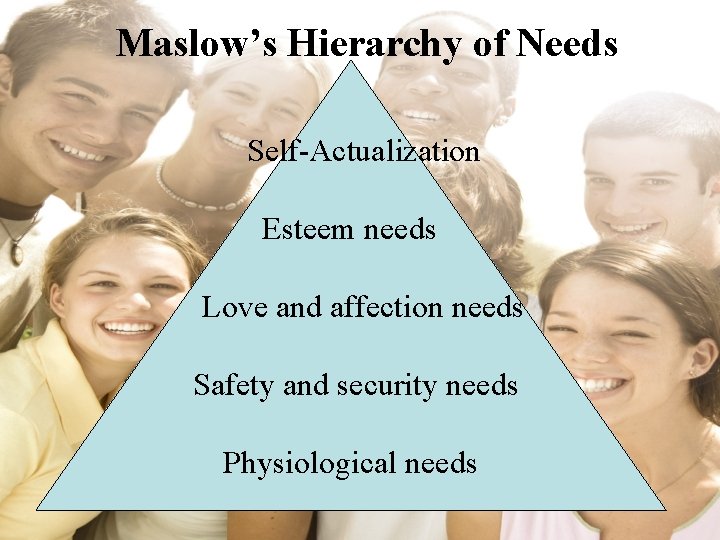
Maslow’s Hierarchy of Needs Self-Actualization Esteem needs Love and affection needs Safety and security needs Physiological needs
William Schutz’s three basic Interpersonal needs 1. The need to give or receive affection 2. The need to include other or be included in relationships. 3. The need to control others or relinquish control to them.
Communication with others Affect on attitude for communicating with others 2 types of people » Extroverted Social individuals who are relationship orientated people » Introverted People who are more focused on themselves rather than on the needs of others.
How we make predictions about others based on first impressions • Physical characteristics • Social traits • Emotional states • Stereotyping
Confirming Perceptions • Checking perception – Seek more information to verify perceptions – Recognize that even if your original perceptions were accurate, people can change over time – Talk with people about whom you are forming perceptions – Check perceptions verbally • Perception check – Verbal statement that reflects your understanding