
ANALYTICS WHAT WHY WHO WHERE WHEN AND HOW


- Slides: 17
ANALYTICS – WHAT, WHY, WHO, WHERE, WHEN AND HOW Views on the hype and reality
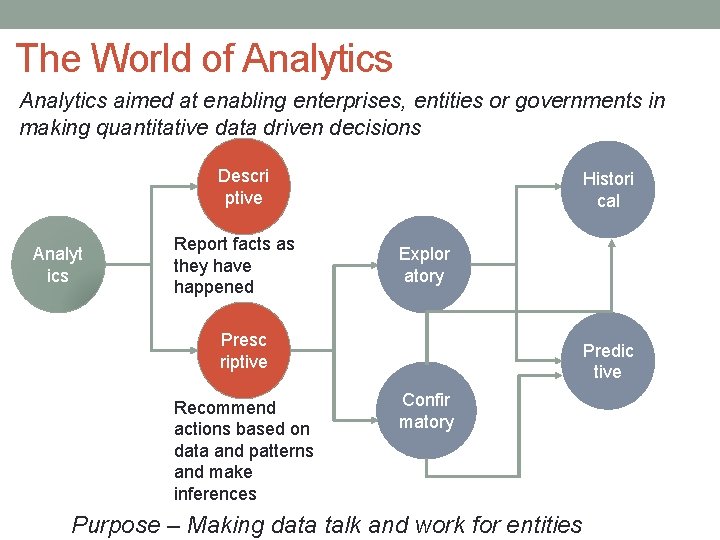
The World of Analytics aimed at enabling enterprises, entities or governments in making quantitative data driven decisions Descri ptive Analyt ics Report facts as they have happened Histori cal Explor atory Presc riptive Recommend actions based on data and patterns and make inferences Predic tive Confir matory Purpose – Making data talk and work for entities
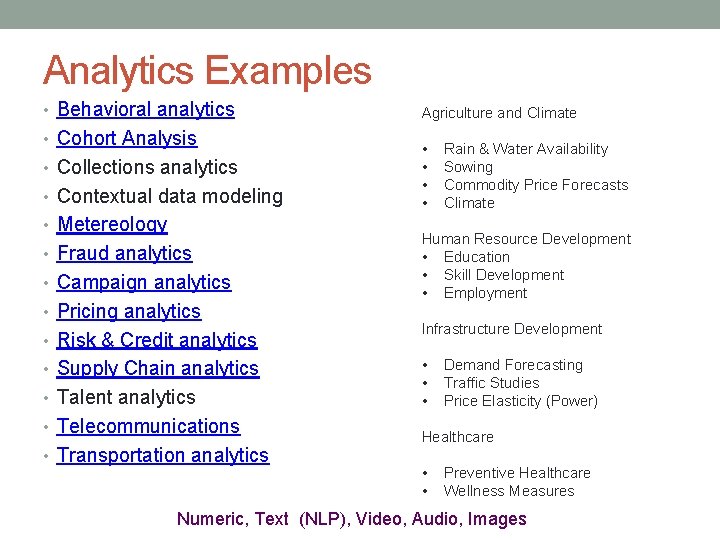
Analytics Examples • Behavioral analytics • Cohort Analysis • Collections analytics • Contextual data modeling • Metereology • Fraud analytics • Campaign analytics • Pricing analytics • Risk & Credit analytics • Supply Chain analytics • Talent analytics • Telecommunications • Transportation analytics Agriculture and Climate • • Rain & Water Availability Sowing Commodity Price Forecasts Climate Human Resource Development • Education • Skill Development • Employment Infrastructure Development • • • Demand Forecasting Traffic Studies Price Elasticity (Power) Healthcare • • Preventive Healthcare Wellness Measures Numeric, Text (NLP), Video, Audio, Images
Predictive Analytics Time series – ARMA, GARCH, Curve Fitting, Hidden Markov Parametric methods – Regression and variants Non-parametric methods – SVMs, Neural Networks Semi-parametric methods – Kernels, Splines, Wavelets Predictions based on historical data and patterns – inductive versus deductive Predictions not crystal ball gazing Early predictions and not late Predictions to influence
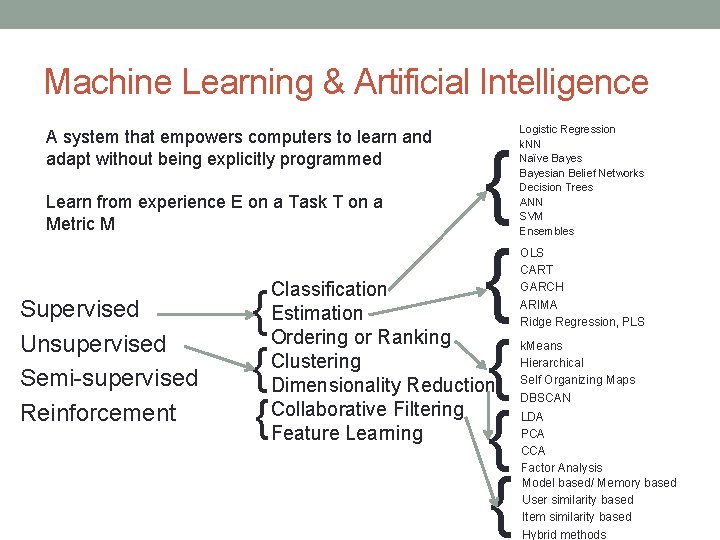
Machine Learning & Artificial Intelligence A system that empowers computers to learn and adapt without being explicitly programmed Learn from experience E on a Task T on a Metric M Supervised Unsupervised Semi-supervised Reinforcement { { { Classification Estimation Ordering or Ranking Clustering Dimensionality Reduction Collaborative Filtering Feature Learning { { { Logistic Regression k. NN Naïve Bayesian Belief Networks Decision Trees ANN SVM Ensembles OLS CART GARCH ARIMA Ridge Regression, PLS k. Means Hierarchical Self Organizing Maps DBSCAN LDA PCA CCA Factor Analysis Model based/ Memory based User similarity based Item similarity based Hybrid methods
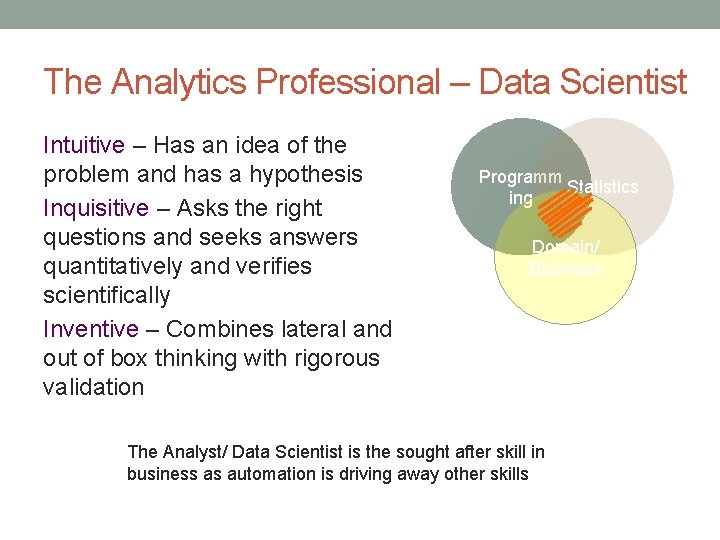
The Analytics Professional – Data Scientist Intuitive – Has an idea of the problem and has a hypothesis Inquisitive – Asks the right questions and seeks answers quantitatively and verifies scientifically Inventive – Combines lateral and out of box thinking with rigorous validation Programm Statistics ing Domain/ Business The Analyst/ Data Scientist is the sought after skill in business as automation is driving away other skills
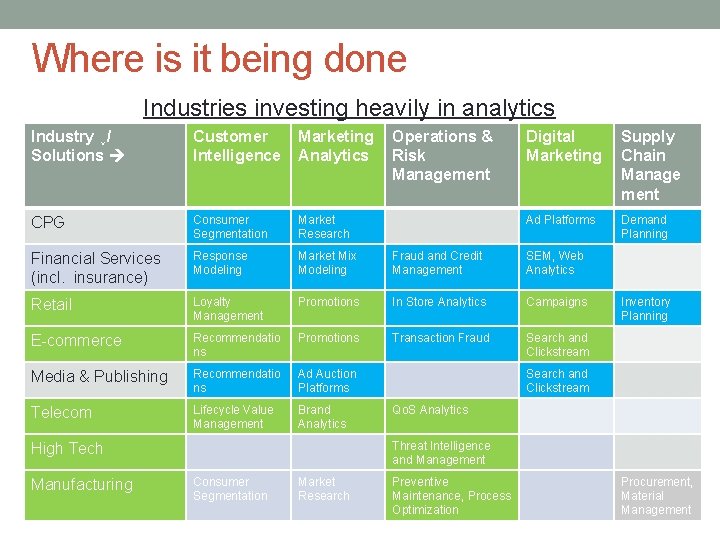
Where is it being done Industries investing heavily in analytics Industry ↓/ Solutions Customer Intelligence Marketing Analytics CPG Consumer Segmentation Market Research Financial Services (incl. insurance) Response Modeling Market Mix Modeling Fraud and Credit Management SEM, Web Analytics Retail Loyalty Management Promotions In Store Analytics Campaigns E-commerce Recommendatio ns Promotions Transaction Fraud Search and Clickstream Media & Publishing Recommendatio ns Ad Auction Platforms Telecom Lifecycle Value Management Brand Analytics Digital Marketing Supply Chain Manage ment Ad Platforms Demand Planning Inventory Planning Search and Clickstream Qo. S Analytics Threat Intelligence and Management High Tech Manufacturing Operations & Risk Management Consumer Segmentation Market Research Preventive Maintenance, Process Optimization Procurement, Material Management
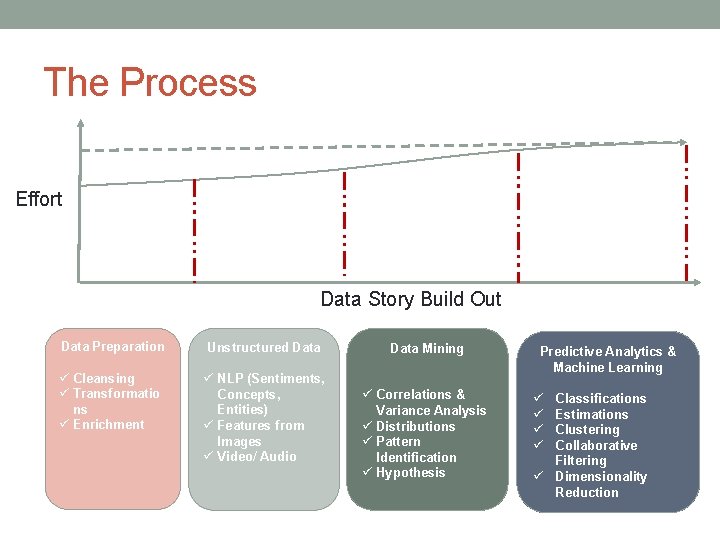
The Process Effort Data Story Build Out Data Preparation Unstructured Data ü Cleansing ü Transformatio ns ü Enrichment ü NLP (Sentiments, Concepts, Entities) ü Features from Images ü Video/ Audio Data Mining ü Correlations & Variance Analysis ü Distributions ü Pattern Identification ü Hypothesis Predictive Analytics & Machine Learning ü ü Classifications Estimations Clustering Collaborative Filtering ü Dimensionality Reduction
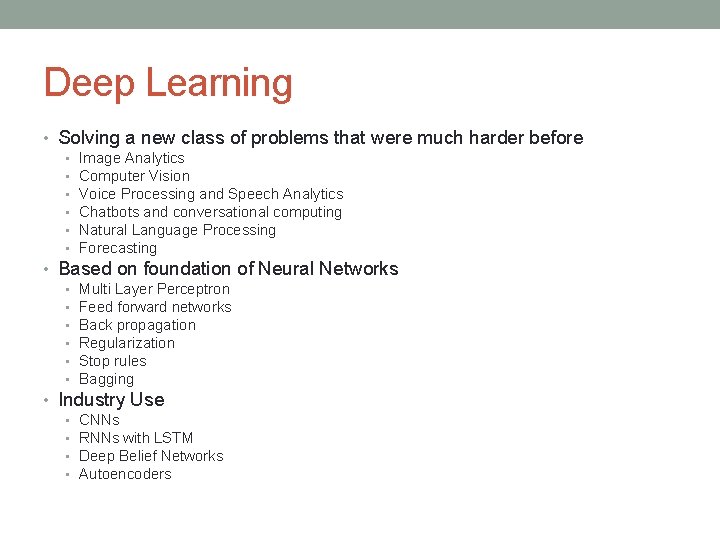
Deep Learning • Solving a new class of problems that were much harder before • • • Image Analytics Computer Vision Voice Processing and Speech Analytics Chatbots and conversational computing Natural Language Processing Forecasting • Based on foundation of Neural Networks • • • Multi Layer Perceptron Feed forward networks Back propagation Regularization Stop rules Bagging • Industry Use • • CNNs RNNs with LSTM Deep Belief Networks Autoencoders
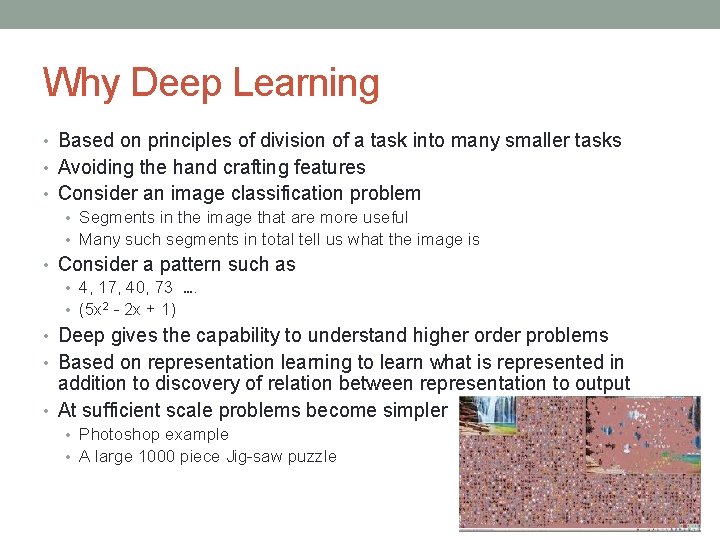
Why Deep Learning • Based on principles of division of a task into many smaller tasks • Avoiding the hand crafting features • Consider an image classification problem • Segments in the image that are more useful • Many such segments in total tell us what the image is • Consider a pattern such as • 4, 17, 40, 73 …. • (5 x 2 – 2 x + 1) • Deep gives the capability to understand higher order problems • Based on representation learning to learn what is represented in addition to discovery of relation between representation to output • At sufficient scale problems become simpler • Photoshop example • A large 1000 piece Jig-saw puzzle
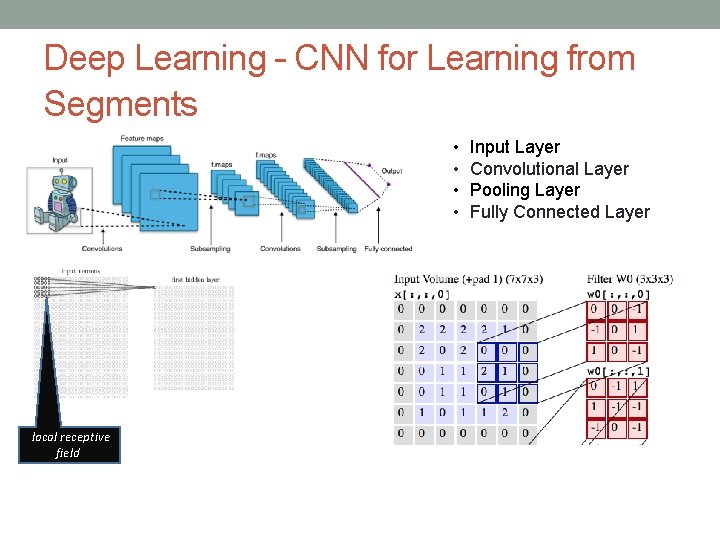
Deep Learning – CNN for Learning from Segments • • local receptive field Input Layer Convolutional Layer Pooling Layer Fully Connected Layer
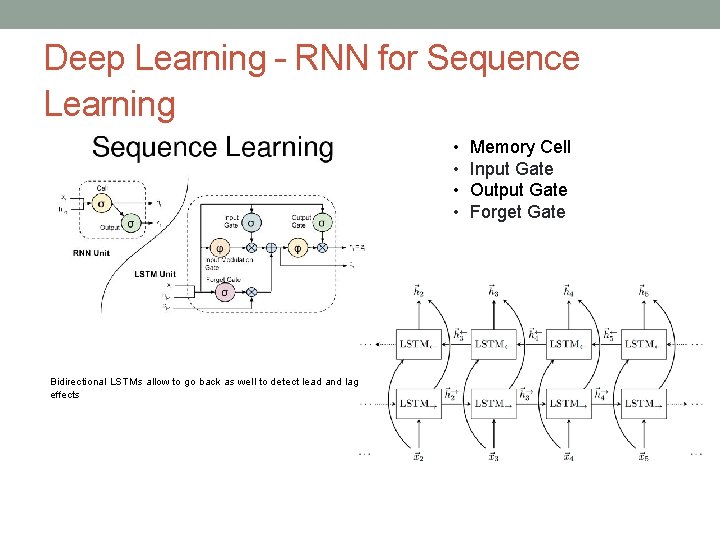
Deep Learning – RNN for Sequence Learning • • Bidirectional LSTMs allow to go back as well to detect lead and lag effects Memory Cell Input Gate Output Gate Forget Gate
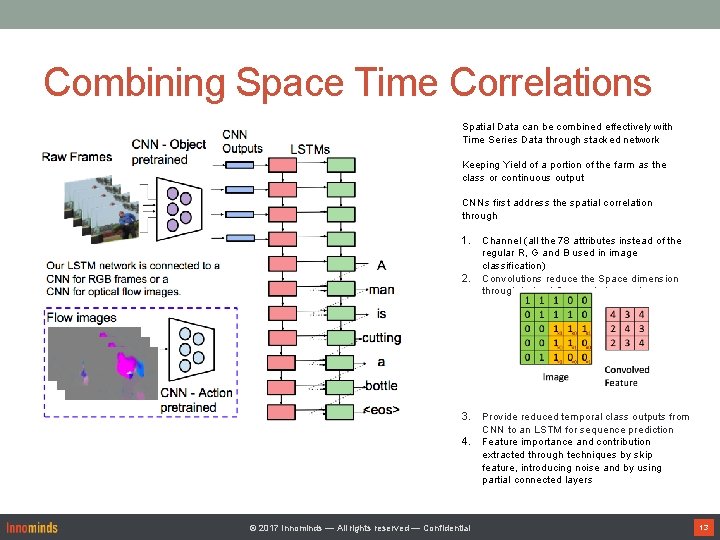
Combining Space Time Correlations Spatial Data can be combined effectively with Time Series Data through stacked network Keeping Yield of a portion of the farm as the class or continuous output CNNs first address the spatial correlation through 1. 2. 3. 4. © 2017 Innominds — All rights reserved — Confidential Channel (all the 78 attributes instead of the regular R, G and B used in image classification) Convolutions reduce the Space dimension through trained Sparse Autoencoders Provide reduced temporal class outputs from CNN to an LSTM for sequence prediction Feature importance and contribution extracted through techniques by skip feature, introducing noise and by using partial connected layers 13
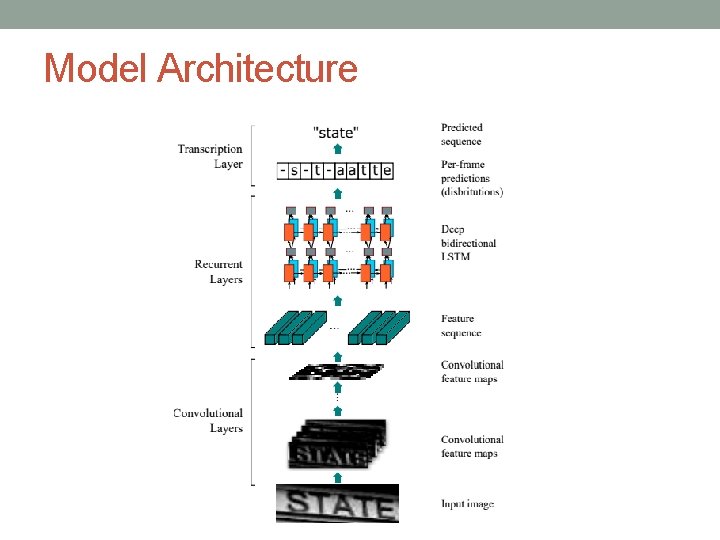
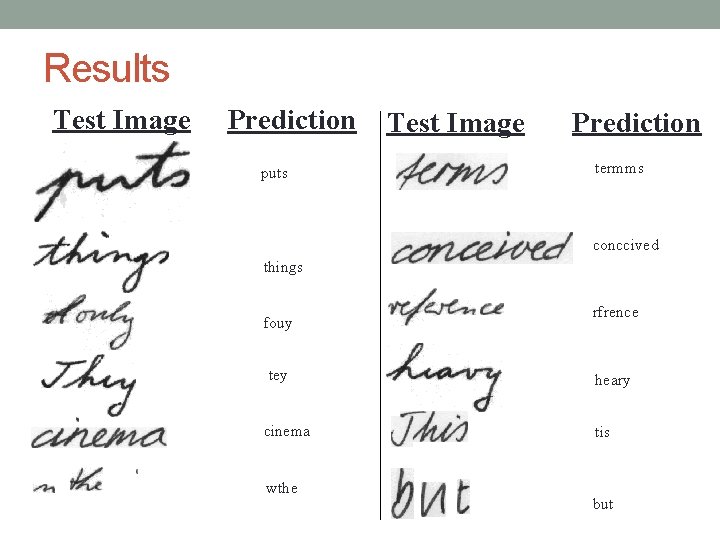
Handwritten Word Recognition
Model Architecture
Results Test Image Prediction puts Test Image Prediction termms conccived things fouy tey cinema wthe rfrence heary tis but
THANK YOU Questions? “Questioning and persistent questioning is the only guaranteed way to learn”