
ANALYTICAL ULTRACENTRIFUGATI ON Chelsea Aitken Peter Aspinall What
- Slides: 15
ANALYTICAL ULTRACENTRIFUGATI ON Chelsea Aitken Peter Aspinall
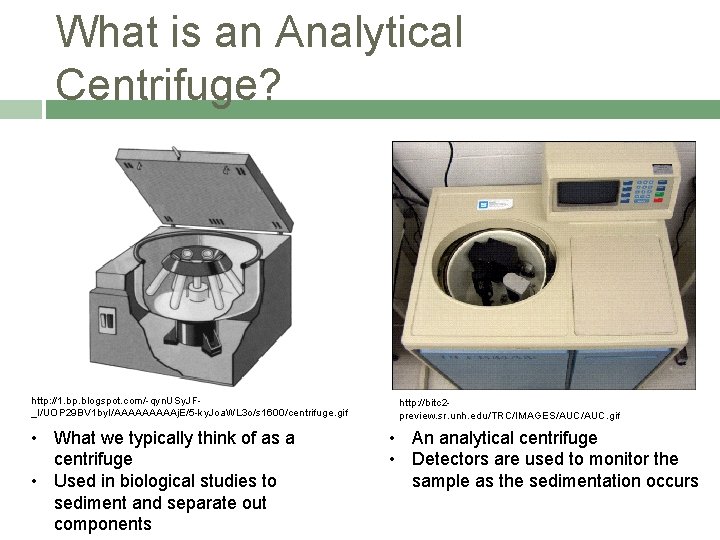
What is an Analytical Centrifuge? http: //1. bp. blogspot. com/-qyn. USy. JF_I/UOP 29 BV 1 by. I/AAAAAj. E/5 -ky. Joa. WL 3 o/s 1600/centrifuge. gif • What we typically think of as a centrifuge • Used in biological studies to sediment and separate out components http: //bitc 2 preview. sr. unh. edu/TRC/IMAGES/AUC. gif • An analytical centrifuge • Detectors are used to monitor the sample as the sedimentation occurs
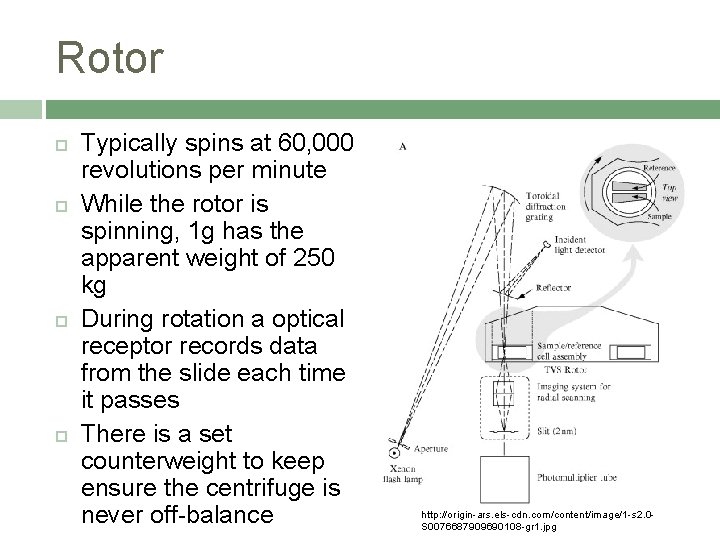
Rotor Typically spins at 60, 000 revolutions per minute While the rotor is spinning, 1 g has the apparent weight of 250 kg During rotation a optical receptor records data from the slide each time it passes There is a set counterweight to keep ensure the centrifuge is never off-balance http: //origin-ars. els-cdn. com/content/image/1 -s 2. 0 S 0076687909690108 -gr 1. jpg
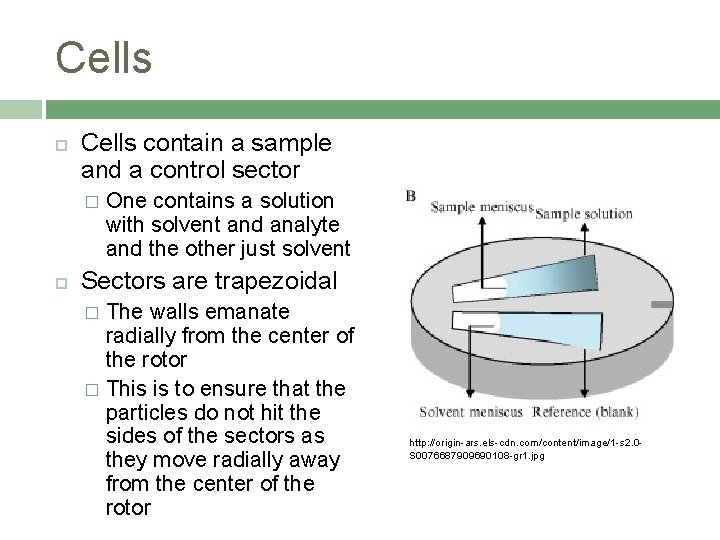
Cells contain a sample and a control sector � One contains a solution with solvent and analyte and the other just solvent Sectors are trapezoidal The walls emanate radially from the center of the rotor � This is to ensure that the particles do not hit the sides of the sectors as they move radially away from the center of the rotor � http: //origin-ars. els-cdn. com/content/image/1 -s 2. 0 S 0076687909690108 -gr 1. jpg
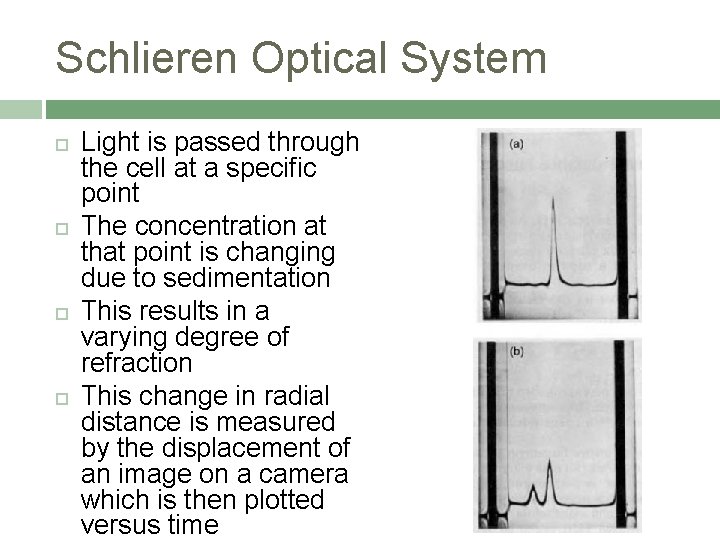
Schlieren Optical System Light is passed through the cell at a specific point The concentration at that point is changing due to sedimentation This results in a varying degree of refraction This change in radial distance is measured by the displacement of an image on a camera which is then plotted versus time
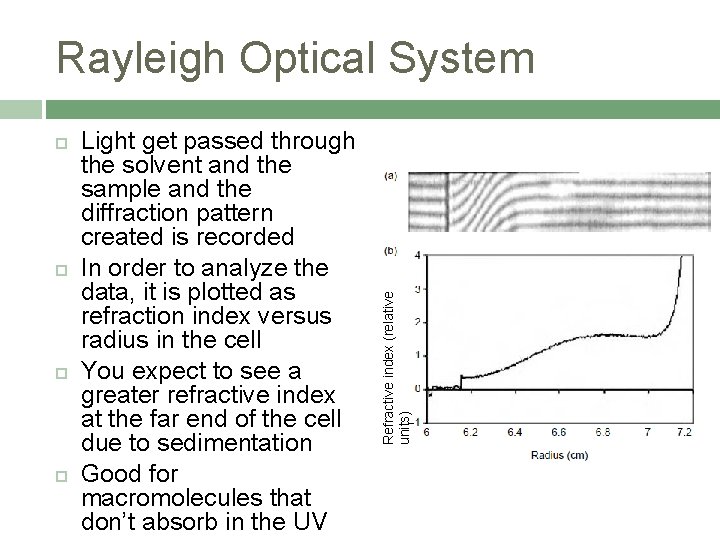
Light get passed through the solvent and the sample and the diffraction pattern created is recorded In order to analyze the data, it is plotted as refraction index versus radius in the cell You expect to see a greater refractive index at the far end of the cell due to sedimentation Good for macromolecules that don’t absorb in the UV Refractive index (relative units) Rayleigh Optical System
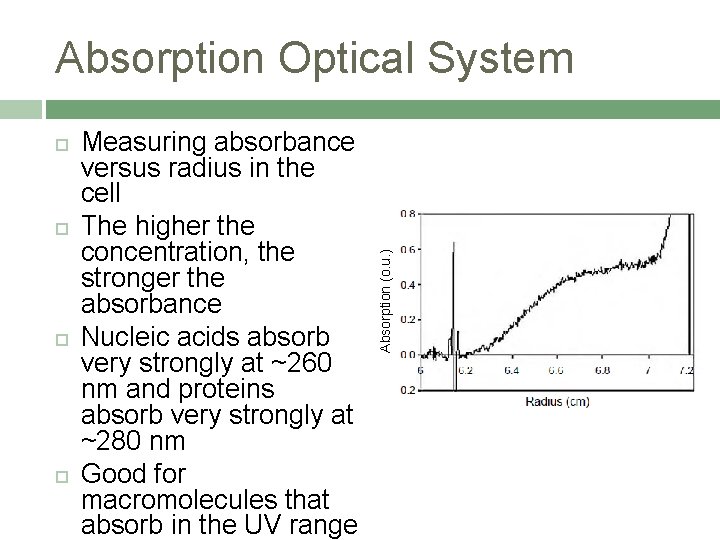
Measuring absorbance versus radius in the cell The higher the concentration, the stronger the absorbance Nucleic acids absorb very strongly at ~260 nm and proteins absorb very strongly at ~280 nm Good for macromolecules that absorb in the UV range Absorption (o. u. ) Absorption Optical System
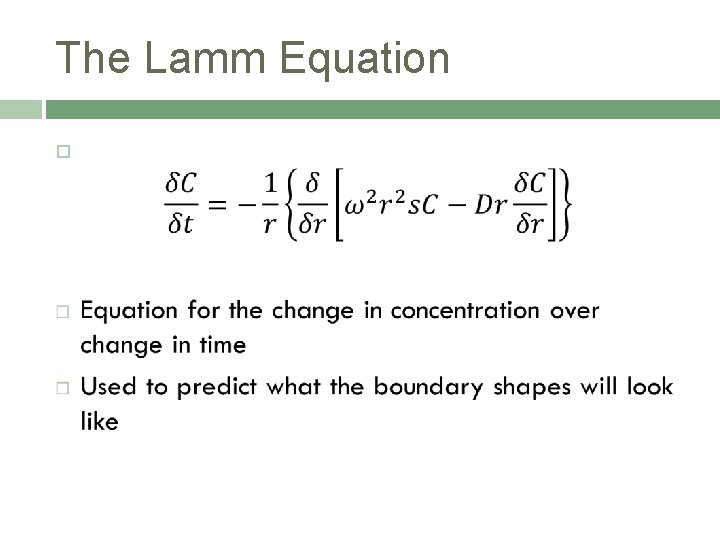
The Lamm Equation
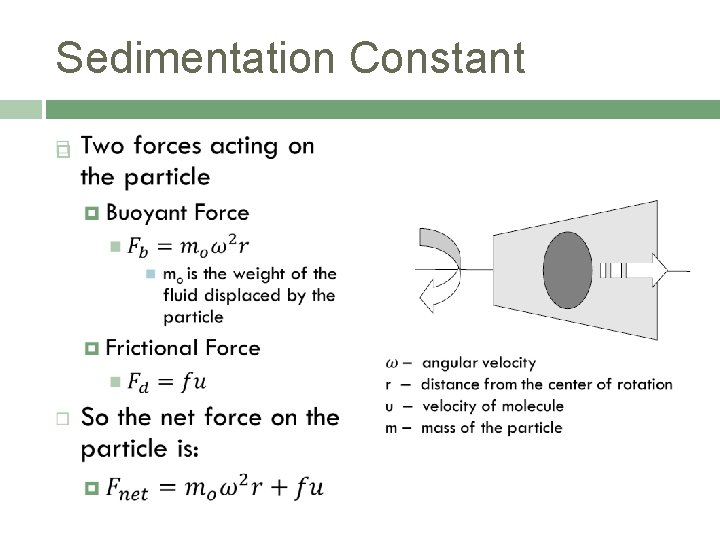
Sedimentation Constant
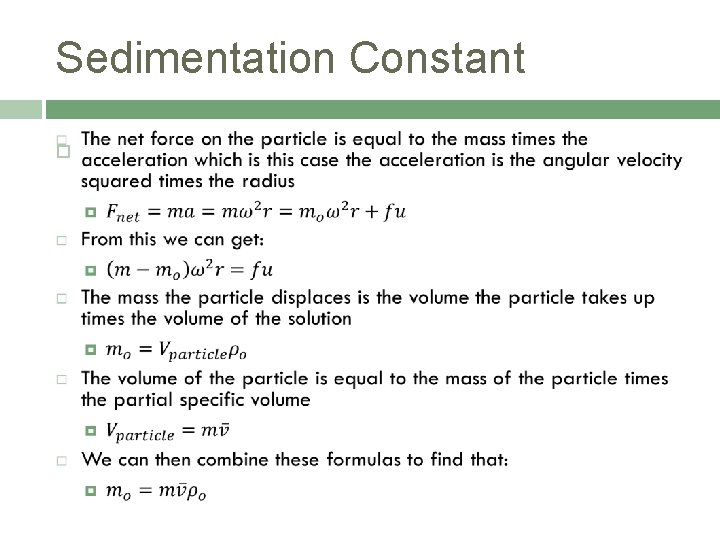
Sedimentation Constant
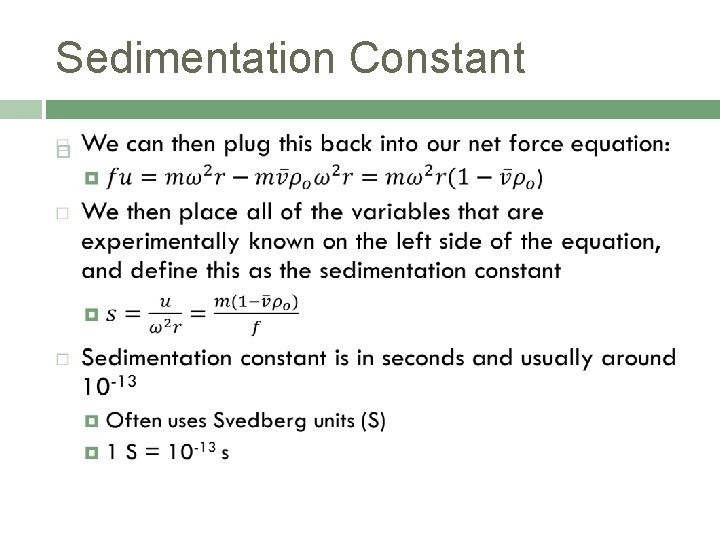
Sedimentation Constant
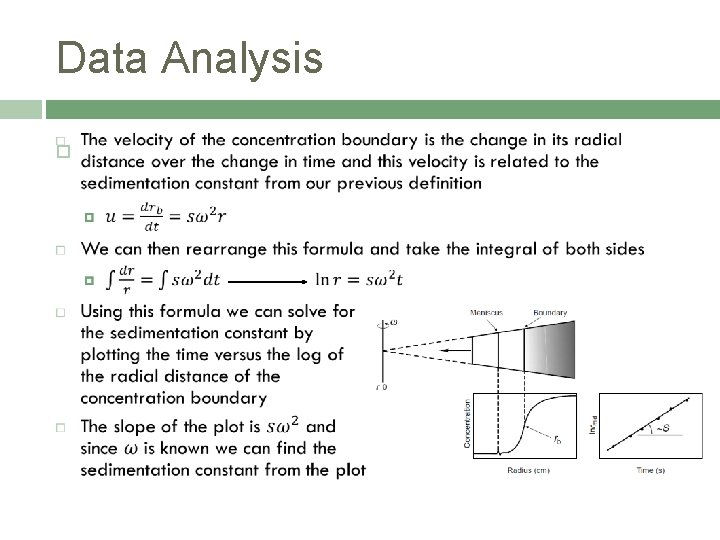
Data Analysis
Analyzing Heterogeneous Solutions What happens when the solution has multiple macromolecules in it? � If the solution is spun slowly, the smallest molecules will not sediment out quickly enough (or at all) and will not produce a useful gradient � If the solution is spun very fast, the largest molecules sediment out too fast and will not be able to be observed To account for this the speed is ratcheted up after a set time step in order to be able to observe a peak for each macromolecule type in the solution
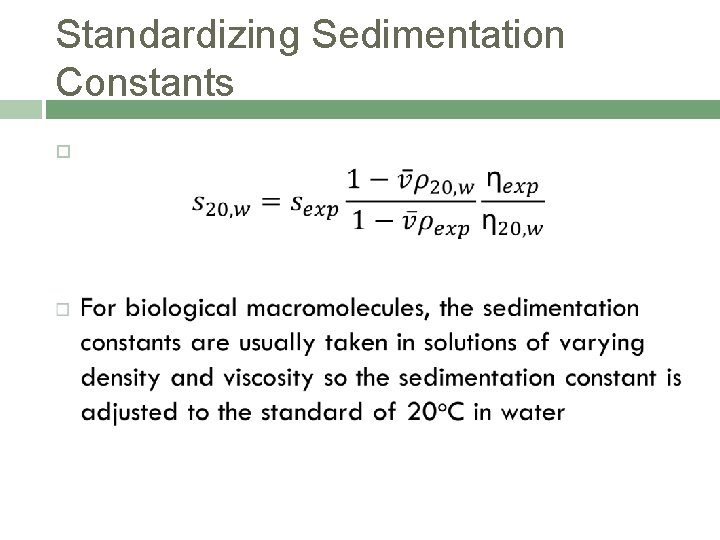
Standardizing Sedimentation Constants
Information taken from: Serdyuk, Igor N. , Nathan R. Zaccai, and Joseph Zaccai. Methods in Molecular Biophysics: Structure, Dynamics, Function. New York: Cambridge University Press, 2007. Print.