
Analytical methods for studying trace metal speciation in







- Slides: 47
Analytical methods for studying trace metal speciation in the natural environment (Analytiske metoder for speciering av spormetaller i naturen) As Hg Cr Sn Se Pb Cd Fe Cu Zn Ni Co Al …. . Date: 8 February 2006 Duration: 45 minutes Target groups: 1 st and 2 nd year Chemistry students Ana BANICA Prøveforelesning 2006 1
Ana BANICA Prøveforelesning 2006 2
Contents 1. Chemical speciation and fractionation 2. Analytical strategies and methodological approaches 3. In-situ (on-field) speciation analysis in aquatic systems 4. Conclusions Ana BANICA Prøveforelesning 2006 3
1. Chemical Speciation and Fractionation Ana BANICA Prøveforelesning 2006 4
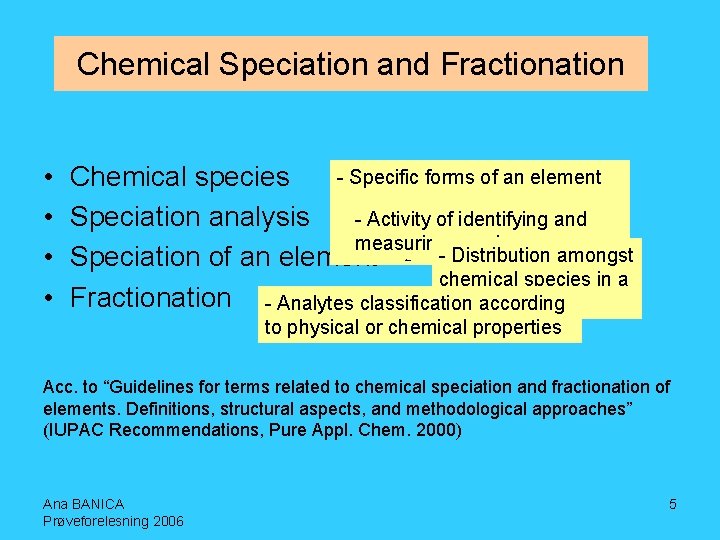
Chemical Speciation and Fractionation • • - Specific forms of an element Chemical species Fe(II)/Fe(III); As(III)/As(V) - Activity of identifying and Speciation analysis measuring species Cu. Cl 2/Cu. CO 3; Hg/CH 3 Hg. Cl - Distribution amongst Speciation of an element chemical species in a Fractionation - Analytes classification according system to physical or chemical properties Acc. to “Guidelines for terms related to chemical speciation and fractionation of elements. Definitions, structural aspects, and methodological approaches” (IUPAC Recommendations, Pure Appl. Chem. 2000) Ana BANICA Prøveforelesning 2006 5
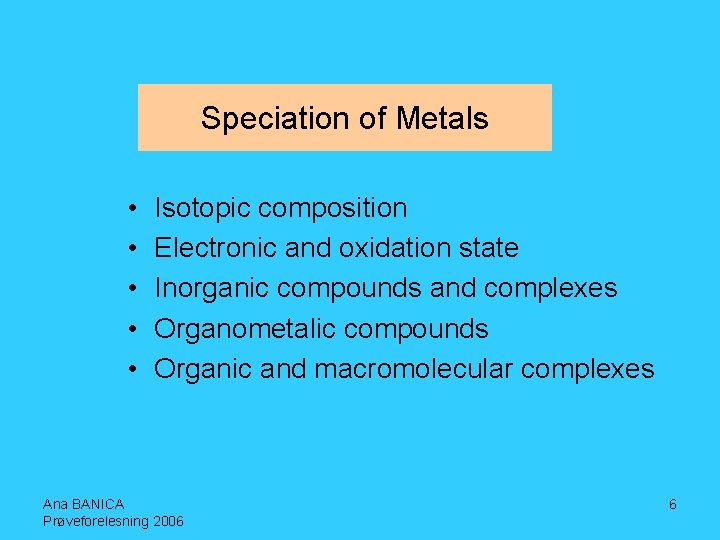
Speciation of Metals • • • Isotopic composition Electronic and oxidation state Inorganic compounds and complexes Organometalic compounds Organic and macromolecular complexes Ana BANICA Prøveforelesning 2006 6
Benefits and Fields of Interest Ana BANICA Prøveforelesning 2006 7
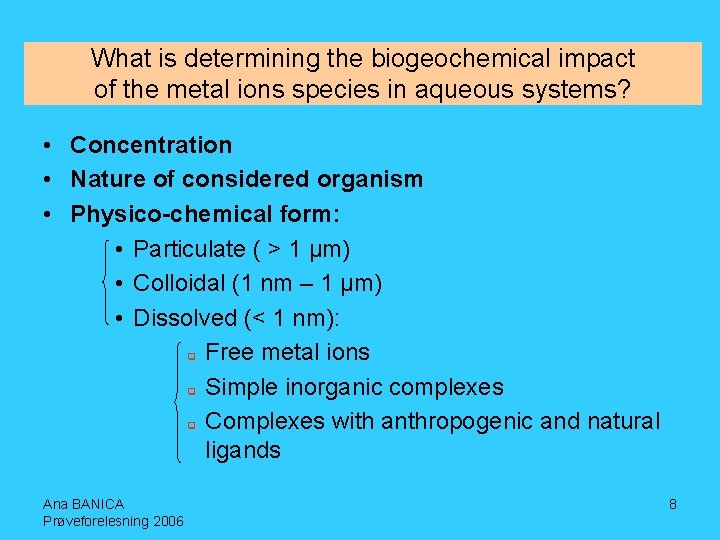
What is determining the biogeochemical impact of the metal ions species in aqueous systems? • Concentration • Nature of considered organism • Physico-chemical form: • Particulate ( > 1 µm) • Colloidal (1 nm – 1 µm) • Dissolved (< 1 nm): q Free metal ions q Simple inorganic complexes q Complexes with anthropogenic and natural ligands Ana BANICA Prøveforelesning 2006 8
2. Analytical Strategies and Methodological Approaches Ana BANICA Prøveforelesning 2006 9
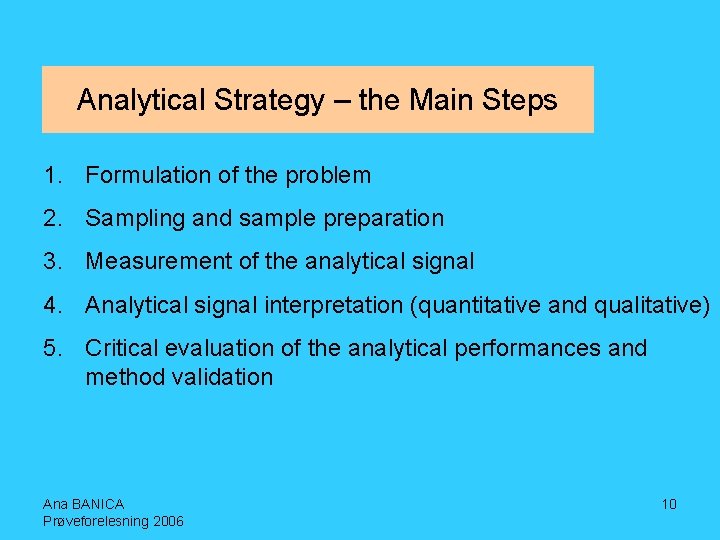
Analytical Strategy – the Main Steps 1. Formulation of the problem 2. Sampling and sample preparation 3. Measurement of the analytical signal 4. Analytical signal interpretation (quantitative and qualitative) 5. Critical evaluation of the analytical performances and method validation Ana BANICA Prøveforelesning 2006 10
What is relevant in a metal speciation study? Individual species Groups of different species with similar properties 1. Formulation of the problem Ana BANICA Prøveforelesning 2006 11
Bio-uptake of Metal Species in Soils • Exchangeable fraction: species most available for biouptake (reagent used: acetic acid 0. 11 M) • Reducible fraction: potentially available for plants (reagent used: a reducing agent like hydroxylamine chloride) • Oxidizable fraction: potentially available for plants (reagent used: an oxidizing agent like H 2 O 2 and NH 4 COOCH 3) • Rezidual fraction: contains naturally occurring minerals Ana BANICA Prøveforelesning 2006 12
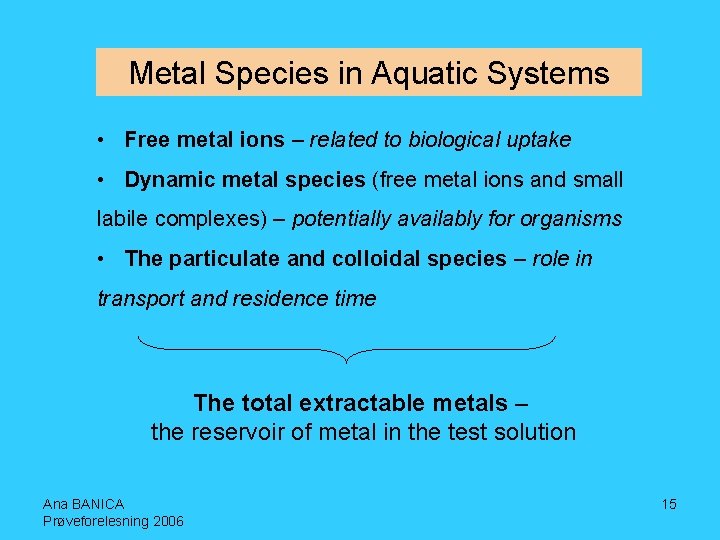
Bio-uptake of Metal Species in Aquatic Systems • Free metal ions – related to biological uptake • Dynamic metal species (free metal ions and small labile complexes) – potentially availably for organisms • The particulate and colloidal species – role in transport and residence time The total extractable metals – the reservoir of metal in the test solution Ana BANICA Prøveforelesning 2006 13
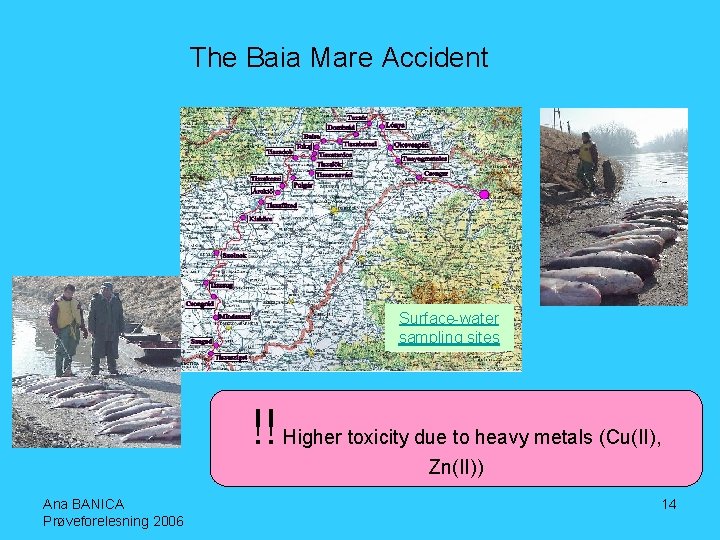
The Baia Mare Accident Surface-water sampling sites !! Higher toxicity due to heavy metals (Cu(II), Zn(II)) Ana BANICA Prøveforelesning 2006 14
Metal Species in Aquatic Systems • Free metal ions – related to biological uptake • Dynamic metal species (free metal ions and small labile complexes) – potentially availably for organisms • The particulate and colloidal species – role in transport and residence time The total extractable metals – the reservoir of metal in the test solution Ana BANICA Prøveforelesning 2006 15
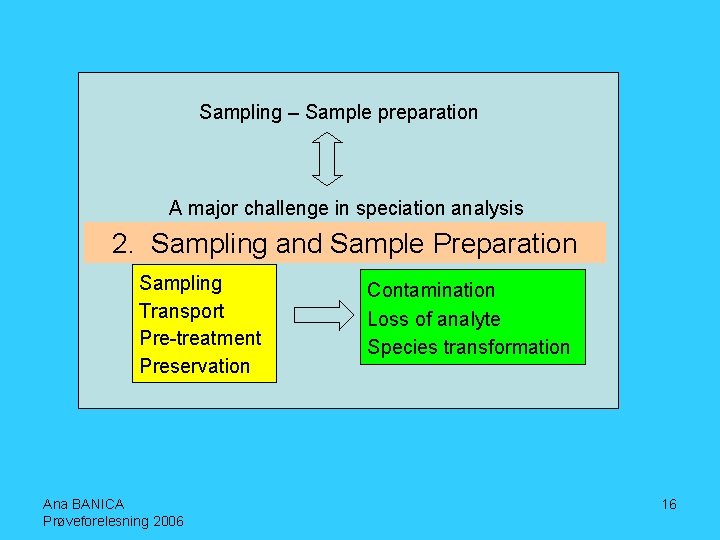
Sampling – Sample preparation A major challenge in speciation analysis 2. Sampling and Sample Preparation Sampling Transport Pre-treatment Preservation Ana BANICA Prøveforelesning 2006 Contamination Loss of analyte Species transformation 16
What is influencing the species stability? • Chemical factors • Physical factors • Biological factors Ana BANICA Prøveforelesning 2006 17
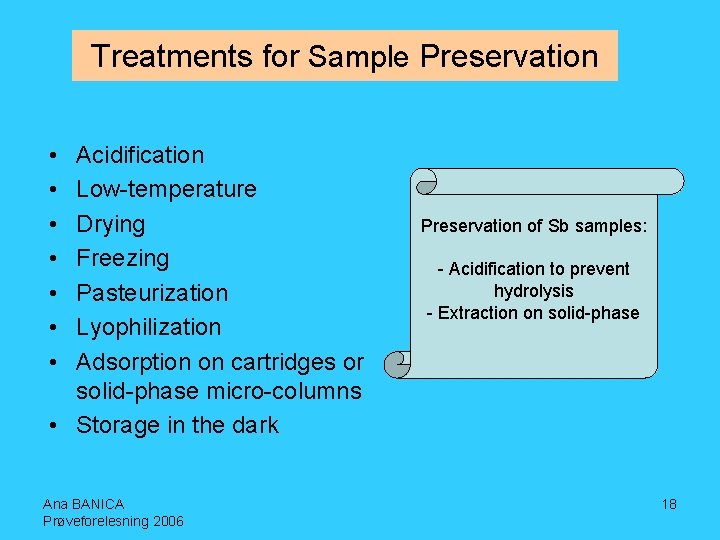
Treatments for Sample Preservation • • Acidification Low-temperature Drying Freezing Pasteurization Lyophilization Adsorption on cartridges or solid-phase micro-columns • Storage in the dark Ana BANICA Prøveforelesning 2006 Preservation of Sb samples: - Acidification to prevent hydrolysis - Extraction on solid-phase 18
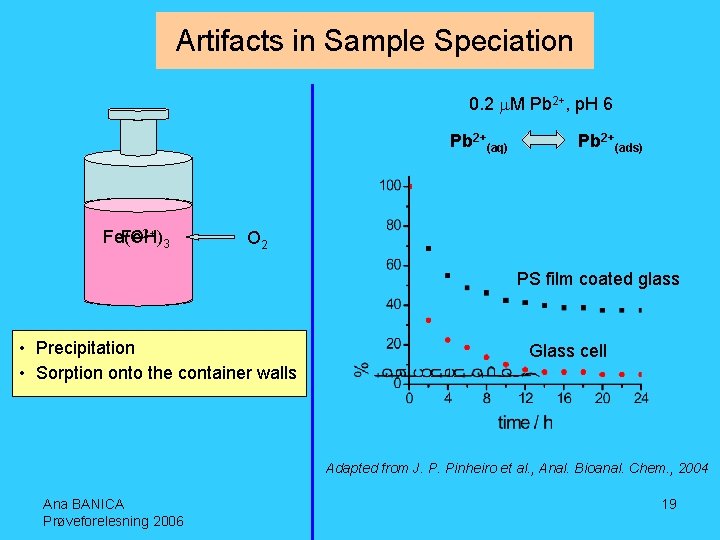
Artifacts in Sample Speciation 0. 2 m. M Pb 2+, p. H 6 Pb 2+(aq) Fe(OH) Fe 2+ 3 Pb 2+(ads) O 2 PS film coated glass • Precipitation • Sorption onto the container walls Glass cell Adapted from J. P. Pinheiro et al. , Anal. Bioanal. Chem. , 2004 Ana BANICA Prøveforelesning 2006 19
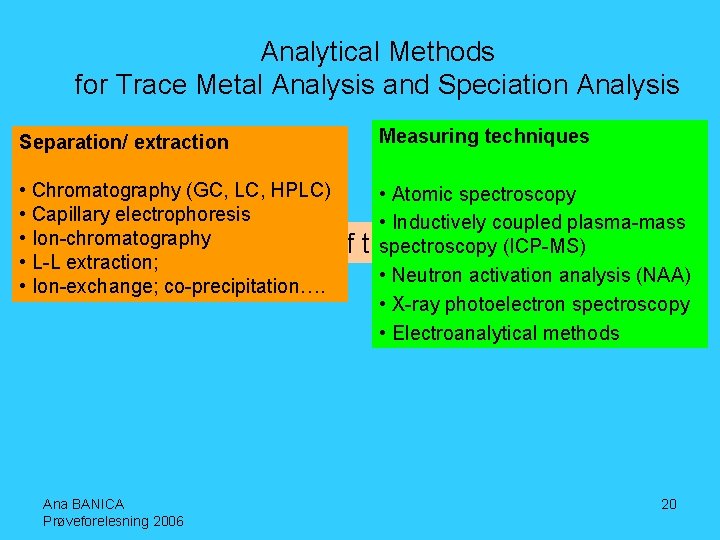
Analytical Methods for Trace Metal Analysis and Speciation Analysis Measuring techniques • Chromatography (GC, LC, HPLC) • Atomic spectroscopy • Capillary electrophoresis • Inductively coupled plasma-mass • Ion-chromatography 3. Measurement of the analytical signal spectroscopy (ICP-MS) • L-L extraction; • Neutron activation analysis (NAA) • Ion-exchange; co-precipitation…. • X-ray photoelectron spectroscopy • Electroanalytical methods Separation/ extraction Ana BANICA Prøveforelesning 2006 20
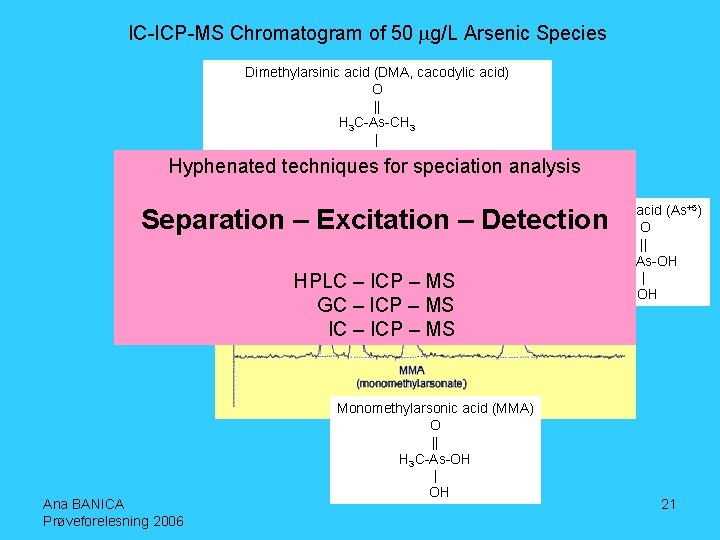
IC-ICP-MS Chromatogram of 50 mg/L Arsenic Species Dimethylarsinic acid (DMA, cacodylic acid) O || H 3 C-As-CH 3 | OH Hyphenated techniques for speciation analysis Arsenic acid (As+5) O || HO-As-OH | OH Separation – Excitation – Detection Arsenious acid (As+3) HO-As-OH | OH Ana BANICA Prøveforelesning 2006 HPLC – ICP – MS GC – ICP – MS IC – ICP – MS Monomethylarsonic acid (MMA) O || H 3 C-As-OH | OH 21
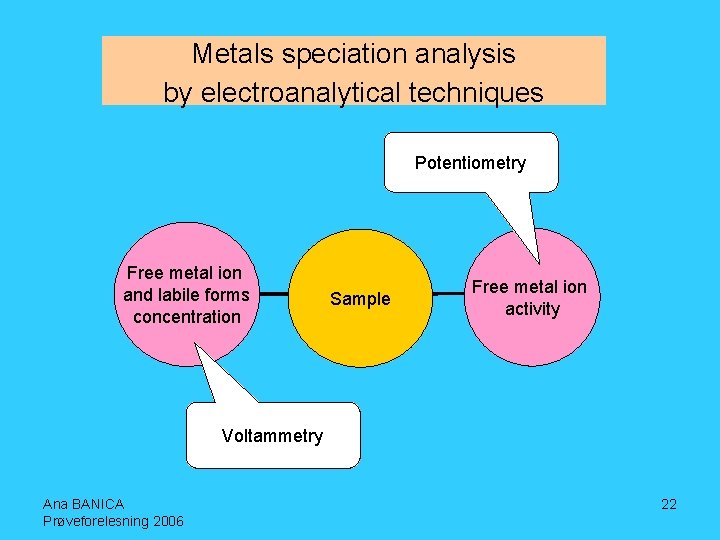
Metals speciation analysis by electroanalytical techniques Potentiometry Free metal ion and labile forms concentration Sample Free metal ion activity Voltammetry Ana BANICA Prøveforelesning 2006 22
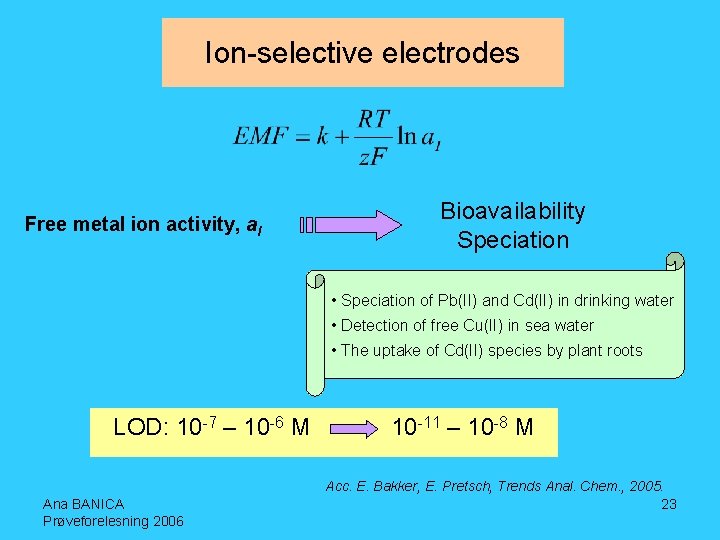
Ion-selective electrodes Free metal ion activity, a. I Bioavailability Speciation • Speciation of Pb(II) and Cd(II) in drinking water • Detection of free Cu(II) in sea water • The uptake of Cd(II) species by plant roots LOD: 10 -7 – 10 -6 M 10 -11 – 10 -8 M Ana BANICA Prøveforelesning 2006 Acc. E. Bakker, E. Pretsch, Trends Anal. Chem. , 2005. 23
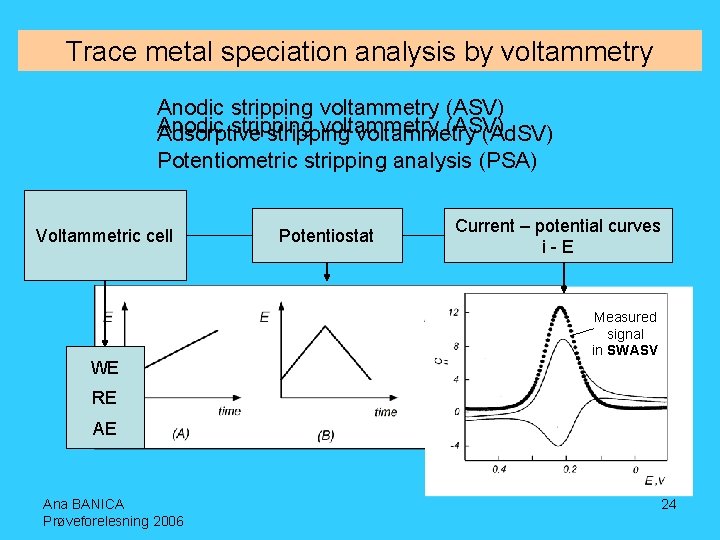
Trace metal speciation analysis by voltammetry Anodic stripping voltammetry (ASV) Adsorptive stripping voltammetry (Ad. SV) Potentiometric stripping analysis (PSA) Voltammetric cell WE Potentiostat Current – potential curves i - E Measured signal in SWASV RE AE Ana BANICA Prøveforelesning 2006 24
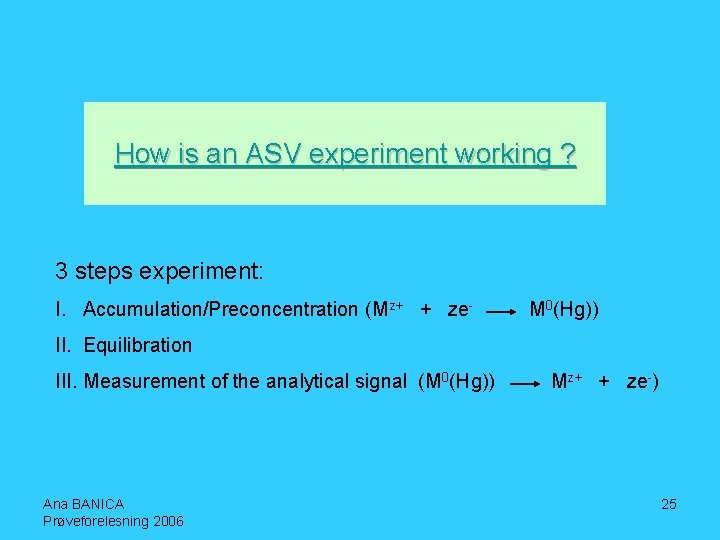
How is an ASV experiment working ? 3 steps experiment: I. Accumulation/Preconcentration (Mz+ + ze- M 0(Hg)) II. Equilibration III. Measurement of the analytical signal (M 0(Hg)) Mz+ + ze-) Ana BANICA Prøveforelesning 2006 25
Strengths and advantages of the voltammetric techniques • Accuracy • Sensitivity • Simplicity • Low detection limit (ppm - ppt) • Well-suited for automatic in situ speciation • Allow to determine the complexing properties of model or naturally occurring complexants Ana BANICA Prøveforelesning 2006 26
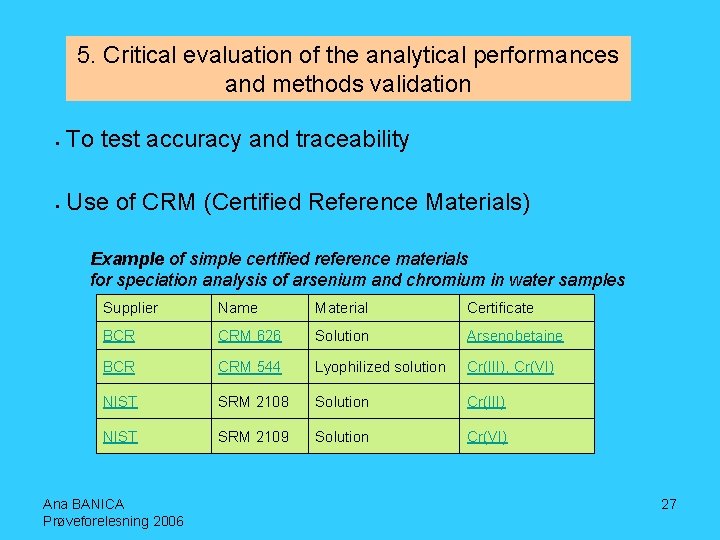
5. Critical evaluation of the analytical performances and methods validation § To test accuracy and traceability § Use of CRM (Certified Reference Materials) Example of simple certified reference materials for speciation analysis of arsenium and chromium in water samples Supplier Name Material Certificate BCR CRM 626 Solution Arsenobetaine BCR CRM 544 Lyophilized solution Cr(III), Cr(VI) NIST SRM 2108 Solution Cr(III) NIST SRM 2109 Solution Cr(VI) Ana BANICA Prøveforelesning 2006 27
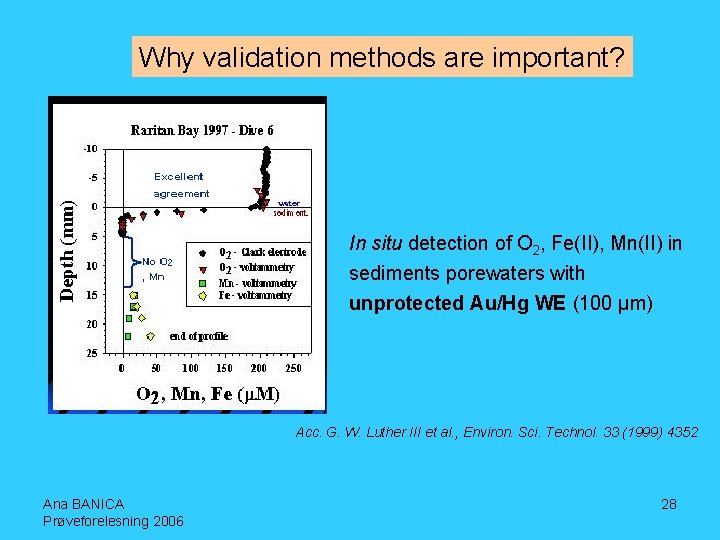
Why validation methods are important? In situ detection of O 2, Fe(II), Mn(II) in sediments porewaters with unprotected Au/Hg WE (100 μm) Acc. G. W. Luther III et al. , Environ. Sci. Technol. 33 (1999) 4352 Ana BANICA Prøveforelesning 2006 28
3. In-situ (on-field) speciation analysis in aquatic systems Ana BANICA Prøveforelesning 2006 29
ATMA (Automated Trace Metal Analyzer) VIP (Voltammetric In situ Profiler) In-situ voltammetric analyzers MPCP (Multi Physical-Chemical Profiler) Ana BANICA Prøveforelesning 2006 30
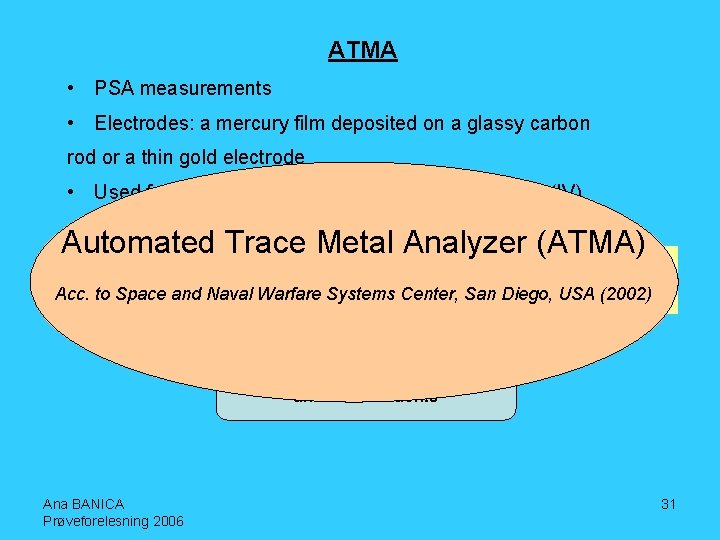
ATMA • PSA measurements • Electrodes: a mercury film deposited on a glassy carbon rod or a thin gold electrode • Used for measuring As(III); Cr(VI); Cu(II); Hg(II); Se(IV). Automated Trace Metal Analyzer (ATMA) Interferences from matrix (organics, solids, other metals) can Acc. to Space and Naval Warfare Systems Center, San Diego, USA (2002) have a dramatic effect on the accuracy of the instrument Caution in use on unpredictable or unknown effluents Ana BANICA Prøveforelesning 2006 31
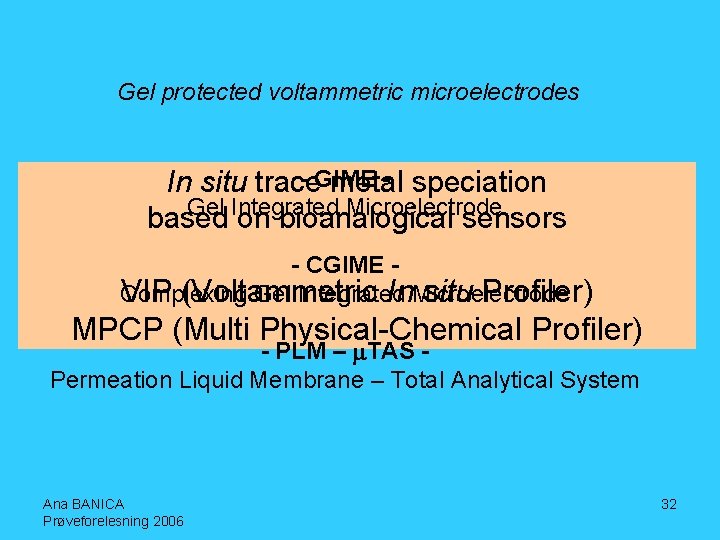
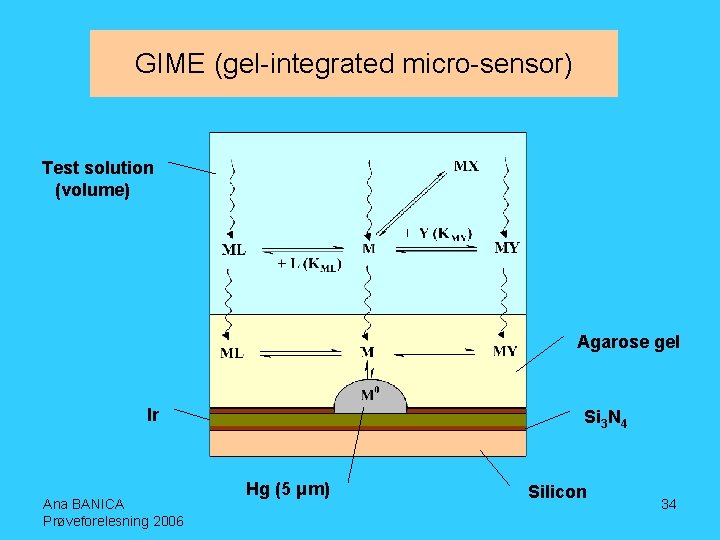
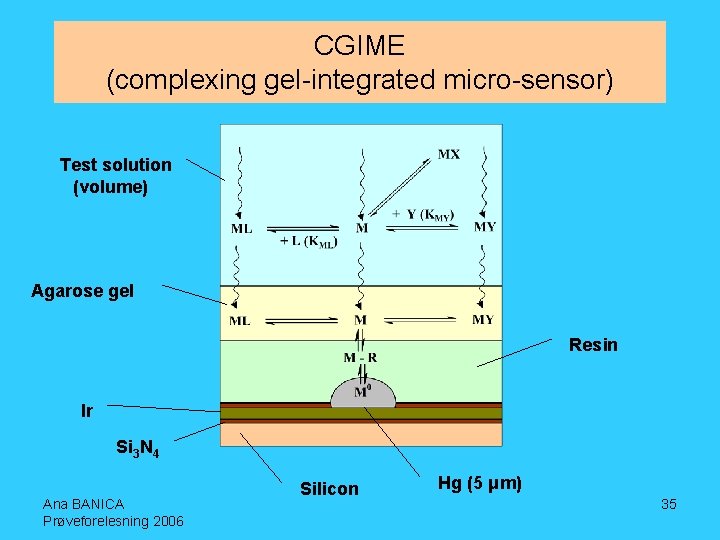
Gel protected voltammetric microelectrodes - GIME In situ trace metal speciation Gel Integrated Microelectrode based on bioanalogical sensors - CGIME VIP (Voltammetric In situ Profiler) Complexing Gel Integrated Microelectrode MPCP (Multi Physical-Chemical Profiler) - PLM – m. TAS Permeation Liquid Membrane – Total Analytical System Ana BANICA Prøveforelesning 2006 32
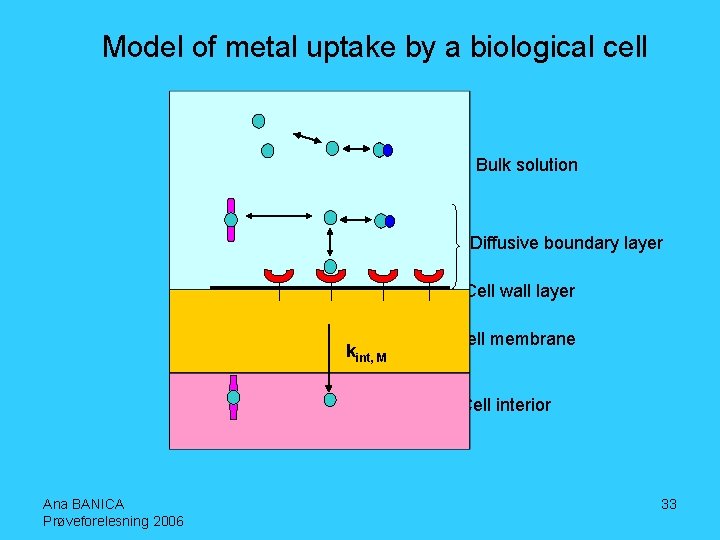
Model of metal uptake by a biological cell Bulk solution Diffusive boundary layer Cell wall layer kint, M Cell membrane Cell interior Ana BANICA Prøveforelesning 2006 33
GIME (gel-integrated micro-sensor) Test solution (volume) Agarose gel Ir Ana BANICA Prøveforelesning 2006 Si 3 N 4 Hg (5 μm) Silicon 34
CGIME (complexing gel-integrated micro-sensor) Test solution (volume) Agarose gel Resin Ir Si 3 N 4 Ana BANICA Prøveforelesning 2006 Silicon Hg (5 μm) 35
From voltammetric sensors to in situ probes Ana BANICA Prøveforelesning 2006 36
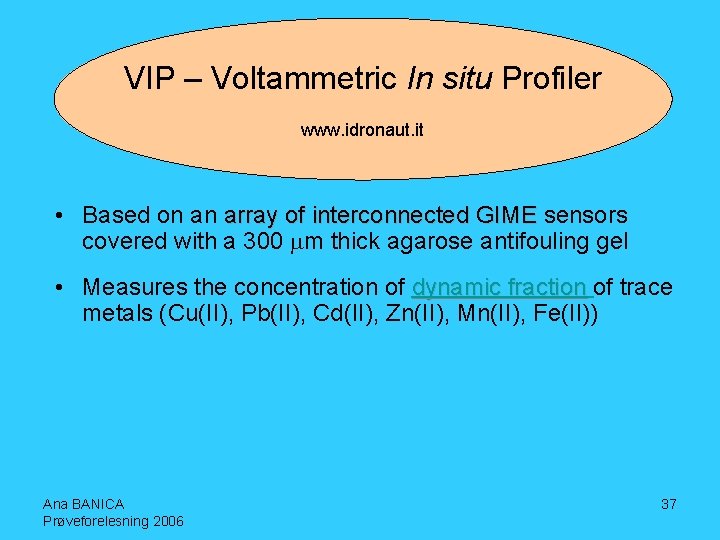
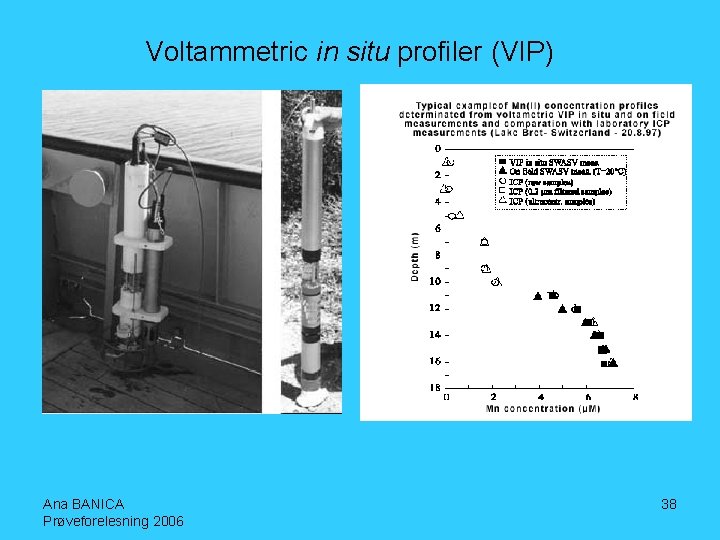
VIP – Voltammetric In situ Profiler www. idronaut. it • Based on an array of interconnected GIME sensors array of interconnected GIME covered with a 300 mm thick agarose antifouling gel • Measures the concentration of dynamic fraction of trace dynamic fraction metals (Cu(II), Pb(II), Cd(II), Zn(II), Mn(II), Fe(II)) Ana BANICA Prøveforelesning 2006 37
Voltammetric in situ profiler (VIP) Ana BANICA Prøveforelesning 2006 38
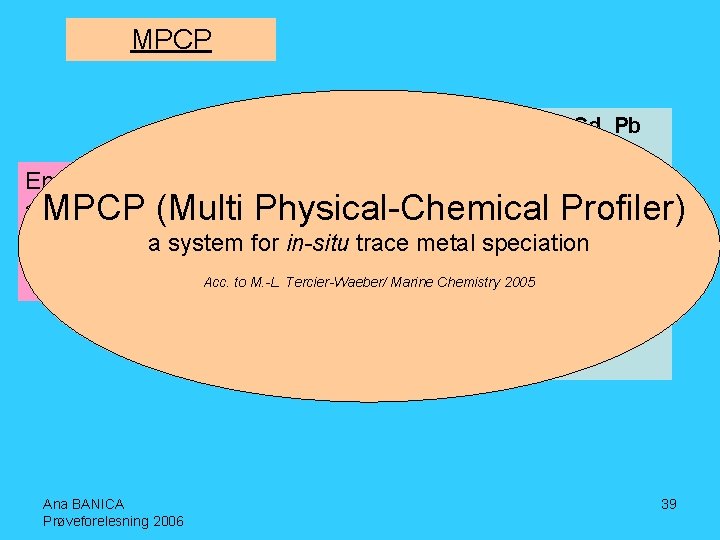
MPCP ð Speciation of Cu, Cd, Pb ð Pressure ð p. H Environmental monitoring ð Temperature and pollution control MPCP (Multi Physical-Chemical Profiler) ð O 2 a system for in-situ trace metal speciation ð Conductivity Biogeochemical studies Acc. to M. -L. Tercier-Waeber/ Marine Chemistry 2005 ð Salinity ð Redox potential ð Turbidity ð Chlorophyll a Ana BANICA Prøveforelesning 2006 39
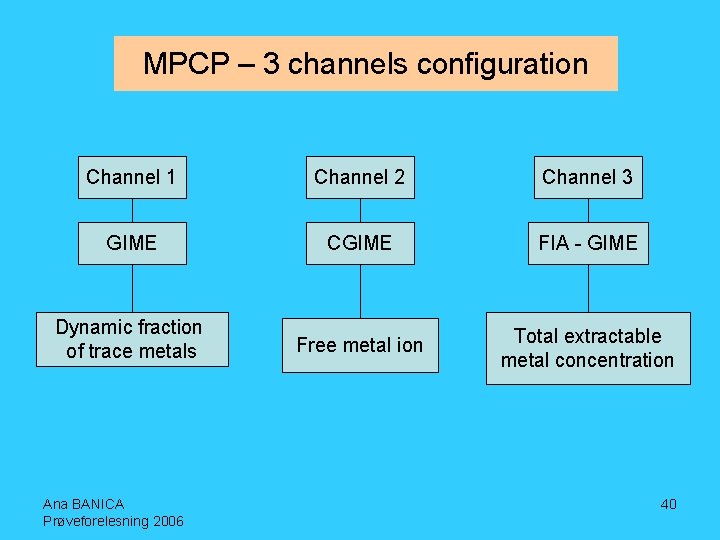
MPCP – 3 channels configuration Channel 1 Channel 2 Channel 3 GIME CGIME FIA - GIME Dynamic fraction of trace metals Free metal ion Total extractable metal concentration Ana BANICA Prøveforelesning 2006 40
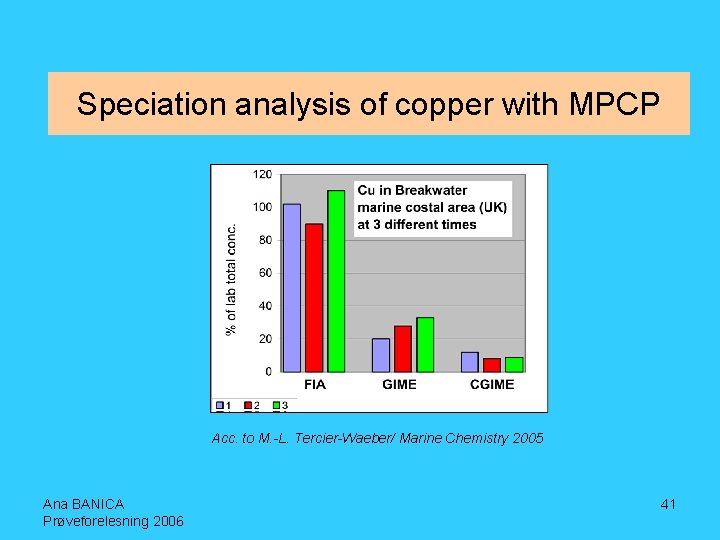
Speciation analysis of copper with MPCP Acc. to M. -L. Tercier-Waeber/ Marine Chemistry 2005 Ana BANICA Prøveforelesning 2006 41
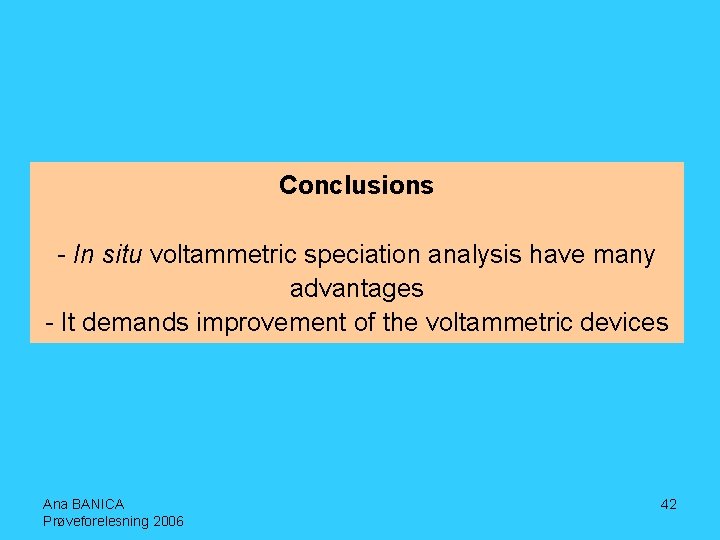
Conclusions - In situ voltammetric speciation analysis have many advantages - It demands improvement of the voltammetric devices Ana BANICA Prøveforelesning 2006 42
4. Conclusions Ana BANICA Prøveforelesning 2006 43
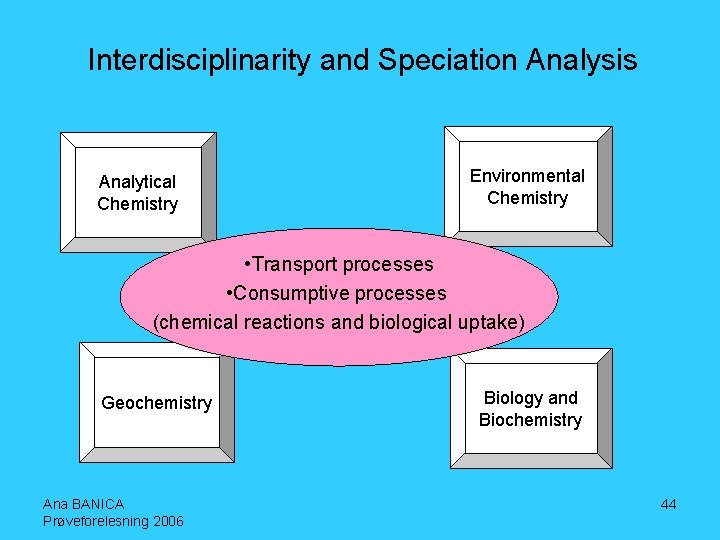
Interdisciplinarity and Speciation Analysis Analytical Chemistry Environmental Chemistry • Transport processes • Consumptive processes (chemical reactions and biological uptake) Geochemistry Ana BANICA Prøveforelesning 2006 Biology and Biochemistry 44
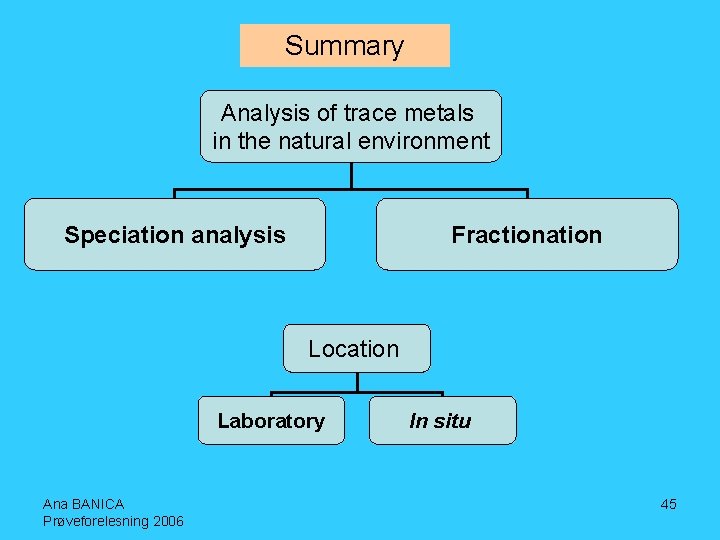
Summary Analysis of trace metals in the natural environment Speciation analysis Fractionation Location Laboratory Ana BANICA Prøveforelesning 2006 In situ 45
Suggestions for further reading • R. Cornelis, J. Caruso, H. Crews, K. Heuman (Eds. ), Handbook of Elemental Speciation: Techniques and Methodology, Wiley, N. Y. , 2005. • J. Buffle, G. Hoarvai (Eds. ), In situ Monitoring of Aquatic Systems: Chemical Analysis and Speciation, IUPAC Ser. Anal. Phys. Chem. Environ. Syst. , Vol. 6, Wiley, Chichester, UK, 2000. • D. M. Templeton, F. Ariese, R. Cornelis, L-G. Danielsson, H. Muntau, H. P. van Leeuwen, R. Łobiński, “Guidelines for terms related to chemical speciation and fractionation of elements. Definitions, structural aspects, and methodological approaches”, Pure Appl. Chem. 72 (2000) 14531470. • E. Prichard, G. M. Mac. Kay, J. Points (Eds. ), “Trace Analysis: a structured approach to obtaining reliable results”, Royal Society of Chemistry, Cambridge, 1996. • Institute for Reference Materials and Measurements (http: //www. irmm. jrc. be/html/homepage. htm) • The European Virtual Institute for Speciation Analysis (EVISA) (http: //www. speciation. net/) Ana BANICA Prøveforelesning 2006 46
‘Many shall pass through and learning shall be increased’ Multi pertransibunt et augebitur scientia The Great Instauration, Francis Bacon Ana BANICA Prøveforelesning 2006 47