
ANALYSISI OF DIAGNOSTIC RECORDS DIAGNOSTIC RECORDS DIAGNOSTIC CAST


- Slides: 16
ANALYSISI OF DIAGNOSTIC RECORDS
DIAGNOSTIC RECORDS § DIAGNOSTIC CAST § RADIOGRAPHS : Lateral Cephalogram and orthopentomogram and others § PHOTOGRAPHS § OTHERS, According to case
DIAGNOSTIC CAST § Symmetry and Space § Space Analysis § Tooth Size Analysis
SYMMETRY AND SPACE § Can be checked with transparent ruled grid placed over the upper dental arch and oriented to the midpalatal raphe § Asymmetry within the dental arch, but with symmetric arch form, also can occur in severely crowded cases because of * lateral drift of incisors due to premature loss of primary canine * one permanent canine being blocked out of the arch while the other is in its normal position. § Drift of posterior teeth is usually caused by early loss of a primary molar, but sometimes develops even when primary teeth were exfoliated on a normal schedule.
SPACE ANALYSIS § Space available – Space required = Space discrepancy § Space available calculation ` * Sum of linear segments of dental arch * Contouring flexible brass wire on contact points of posterior teeth and incisal edges of anterior teeth. § Space required calculation Sum of mesiodistal with of all teeth upto 1 st molar.
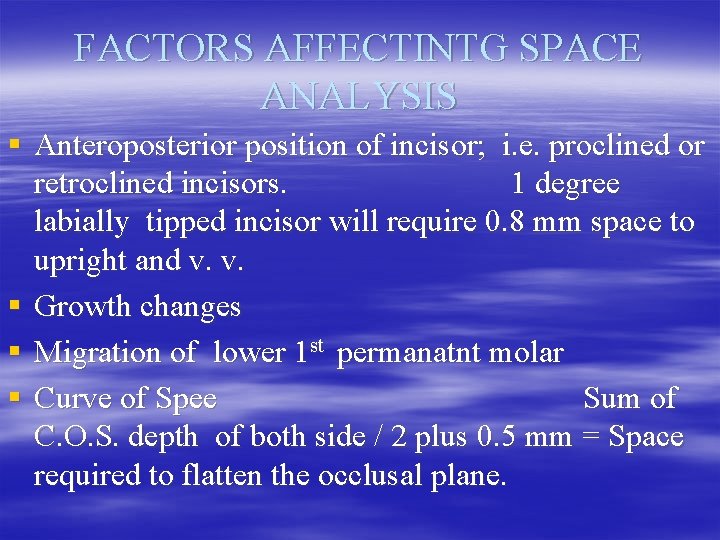
FACTORS AFFECTINTG SPACE ANALYSIS § Anteroposterior position of incisor; i. e. proclined or retroclined incisors. 1 degree labially tipped incisor will require 0. 8 mm space to upright and v. v. § Growth changes § Migration of lower 1 st permanatnt molar § Curve of Spee Sum of C. O. S. depth of both side / 2 plus 0. 5 mm = Space required to flatten the occlusal plane.
MIXED DENTITION SPACE ANALYSIS § Radiographic Method § Tanaka and Johnston Prediction Method § Moyers Prediction Method § Staley & Kerber’s Combination Method
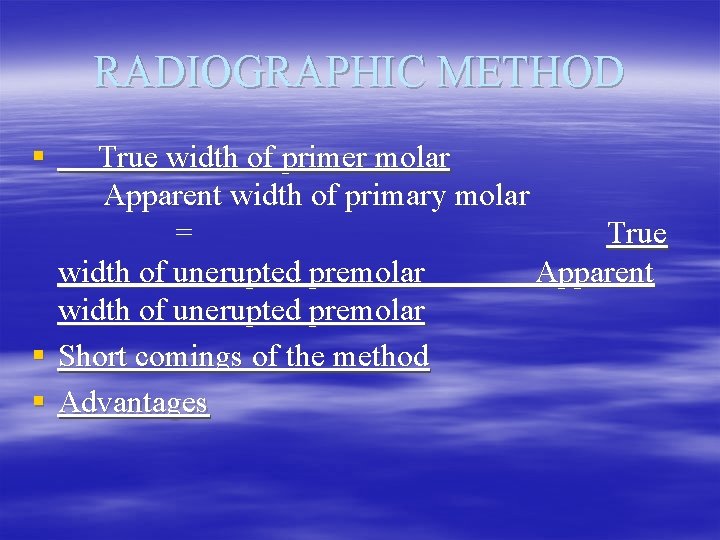
RADIOGRAPHIC METHOD § True width of primer molar Apparent width of primary molar = True width of unerupted premolar Apparent width of unerupted premolar § Short comings of the method § Advantages
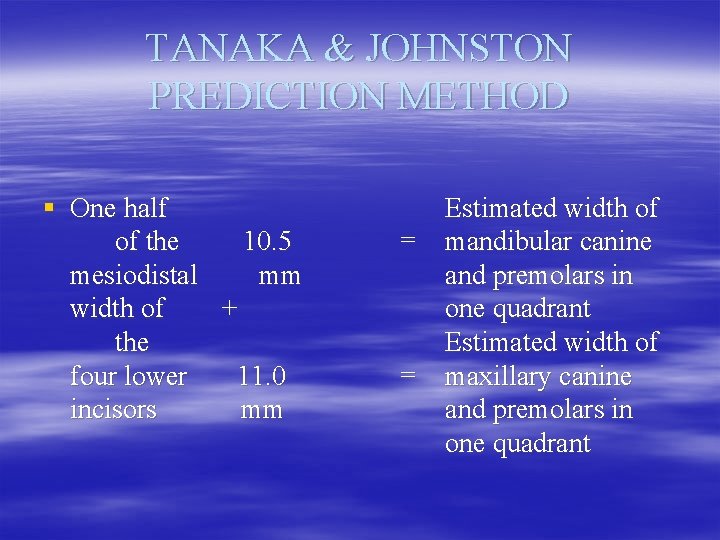
TANAKA & JOHNSTON PREDICTION METHOD § One half of the 10. 5 mesiodistal mm width of + the four lower 11. 0 incisors mm = = Estimated width of mandibular canine and premolars in one quadrant Estimated width of maxillary canine and premolars in one quadrant
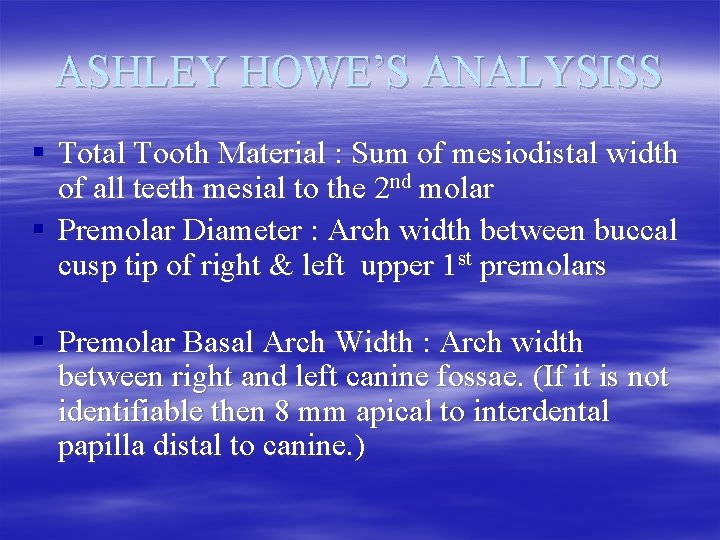
ASHLEY HOWE’S ANALYSISS § Total Tooth Material : Sum of mesiodistal width of all teeth mesial to the 2 nd molar § Premolar Diameter : Arch width between buccal cusp tip of right & left upper 1 st premolars § Premolar Basal Arch Width : Arch width between right and left canine fossae. (If it is not identifiable then 8 mm apical to interdental papilla distal to canine. )
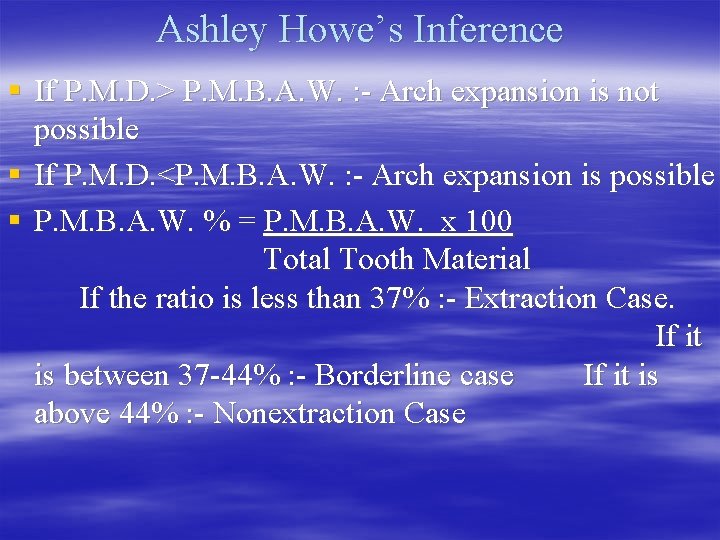
Ashley Howe’s Inference § If P. M. D. > P. M. B. A. W. : - Arch expansion is not possible § If P. M. D. <P. M. B. A. W. : - Arch expansion is possible § P. M. B. A. W. % = P. M. B. A. W. x 100 Total Tooth Material If the ratio is less than 37% : - Extraction Case. If it is between 37 -44% : - Borderline case If it is above 44% : - Nonextraction Case
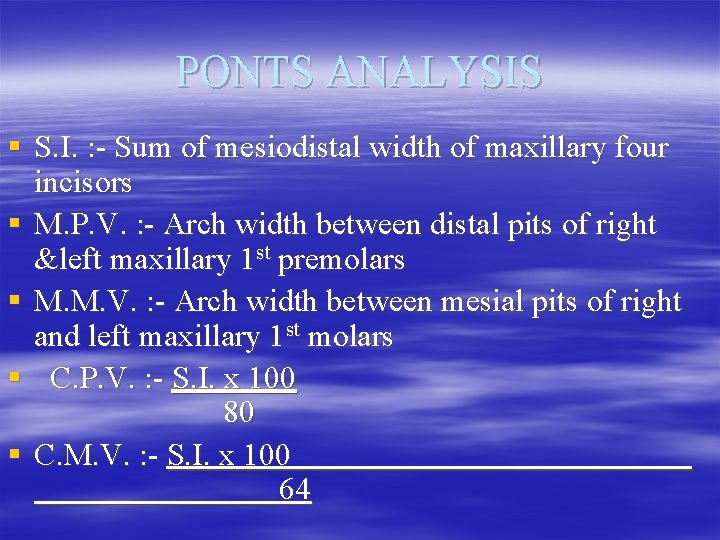
PONTS ANALYSIS § S. I. : - Sum of mesiodistal width of maxillary four incisors § M. P. V. : - Arch width between distal pits of right &left maxillary 1 st premolars § M. M. V. : - Arch width between mesial pits of right and left maxillary 1 st molars § C. P. V. : - S. I. x 100 80 § C. M. V. : - S. I. x 100 64
Ponts Analysis Inference § If measured value is less than calculated value, expansion is needed. § The difference between calculated and measured value indicates amount of expansion required.
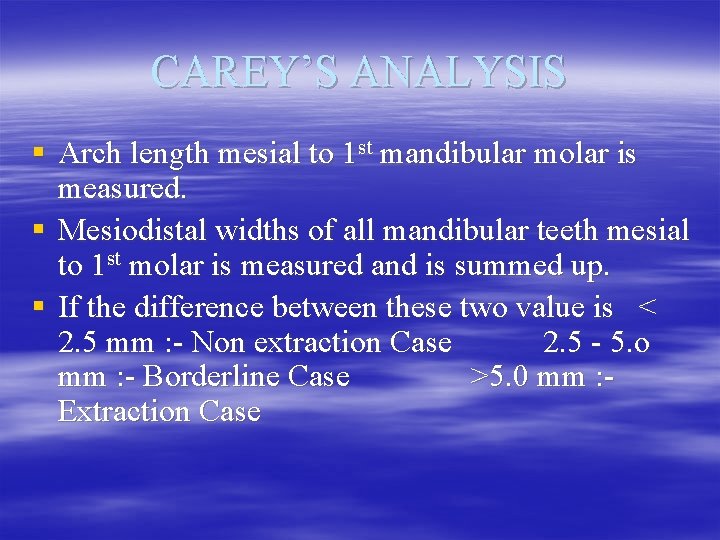
CAREY’S ANALYSIS § Arch length mesial to 1 st mandibular molar is measured. § Mesiodistal widths of all mandibular teeth mesial to 1 st molar is measured and is summed up. § If the difference between these two value is < 2. 5 mm : - Non extraction Case 2. 5 - 5. o mm : - Borderline Case >5. 0 mm : Extraction Case
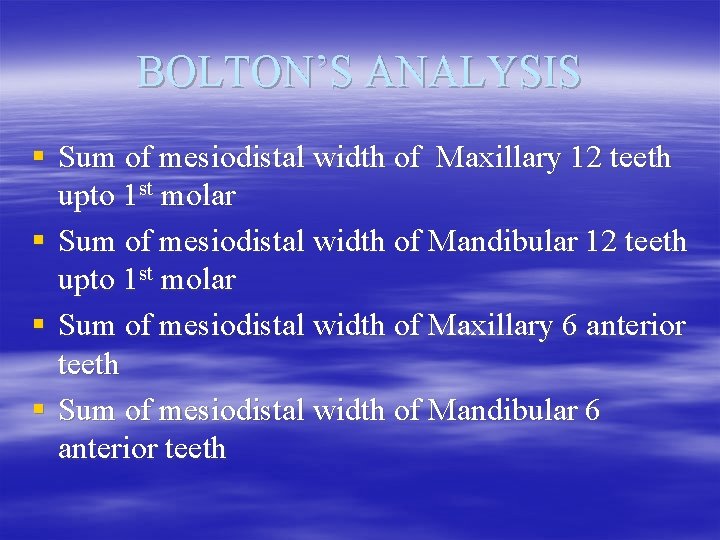
BOLTON’S ANALYSIS § Sum of mesiodistal width of Maxillary 12 teeth upto 1 st molar § Sum of mesiodistal width of Mandibular 12 teeth upto 1 st molar § Sum of mesiodistal width of Maxillary 6 anterior teeth § Sum of mesiodistal width of Mandibular 6 anterior teeth
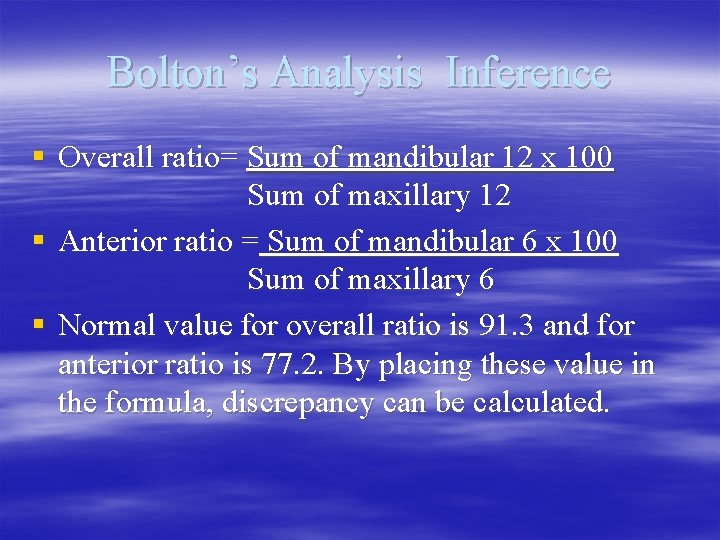
Bolton’s Analysis Inference § Overall ratio= Sum of mandibular 12 x 100 Sum of maxillary 12 § Anterior ratio = Sum of mandibular 6 x 100 Sum of maxillary 6 § Normal value for overall ratio is 91. 3 and for anterior ratio is 77. 2. By placing these value in the formula, discrepancy can be calculated.