
Analysis Skills Language and Structure Knowledge Organiser Language
- Slides: 2
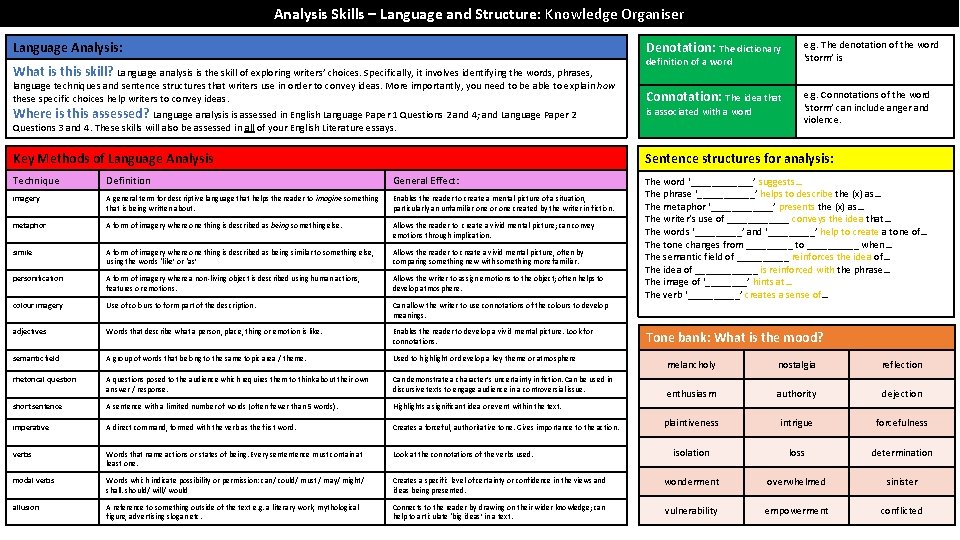
Analysis Skills – Language and Structure: Knowledge Organiser Language Analysis: What is this skill? Language analysis is the skill of exploring writers’ choices. Specifically, it involves identifying the words, phrases, language techniques and sentence structures that writers use in order to convey ideas. More importantly, you need to be able to explain how these specific choices help writers to convey ideas. Where is this assessed? Language analysis is assessed in English Language Paper 1 Questions 2 and 4; and Language Paper 2 Denotation: The dictionary e. g. The denotation of the word ‘storm’ is Connotation: The idea that e. g. Connotations of the word ‘storm’ can include anger and violence. definition of a word is associated with a word Questions 3 and 4. These skills will also be assessed in all of your English Literature essays. Key Methods of Language Analysis Sentence structures for analysis: Technique Definition General Effect: imagery A general term for descriptive language that helps the reader to imagine something that is being written about. Enables the reader to create a mental picture of a situation, particularly an unfamiliar one or one created by the writer in fiction. metaphor A form of imagery where one thing is described as being something else. Allows the reader to create a vivid mental picture; can convey emotions through implication. simile A form of imagery where one thing is described as being similar to something else, using the words ‘like’ or ‘as’ Allows the reader to create a vivid mental picture, often by comparing something new with something more familiar. personification A form of imagery where a non-living object is described using human actions, features or emotions. Allows the writer to assign emotions to the object; often helps to develop atmosphere. colour imagery Use of colours to form part of the description. Can allow the writer to use connotations of the colours to develop meanings. adjectives Words that describe what a person, place, thing or emotion is like. Enables the reader to develop a vivid mental picture. Look for connotations. semantic field A group of words that belong to the same topic area / theme. Used to highlight or develop a key theme or atmosphere rhetorical question A questions posed to the audience which requires them to think about their own answer / response. Can demonstrate a character’s uncertainty in fiction. Can be used in discursive texts to engage audience in a controversial issue. short sentence A sentence with a limited number of words (often fewer than 5 words). Highlights a significant idea or event within the text. imperative A direct command, formed with the verb as the first word. Creates a forceful, authoritative tone. Gives importance to the action. verbs Words that name actions or states of being. Every sententence must contain at least one. Look at the connotations of the verbs used. modal verbs Words which indicate possibility or permission: can/ could/ must / may/ might/ shall. should/ will/ would allusion A reference to something outside of the text e. g. a literary work, mythological figure, advertising slogan etc. The word ‘______’ suggests… The phrase ‘______’ helps to describe the (x) as… The metaphor ‘______’ presents the (x) as… The writer’s use of ______ conveys the idea that… The words ‘_____’ and ‘_____’ help to create a tone of… The tone changes from _____ to _____ when… The semantic field of _____ reinforces the idea of… The idea of ______ is reinforced with the phrase… The image of ‘____’ hints at… The verb ‘_____’ creates a sense of… Tone bank: What is the mood? melancholy nostalgia reflection enthusiasm authority dejection plaintiveness intrigue forcefulness isolation loss determination Creates a specific level of certainty or confidence in the views and ideas being presented. wonderment overwhelmed sinister Connects to the reader by drawing on their wider knowledge; can help to articulate ‘big ideas’ in a text. vulnerability empowerment conflicted
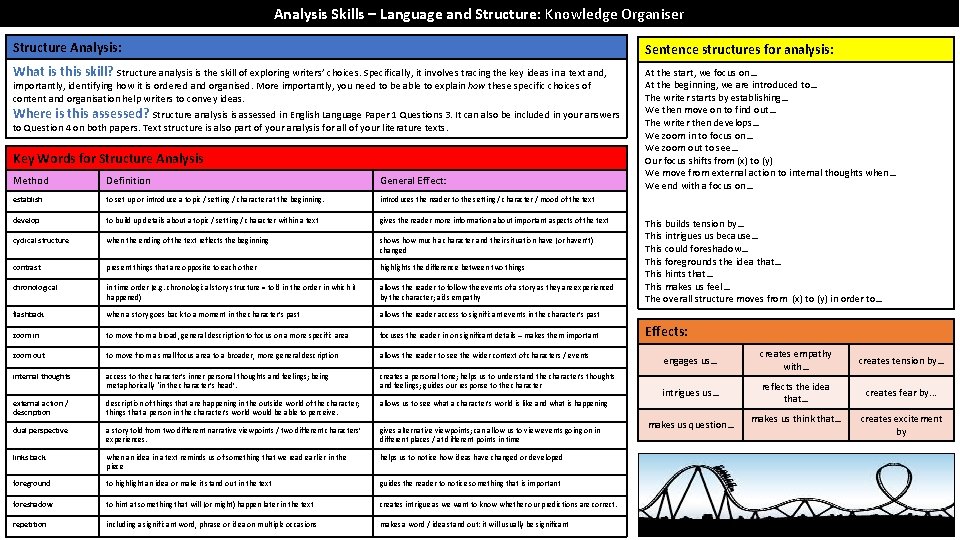
Analysis Skills – Language and Structure: Knowledge Organiser Structure Analysis: Sentence structures for analysis: What is this skill? Structure analysis is the skill of exploring writers’ choices. Specifically, it involves tracing the key ideas in a text and, At the start, we focus on… At the beginning, we are introduced to… The writer starts by establishing… We then move on to find out… The writer then develops… We zoom in to focus on… We zoom out to see… Our focus shifts from (x) to (y) We move from external action to internal thoughts when… We end with a focus on… importantly, identifying how it is ordered and organised. More importantly, you need to be able to explain how these specific choices of content and organisation help writers to convey ideas. Where is this assessed? Structure analysis is assessed in English Language Paper 1 Questions 3. It can also be included in your answers to Question 4 on both papers. Text structure is also part of your analysis for all of your literature texts. Key Words for Structure Analysis Method Definition General Effect: establish to set up or introduce a topic / setting / character at the beginning. introduces the reader to the setting / character / mood of the text develop to build up details about a topic / setting / character within a text gives the reader more information about important aspects of the text cyclical structure when the ending of the text reflects the beginning shows how much a character and their situation have (or haven’t) changed contrast present things that are opposite to each other highlights the difference between two things chronological in time order (e. g. chronological story structure = told in the order in which it happened) allows the reader to follow the events of a story as they are experienced by the character; aids empathy flashback when a story goes back to a moment in the character’s past allows the reader access to significant events in the character’s past zoom in to move from a broad, general description to focus on a more specific area focuses the reader in on significant details – makes them important zoom out to move from a small focus area to a broader, more general description allows the reader to see the wider context of characters / events internal thoughts access to the character’s inner personal thoughts and feelings; being metaphorically ‘in the character’s head’. creates a personal tone; helps us to understand the character’s thoughts and feelings; guides our response to the character external action / description of things that are happening in the outside world of the character; things that a person in the character’s world would be able to perceive. allows us to see what a character’s world is like and what is happening dual perspective a story told from two different narrative viewpoints / two different characters’ experiences. gives alternative viewpoints; can allow us to view events going on in different places / at different points in time links back when an idea in a text reminds us of something that we read earlier in the piece helps us to notice how ideas have changed or developed foreground to highlight an idea or make it stand out in the text guides the reader to notice something that is important foreshadow to hint at something that will (or might) happen later in the text creates intrigue as we want to know whether our predictions are correct. repetition including a significant word, phrase or idea on multiple occasions makes a word / idea stand out: it will usually be significant This builds tension by… This intrigues us because… This could foreshadow… This foregrounds the idea that… This hints that… This makes us feel… The overall structure moves from (x) to (y) in order to… Effects: engages us… creates empathy with… creates tension by… intrigues us… reflects the idea that… creates fear by. . . makes us question… makes us think that… creates excitement by