
Analysis of Variance ANOVA MIT Proposed Schedule Changes
- Slides: 27
Analysis of Variance ANOVA MIT
Proposed Schedule Changes • Switch lecture • No quiz – Informal (ungraded) presentation of term project ideas • Read Phadke ch. 7 --Construction Orthogonal Arrays – Quiz on ANOVA – Noise experiment due MIT
Learning Objectives • Introduce hypothesis testing • Introduce ANOVA in statistic practice • Introduce ANOVA as practiced in RD • Compare to ANOM • Get some practice applying ANOVA in RD • Discuss / compare / contrast MIT
Hypothesis Testing A technique that uses sample data from a population to come to reasonable conclusions with a certain degree of confidence MIT
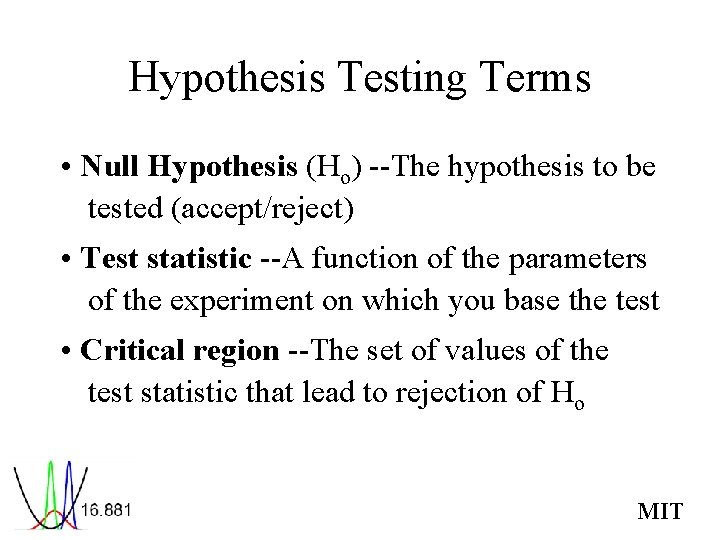
Hypothesis Testing Terms • Null Hypothesis (Ho) --The hypothesis to be tested (accept/reject) • Test statistic --A function of the parameters of the experiment on which you base the test • Critical region --The set of values of the test statistic that lead to rejection of Ho MIT
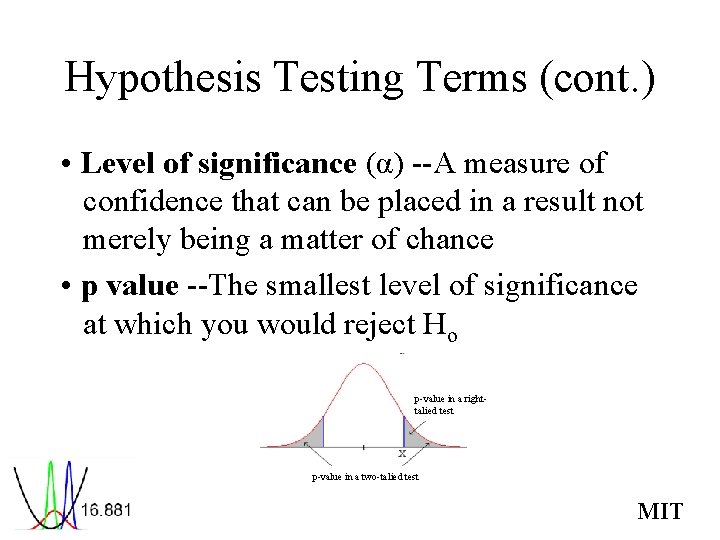
Hypothesis Testing Terms (cont. ) • Level of significance (α) --A measure of confidence that can be placed in a result not merely being a matter of chance • p value --The smallest level of significance at which you would reject Ho p-value in a righttalied test p-value in a two-talied test MIT
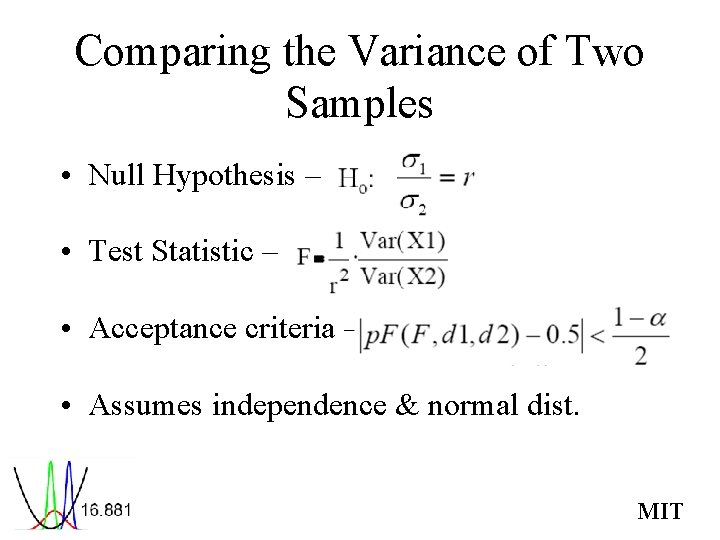
Comparing the Variance of Two Samples • Null Hypothesis – • Test Statistic – • Acceptance criteria – • Assumes independence & normal dist. MIT
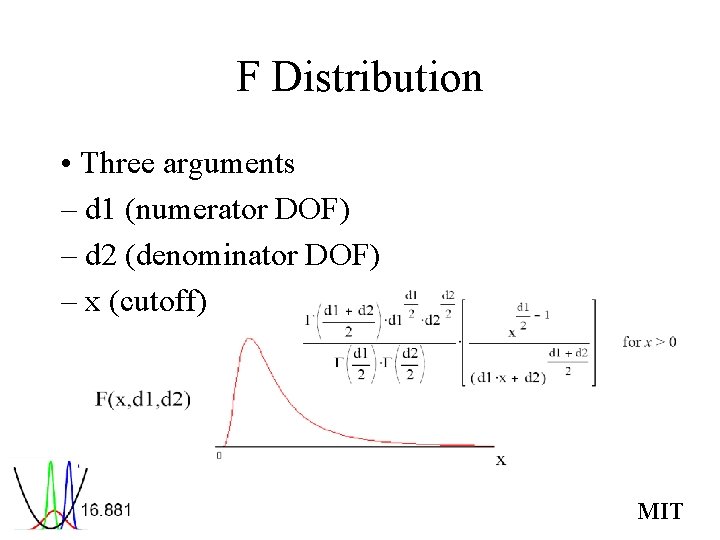
F Distribution • Three arguments – d 1 (numerator DOF) – d 2 (denominator DOF) – x (cutoff) MIT
Rolling Dice • Population 1 --Roll one die • Population 2 --Roll two die • Go to excel sheet “dice_f_test. xls” MIT
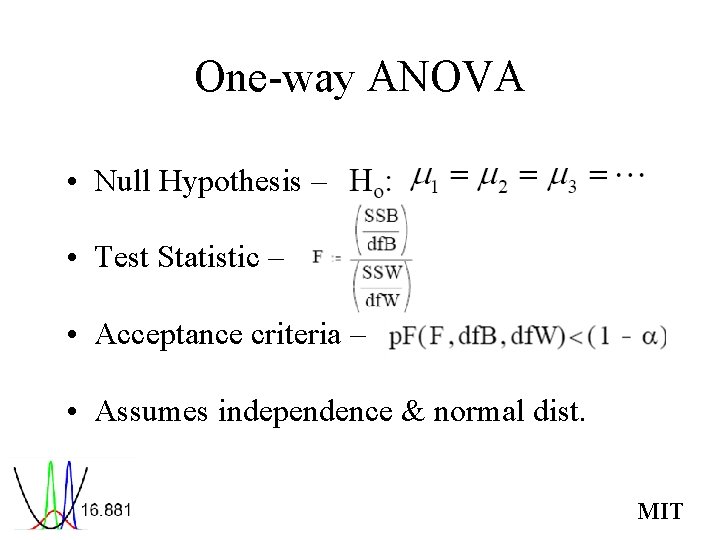
One-way ANOVA • Null Hypothesis – • Test Statistic – • Acceptance criteria – • Assumes independence & normal dist. MIT
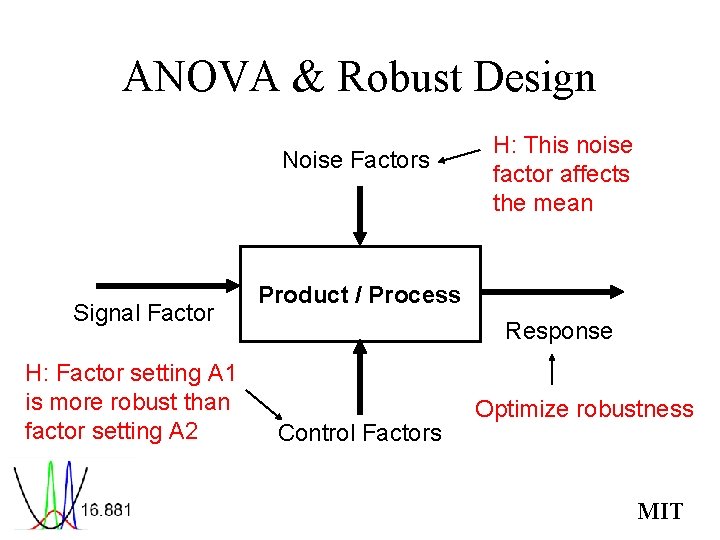
ANOVA & Robust Design Noise Factors Signal Factor H: Factor setting A 1 is more robust than factor setting A 2 H: This noise factor affects the mean Product / Process Response Control Factors Optimize robustness MIT
ANOVA and the Noise Experiment • Did the noise factors we experimented with really have an effect on mean? • Switch to Excel sheet “catapult_L 4_static_anova. xls” MIT
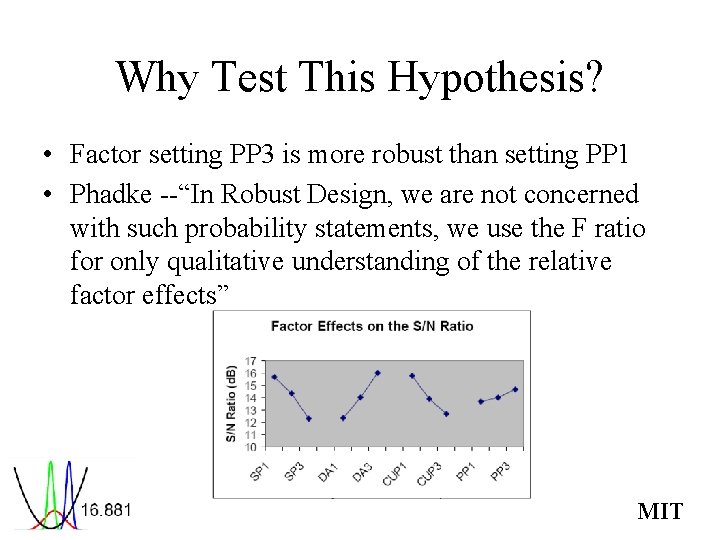
Why Test This Hypothesis? • Factor setting PP 3 is more robust than setting PP 1 • Phadke --“In Robust Design, we are not concerned with such probability statements, we use the F ratio for only qualitative understanding of the relative factor effects” MIT
Analysis of Variance (ANOVA) • ANOVA helps to resolve the relative magnitude of the factor effects compared to the error variance • Are the factor effects real or just noise? • I will cover it in Lecture 7. • You may want to try the Mathcad “resource center” under the help menu MIT
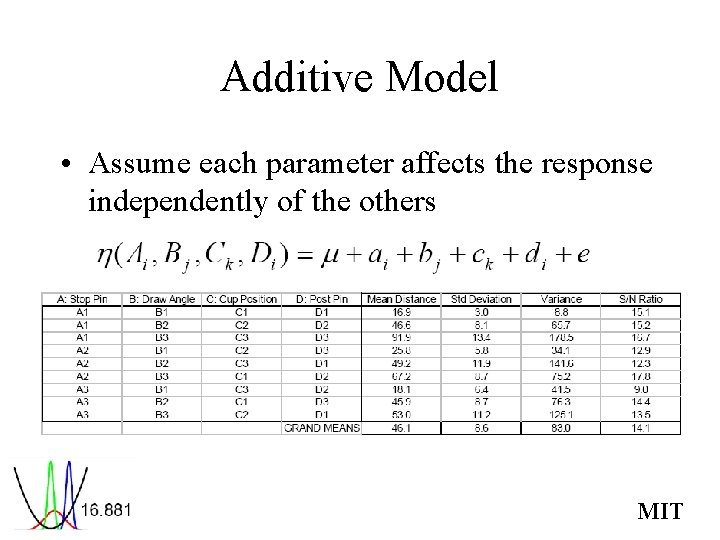
Additive Model • Assume each parameter affects the response independently of the others MIT
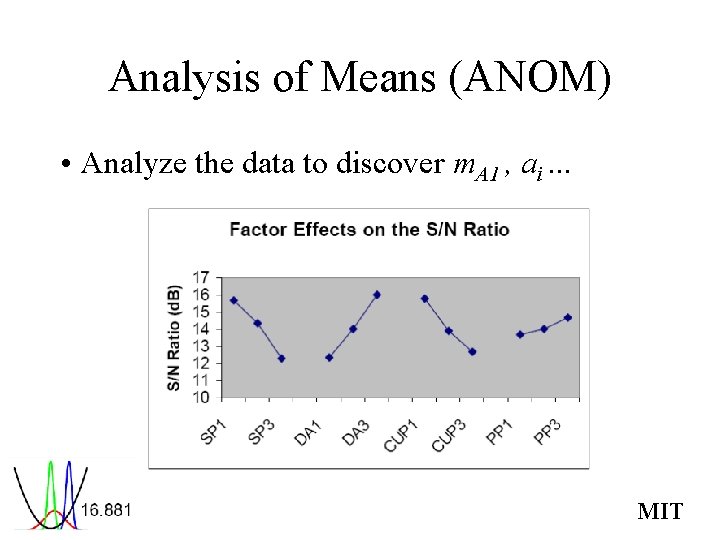
Analysis of Means (ANOM) • Analyze the data to discover m. A 1 , ai. . . MIT
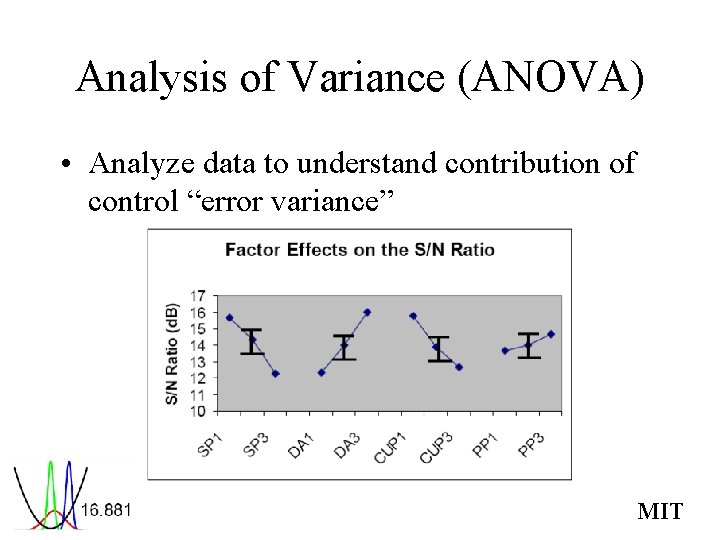
Analysis of Variance (ANOVA) • Analyze data to understand contribution of control “error variance” MIT
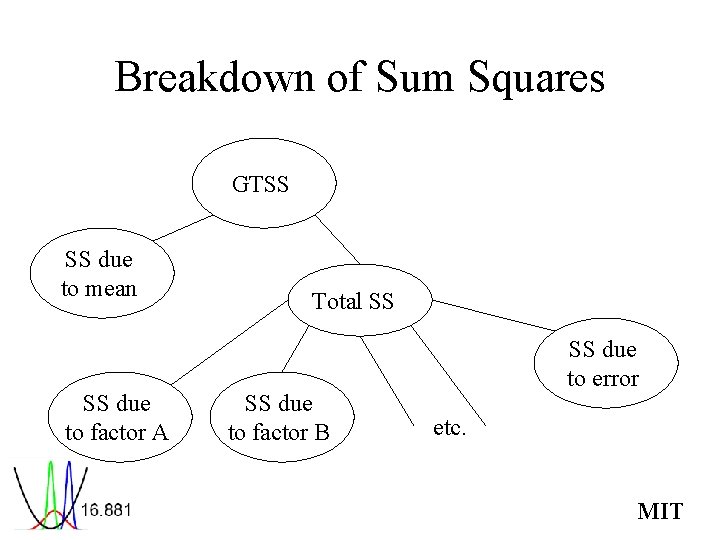
Breakdown of Sum Squares GTSS SS due to mean SS due to factor A Total SS SS due to factor B SS due to error etc. MIT
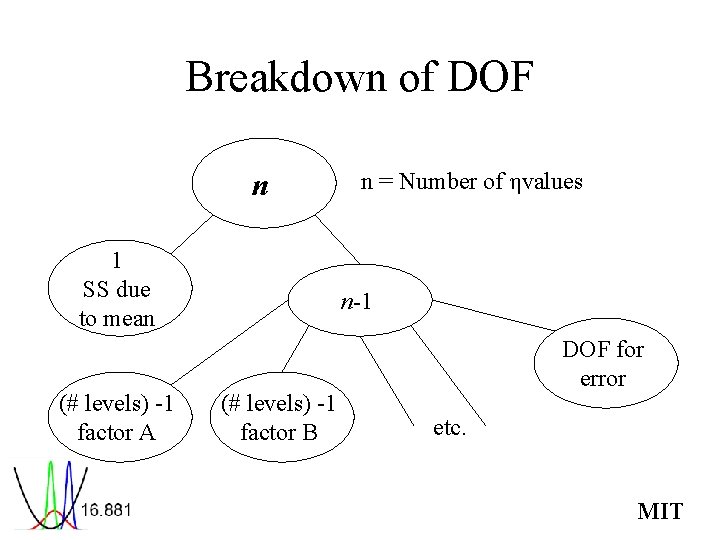
Breakdown of DOF n 1 SS due to mean (# levels) -1 factor A n = Number of ηvalues n-1 (# levels) -1 factor B DOF for error etc. MIT
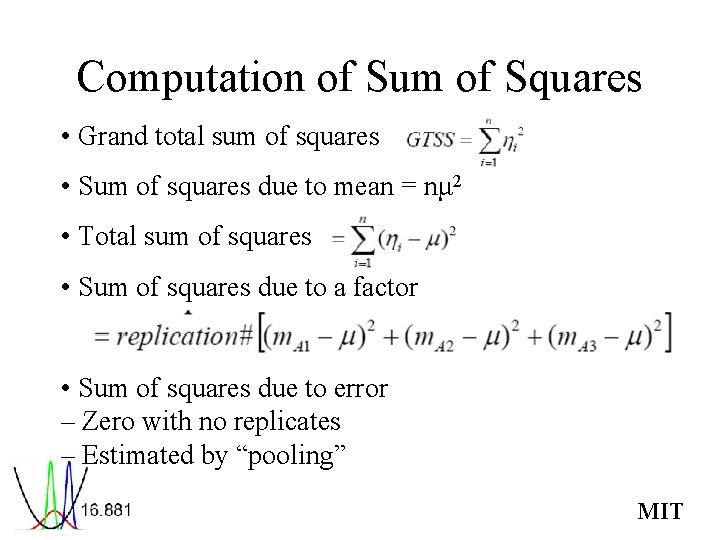
Computation of Sum of Squares • Grand total sum of squares • Sum of squares due to mean = nμ 2 • Total sum of squares • Sum of squares due to a factor • Sum of squares due to error – Zero with no replicates – Estimated by “pooling” MIT
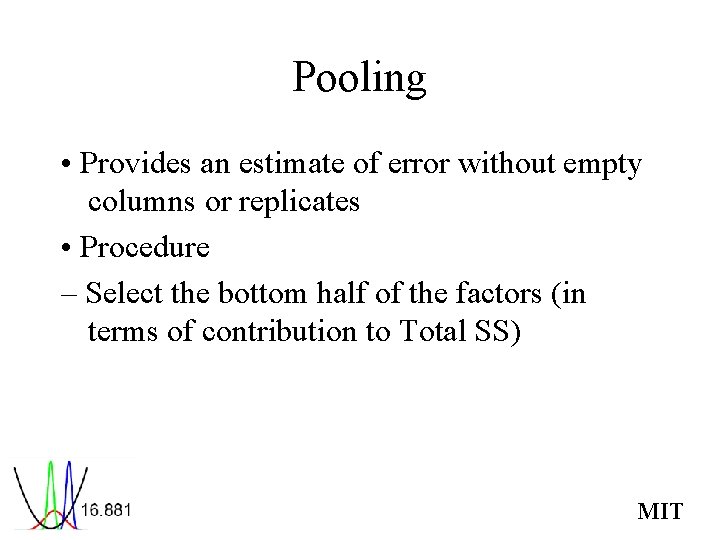
Pooling • Provides an estimate of error without empty columns or replicates • Procedure – Select the bottom half of the factors (in terms of contribution to Total SS) MIT
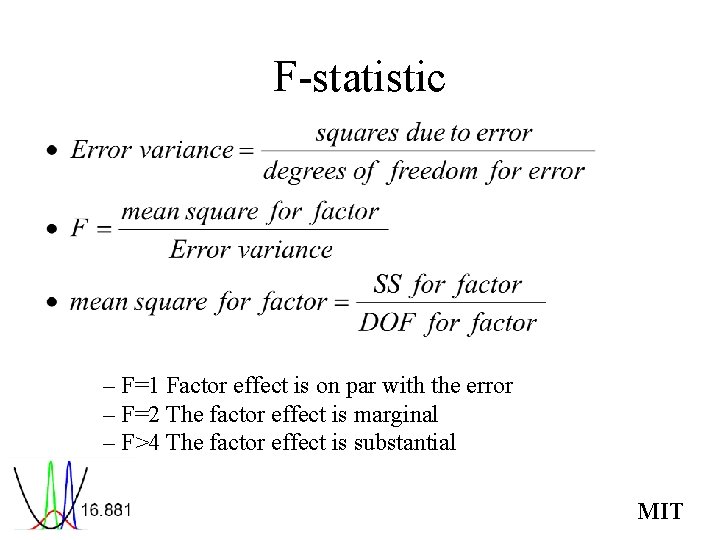
F-statistic – F=1 Factor effect is on par with the error – F=2 The factor effect is marginal – F>4 The factor effect is substantial MIT
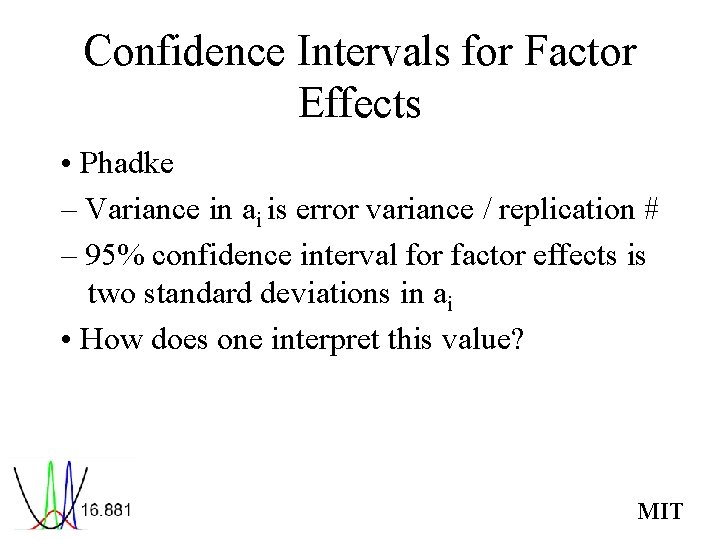
Confidence Intervals for Factor Effects • Phadke – Variance in ai is error variance / replication # – 95% confidence interval for factor effects is two standard deviations in ai • How does one interpret this value? MIT
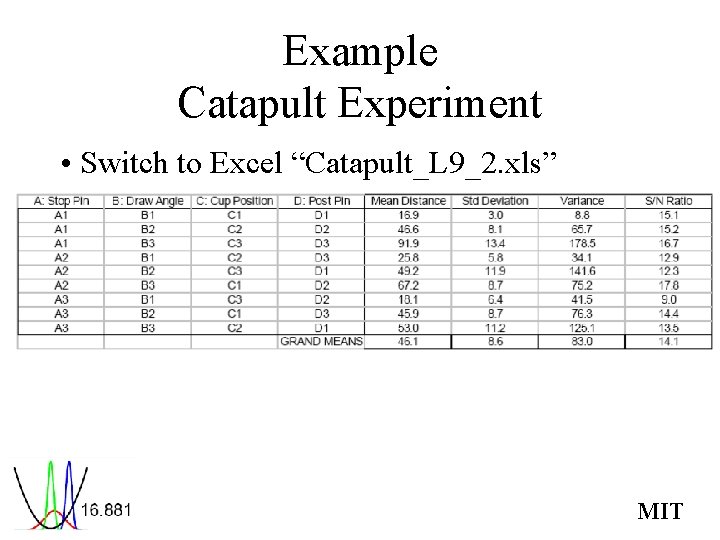
Example Catapult Experiment • Switch to Excel “Catapult_L 9_2. xls” MIT
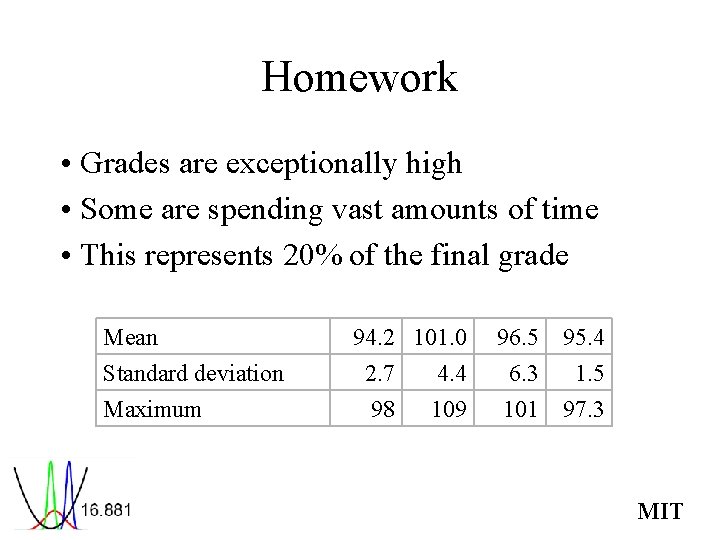
Homework • Grades are exceptionally high • Some are spending vast amounts of time • This represents 20% of the final grade Mean Standard deviation Maximum 94. 2 101. 0 2. 7 4. 4 98 109 96. 5 6. 3 101 95. 4 1. 5 97. 3 MIT
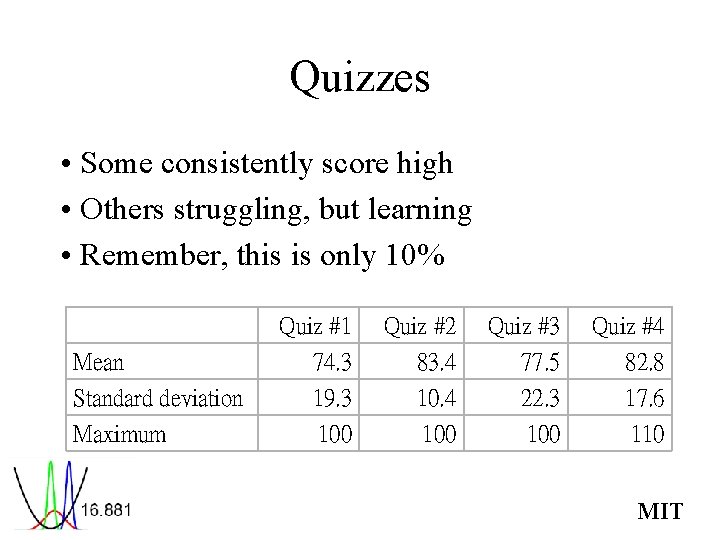
Quizzes • Some consistently score high • Others struggling, but learning • Remember, this is only 10% Mean Standard deviation Maximum Quiz #1 74. 3 19. 3 100 Quiz #2 83. 4 100 Quiz #3 77. 5 22. 3 100 Quiz #4 82. 8 17. 6 110 MIT
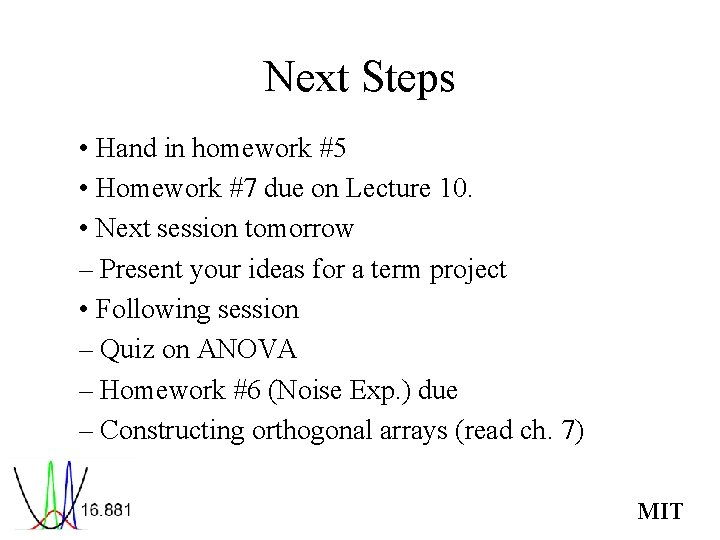
Next Steps • Hand in homework #5 • Homework #7 due on Lecture 10. • Next session tomorrow – Present your ideas for a term project • Following session – Quiz on ANOVA – Homework #6 (Noise Exp. ) due – Constructing orthogonal arrays (read ch. 7) MIT