
Analysis of the training needs of health sector
- Slides: 26
Analysis of the training needs of health sector workers - stage II Report prepared by: IBC GROUP Central Europe Holding Ltd.
Analysis of the training needs of health sector workers - stage II Aim of the study The main objective of the evaluation study was to assess the quality of knowledge and skills acquired through participation in projects implemented under the Operational Program Knowledge Education and Development 2014 -2020 (OP KED) and to learn about the current training needs of medical and non-medical workers in the healthcare sector. This study was the second stage of the evaluation of training needs of health sector workers. The first stage of the study was carried out in 2016: Report prepared by AGROTEC POLSKA Ltd. commissioned by the Ministry of Health: Analysis of the training needs of health sector employees.
Analysis of the training needs of health sector workers - stage II Detailed objectives of the study Assessment of the usefulness and adequacy of knowledge and skills acquired through participation in OP KED projects by representatives of medical professions in relation to their current needs (adequacy and usefulness criterion) Assessment of the usefulness and adequacy of knowledge and skills acquired through participation in OP KED projects by administrative employees of the health sector of medical professions in relation to their current needs (adequacy and usefulness criterion); Analysis of new training needs of employees in the health care sector and those for which the support was insufficient (adequacy criterion); Identification of the most effective and adequate forms of support and methods of transferring knowledge to health care workers under OP KED in the context of programming future ESF + support (adequacy and effectiveness criterion).
Analysis of the training needs of health sector workers - stage II Activities covered by the study Measure 5. 2 OP KED Measure 5. 4 OP KED Pro-quality activities and organizational solutions in the health care system facilitating access to inexpensive, durable and high-quality health services. Professional competences and qualifications of Until March 20, 2020, 2 recruitments concerning the training for employees of health care administration were conducted. In the process, 32 co-financing agreements were concluded for 46. 6 million PLN (including the ESF contribution in the amount of over 39. 3 million PLN). Training to improve the effectiveness of the health care system, with particular emphasis on the development of analytical and internal audit capabilities in health care system units. Until March 20, 2020, 7 recruitments (including one non-competitive) were carried out. medical staff. 89 co-financing contracts were concluded with a value of 339 million PLN (including an ESF contribution of 285 million PLN). Training to raise competences in the areas related to epidemiological and demographic needs, postgraduate education of doctors in other forms than specialization, with particular emphasis on doctors cooperating with POZ facilities.
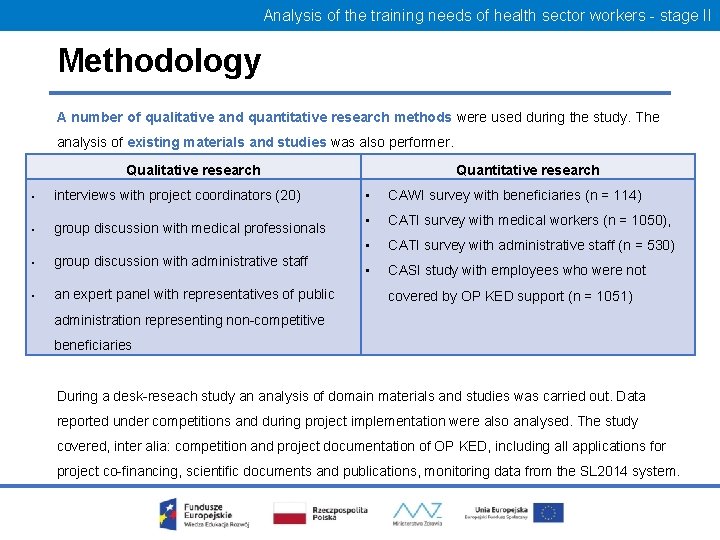
Analysis of the training needs of health sector workers - stage II Methodology A number of qualitative and quantitative research methods were used during the study. The analysis of existing materials and studies was also performer. Qualitative research • interviews with project coordinators (20) • group discussion with medical professionals • group discussion with administrative staff • an expert panel with representatives of public Quantitative research • CAWI survey with beneficiaries (n = 114) • CATI survey with medical workers (n = 1050), • CATI survey with administrative staff (n = 530) • CASI study with employees who were not covered by OP KED support (n = 1051) administration representing non-competitive beneficiaries During a desk-reseach study an analysis of domain materials and studies was carried out. Data reported under competitions and during project implementation were also analysed. The study covered, inter alia: competition and project documentation of OP KED, including all applications for project co-financing, scientific documents and publications, monitoring data from the SL 2014 system.
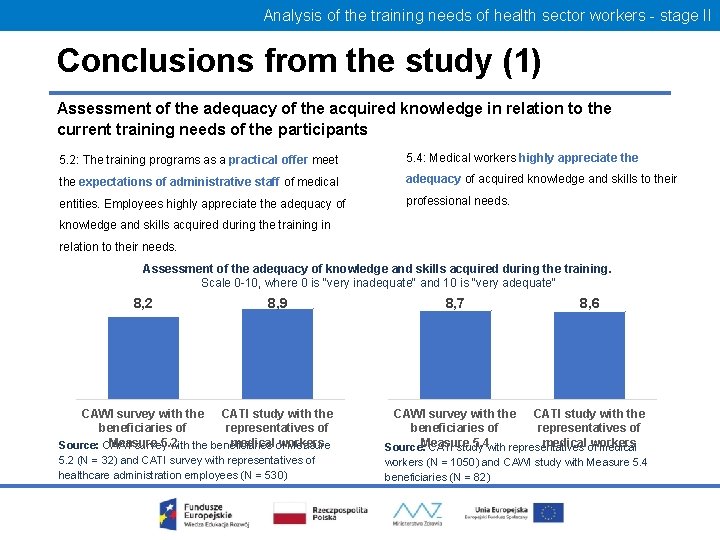
Analysis of the training needs of health sector workers - stage II Conclusions from the study (1) Assessment of the adequacy of the acquired knowledge in relation to the current training needs of the participants 5. 2: The training programs as a practical offer meet 5. 4: Medical workers highly appreciate the expectations of administrative staff of medical adequacy of acquired knowledge and skills to their entities. Employees highly appreciate the adequacy of professional needs. knowledge and skills acquired during the training in relation to their needs. Assessment of the adequacy of knowledge and skills acquired during the training. Scale 0 -10, where 0 is "very inadequate" and 10 is "very adequate" 8, 2 8, 9 8, 7 8, 6 CAWI survey with the CATI study with the beneficiaries of representatives of Measure 5. 2 medical of workers Source: CAWI survey with the beneficiaries Measure CAWI survey with the CATI study with the beneficiaries of representatives of Measure 5. 4 medicalof workers Source: CATI study with representatives medical 5. 2 (N = 32) and CATI survey with representatives of healthcare administration employees (N = 530) workers (N = 1050) and CAWI study with Measure 5. 4 beneficiaries (N = 82)
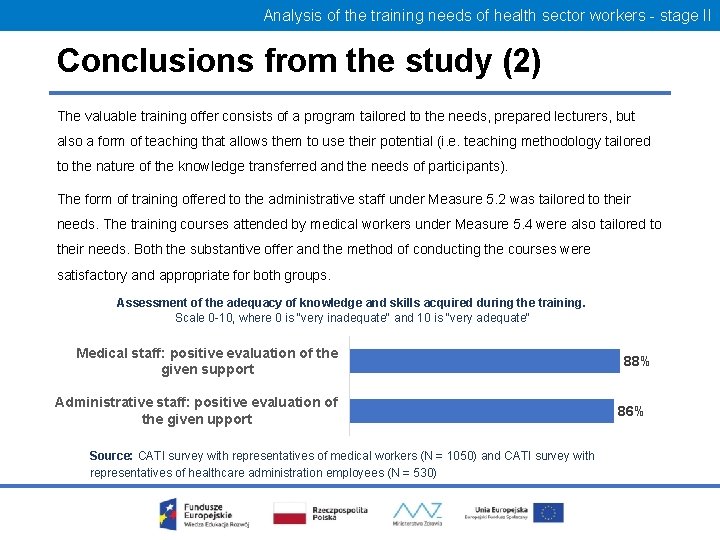
Analysis of the training needs of health sector workers - stage II Conclusions from the study (2) The valuable training offer consists of a program tailored to the needs, prepared lecturers, but also a form of teaching that allows them to use their potential (i. e. teaching methodology tailored to the nature of the knowledge transferred and the needs of participants). The form of training offered to the administrative staff under Measure 5. 2 was tailored to their needs. The training courses attended by medical workers under Measure 5. 4 were also tailored to their needs. Both the substantive offer and the method of conducting the courses were satisfactory and appropriate for both groups. Assessment of the adequacy of knowledge and skills acquired during the training. Scale 0 -10, where 0 is "very inadequate" and 10 is "very adequate" Medical staff: positive evaluation of the given support Administrative staff: positive evaluation of the given upport Source: CATI survey with representatives of medical workers (N = 1050) and CATI survey with representatives of healthcare administration employees (N = 530) 88% 86%
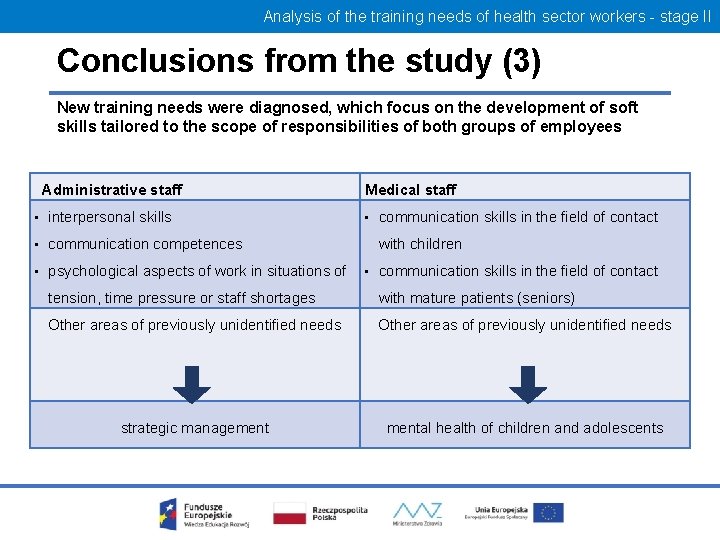
Analysis of the training needs of health sector workers - stage II Conclusions from the study (3) New training needs were diagnosed, which focus on the development of soft skills tailored to the scope of responsibilities of both groups of employees Administrative staff • interpersonal skills • communication competences • psychological aspects of work in situations of Medical staff • communication skills in the field of contact with children • communication skills in the field of contact tension, time pressure or staff shortages with mature patients (seniors) Other areas of previously unidentified needs strategic managemental health of children and adolescents
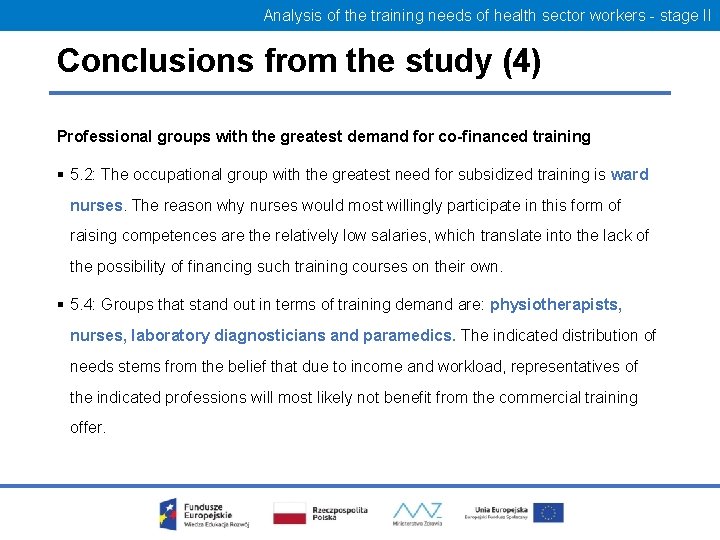
Analysis of the training needs of health sector workers - stage II Conclusions from the study (4) Professional groups with the greatest demand for co-financed training § 5. 2: The occupational group with the greatest need for subsidized training is ward nurses. The reason why nurses would most willingly participate in this form of raising competences are the relatively low salaries, which translate into the lack of the possibility of financing such training courses on their own. § 5. 4: Groups that stand out in terms of training demand are: physiotherapists, nurses, laboratory diagnosticians and paramedics. The indicated distribution of needs stems from the belief that due to income and workload, representatives of the indicated professions will most likely not benefit from the commercial training offer.
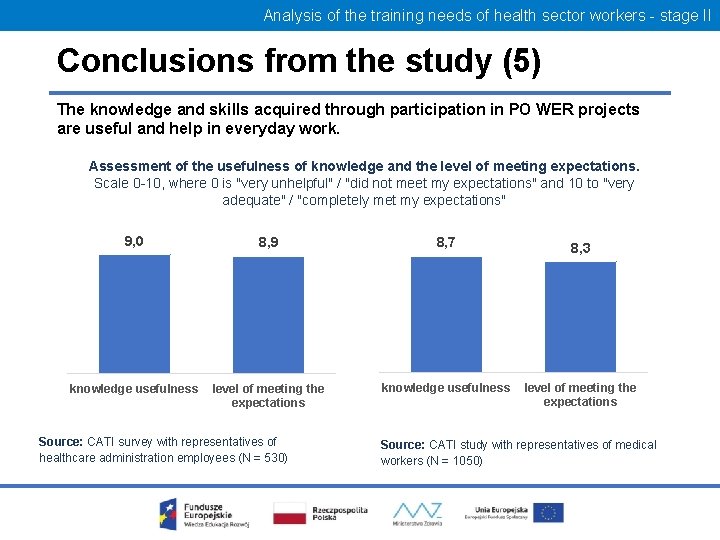
Analysis of the training needs of health sector workers - stage II Conclusions from the study (5) The knowledge and skills acquired through participation in PO WER projects are useful and help in everyday work. Assessment of the usefulness of knowledge and the level of meeting expectations. Scale 0 -10, where 0 is "very unhelpful" / "did not meet my expectations" and 10 to "very adequate" / "completely met my expectations" 9, 0 8, 9 8, 7 8, 3 knowledge usefulness level of meeting the expectations Source: CATI survey with representatives of healthcare administration employees (N = 530) Source: CATI study with representatives of medical workers (N = 1050)
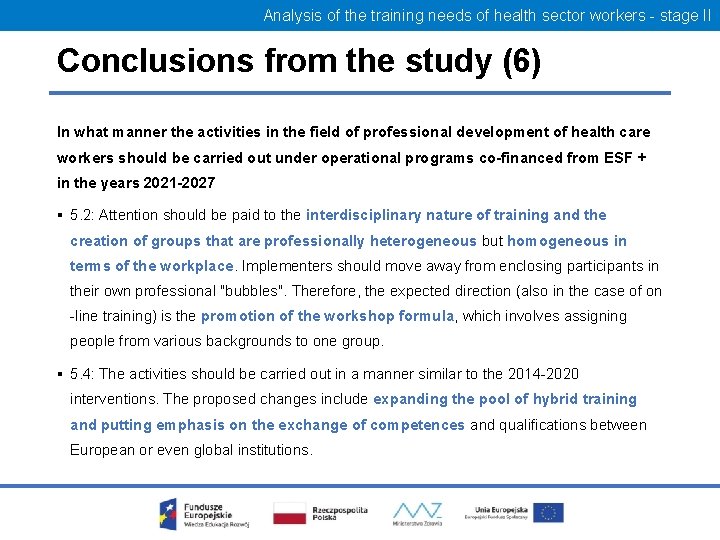
Analysis of the training needs of health sector workers - stage II Conclusions from the study (6) In what manner the activities in the field of professional development of health care workers should be carried out under operational programs co-financed from ESF + in the years 2021 -2027 § 5. 2: Attention should be paid to the interdisciplinary nature of training and the creation of groups that are professionally heterogeneous but homogeneous in terms of the workplace. Implementers should move away from enclosing participants in their own professional "bubbles". Therefore, the expected direction (also in the case of on -line training) is the promotion of the workshop formula, which involves assigning people from various backgrounds to one group. § 5. 4: The activities should be carried out in a manner similar to the 2014 -2020 interventions. The proposed changes include expanding the pool of hybrid training and putting emphasis on the exchange of competences and qualifications between European or even global institutions.
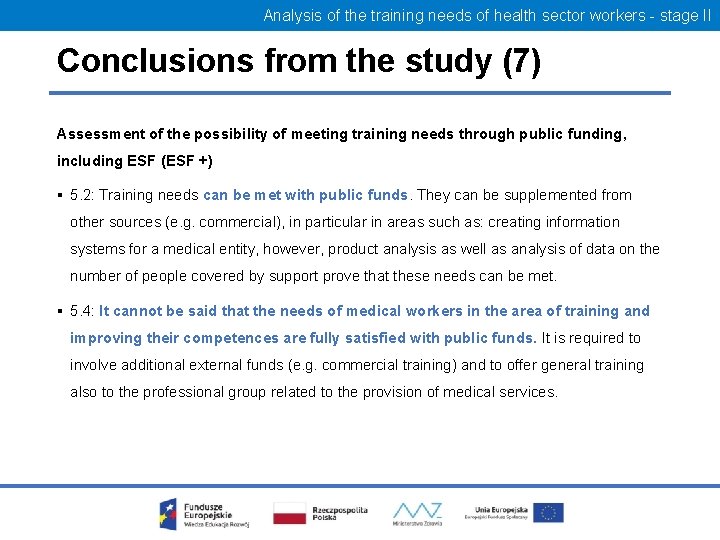
Analysis of the training needs of health sector workers - stage II Conclusions from the study (7) Assessment of the possibility of meeting training needs through public funding, including ESF (ESF +) § 5. 2: Training needs can be met with public funds. They can be supplemented from other sources (e. g. commercial), in particular in areas such as: creating information systems for a medical entity, however, product analysis as well as analysis of data on the number of people covered by support prove that these needs can be met. § 5. 4: It cannot be said that the needs of medical workers in the area of training and improving their competences are fully satisfied with public funds. It is required to involve additional external funds (e. g. commercial training) and to offer general training also to the professional group related to the provision of medical services.
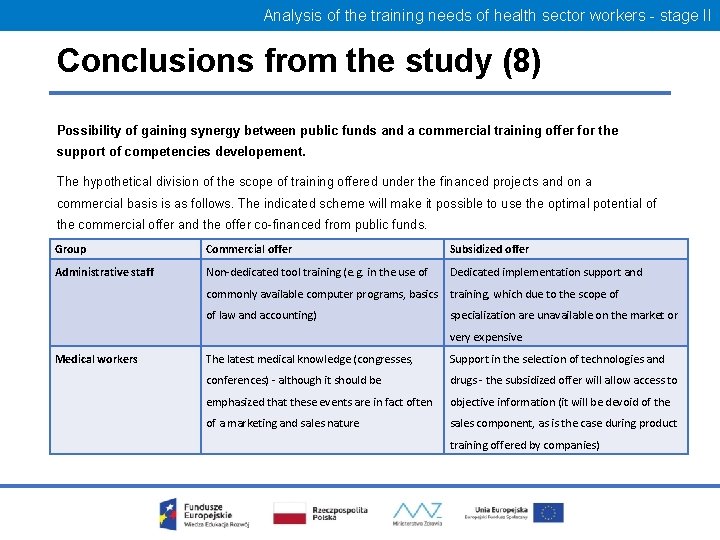
Analysis of the training needs of health sector workers - stage II Conclusions from the study (8) Possibility of gaining synergy between public funds and a commercial training offer for the support of competencies developement. The hypothetical division of the scope of training offered under the financed projects and on a commercial basis is as follows. The indicated scheme will make it possible to use the optimal potential of the commercial offer and the offer co-financed from public funds. Group Commercial offer Subsidized offer Administrative staff Non-dedicated tool training (e. g. in the use of Dedicated implementation support and commonly available computer programs, basics training, which due to the scope of of law and accounting) specialization are unavailable on the market or very expensive Medical workers The latest medical knowledge (congresses, Support in the selection of technologies and conferences) - although it should be drugs - the subsidized offer will allow access to emphasized that these events are in fact often objective information (it will be devoid of the of a marketing and sales nature sales component, as is the case during product training offered by companies)
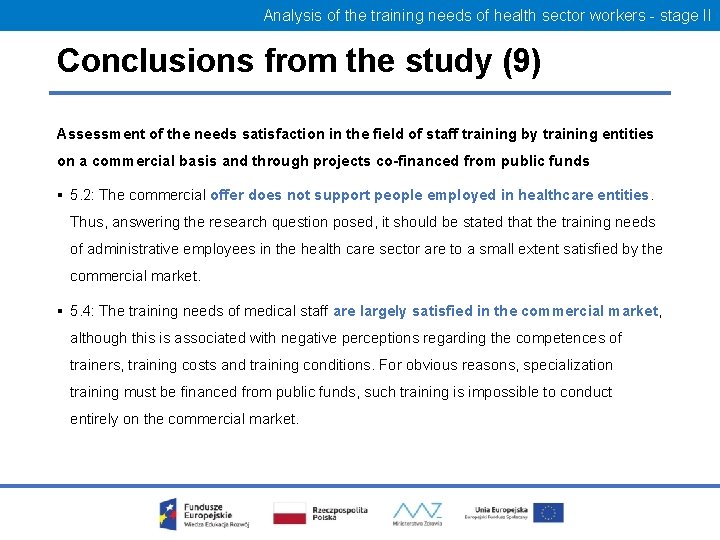
Analysis of the training needs of health sector workers - stage II Conclusions from the study (9) Assessment of the needs satisfaction in the field of staff training by training entities on a commercial basis and through projects co-financed from public funds § 5. 2: The commercial offer does not support people employed in healthcare entities. Thus, answering the research question posed, it should be stated that the training needs of administrative employees in the health care sector are to a small extent satisfied by the commercial market. § 5. 4: The training needs of medical staff are largely satisfied in the commercial market, although this is associated with negative perceptions regarding the competences of trainers, training costs and training conditions. For obvious reasons, specialization training must be financed from public funds, such training is impossible to conduct entirely on the commercial market.
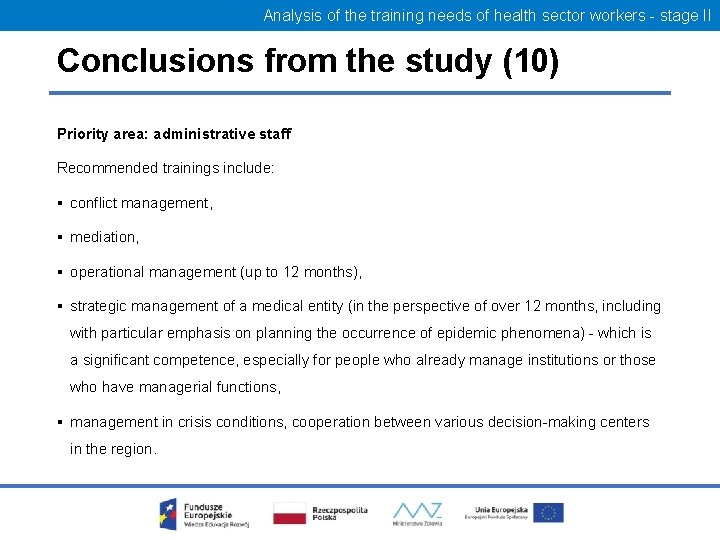
Analysis of the training needs of health sector workers - stage II Conclusions from the study (10) Priority area: administrative staff Recommended trainings include: § conflict management, § mediation, § operational management (up to 12 months), § strategic management of a medical entity (in the perspective of over 12 months, including with particular emphasis on planning the occurrence of epidemic phenomena) - which is a significant competence, especially for people who already manage institutions or those who have managerial functions, § management in crisis conditions, cooperation between various decision-making centers in the region.
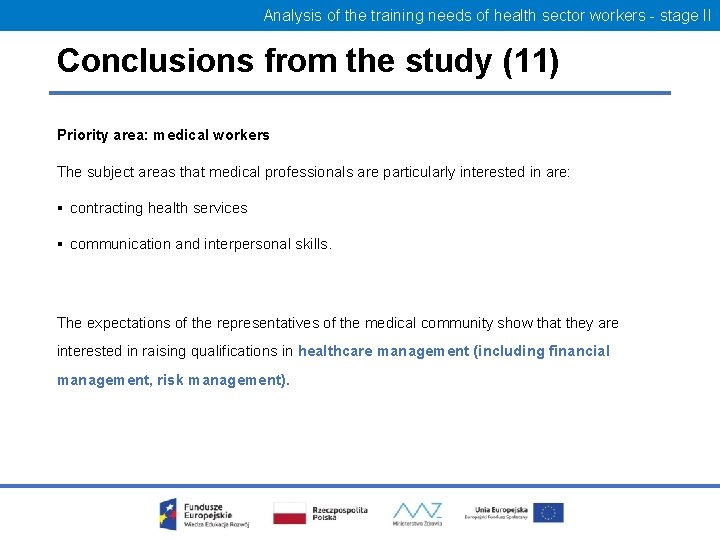
Analysis of the training needs of health sector workers - stage II Conclusions from the study (11) Priority area: medical workers The subject areas that medical professionals are particularly interested in are: § contracting health services § communication and interpersonal skills. The expectations of the representatives of the medical community show that they are interested in raising qualifications in healthcare management (including financial management, risk management).
Analysis of the training needs of health sector workers - stage II Conclusions from the study (12) The most important factors to ensure the maximum suitability / usefulness of training addressed to employees of the healthcare sector § 5. 2: Significant factors increasing the usefulness of training are: gaining management knowledge, gaining more medical knowledge and the possibility of using the knowledge in everyday work, organizing hybrid trainings (combining workshop / practical elements with remote learning), creating both dedicated trainings for individual administrative functions. Trainings should focus on the transfer of knowledge directly related to everyday professional challenges - the practical application may be basing the training program on discussing specific cases. § 5. 4: Significant factors that increase the usefulness of the training are: gaining management knowledge, the possibility of using the knowledge in everyday work, putting emphasis on practical skills and the workshop formula, creating shorter trainings that would be carried out in more frequent series, certification of participants who complete the trainings.
Analysis of the training needs of health sector workers - stage II Conclusions from the study (13) Barriers to access to education for health care workers 5. 2: The most important barriers include: financial barriers (cost of commercial training, studies, but also the need to incur costs related to logistics - transport to the place of training), availability of tailored training (insufficient training (or lack of) dedicated to individual institutions or focused on the specificity of of a given profession in administration in the health service. Often the training did not take into account the specificity of the industry to a sufficient degree), time availability (administrative employees are often unable to afford to participate in training due to a large number of current professional duties) 5. 4: The most important barriers include: financial barriers (too high costs, especially for the lowest-earned groups of employees, e. g. nurses, paramedics), availability of training (limited especially during the last year due to the pandemic) and lack of time.
Analysis of the training needs of health sector workers - stage II Conclusions from the study (14) Expectations regarding specialist equipment necessary for effective training § 5. 2: The expectations regarding the specialist equipment necessary to conduct training include: communication platform for conducting high-quality distance training (platforms that only transmit audio and video are not recommended, but those that allow for the presentation of the lecture, transfer of files, videos and other content, including remote seminars, workshops). For this purpose, it is possible to create a dedicated platform or use existing solutions (eg Zoom, MS-Teams, etc. ). At the same time, it is recommended to automate the processes related to collecting data of training participants in order to minimize the number of activities related to the processing of participants' data. § 5. 4: Among the most frequently cited training-related expectations are: the possibility of remote participation in the training and the provision of training materials to each participant. The possibility of using simulation centers, which can be used both in the course of postgraduate education, as well as short training courses dedicated to various groups of medical workers, brings great value.
Analysis of the training needs of health sector workers - stage II Conclusions from the study (15) The size of the financial gap in the case of support for postgraduate education and professional development of employees in the health care sector Using the principle that the "financial gap" is the relation (inversely proportional) of income from projects to the value of co-financing, it can be concluded that due to the lack of direct income from training, there is no financial gap. Thus, taking into account the planning of future expenditure on training of personnel in the health system, it seems advisable - on the basis of expert analysis and literature data - to maintain the current level of funding, which may be increased in the case when thematic scope or target group of project participants will be greater.
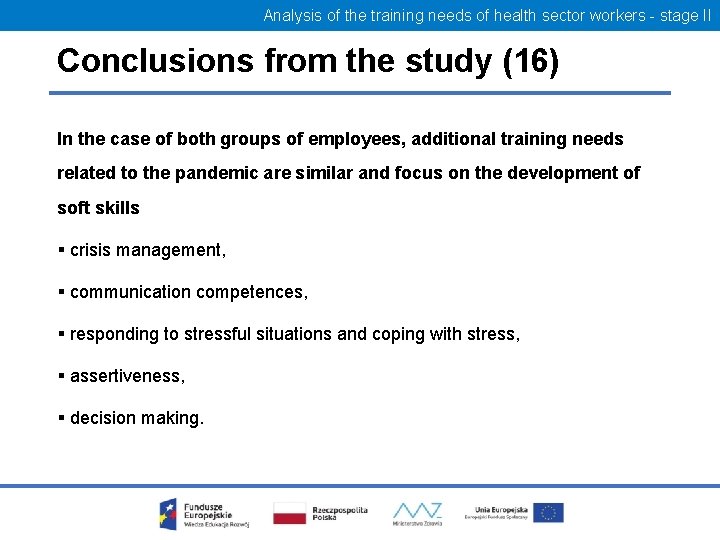
Analysis of the training needs of health sector workers - stage II Conclusions from the study (16) In the case of both groups of employees, additional training needs related to the pandemic are similar and focus on the development of soft skills § crisis management, § communication competences, § responding to stressful situations and coping with stress, § assertiveness, § decision making.
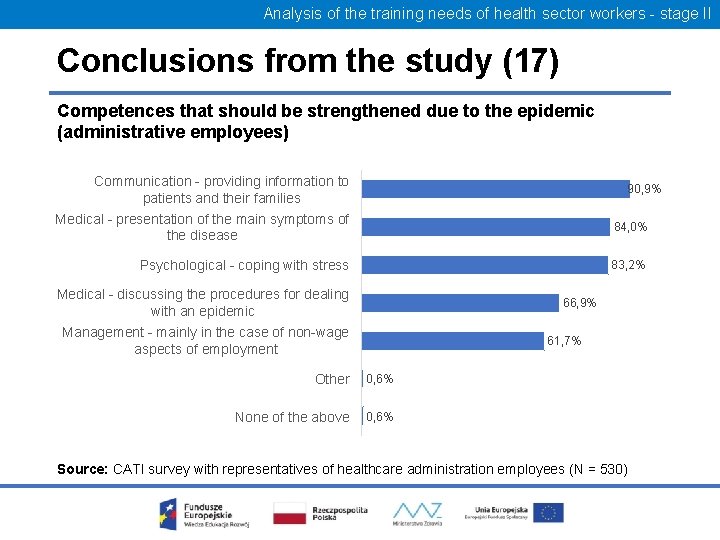
Analysis of the training needs of health sector workers - stage II Conclusions from the study (17) Competences that should be strengthened due to the epidemic (administrative employees) Communication - providing information to patients and their families 90, 9% Medical - presentation of the main symptoms of the disease 84, 0% Psychological - coping with stress 83, 2% Medical - discussing the procedures for dealing with an epidemic 66, 9% Management - mainly in the case of non-wage aspects of employment 61, 7% Other 0, 6% None of the above 0, 6% Source: CATI survey with representatives of healthcare administration employees (N = 530)
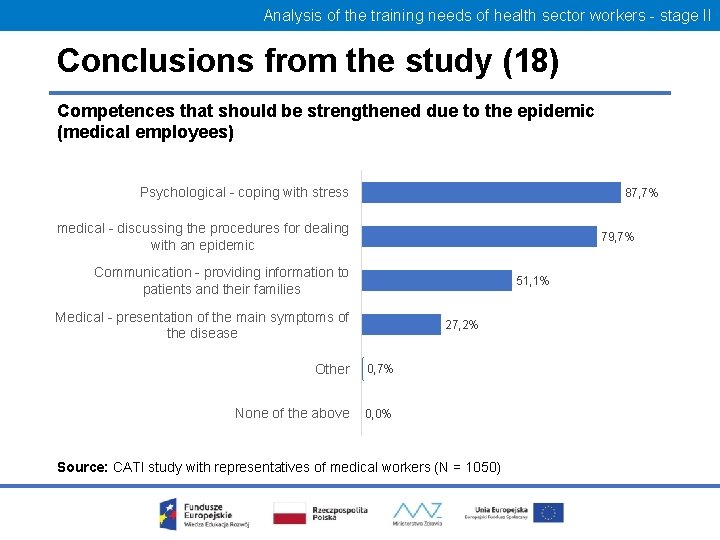
Analysis of the training needs of health sector workers - stage II Conclusions from the study (18) Competences that should be strengthened due to the epidemic (medical employees) Psychological - coping with stress 87, 7% medical - discussing the procedures for dealing with an epidemic 79, 7% Communication - providing information to patients and their families 51, 1% Medical - presentation of the main symptoms of the disease 27, 2% Other 0, 7% None of the above 0, 0% Source: CATI study with representatives of medical workers (N = 1050)
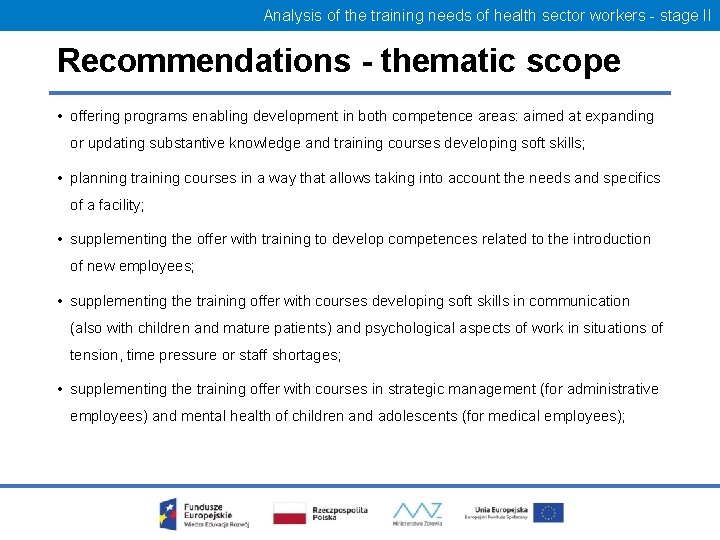
Analysis of the training needs of health sector workers - stage II Recommendations - thematic scope • offering programs enabling development in both competence areas: aimed at expanding or updating substantive knowledge and training courses developing soft skills; • planning training courses in a way that allows taking into account the needs and specifics of a facility; • supplementing the offer with training to develop competences related to the introduction of new employees; • supplementing the training offer with courses developing soft skills in communication (also with children and mature patients) and psychological aspects of work in situations of tension, time pressure or staff shortages; • supplementing the training offer with courses in strategic management (for administrative employees) and mental health of children and adolescents (for medical employees);
Analysis of the training needs of health sector workers - stage II Recommendations - form of training • supporting solutions that save participants' time (e. g. remote / hybrid or stationary forms close to the place of employment); • promotion of short training forms aimed at solving specific dilemmas occurring in professional practice; • emphasis on training enabling interaction with the lecturer. The form of teaching with the use of modern technologies is acceptable, but with the possibility of real-time contact with the trainer;
Analysis of the training needs of health sector workers - stage II Recommendations - target groups • competence support for people managing institutions and teams. Managerial training should be addressed to people whose promotion is planned, as well as to employees who already hold managerial positions and have specific knowledge about the challenges related to their function; • extending the training offer for: departmental nurses, physiotherapists, nurses, laboratory diagnosticians, paramedics.