
ANALYSIS OF THE SYMPTOMS Dr V SATHISH KUMAR

- Slides: 16
ANALYSIS OF THE SYMPTOMS Dr. V. SATHISH KUMAR, M. D (Hom) HOD and Professor, Department of Repertory Sarada Krishna Homoeopathic Medical College Kulasekharam S K H M C KULSEKHARAM, DEPT OF REPERTORY
Analysis of Symptoms • Grouping or classifying symptoms logically under various subheadings is called analysis of symptoms OR It means resolving or separating a symptom into its elements or components parts. • Once the case taking is over, the symptoms are recorded in a case sheet as per the expression of the patient. • Now these symptoms are to be analysed and this discrimination of Symptomatology according to the philosophy of the author for which the repertory is to be chosen. S K H M C KULSEKHARAM, DEPT OF REPERTORY
• • Different authors have classified symptoms under different headings as per their philosophy. Mainly four types of author’s analysis are illustrated here 1. 2. 3. 4. Hahnemann Boenninghausen Kent Garth Boericke S K H M C KULSEKHARAM, DEPT OF REPERTORY
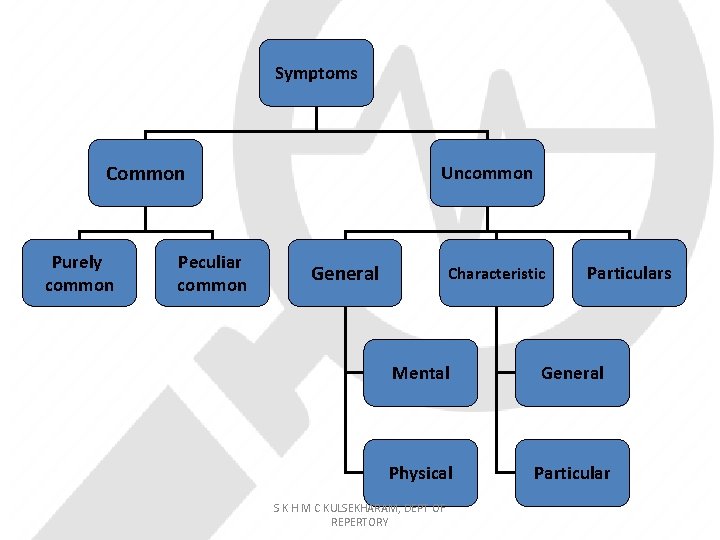
Hahnemannian Classification • Hahnemann has classified symptoms into two groups. 1. Common 2. Uncommon § Common: These are those symptoms common to the disease or seen in many remedies while proving. These symptoms are helpful for the diagnosis. Homoeopathic point of view it is of not much use but it is used to find out the characteristic symptoms by discarding the common symptoms. S K H M C KULSEKHARAM, DEPT OF REPERTORY
Uncommon: These are those symptoms that are characteristic or individualizing the person. This is given under Aphorism 153. This is of no use to diagnose the disease but it helps to diagnose the remedy. S K H M C KULSEKHARAM, DEPT OF REPERTORY
Symptoms Common Purely common Peculiar common Uncommon General Characteristic Particulars Mental General Physical Particular S K H M C KULSEKHARAM, DEPT OF REPERTORY
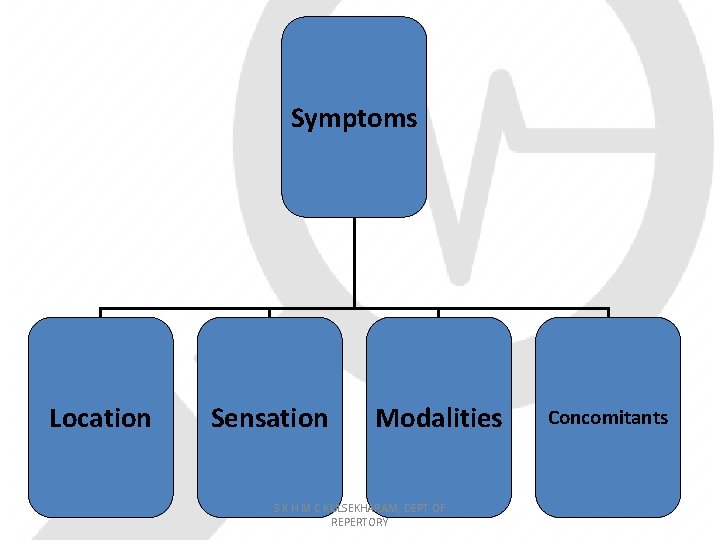
Boenninghausen’s Analysis Boenninghausen has grouped or analyzed as complete symptoms, which in turn has the four components. They are 1. Location: The part or organ 2. Sensation – the character or sensation and pathology 3. Modalities – Causative, aggravation and amelioration 4. Concomitants – without any pathological relation with the main complaint and with strict time relation. S K H M C KULSEKHARAM, DEPT OF REPERTORY
Symptoms Location Sensation Modalities S K H M C KULSEKHARAM, DEPT OF REPERTORY Concomitants
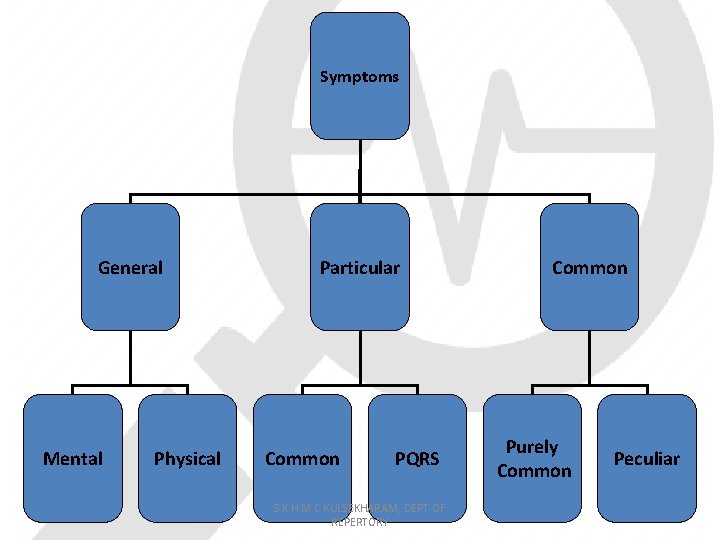
Kent’s Analysis • Kent has analyzed symptoms into 1. General – Mental and physical 2. Particular 3. Common 1. General Symptoms - These are of much importance as far as Kent’s Philosophy is concerned. The general symptoms are divided into Mental general and Physical general S K H M C KULSEKHARAM, DEPT OF REPERTORY
• Mental generals are again classified in the hierarchy as will and emotion, understanding and memory. • Physical generals consist of general modalities, relation to eating, bowel habits, menstrual history, sexual symptoms and character of discharges. 2. Particular Symptoms: 3. Common Symptoms: S K H M C KULSEKHARAM, DEPT OF REPERTORY
Symptoms General Mental Physical Particular Common PQRS S K H M C KULSEKHARAM, DEPT OF REPERTORY Common Purely Common Peculiar
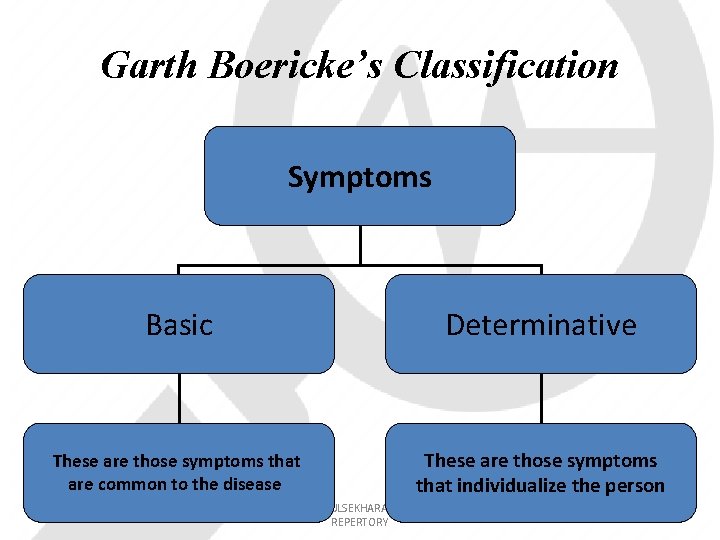
Garth Boericke’s Classification Symptoms Basic Determinative These are those symptoms that are common to the disease These are those symptoms that individualize the person S K H M C KULSEKHARAM, DEPT OF REPERTORY
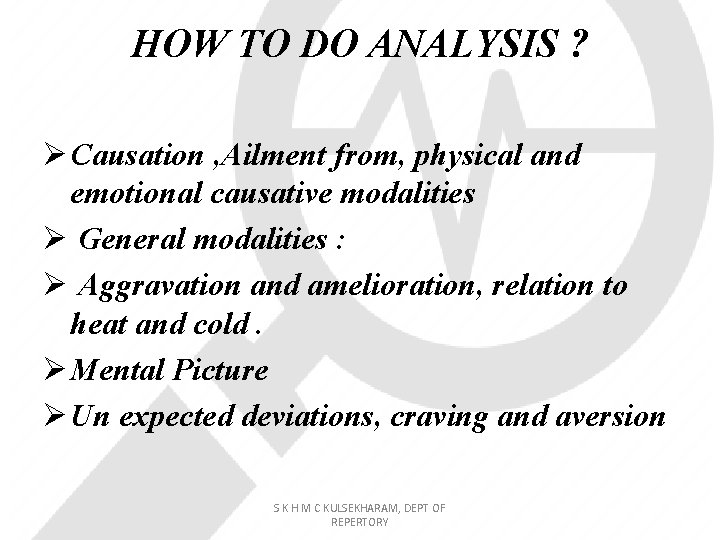
HOW TO DO ANALYSIS ? Ø Causation , Ailment from, physical and emotional causative modalities Ø General modalities : Ø Aggravation and amelioration, relation to heat and cold. Ø Mental Picture Ø Un expected deviations, craving and aversion S K H M C KULSEKHARAM, DEPT OF REPERTORY
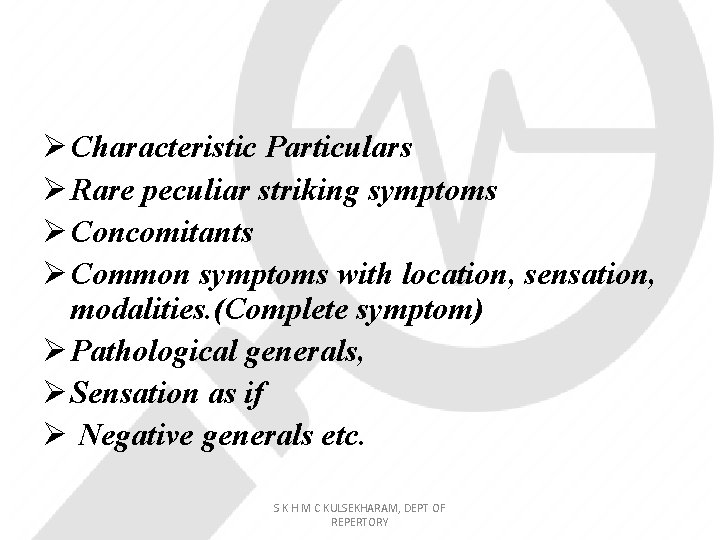
Ø Characteristic Particulars Ø Rare peculiar striking symptoms Ø Concomitants Ø Common symptoms with location, sensation, modalities. (Complete symptom) Ø Pathological generals, Ø Sensation as if Ø Negative generals etc. S K H M C KULSEKHARAM, DEPT OF REPERTORY
References • A reference to repertories for Homoeopathic students-Dr. SIJU. P. V • Essentials of repertorisation-Dr. SHASHI KANT TIWARI SARADA KRISHNA HOMOEOPATHIC MEDICAL COLLEGE DEPT OF REPERTORY
THANK YOU SARADA KRISHNA HOMOEOPATHIC MEDICAL COLLEGE, DEPT. OF REPERTORY