
Analysis of the SACCO Balance Sheet PEARLS Dave
Analysis of the SACCO Balance Sheet & PEARLS Dave Grace Vice President World Council of Credit Unions dgrace@woccu. org www. woccu. org
Assets Earning Assets Loans Liquid Investments Non-Financial Investments
Assets Non-Earning Assets Liquid Assets Accounts Receivable Fixed Assets Other Assets Problem Assets TOTAL Assets
Liabilities Interest Bearing Liabilities Savings Shares External Credit Non-interest Bearing Accounts Payable Other Liabilities Total Liabilities
Capital Transitory Capital Educational Reserves Social Reserves Institutional Capital Statuary Reserves Retained Earnings Undistributed Net Income Total Capital
Differences from Banks • Capital Structure – limited or no market access • Governance – one member one vote • Liquidity management – Often pooled • Not-profit maximizing • Serve primarily members who are also owners
What is PEARLS? P Protection E Effective Financial Structure A Asset Quality R Rate of Return & Cost L Liquidity S Signs of Growth
What is PEARLS? Monitoring system comprised of 45 quantitative financial indicators that facilitate an integral analysis and interpretation of the financial condition of any credit union.
Why do CU Managers like PEARLS? • It is logical & easy to use • It is complete & concise • It provides strategic direction in the management decision-making. • It is a common language of understanding amongst employee
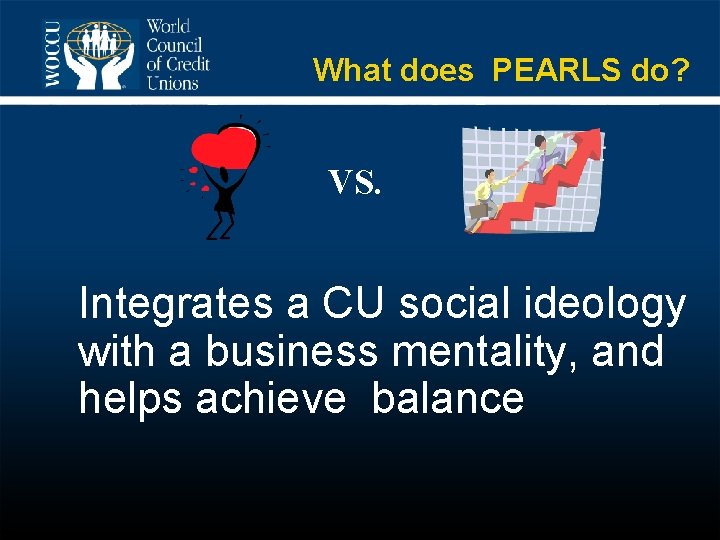
What does PEARLS do? VS. Integrates a CU social ideology with a business mentality, and helps achieve balance
What PEARLS is Not • Not designed as a supervisory system • Not a legislative or regulatory mandate • However, it is available free of charge to supervisors that would like to make use of it.
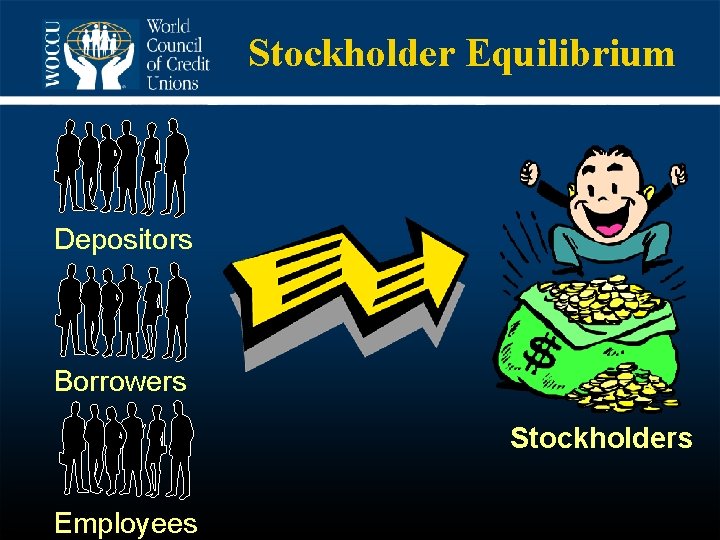
Stockholder Equilibrium Depositors Borrowers Stockholders Employees
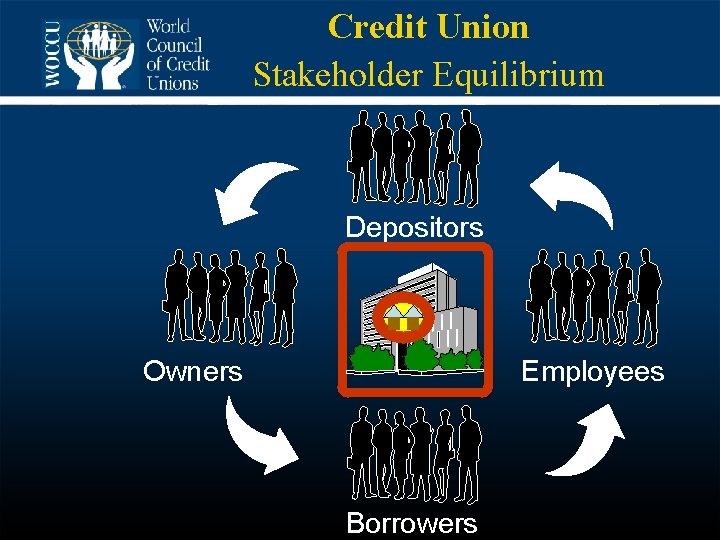
Credit Union Stakeholder Equilibrium Depositors Employees Owners Borrowers
How does PEARLS work?
The Standards of PEARLS Where did they come from?

The Standards of PEARLS? From Successful Credit Unions around the World
PEARLS P Protection E Effective Financial Structure A Asset Quality R Rate of Return & Cost L S Liquidity Signs of Growth
P = Protection 7 ratios measuring quality of loan portfolio, financial investments management and adequacy of provisions
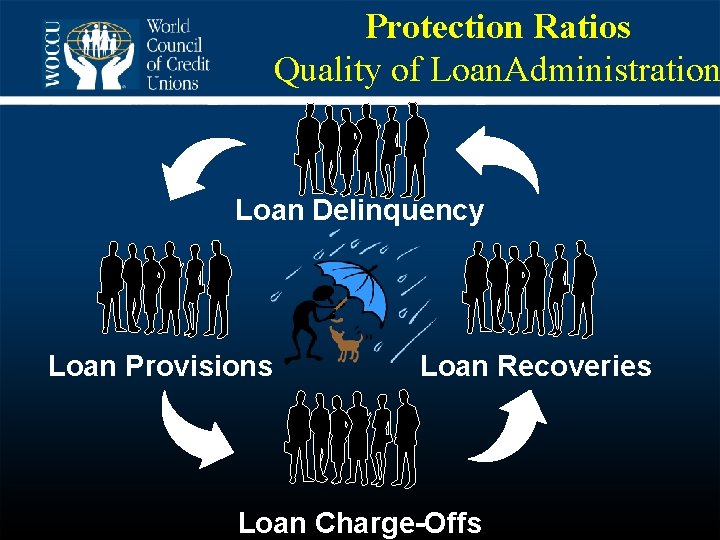
Protection Ratios Quality of Loan. Administration Loan Delinquency Loan Provisions Loan Recoveries Loan Charge-Offs
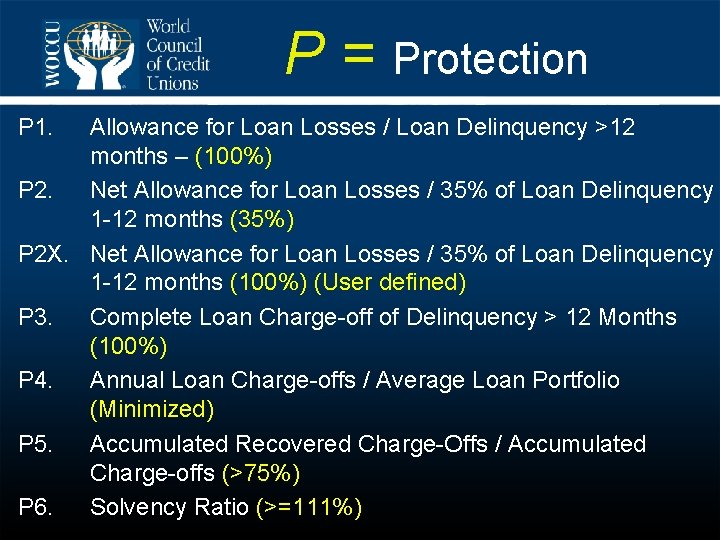
P = Protection P 1. Allowance for Loan Losses / Loan Delinquency >12 months – (100%) P 2. Net Allowance for Loan Losses / 35% of Loan Delinquency 1 -12 months (35%) P 2 X. Net Allowance for Loan Losses / 35% of Loan Delinquency 1 -12 months (100%) (User defined) P 3. Complete Loan Charge-off of Delinquency > 12 Months (100%) P 4. Annual Loan Charge-offs / Average Loan Portfolio (Minimized) P 5. Accumulated Recovered Charge-Offs / Accumulated Charge-offs (>75%) P 6. Solvency Ratio (>=111%)

Social Value of PEARLS P= PROTECTION • A Safe Place to Save your Money!!
PEARLS P Protection E Effective Financial Structure A Asset Quality R Rate of Return & Cost L S Liquidity Signs of Growth

E = Effective Financial Structure 9 ratios measuring the most important assets, liabilities, and capital accounts of a credit union. As growth occurs, ratios help prevent structural imbalances.
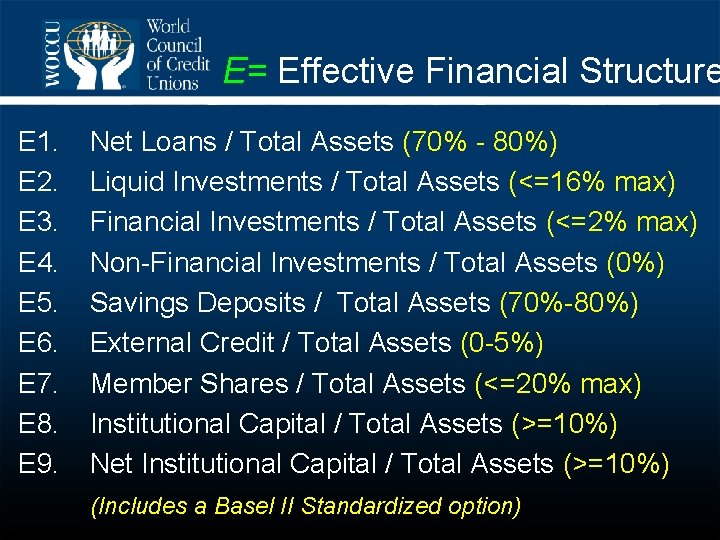
E= Effective Financial Structure E 1. E 2. E 3. E 4. E 5. E 6. E 7. E 8. E 9. Net Loans / Total Assets (70% - 80%) Liquid Investments / Total Assets (<=16% max) Financial Investments / Total Assets (<=2% max) Non-Financial Investments / Total Assets (0%) Savings Deposits / Total Assets (70%-80%) External Credit / Total Assets (0 -5%) Member Shares / Total Assets (<=20% max) Institutional Capital / Total Assets (>=10%) Net Institutional Capital / Total Assets (>=10%) (Includes a Basel II Standardized option)
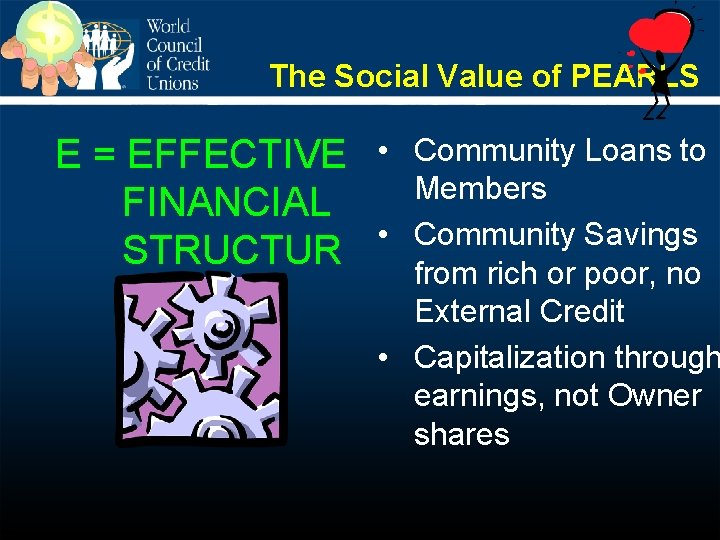
The Social Value of PEARLS E = EFFECTIVE • FINANCIAL • STRUCTUR E Community Loans to Members Community Savings from rich or poor, no External Credit • Capitalization through earnings, not Owner shares
A = Asset Quality 3 ratios evaluating areas of common mismanagement: Delinquency and Excessive Non-earning Assets.
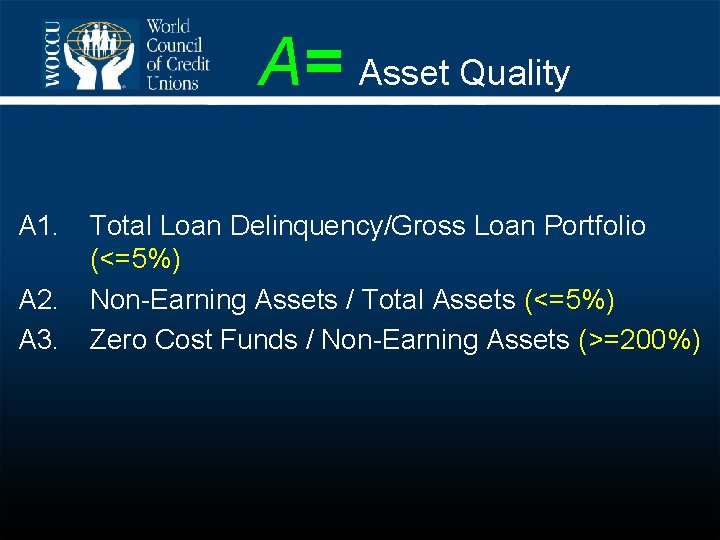
A= Asset Quality A 1. A 2. A 3. Total Loan Delinquency/Gross Loan Portfolio (<=5%) Non-Earning Assets / Total Assets (<=5%) Zero Cost Funds / Non-Earning Assets (>=200%)
The Social Value of PEARLS A = ASSET QUALITY • Monitor Delinquent Members so they honor their financial commitments instead of forcing good Members to pay • Affordable Buildings & other fixed assets
PEARLS P Protection E Effective Financial Structure A Asset Quality R Rate of Return & Cost L S Liquidity Signs of Growth
R = Rates of Return & Costs 13 ratios measuring the yields of the most important assets and liabilities, and also analyzing operating expenses, provisions, and impact of return net on assets.
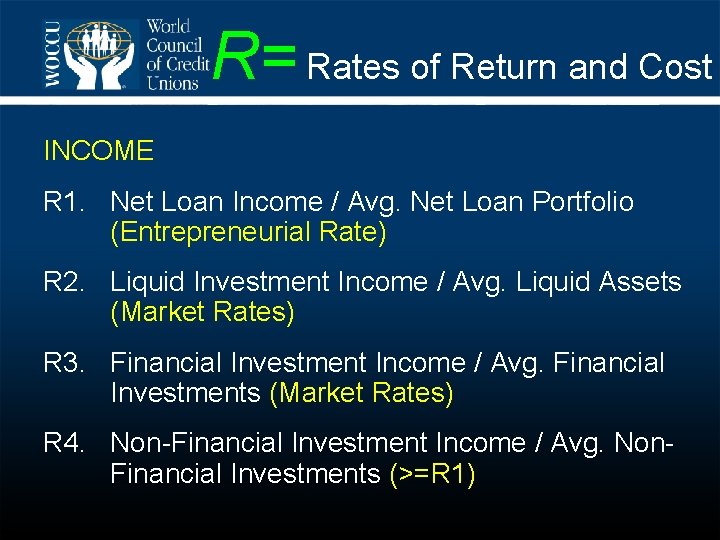
R= Rates of Return and Cost INCOME R 1. Net Loan Income / Avg. Net Loan Portfolio (Entrepreneurial Rate) R 2. Liquid Investment Income / Avg. Liquid Assets (Market Rates) R 3. Financial Investment Income / Avg. Financial Investments (Market Rates) R 4. Non-Financial Investment Income / Avg. Non. Financial Investments (>=R 1)
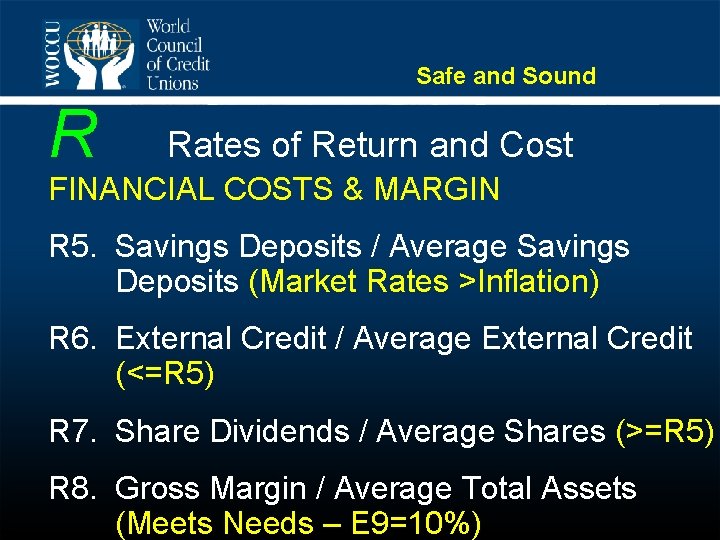
Safe and Sound R Rates of Return and Cost FINANCIAL COSTS & MARGIN R 5. Savings Deposits / Average Savings Deposits (Market Rates >Inflation) R 6. External Credit / Average External Credit (<=R 5) R 7. Share Dividends / Average Shares (>=R 5) R 8. Gross Margin / Average Total Assets (Meets Needs – E 9=10%)
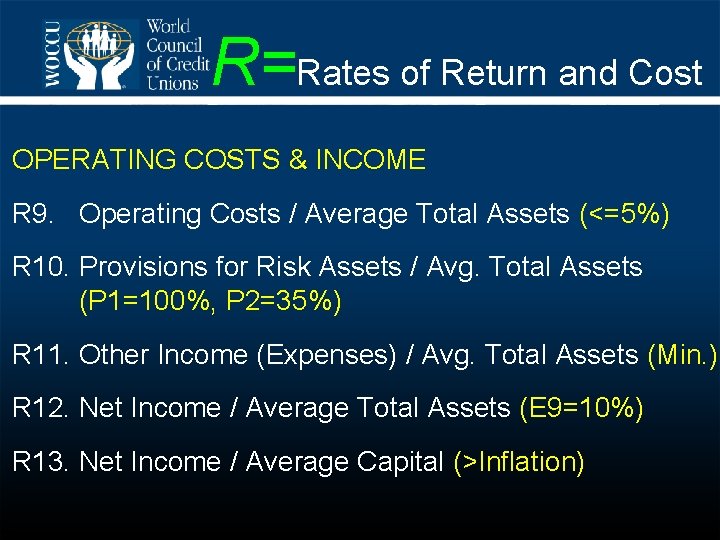
R=Rates of Return and Cost OPERATING COSTS & INCOME R 9. Operating Costs / Average Total Assets (<=5%) R 10. Provisions for Risk Assets / Avg. Total Assets (P 1=100%, P 2=35%) R 11. Other Income (Expenses) / Avg. Total Assets (Min. ) R 12. Net Income / Average Total Assets (E 9=10%) R 13. Net Income / Average Capital (>Inflation)
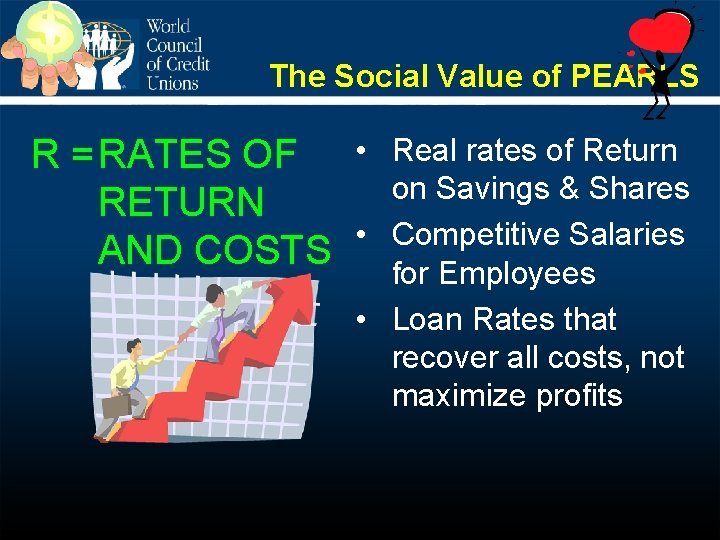
The Social Value of PEARLS R =RATES OF • RETURN • AND COSTS Real rates of Return on Savings & Shares Competitive Salaries for Employees • Loan Rates that recover all costs, not maximize profits
L = Liquidity 3 ratios measuring maintenance of adequate liquidity
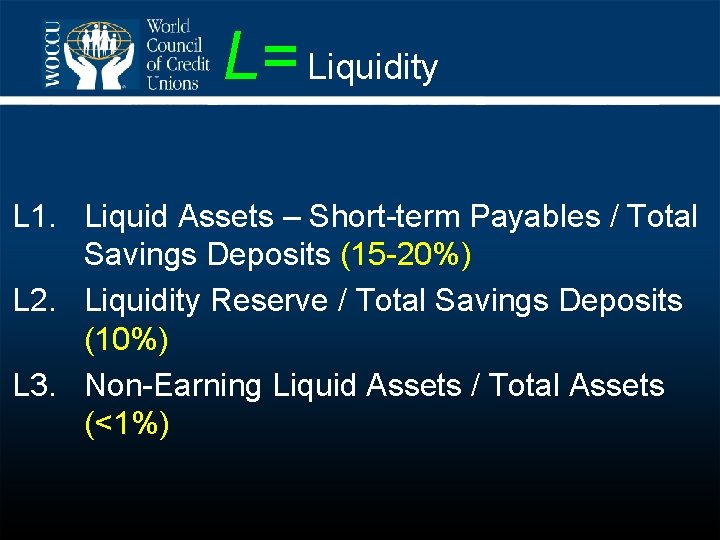
L= Liquidity L 1. Liquid Assets – Short-term Payables / Total Savings Deposits (15 -20%) L 2. Liquidity Reserve / Total Savings Deposits (10%) L 3. Non-Earning Liquid Assets / Total Assets (<1%)
The Social Value of PEARLS L = LIQUIDITY • Enable Members to deposit and withdraw their savings when they need it. • Provide Members with immediate cash, instead of going to bank. • Minimize excess cash

S = Signs of Growth 11 ratios measuring growth of most important, liabilities, and capital of a credit union, plus expansion of membership
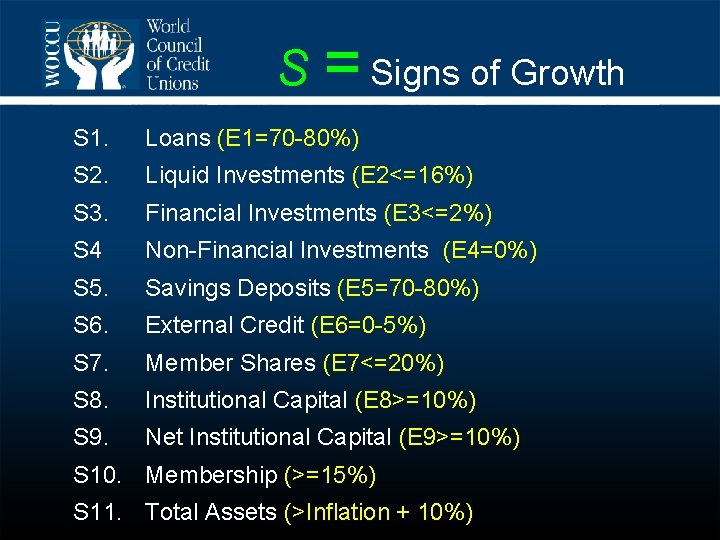
S = Signs of Growth S 1. Loans (E 1=70 -80%) S 2. Liquid Investments (E 2<=16%) S 3. Financial Investments (E 3<=2%) S 4 Non-Financial Investments (E 4=0%) S 5. Savings Deposits (E 5=70 -80%) S 6. External Credit (E 6=0 -5%) S 7. Member Shares (E 7<=20%) S 8. Institutional Capital (E 8>=10%) S 9. Net Institutional Capital (E 9>=10%) S 10. Membership (>=15%) S 11. Total Assets (>Inflation + 10%)
The Social Value of PEARLS S = Signs of Growth • Encourage anyone to join • Encourage anyone to save • Encourage anyone to borrow (who meets standards)
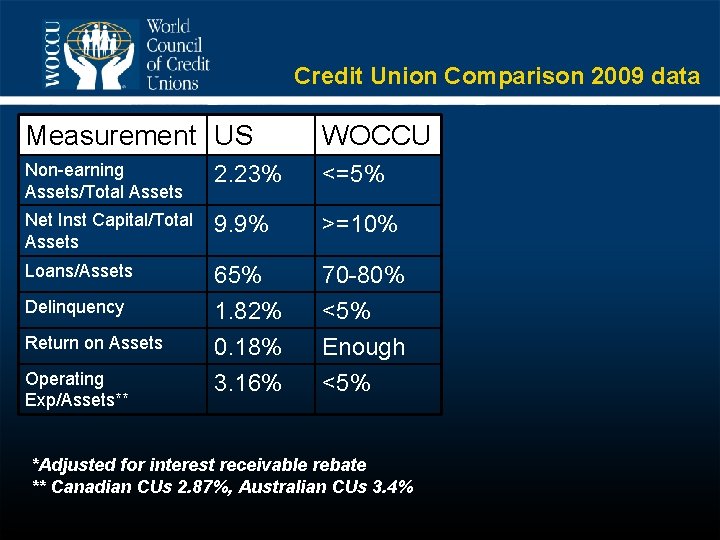
Credit Union Comparison 2009 data Measurement US WOCCU Non-earning Assets/Total Assets 2. 23% <=5% Net Inst Capital/Total Assets 9. 9% >=10% Loans/Assets 65% 1. 82% 0. 18% 3. 16% 70 -80% <5% Enough <5% Delinquency Return on Assets Operating Exp/Assets** *Adjusted for interest receivable rebate ** Canadian CUs 2. 87%, Australian CUs 3. 4%

Questions Dave Grace VP Association Services World Council of Credit Unions dgrace@woccu. org www. woccu. org
- Slides: 43