
Analysis of the Popliteal Lymph Node as a
- Slides: 1
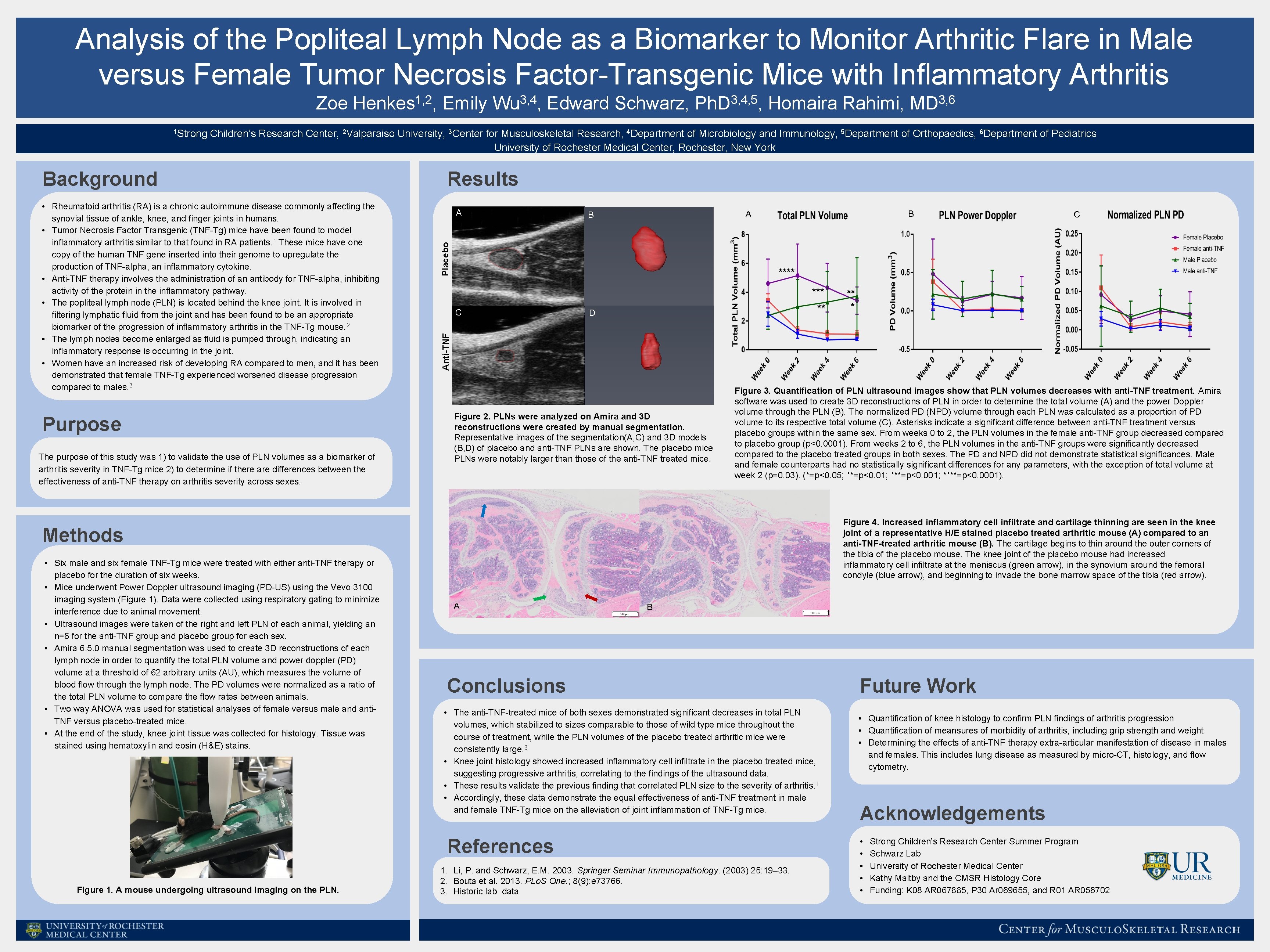
Analysis of the Popliteal Lymph Node as a Biomarker to Monitor Arthritic Flare in Male versus Female Tumor Necrosis Factor-Transgenic Mice with Inflammatory Arthritis Zoe Emily 3, 4 Wu , Edward Schwarz, 3, 4, 5 Ph. D , Homaira Rahimi, 3, 6 MD Children’s Research Center, 2 Valparaiso University, 3 Center for Musculoskeletal Research, 4 Department of Microbiology and Immunology, 5 Department of Orthopaedics, 6 Department of Pediatrics University of Rochester Medical Center, Rochester, New York • Rheumatoid arthritis (RA) is a chronic autoimmune disease commonly affecting the synovial tissue of ankle, knee, and finger joints in humans. • Tumor Necrosis Factor Transgenic (TNF-Tg) mice have been found to model inflammatory arthritis similar to that found in RA patients. 1 These mice have one copy of the human TNF gene inserted into their genome to upregulate the production of TNF-alpha, an inflammatory cytokine. • Anti-TNF therapy involves the administration of an antibody for TNF-alpha, inhibiting activity of the protein in the inflammatory pathway. • The popliteal lymph node (PLN) is located behind the knee joint. It is involved in filtering lymphatic fluid from the joint and has been found to be an appropriate biomarker of the progression of inflammatory arthritis in the TNF-Tg mouse. 2 • The lymph nodes become enlarged as fluid is pumped through, indicating an inflammatory response is occurring in the joint. • Women have an increased risk of developing RA compared to men, and it has been demonstrated that female TNF-Tg experienced worsened disease progression compared to males. 3 Purpose The purpose of this study was 1) to validate the use of PLN volumes as a biomarker of arthritis severity in TNF-Tg mice 2) to determine if there are differences between the effectiveness of anti-TNF therapy on arthritis severity across sexes. Results A B Placebo Background **** C ** D Figure 2. PLNs were analyzed on Amira and 3 D reconstructions were created by manual segmentation. Representative images of the segmentation(A, C) and 3 D models (B, D) of placebo and anti-TNF PLNs are shown. The placebo mice PLNs were notably larger than those of the anti-TNF treated mice. Figure 4. Increased inflammatory cell infiltrate and cartilage thinning are seen in the knee joint of a representative H/E stained placebo treated arthritic mouse (A) compared to an anti-TNF-treated arthritic mouse (B). The cartilage begins to thin around the outer corners of the tibia of the placebo mouse. The knee joint of the placebo mouse had increased inflammatory cell infiltrate at the meniscus (green arrow), in the synovium around the femoral condyle (blue arrow), and beginning to invade the bone marrow space of the tibia (red arrow). A B Conclusions • The anti-TNF-treated mice of both sexes demonstrated significant decreases in total PLN volumes, which stabilized to sizes comparable to those of wild type mice throughout the course of treatment, while the PLN volumes of the placebo treated arthritic mice were consistently large. 3 • Knee joint histology showed increased inflammatory cell infiltrate in the placebo treated mice, suggesting progressive arthritis, correlating to the findings of the ultrasound data. • These results validate the previous finding that correlated PLN size to the severity of arthritis. 1 • Accordingly, these data demonstrate the equal effectiveness of anti-TNF treatment in male and female TNF-Tg mice on the alleviation of joint inflammation of TNF-Tg mice. References Figure 1. A mouse undergoing ultrasound imaging on the PLN. ** * Figure 3. Quantification of PLN ultrasound images show that PLN volumes decreases with anti-TNF treatment. Amira software was used to create 3 D reconstructions of PLN in order to determine the total volume (A) and the power Doppler volume through the PLN (B). The normalized PD (NPD) volume through each PLN was calculated as a proportion of PD volume to its respective total volume (C). Asterisks indicate a significant difference between anti-TNF treatment versus placebo groups within the same sex. From weeks 0 to 2, the PLN volumes in the female anti-TNF group decreased compared to placebo group (p<0. 0001). From weeks 2 to 6, the PLN volumes in the anti-TNF groups were significantly decreased compared to the placebo treated groups in both sexes. The PD and NPD did not demonstrate statistical significances. Male and female counterparts had no statistically significant differences for any parameters, with the exception of total volume at week 2 (p=0. 03). (*=p<0. 05; **=p<0. 01; ***=p<0. 001; ****=p<0. 0001). Methods • Six male and six female TNF-Tg mice were treated with either anti-TNF therapy or placebo for the duration of six weeks. • Mice underwent Power Doppler ultrasound imaging (PD-US) using the Vevo 3100 imaging system (Figure 1). Data were collected using respiratory gating to minimize interference due to animal movement. • Ultrasound images were taken of the right and left PLN of each animal, yielding an n=6 for the anti-TNF group and placebo group for each sex. • Amira 6. 5. 0 manual segmentation was used to create 3 D reconstructions of each lymph node in order to quantify the total PLN volume and power doppler (PD) volume at a threshold of 62 arbitrary units (AU), which measures the volume of blood flow through the lymph node. The PD volumes were normalized as a ratio of the total PLN volume to compare the flow rates between animals. • Two way ANOVA was used for statistical analyses of female versus male and anti. TNF versus placebo-treated mice. • At the end of the study, knee joint tissue was collected for histology. Tissue was stained using hematoxylin and eosin (H&E) stains. C Anti-TNF 1 Strong 1, 2 Henkes , 1. Li, P. and Schwarz, E. M. 2003. Springer Seminar Immunopathology. (2003) 25: 19– 33. 2. Bouta et al. 2013. PLo. S One. ; 8(9): e 73766. 3. Historic lab data Future Work • Quantification of knee histology to confirm PLN findings of arthritis progression • Quantification of meansures of morbidity of arthritis, including grip strength and weight • Determining the effects of anti-TNF therapy extra-articular manifestation of disease in males and females. This includes lung disease as measured by micro-CT, histology, and flow cytometry. Acknowledgements • • • Strong Children’s Research Center Summer Program Schwarz Lab University of Rochester Medical Center Kathy Maltby and the CMSR Histology Core Funding: K 08 AR 067885, P 30 Ar 069655, and R 01 AR 056702