
Analysis of the OSLC Specs and the PLM

- Slides: 39
Analysis of the OSLC Specs and the PLM Reference model in the context of SE Scenario #1 V 0. 6 December 7 th 2010 Gray Bachelor Mike Loeffler OSLC PLM Workgroup For OSLC PLM Workgroup meeting 7 th Dec 2010 1
Acknowledgements l OSLC PLM Workgroup ¡ Mike Loeffler ¡ Gray Bachelor l OSLC ¡ Ian RM Workgroup lead Green For OSLC PLM Workgroup meeting 7 th Dec 2010 2
Contents l Background l Motivation l PLM Reference Model (proposed) overview l Analysis of the OSLC Specs and PLM Reference Model in the content of the selected Scenario l Next steps For OSLC PLM Workgroup meeting 7 th Dec 2010 3
Background Open Services for Lifecycle Collaboration are community developed interface specifications l The OSLC PLM Workgroup aims to promote and pursue the use of the OSLC Resource models (Specs) to support collaboration between Software Application Lifecycle Management and Product Lifecycle Management l Due to the lack of available and agreed reference or domain information the PLM Workgroup sponsored work to support investigation and subsequent recommendation by selecting and building up a representative scenario and PLM Reference model l The current focus is on analysis and comparison with the aim of publishing some findings that can guide current usage and potential extensions l For OSLC PLM Workgroup meeting 7 th Dec 2010 4
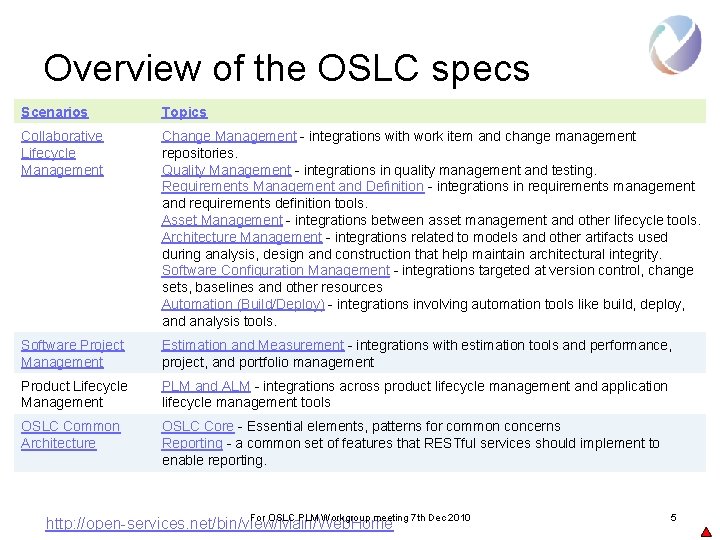
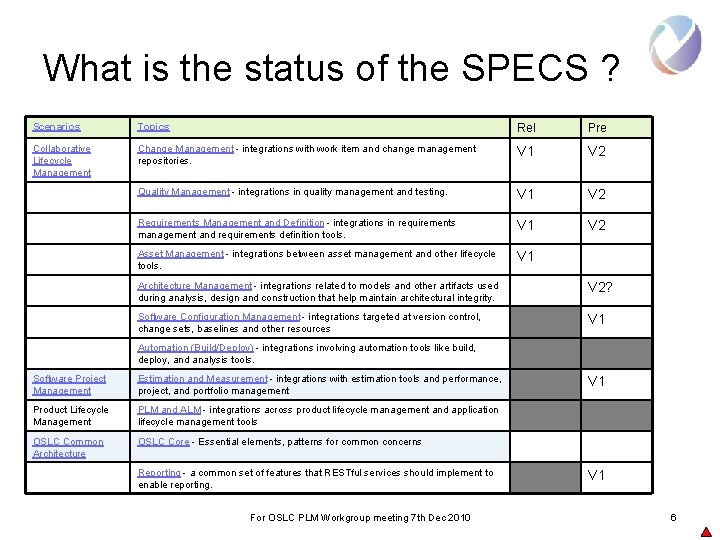
Overview of the OSLC specs Scenarios Topics Collaborative Lifecycle Management Change Management - integrations with work item and change management repositories. Quality Management - integrations in quality management and testing. Requirements Management and Definition - integrations in requirements management and requirements definition tools. Asset Management - integrations between asset management and other lifecycle tools. Architecture Management - integrations related to models and other artifacts used during analysis, design and construction that help maintain architectural integrity. Software Configuration Management - integrations targeted at version control, change sets, baselines and other resources Automation (Build/Deploy) - integrations involving automation tools like build, deploy, and analysis tools. Software Project Management Estimation and Measurement - integrations with estimation tools and performance, project, and portfolio management Product Lifecycle Management PLM and ALM - integrations across product lifecycle management and application lifecycle management tools OSLC Common Architecture OSLC Core - Essential elements, patterns for common concerns Reporting - a common set of features that RESTful services should implement to enable reporting. For OSLC PLM Workgroup meeting 7 th Dec 2010 http: //open-services. net/bin/view/Main/Web. Home 5
What is the status of the SPECS ? Scenarios Topics Rel Pre Collaborative Lifecycle Management Change Management - integrations with work item and change management repositories. V 1 V 2 Quality Management - integrations in quality management and testing. V 1 V 2 Requirements Management and Definition - integrations in requirements management and requirements definition tools. V 1 V 2 Asset Management - integrations between asset management and other lifecycle tools. V 1 Architecture Management - integrations related to models and other artifacts used during analysis, design and construction that help maintain architectural integrity. V 2? Software Configuration Management - integrations targeted at version control, change sets, baselines and other resources V 1 Automation (Build/Deploy) - integrations involving automation tools like build, deploy, and analysis tools. Software Project Management Estimation and Measurement - integrations with estimation tools and performance, project, and portfolio management Product Lifecycle Management PLM and ALM - integrations across product lifecycle management and application lifecycle management tools OSLC Common Architecture OSLC Core - Essential elements, patterns for common concerns Reporting - a common set of features that RESTful services should implement to enable reporting. For OSLC PLM Workgroup meeting 7 th Dec 2010 V 1 6
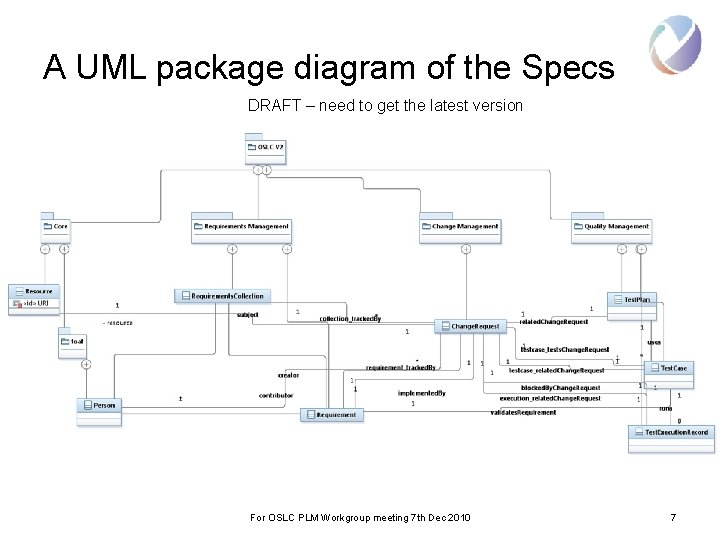
A UML package diagram of the Specs DRAFT – need to get the latest version For OSLC PLM Workgroup meeting 7 th Dec 2010 7
Motivation For OSLC PLM Workgroup meeting 7 th Dec 2010 8
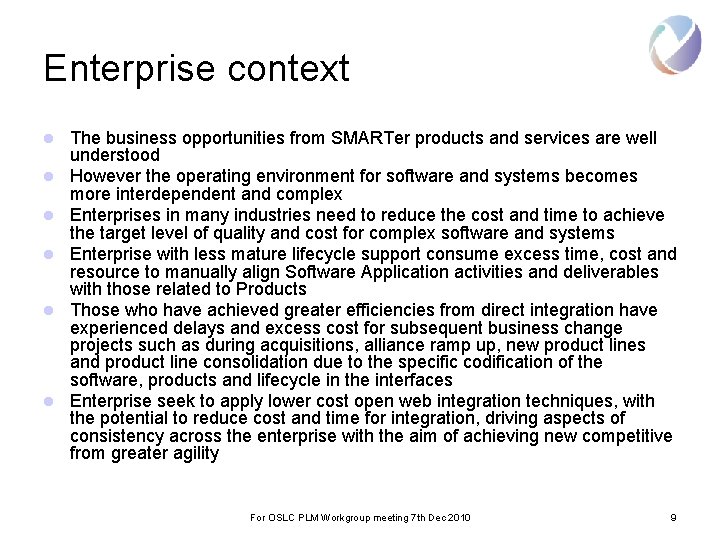
Enterprise context l l l The business opportunities from SMARTer products and services are well understood However the operating environment for software and systems becomes more interdependent and complex Enterprises in many industries need to reduce the cost and time to achieve the target level of quality and cost for complex software and systems Enterprise with less mature lifecycle support consume excess time, cost and resource to manually align Software Application activities and deliverables with those related to Products Those who have achieved greater efficiencies from direct integration have experienced delays and excess cost for subsequent business change projects such as during acquisitions, alliance ramp up, new product lines and product line consolidation due to the specific codification of the software, products and lifecycle in the interfaces Enterprise seek to apply lower cost open web integration techniques, with the potential to reduce cost and time for integration, driving aspects of consistency across the enterprise with the aim of achieving new competitive from greater agility For OSLC PLM Workgroup meeting 7 th Dec 2010 9
Goal l To reduce the cost and time to provide process support for the product and service lifecycle by reducing the complexity of enterprise integration For OSLC PLM Workgroup meeting 7 th Dec 2010 10
Strategy l To enable aggregation and combination of heterogeneous services and information ¡ Greater support for preferred representations e. g. OSLC ¡ Support for aggregation and combination ¡ Support for prototyping For OSLC PLM Workgroup meeting 7 th Dec 2010 11
Objective Towards the strategy of enabling aggregation and combination of heterogeneous services and information by providing greater support for preferred representations e. g. OSLC ¡ To make the use of the OSLC Resource model (aka OSLC Specs) viable for both OSLC and PLM Service Providers For OSLC PLM Workgroup meeting 7 th Dec 2010 12
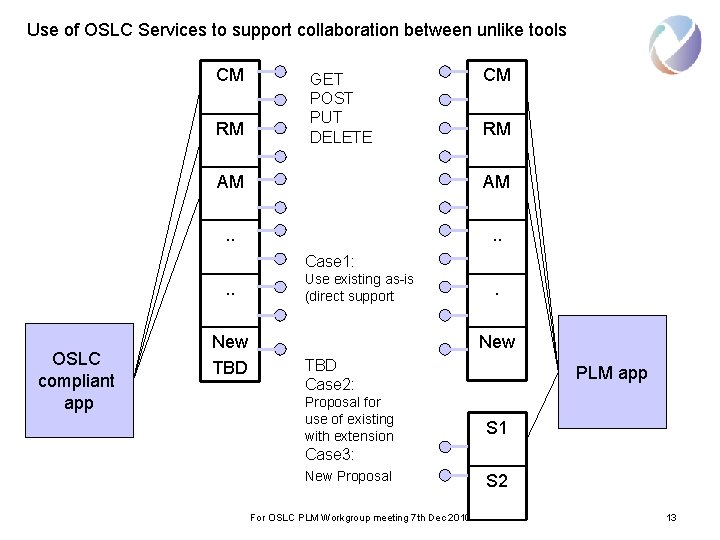
Use of OSLC Services to support collaboration between unlike tools CM RM GET POST PUT DELETE CM RM AM AM . . Case 1: . . OSLC compliant app New TBD Use existing as-is (direct support . New TBD Case 2: Proposal for use of existing with extension PLM app S 1 Case 3: New Proposal For OSLC PLM Workgroup meeting 7 th Dec 2010 S 2 13
PLM Reference Model For OSLC PLM Workgroup meeting 7 th Dec 2010 14
Overview of the PLM Reference Model l The objective of the model is to provide a representative description of PLM information related to the scenario l Certain standard representations have been selected to address the concerns of Scenario #1 ¡ Sys. ML and STEP Due to their ability to represent aspects of context, requirements and system implementation l Due to the motive to support modelling l For OSLC PLM Workgroup meeting 7 th Dec 2010 15
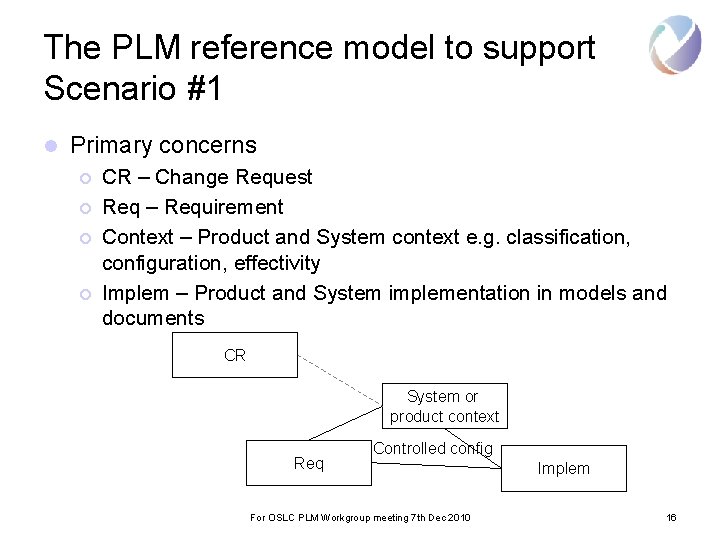
The PLM reference model to support Scenario #1 l Primary concerns ¡ ¡ CR – Change Request Req – Requirement Context – Product and System context e. g. classification, configuration, effectivity Implem – Product and System implementation in models and documents CR System or product context Req Controlled config For OSLC PLM Workgroup meeting 7 th Dec 2010 Implem 16
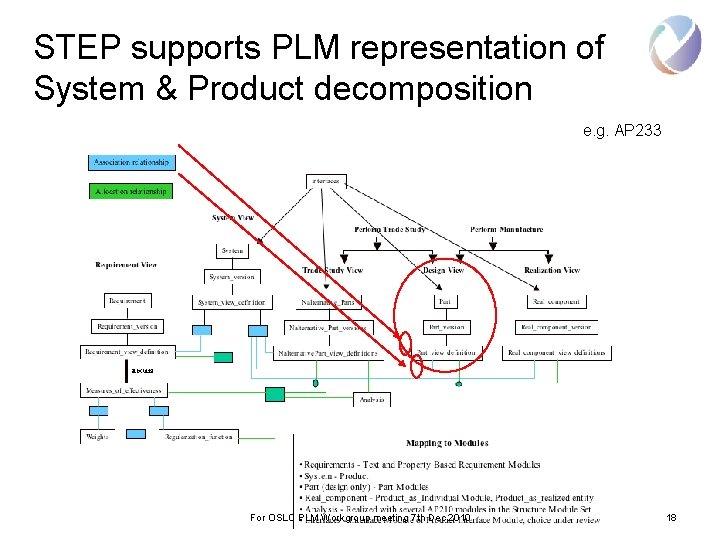
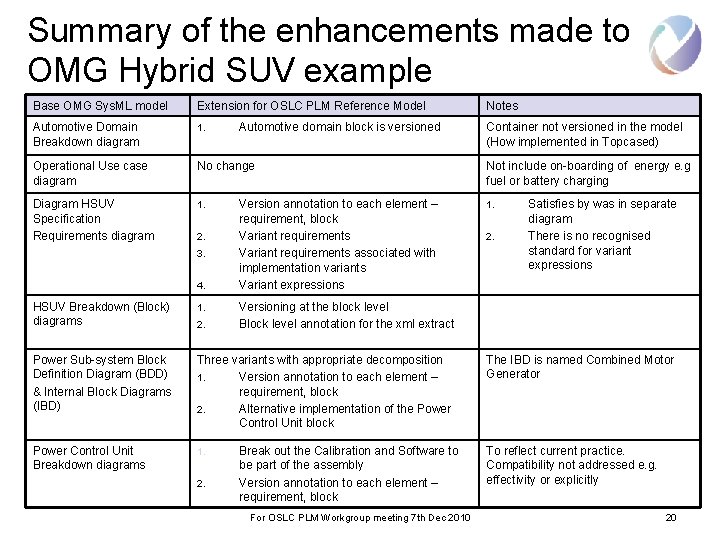
Overview of the proposed PLM Reference Model content Based on the OMG Sys. ML education example with enhancements for PLM l Main elements l ¡ Sys. ML model representations l l ¡ l Requirements Diagram Block diagrams STEP text, xml and OWL representations Example instance ¡ Hybrid SUV l Based upon the OMG Sys. ML model with extensions to support the scenario and to provide a viable reference model For OSLC PLM Workgroup meeting 7 th Dec 2010 17
STEP supports PLM representation of System & Product decomposition e. g. AP 233 For OSLC PLM Workgroup meeting 7 th Dec 2010 18
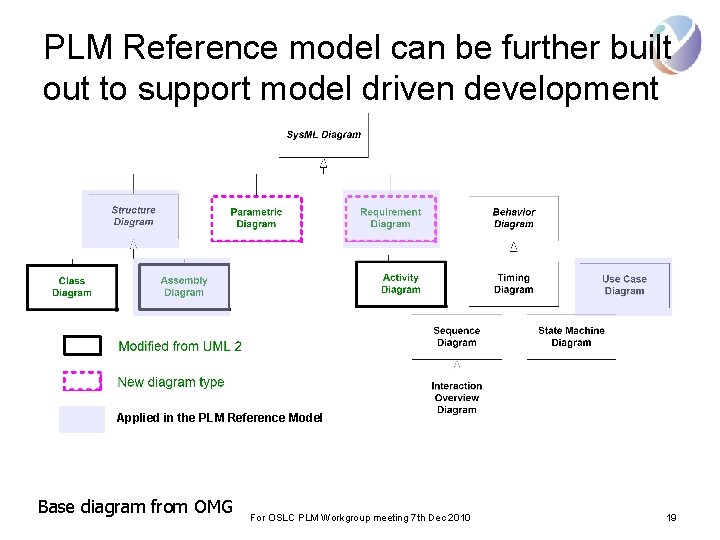
PLM Reference model can be further built out to support model driven development Applied in the PLM Reference Model Base diagram from OMG For OSLC PLM Workgroup meeting 7 th Dec 2010 19
Summary of the enhancements made to OMG Hybrid SUV example Base OMG Sys. ML model Extension for OSLC PLM Reference Model Automotive Domain Breakdown diagram 1. Operational Use case diagram No change Diagram HSUV Specification Requirements diagram 1. 2. 3. 4. Automotive domain block is versioned Version annotation to each element – requirement, block Variant requirements associated with implementation variants Variant expressions HSUV Breakdown (Block) diagrams 1. Power Sub-system Block Definition Diagram (BDD) & Internal Block Diagrams (IBD) Three variants with appropriate decomposition 1. Version annotation to each element – requirement, block 2. Alternative implementation of the Power Control Unit block Power Control Unit Breakdown diagrams 1. 2. Notes Container not versioned in the model (How implemented in Topcased) Not include on-boarding of energy e. g fuel or battery charging 1. 2. Satisfies by was in separate diagram There is no recognised standard for variant expressions Versioning at the block level Block level annotation for the xml extract Break out the Calibration and Software to be part of the assembly Version annotation to each element – requirement, block For OSLC PLM Workgroup meeting 7 th Dec 2010 The IBD is named Combined Motor Generator To reflect current practice. Compatibility not addressed e. g. effectivity or explicitly 20
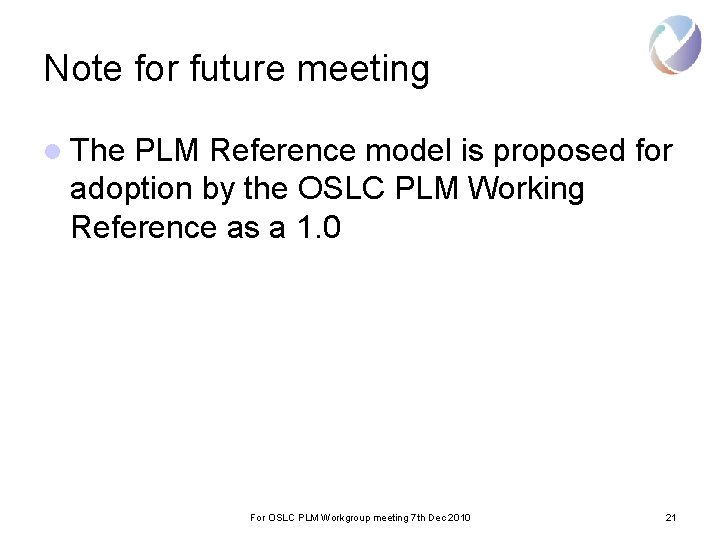
Note for future meeting l The PLM Reference model is proposed for adoption by the OSLC PLM Working Reference as a 1. 0 For OSLC PLM Workgroup meeting 7 th Dec 2010 21
Analysis For OSLC PLM Workgroup meeting 7 th Dec 2010 22
Objective l To identify the ability of the current Spec to support the scenario l To identify extensions of the current Spec to support the scenario For OSLC PLM Workgroup meeting 7 th Dec 2010 23
OSLC SPEC analysis l Analysis of existing specs ¡ l Traceability scenarios from RM team ¡ l Initial focus on Core and RM Link Identify “same as” or “equivalent” using OWL ¡ Capture gaps and issues Investigate possibility to make a basic transformation l CM, AM next iteration l For OSLC PLM Workgroup meeting 7 th Dec 2010 24
What might the output of analysis look like ? l. A set of statements about entities and relationships compared across the OSLC Spec and the PLM Reference Model l A list of resources with examples of GET, PUT, POST l A data graph of entities and relationships with resources identified l A taxonomy for entities, relationships and resources showing origin or equivalence For OSLC PLM Workgroup meeting 7 th Dec 2010 25
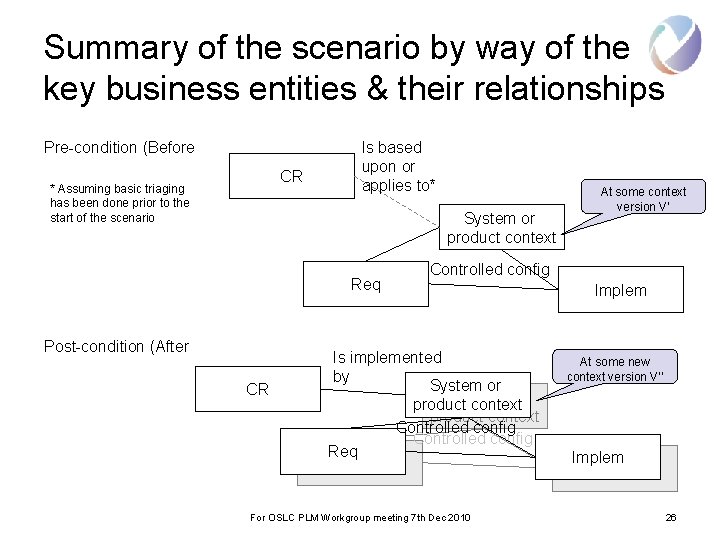
Summary of the scenario by way of the key business entities & their relationships Pre-condition (Before CR * Assuming basic triaging has been done prior to the start of the scenario Is based upon or applies to* System or product context Req Post-condition (After CR At some context version V’ Controlled config Is implemented by System or product context Controlled config Req For OSLC PLM Workgroup meeting 7 th Dec 2010 Implem At some new context version V’’ Implem 26
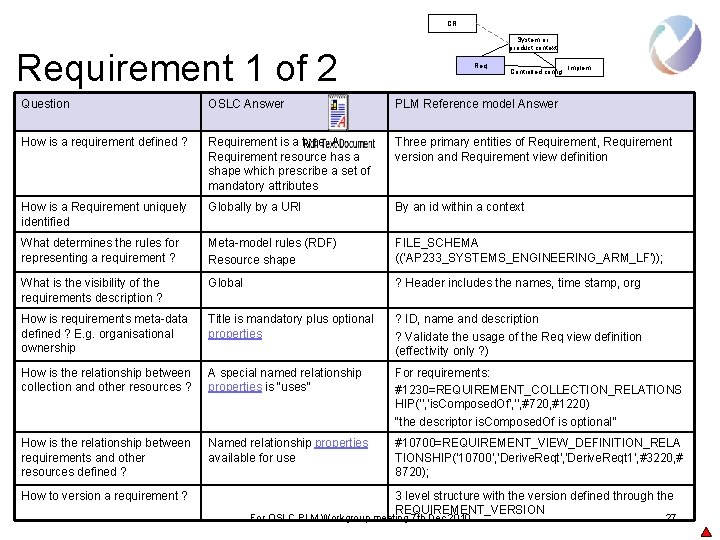
CR System or product context Requirement 1 of 2 Req Controlled config Implem Question OSLC Answer PLM Reference model Answer How is a requirement defined ? Requirement is a type. A Requirement resource has a shape which prescribe a set of mandatory attributes Three primary entities of Requirement, Requirement version and Requirement view definition How is a Requirement uniquely identified Globally by a URI By an id within a context What determines the rules for representing a requirement ? Meta-model rules (RDF) Resource shape FILE_SCHEMA (('AP 233_SYSTEMS_ENGINEERING_ARM_LF')); What is the visibility of the requirements description ? Global ? Header includes the names, time stamp, org How is requirements meta-data defined ? E. g. organisational ownership Title is mandatory plus optional properties ? ID, name and description ? Validate the usage of the Req view definition (effectivity only ? ) How is the relationship between collection and other resources ? A special named relationship properties is “uses” For requirements: #1230=REQUIREMENT_COLLECTION_RELATIONS HIP('', 'is. Composed. Of', '', #720, #1220) “the descriptor is. Composed. Of is optional” How is the relationship between requirements and other resources defined ? Named relationship properties available for use #10700=REQUIREMENT_VIEW_DEFINITION_RELA TIONSHIP('10700', 'Derive. Reqt 1', #3220, # 8720); How to version a requirement ? 3 level structure with the version defined through the REQUIREMENT_VERSION For OSLC PLM Workgroup meeting 7 th Dec 2010 27
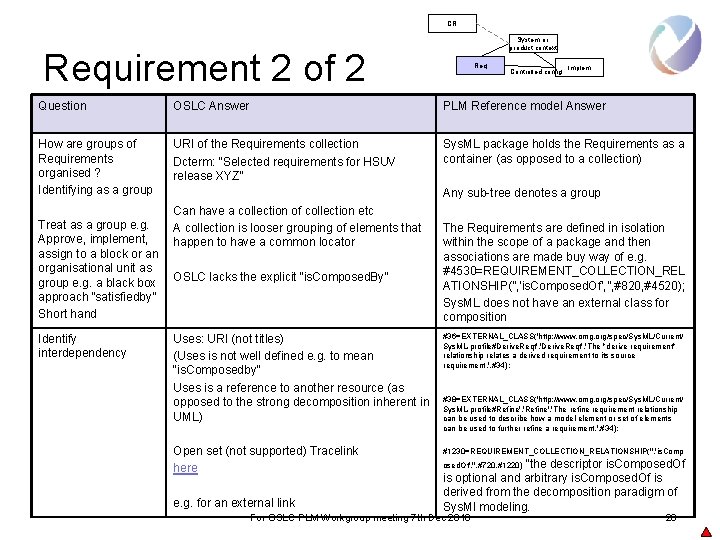
CR System or product context Requirement 2 of 2 Req Controlled config Implem Question OSLC Answer PLM Reference model Answer How are groups of Requirements organised ? Identifying as a group URI of the Requirements collection Dcterm: “Selected requirements for HSUV release XYZ” Sys. ML package holds the Requirements as a container (as opposed to a collection) Treat as a group e. g. Approve, implement, assign to a block or an organisational unit as group e. g. a black box approach “satisfiedby” Short hand Identify interdependency Any sub-tree denotes a group Can have a collection of collection etc A collection is looser grouping of elements that happen to have a common locator OSLC lacks the explicit “is. Composed. By” The Requirements are defined in isolation within the scope of a package and then associations are made buy way of e. g. #4530=REQUIREMENT_COLLECTION_REL ATIONSHIP('', 'is. Composed. Of', '', #820, #4520); Sys. ML does not have an external class for composition Uses: URI (not titles) (Uses is not well defined e. g. to mean “is. Composedby” Uses is a reference to another resource (as opposed to the strong decomposition inherent in UML) #36=EXTERNAL_CLASS('http: //www. omg. org/spec/Sys. ML/Current/ Sys. ML-profile#Derive. Reqt', 'The "derive requirement" relationship relates a derived requirement to its source requirement. ', #34); Open set (not supported) Tracelink here #1230=REQUIREMENT_COLLECTION_RELATIONSHIP('', 'is. Comp e. g. for an external link #38=EXTERNAL_CLASS('http: //www. omg. org/spec/Sys. ML/Current/ Sys. ML-profile#Refine', 'The refine requirement relationship can be used to describe how a model element or set of elements can be used to further refine a requirement. ', #34); “the descriptor is. Composed. Of is optional and arbitrary is. Composed. Of is derived from the decomposition paradigm of Sys. Ml modeling. osed. Of', '', #720, #1220) For OSLC PLM Workgroup meeting 7 th Dec 2010 28
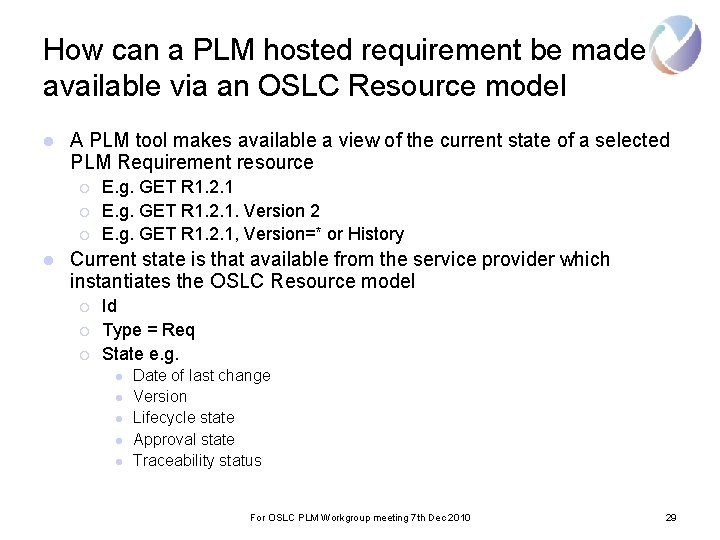
How can a PLM hosted requirement be made available via an OSLC Resource model l A PLM tool makes available a view of the current state of a selected PLM Requirement resource ¡ ¡ ¡ l E. g. GET R 1. 2. 1. Version 2 E. g. GET R 1. 2. 1, Version=* or History Current state is that available from the service provider which instantiates the OSLC Resource model ¡ ¡ ¡ Id Type = Req State e. g. l l l Date of last change Version Lifecycle state Approval state Traceability status For OSLC PLM Workgroup meeting 7 th Dec 2010 29
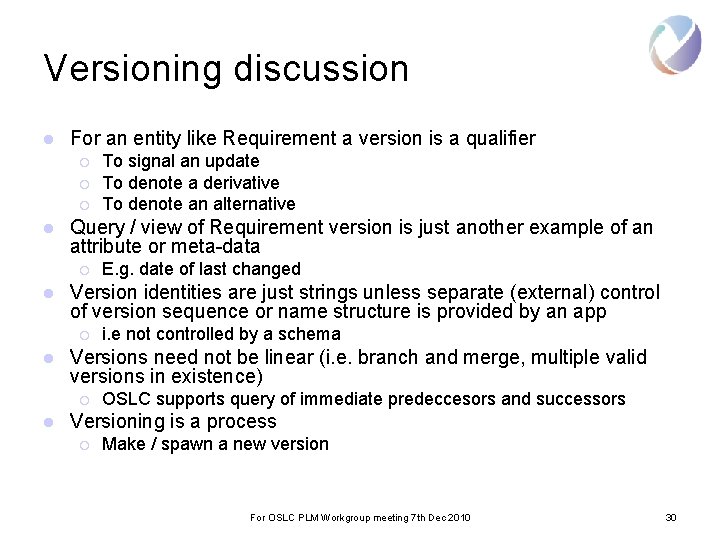
Versioning discussion l For an entity like Requirement a version is a qualifier ¡ ¡ ¡ l Query / view of Requirement version is just another example of an attribute or meta-data ¡ l i. e not controlled by a schema Versions need not be linear (i. e. branch and merge, multiple valid versions in existence) ¡ l E. g. date of last changed Version identities are just strings unless separate (external) control of version sequence or name structure is provided by an app ¡ l To signal an update To denote a derivative To denote an alternative OSLC supports query of immediate predeccesors and successors Versioning is a process ¡ Make / spawn a new version For OSLC PLM Workgroup meeting 7 th Dec 2010 30
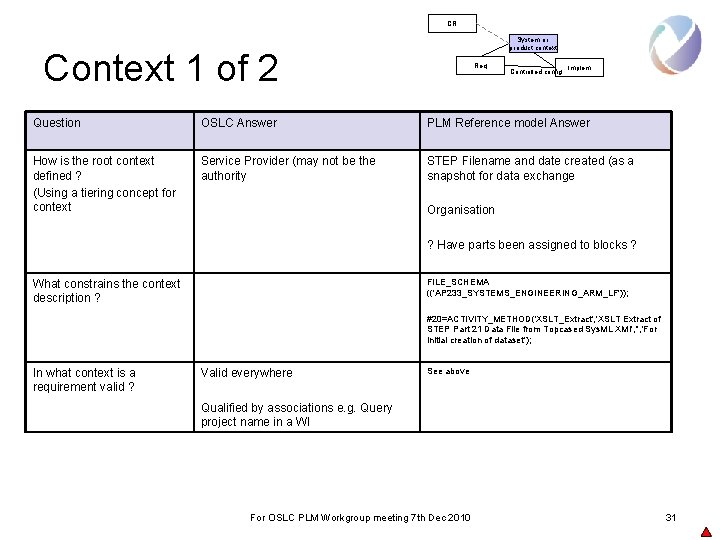
CR System or product context Context 1 of 2 Req Controlled config Implem Question OSLC Answer PLM Reference model Answer How is the root context defined ? (Using a tiering concept for context Service Provider (may not be the authority STEP Filename and date created (as a snapshot for data exchange Organisation ? Have parts been assigned to blocks ? FILE_SCHEMA (('AP 233_SYSTEMS_ENGINEERING_ARM_LF')); What constrains the context description ? #20=ACTIVITY_METHOD('XSLT_Extract', 'XSLT Extract of STEP Part 21 Data File from Topcased Sys. ML XMI', 'For initial creation of dataset'); In what context is a requirement valid ? Valid everywhere See above Qualified by associations e. g. Query project name in a WI For OSLC PLM Workgroup meeting 7 th Dec 2010 31
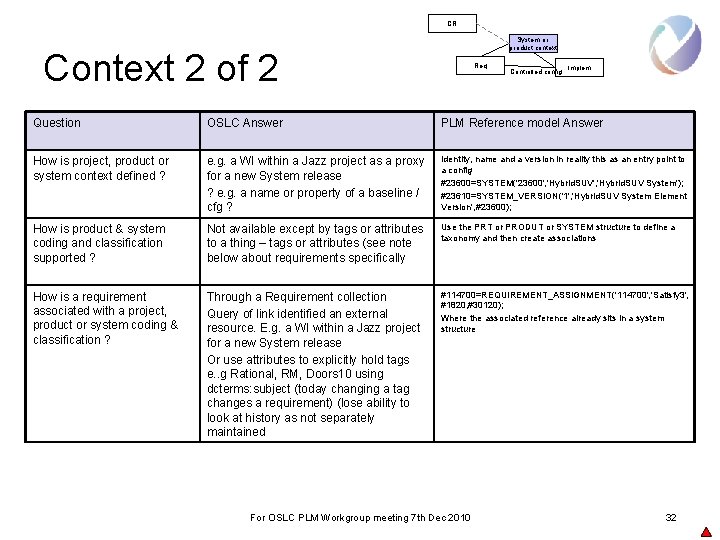
CR System or product context Context 2 of 2 Req Controlled config Implem Question OSLC Answer PLM Reference model Answer How is project, product or system context defined ? e. g. a WI within a Jazz project as a proxy for a new System release ? e. g. a name or property of a baseline / cfg ? Identity, name and a version in reality this as an entry point to a config #23600=SYSTEM('23600', 'Hybrid. SUV System'); #23610=SYSTEM_VERSION('1', 'Hybrid. SUV System Element Version', #23600); How is product & system coding and classification supported ? Not available except by tags or attributes to a thing – tags or attributes (see note below about requirements specifically Use the PRT or PRODUT or SYSTEM structure to define a taxonomy and then create associations How is a requirement associated with a project, product or system coding & classification ? Through a Requirement collection Query of link identified an external resource. E. g. a WI within a Jazz project for a new System release Or use attributes to explicitly hold tags e. . g Rational, RM, Doors 10 using dcterms: subject (today changing a tag changes a requirement) (lose ability to look at history as not separately maintained #114700=REQUIREMENT_ASSIGNMENT('114700', 'Satisfy 3', #1820, #30120); Where the associated reference already sits in a system structure For OSLC PLM Workgroup meeting 7 th Dec 2010 32
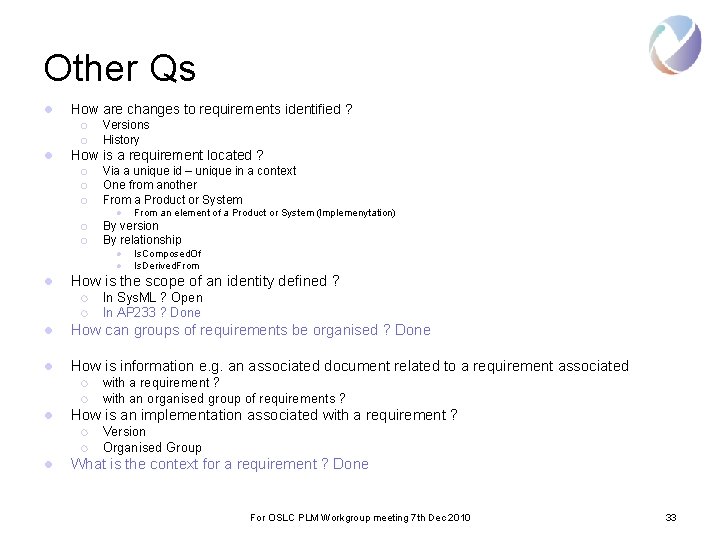
Other Qs l How are changes to requirements identified ? ¡ ¡ l Versions History How is a requirement located ? ¡ ¡ ¡ Via a unique id – unique in a context One from another From a Product or System l ¡ ¡ By version By relationship l l l From an element of a Product or System (Implemenytation) Is. Composed. Of Is. Derived. From How is the scope of an identity defined ? ¡ ¡ In Sys. ML ? Open In AP 233 ? Done l How can groups of requirements be organised ? Done l How is information e. g. an associated document related to a requirement associated ¡ ¡ l How is an implementation associated with a requirement ? ¡ ¡ l with a requirement ? with an organised group of requirements ? Version Organised Group What is the context for a requirement ? Done For OSLC PLM Workgroup meeting 7 th Dec 2010 33
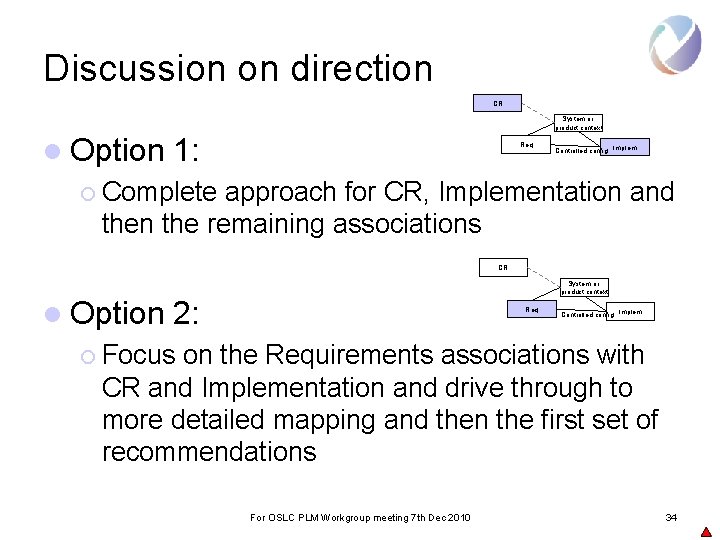
Discussion on direction CR System or product context l Option 1: Req Controlled config Implem ¡ Complete approach for CR, Implementation and then the remaining associations CR l Option System or product context 2: Req Controlled config Implem ¡ Focus on the Requirements associations with CR and Implementation and drive through to more detailed mapping and then the first set of recommendations For OSLC PLM Workgroup meeting 7 th Dec 2010 34
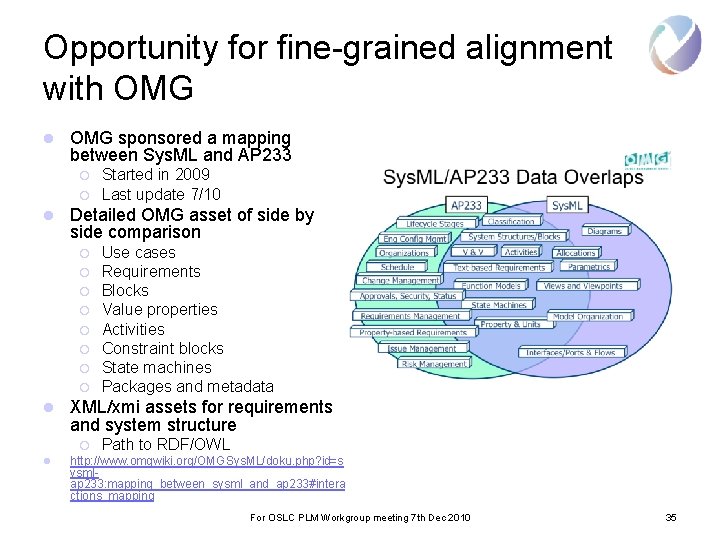
Opportunity for fine-grained alignment with OMG l OMG sponsored a mapping between Sys. ML and AP 233 ¡ ¡ l Detailed OMG asset of side by side comparison ¡ ¡ ¡ ¡ l l Started in 2009 Last update 7/10 Use cases Requirements Blocks Value properties Activities Constraint blocks State machines Packages and metadata XML/xmi assets for requirements and system structure ¡ Path to RDF/OWL http: //www. omgwiki. org/OMGSys. ML/doku. php? id=s ysmlap 233: mapping_between_sysml_and_ap 233#intera ctions_mapping For OSLC PLM Workgroup meeting 7 th Dec 2010 35
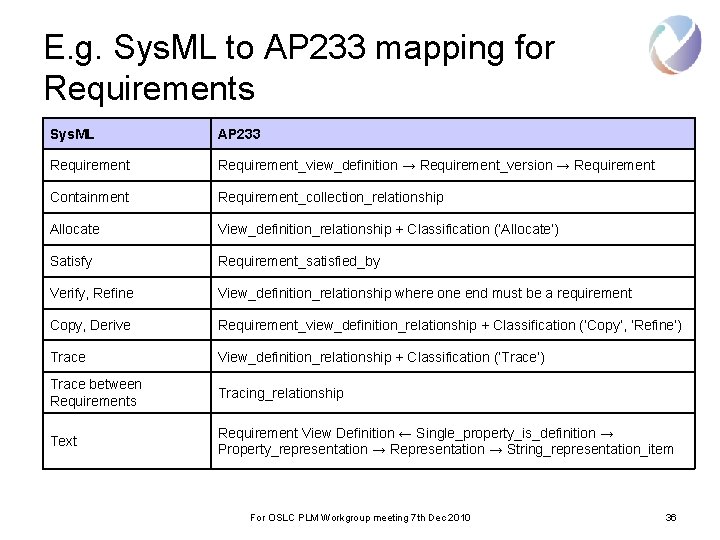
E. g. Sys. ML to AP 233 mapping for Requirements Sys. ML AP 233 Requirement_view_definition → Requirement_version → Requirement Containment Requirement_collection_relationship Allocate View_definition_relationship + Classification (‘Allocate’) Satisfy Requirement_satisfied_by Verify, Refine View_definition_relationship where one end must be a requirement Copy, Derive Requirement_view_definition_relationship + Classification (‘Copy’, ‘Refine’) Trace View_definition_relationship + Classification (’Trace’) Trace between Requirements Tracing_relationship Text Requirement View Definition ← Single_property_is_definition → Property_representation → Representation → String_representation_item For OSLC PLM Workgroup meeting 7 th Dec 2010 36
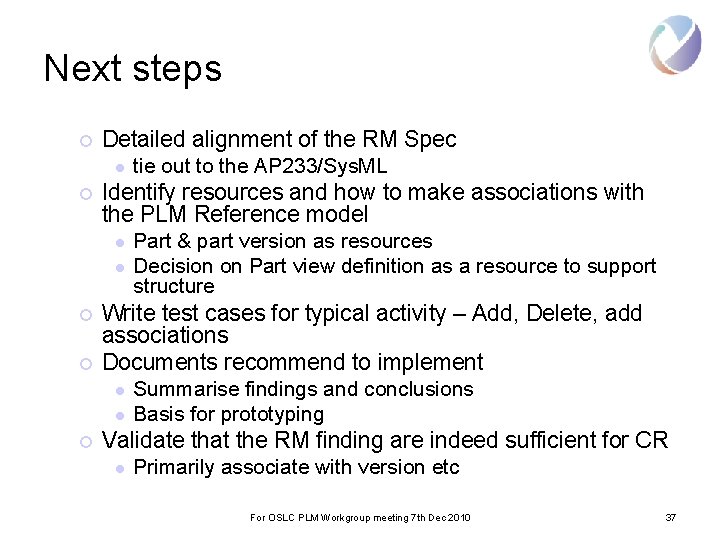
Next steps ¡ Detailed alignment of the RM Spec l ¡ Identify resources and how to make associations with the PLM Reference model l l ¡ ¡ Part & part version as resources Decision on Part view definition as a resource to support structure Write test cases for typical activity – Add, Delete, add associations Documents recommend to implement l l ¡ tie out to the AP 233/Sys. ML Summarise findings and conclusions Basis for prototyping Validate that the RM finding are indeed sufficient for CR l Primarily associate with version etc For OSLC PLM Workgroup meeting 7 th Dec 2010 37
Relevant OSLC Links l Systems ¡ Engineering Scenario #1 Systems Engineer Reacts to Changed Requirements l http: //openservices. net/bin/view/Main/Plm. Systems. Engineering. Scenario. Systems. Engineer. Reactsto Changed. Requirements l Proposed ¡ PLM Reference Model http: //open-services. net/bin/view/Main/PLMReference. Model l Reference ¡ http: //open-services. net/bin/view/Main/Plm. Scenarios. Gm l Existing ¡ model contribution Specs http: //open-services. net/bin/view/Main/Web. Home Consult the Appendix for related links For OSLC PLM Workgroup meeting 7 th Dec 2010 38
For more information l Open Services for Lifecycle Collaboration PLM Workgroup ¡ http: //open-services. net/bin/view/Main/Plm. Home l Contacts ¡ Dr Rainer Ersch, Siemens ¡ Gray Bachelor, IBM ¡ Mike Loeffler, GM For OSLC PLM Workgroup meeting 7 th Dec 2010 39