
Analysis of the Anterior Drawer Test in ACL
- Slides: 7
Analysis of the Anterior Drawer Test in ACL Injured Mouse Models Srilatha Edara; Hana Kalčo, Alexander Kotelsky, Ph. D; Sandeep Mannava, M. D. , Ph. D; Whasil Lee, Ph. D. Biology, Biomedical Engineering, Pharmacology and Physiology, Orthopedics NIH P 30 AR 069655, T 32 AR 076950 sedara 2@u. rochester. eduhkalco@u. rochester. e du This content is copyright protected and the sole property of the authors. Unauthorized use of the material on this poster, including plagiarism, screen captures, or video recordings, are prohibited under the penalty of the law. 20 CENTER for MUSCULOSKELETAL RESEARCH Years
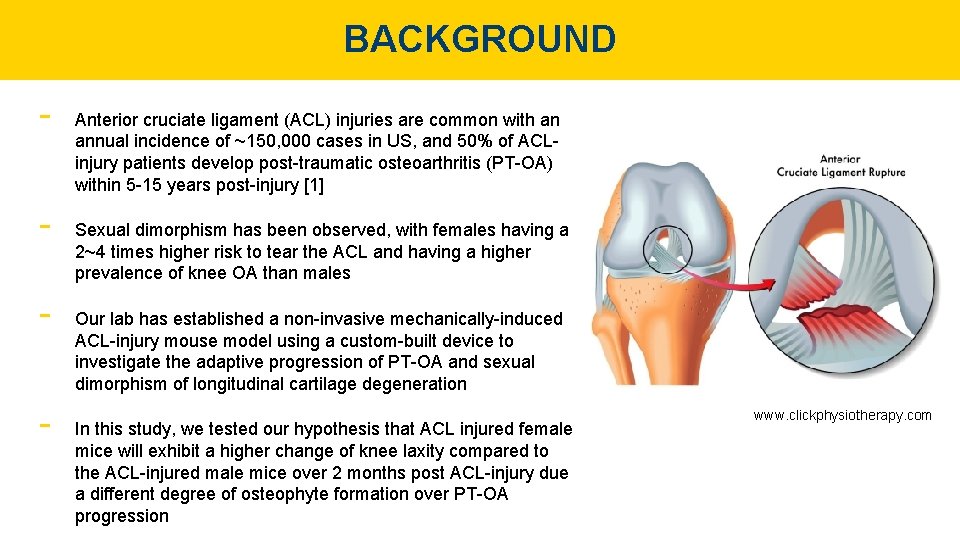
BACKGROUND - Anterior cruciate ligament (ACL) injuries are common with an annual incidence of ~150, 000 cases in US, and 50% of ACLinjury patients develop post-traumatic osteoarthritis (PT-OA) within 5 -15 years post-injury [1] Sexual dimorphism has been observed, with females having a 2~4 times higher risk to tear the ACL and having a higher prevalence of knee OA than males Our lab has established a non-invasive mechanically-induced ACL-injury mouse model using a custom-built device to investigate the adaptive progression of PT-OA and sexual dimorphism of longitudinal cartilage degeneration In this study, we tested our hypothesis that ACL injured female mice will exhibit a higher change of knee laxity compared to the ACL-injured male mice over 2 months post ACL-injury due a different degree of osteophyte formation over PT-OA progression www. clickphysiotherapy. com
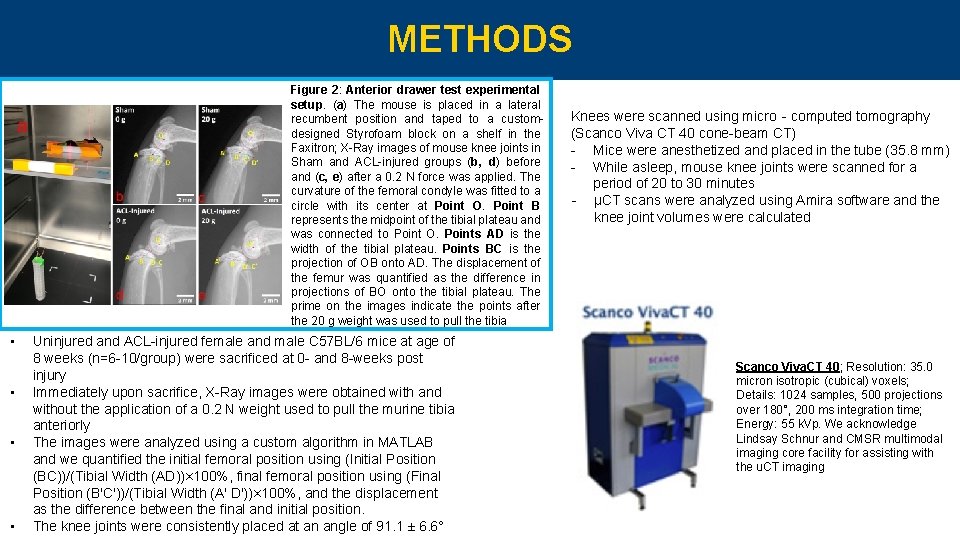
METHODS Figure 2: Anterior drawer test experimental setup. (a) The mouse is placed in a lateral recumbent position and taped to a customdesigned Styrofoam block on a shelf in the Faxitron; X-Ray images of mouse knee joints in Sham and ACL-injured groups (b, d) before and (c, e) after a 0. 2 N force was applied. The curvature of the femoral condyle was fitted to a circle with its center at Point O. Point B represents the midpoint of the tibial plateau and was connected to Point O. Points AD is the width of the tibial plateau. Points BC is the projection of OB onto AD. The displacement of the femur was quantified as the difference in projections of BO onto the tibial plateau. The prime on the images indicate the points after the 20 g weight was used to pull the tibia • • Uninjured and ACL-injured female and male C 57 BL/6 mice at age of 8 weeks (n=6 -10/group) were sacrificed at 0 - and 8 -weeks post injury Immediately upon sacrifice, X-Ray images were obtained with and without the application of a 0. 2 N weight used to pull the murine tibia anteriorly The images were analyzed using a custom algorithm in MATLAB and we quantified the initial femoral position using (Initial Position (BC))/(Tibial Width (AD))× 100%, final femoral position using (Final Position (B′C′))/(Tibial Width (A′ D′))× 100%, and the displacement as the difference between the final and initial position. The knee joints were consistently placed at an angle of 91. 1 ± 6. 6° Knees were scanned using micro‐computed tomography (Scanco Viva CT 40 cone-beam CT) - Mice were anesthetized and placed in the tube (35. 8 mm) - While asleep, mouse knee joints were scanned for a period of 20 to 30 minutes - μCT scans were analyzed using Amira software and the knee joint volumes were calculated Scanco Viva. CT 40; Resolution: 35. 0 micron isotropic (cubical) voxels; Details: 1024 samples, 500 projections over 180°, 200 ms integration time; Energy: 55 k. Vp. We acknowledge Lindsay Schnur and CMSR multimodal imaging core facility for assisting with the u. CT imaging
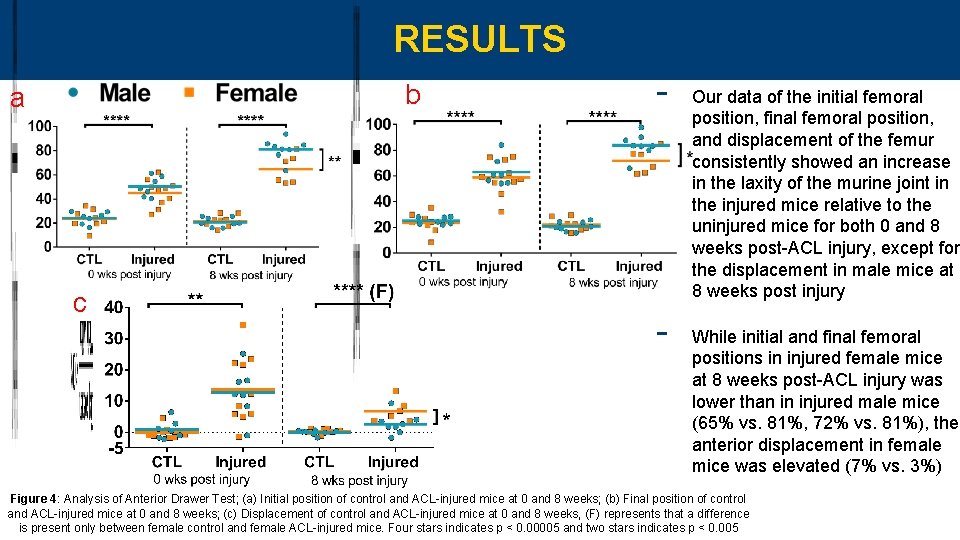
RESULTS b a c - Our data of the initial femoral position, final femoral position, and displacement of the femur consistently showed an increase in the laxity of the murine joint in the injured mice relative to the uninjured mice for both 0 and 8 weeks post-ACL injury, except for the displacement in male mice at 8 weeks post injury While initial and final femoral positions in injured female mice at 8 weeks post-ACL injury was lower than in injured male mice (65% vs. 81%, 72% vs. 81%), the anterior displacement in female mice was elevated (7% vs. 3%) Figure 4: Analysis of Anterior Drawer Test; (a) Initial position of control and ACL-injured mice at 0 and 8 weeks; (b) Final position of control and ACL-injured mice at 0 and 8 weeks; (c) Displacement of control and ACL-injured mice at 0 and 8 weeks, (F) represents that a difference is present only between female control and female ACL-injured mice. Four stars indicates p < 0. 00005 and two stars indicates p < 0. 005
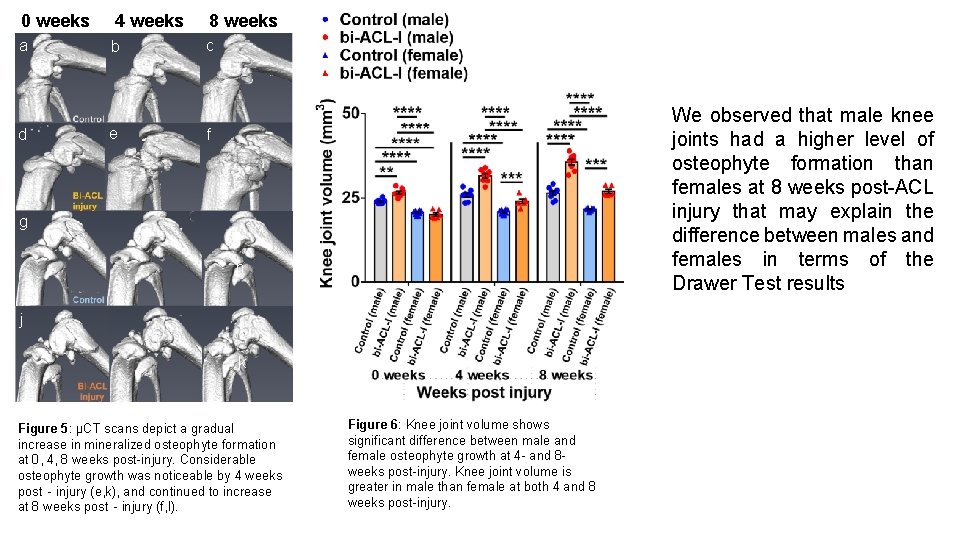
0 weeks 4 weeks 8 weeks a b c d e We observed that male knee joints had a higher level of osteophyte formation than females at 8 weeks post-ACL injury that may explain the difference between males and females in terms of the Drawer Test results f g h i k l j Figure 5: µCT scans depict a gradual increase in mineralized osteophyte formation at 0, 4, 8 weeks post-injury. Considerable osteophyte growth was noticeable by 4 weeks post‐injury (e, k), and continued to increase at 8 weeks post‐injury (f, l). Figure 6: Knee joint volume shows significant difference between male and female osteophyte growth at 4 - and 8 - weeks post-injury. Knee joint volume is greater in male than female at both 4 and 8 weeks post-injury.
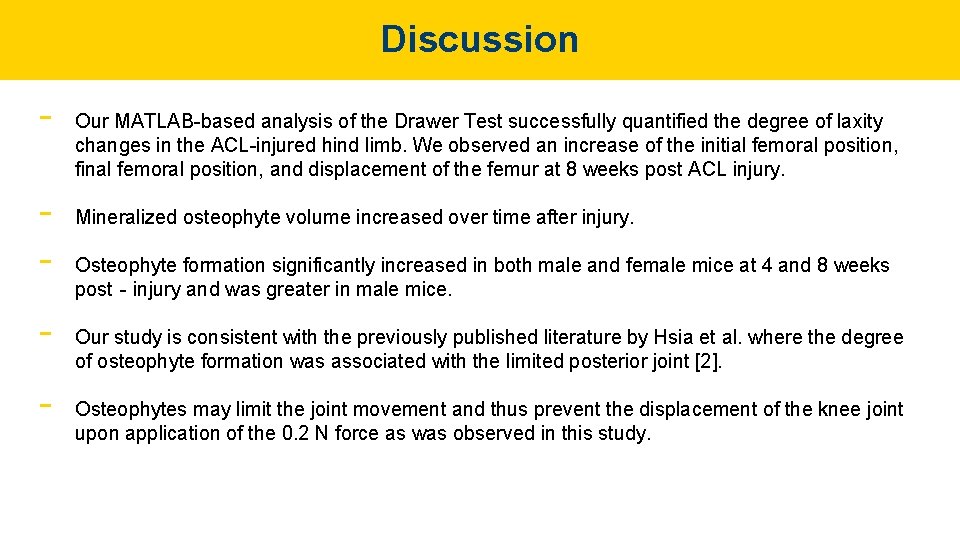
Discussion - Our MATLAB-based analysis of the Drawer Test successfully quantified the degree of laxity changes in the ACL-injured hind limb. We observed an increase of the initial femoral position, final femoral position, and displacement of the femur at 8 weeks post ACL injury. Mineralized osteophyte volume increased over time after injury. Osteophyte formation significantly increased in both male and female mice at 4 and 8 weeks post‐injury and was greater in male mice. Our study is consistent with the previously published literature by Hsia et al. where the degree of osteophyte formation was associated with the limited posterior joint [2]. Osteophytes may limit the joint movement and thus prevent the displacement of the knee joint upon application of the 0. 2 N force as was observed in this study.
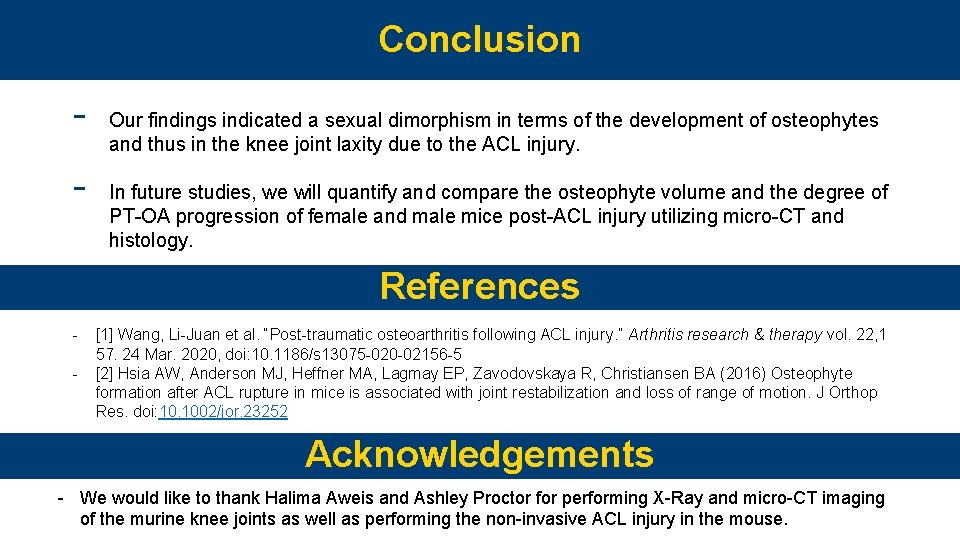
Conclusion - Our findings indicated a sexual dimorphism in terms of the development of osteophytes and thus in the knee joint laxity due to the ACL injury. In future studies, we will quantify and compare the osteophyte volume and the degree of PT-OA progression of female and male mice post-ACL injury utilizing micro-CT and histology. References - [1] Wang, Li-Juan et al. “Post-traumatic osteoarthritis following ACL injury. ” Arthritis research & therapy vol. 22, 1 57. 24 Mar. 2020, doi: 10. 1186/s 13075 -020 -02156 -5 [2] Hsia AW, Anderson MJ, Heffner MA, Lagmay EP, Zavodovskaya R, Christiansen BA (2016) Osteophyte formation after ACL rupture in mice is associated with joint restabilization and loss of range of motion. J Orthop Res. doi: 10. 1002/jor. 23252 Acknowledgements - We would like to thank Halima Aweis and Ashley Proctor for performing X-Ray and micro-CT imaging of the murine knee joints as well as performing the non-invasive ACL injury in the mouse.