
Analysis of Performance GCSE PE In this Analysis

- Slides: 12
Analysis of Performance GCSE PE In this Analysis we will be concentrating on football However you can use it for any sport.
ANALYSIS OF PERFORMANCE FOOTBALL This analysis of performance will be based around the sport of football. It will aim to analyse the rules, regulations and terminology through video footage. Compare two different performers technique from two different sections of the performance pyramid. Highlight where improvements can be made and how the performer can implement these improvements. In addition develop strategies and tactics to outwit opponents. Finally recommending a 6 week personal exercise plan (PEP) to improve performance, stating how training principles and methods have been used to aid improvement in performance.
ANALYSIS VIDEO
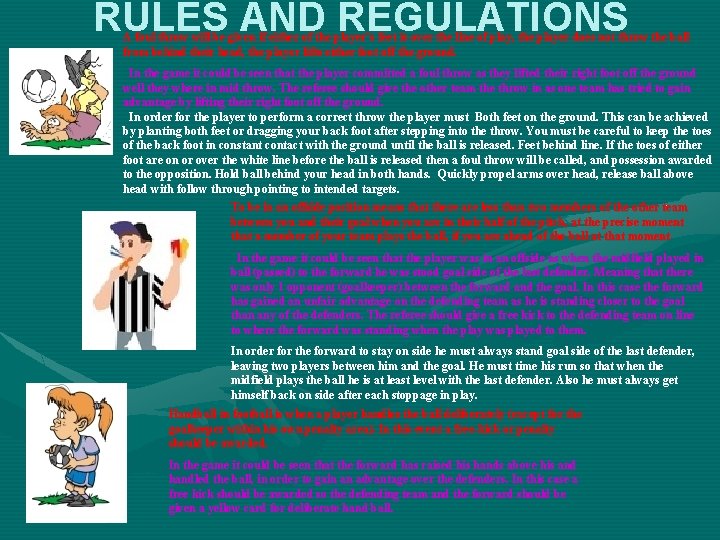
RULES AND REGULATIONS A foul throw will be given if either of the player’s feet is over the line of play, the player does not throw the ball from behind their head, the player lifts either foot off the ground. In the game it could be seen that the player committed a foul throw as they lifted their right foot off the ground well they where in mid throw. The referee should give the other team the throw in as one team has tried to gain advantage by lifting their right foot off the ground. In order for the player to perform a correct throw the player must Both feet on the ground. This can be achieved by planting both feet or dragging your back foot after stepping into the throw. You must be careful to keep the toes of the back foot in constant contact with the ground until the ball is released. Feet behind line. If the toes of either foot are on or over the white line before the ball is released then a foul throw will be called, and possession awarded to the opposition. Hold ball behind your head in both hands. Quickly propel arms over head, release ball above head with follow through pointing to intended targets. To be in an offside position means that there are less than two members of the other team between you and their goal when you are in their half of the pitch, at the precise moment that a member of your team plays the ball, if you are ahead of the ball at that moment In the game it could be seen that the player was in an offside as when the midfield played in ball (passed) to the forward he was stood goal side of the last defender. Meaning that there was only 1 opponent (goalkeeper) between the forward and the goal. In this case the forward has gained an unfair advantage on the defending team as he is standing closer to the goal than any of the defenders. The referee should give a free kick to the defending team on line to where the forward was standing when the play was played to them. In order for the forward to stay on side he must always stand goal side of the last defender, leaving two players between him and the goal. He must time his run so that when the midfield plays the ball he is at least level with the last defender. Also he must always get himself back on side after each stoppage in play. Handball in football is when a player handles the ball deliberately (except for the goalkeeper within his own penalty area). In this event a free-kick or penalty should be awarded. In the game it could be seen that the forward has raised his hands above his and handled the ball, in order to gain an advantage over the defenders. In this case a free kick should be awarded so the defending team and the forward should be given a yellow card for deliberate hand ball.
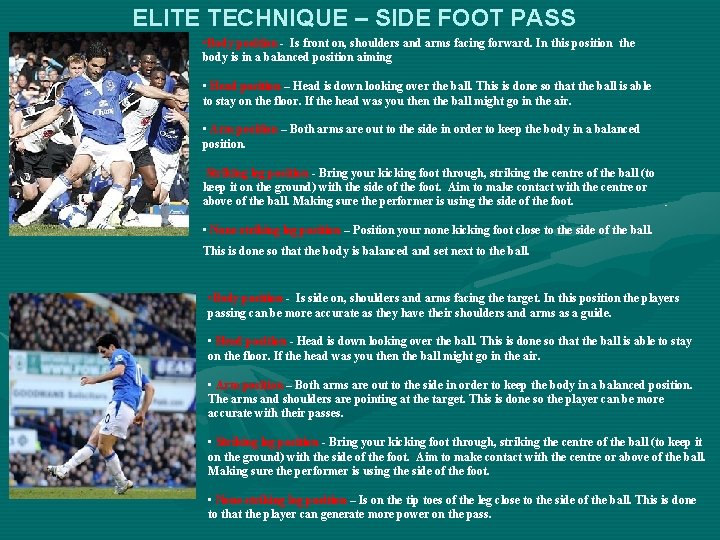
ELITE TECHNIQUE – SIDE FOOT PASS • Body position - Is front on, shoulders and arms facing forward. In this position the body is in a balanced position aiming • Head position – Head is down looking over the ball. This is done so that the ball is able to stay on the floor. If the head was you then the ball might go in the air. • Arm position – Both arms are out to the side in order to keep the body in a balanced position. Striking leg position - Bring your kicking foot through, striking the centre of the ball (to keep it on the ground) with the side of the foot. Aim to make contact with the centre or above of the ball. Making sure the performer is using the side of the foot. • None striking leg position – Position your none kicking foot close to the side of the ball. This is done so that the body is balanced and set next to the ball. • Body position - Is side on, shoulders and arms facing the target. In this position the players passing can be more accurate as they have their shoulders and arms as a guide. • Head position - Head is down looking over the ball. This is done so that the ball is able to stay on the floor. If the head was you then the ball might go in the air. • Arm position – Both arms are out to the side in order to keep the body in a balanced position. The arms and shoulders are pointing at the target. This is done so the player can be more accurate with their passes. • Striking leg position - Bring your kicking foot through, striking the centre of the ball (to keep it on the ground) with the side of the foot. Aim to make contact with the centre or above of the ball. Making sure the performer is using the side of the foot. • None striking leg position – Is on the tip toes of the leg close to the side of the ball. This is done to that the player can generate more power on the pass.
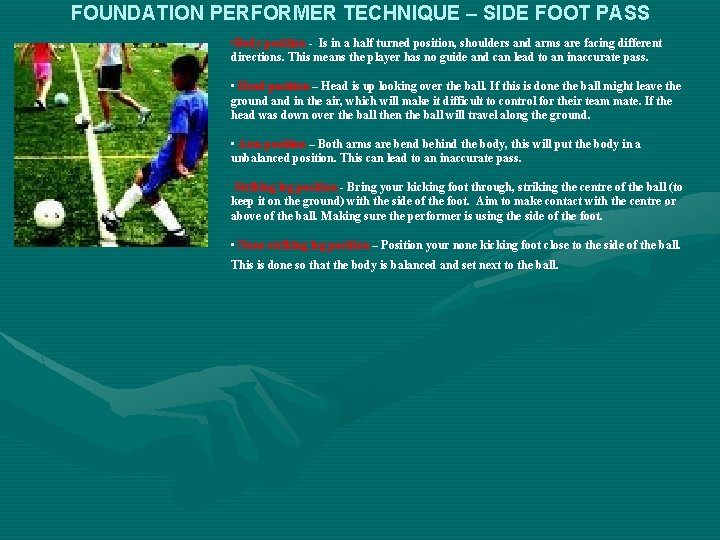
FOUNDATION PERFORMER TECHNIQUE – SIDE FOOT PASS • Body position - Is in a half turned position, shoulders and arms are facing different directions. This means the player has no guide and can lead to an inaccurate pass. • Head position – Head is up looking over the ball. If this is done the ball might leave the ground and in the air, which will make it difficult to control for their team mate. If the head was down over the ball then the ball will travel along the ground. • Arm position – Both arms are bend behind the body, this will put the body in a unbalanced position. This can lead to an inaccurate pass. Striking leg position - Bring your kicking foot through, striking the centre of the ball (to keep it on the ground) with the side of the foot. Aim to make contact with the centre or above of the ball. Making sure the performer is using the side of the foot. • None striking leg position – Position your none kicking foot close to the side of the ball. This is done so that the body is balanced and set next to the ball.
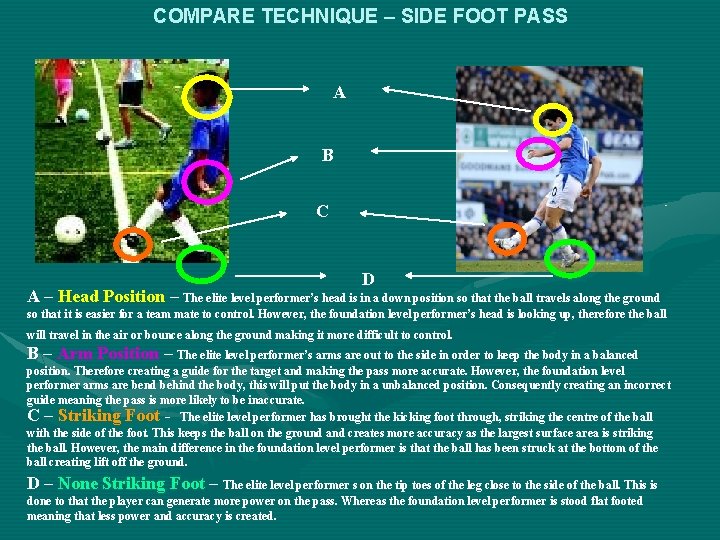
COMPARE TECHNIQUE – SIDE FOOT PASS A B C D A – Head Position – The elite level performer’s head is in a down position so that the ball travels along the ground so that it is easier for a team mate to control. However, the foundation level performer’s head is looking up, therefore the ball will travel in the air or bounce along the ground making it more difficult to control. B – Arm Position – The elite level performer’s arms are out to the side in order to keep the body in a balanced position. Therefore creating a guide for the target and making the pass more accurate. However, the foundation level performer arms are bend behind the body, this will put the body in a unbalanced position. Consequently creating an incorrect guide meaning the pass is more likely to be inaccurate. C – Striking Foot - The elite level performer has brought the kicking foot through, striking the centre of the ball with the side of the foot. This keeps the ball on the ground and creates more accuracy as the largest surface area is striking the ball. However, the main difference in the foundation level performer is that the ball has been struck at the bottom of the ball creating lift off the ground. D – None Striking Foot – The elite level performer s on the tip toes of the leg close to the side of the ball. This is done to that the player can generate more power on the pass. Whereas the foundation level performer is stood flat footed meaning that less power and accuracy is created.
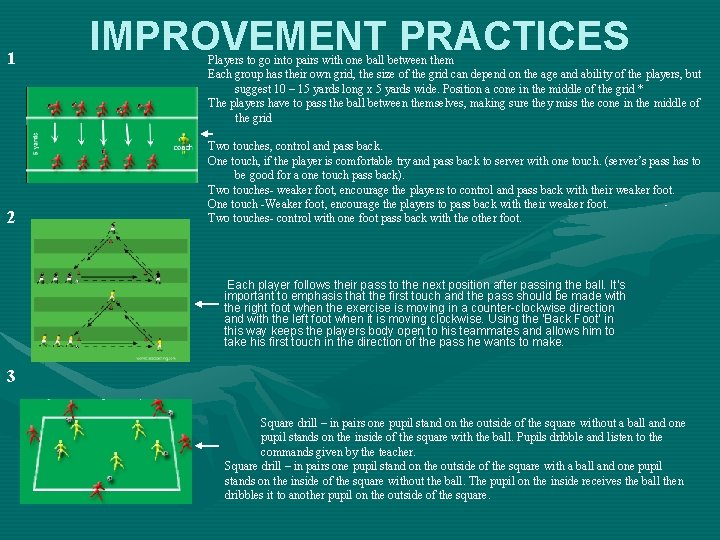
1 2 IMPROVEMENT PRACTICES Players to go into pairs with one ball between them Each group has their own grid, the size of the grid can depend on the age and ability of the players, but suggest 10 – 15 yards long x 5 yards wide. Position a cone in the middle of the grid * The players have to pass the ball between themselves, making sure they miss the cone in the middle of the grid Two touches, control and pass back. One touch, if the player is comfortable try and pass back to server with one touch. (server’s pass has to be good for a one touch pass back). Two touches- weaker foot, encourage the players to control and pass back with their weaker foot. One touch -Weaker foot, encourage the players to pass back with their weaker foot. Two touches- control with one foot pass back with the other foot. Each player follows their pass to the next position after passing the ball. It’s important to emphasis that the first touch and the pass should be made with the right foot when the exercise is moving in a counter-clockwise direction and with the left foot when it is moving clockwise. Using the ‘Back Foot’ in this way keeps the players body open to his teammates and allows him to take his first touch in the direction of the pass he wants to make. 3 Square drill – in pairs one pupil stand on the outside of the square without a ball and one pupil stands on the inside of the square with the ball. Pupils dribble and listen to the commands given by the teacher. Square drill – in pairs one pupil stand on the outside of the square with a ball and one pupil stands on the inside of the square without the ball. The pupil on the inside receives the ball then dribbles it to another pupil on the outside of the square.
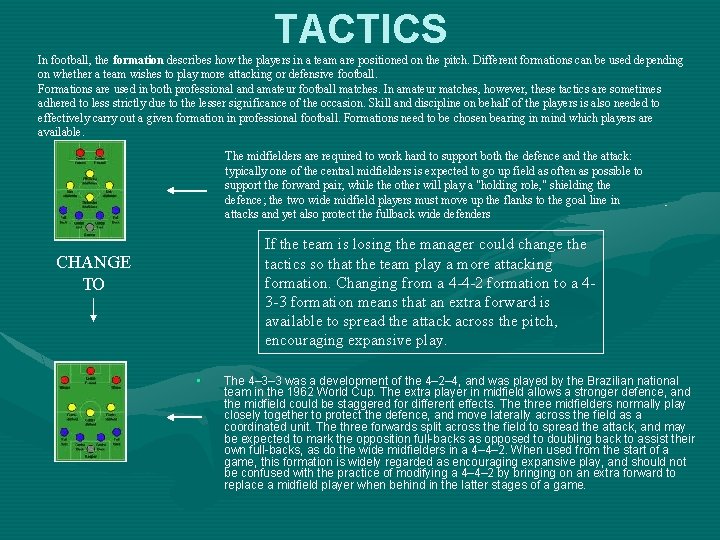
TACTICS In football, the formation describes how the players in a team are positioned on the pitch. Different formations can be used depending on whether a team wishes to play more attacking or defensive football. Formations are used in both professional and amateur football matches. In amateur matches, however, these tactics are sometimes adhered to less strictly due to the lesser significance of the occasion. Skill and discipline on behalf of the players is also needed to effectively carry out a given formation in professional football. Formations need to be chosen bearing in mind which players are available. The midfielders are required to work hard to support both the defence and the attack: typically one of the central midfielders is expected to go up field as often as possible to support the forward pair, while the other will play a "holding role, " shielding the defence; the two wide midfield players must move up the flanks to the goal line in attacks and yet also protect the fullback wide defenders If the team is losing the manager could change the tactics so that the team play a more attacking formation. Changing from a 4 -4 -2 formation to a 43 -3 formation means that an extra forward is available to spread the attack across the pitch, encouraging expansive play. CHANGE TO • The 4– 3– 3 was a development of the 4– 2– 4, and was played by the Brazilian national team in the 1962 World Cup. The extra player in midfield allows a stronger defence, and the midfield could be staggered for different effects. The three midfielders normally play closely together to protect the defence, and move laterally across the field as a coordinated unit. The three forwards split across the field to spread the attack, and may be expected to mark the opposition full-backs as opposed to doubling back to assist their own full-backs, as do the wide midfielders in a 4– 4– 2. When used from the start of a game, this formation is widely regarded as encouraging expansive play, and should not be confused with the practice of modifying a 4– 4– 2 by bringing on an extra forward to replace a midfield player when behind in the latter stages of a game.
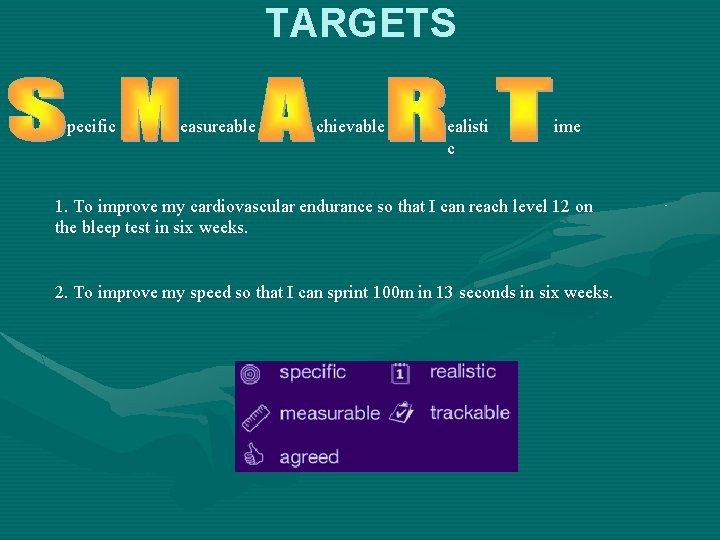
TARGETS pecific easureable chievable ealisti c ime 1. To improve my cardiovascular endurance so that I can reach level 12 on the bleep test in six weeks. 2. To improve my speed so that I can sprint 100 m in 13 seconds in six weeks.
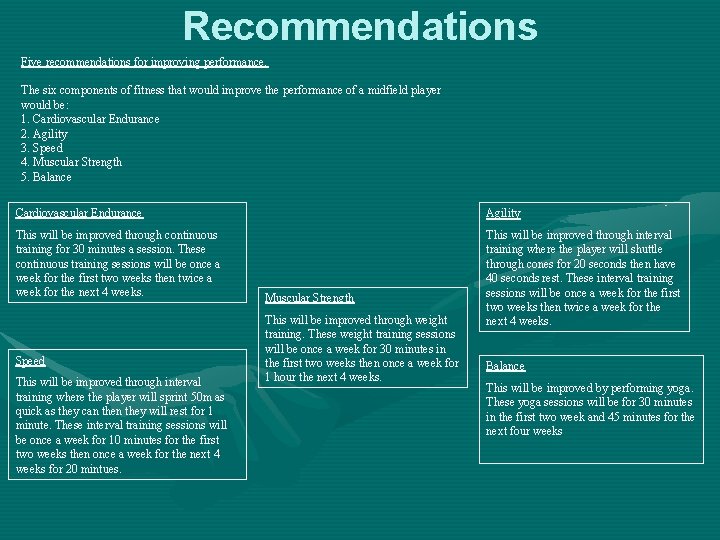
Recommendations Five recommendations for improving performance. The six components of fitness that would improve the performance of a midfield player would be: 1. Cardiovascular Endurance 2. Agility 3. Speed 4. Muscular Strength 5. Balance Cardiovascular Endurance Agility This will be improved through continuous training for 30 minutes a session. These continuous training sessions will be once a week for the first two weeks then twice a week for the next 4 weeks. This will be improved through interval training where the player will shuttle through cones for 20 seconds then have 40 seconds rest. These interval training sessions will be once a week for the first two weeks then twice a week for the next 4 weeks. Speed This will be improved through interval training where the player will sprint 50 m as quick as they can they will rest for 1 minute. These interval training sessions will be once a week for 10 minutes for the first two weeks then once a week for the next 4 weeks for 20 mintues. Muscular Strength This will be improved through weight training. These weight training sessions will be once a week for 30 minutes in the first two weeks then once a week for 1 hour the next 4 weeks. Balance This will be improved by performing yoga. These yoga sessions will be for 30 minutes in the first two week and 45 minutes for the next four weeks
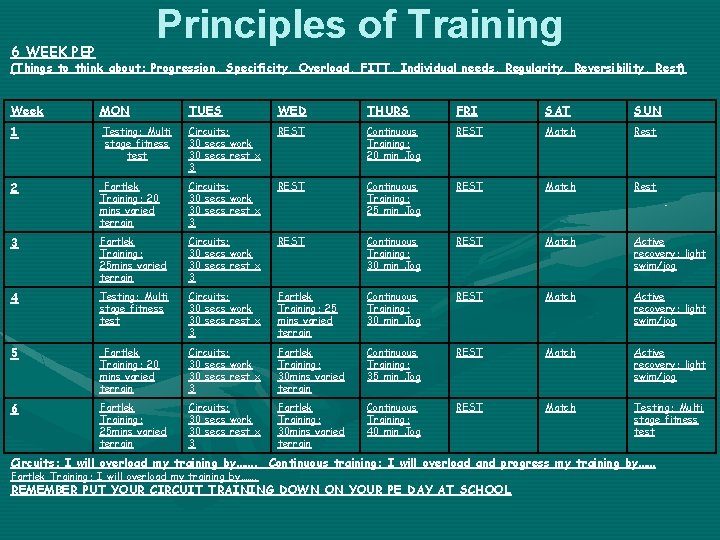
Principles of Training 6 WEEK PEP (Things to think about: Progression, Specificity, Overload, FITT, Individual needs, Regularity, Reversibility, Rest) Week MON TUES WED THURS FRI SAT SUN 1 Testing: Multi stage fitness test Circuits: 30 secs work 30 secs rest x 3 REST Continuous Training: 20 min Jog REST Match Rest 2 Fartlek Training: 20 mins varied terrain Circuits: 30 secs work 30 secs rest x 3 REST Continuous Training: 25 min Jog REST Match Rest 3 Fartlek Training: 25 mins varied terrain Circuits: 30 secs work 30 secs rest x 3 REST Continuous Training: 30 min Jog REST Match Active recovery: light swim/jog 4 Testing: Multi stage fitness test Circuits: 30 secs work 30 secs rest x 3 Fartlek Training: 25 mins varied terrain Continuous Training: 30 min Jog REST Match Active recovery: light swim/jog 5 Fartlek Training: 20 mins varied terrain Circuits: 30 secs work 30 secs rest x 3 Fartlek Training: 30 mins varied terrain Continuous Training: 35 min Jog REST Match Active recovery: light swim/jog 6 Fartlek Training: 25 mins varied terrain Circuits: 30 secs work 30 secs rest x 3 Fartlek Training: 30 mins varied terrain Continuous Training: 40 min Jog REST Match Testing: Multi stage fitness test Circuits: I will overload my training by……. Continuous training: I will overload and progress my training by…… Fartlek Training: I will overload my training by……. REMEMBER PUT YOUR CIRCUIT TRAINING DOWN ON YOUR PE DAY AT SCHOOL