
Analysis of Motion Measuring motion in biological vision
Analysis of Motion Measuring motion in biological vision systems CS 332 Visual Processing Department of Computer Science Wellesley College 1 -
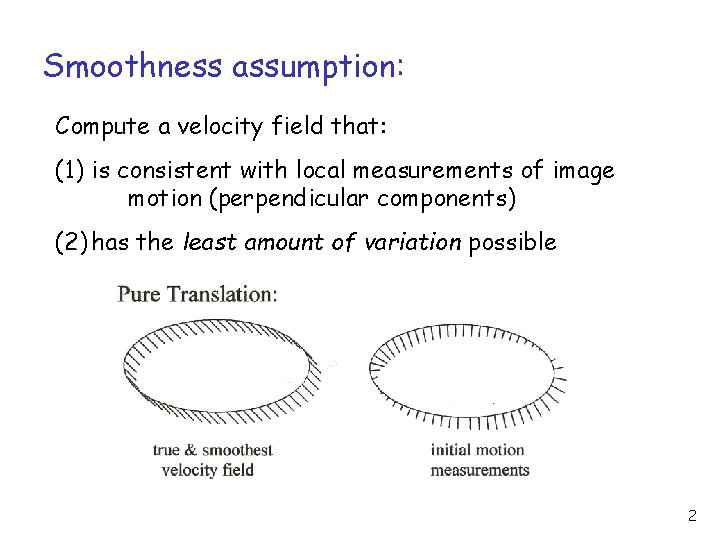
Smoothness assumption: Compute a velocity field that: (1) is consistent with local measurements of image motion (perpendicular components) (2) has the least amount of variation possible 2
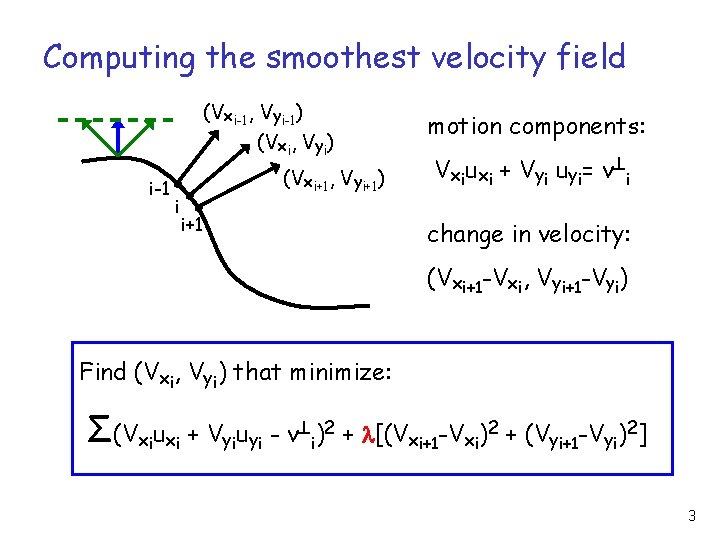
Computing the smoothest velocity field (Vxi-1, Vyi-1) (Vxi, Vyi) i-1 i (Vxi+1, Vyi+1) i+1 motion components: V x i ux i + V y i uy i = v i change in velocity: (Vxi+1 -Vxi, Vyi+1 -Vyi) Find (Vxi, Vyi) that minimize: Σ(Vxiuxi + Vyiuyi - v i)2 + [(Vxi+1 -Vxi)2 + (Vyi+1 -Vyi)2] 3
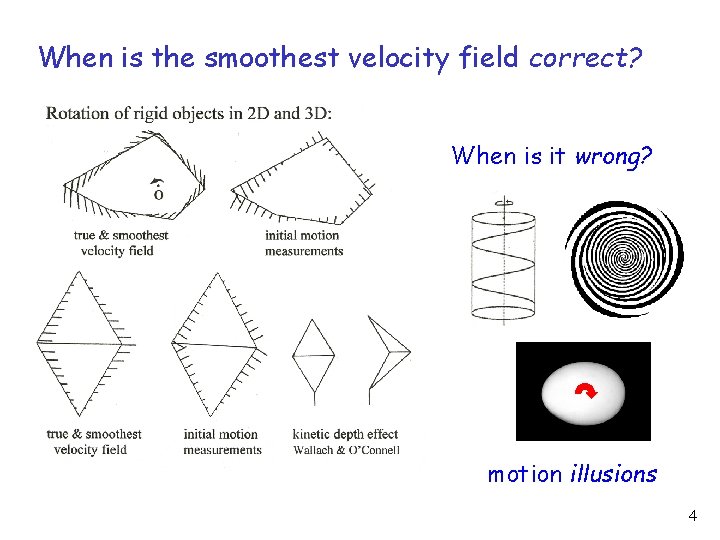
When is the smoothest velocity field correct? When is it wrong? motion illusions 4
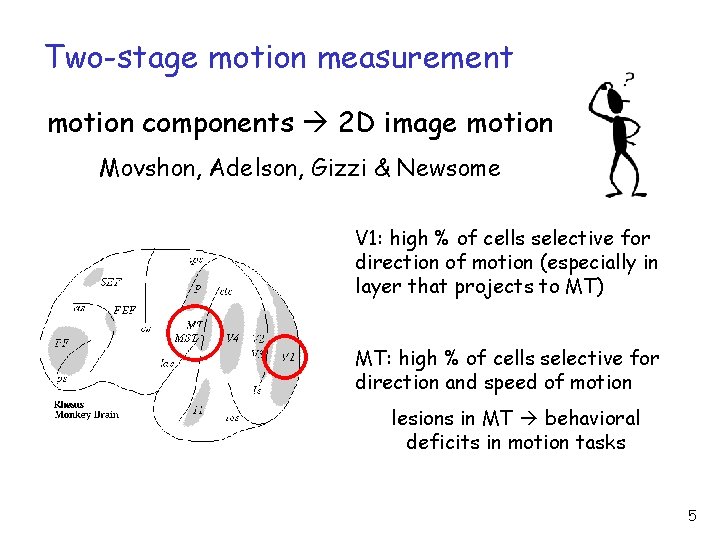
Two-stage motion measurement motion components 2 D image motion Movshon, Adelson, Gizzi & Newsome V 1: high % of cells selective for direction of motion (especially in layer that projects to MT) MT: high % of cells selective for direction and speed of motion lesions in MT behavioral deficits in motion tasks 5
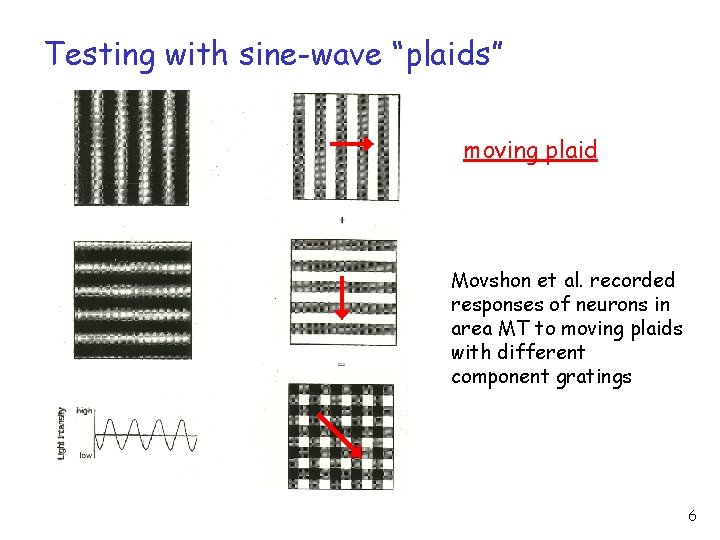
Testing with sine-wave “plaids” moving plaid Movshon et al. recorded responses of neurons in area MT to moving plaids with different component gratings 6
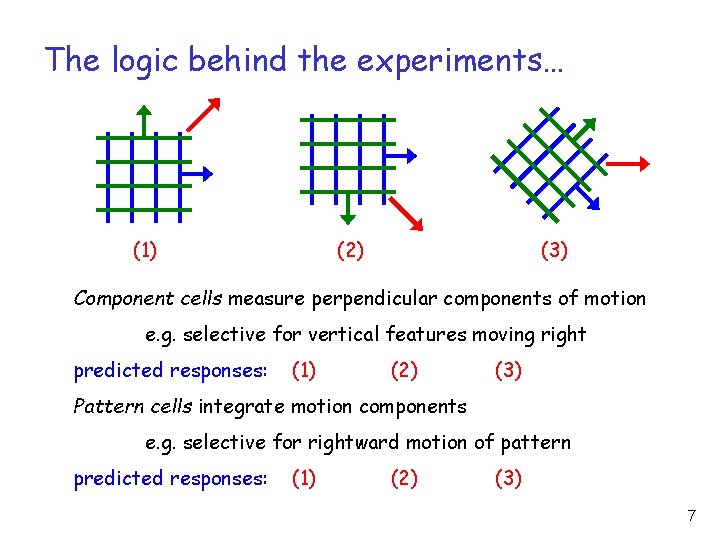
The logic behind the experiments… (1) (2) (3) Component cells measure perpendicular components of motion e. g. selective for vertical features moving right predicted responses: (1) (2) (3) Pattern cells integrate motion components e. g. selective for rightward motion of pattern predicted responses: (1) (2) (3) 7
Movshon et al. observations: Cortical area V 1: all neurons behaved like component cells Cortical area MT: layers 4 & 6: component cells layers 2, 3, 5: pattern cells Evidence for two -stage motion measurement! Perceptually, two components are not integrated if: large difference in spatial frequency large difference in speed components have different stereo disparity 8
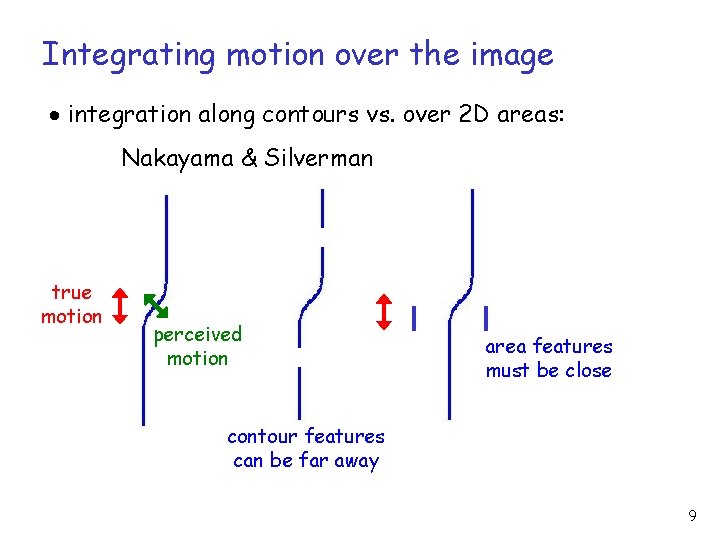
Integrating motion over the image integration along contours vs. over 2 D areas: Nakayama & Silverman true motion perceived motion area features must be close contour features can be far away 9
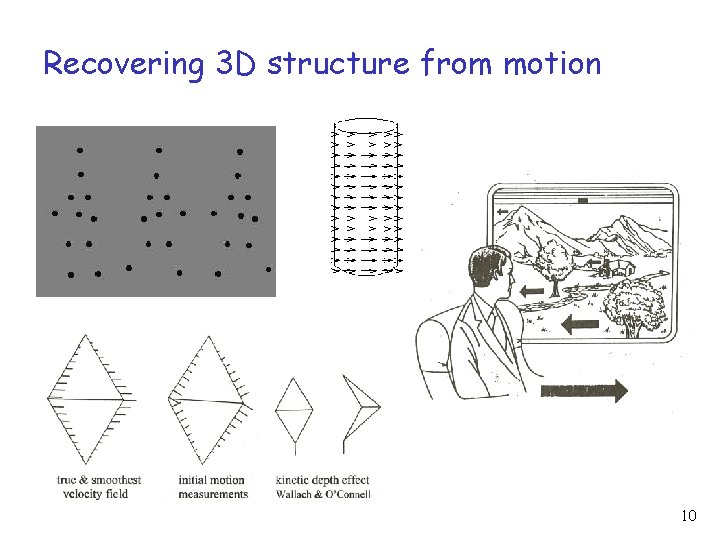
Recovering 3 D structure from motion 10
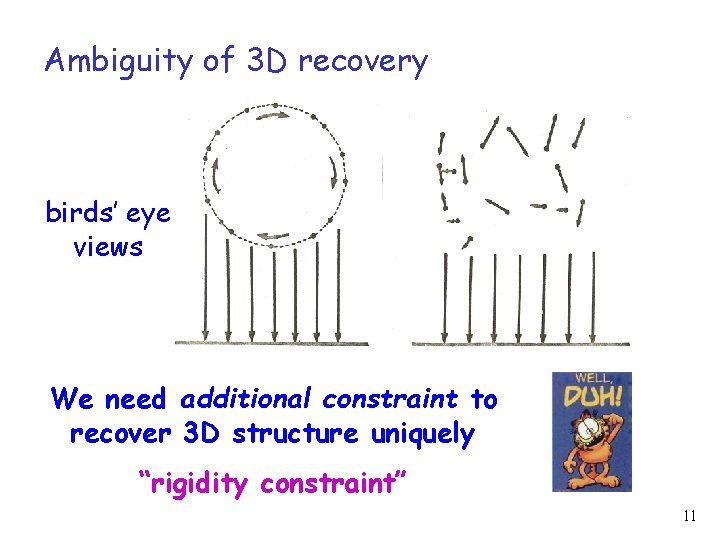
Ambiguity of 3 D recovery birds’ eye views We need additional constraint to recover 3 D structure uniquely “rigidity constraint” 11
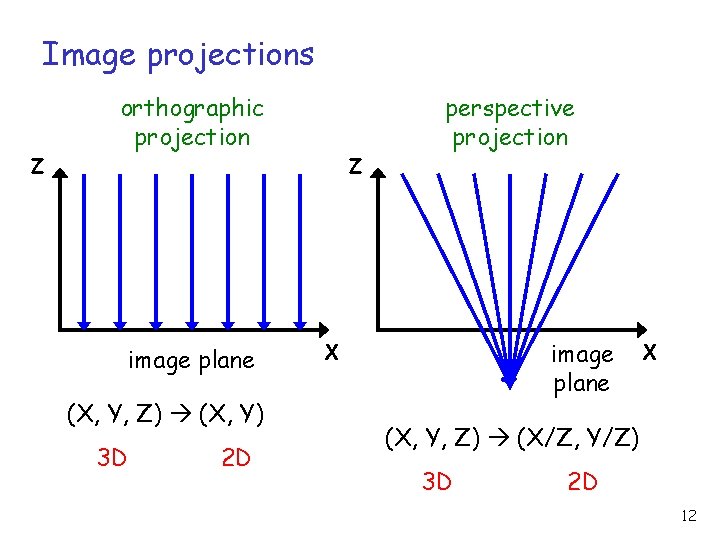
Image projections Z orthographic projection image plane (X, Y, Z) (X, Y) 3 D 2 D Z perspective projection image plane X X (X, Y, Z) (X/Z, Y/Z) 3 D 2 D 12
- Slides: 12