
Analysis of modern algorithms for named entity recognition
![Thanks for your attention! [act] 0 [per] [act]](https://slidetodoc.com/presentation_image_h2/1af8292c84c263793d0b387a1f3a1321/image-12.jpg "Thanks for your attention! [act] 0 [per] [act]")
- Slides: 12
Analysis of modern algorithms for named entity recognition and text summarization S. Berezin, NSU
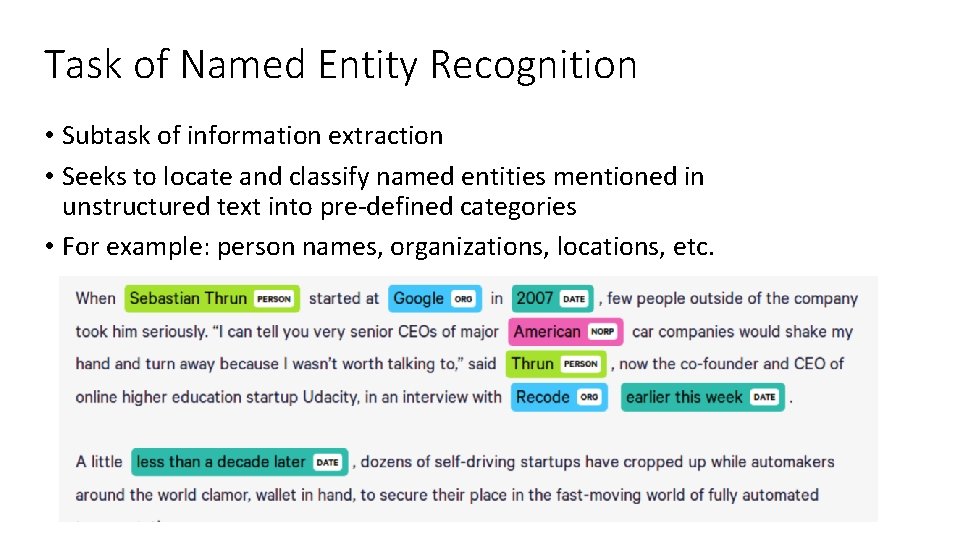
Task of Named Entity Recognition • Subtask of information extraction • Seeks to locate and classify named entities mentioned in unstructured text into pre-defined categories • For example: person names, organizations, locations, etc.
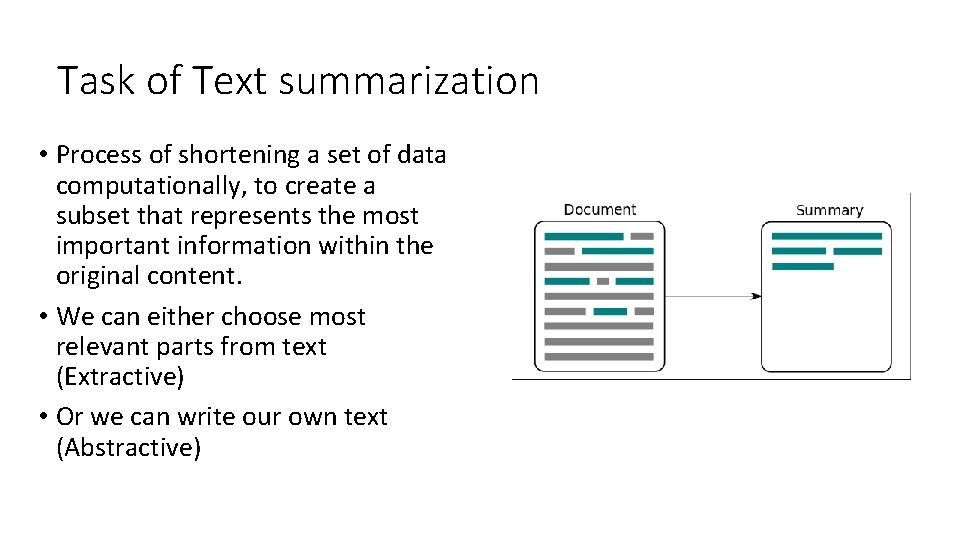
Task of Text summarization • Process of shortening a set of data computationally, to create a subset that represents the most important information within the original content. • We can either choose most relevant parts from text (Extractive) • Or we can write our own text (Abstractive)
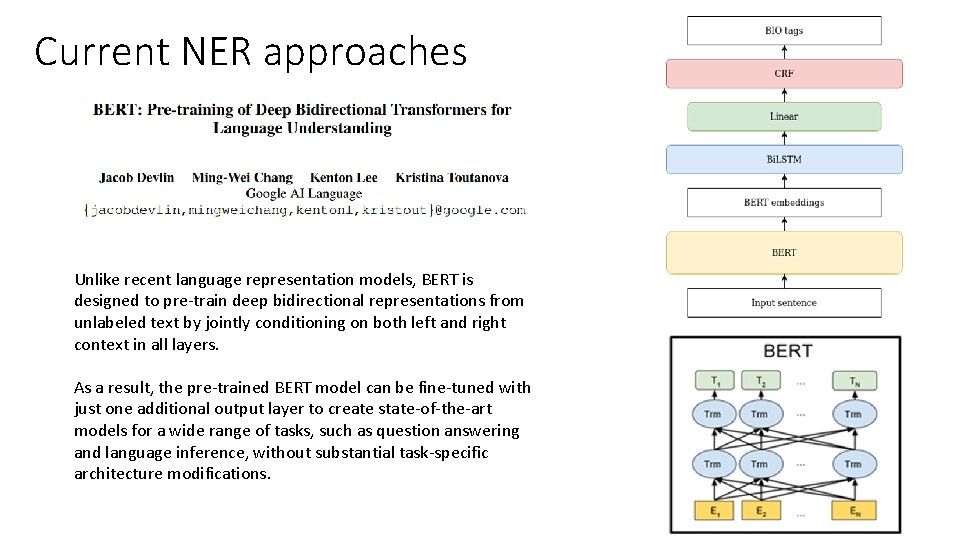
Current NER approaches Unlike recent language representation models, BERT is designed to pre-train deep bidirectional representations from unlabeled text by jointly conditioning on both left and right context in all layers. As a result, the pre-trained BERT model can be fine-tuned with just one additional output layer to create state-of-the-art models for a wide range of tasks, such as question answering and language inference, without substantial task-specific architecture modifications.
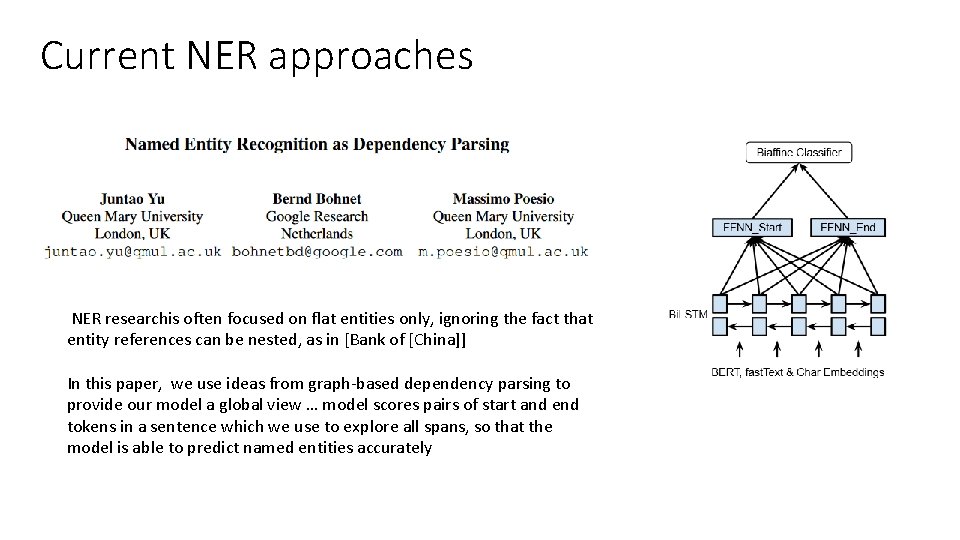
Current NER approaches NER researchis often focused on flat entities only, ignoring the fact that entity references can be nested, as in [Bank of [China]] In this paper, we use ideas from graph-based dependency parsing to provide our model a global view … model scores pairs of start and end tokens in a sentence which we use to explore all spans, so that the model is able to predict named entities accurately
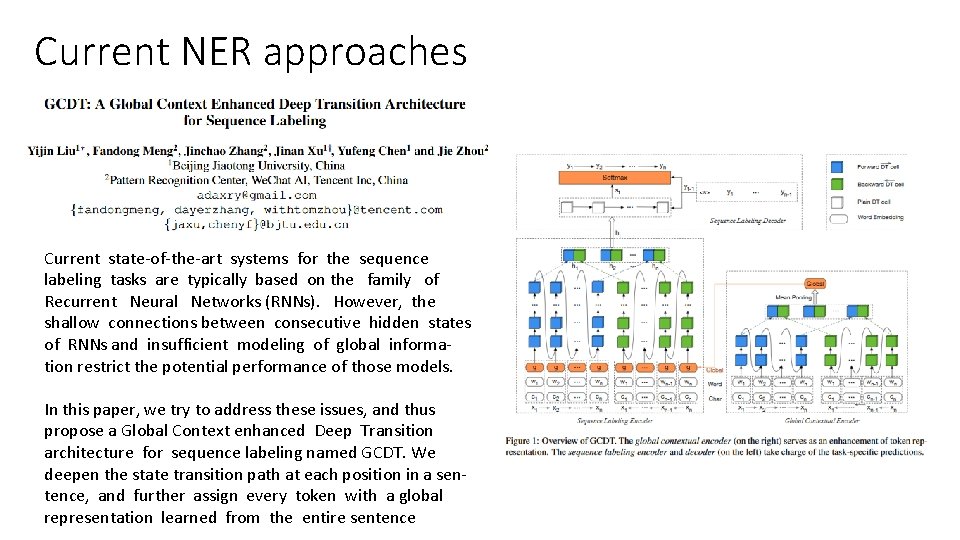
Current NER approaches Current state-of-the-art systems for the sequence labeling tasks are typically based on the family of Recurrent Neural Networks (RNNs). However, the shallow connections between consecutive hidden states of RNNs and insufficient modeling of global information restrict the potential performance of those models. In this paper, we try to address these issues, and thus propose a Global Context enhanced Deep Transition architecture for sequence labeling named GCDT. We deepen the state transition path at each position in a sentence, and further assign every token with a global representation learned from the entire sentence
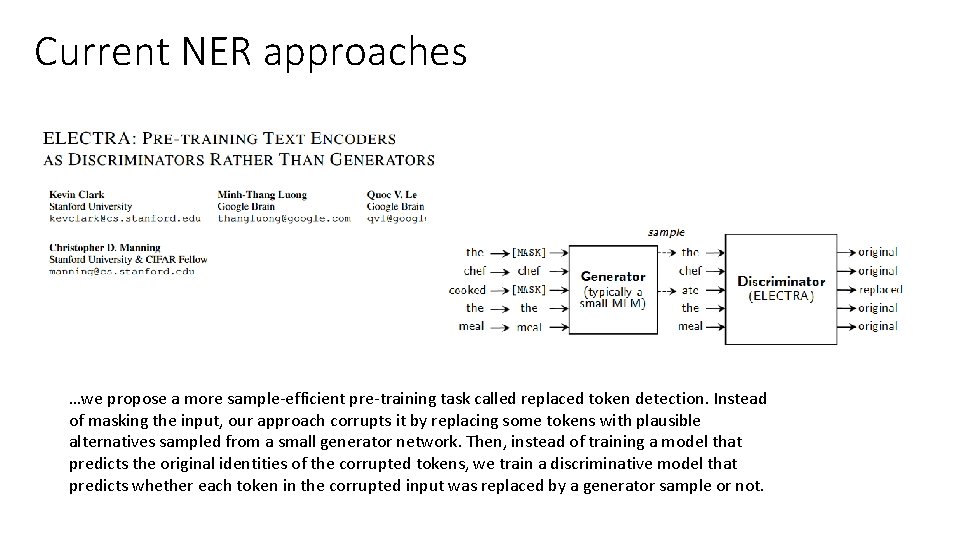
Current NER approaches …we propose a more sample-efficient pre-training task called replaced token detection. Instead of masking the input, our approach corrupts it by replacing some tokens with plausible alternatives sampled from a small generator network. Then, instead of training a model that predicts the original identities of the corrupted tokens, we train a discriminative model that predicts whether each token in the corrupted input was replaced by a generator sample or not.
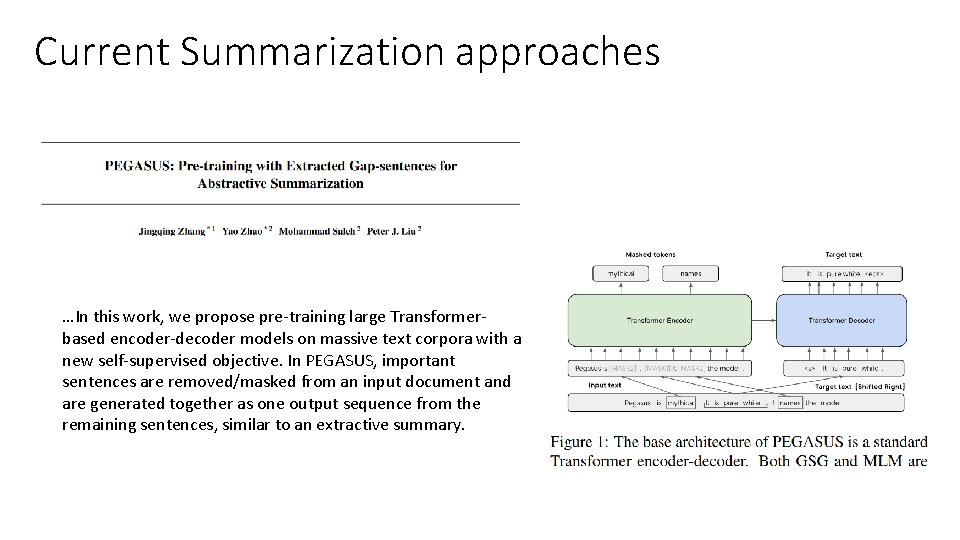
Current Summarization approaches …In this work, we propose pre-training large Transformerbased encoder-decoder models on massive text corpora with a new self-supervised objective. In PEGASUS, important sentences are removed/masked from an input document and are generated together as one output sequence from the remaining sentences, similar to an extractive summary.
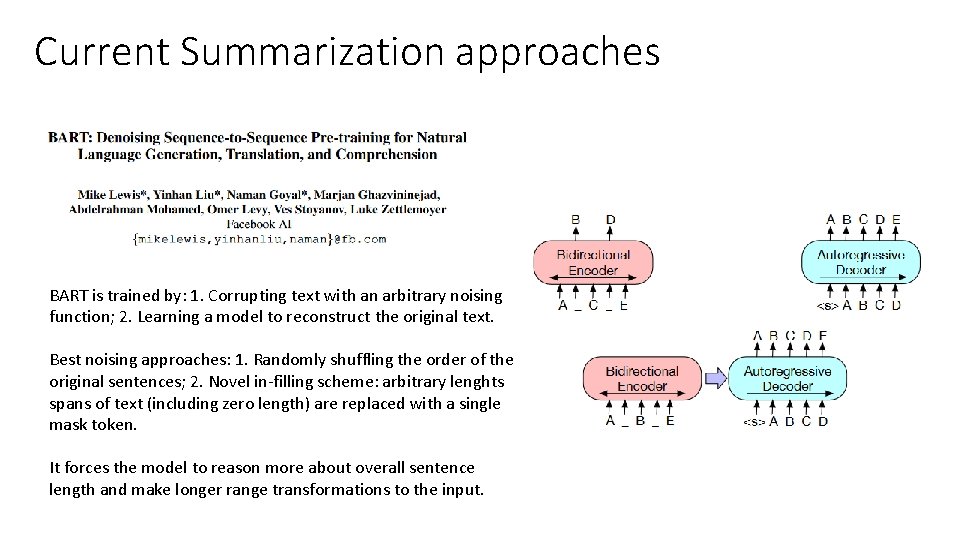
Current Summarization approaches BART is trained by: 1. Corrupting text with an arbitrary noising function; 2. Learning a model to reconstruct the original text. Best noising approaches: 1. Randomly shuffling the order of the original sentences; 2. Novel in-filling scheme: arbitrary lenghts spans of text (including zero length) are replaced with a single mask token. It forces the model to reason more about overall sentence length and make longer range transformations to the input.
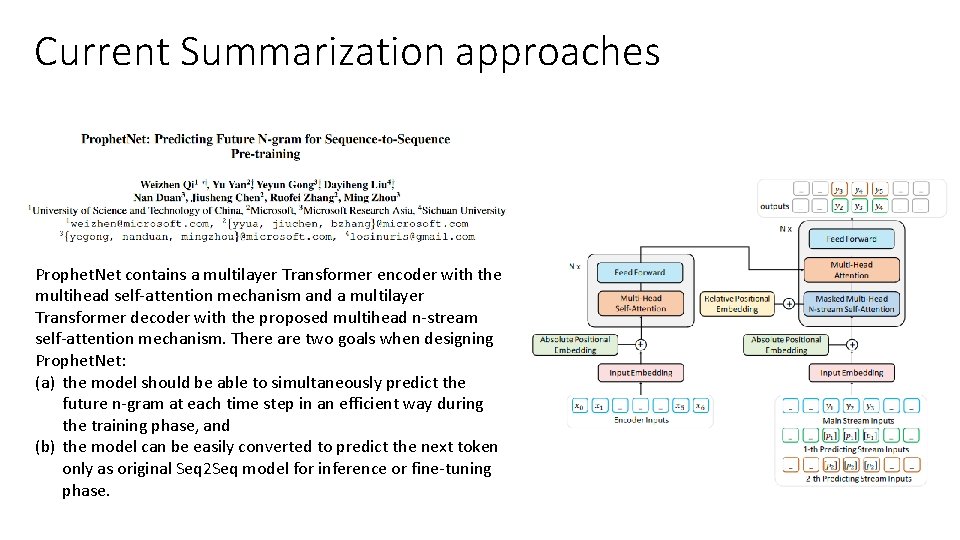
Current Summarization approaches Prophet. Net contains a multilayer Transformer encoder with the multihead self-attention mechanism and a multilayer Transformer decoder with the proposed multihead n-stream self-attention mechanism. There are two goals when designing Prophet. Net: (a) the model should be able to simultaneously predict the future n-gram at each time step in an efficient way during the training phase, and (b) the model can be easily converted to predict the next token only as original Seq 2 Seq model for inference or fine-tuning phase.
Thanks for your attention! [act] 0 [per] [act]