
Analysis of Material Transport VALUE STREAM MAPPING Outline
- Slides: 23
Analysis of Material Transport VALUE STREAM MAPPING
Outline Ø Introduction to Value Stream Mapping Ø Current State Map Ø Data Collection Ø Activity: Map Current State
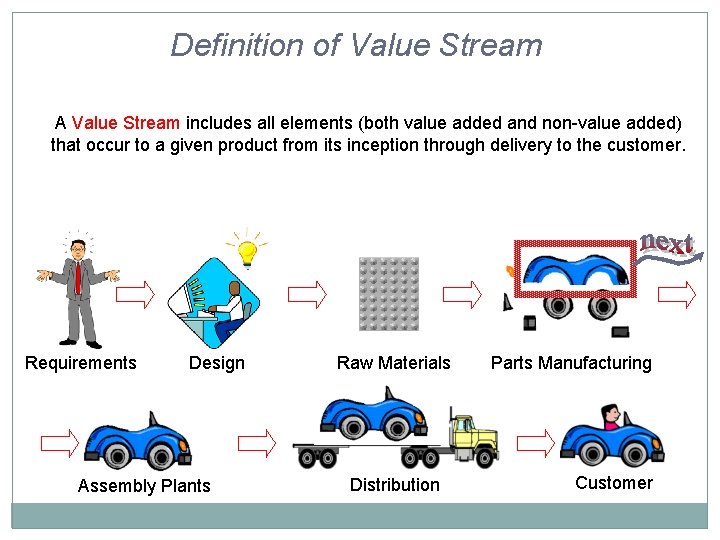
Definition of Value Stream A Value Stream includes all elements (both value added and non-value added) that occur to a given product from its inception through delivery to the customer. Requirements Design Assembly Plants Raw Materials Distribution Parts Manufacturing Customer
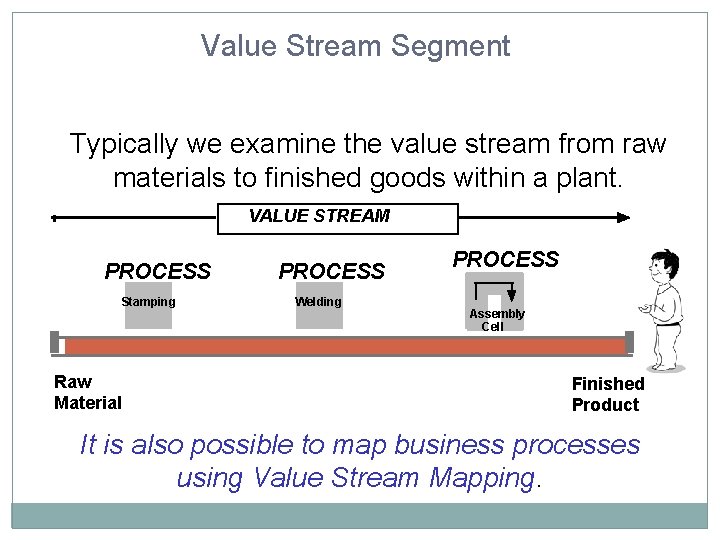
Value Stream Segment Typically we examine the value stream from raw materials to finished goods within a plant. VALUE STREAM PROCESS Stamping Raw Material PROCESS Welding PROCESS Assembly Cell Finished Product It is also possible to map business processes using Value Stream Mapping.
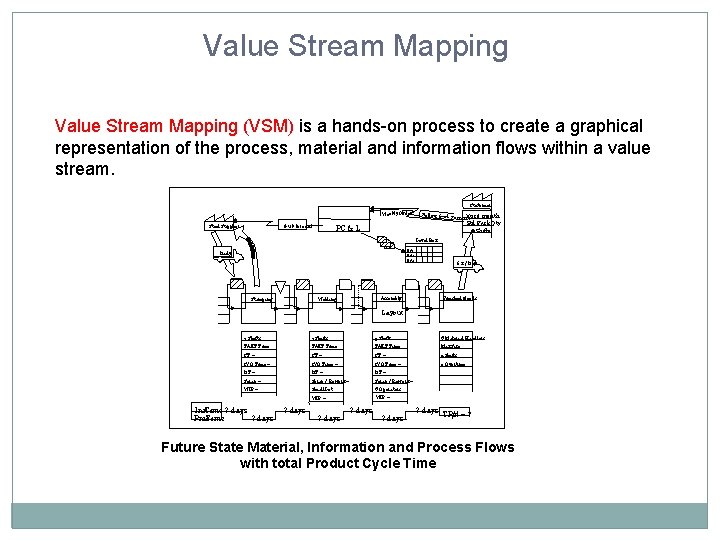
Value Stream Mapping (VSM) is a hands-on process to create a graphical representation of the process, material and information flows within a value stream. Customer Weekly Order 6 -wk forecast Steel Supplier Rolling 6 -wk For X pcs/ month ecast PC & L Std Pack Qty # Shifts Level Box DA 1 DA 2 DA 3 Daily Stamping 6 x / Day Assembly Welding Finished Goods Layout 3 Shifts # Material Handlers TAKT Time Max Size CT = 2 Shifts C/O Time = 0 Overtime DT = Scrap / Rework= Scrap / Rework = WIP = Small Lot # Operators WIP = Inv. Time ? days Proc. Time ? days ? days TPc /t = ? Future State Material, Information and Process Flows with total Product Cycle Time
Objectives of Value Stream Mapping Ø Provide the means to see the material, process and information flows. Ø Support the prioritization of continuous improvement activities at the value stream Ø Provide the basis for facility layout AND. . . Eliminate Waste
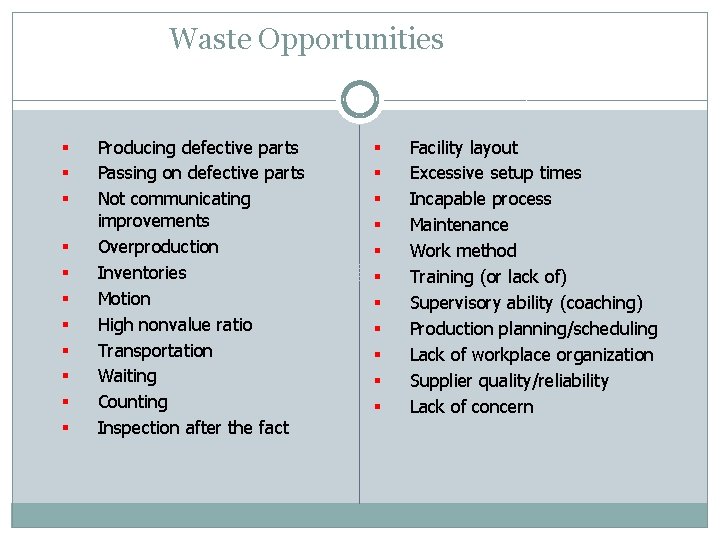
Waste Opportunities § § § Producing defective parts Passing on defective parts Not communicating improvements Overproduction Inventories Motion High nonvalue ratio Transportation Waiting Counting Inspection after the fact § § § Facility layout Excessive setup times Incapable process Maintenance Work method Training (or lack of) Supervisory ability (coaching) Production planning/scheduling Lack of workplace organization Supplier quality/reliability Lack of concern
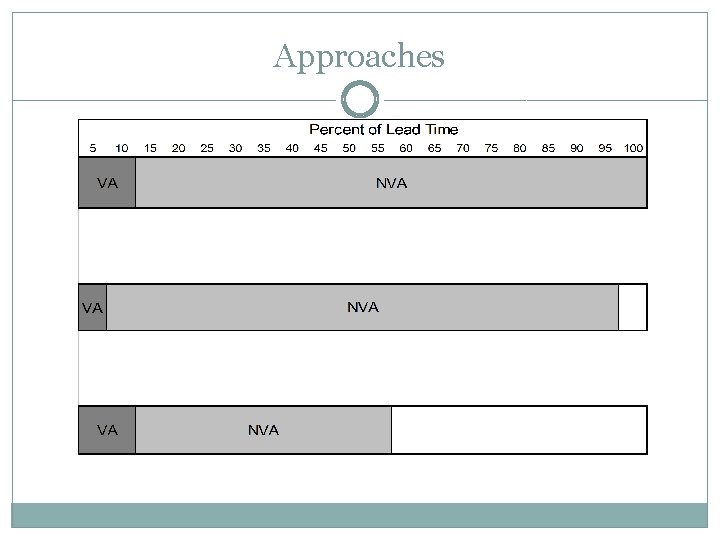
Approaches
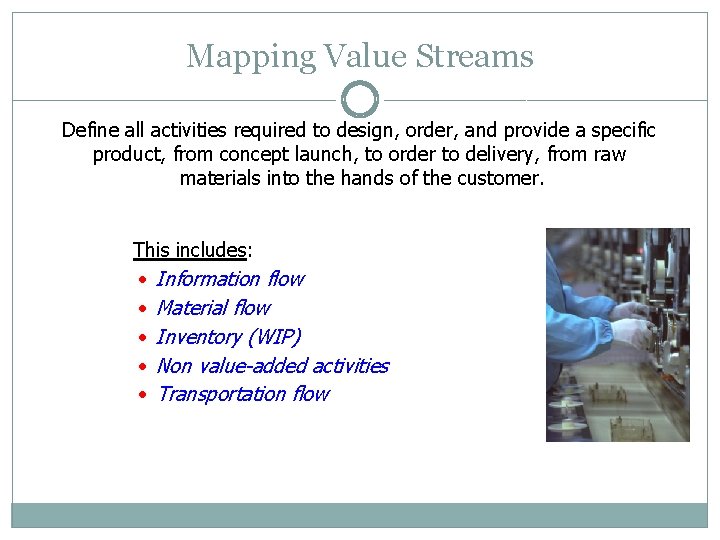
Mapping Value Streams Define all activities required to design, order, and provide a specific product, from concept launch, to order to delivery, from raw materials into the hands of the customer. This includes: • Information flow • Material flow • Inventory (WIP) • Non value-added activities • Transportation flow
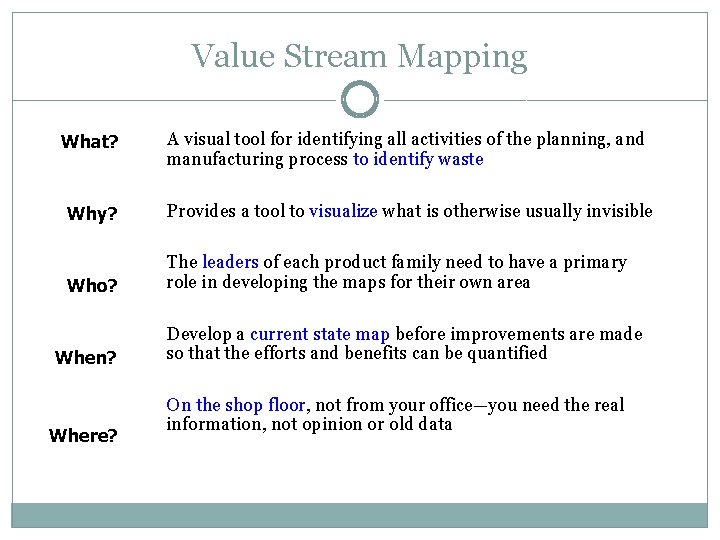
Value Stream Mapping What? A visual tool for identifying all activities of the planning, and manufacturing process to identify waste Why? Provides a tool to visualize what is otherwise usually invisible Who? The leaders of each product family need to have a primary role in developing the maps for their own area When? Where? Develop a current state map before improvements are made so that the efforts and benefits can be quantified On the shop floor, not from your office—you need the real information, not opinion or old data
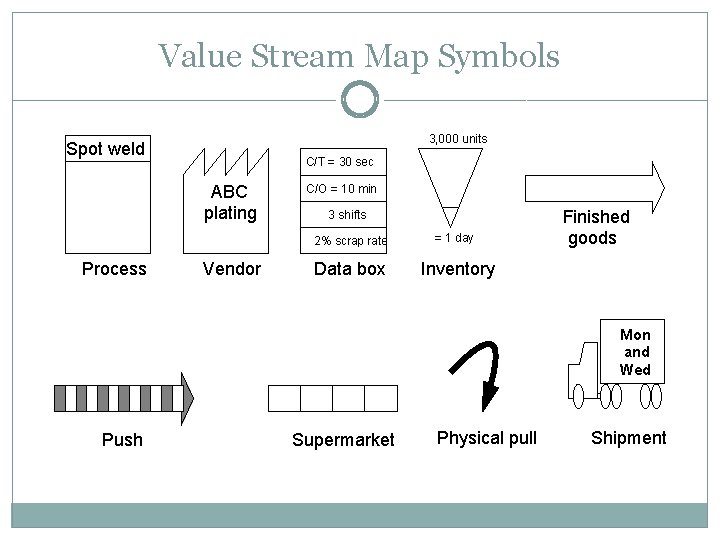
Value Stream Map Symbols 3, 000 units Spot weld C/T = 30 sec ABC plating Process Vendor C/O = 10 min 3 shifts 2% scrap rate = 1 day Data box Inventory Finished goods Mon and Wed Push Supermarket Physical pull Shipment
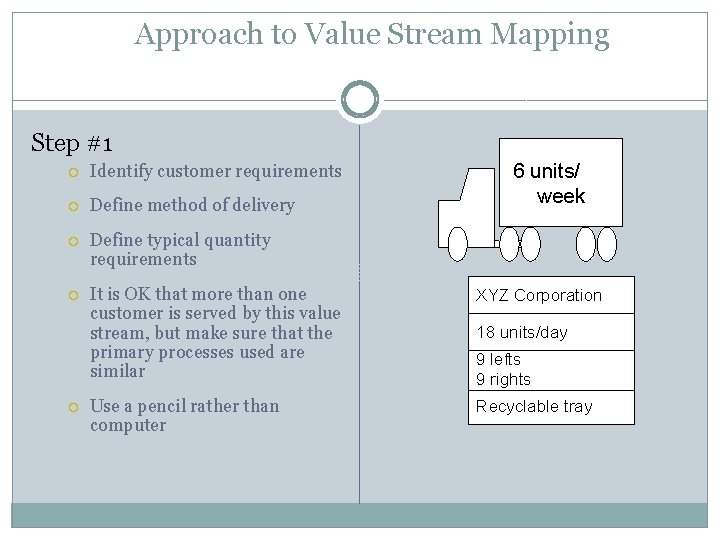
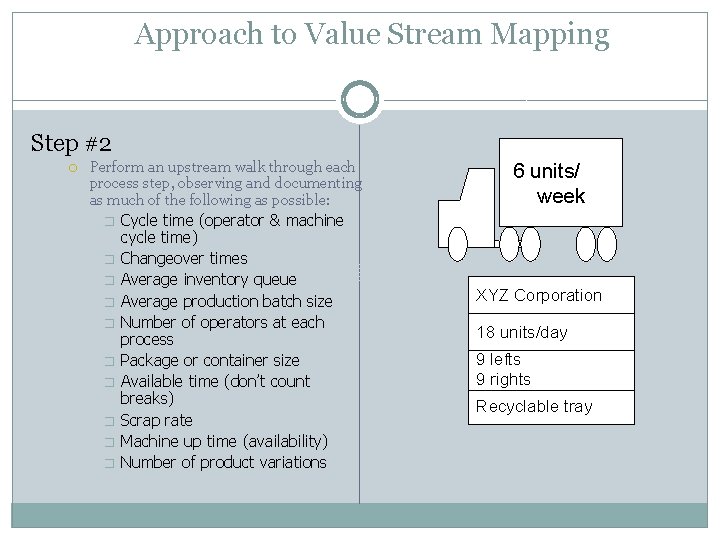
Approach to Value Stream Mapping Step #1 6 units/ week Identify customer requirements Define method of delivery Define typical quantity requirements It is OK that more than one customer is served by this value stream, but make sure that the primary processes used are similar XYZ Corporation Use a pencil rather than computer Recyclable tray 18 units/day 9 lefts 9 rights
Approach to Value Stream Mapping Step #2 Perform an upstream walk through each process step, observing and documenting as much of the following as possible: � � � � � Cycle time (operator & machine cycle time) Changeover times Average inventory queue Average production batch size Number of operators at each process Package or container size Available time (don’t count breaks) Scrap rate Machine up time (availability) Number of product variations 6 units/ week XYZ Corporation 18 units/day 9 lefts 9 rights Recyclable tray
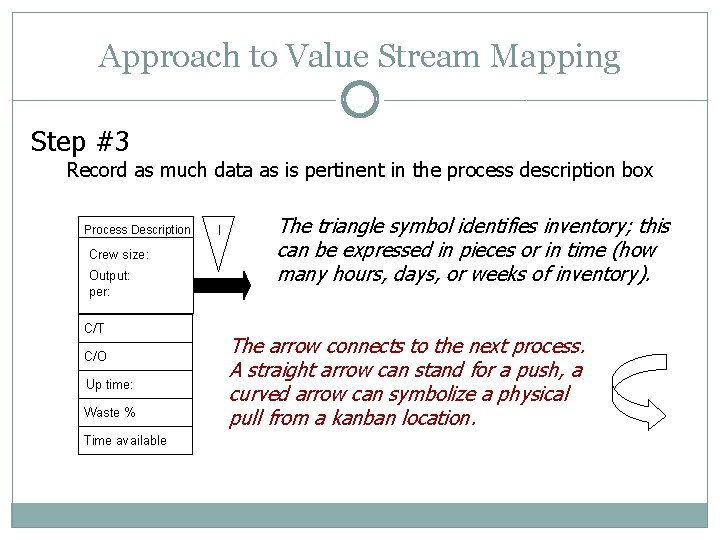
Approach to Value Stream Mapping Step #3 Record as much data as is pertinent in the process description box Process Description Crew size: Output: per: C/T C/O Up time: Waste % Time available I The triangle symbol identifies inventory; this can be expressed in pieces or in time (how many hours, days, or weeks of inventory). The arrow connects to the next process. A straight arrow can stand for a push, a curved arrow can symbolize a physical pull from a kanban location.
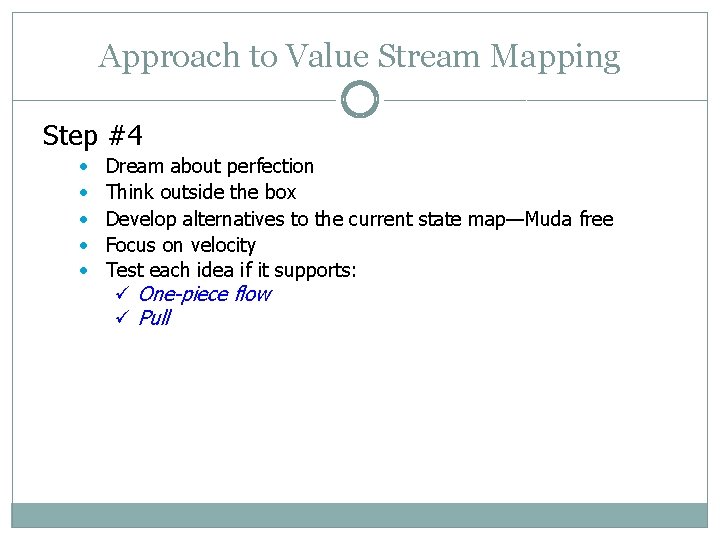
Approach to Value Stream Mapping Step #4 • • • Dream about perfection Think outside the box Develop alternatives to the current state map—Muda free Focus on velocity Test each idea if it supports: ü One-piece flow ü Pull
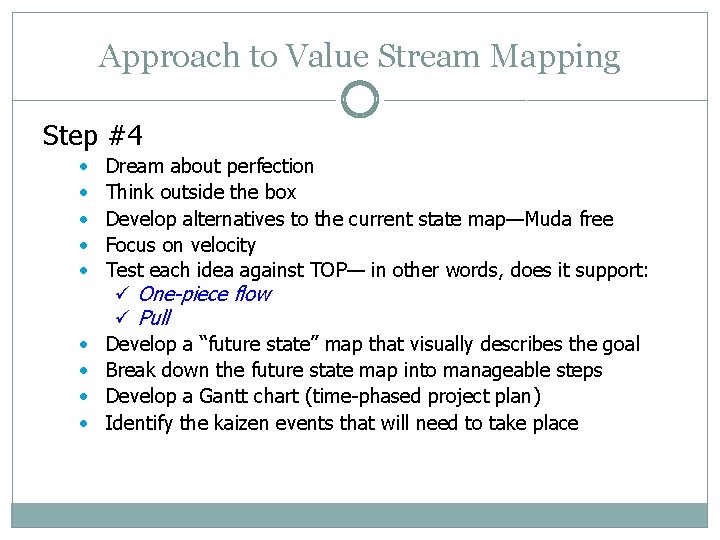
Approach to Value Stream Mapping Step #4 • • • Dream about perfection Think outside the box Develop alternatives to the current state map—Muda free Focus on velocity Test each idea against TOP— in other words, does it support: ü One-piece flow ü Pull Develop a “future state” map that visually describes the goal Break down the future state map into manageable steps Develop a Gantt chart (time-phased project plan) Identify the kaizen events that will need to take place
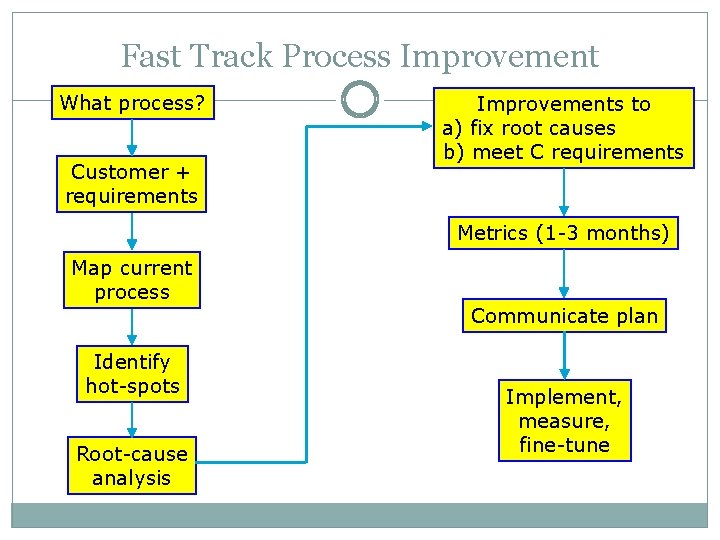
Fast Track Process Improvement What process? Customer + requirements Improvements to a) fix root causes b) meet C requirements Metrics (1 -3 months) Map current process Identify hot-spots Root-cause analysis Communicate plan Implement, measure, fine-tune
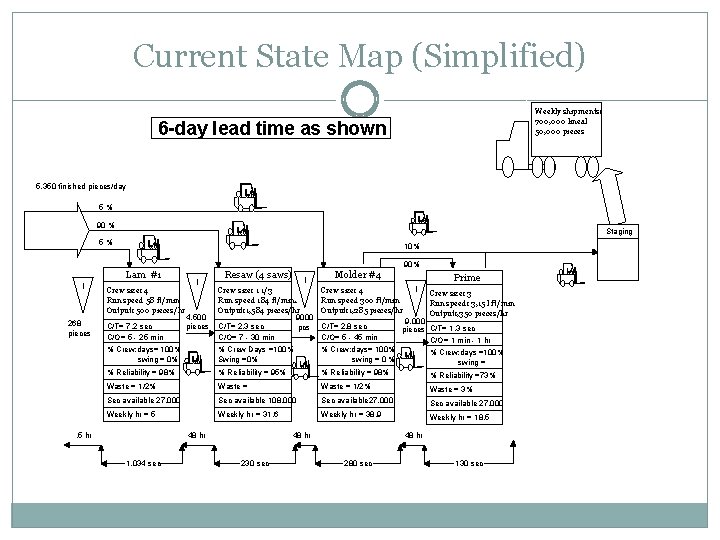
Current State Map (Simplified) Weekly shipments: 700, 000 lineal 50, 000 pieces 6 -day lead time as shown 5, 350 finished pieces/day 5% 90 % Staging 5% 10% 90% Lam #1 I 268 pieces Resaw (4 saws) Molder #4 Prime 4, 500 C/T= 7. 2 sec pieces C/O= 5 - 25 min % Crew: days= 100% swing = 0% I Crew size: 1 1/3 Run speed 184 ft/min. Output: 1, 584 pieces/hr 9000 C/T= 2. 3 sec pcs C/O= 7 - 30 min % Crew Days =100% Swing =0% % Reliability = 98% % Reliability = 95% % Reliability = 98% % Reliability =73% Waste = 1/2% Waste = 3% Sec available 27, 000 Sec available 108, 000 Sec available 27, 000 Weekly hr = 5 Weekly hr = 31. 6 Weekly hr = 38. 9 Weekly hr = 18. 5 Crew size: 4 Run speed 58 ft/min Output: 500 pieces/hr . 5 hr I 48 hr 1, 034 sec Crew size: 4 Run speed 300 ft/min Output: 1, 285 pieces/hr Crew size: 3 Run speed: 3, 15 l ft/min Output: 1, 350 pieces/hr 9, 000 C/T= 2. 8 sec pieces C/T= 1. 3 sec C/O= 5 - 45 min C/O= 1 min - 1 hr % Crew: days= 100% % Crew: days =100% swing = 0 % swing = 48 hr 230 sec I 48 hr 280 sec 130 sec
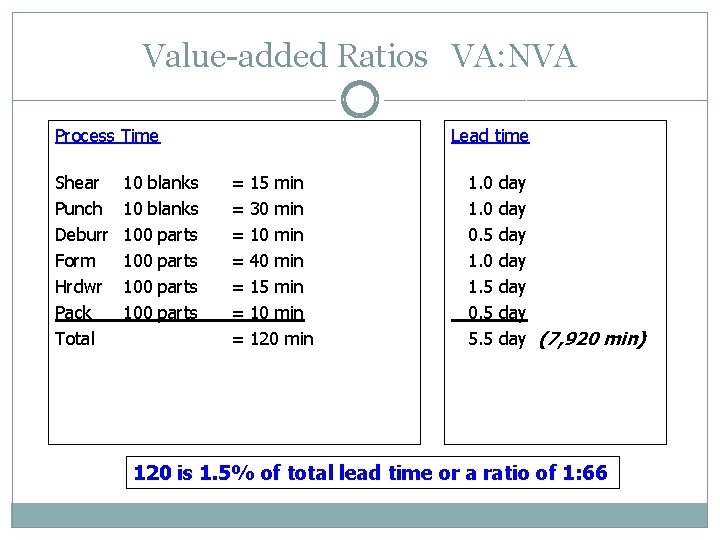
Value-added Ratios VA: NVA Process Time Shear Punch Deburr Form Hrdwr Pack Total 10 blanks 100 parts Lead time = = = = 15 min 30 min 10 min 40 min 15 min 10 min 120 min 1. 0 0. 5 1. 0 1. 5 0. 5 5. 5 day day (7, 920 min) 120 is 1. 5% of total lead time or a ratio of 1: 66
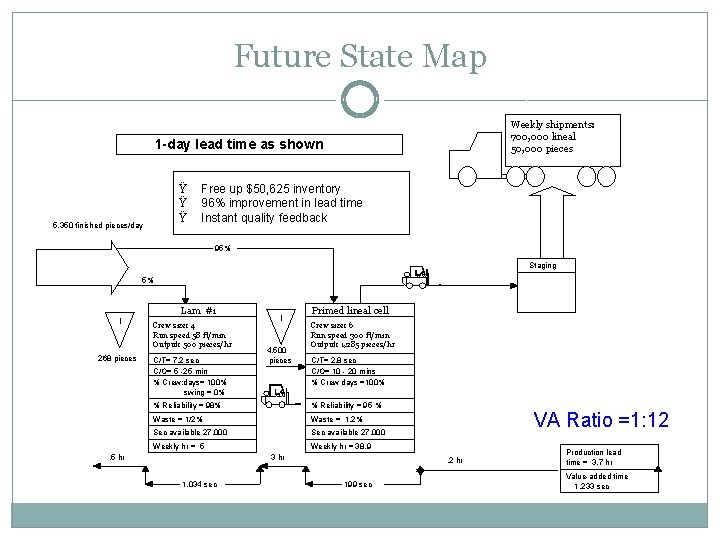
Future State Map Weekly shipments: 700, 000 lineal 50, 000 pieces 1 -day lead time as shown Ÿ Ÿ Ÿ 5, 350 finished pieces/day Free up $50, 625 inventory 96% improvement in lead time Instant quality feedback 95% Staging 5% Lam #1 I Crew size: 4 Run speed 58 ft/min Output: 500 pieces/hr 268 pieces C/T= 7. 2 sec C/O= 5 -25 min % Crew: days= 100% swing = 0% I 4, 500 pieces Primed lineal cell Crew size: 6 Run speed 300 ft/min Output: 1, 285 pieces/hr C/T= 2. 8 sec C/O= 10 - 20 mins % Crew days =100% % Reliability = 98% % Reliability = 95 % Waste = 1/2% Waste = 1. 2% Sec available 27, 000 Weekly hr = 5. 5 hr Weekly hr = 38. 9 3 hr 1, 034 sec VA Ratio =1: 12. 2 hr 199 sec Production lead time = 3. 7 hr Value-added time 1, 233 sec
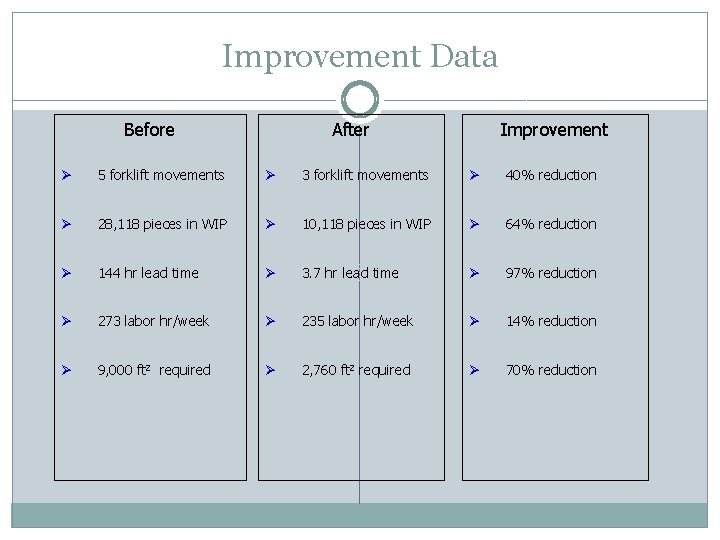
Improvement Data Before After Improvement Ø 5 forklift movements Ø 3 forklift movements Ø 40% reduction Ø 28, 118 pieces in WIP Ø 10, 118 pieces in WIP Ø 64% reduction Ø 144 hr lead time Ø 3. 7 hr lead time Ø 97% reduction Ø 273 labor hr/week Ø 235 labor hr/week Ø 14% reduction Ø 9, 000 ft 2 required Ø 2, 760 ft 2 required Ø 70% reduction
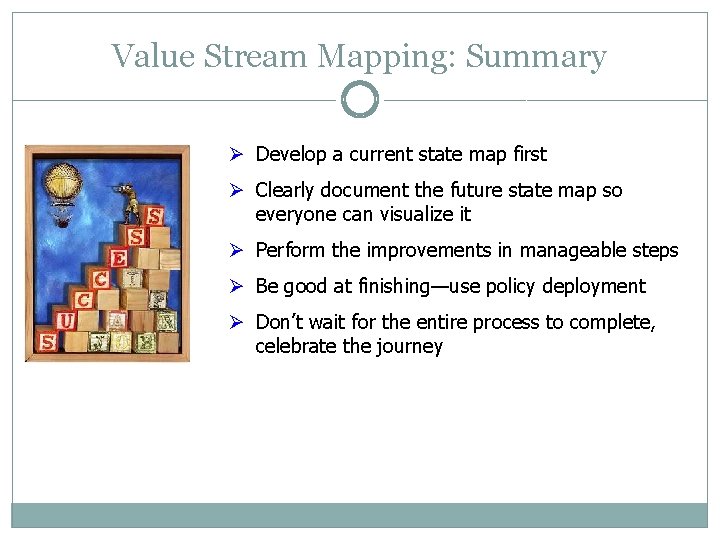
Value Stream Mapping: Summary Ø Develop a current state map first Ø Clearly document the future state map so everyone can visualize it Ø Perform the improvements in manageable steps Ø Be good at finishing—use policy deployment Ø Don’t wait for the entire process to complete, celebrate the journey
References Dr. Kenneth Andrews Garry Conner