
Analysis of Language Use EXAM REVISION The exam
- Slides: 44
Analysis of Language Use EXAM REVISION
The exam is 6 weeks away 42 days from today
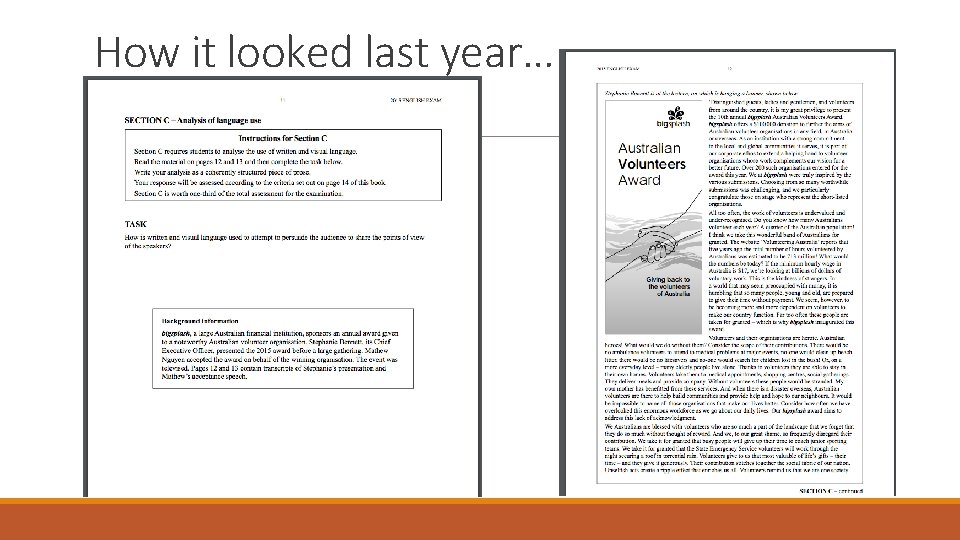
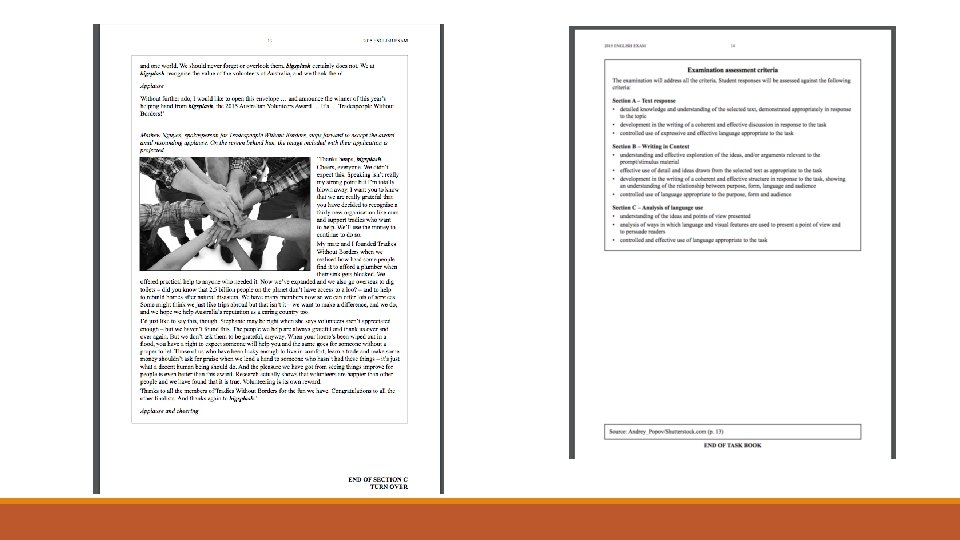
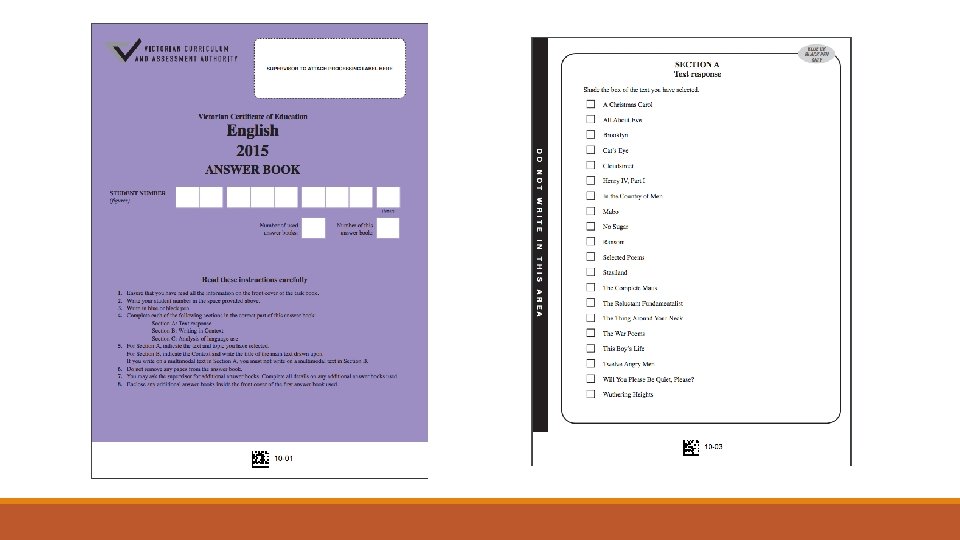
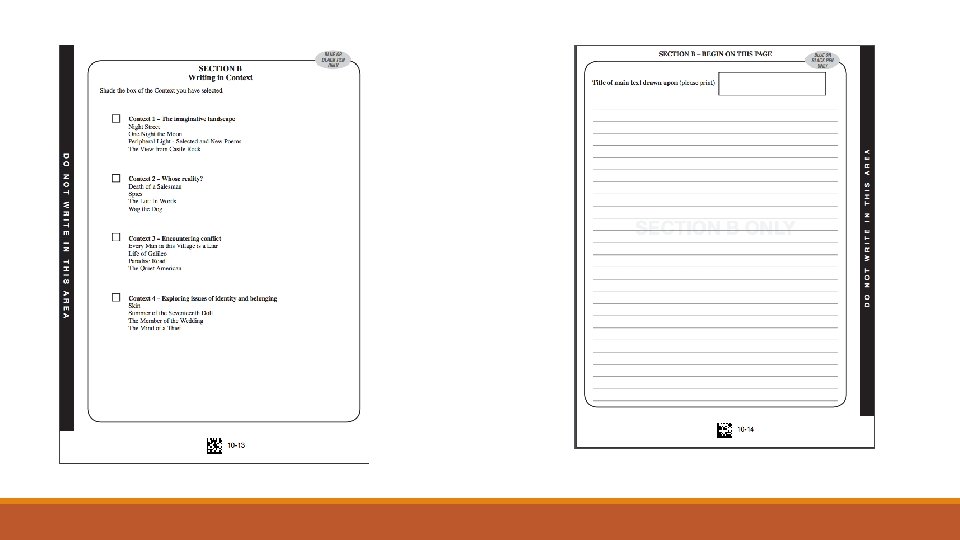
How it looked last year…
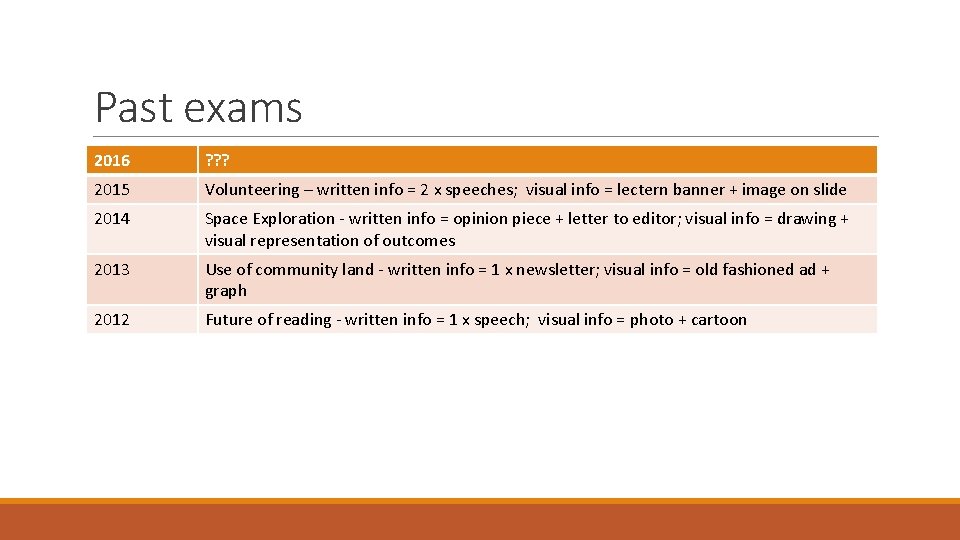
Past exams 2016 ? ? ? 2015 Volunteering – written info = 2 x speeches; visual info = lectern banner + image on slide 2014 Space Exploration - written info = opinion piece + letter to editor; visual info = drawing + visual representation of outcomes 2013 Use of community land - written info = 1 x newsletter; visual info = old fashioned ad + graph 2012 Future of reading - written info = 1 x speech; visual info = photo + cartoon
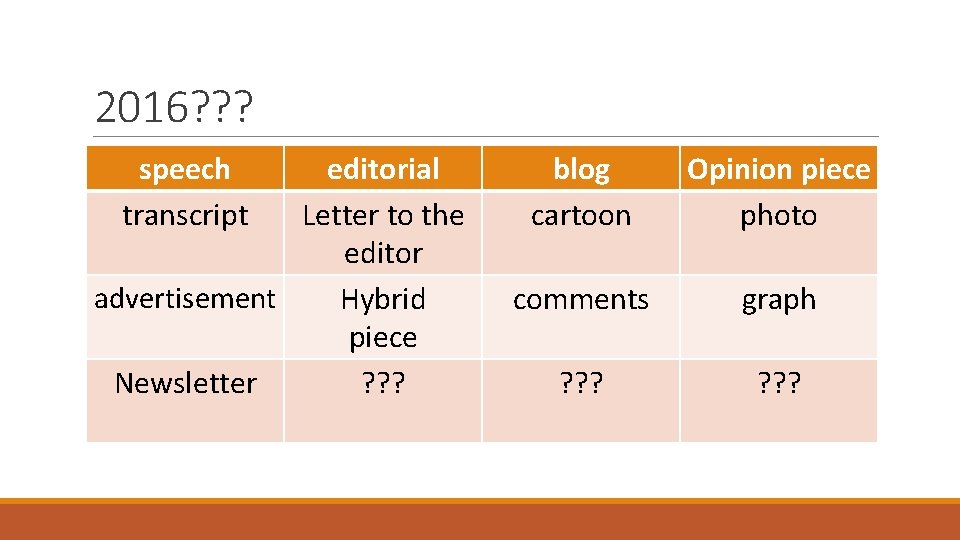
2016? ? ? speech transcript editorial Letter to the editor advertisement Hybrid piece Newsletter ? ? ? blog cartoon Opinion piece photo comments graph ? ? ?
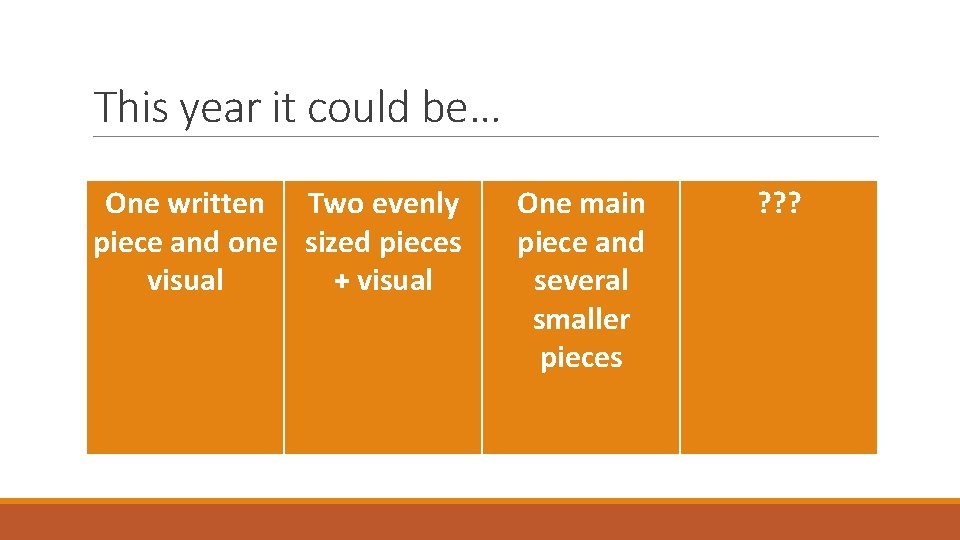
This year it could be… One written Two evenly piece and one sized pieces visual + visual One main piece and several smaller pieces ? ? ?
Section C Section A- Text response Section B- Writing in Context Section C- Analysis of language use Do this section FIRST!!! WHY?
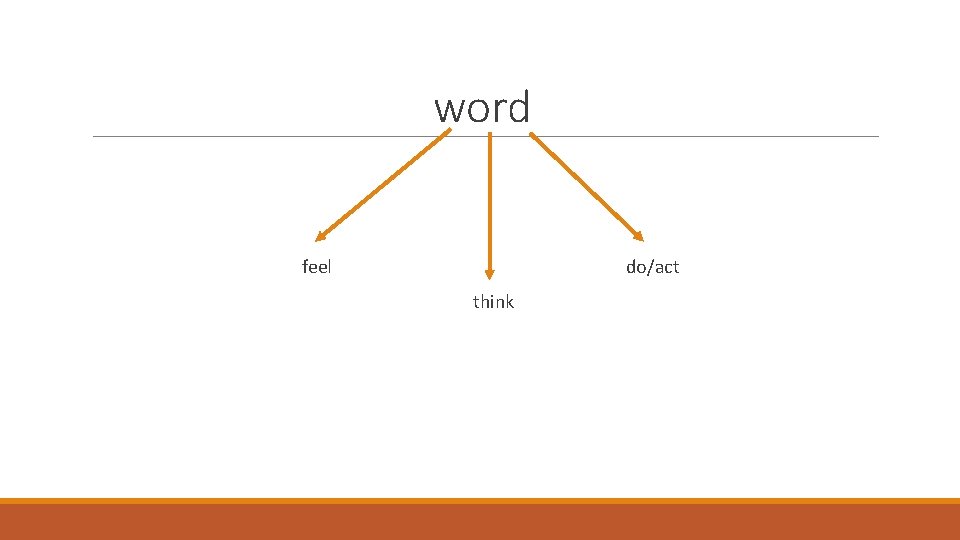
Reading time 15 minutes reading the exam, carefully reading the questions for Section A (text) and Section B (context) 10 minutes reading Section C…this should be enough to read the information twice Ølook at all the information as a whole (contention, arguments) Øthink about how the information connects (visual & written) ØWhat does it make you feel, think, do? ØThink about tone (and tonal shifts) When writing time starts BEGIN with LANGUAGE ANALYSIS. . . SECTION C and start by annotating the material
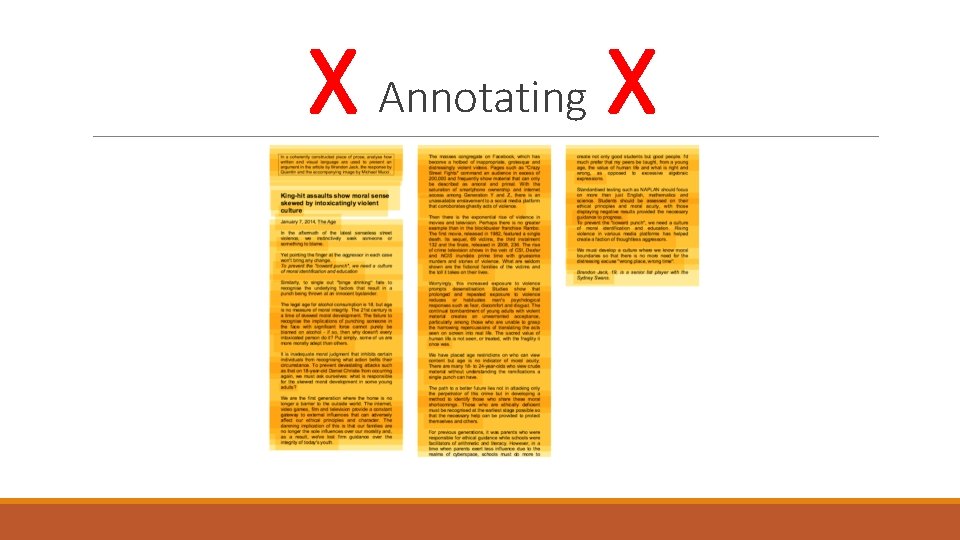
X Annotating X
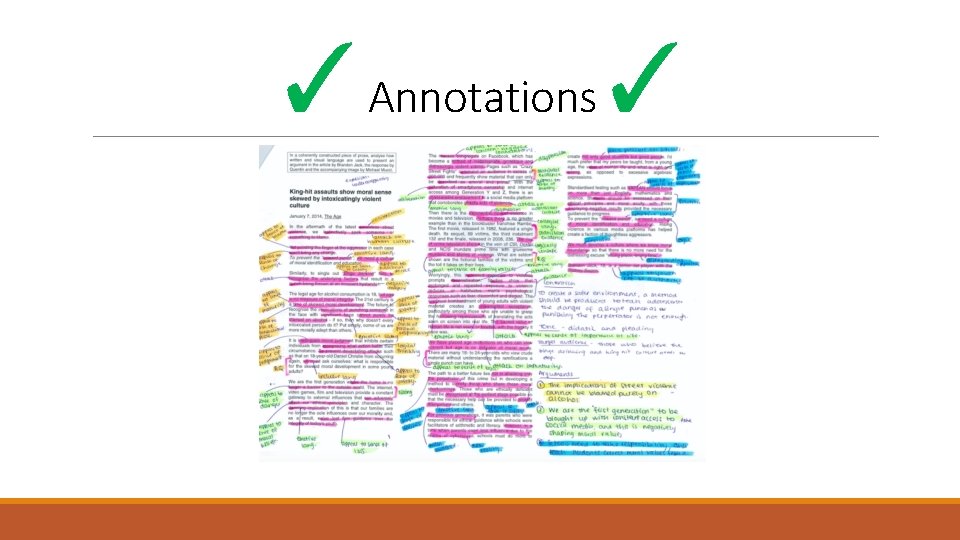
✓Annotations✓
Examination Assessment Criteria • Understanding of the ideas and points of view presented • Analysis of ways in which language and visual features are used to present a point of view and to persuade readers • Controlled and effective use of language appropriate to the task
What’s the secret? ØKnow what to do ØUnderstand the material ØWrite concisely, precisely and construct a balanced response
Common traps X Analysis focuses on listing techniques X Empty analysis (textbook phrases/definitions to describe the effects rather that considering the material in light on this particular issue, argument and audience) X Summarises what the author is saying rather than analysing what the author is doing, how his/her language is being used and why (for what outcome)
How to fix? ØUnderstand that each language analysis task is different…you must adopt your own FLEXIBLE and CRITICAL approach to the individual task (be SPECIFIC not GENERIC) ØUnderstand the interplay of text, context and author ØDifferentiate
ZOOM IN and OUT ZOOM IN and analyse the what, how, why (feel, think, do). ZOOM OUT and consider the contextualisation…why is the issue relelevant at this time? What has precipatated this debate? How does the issue affect (the rights, responsibilities, wellbeing. . . ) of: ØMe (the individual) + those closest to me ØLocal community > wider society > nation > global community ØFuture (or past) generations ØPeople, places, nature, possibilities (concrete vs abstract)
What are the tensions? What are the dimensions of the issues? (moral/ethical; environmental; religious…) Who are the stakeholders? What values distinguish these groups? Who has a vested interest? What are the motivations of the author? How does this affect how they might approach the issue? What do they stand to gain? Self interest (egotistic) or altruistic? BRING TOGETHER THE CONTEXT TO UNDERSTAND THE INTERPLAY BETWEEN ISSUE, AUTHOR, AUDIENCE & LANGUAGE.
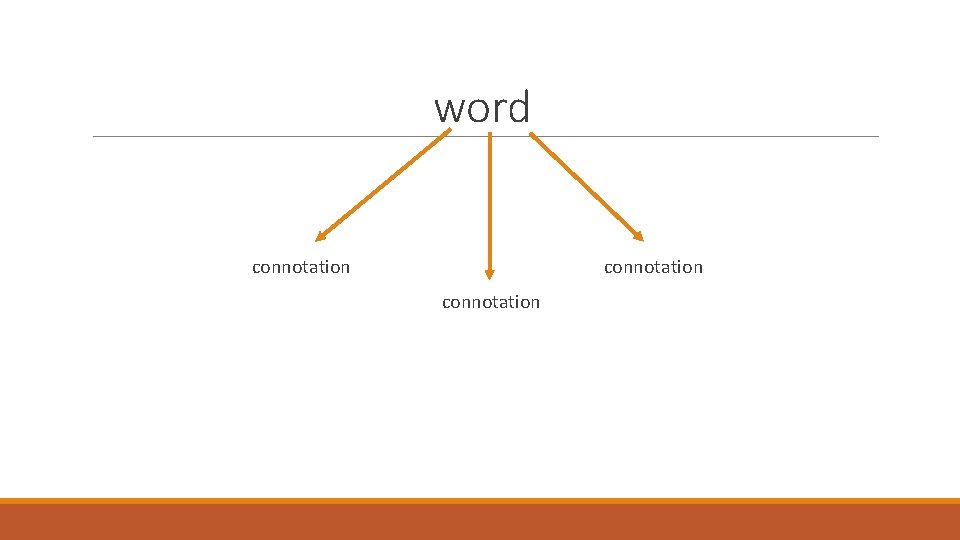
Choices shape meaning Analyse the language (visual and written) used and how this shapes meaning and guides the reader to feel and think in a particular way (for a particular reason) and consider how specific choices shape meaning. WORDS, WORDS Specific word choices infer meaning.
word connotation
word feel do/act think
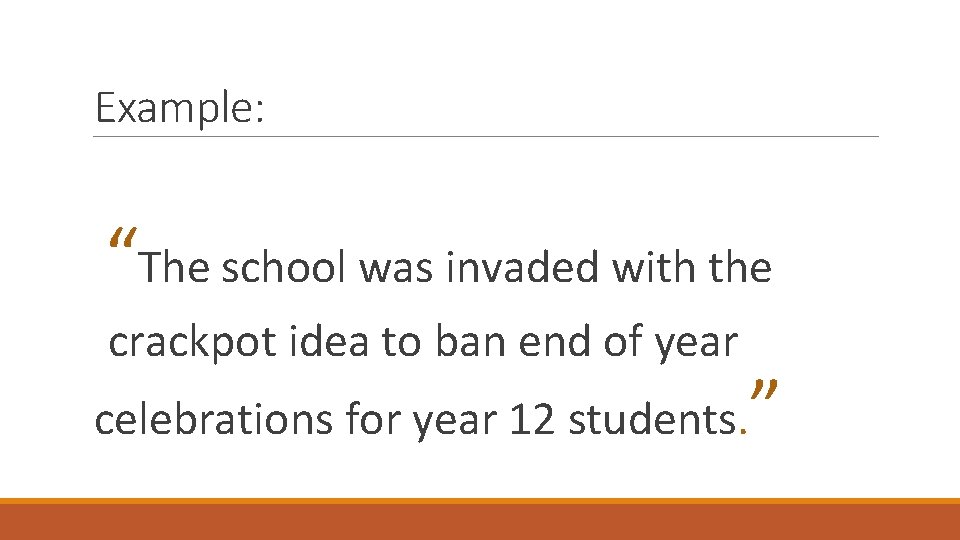
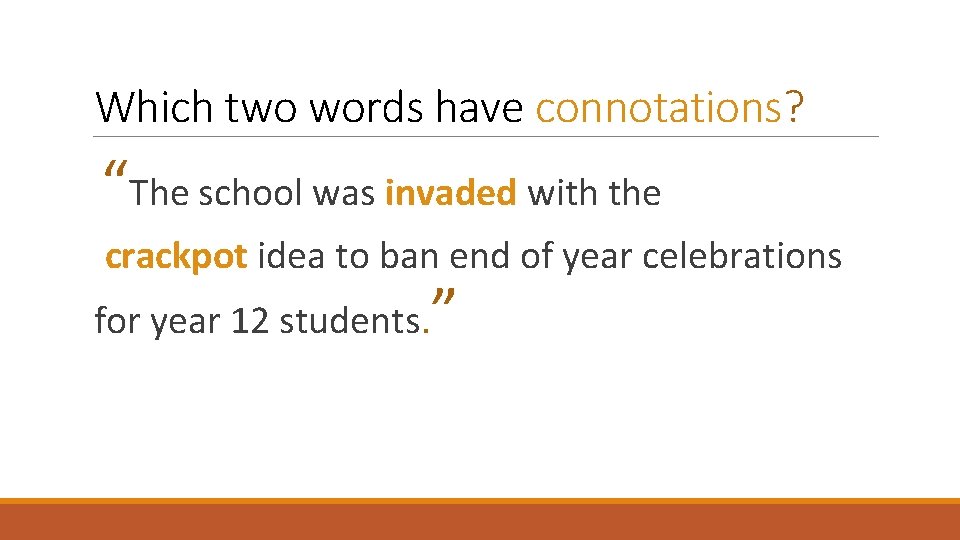
Example: “The school was invaded with the crackpot idea to ban end of year celebrations for year 12 students. ”
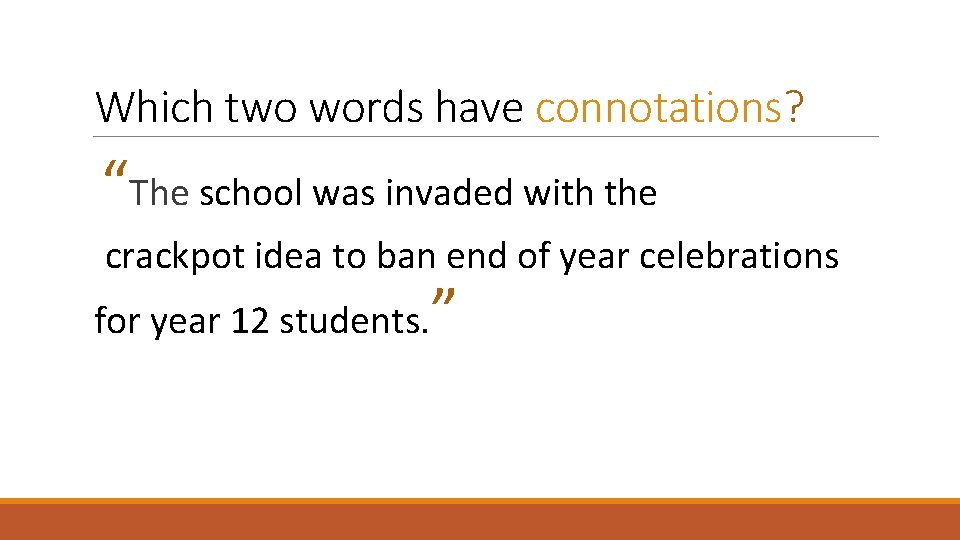
Which two words have connotations? “The school was invaded with the crackpot idea to ban end of year celebrations for year 12 students. ”
Which two words have connotations? “The school was invaded with the crackpot idea to ban end of year celebrations for year 12 students. ”
word connotation
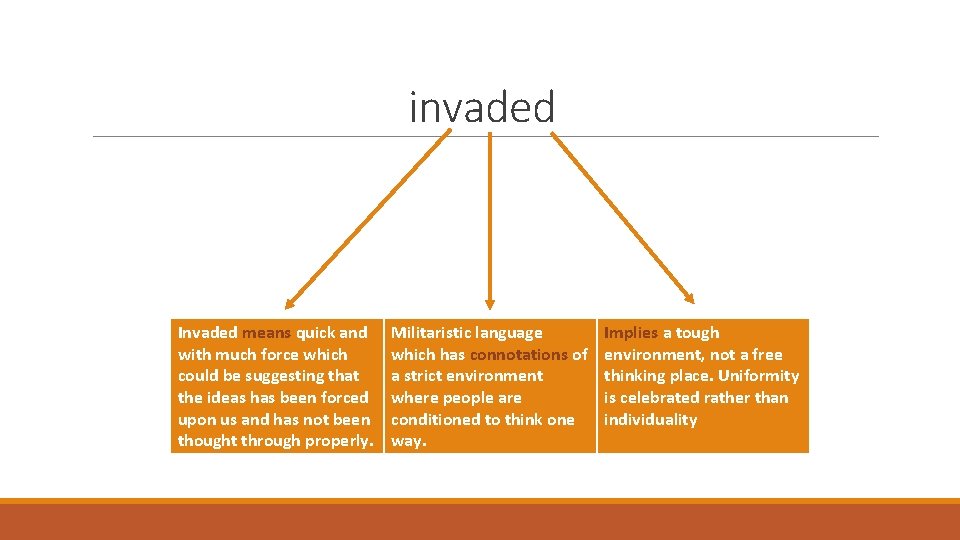
invaded Invaded means quick and with much force which could be suggesting that the ideas has been forced upon us and has not been thought through properly. Militaristic language which has connotations of a strict environment where people are conditioned to think one way. Implies a tough environment, not a free thinking place. Uniformity is celebrated rather than individuality
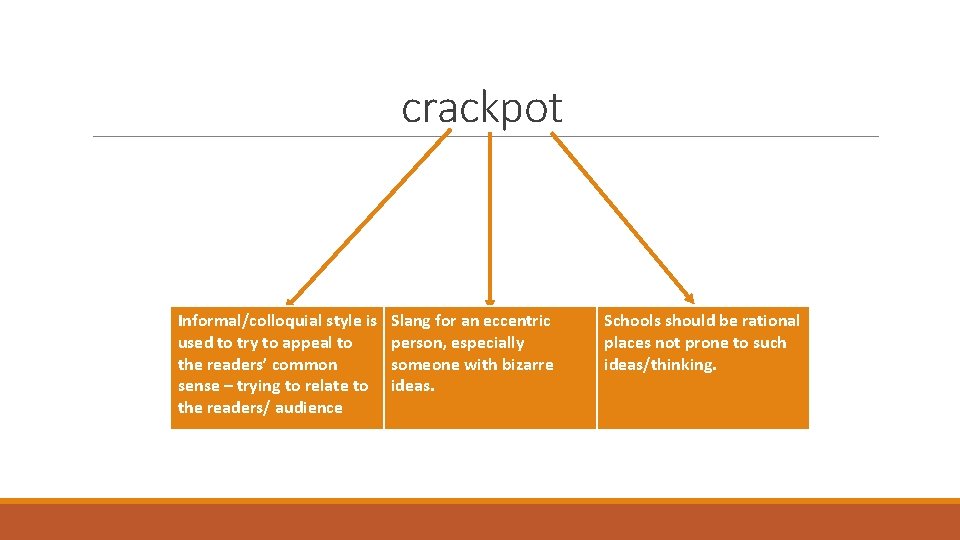
crackpot Informal/colloquial style is used to try to appeal to the readers’ common sense – trying to relate to the readers/ audience Slang for an eccentric person, especially someone with bizarre ideas. Schools should be rational places not prone to such ideas/thinking.
VISUALS Do not take them out of context, look for the specific LINK between the written material and the visual material (don’t forget, VISUAL could also include formatting and layout) What can you see + what does it mean? Don’t just describe…analyse (What does it suggest? What does it represent? What is it symbolic of? How does it connect to the written material? )
Comment on the effect of… ØContrasts, juxtapositioning and links ØSize/scale ØBackground/foreground ØLight/dark ØCaricature (body language) ØSymbolism ØText in the visual ØLinks between visual and written text
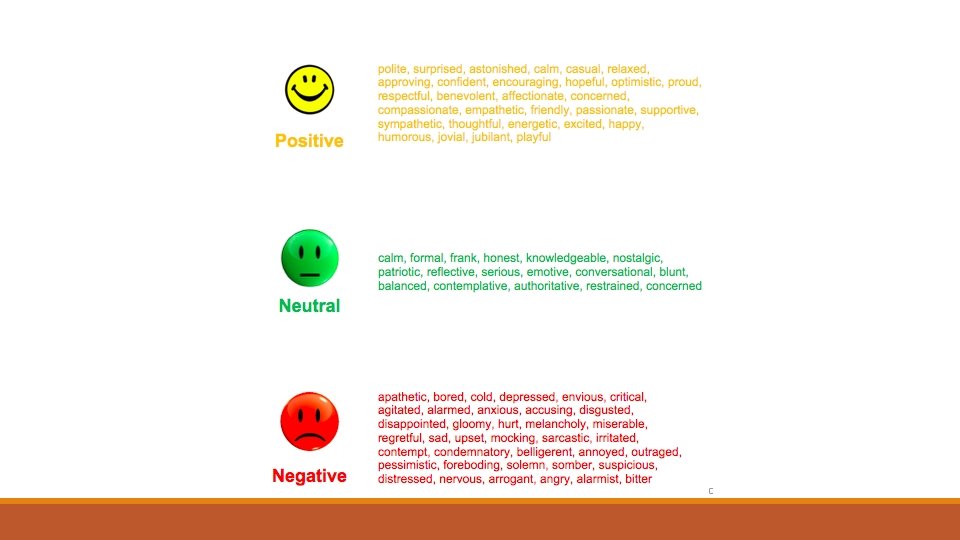
Tone X Informative tone NO! X authoritative, contemplative, balanced, confident, erudite, matter-of-fact, objective…
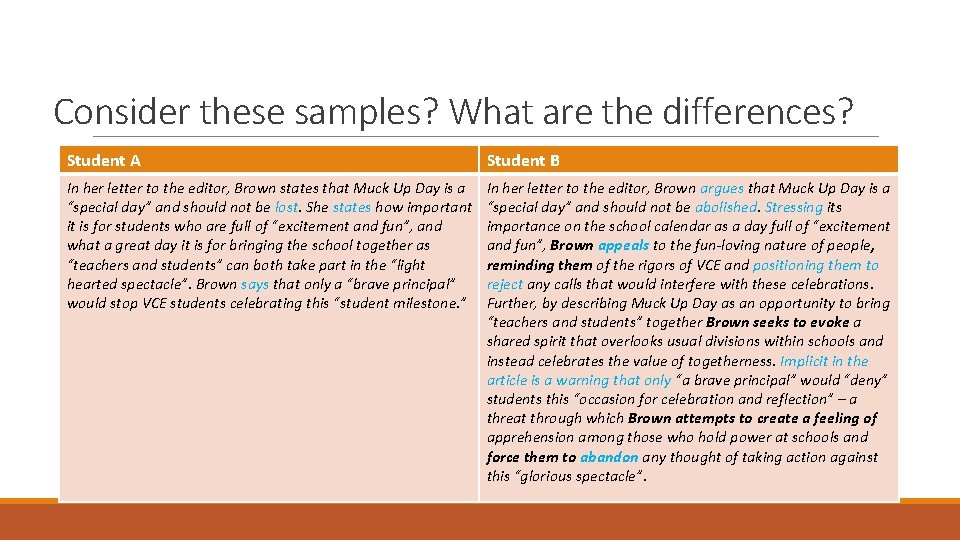
Consider these samples? What are the differences? Student A Student B In her letter to the editor, Brown states that Muck Up Day is a “special day” and should not be lost. She states how important it is for students who are full of “excitement and fun”, and what a great day it is for bringing the school together as “teachers and students” can both take part in the “light hearted spectacle”. Brown says that only a “brave principal” would stop VCE students celebrating this “student milestone. ” In her letter to the editor, Brown argues that Muck Up Day is a “special day” and should not be abolished. Stressing its importance on the school calendar as a day full of “excitement and fun”, Brown appeals to the fun-loving nature of people, reminding them of the rigors of VCE and positioning them to reject any calls that would interfere with these celebrations. Further, by describing Muck Up Day as an opportunity to bring “teachers and students” together Brown seeks to evoke a shared spirit that overlooks usual divisions within schools and instead celebrates the value of togetherness. Implicit in the article is a warning that only “a brave principal” would “deny” students this “occasion for celebration and reflection” – a threat through which Brown attempts to create a feeling of apprehension among those who hold power at schools and force them to abandon any thought of taking action against this “glorious spectacle”.
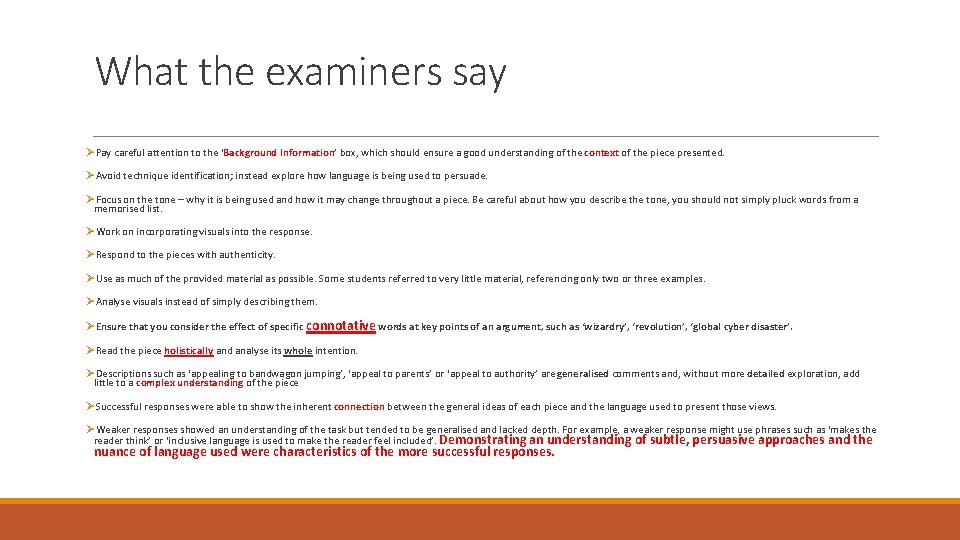
What the examiners say ØPay careful attention to the ‘Background Information’ box, which should ensure a good understanding of the context of the piece presented. ØAvoid technique identification; instead explore how language is being used to persuade. ØFocus on the tone – why it is being used and how it may change throughout a piece. Be careful about how you describe the tone, you should not simply pluck words from a memorised list. ØWork on incorporating visuals into the response. ØRespond to the pieces with authenticity. ØUse as much of the provided material as possible. Some students referred to very little material, referencing only two or three examples. ØAnalyse visuals instead of simply describing them. ØEnsure that you consider the effect of specific connotative words at key points of an argument, such as ‘wizardry’, ‘revolution’, ‘global cyber disaster’. ØRead the piece holistically and analyse its whole intention. ØDescriptions such as ‘appealing to bandwagon jumping’, ‘appeal to parents’ or ‘appeal to authority’ are generalised comments and, without more detailed exploration, add little to a complex understanding of the piece ØSuccessful responses were able to show the inherent connection between the general ideas of each piece and the language used to present those views. ØWeaker responses showed an understanding of the task but tended to be generalised and lacked depth. For example, a weaker response might use phrases such as ‘makes the reader think’ or ‘inclusive language is used to make the reader feel included’. Demonstrating an understanding of subtle, persuasive approaches and the nuance of language used were characteristics of the more successful responses.
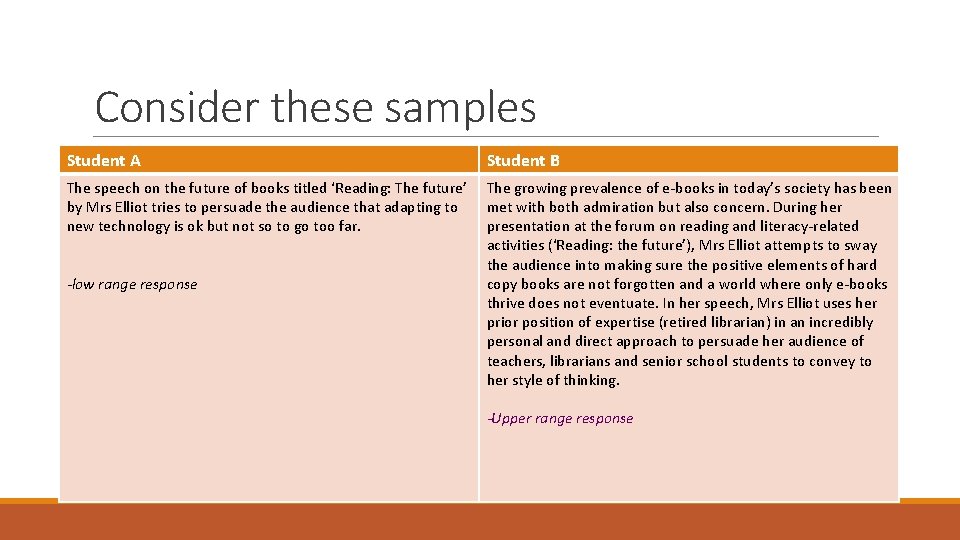
Consider these samples Student A Student B The speech on the future of books titled ‘Reading: The future’ by Mrs Elliot tries to persuade the audience that adapting to new technology is ok but not so to go too far. The growing prevalence of e-books in today’s society has been met with both admiration but also concern. During her presentation at the forum on reading and literacy-related activities (‘Reading: the future’), Mrs Elliot attempts to sway the audience into making sure the positive elements of hard copy books are not forgotten and a world where only e-books thrive does not eventuate. In her speech, Mrs Elliot uses her prior position of expertise (retired librarian) in an incredibly personal and direct approach to persuade her audience of teachers, librarians and senior school students to convey to her style of thinking. -low range response -Upper range response
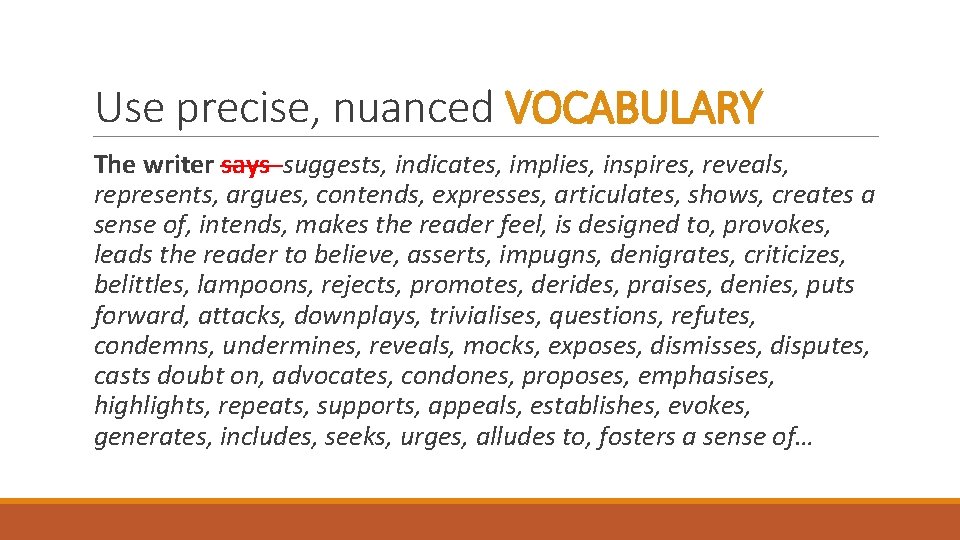
Use precise, nuanced VOCABULARY The writer says suggests, indicates, implies, inspires, reveals, represents, argues, contends, expresses, articulates, shows, creates a sense of, intends, makes the reader feel, is designed to, provokes, leads the reader to believe, asserts, impugns, denigrates, criticizes, belittles, lampoons, rejects, promotes, derides, praises, denies, puts forward, attacks, downplays, trivialises, questions, refutes, condemns, undermines, reveals, mocks, exposes, dismisses, disputes, casts doubt on, advocates, condones, proposes, emphasises, highlights, repeats, supports, appeals, establishes, evokes, generates, includes, seeks, urges, alludes to, fosters a sense of…
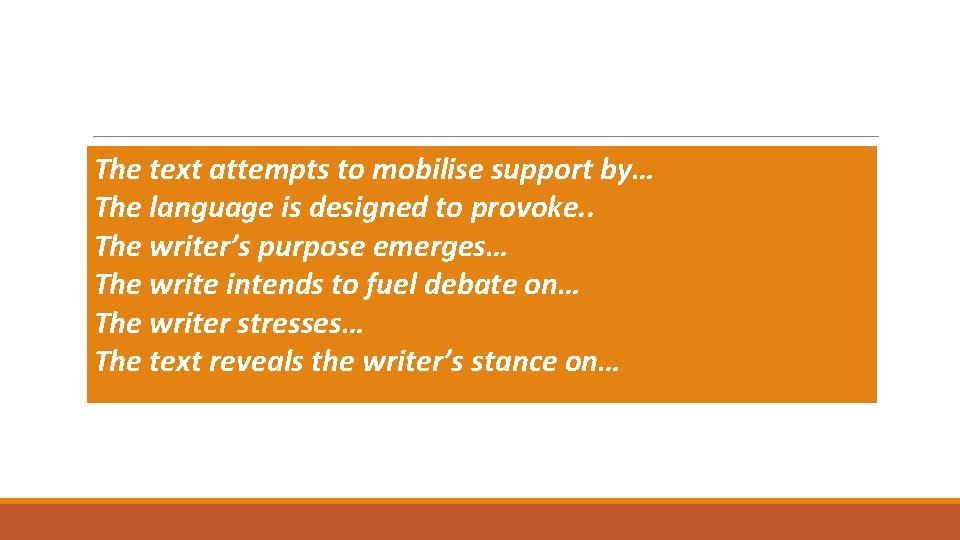
The text attempts to mobilise support by… The language is designed to provoke. . The writer’s purpose emerges… The write intends to fuel debate on… The writer stresses… The text reveals the writer’s stance on…
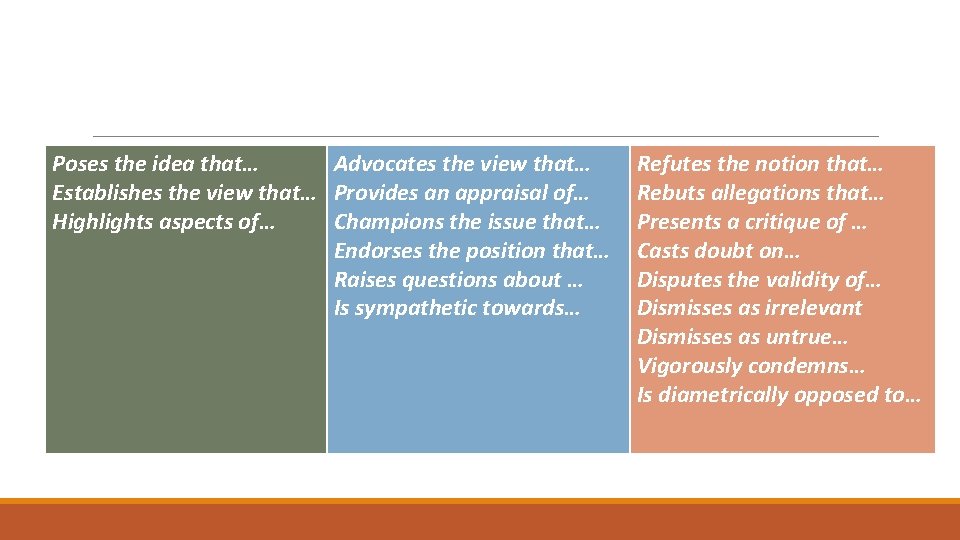
Poses the idea that… Advocates the view that… Establishes the view that… Provides an appraisal of… Highlights aspects of… Champions the issue that… Endorses the position that… Raises questions about … Is sympathetic towards… Refutes the notion that… Rebuts allegations that… Presents a critique of … Casts doubt on… Disputes the validity of… Dismisses as irrelevant Dismisses as untrue… Vigorously condemns… Is diametrically opposed to…
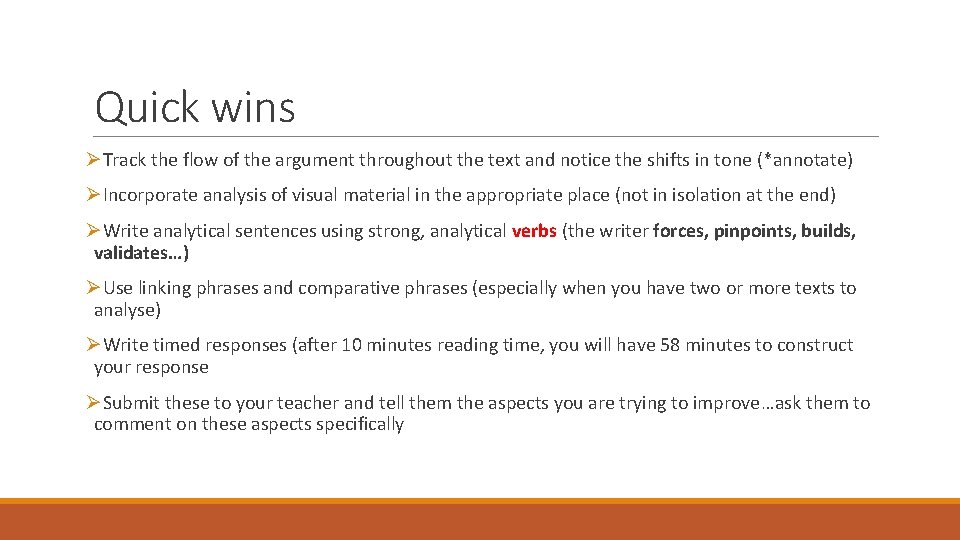
Quick wins ØTrack the flow of the argument throughout the text and notice the shifts in tone (*annotate) ØIncorporate analysis of visual material in the appropriate place (not in isolation at the end) ØWrite analytical sentences using strong, analytical verbs (the writer forces, pinpoints, builds, validates…) ØUse linking phrases and comparative phrases (especially when you have two or more texts to analyse) ØWrite timed responses (after 10 minutes reading time, you will have 58 minutes to construct your response ØSubmit these to your teacher and tell them the aspects you are trying to improve…ask them to comment on these aspects specifically
References: Victorian Curriculum and Assessment Authority Marjan Mossammaparast (VATE English Day 2016) Nathan Armstrong