
Analysis of GNDs beneath indents of different depth
Analysis of GNDs beneath indents of different depth using EBSD tomography E. Demir, S. Zaefferer, F. Roters, D. Raabe Department of Microstructure Physics and Metal Forming Düsseldorf, Germany d. raabe@mpie. de 27. October 2009, MS&T, Pittsburgh
Overview § Methods (3 D EBSD, CP-FEM ) § Characterization § Orientation gradients and dislocation analysis § Discussion Dierk Raabe, MS&T, Pittsburgh, 27. Oct. 2009, MPIE
Motivation and approach: specific § Relationship between ISE and GND: hardness and GND in the same experiment § Indents of different depths, Cu single crystal § 3 D EBSD: plastic volume, orientation gradients, GNDs 2
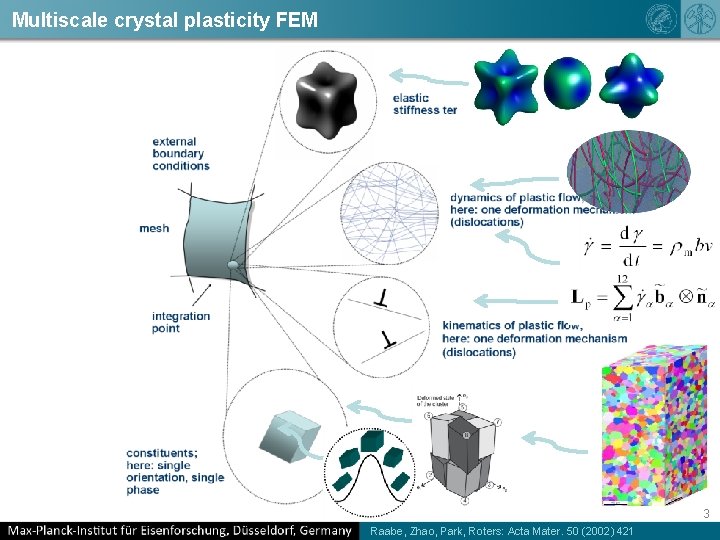
Multiscale crystal plasticity FEM 3 Raabe, Zhao, Park, Roters: Acta Mater. 50 (2002) 421
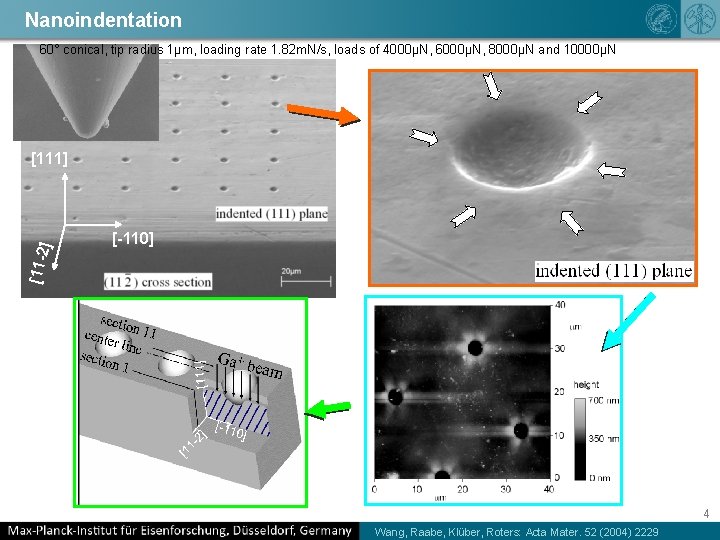
Nanoindentation 60° conical, tip radius 1μm, loading rate 1. 82 m. N/s, loads of 4000μN, 6000μN, 8000μN and 10000μN [-110] [11 -2 ] [111] 4 Wang, Raabe, Klüber, Roters: Acta Mater. 52 (2004) 2229
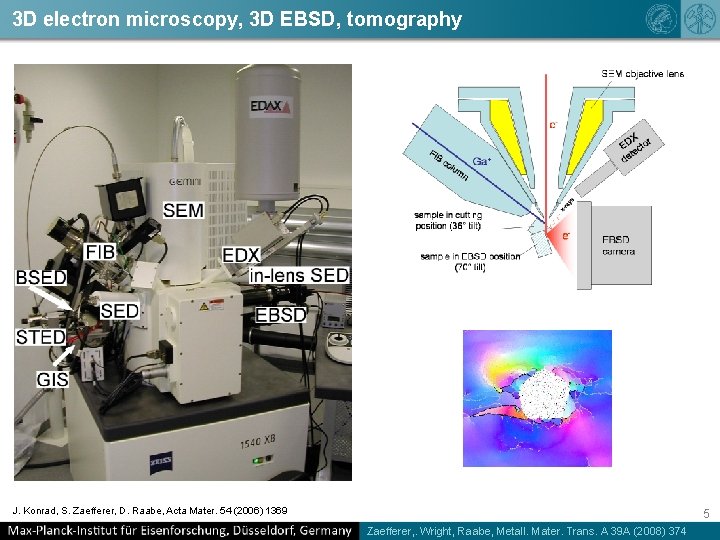
3 D electron microscopy, 3 D EBSD, tomography J. Konrad, S. Zaefferer, D. Raabe, Acta Mater. 54 (2006) 1369 5 Zaefferer, . Wright, Raabe, Metall. Mater. Trans. A 39 A (2008) 374
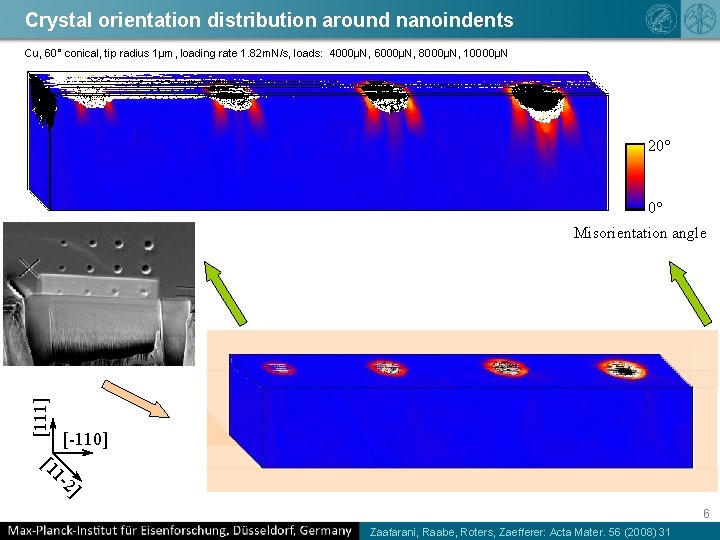
Crystal orientation distribution around nanoindents Cu, 60° conical, tip radius 1μm, loading rate 1. 82 m. N/s, loads: 4000μN, 6000μN, 8000μN, 10000μN 20° 0° [111] Misorientation angle [-110] 2] 1[1 6 Zaafarani, Raabe, Roters, Zaefferer: Acta Mater. 56 (2008) 31
![dislocation-based CPFEM simulation experiment 3 D EBSD [111] scan 9 scan 8 scan 7](http://slidetodoc.com/presentation_image_h/2568c68f79d45c4715094968ae7db6a5/image-8.jpg "dislocation-based CPFEM simulation experiment 3 D EBSD [111] scan 9 scan 8 scan 7")
dislocation-based CPFEM simulation experiment 3 D EBSD [111] scan 9 scan 8 scan 7 viscoplastic CPFEM experiment Comparison, crystal rotations about [11 -2] axis [-110] [1 2] 1 Zaafarani, Raabe, Singh, Roters, Zaefferer: Acta Mater. 54 (2006) 1707 Zaafarani, Raabe, Roters, Zaefferer: Acta Mater. 56 (2008) 31 7
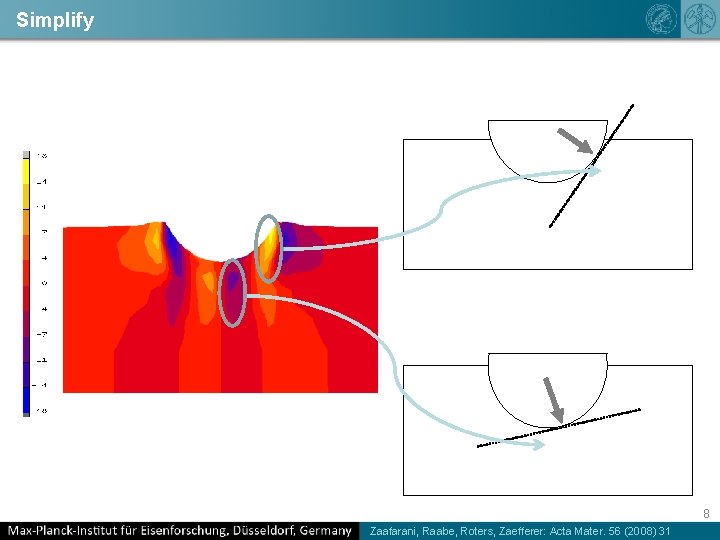
Simplify 8 Zaafarani, Raabe, Roters, Zaefferer: Acta Mater. 56 (2008) 31
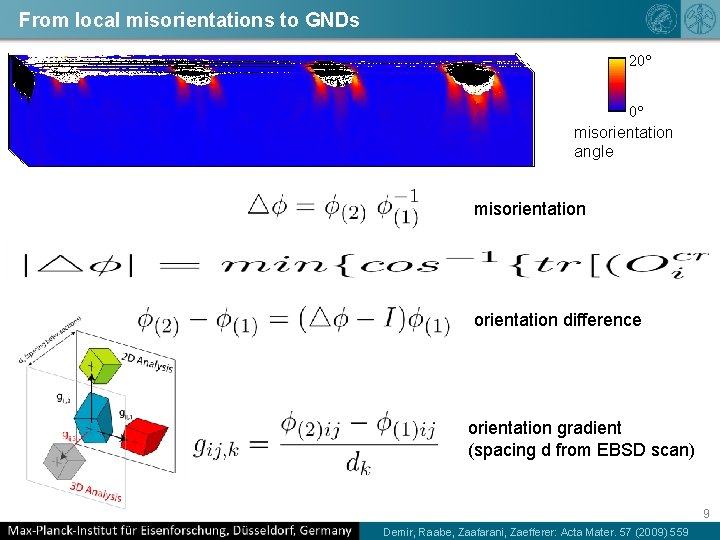
From local misorientations to GNDs 20° 0° misorientation angle misorientation difference orientation gradient (spacing d from EBSD scan) 9 Demir, Raabe, Zaafarani, Zaefferer: Acta Mater. 57 (2009) 559
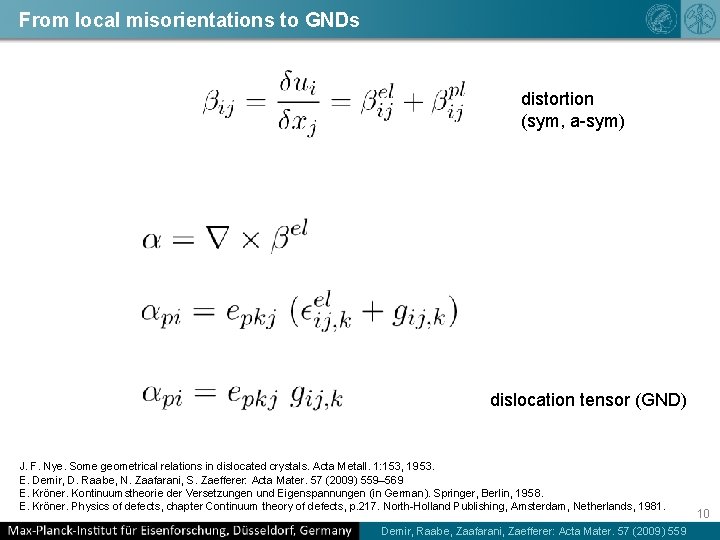
From local misorientations to GNDs distortion (sym, a-sym) dislocation tensor (GND) J. F. Nye. Some geometrical relations in dislocated crystals. Acta Metall. 1: 153, 1953. E. Demir, D. Raabe, N. Zaafarani, S. Zaefferer: Acta Mater. 57 (2009) 559– 569 E. Kröner. Kontinuumstheorie der Versetzungen und Eigenspannungen (in German). Springer, Berlin, 1958. E. Kröner. Physics of defects, chapter Continuum theory of defects, p. 217. North-Holland Publishing, Amsterdam, Netherlands, 1981. Demir, Raabe, Zaafarani, Zaefferer: Acta Mater. 57 (2009) 559 10
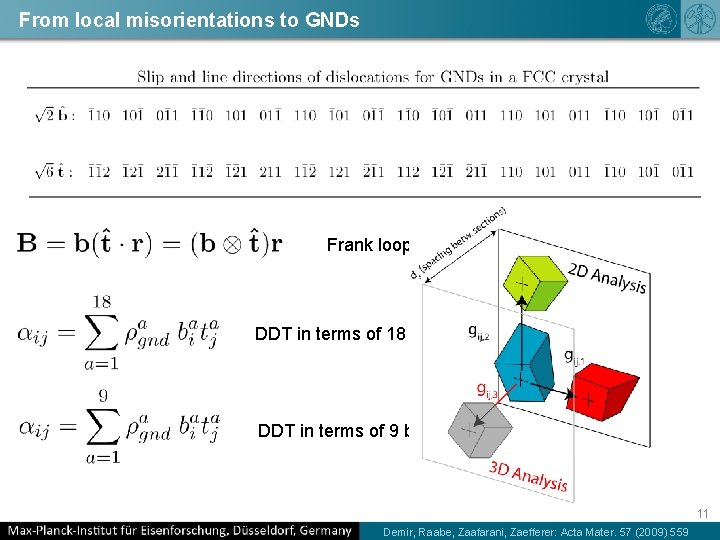
From local misorientations to GNDs Frank loop through area r DDT in terms of 18 b, t combinations DDT in terms of 9 b, t combinations 11 Demir, Raabe, Zaafarani, Zaefferer: Acta Mater. 57 (2009) 559
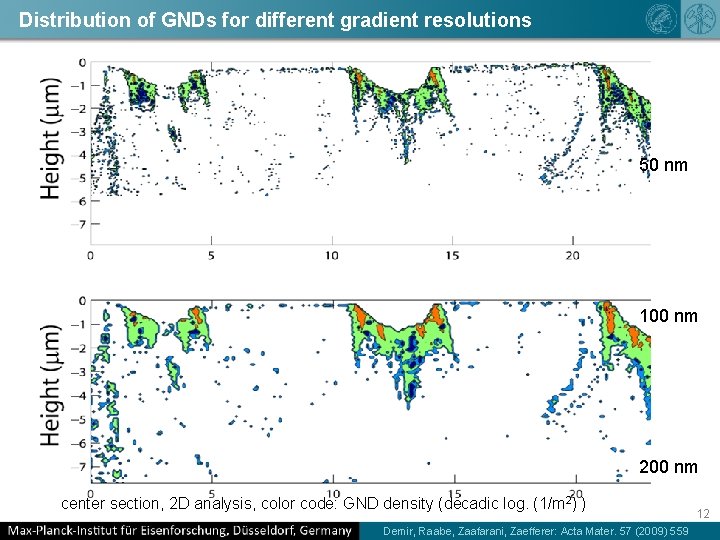
Distribution of GNDs for different gradient resolutions 50 nm 100 nm 200 nm center section, 2 D analysis, color code: GND density (decadic log. (1/m 2) ) Demir, Raabe, Zaafarani, Zaefferer: Acta Mater. 57 (2009) 559 12
![depth [mm] Identification of the plastic volume Reference volumes (red color) indicates the plastic](http://slidetodoc.com/presentation_image_h/2568c68f79d45c4715094968ae7db6a5/image-14.jpg "depth [mm] Identification of the plastic volume Reference volumes (red color) indicates the plastic")
depth [mm] Identification of the plastic volume Reference volumes (red color) indicates the plastic volume using lower threshold of GNDs of 1014/m 2 center section, 2 D analysis, color code: GND density (decadic log. (1/m 2) ) 13 Demir, Raabe, Zaafarani, Zaefferer: Acta Mater. 57 (2009) 559
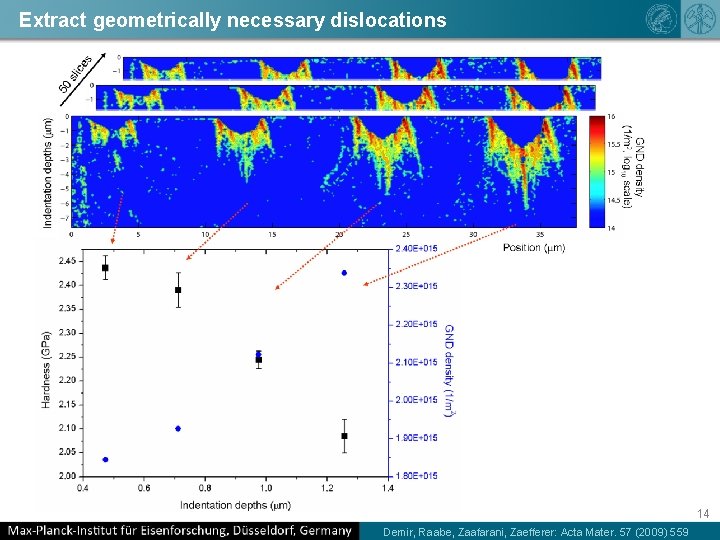
Extract geometrically necessary dislocations 14 Demir, Raabe, Zaafarani, Zaefferer: Acta Mater. 57 (2009) 559
Conclusions § GNDs have inhomogeneous distribution below indents with very high local density values. § Total GND density below indents drops with decreasing indentation depths. Observation contradicts strain gradient theory. 15
- Slides: 16